On Tuesday, Alphabet CEO Sundar Pichai warned of “irrationality” in the AI market, telling the BBC in an interview, “I think no company is going to be immune, including us.” His comments arrive as scrutiny over the state of the AI market has reached new heights, with Alphabet shares doubling in value over seven months to reach a $3.5 trillion market capitalization.
Speaking exclusively to the BBC at Google’s California headquarters, Pichai acknowledged that while AI investment growth is at an “extraordinary moment,” the industry can “overshoot” in investment cycles, as we’re seeing now. He drew comparisons to the late 1990s Internet boom, which saw early Internet company valuations surge before collapsing in 2000, leading to bankruptcies and job losses.
“We can look back at the Internet right now. There was clearly a lot of excess investment, but none of us would question whether the Internet was profound,” Pichai said. “I expect AI to be the same. So I think it’s both rational and there are elements of irrationality through a moment like this.”
Staying ahead of cyber threats means constantly evolving defenses and stopping new and often unpredictable threats. From its founding, SentinelOne has embraced AI as a means of detecting and autonomously responding to novel malware and TTPs, revolutionizing and setting the standard for modern endpoint protection in the process.
It’s not just central to our philosophy, it’s a core architectural tenet. It is how we give customers the advantage of speed and innovation when defending themselves against sophisticated nation state actors, constantly evolving ransomware variants, and the rise of a cybercriminal underground that keeps lowering the barrier to entry for the financially or politically motivated. Simply put, it’s how we stop modern attacks before they happen.
With the introduction of our new Framework for Optimized Rule Generation and Evaluation, or FORGE, SentinelOne is building on that foundation by using the power of agentic AI and large language models (LLMs) to completely reimagine and accelerate how teams create new, adaptive detection rules to stop ever-evolving threats.
The “AlphaEvolve Moment” Within the Cyber Space
Recently, Google DeepMind revealed AlphaEvolve, a powerful AI agent that evolves and optimizes algorithms for computing challenges. While AlphaEvolve explores the future of evolving algorithms in computing, SentinelOne’s FORGE1 offers a highly analogous approach in cybersecurity – an operationalized system for enhancing threat detection for real-world enterprise environments. Like AlphaEvolve, FORGE combines the creative problem-solving power of AI and LLMs with a rigorous evaluation process, enabling it to quickly generate highly effective, precise, and adaptive detection rules.
Traditional detection engines and AI-based models offer comprehensive coverage and are effective at identifying common attack patterns, forming a solid foundation for threat detection. However, updating and deploying models can be slow and complex, while attackers continually evolve their methods in real-time. Detection rules enable teams to close emerging detection gaps in a timely way, as well as fine-tune coverage.
The downside is that writing and maintaining these rules is slow, even for experts, requiring repeated testing to avoid false positives or blind spots. FORGE addresses this challenge by automatically generating high-quality rule candidates, significantly reducing manual effort and strengthening the detection stack.
Unlike traditional approaches, where rules can quickly become outdated in the face of sophisticated evasion techniques, FORGE utilizes diversified AI prompts to dynamically generate multiple rule candidates, which then undergo a rigorous, multi-tiered evaluation, ensuring that only the highest-quality rules are advanced to deployment.
Much like AlphaEvolve’s iterative approach, which uses automated evaluation to refine algorithms systematically, FORGE continuously learns and improves detection logic. When a rule does not meet the stringent precision and recall criteria, feedback is automatically integrated to guide AI-driven revisions. The result is an iterative refinement loop where detection logic rapidly adapts to emerging threats to minimize false positives and maximize coverage.
Example: Using Native OS Capabilities to Execute Malicious Code
Let’s take a look at an example where FORGE aids in our detection capabilities.
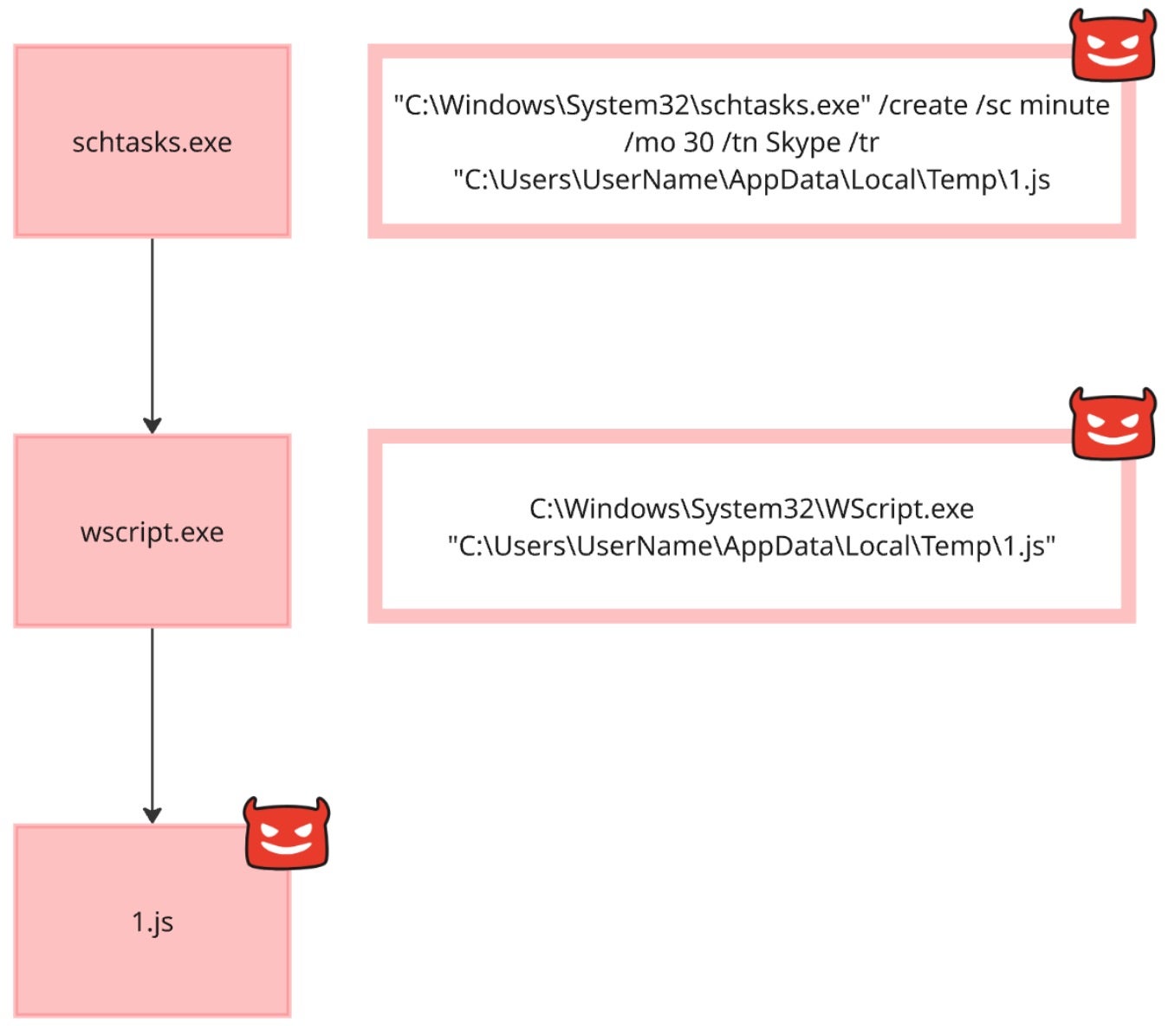
Figure 1 below represents a very typical example of how malware can maintain persistence on a Windows machine using built-in tools. The workflow is broken down into the following:
The attacker uses the Scheduled Tasks executable (schtasks.exe) to create a new task named “Skype” that runs every 30 minutes.
This task is configured to execute a JavaScript file called 1.js located in the user’s temporary files folder.
When the task runs, it launches wscript.exe, which is the Windows Script Host used to execute .js files.
As a result, this 1.js script is executed repeatedly on the system.
Figure 1: An example of how malware can persist on Windows
This technique is dangerous because it leverages entirely legitimate Windows components, making it difficult to detect and mitigate. By naming the task something inconspicuous such as “Skype” and placing the script in a temporary directory, the attacker avoids drawing attention. Malware authors often employ this method to ensure their code continues to run even after the system reboots or the user logs out.
We can tackle this problem with FORGE as it can easily create a detection rule to differentiate between malicious and non-malicious tasks.
How FORGE Helps Detect Malicious Activities
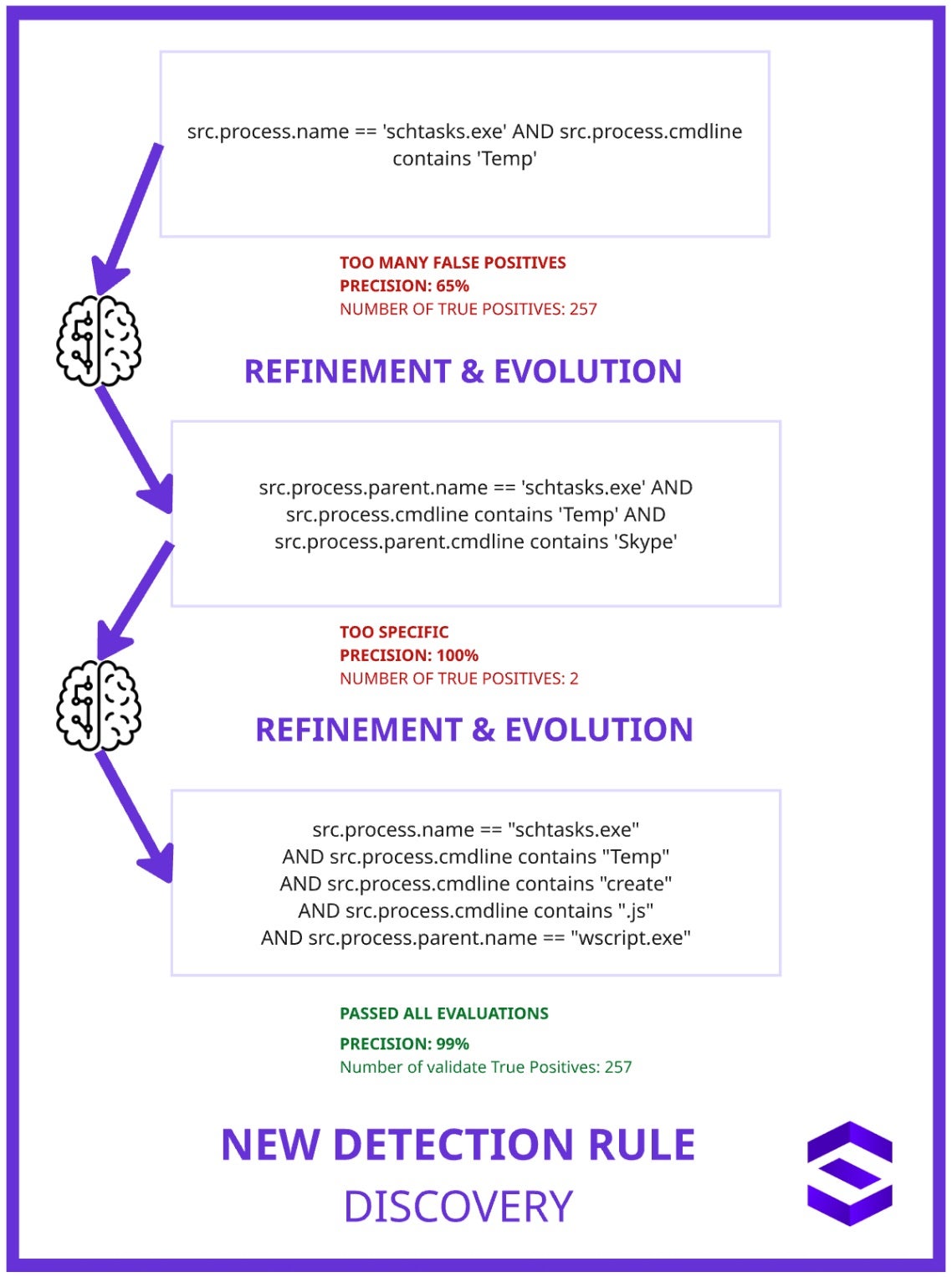
In Figure 2 below, we can see how FORGE generates and refines a detection rule for identifying malicious use of Windows Scheduled Tasks to execute JavaScript malware.
Figure 2
First, a broad rule flags any use of schtasks.exe with a command line referencing the Temp folder. While it captures many true positives in this example (257), the broad rule yielded a low precision rate of 65%, meaning it generated many false alarms.
Here, we iterate with the next generation of the rule created by FORGE. FORGE allows us to reduce noise by adding a condition that the parent command line must include “Skype”. However, this made the rule too narrow and it only caught 2 cases, though with perfect precision.
Finally, a more balanced and effective rule is created. FORGE checks for the creation of a scheduled task (create) that targets a JavaScript file (.js) in the Temp folder,and requires that the parent process be wscript.exe.
This rule now yields a high precision (99%) and successfully captures all 257 true positives, striking the right balance between generality and specificity.
This example illustrates how detection logic evolves through iterative tuning to enhance accuracy and minimize false positives in threat detection systems. It is important to note that FORGE does not replace our analysts. Rather, it eliminates the repetitive elements of rule generation and tuning, allowing analysts to concentrate on in-depth threat analysis and proactive defense strategies.
FORGE sets a new standard for AI-driven cybersecurity, enabling us to be agile, precise, and remain steps ahead of attackers.
1 Patent Pending
Third-Party Trademark Disclaimer
All third-party product names, logos, and brands mentioned in this publication are the property of their respective owners and are for identification purposes only. Use of these names, logos, and brands does not imply affiliation, endorsement, sponsorship, or association with the third-party.
Singularity XDR
Discover and mitigate threats at machine speed with a unified XDR platform for the entire enterprise.
In order to review how the internship programme fits with the firm's
"strategic priorities" and "long-term focus," Alphabet's DeepMind has
paused hiring new interns.
"Disappointed & shocked to hear that DeepMind 'paused' intern hiring and
canceled all scheduled interviews, just one hour before my interview... Anyone
knows more details?" Linfeng Zhao, an applicant wrote on Twitter
Wednesday.
Disappointed & shocked to hear that DeepMind “paused” intern hiring
and canceled all scheduled interviews, just one hour before my
interview... Anyone knows more details?
pic.twitter.com/eLB5uHZAlB
A representative for DeepMind told Business Insider: "We've paused hiring for
new interns at this time as we review how our Intern Program aligns with our
long-term focus and strategic priorities as an organization. We are in
communication with all applicants, and are grateful for the time they've
invested in the process so far."
Here are some more tweets from aspiring interns:
Gutted @DeepMind has paused internship cycles for this year (espesh after making it to final round🥲) Internships are a great way for early stage academics to get a feel for industry - the tech hiring freeze is hitting hard😑 Buuut I'm now back on the market so hmu with ideas👀😅
Working at DeepMind would definitely be a dream comes true for me. I did not get pass the screening phase last year. I got through this year's screening. Then the freeze happened :( If only... https://t.co/81eFaU1VHH

 Login
Login
 XDR
XDR