Reading view

There are new articles available, click to refresh the page.

XRP ETFs Record 13-Day Streak As SOL Funds See Largest Outflows Since Launch

As institutional demand intensifies and the crypto market recovers, US spot XRP Exchange-Traded Funds (ETFs) continue to lead the sector with a 13-day streak and over $200 million in positive net flows this week, outshining Solana (SOL) ETFs, which recorded their third day of outflows in seven days.

XRP Funds Lead Crypto ETF Inflows

Spot XRP exchange-traded funds have extended their record-breaking streak after registering their thirteenth consecutive day of positive net flows, with $50.27 million in inflows on December 3.

The investment products have seen a remarkable performance since the launch of Canary Capital’s XRPC, the first single-token XRP spot ETF, on November 13, positioning the funds as the fastest-growing altcoin-based category.

Notably, XRPC surpassed all initial expectations and debuted on Nasdaq with a total volume of $58 million, recording around $357.54 million in positive net flows in 13 days. Last week, the second group of XRP funds went live, becoming the largest US ETF launches of 2025 with over $60 million in net inflows each during their first day.

Moreover, the category, led by Grayscale’s GXRP and Franklin Templeton’s XRPZ, surpassed other major ETFs in single-day inflows, including those based on the largest cryptocurrencies by market capitalization, Solana, Bitcoin (BTC), and Ether (ETH).

Amid this week’s market recovery, XRP ETFs saw $89.65 million on Monday, $67.7 million the following day, and an additional $50.27 million on Wednesday, for a cumulative net inflow of $207.66 million during the first three days of December.

As a result, the leading category surpassed both Bitcoin ETFs’ $52.4 million and Ethereum ETFs’ $51.3 million positive net flows, respectively, during the same three-day period.

With a total of $874.28 million in inflows in 13 days, spot XRP ETFs have surpassed the $618.62 million total inflows of SOL ETFs, which held the record among the second wave of altcoin-based investment products.

Solana ETFs Demand Loses Steam

While XRP ETFs take the spotlight, Solana funds’ momentum has slowed, seeing their largest days of outflows this week. According to SoSovalue data, the investment products recorded $32.9 million in outflows on December 3, marking their third negative net flows day since the category debuted on October 28.

Despite pulling out positive net flows, Bitwise’s BSOL, Fidelity’s FSOL, and Grayscale’s GSOL were unable to absorb 21Shares’ TSOL $41.8 million in outflows. This performance also marks the fourth negative day for TSOL over the past week.

As reported by NewsBTC, Solana ETFs experienced a record performance in November despite the market correction, with $613 million in inflows during their 22 consecutive day positive streak.

However, the remarkable streak ended a week ago when TSOL registered negative net flows for the first time, and the category was unable to absorb them, recording outflows of $8.1 million.

SOL-based investment products started December with outflows worth $13.5 million, which were followed by strong inflows worth $45.77 million on Tuesday. On December 3, the funds registered $32.19 million in outflows, amounting to a negative net flow of $700,000 for the first half of the week, despite the altcoin’s recent price recovery.

XRP, XRPUSDT

Solana Price Prediction: 21 Days of Straight ETF Inflows – Is SOL the Strongest Bet in Crypto Right Now?

21 straight days of ETF inflows could not stop Solana from sliding toward a new yearly low, hitting 127 dollars on December 2. So the real question becomes: if inflows could not save it, what happens on the outflow days?

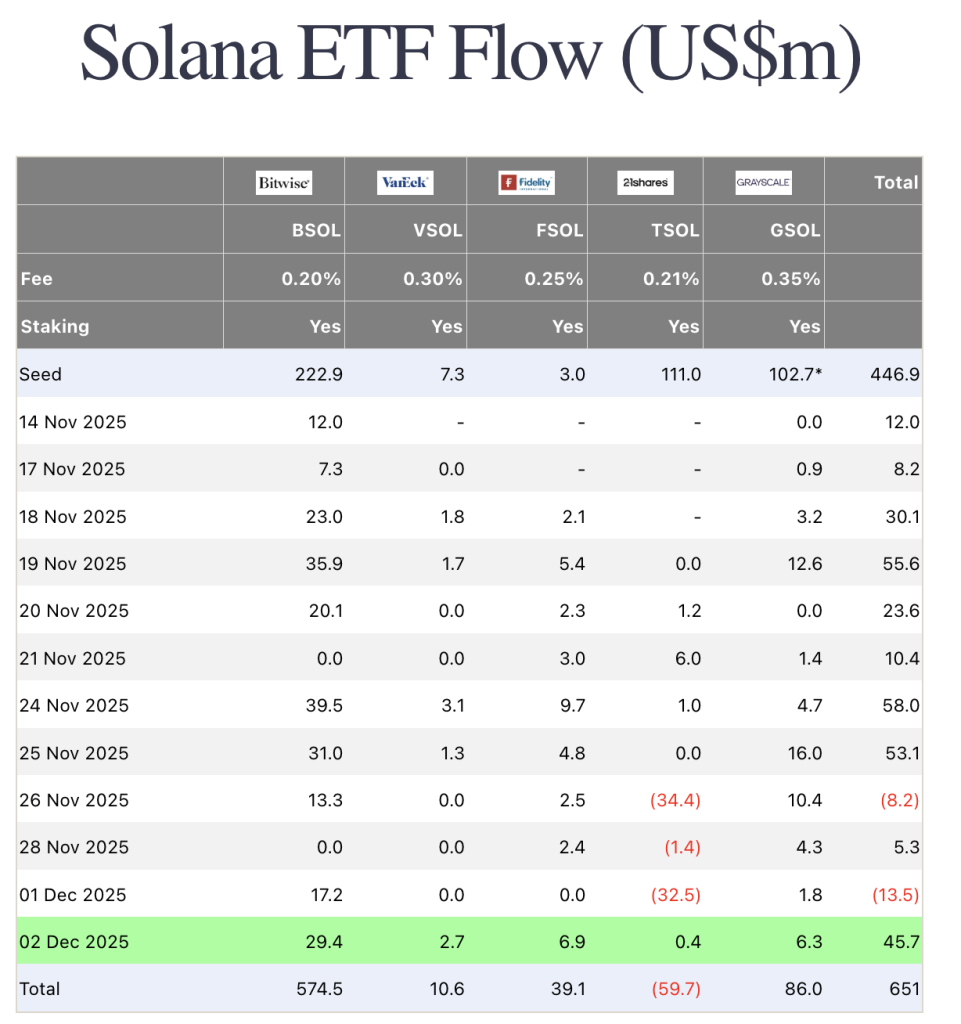
Solana ETFs saw a notable outflow of $8.10 million on November 26, the first since they launched on October 28. Then it happened again on the first day of December, this time totaling more than $13.5 million in outflows.

The following day, Solana bounced back with one of its biggest inflow days yet, pulling in more than $45 million. This basically means that the outflows are tiny compared to the inflows, and this growing institutional interest in Solana shouldn’t be ignored.

Source: Farside Investors

Since launching, SOL ETFs have brought in more than $650 million in net inflows. During that same period, investors pulled more than 3 billion from Bitcoin ETFs and over 1 billion from Ethereum ETFs. That kind of contrast makes Solana look like one of the strongest bets in crypto for the coming months.

Solana Price Prediction: Why $127 Dip Could Have Been A Gift

Source: SOLUSD / TradingView

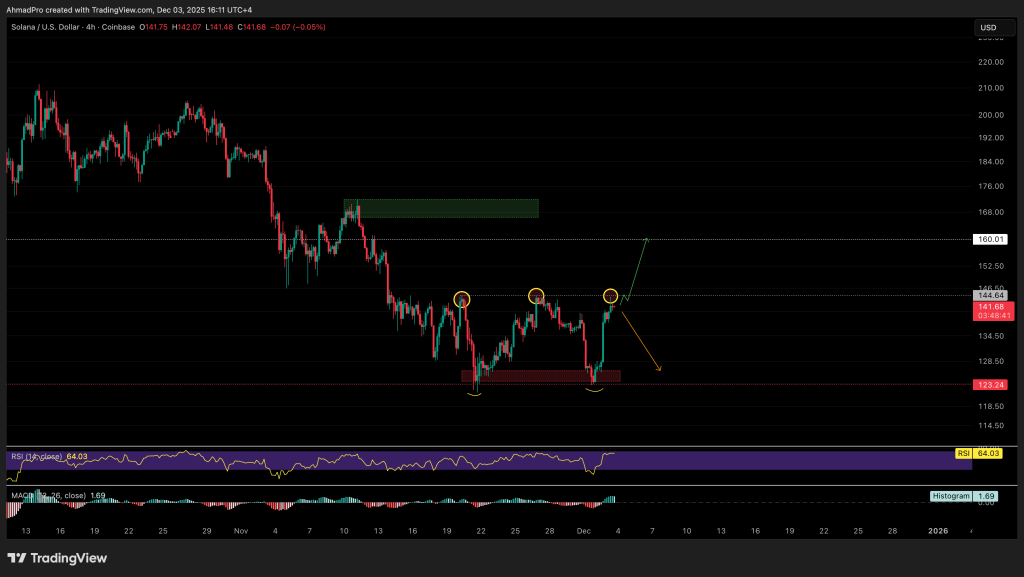
Solana is currently sitting around $141 and is once again trying to retest the $144 level, which turned into one of November’s toughest resistance zones. SOL hit this level multiple times already and has not managed to break through even once.

If the price can finally close above $144 with strength, the SOL/USDT pair could push toward $160, and from there, a revisit of the $170 area becomes possible.

If it fails again, though, we could see it drop back toward the $120 zone before going even lower, and that is the last scenario SOL bulls want to watch play out.

Could Bitcoin Hyper Compete With Solana?

While Solana wrestles with heavy volatility, failed breakouts, and a market that cannot decide whether to punish or reward its ETF flows, one project is managing to push forward with momentum that is actually holding up even in the chop.

That project is Bitcoin Hyper, and it is quietly becoming one of the strongest early-cycle plays of 2025.

Bitcoin Hyper is building a high-speed Bitcoin Layer 2 powered by the Solana Virtual Machine, giving it Solana-level performance while still settling back to Bitcoin for actual security. It is the mix traders are rotating into right now: fast, scalable, and backed by Bitcoin’s base layer instead of relying on unstable L1s.

And the numbers explain why confidence is rising. The presale has already raised more than $28.9 million, which is massive considering how shaky the market has been. Early buyers have not slowed down at all, and staking rewards still sit at a heavy 40% APY, making it one of the strongest yield opportunities tied to the Bitcoin ecosystem.

If the market rotates back into high efficiency ecosystems, Bitcoin Hyper does not just have momentum… it has timing.

Visit the Official Website Here

The post Solana Price Prediction: 21 Days of Straight ETF Inflows – Is SOL the Strongest Bet in Crypto Right Now? appeared first on Cryptonews.

CoinShares Withdraws Multiple US Crypto ETF Applications — Details

Asset management firm CoinShares has announced its decision to pull the plug on its different crypto exchange-traded fund (ETF) applications with the United States Securities and Exchange Commission (SEC). This move marks a change in the firm’s strategy as it looks away from the slowly-saturating US crypto ETF space.

CoinShares Pulls Plug On Solana, XRP, Litecoin ETFs

On Friday, November 28, CoinShares discontinued its interest in launching multiple spot crypto exchange-traded funds, including the XRP ETF, Solana staking ETF, and Litecoin ETF. The asset manager filed with the US SEC to withdraw its Form S-1 registration statements for these exchange-traded funds.

One of the withdrawal applications read:

The Registration Statement sought to register shares to be issued in connection with a transaction that was ultimately not effectuated. No shares were sold, or will be sold, pursuant to the above-mentioned Registration Statement.

In a bold move, CoinShares sought the SEC’s approval to list spot Litecoin and XRP ETFs in the United States in January 2025. The crypto asset manager then later filed for a spot Solana exchange-traded fund in June, while proposing a staking integration. 

However, CoinShares’ decision to wind down its push for these spot crypto ETFs seems to align with its shift in product strategy for the United States. Earlier on Friday, the digital asset manager announced its “strategic approach” to the United States market while preparing for its public listing in the country.

Jean-Marie Mognetti, CEO and co-founder of CoinShares, said in a statement:

The U.S. market presents a different landscape. Single-asset crypto ETPs have been rapidly commoditized, with the market consolidating around large-scale players, leaving limited opportunities for the differentiation that drives sustainable margins. As a result, this market requires a different playbook, one that leverages our core strengths in new product categories where we can deliver genuine investor value and premium economics.

With the plug already pulled on the spot single-crypto exchange-traded funds, CoinShares said it still aims to launch new products in the US market over the next 12 – 18 months. Some of these products will include crypto equity exposure vehicles, thematic baskets, and actively managed strategies combining crypto and other assets.

Crypto Asset Manager To Focus On ‘Higher-Margin’ Opportunities In US

In his statement, the CoinShares CEO also revealed the plans to further trim its US product list by winding down its Bitcoin Futures Leveraged product (with the ticker BTFX). 

Meanwhile, Mognetti noted that the resources initially allocated to the planned launches of the different single-asset crypto ETFs will now be redirected toward “higher-margin” opportunities.

As Bitcoinist reported in September, the European-based digital asset manager is preparing for its public listing in the US on the Nasdaq Stock Exchange. This initial public offering will come on the back of its $1.2 billion merger with Vine Hill Capital Investments, a special purpose acquisition company (SPAC). 

Crypto

Solana ETFs Hit $8M Outflow, Break 21-Day Inflow Streak – What’s Next?

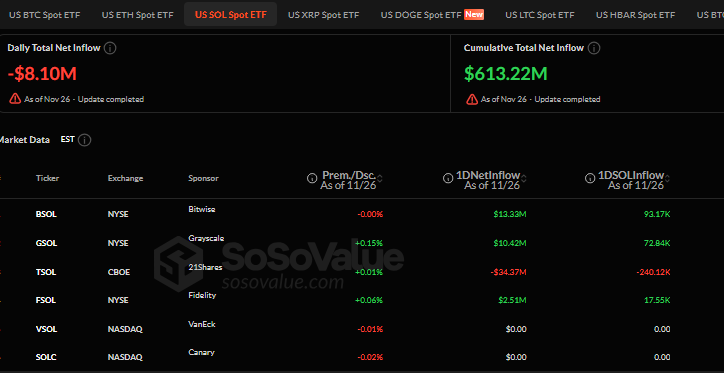
Solana’s string of uninterrupted ETF inflows came to an abrupt end on Wednesday, as U.S. spot Solana exchange-traded funds recorded $8.1 million in net outflows, according to data from SoSoValue.

Source: SoSoValue

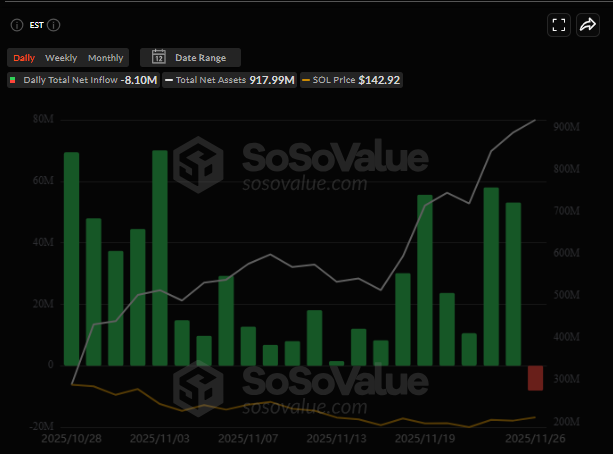
The outflow marked the first negative session since the products launched earlier this month and broke a 21-day accumulation streak that had helped position Solana as one of the fastest-growing ETF markets among non-Bitcoin assets.

21Shares’ TSOL Dragged Solana ETFs Into Red, As Solana ETFs Hold Nearly $1B

The reversal was largely driven by the 21Shares Solana ETF, TSOL, which saw more than $34 million exit the fund in a single session.

TSOL has now registered $26 million in total net outflows since launch, with current net assets standing at $86 million.

While the sharp pullback from one issuer triggered the broader negative print, other Solana ETFs continued to attract steady capital, absorbing much of the imbalance.

Source: SoSoValue

The Bitwise Solana Staking ETF, BSOL, led inflows with a $13.33 million intake, bringing its cumulative total to $527.79 million.

The Grayscale Solana Trust also posted a strong day, adding $10.42 million, while Fidelity’s FSOL fund logged $2.51 million.

Combined, Solana ETF products now hold approximately 6.83 million SOL tokens valued at around $964 million, showing that institutional demand remains elevated even as short-term flows turn uneven.

Despite Wednesday’s setback, Solana spot ETFs ended the week with a net addition of nearly $103 million, pushing cumulative inflows to $613.22 million and total net assets to $917.99 million.

November alone has generated $414.01 million in inflows, surpassing the $199.21 million recorded in October during their debut month.

The mixed day for Solana ETFs contrasts with the momentum seen in the newly launched XRP products, which have yet to log a single outflow session.

XRP ETFs recorded another $21 million in combined inflows on Wednesday, lifting their cumulative total to $643 million.

The Bitwise XRP ETF led with $7.4 million, followed by Canary’s XRPC with $5.2 million and roughly $4 million each for Franklin Templeton’s XRPZ and Grayscale’s GXRP.

Elsewhere, Dogecoin ETF performance lagged expectations. The New York Stock Exchange approved the listing of Grayscale’s Dogecoin Trust ETF, but the product fell short of analyst estimates, with a debut of only $11 million.

Institutional Demand Lifts Bitcoin ETFs as Solana Market Indicators Turn Bearish

Meanwhile, Bitcoin ETFs continued their pattern of modest strength, adding $21.12 million on November 26 despite recent volatility.

Total cumulative Bitcoin ETF inflows now stand at $57.63 billion, supported by daily trading volumes above $4.5 billion.

Ethereum ETFs also showed improving daily activity late in the month, with inflows above $60 million for three consecutive sessions.

However, they continue to face sustained net outflows for November, totaling $1.50 billion as investors rotate toward Bitcoin, Solana, and XRP.

Analysts monitoring Solana’s ETF performance note that the outflow coincides with a period of broader market caution and weakening on-chain activity.

According to data from Nansen, there was a 6% decline in active Solana addresses and a 16% drop in network fees over the past week. The total value locked on the network has fallen 32% from its September peak of $13.23 billion, currently standing at roughly $9.1 billion.

The slowdown has carried through to major Solana protocols, including Jito, Jupiter, Raydium, and Sanctum, each posting double-digit TVL declines this month.

Technical readings point to continued uncertainty. Solana is trading within a bearish continuation pattern after retreating from the $170 region earlier in the month.

Traders point out the $140–$145 area as a pivotal zone, with a break below potentially confirming a continuation toward lower support levels.

Market strategists say the divergence between strong ETF inflows and weakening spot performance illustrates the broader tension in crypto markets, where institutional accumulation continues even as retail-led selling and cautious sentiment weigh on prices.

In the coming days and weeks, analysts expect Solana to remain sensitive to market-wide volatility and ETF flow consistency.

The post Solana ETFs Hit $8M Outflow, Break 21-Day Inflow Streak – What’s Next? appeared first on Cryptonews.

Franklin Templeton adds XRP, ADA, SOL, DOGE, LINK and XLM to its crypto index ETF

  • Franklin expands its crypto index ETF to include six major altcoins.
  • New SEC-approved rules allow broader asset tracking in crypto funds.
  • XRP demand surges as multiple US spot XRP products launch.

Franklin Templeton is widening the scope of its flagship digital-asset fund, marking one of the most significant shifts yet in how traditional finance approaches the crypto market.

The firm is moving beyond its long-standing focus on Bitcoin (BTC) and Ethereum (ETH) and opening the door to a broader mix of leading altcoins.

Franklin Crypto Index ETF adds more coins

According to a filing made on November 24, the Franklin Crypto Index ETF will begin tracking XRP, Solana (SOL), Dogecoin (DOGE), Cardano (ADA), Stellar (XLM), and Chainlink (LINK) on December 1, 2025, turning it into a far more comprehensive representation of the market.

Notably, the recently approved Fresh Cboe exchange rules have played a key role in making this expansion possible.

For the first time, issuers are allowed to include any cryptocurrency present in their benchmark indices rather than limiting exposure to only Bitcoin and Ethereum.

Franklin’s ETF is among the earliest to capitalise on the new framework, signalling how fast the regulated side of crypto investing is moving.

Particularly, instead of dominance by the two largest cryptocurrencies, the fund will now adjust its holdings each quarter to match index changes and market conditions.

These scheduled rebalancings open the door for assets to be added or removed depending on performance, liquidity, and market relevance.

The firm has also modernised its operational model, allowing authorised participants to create or redeem ETF shares using actual crypto assets instead of cash only, a change that should tighten tracking accuracy and improve liquidity.

This adjustment is likely to make the ETF more efficient during high-volatility periods, a common challenge for digital-asset funds.

Franklin Templeton recently launched a spot XRP ETF

Franklin Templeton’s index ETF overhaul follows closely behind another milestone: the launch of its spot XRP fund, trading under the ticker XRPZ with a 0.19% sponsor fee.

The debut of the XRP ETF arrived at a moment when interest in regulated XRP exposure has surged across the US market.

Franklin has now joined a fast-growing group of firms racing to meet the appetite for XRP-based products.

Canary Capital set the pace earlier in the month, securing more than $250 million on the launch day of its XRP ETF.

Other firms that have successfully launched XRP ETFs are Grayscale and Bitwise, which recorded $25 million in first-day volume and $118 million in inflows during the first week of trading.

This rapid expansion has placed XRP among the few assets outside BTC and ETH that have attracted this speed of ETF development.

As a result, the XRP price has rebounded, climbing more than 7% on November 25 to an intraday high of $2.28 as institutional-grade inflows begin accelerating.

The post Franklin Templeton adds XRP, ADA, SOL, DOGE, LINK and XLM to its crypto index ETF appeared first on CoinJournal.

Crypto ETF flows: BTC sees $151M outflows as ETH and SOL funds thrive

  • Bitcoin spot ETFs recorded $151M outflows on November 24.
  • Ethereum’s products saw inflows of $96.67 million.
  • Solana ETFs continue their winning streak with yesterday’s $57 million.

The cryptocurrency sector remains weak as bearish sentiments prevail.

Indeed, recent price drops, muted trading activities, and worries about short-term recoveries have seen many investors adopt a defensive bias.

Exchange-traded funds flow data reflects this uncertainty, with Bitcoin recording massive withdrawals as altcoin products hold steady. Let us find out more.

Bitcoin ETFs continue to struggle – Fidelity’s stands out

BTC spot ETFs had a rough session on Monday, with net outflows totaling $151 million, according to SoSoValue.

That signals deteriorated interest in these financial products, which have played a key role in institutional crypto adoption.

Meanwhile, Fidelity’s FBTC stood out as it posted positive ETF flows of $15.49 million on Monday amidst the broader retreat.

On the other hand, BlackRock has struggled lately, with iShares’ outflows surpassing $2.2 billion so far in November.

Meanwhile, the mixed ETF outflows come as the Bitcoin price experiences notable downward pressure.

The bellwether crypto is trading at $88,190, down from late last month’s high above $115,500.

Ethereum posts inflows

While investors remain more conservative about Bitcoin, Ethereum thrived.

Data shows Ether ETFs attracted $96.67 million in inflows yesterday, with BlackRock’s ETHA dominating at $92.61 million.

Ethereum seems to thrive as Bitcoin struggles, as narratives like the latest attacks on Strategy by JPMorgan magnified uncertainty in BTC-based financial products.

Institutions are seemingly migrating to Ethereum, possibly indicating renewed trust in its unique role in powering scaling solutions, decentralized apps (dApps), and support for new infrastructure.

ETH is changing hands at $2,925 after gaining 3% the past 24 hours. It lost more than 2% the past week.

Solana ETFs maintain upside momentum

Solana held its ground, attracting net inflows of $57.99 million on November 24.

The altcoin has seen positive ETF flows since its debut, highlighting steady institutional demand.

For instance, Bitwise’s Solana spot exchange-traded fund surpassed $500 million AUM last week.

Solana experienced amplified institutional interest due to its robust network that prioritizes scalability, speed, and security.

The team spent the past years rewriting Solana’s reputation, darkened by previous network outages.

Now, the blockchain exhibits a thriving developer community, booming app usage, and Solana-based tokens.

With these factors, Solana has carved a unique lane in the blockchain industry.

SOL is trading at $138 after soaring 5% in the last 24 hours.

The altcoin lost nearly 30% of its value over the past month.

Meanwhile, Solana inflow confirms investors looking beyond price performance while prioritizing long-term potential.

Meanwhile, the latest ETF flow statistics highlight a split market.

Investors are now exploring crypto offerings beyond Bitcoin.

Institutional investors are no longer treating all cryptocurrencies the same.

They’re now evaluating every project based on solid catalysts, narratives, and momentum.

The post Crypto ETF flows: BTC sees $151M outflows as ETH and SOL funds thrive appeared first on CoinJournal.

Hong Kong crypto rules attract global banks as AMINA wins new approval

  • The licence covers 13 cryptocurrencies, including Bitcoin, Ether, USD,C and Tether.
  • AMINA reported a 233% increase in Hong Kong trading volumes in early 2025.
  • Hong Kong launched new stablecoin rules and approved a Solana ETF this year.

Hong Kong’s push to build a regulated digital asset market is drawing more interest from global financial institutions, and the latest example is Swiss crypto bank AMINA Bank AG securing approval to expand its services in the city.

The bank received a Type 1 licence uplift from the Securities and Futures Commission, which makes it the first international bank allowed to offer regulated crypto trading and custody to institutional clients in Hong Kong.

The move strengthens the city’s position as a regional digital asset hub and highlights rising demand for bank-grade crypto services among professional traders.

AMINA plans to use the approval to provide institutional users with a regulated route into cryptocurrencies at a time when clients are looking for stronger safeguards and clearer rules.

Hong Kong’s compliance standards have often limited the number of foreign institutions able to offer these services, which has left a gap in the market for firms with established banking frameworks.

AMINA’s entry aims to fill that gap while giving clients a regulated platform backed by traditional financial infrastructure.

AMINA expands in a fast growing market

The licence uplift allows AMINA’s Hong Kong subsidiary to offer trading and custody for 13 cryptocurrencies.

These include Bitcoin, Ether, USDC, Tether, and several leading decentralised finance tokens that are widely used across global exchanges.

The approval creates new opportunities for institutional clients looking for a single regulated venue with access to a curated list of major digital assets.

AMINA also reported a sharp rise in market activity.

The bank recorded a 233% increase in trading volume on Hong Kong crypto exchanges in the first half of 2025.

The increase points to stronger engagement from both institutional and retail segments, which are becoming more active as Hong Kong’s regulatory environment evolves.

The bank expects the new approval to support a wider product range.

It plans to expand into private fund management, structured crypto products, derivatives, and tokenised real-world assets.

These additions would place AMINA among the firms offering institutional clients diversified exposure across multiple types of digital assets.

Local players face new global competition

While AMINA is the first international bank to receive this specific licence upgrade, it enters a competitive market.

Hong Kong already hosts regulated local firms such as Tiger Brokers and HashKey, which serve institutional and retail clients under earlier permissions.

AMINA’s approval signals that the market is open to more foreign institutions, which could change competitive dynamics for both global and local providers.

Hong Kong officials have said on multiple occasions that attracting global firms is central to the city’s digital asset strategy.

AMINA’s arrival may encourage more banks and brokerages abroad to consider similar applications as they assess opportunities in Asia’s regulated crypto markets.

Policy changes shape Hong Kong’s crypto framework

AMINA’s approval arrives during a period of rapid policy development in the city.

Hong Kong introduced its new stablecoin rules in August, creating a formal licensing pathway for issuers.

Following this, major regional banks such as HSBC and ICBC indicated they were examining licence applications as part of their digital asset plans.

The city also approved its first Solana exchange-traded fund in late October.

The approval placed Hong Kong ahead of the US in allowing a regulated Solana ETF and added another product to its growing list of crypto-linked investment options.

Hong Kong tightened rules around self-custody of digital assets in August.

The change focused on improving cybersecurity protections and reducing risks tied to individual key management.

The decision was presented as a safety measure rather than a restriction on user access.

The combination of new rules and rising institutional interest has created an environment that is now attracting more global firms.

AMINA’s regulatory progress adds momentum to Hong Kong’s strategy of balancing strong compliance with market expansion.

The post Hong Kong crypto rules attract global banks as AMINA wins new approval appeared first on CoinJournal.

SOL could dip below $120 as ETF inflows and sentiment weaken

Key takeaways

  • Solana is down 10% in the last 24 hours and is now trading below $140.
  • The coin could dip further as the market sentiment weakens.

Market sentiment weakens as cryptos suffer huge losses.

SOL, the sixth-largest cryptocurrency by market cap, has lost 13% of its value this week, making it the third consecutive week of recording losses. The bearish performance comes despite the two-week-old Solana spot Exchange Traded Funds (ETFs) in the US recording the lowest net inflows ever, suggesting softer institutional demand. According to Sosovalue, the US Solana spot ETFs logged $1.49 million net inflow on Thursday, mainly driven by the Bitwise Solana staking ETF. This was the lowest inflow since the inception of Solana ETFs, suggesting a decline in demand from institutional investors. 

In addition to that, CoinGlass data reveals that the SOL futures Open Interest (OI) is down 3.34% in the last 24 hours to $7.35 billion. This suggests that futures traders are either closing long positions or reducing leverage. 

In line with the current market conditions, the OI-weighted funding rate has shifted to a negative level of -0.0076% from near-neutral levels earlier in the day, indicating that traders are holding more short positions. If the current market conditions persist, the recovery would be a tough battle for bulls. 

Will Solana extend the decline to $120?

The SOL/USD daily chart remains bearish and efficient as Solana has underperformed in recent days. The coin is edging lower for the fourth consecutive day this week after breaking below the $150 psychological level a few hours ago. 

At press time, SOL is trading at $138 and is aiming for the $126 low from June 22. If SOL breaks below this low, it could test the $100 psychological support over the coming days or weeks. 

SOL/USD Daily Chart

The Relative Strength Index (RSI) dips to 36 on the same chart, oscillating towards the oversold zone, indicating selling pressure. The Moving Average Convergence Divergence (MACD) also failed to cross above the signal line, extending the downward trend.

However, if the technical indicators improve and SOL maintains its value above $126, it could record a slight recovery towards the $155 demand-turned-supply zone. The next resistance level at $175 could prove challenging in the near term.

The post SOL could dip below $120 as ETF inflows and sentiment weaken appeared first on CoinJournal.

Nasdaq certifies XRP ETF as Canary Capital prepares to enter crypto fund arena

  • Canary’s fund is set to be the sixth single-crypto ETF if it launches.
  • The fund’s official website has gone live ahead of the anticipated debut.
  • Past ETFs launched during the government shutdown used automatic effectiveness rules.

The cryptocurrency market is poised for a new addition with the likely debut of the first spot XRP exchange-traded fund, issued by Canary Capital.

On Wednesday, Nasdaq confirmed it had accepted the Form 8-A filing for the Canary XRP ETF, under the ticker XRPC, signalling formal readiness to list the asset.

While the announcement stirred excitement among ETF watchers, the fund still lacks the US Securities and Exchange Commission’s final approval to begin trading.

This has left its launch in limbo, even as industry observers anticipate a possible debut on Thursday.

Canary’s ETF becomes the sixth single-asset crypto fund to reach this milestone following earlier approvals for Bitcoin, Ether, Solana, Litecoin and Hedera.

However, this fund’s progression highlights a more complex regulatory backdrop, influenced by recent shifts in SEC processes during the US government shutdown.

Certification clears Nasdaq listing, but trading awaits

Nasdaq formally notified the SEC that it had received and filed the Form 8-A for Canary’s XRP ETF.

Bloomberg’s ETF analyst Eric Balchunas shared the update on X, stating that “The official listing notice for XRPC has arrived from Nasdaq.”

Despite this progress, the ETF has not yet received the green light to commence trading. The letter issued by Nasdaq confirmed approval of the listing but did not equate to SEC authorisation.

Observers have clarified that the letter is a procedural step and part of the process to join the registrant’s request for the fund to become effective.

Some in the crypto community highlighted the difference, noting that the Nasdaq letter does not declare the fund effective but only acknowledges the listing certification.

The SEC has not issued an effectiveness order, which means trading cannot begin until that step is completed.

Canary’s XRP fund joins crypto ETF roster

Following the Nasdaq filing, Canary Capital launched its official website for the ETF.

Nate Geraci, president of NovaDius Wealth Management, posted about the development, signalling that Canary was likely to be the first to market with an XRP-backed ETF.

If approved, the XRPC ETF will join the growing roster of single-asset crypto ETFs now available to investors. These include Bitcoin, Ether, Solana, Litecoin and Hedera.

Eleanor Terrett of Crypto America also indicated on X that Nasdaq had cleared XRPC for a market open launch, which further raised expectations for an imminent debut. However, the fund cannot proceed to trading without confirmation from the SEC.

ETF timing reflects shutdown-related procedure shifts

Canary’s ETF launch coincides with the recent end of the longest US government shutdown in history.

On Wednesday, President Donald Trump signed legislation that officially reopened government operations.

During the shutdown, ETFs for Solana, Litecoin and Hedera began trading under automatic effectiveness provisions.

These mechanisms allowed trading to begin without active SEC approval during periods when regulatory processes were delayed.

This approach was not used in earlier launches of Bitcoin and Ether ETFs, which both started trading only after formal authorisation from the regulator.

It remains unclear which approach the XRPC fund will follow.

Without a current effectiveness order, Canary’s ETF may be subject to additional delays, unless it qualifies under the same automatic provisions used during the shutdown period.

Launch window narrows as market watches SEC decision

Although Nasdaq has certified the listing and Canary’s infrastructure appears ready, the fate of the XRPC ETF ultimately depends on the SEC.

Canary’s website launch and market interest reflect growing anticipation, but trading cannot begin until regulators give their final approval.

Although Nasdaq certified the listing and Canary Capital launched its website, the fund did not begin trading immediately after 28 October, the initially anticipated date.

Without a final effectiveness order from the SEC, the ETF remains in limbo. Until that regulatory step is completed, XRPC cannot begin trading, and the market continues to await confirmation.

The post Nasdaq certifies XRP ETF as Canary Capital prepares to enter crypto fund arena appeared first on CoinJournal.

❌