❌

Reading view

There are new articles available, click to refresh the page.

Magnus Effect Drone Flies, Looks Impossible
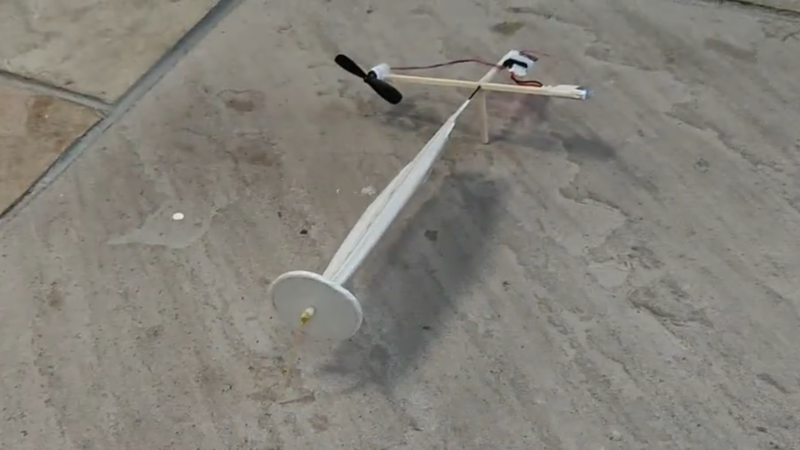
By now we’re all familiar with the quad-rotor design most popular among modern drones, and of course there are many variants using more or less propellers and even fixed-wing drones that can fly autonomously. We’ve even seen drones that convert from rotorcraft to fixed-wing mid flight. But there are even more esoteric drones out there that are far more experimental and use even more bizarre wing designs that look like they shouldn’t be able to fly at all. Take [Starsistor]’s latest design, which uses a single motor and an unconventional single off-center wing to generate lift.

This wing, though, is not a traditional foil shape typically found on aircraft. It uses the Magnus effect to generate lift. Briefly, the Magnus effect is when lift is generated from a spinning object in a fluid. Unlike other Magnus effect designs which use a motor to spin a cylinder, this one uses a design inspired by Savonius wind turbines where a wing is free to rotate around a shaft. A single propeller provides a rotational force to the craft, allowing this off-center wing to begin spinning and generating lift. The small craft was able to sustain several flights but was limited due to its lack of active control.

[Starsistor] went through a number of iterations before finally getting this unusual craft to fly. His first designs did not have enough rotational inertia and would flip over at speed, which was fixed by moving the propeller further away from the center of the craft. Eventually he was able to get a working design to prove his conceptual aircraft, and we hope to see others from him in the future.
Using Multiple Quadcopters to Efficiently Lift Loads Together

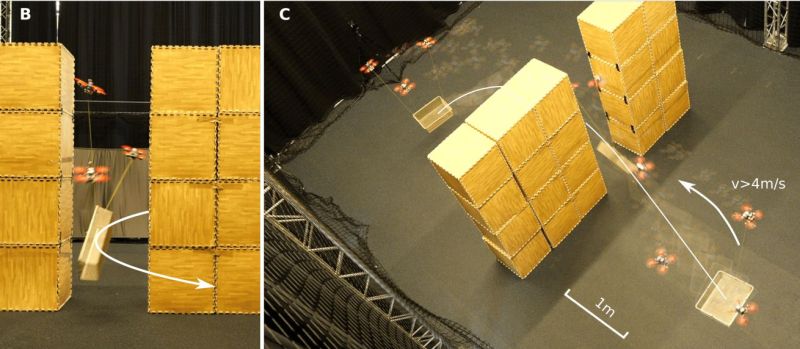
Much like calling over a buddy or two to help with moving a large piece of furniture and pivot it up a narrow flight of stairs, so too can quadcopters increase their carrying capacity through the power of friendship and cooperation. However, unless you want to do a lot of yelling at your mates about when to pivot and lift, you’d better make sure that your coordination is up to snuff. The same is true with quadcopters, where creating an efficient coordination algorithm for sharing a load is far from easy and usually leads to fairly slow and clumsy maneuvering.

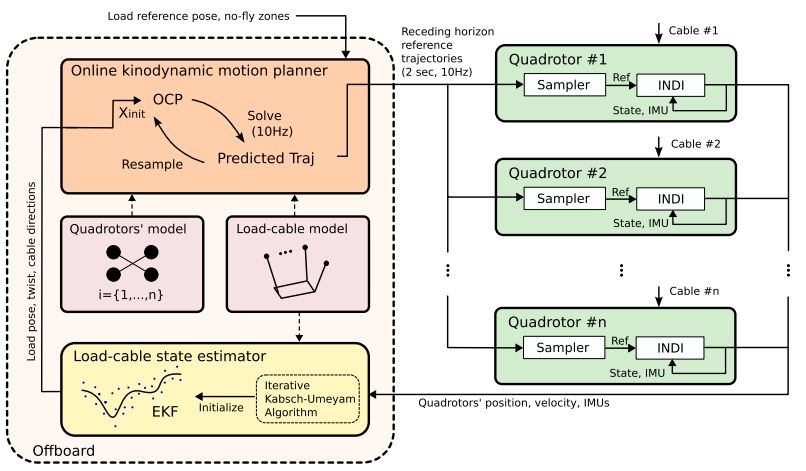
Simplified overview of the motion planner by Sihao Sun et al.

Recently. researchers at the Technical University of Delft came up with what appears to be a quite efficient algorithm for this purpose. In the demonstration video below, it’s easy to see how the quadcopters make short work of even convoluted obstacles while keeping themselves and their mates from getting tangled.

The research by [Sihao Sun] et al. appears in Science Robotics (preprint), in which they detail their trajectory-based framework and its kinodynamic motion planner. In short, this planner considers the whole-body dynamics of the load, the cables, and the quadcopters. An onboard controller for each quadcopter is responsible for translating the higher-level commands into specific changes to its rotor speeds and orientation.

Along with tests of its robustness to various environmental factors, such as wind, the researchers experimented with how many simultaneous quadcopters could work together with their available computing capacity. The answer, so far, is nine units, though they think that the implementation can be further optimized.

Of course, sometimes you just want to watch synchronized drones.

eVTOL for Everyone

While most of the world’s venture capital is off chasing anything with β€œAI” in the name in what many think looks increasingly like an inflated spherical film of soap molecules, in aviation all the hot money is betting on eVTOL: electric vertical take off and landing.

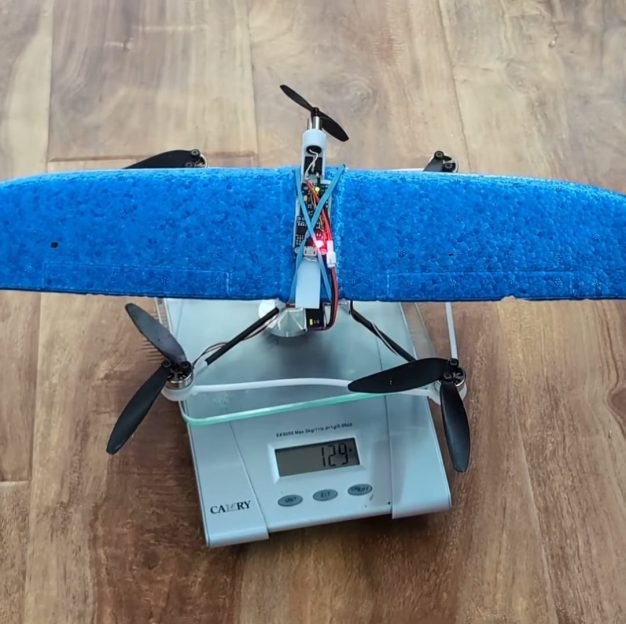
What if you want to get in on the eVTOL game but don’t have (or want) billionaire backing? Long-time contributor [spiritplumber] demonstrates how to do it on the cheap, with a low-cost quadcopter and a foam wing called Lift5.Β 

Most eVTOL isn’t just quadcopters, after all β€” multirotors are great for playing with in the back yard, but their thrust-based lift makes for short range, and the engine-out options are all bad. Add a wing, and you can get that sweet, sweet dynamic lift. Add an extra, forward facing motor, and you can get thrust in the direction you need it most. That’s what [spiritplumber] is doing here: strapping a foam wing to a cheap quadcopter. Specifically, his custom frame for an Eiele F120 drone kit.You can see it in action in the demo video embedded below.

The wing and its forward thrust motor are equipped with its own speed controller, so the concept should be adaptable to just about any little drone. Quadcopter flight computers are mostly going to be able to compensate for the added lift and thrust automatically, which is neat, considering that these forces would require some bizarre headwind/updraft very unlikely to be found in nature.

Now the wing does add a lot of drag during the lift phase, to be sure, so [spiritplumber] is working on folding or tilting it out of the way, but that version is apparently inordinately fond of trees. Once the control issues are worked out you’ll likely see it on his site and YouTube channel Robots Everywhere.

[spiritplumber] has been contributing hacks here at least since 2009, when he showed us how to make a Macbook right click.

❌