❌

Reading view

There are new articles available, click to refresh the page.

DIY Light Panels Work With Home Assistant
By: Lewin Day

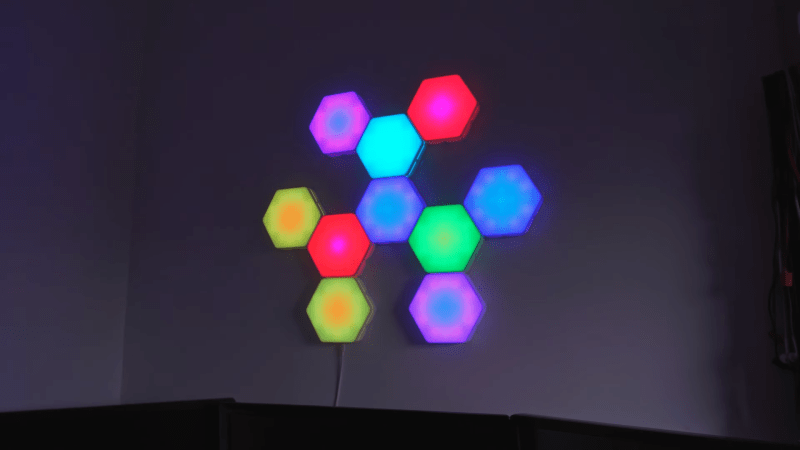
There are a few major companies out there building colorful LED panels you can stick on your wall for aesthetic purposes. Most commercial options are pretty expensive, and come with certain limitations in how they can be controlled. [Smart Solutions For Home] has whipped up a flexible DIY design for decorating your walls with light that is altogether more customizable.

In this case, the DIY light panels ape the hexagonal design made popular by brands like Nanoleaf. In this case, each hexagon panel runs an ESP32 microcontroller, which controls a series of WS2812 addressable LEDs. This allows each panel to glow whatever color you like, and they’re arranged in an XY grid to enable you to light individual panels with a range of different geometric effects. The benefit of having a full microcontroller on each panel is that they can act quite independentlyβ€”each one able to be used as a smart light, an notification display, or even as a physical button, all integrated with Home Assistant.

If you’re a fan of DIY smart home products, these might be right up your alley. They’re supremely flexible and customizable, and can do a lot of things that commercial versions can’t easily replicate. Just don’t ignore the fact that they require a considerable amount of assembly, what with the custom PCBs, 3D printed enclosures, and front diffusers to deal with. That’s just the way the LED wall crumbles.

We’ve seen other similar builds before, too. Why? The simple fact is that a lot of people want cool glowy panels on their wall without having to pay through the nose for them.
A Flexible Light Inspired by IKEA

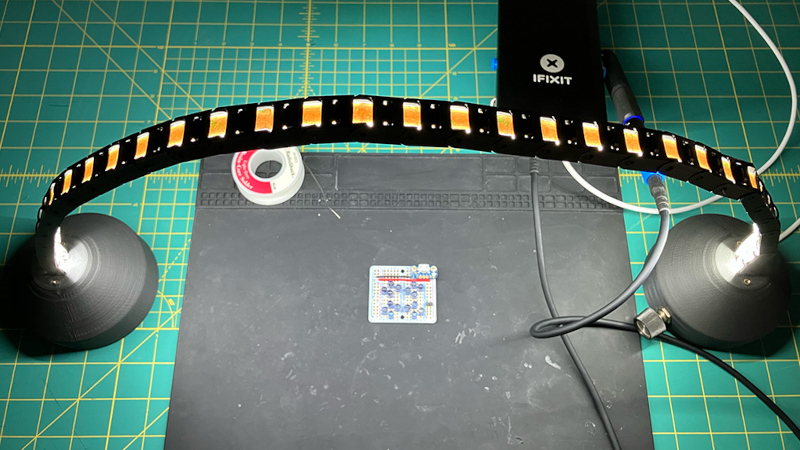
The IKEA SMΓ…SNΓ–RE is a flexible silicone rod with an embedded LED strip, attached at each end to a base. It’s eye-catching enough, and it has the useful property of providing a diffuse light from multiple angles that makes it a promising candidate for a work lamp. That’s enough for [Daniel James] to create his own lamp on a similar vein.

The electronics of his lamp are straightforward enough: a 12 volt LED strip whose brightness is controlled by a Pi Pico in response to a potentiometer as a brightness control. It’s not quite stiff enough to form the arch itself, so he’s created a 3D printed chain that forms the structure of the lamp. Similar to a bicycle chain in the way it’s constructed, it has individual links that slot together and pivot. The electronics are in the printed base at one end.

We like this lamp a lot, for the light it gives on the bench and for the ingenuity of the printed chain. We might even make one for ourselves.

Build a Stranger Things Wall You Can Freak Out At In Your Own Home

By: Lewin Day

When Stranger Things premiered in 2016, it was a cultural force. Foreign DJs gushed over the lush 80s soundtrack, fashionistas loved the clothing, and the world became obsessed with the idea of using Christmas lights to communicate across material planes. [kyjohnso] has recreated that experience with the technology of today.

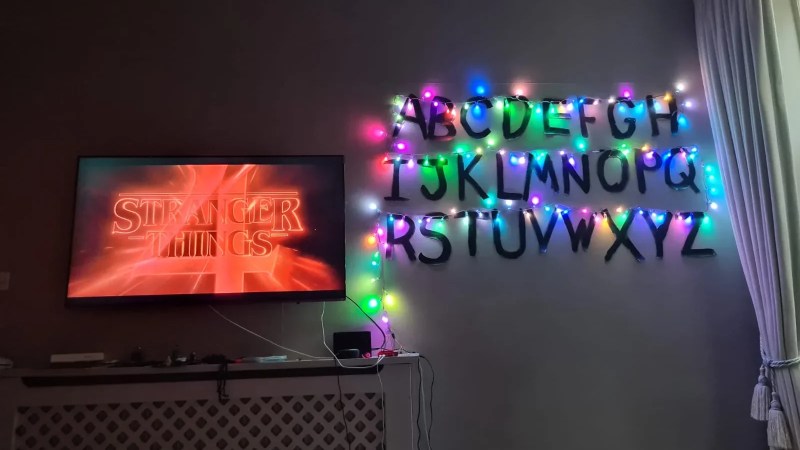
If you haven’t watched the show β€” Joyce Byers is trying to communicate with her son Will, who just so happens to be stuck in another plane of existence called the Upside Down. She screams questions at her living room wall, upon which hangs a series of Christmas lights, marked with the letters A to Z. Will is able to communicate back by causing the lights to flash, one letter at a time.

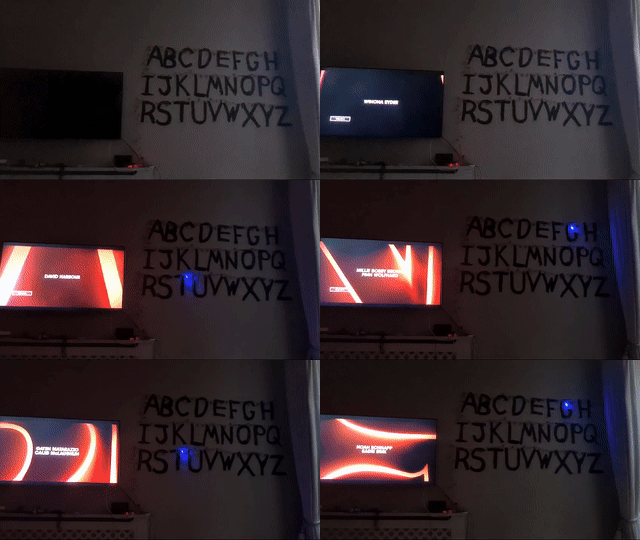
This build works a little differently. You basically type a message into a terminal on a Raspberry Pi, and it gets sent to a large language modelβ€”namely, the Claude API. The response from Claude (or Will Byers, if you’re imagining) is then flashed out on a WS2812B set of LED Christmas lights on the wall. [kyjohnso] added dramatic pauses whenever there’s a space in the output, somewhat replicating the dramatic elements of the show itself. Files are on GitHub for the spooky and curious.

It’s a neat build that would be a hit at any Halloween party. We can’t imagine how much more immersive it would be if paired with a speech-to-text engine so you could actually scream at the thing like a distraught Midwestern parent who has just lost her youngest child. It’s all about committing to the bit; if you build such a thing, don’t hesitate to notify the tipsline!

❌