As stablecoins continue to gain worldwide momentum, the International Monetary Fund (IMF) has called for global cooperation to avert potential macro financial stability risks related to the rapidly growing sector and to turn the industry “into a force for good.”
Stablecoins To Foster Innovation, Financial Inclusion
On Thursday, the IMF released a 56-page report discussing the growing influence of stablecoins, their potential use cases in mainstream financial markets, and the risks associated with the sector’s varying oversight.
Amid the sector’s rapid growth, the organization highlighted that the two largest stablecoins, USDT and USDC, have tripled their market capitalization since 2023, reaching a combined $260 billion. Meanwhile, their trading volume has increased by around 90% to $23 trillion in 2024, with Asia surpassing North America in stablecoin activity volume.
The IMF noted two major potential benefits from stablecoins. First, they could enable faster and cheaper cross-border payments, especially for remittances, which can cost 20% of the amount being sent and face some delays.
However, “being a single source of information, blockchains can greatly simplify the processes linked with cross-border payments and reduce costs,” the Fund’s economists explained in a blog post.
Second, stablecoins could expand financial access, driving innovation by increasing competition with established payment service providers, therefore, making retail digital payments more accessible to underserved customers.
They could facilitate digital payments in areas where it is costly or not profitable for banks to serve customers. Many developing countries are already leapfrogging traditional banking with the expansion of mobile phones and different forms of digital and tokenized money.
Notably, competition with already established providers could lower costs and lead to enhanced product diversity, “leveraging synergies between digital payments and other digital services.”
IMF Warns Of Fragmented Oversight
Despite their potential benefits, stablecoins also carry significant risks, the IMF explained, including de-pegging and collapsing if the underlying assets lose value or if users lose confidence in the ability to cash out. Per the report, this could also trigger fire sales of the reserve assets and disrupt financial markets.
Stablecoins could also accelerate a “currency substitution” dynamic, where individuals and companies abandon their national currency in favor of a foreign one, like US dollars or euros, due to instability or high inflation.
The organization noted that the dynamic decreases a country’s central bank’s ability to control its monetary policy and serve as the lender of last resort, damaging the financial sovereignty of affected nations.
In addition, the potential to reduce cross-border frictions and make faster and cheaper transactions could be undermined by a lack of interoperability if various networks are unable to connect or are restricted by different regulations and other hurdles.
“Stablecoin regulation is in its infancy, so the ability to mitigate these risks remains uneven across countries,” the organization affirmed, noting that “the IMF and the Financial Stability Board have issued recommendations to safeguard against currency substitution, maintain capital flow controls, address fiscal risks, ensure clear legal treatment and robust regulation, implement financial integrity standards, and strengthen global cooperation.”
As reported by Bitcoinist, the FSB vowed in October to address the evolving threats from private finance and the growing use of stablecoins, promising to increase the global watchdog’s policy response and overhaul its surveillance system to make it more flexible and quicker.
Nonetheless, major jurisdictions have taken different stances in key areas, as the IMF detailed, which could result in the exploitation of gaps between jurisdictions and issuers to locate where oversight is weaker.
All this underscores the need for strong international cooperation to mitigate macrofinancial and spillover risks (…). Tokenization and stablecoins are here to stay. But their future adoption and the outlook for this technology are still mostly unknown.
The organization concluded that “improving the existing global financial infrastructure might be easier than replacing it. Achieving the best possible balance will require close cooperation among policymakers, regulators, and the private sector.”
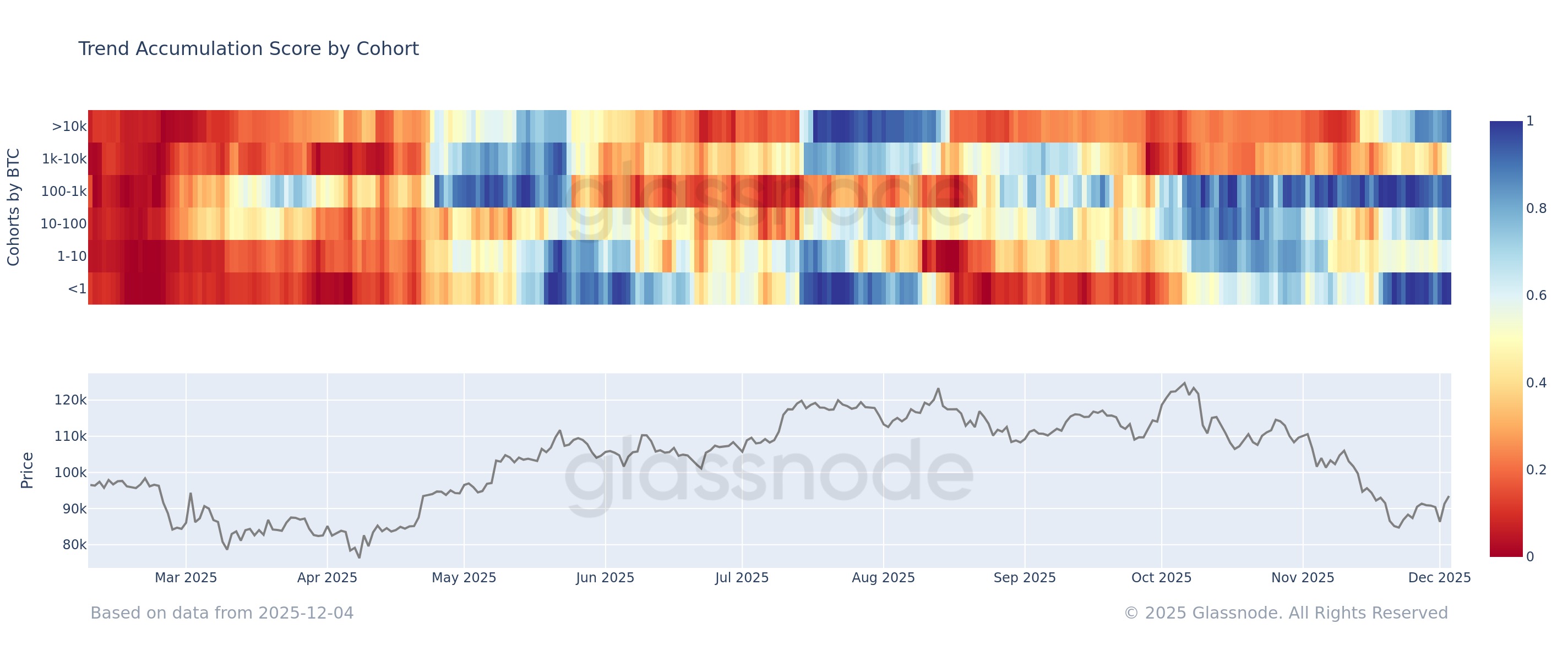
As explained by Glassnode analyst Chris Beamish in an X post, Bitcoin investors have been showing a lot less distribution at the recent price levels. The on-chain indicator of relevance here is the “Accumulation Trend Score,” which tells us about whether BTC holders are buying or selling.
The metric tracks investor behavior using not just the changes happening in their wallet balance, but also accounting for the size of their wallets. This means that larger entities have a higher influence on the score.
When the value of the Accumulation Trend Score is greater than 0.5, it means the investors are displaying a net trend of accumulation. On the other hand, it being under the threshold suggests the dominance of distribution.
Now, here is the chart shared by Beamish that shows how the Accumulation Trend Score has changed for the different Bitcoin investor segments over the last few years:
As displayed in the above graph, the Bitcoin Accumulation Trend Score has reflected a varied behavior for the different investor segments during the last couple of months, but very recently, a uniform picture has started to develop.
The smallest of investors in the market, those holding less than 1 BTC, started participating in aggressive accumulation around the time of BTC’s low in November and have since maintained the indicator nearly at a perfect value of 1. This suggests that retail investors have been buying the dip.
Meanwhile, the 100 to 1,000 BTC traders, popularly called the sharks, have been accumulating throughout the drawdown that has followed since the early October peak, indicating that these investors haven’t lost conviction despite the deep decline.
The story is a bit different for the whale cohorts, however. The 10,000+ BTC holders, corresponding to the largest of hands on the network, were in a phase of distribution between August and November, but they have finally started accumulating since the price low, although the Accumulation Trend Score isn’t as high as the retail investors in their case.
The 1,000 to 10,000 BTC whale group didn’t stop distributing even after the bottom, but very recently, their score has just breached the 0.5 mark. With this, a uniform behavior has begun to appear on the Bitcoin blockchain, with investors as a whole opting to expand their wallet balance.
It now remains to be seen how long this trend of accumulation will continue.
BTC Price
Bitcoin has faced a drop of more than 3% over the last 24 hours that has taken its price to $89,300.
Many in the crypto space have echoed a familiar sentiment over recent months: “The four-year crypto market cycle is dead.” Experts from the Bull Theory assert that while the four-year cycle may have come to an end, the Bitcoin bull run itself is merely delayed and could stretch until 2027.
Why The Four-Year Cycle May Be Ending
In a recent post on social media platform X, formerly known as Twitter, the Bull Theory analysts noted that the concept of Bitcoin adhering to a neat four-year cycle is weakening.
They highlighted that significant price movements over the last decade weren’t solely driven by Halving events; rather, they were influenced by shifts in global liquidity.
The analysts pointed to the current landscape of stablecoin liquidity, which remains high despite recent downturns, indicating that larger investors are still engaged in the market, poised to invest when appropriate macroeconomic conditions arise.
In the US, Treasury policies are emerging as pivotal catalysts. The recent buybacks are notable, but the analysts emphasize that the larger narrative lies in the Treasury General Account (TGA) balance, which is currently around $940 billion—almost $90 billion above its normal range.
This surplus cash is likely to flow back into the financial system, enhancing financing conditions and adding liquidity that typically gravitates toward risk assets.
Globally, the trends appear even more promising. China has been injecting liquidity for several months, while Japan recently announced a stimulus package worth approximately $135 billion, alongside efforts to simplify cryptocurrency regulations.
Canada is also moving toward easing its monetary policy, and the US Federal Reserve (Fed) has officially halted its quantitative tightening (QT) measures—a historical precursor to some form of liquidity expansion.
Political And Monetary Factors Align To Create Bullish Condition
The analysts explained that when major economies adopt expansive monetary policies simultaneously, risk assets like Bitcoin tend to respond more rapidly than traditional stocks or broader markets.
Additionally, potential policy tools, such as the Supplementary Leverage Ratio (SLR) exemption—implemented in 2020 to allow banks more flexibility in expanding their balance sheets—could return, resulting in increased credit creation and overall market liquidity.
There is also a political dimension to consider. President Trump has discussed potential tax reforms, including abolishing income tax and distributing $2,000 tariff dividends.
Furthermore, the likelihood of a new Federal Reserve chair who supports liquidity assistance and is constructive toward cryptocurrency could bolster conditions for economic growth.
Extended Bitcoin Uptrend
Historically, whenever the Institute for Supply Management’s Purchasing Managers’ Index (ISM PMI) surpasses 55, it has been followed by periods of altcoin season. The probability of this occurring in 2026 appears high, according to the Bull Theory.
The convergence of rising stablecoin liquidity, the Treasury’s injection of cash back into markets, global quantitative easing, the cessation of QT in the US, potential bank-lending relief, pro-market policy shifts in 2026, and major players entering the crypto sector suggests a very different scenario than the old four-year halving model.
The analysts concluded that if liquidity expands concurrently across the US, Japan, China, Canada, and other significant economies, Bitcoin is unlikely to move counter to that trend.
Therefore, rather than experiencing a sharp rally followed by a prolonged bear market, the current environment indicates a more extended and broader uptrend that could span through 2026 and into 2027.
Featured image from DALL-E, chart from TradingView.com
Do Kwon, the troubled co-founder of Terraform Labs based in Singapore, is facing a possible 12-year prison sentence in the United States due to his role in the collapse of the TerraUSD stablecoin, which resulted in significant losses within the cryptocurrency market.
Do Kwon Seeks Reduced Sentence Of Five Years
Bloomberg reported that in a court filing late Thursday, US prosecutors described the Terraform Labs co-founder’s fraudulent actions as “colossal in scope.”
They emphasized that his “misleading statements to customers” triggered a domino effect of crises across the crypto landscape, culminating in the downfall of notable entities such as Sam Bankman-Fried’s FTX.
This comes amid a regulatory environment that has grown increasingly lenient under the Trump administration. In late October, President Trump pardoned Binance founder Changpeng Zhao (CZ), who had been convicted for failing to uphold proper anti-money laundering measures.
In a recent court filing, Terraform Labs co-founder expressed a desire for a reduced sentence of five years. His legal team asserted that he has already “suffered substantially” for his actions, noting that he has spent nearly three years in detention conditions described as “brutal” in Montenegro.
Kwon’s lawyers argued that a five-year prison term would be sufficient and that the prosecutors’ recommendation of 12 years is “far greater than necessary” for justice to be served.
Potential For Sentence Transfer For Terraform Labs Co-Founder
Initially, Kwon pleaded not guilty in January to a nine-count indictment that charged him with securities fraud, wire fraud, commodities fraud, and conspiracy to commit money laundering. However, he changed his plea in August to guilty for conspiracy to defraud and wire fraud.
During this change, Terraform Labs’ leader acknowledged that his actions included making “false and misleading statements” regarding the restoration of TerraUSD’s peg in 2021, admitting, “What I did was wrong.”
As part of his plea agreement, Kwon has consented to forfeit $19.3 million and some properties. Prosecutors have chosen not to demand restitution for the millions of investors who collectively lost $40 billion, citing that calculating individual losses would be too complicated.
Kwon faces charges in both the US and his native South Korea, where prosecutors are also pursuing a lengthy prison sentence potentially reaching up to 40 years.
He was arrested in Montenegro in 2023 while using a fake passport, and following a protracted legal battle, he was extradited to the United States in January after spending nearly two years in a Balkan jail.
US prosecutors have indicated they would support Kwon’s opportunity to serve the second half of his sentence in South Korea, provided he adheres to the terms of his plea deal and qualifies for a transfer program. Kwon is scheduled for sentencing by US District Judge Paul Engelmayer on December 11.
When writing, Terraform Labs’ native token Luna Classic (LUNC) saw a 75% increase in response to Do Kwon’s probable sentence, trading at $0.000050 and placing it at the helm of the market’s top performers on Friday.
Featured image from DALL-E, chart from TradingView.com
Reports have disclosed that central banks around the globe have stepped up purchases of gold this year, with one month standing out. In October 2025, officials bought 53 tons of gold, a level that analysts say is the highest monthly demand seen this year. These moves reflect growing concern about inflation, weaker currencies and rising geopolitical risk.
Central Bank Buying Surges
According to data cited by financial outlets, 2025 is on track to be the fourth-highest year this century for institutional gold accumulation when measured net year-to-date through October. Analysts at Deutsche Bank put gold’s share of central-bank reserves at about 24%, a level not seen since the 1990s. Those figures help explain why governments that once moved away from bullion are returning to it now.
Bitcoin Enters The Conversation
Some banks and market researchers are now asking whether Bitcoin could play a similar role for national treasuries. Based on reports from major financial firms, Deutsche Bank projects that Bitcoin could appear on central-bank balance sheets by 2030 as a complementary reserve asset.
Central banks are ramping up gold purchases:
Global central banks purchased +53 tonnes of gold in October, the most since November 2024.
This marks a +194% jump compared to July, and the 3rd-straight monthly acceleration.
Bitcoin’s market profile has changed: liquidity has risen, and price swings have been less extreme during recent months even though volatility remains higher than older reserve assets. Bitcoin also reached a record above $123,500 in recent trading, a price point that has captured wide attention.
A Few Banks Are Testing The Idea
A small number of central banks are now at least studying the idea more seriously. The Czech National Bank, for example, has discussed the possibility of a “test allocation” to learn how crypto might behave inside a reserve mix. Those conversations tend to focus on custody, accounting rules and how to report gains or losses, rather than immediate buying.
On Gold & Bitcoin: Why Officials Are Cautious
Risk is the main reason most central banks have not moved faster. Bitcoin still shows larger price swings than standard reserve assets, and global rules for how to hold and audit crypto are not uniform. Based on expert commentary, regulators and auditors would need clear guidance before many central banks felt comfortable adding crypto to official reserves.
What This Could Mean For Markets
If even a handful of national banks were to allocate a small share of reserves to Bitcoin, demand could rise sharply and change how markets view the asset. A modest sovereign allocation would not replace gold or the US dollar, but it could give Bitcoin a stronger role as a hedge for countries facing currency weakness or rising inflation. At the same time, such a move would push more work into custody and compliance services, which would have to scale up quickly.
Gold buying by central banks is already significant — 53 tons in one month and about 24% of reserves in gold for some — and that Bitcoin is being discussed as a possible next step for some policymakers. The path from discussion to adoption is uncertain, and many technical and legal questions remain. Still, the debate has moved from theory to test runs and official reports, making this one of the more closely watched trends in global finance this year.
Featured image from Unsplash, chart from TradingView
Bitcoin (BTC) is retesting a crucial support area after its price slid 5% from the recent highs and fell below the $90,000 barrier. Some analysts have suggested that the cryptocurrency’s structure remains intact, but warned that it must bounce quickly or risk retesting the November lows.
Bitcoin Retests $88,000 After Rejection
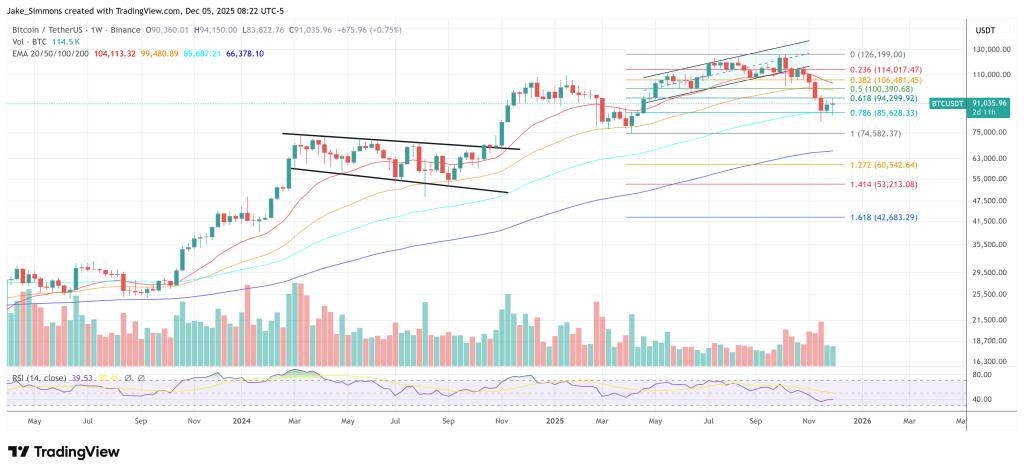
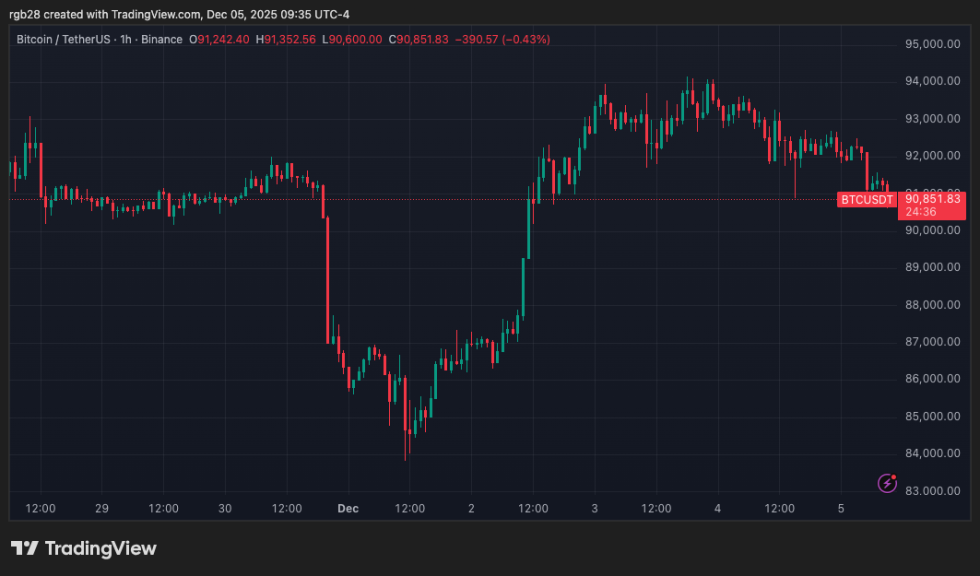
On Friday, Bitcoin lost the recently reclaimed $90,000 level, falling to a key support area before stabilizing. The flagship crypto has been attempting to recover from the November market correction, which sent its price to a seven-month low of $80,600.
Since reaching its local lows two weeks ago, the cryptocurrency has traded within a macro re-accumulation range, between $82,000 and $93,500, attempting to break out of this zone on Wednesday, when it reached a multi-week high of $94,150.
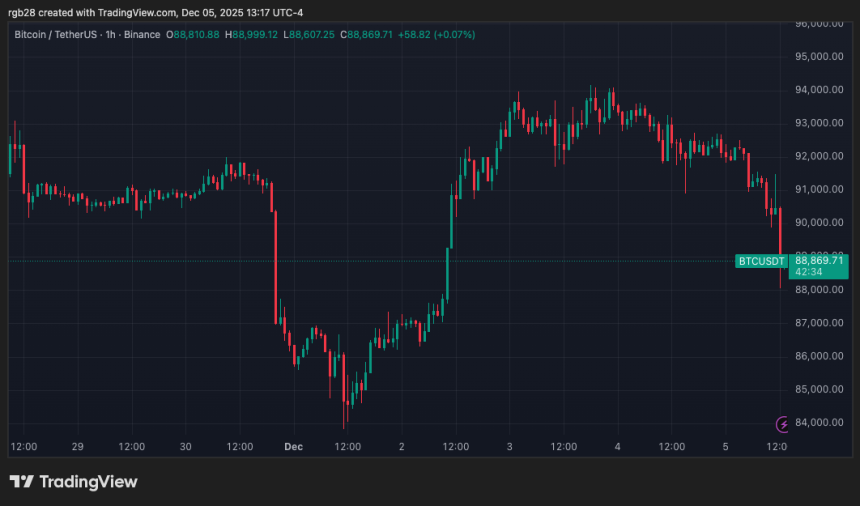
However, as the first week of December approaches its end, BTC has lost the upper area of its local range again, falling below its monthly open and tapping the $88,000 support.
Amid the drop, Analyst Ted Pillows noted that BTC has been struggling to reclaim the $94,000 resistance, adding that price “wants to go lower here before another breakout attempt.” Therefore, he suggested that a bounce back from the $88,000-$89,000 support zone is likely.
Altcoin Sherpa affirmed that the ongoing retest would confirm whether the recent bounce was “just lower highs and price is going lower or if we actually have any juice to bounce to like 100k or something.”
The analyst outlined two potential outcomes. In the first scenario, the flagship crypto would retrace to the $87,000-$89,000 area and bounce above the $93,000-$94,000 resistance levels.
In the second scenario, Bitcoin would continue to move sideways below the local resistance before eventually sliding to the November lows and potentially lower levels. Per the analysis, the leading cryptocurrency must bottom quickly, or it will risk the second outcome.
BTC Shows Shallowing Pullback Tendency
Analyst Rekt Capital also pointed out that Bitcoin continues to face rejection from the range high resistance. However, he considers that investors should not worry as long as the pullback isn’t as big as the previous ones.
If “the rejection is shallower than the previous two, then this resistance will continue to weaken until eventually breached,” he explained, adding that “as long as this weakening continues, BTC should be able to finally breach this resistance over time & try to challenge the multi-week Downtrend above.”
Earlier this week, the analyst affirmed that BTC’s consolidation structure will remain intact as long as Bitcoin closes the week above the range lows. He also noted that its Macro Downtrend, which “has been dictating resistance throughout this phase of the cycle,” remains the dominant structural barrier and the level to break.
As the price stabilized between the $88,500-$89,350 area, the analyst added that today’s retracement “continues to be a shallower pullback than the previous two,” which keeps the range “‘retrace shallowing’ tendency” intact.
He noted that Bitcoin could technically drop into the ascending two-week support trendline, or tap the $86,000 level and still perform a shallower correction than the recent 10% drop.
As of this writing, Bitcoin is trading at $89,400, a 2.9% decline in the daily timeframe.
Despite the Bitcoin price recovery above the crucial $90,000 threshold—a level that has historically served as a supportive floor for the cryptocurrency—the market is exhibiting signs that a further correction may be imminent.
Bitcoin Price Recovery At Risk?
Market expert Rekt Fencer recently shared insights on social media platform X, formerly known as Twitter, suggesting that the Bitcoin price might be forming what he calls a “massive bull trap.”
This term refers to a deceptive bullish signal in which the price briefly surpasses a resistance level, in this case, the $90,000 mark, only to reverse into a decline. Such movements can entrap investors who bought in during the peak, leading to significant losses.
Fencer pointed out a troubling pattern reminiscent of early 2022 when Bitcoin reclaimed its 50-week moving average (MA)—currently positioned above $102,300—before experiencing a severe decline of roughly 60%, plummeting below $20,000 by June of that year.
He indicated that the recent price recovery following major drops to $84,000 should not be interpreted as a signal of near-term success, especially since the Bitcoin price is currently trading under the 50-week MA.
If historical trends repeat, this could mean that Bitcoin might see a significant drop, potentially reaching around $36,200, which could potentially represent the low point of the bearish cycle for the cryptocurrency. On the other hand, there are analysts who retain a bullish outlook.
BTC Bottom In Sight?
Market researcher and analyst Miles Deutscher expressed a confident sentiment, stating he believes there is a 91.5% likelihood that the Bitcoin price has hit its bottom, based on his analysis of key developments.
He noted that recent weeks have been dominated by negative news stories, including concerns surrounding Tether (USDT) and the implications of China’s actions on crypto, which he asserts often mark local price bottoms.
Moreover, Deutscher pointed out a shift in market flows from predominantly bearish to bullish. He explained that the trading environment has recently seen a resurgence in buying momentum, with large investors, or “OG whales,” ceasing their selling. This change has been reflected in the order books, indicating a possible stabilization in market sentiment.
Additionally, the liquidity landscape appears to be shifting, with market conditions tightening in recent months. The potential appointment of a new Federal Reserve chair known for dovish policies, coupled with the official end of quantitative tightening (QT), could further influence market dynamics in favor of buyers.
Deutscher concluded by emphasizing that given the extreme levels of fear, uncertainty, and doubt (FUD) in the market, combined with improvements in trading flows, he believes that the odds favor the notion that the Bitcoin price has indeed reached its bottom.
Featured image from DALL-E, chart from TradingView.com
One of the most influential inventions of the 20th century was Big Mouth Billy Bass. A celebrity bigger than the biggest politicians or richest movie stars, there’s almost nothing that could beat Billy. That is, until [Kiara] from Kiara’s Workshop built a Magikarp version of Big Mouth Billy Bass.
Sizing in at over 2 entire feet, the orange k-carp is able to dance, it is able to sing, and it is able to stun the crowd. Magikarp functions the same way as its predecessor; a small button underneath allows the show to commence. Of course, this did not come without its challenges.
Starting the project was easy, just a model found online and some Blender fun to create a basic mold. Dissecting Big Mouth Billy Bass gave direct inspiration for how to construct the new idol in terms of servos and joints. Programming wasn’t even all that much with the use of Bottango for animations. Filling the mold with the silicone filling proved to be a bit more of a challenge.
After multiple attempts with some minor variations in procedure, [Kirara] got the fish star’s skin just right. All it took was a paint job and some foam filling to get the final touches. While this wasn’t the most mechanically challenging animatronic project, we have seen our fair share of more advanced mechanics. For example, check out this animatronic that sees through its own eyes!
With the Christmas holidays now just around the corner, Mac owners can get all festive by adding snow and Christmas lights to their computer thanks to the Snowy app.
Fundstrat’s Tom Lee told attendees at Binance Blockchain Week that he believes the worst leg of the recent crypto slump is likely over and that markets may be ready for a gradual recovery. He pointed to weakening selling pressure and growing underlying activity as reasons for cautious optimism.
Market Sentiment May Be Near A Turning Point
According to Lee, mood on the street turned darker after October, with many investors showing fatigue after steady losses. He said the current selling looks closer to exhaustion than to the start of another major decline. Trading desks have cut back. Volume has thinned. Sentiment is low. Lee argued that often, when pessimism peaks, conditions for a reversal begin to form.
Bitcoin Drawdowns Are Not Uncommon
Based on reports, Bitcoin has fallen about 36% from its all-time high in the recent retreat. That size of drop has happened in prior cycles, including 2017 and 2021, and has been followed by rallies that reached new records.
“Crypto prices likely bottomed. The best years of growth are still ahead: there is 200x adoption to come.” – Tom Lee, Chairman of Bitmine pic.twitter.com/fPWbWdaosO
Lee pointed to long-term returns for bitcoin and ether compared with some traditional assets over the last decade, saying crypto’s gains were larger. He used that history to support the idea that patient holders have been rewarded after past stress.
Tokenization Could Be A Major Story In 2026
Lee also presented tokenization as a key theme for the future. He said large institutions are preparing to move more financial products on-chain and that, if real estate joins the shift, close to a quadrillion dollars in assets could eventually be tokenized.
Stablecoins were cited as an early example of why tokenized instruments can attract demand. He suggested that a broader institutional push could add steady interest to the market over time.
BlackRock’s Bitcoin ETF Was Highlighted As A Signal
Reports have disclosed that BlackRock’s bitcoin ETF has become one of the firm’s top fee-earning products, a fact Lee used to show growing involvement from legacy finance. That kind of institutional participation, he argued, points to deeper engagement from big players who were previously on the sidelines.
Adoption Gap Suggests Large Upside
According to Lee, only 4.4 million bitcoin wallets hold more than $10,000 in BTC, while nearly 900 million people globally have more than $10,000 in retirement savings.
He said that gap shows how early the market still is and argued that if just a fraction of those savers put money into bitcoin, adoption could expand by as much as 200 times. The figure is speculative, he acknowledged, but he used it to show the potential scale for future demand.
What This Means For Investors Now
Lee questioned whether the old four-year cycle should be used as a strict guide. He suggested recent moves were driven more by de-leveraging and structural shifts than by the halving rhythm that shaped earlier cycles.
Featured image from Unsplash, chart from TradingView
On 3rd December, official filings and press releases announced Twenty One Capital’s upcoming debut on the New York Stock Exchange (NYSE), positioning the company as one of the largest Bitcoin treasury firms ever to enter public markets. The listing brings a dedicated Bitcoin balance sheet into Wall Street’s core ecosystem, signaling a structural shift in how institutional investors can gain long-term BTC exposure.
A Bitcoin Treasury Giant Steps Onto The NYSE Stage
Twenty One Capital’s NYSE entry is anchored by its business combination with Cantor Equity Partners (CEP), the SPAC serving as the public-market vehicle for the transaction. CEP shareholders have already approved the merger, and the deal is expected to close around December 8. Once completed, the combined entity will operate as Twenty One Capital, Inc. and begin trading on December 9 under the ticker XXI.
The original announcement, released through official press channels and SEC-related filings, emphasized CEP’s central role in enabling the listing and establishing the company’s public-market structure. CEO Jack Mallers also highlighted the milestone on X, noting the company’s readiness for its debut.
According to this press announcement, Twenty One Capital will debut with an estimated 43,500 BTC, a reserve valued near $4 billion at recent market levels. This immediately places it among the top corporate Bitcoin treasuries globally. Unlike companies that hold Bitcoin as a secondary reserve, Twenty One is specifically engineered around a Bitcoin-native model. The firm intends to report “Bitcoin-per-share,” providing investors a transparent look at how much BTC each equity unit represents. It also pledges full, on-chain proof-of-reserves, positioning itself as a high-transparency asset custodian at launch.
This model effectively transforms Twenty One into a regulated balance-sheet wrapper for Bitcoin. It lowers operational friction for institutional allocators who want direct BTC exposure without the complexities of crypto custody, self-storage, or exchange-based acquisition. By listing on the NYSE rather than relying on ETFs or derivatives, Twenty One creates a regulated public equity vehicle that holds, safeguards, and transparently tracks Bitcoin for institutional and retail investors alike.
Wall Street’s New On-Ramp To Institutional BTC Exposure
The market impact of Twenty One’s listing reflects the accelerating integration of Bitcoin into mainstream financial architecture. The company’s backers—including Tether-linked entities, Bitfinex-aligned interests, SoftBank-connected capital, and Cantor’s public-markets network—provide a cross-sector foundation aimed at bridging crypto-native philosophies with institutional liquidity channels.
Under this structure, Twenty One aims to become a long-term institutional treasury vessel—a regulated balance sheet that accumulates BTC and gives investors an equity-linked way to participate in Bitcoin’s upside without engaging directly with crypto custody or trading infrastructure.
As the NYSE debut approaches, Twenty One Capital embodies a pivot point where BTC’s role in capital markets shifts from speculative asset to institutional treasury instrument. If XXI attracts sustained flow, it could set a new blueprint for how corporate entities engage with Bitcoin—anchoring Wall Street’s next phase of digital-asset adoption.
VTB, Russia’s second-largest bank, has told clients it plans to let them buy and sell real cryptocurrencies through its brokerage service, with a target rollout in 2026 pending regulator approval.
According to the bank, the move would go beyond the derivative products that most Russian banks have offered so far. It is a clear shift toward opening traditional finance to digital assets, at least for now among wealthy clients.
Client Eligibility And Timetable
Reports have disclosed that VTB intends to begin with high-net-worth customers only. The bank set thresholds for its initial offering: clients with assets above $1.3 million or annual income over $649,000 would be eligible at first.
Andrey Yatskov, who heads VTB’s brokerage arm, said there is “sharp demand” from clients for access to actual crypto, not just paper products tied to token prices. The bank has picked 2026 as the planned start year, but it made that clear the launch depends on regulators signing off.
Real Crypto, Not Just Contracts
Based on reports, the service would allow ownership of the underlying coins — not merely derivative contracts or token-linked notes. That is a significant distinction in Russia, where until recently banks were limited to offering exposure through derivative instruments.
Allowing customers to hold coins directly would require legal and compliance work, from custody arrangements to anti-money-laundering controls. Those steps are on the critical path before any retail expansion can happen.
Potential Market Signals
VTB has also given investors a sense of how it views crypto as an asset class. The bank recommended a 7% allocation to crypto for some investor profiles, and its internal forecasts have mentioned medium-term Bitcoin price targets in the $200,000–$250,000 range under favorable conditions.
If VTB moves forward, it could be the first major Russian bank to operate in this way — a signal that some parts of the financial sector see token ownership as something to be offered through mainstream channels.
Regulatory Hurdles And Geopolitics
The plan is not risk free. Russian regulation of crypto is still evolving, and any permit to offer direct trading will require approval from the relevant authorities. Sanctions and other geopolitical pressures could alter timelines or force changes to how the service is structured.
Compliance teams will need to reconcile domestic rules with international restrictions that affect many big banks operating in or dealing with Russia.
For now, the rollout remains conditional. VTB’s timeline, client criteria, and product design all hinge on legal clarifications and regulator consent. Market participants and clients will likely follow announcements from the Bank of Russia and other agencies to judge how soon broader access might come.
Featured image from Pexels, chart from TradingView
A critical remote code execution (RCE) vulnerability, dubbed ‘React2Shell’, affecting React Server Components (RSC) and Next.js, is allowing unauthenticated attackers to perform server-side code attacks via malicious HTTP requests.
Discovered by Lachlan Davidson, the flaw stems from insecure deserialization in the RSC ‘Flight’ protocol and impacts packages including react-server-dom-webpack, react-server-dom-parcel, and react-server-dom-turbopack. Exploitation is highly reliable, even in default deployments, and a single request can compromise the full Node.js process. The flaw is being tracked as CVE-2025-55182. Originally tagged as a CVE for Next.js, NIST subsequently rejected CVE-2025-66478, as it is a duplicate of CVE-2025-55182.
This blog post includes the critical, immediate actions recommended to secure your environment, new and existing Platform Detection Rules designed to defend against this vulnerability, and information on how SentinelOne Offensive Security Engine, a core component of the Singularity Cloud Security solution, allows our customers to quickly identify potentially vulnerable workloads.
What is React2Shell? Background & Impact
On December 3, 2025, the React and Next.js teams disclosed two related vulnerabilities in the React Server Components (RSC) Flight protocol: CVE-2025-55182 (React) and CVE-2025-66478 (Next.js), with the latter CVE now marked by NIST as a duplicate.
Both enable unauthenticated RCE, impacting applications that use RSC directly or through popular frameworks such as Next.js. These vulnerabilities are rated critical (CVSS 10.0) because exploitation requires only a crafted HTTP request. No authentication, user action, or developer-added server code is needed for an attacker to gain control of the underlying Node.js process.
The vulnerability exists because RSC payloads are deserialized without proper validation, exposing server functions to attacker-controlled inputs. Since many modern frameworks enable RSC as part of their default build, some teams may be exposed without being aware that server-side RSC logic is active in their environment.
Security testing currently shows:
Exploitation can succeed with near 100% reliability
Default configurations are exploitable, including a standard Next.js app created with create-next-app and deployed with no code changes
Applications may expose RSC endpoints even without custom server functions
A single malicious request can escalate to full Node.js process compromise
Security researchers warn that cloud environments and server-side applications using default React or Next.js builds are particularly at risk. Exploitation could allow attackers to gain full control over servers, access sensitive data, and compromise application functionality. Reports have already emerged of China-nexus threat groups “racing to weaponize” the flaw.
Companies are advised to review deployments, restrict unnecessary server-side exposure, and monitor logs for anomalous RSC requests. Securing default configurations, validating deserialized input, and maintaining a regular patch management schedule can prevent attackers from exploiting framework-level vulnerabilities in production applications.
Update React by installing the patched versions of React as listed above.
Update Next.js and other RSC-enabled frameworks as listed above. Ensure the latest framework and bundler releases are installed so they ship the patched React server bundles.
Review deployment behavior by checking whether your organization’s workloads expose RSC server function endpoints. These may exist regardless of whether developers added custom server functions.
How SentinelOne Protects Our Customers
Cloud Native Security – Offensive Security Engine
SentinelOne’s Offensive Security Engine (OSE), core component of its Singularity Cloud Security solution, proactively distinguishes between theoretical risks and actual threats by simulating an attacker’s methodology. Rather than relying solely on static scans that flag every potential misconfiguration or vulnerability, this engine automatically conducts safe, harmless simulations against your cloud infrastructure to validate exploitability.
This approach delivers differentiated outcomes by radically reducing alert fatigue and focusing security teams on immediate, confirmed dangers. By providing concrete evidence of exploitability—such as screenshots or code snippets of the successful simulation—it eliminates the need for manual validation and “red teaming” of every alert. Shift from chasing hypothetical vulnerabilities to remediating verified attack vectors, ensuring resources are always deployed against the risks that pose a genuine threat to their environment.
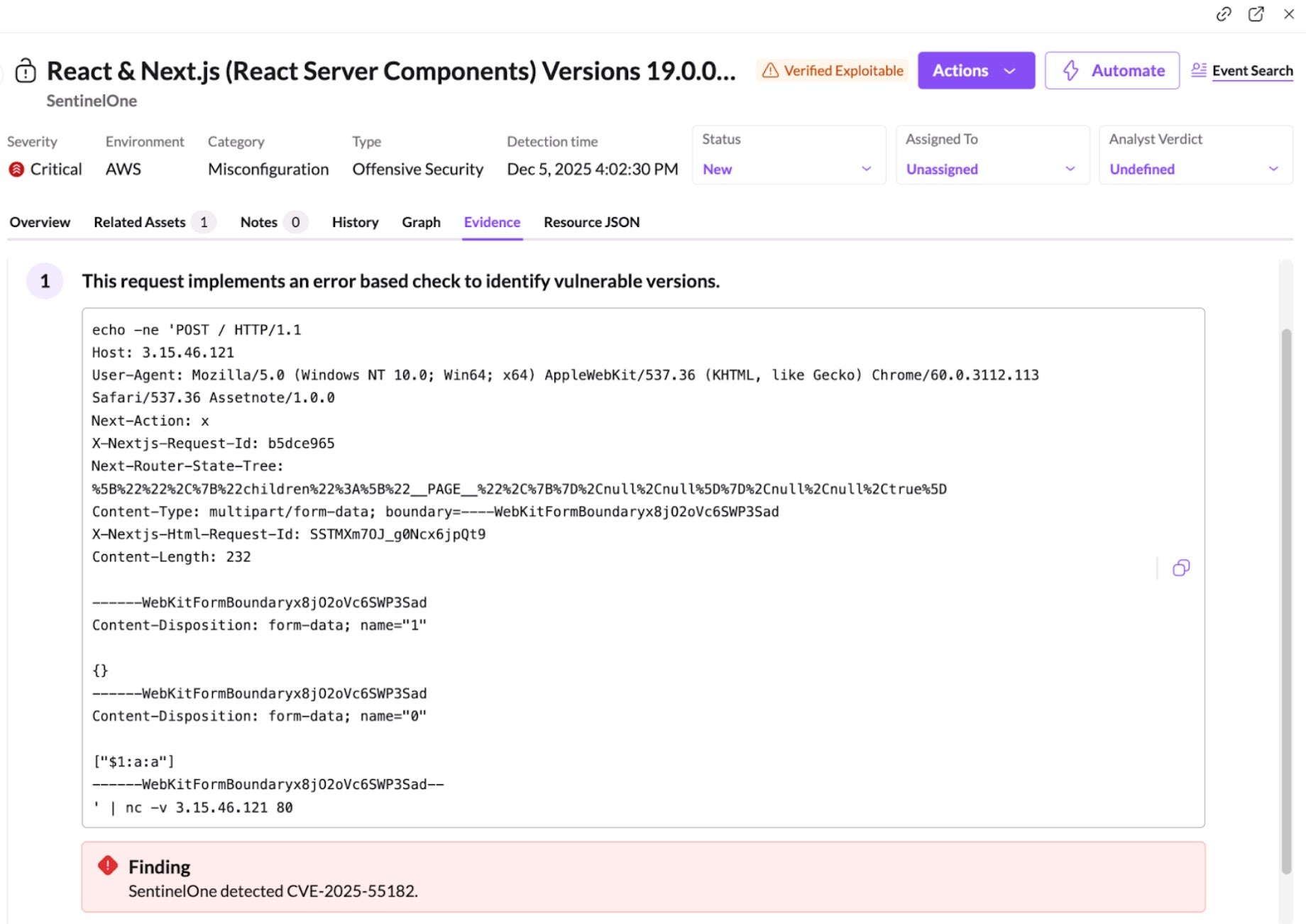
In response to this vulnerability, SentinelOne released a new OSE plugin which can verify exploitability of these vulnerabilities for publicly accessible workloads using a defanged (i.e., harmless) HTTP payload.
Viewing Misconfigurations in the SentinelOne Console
SentinelOne customers can quickly identify potentially vulnerable workloads using the Misconfigurations page in the SentinelOne Console.
Search for:
React & Next.js (React Server Components) Versions 19.0.0–19.2.0 Vulnerable to Pre-Authentication Remote Code Execution via Unsafe Deserialization (CVE-2025-55182)
This highlights Node.js workloads that are exposing RSC-related server function endpoints. Once identified, affected assets can be patched or temporarily isolated. SentinelOne CNS also detects suspicious Node.js behavior associated with exploitation attempts, providing protection while updates are deployed.
It identifies verified exploitable paths on your publicly exposed assets, confirming which systems are truly at risk. By validating exploitability rather than simply flagging theoretical vulnerabilities, Singularity Cloud Security minimizes noise and provides concrete evidence so security teams can focus on what matters.
Wayfinder Threat Hunting
The Wayfinder Threat Hunting team is proactively hunting for this emerging threat by leveraging comprehensive threat intelligence. This includes, but is not limited to, indicators and tradecraft associated with known active groups such as Earth Lamia and Jackpot Panda.
Our current operational coverage includes:
Atomic IOC Hunting: We have updated our atomic IOC library to include known infrastructure and indicators from these threat actors, as well as broader intelligence regarding this campaign.
Behavioral Hunting: We are actively building and executing hunts designed to detect behavioral TTP matches that identify suspicious activity beyond static indicators.
Notification & Response All identified true positive findings will generate alerts within the console for the affected sites. For clients with MDR, the MDR team will actively review these alerts and manage further escalation as required.
Platform Detection Rules
SentinelOne’s products provide a variety of detections for potential malicious follow-on reverse shell behaviors and other actions which may follow this exploit. As of December 5, 2025, SentinelOne released new Platform Detection Rules specifically to detect observed in-the-wild exploit activity. We recommend customers apply the latest detection rule, Potential Exploitation via Insecure Deserialization of React Server Components (RSC), urgently to ensure maximum protection.
Additionally, SentinelOne recommends customers verify the following existing rules have also been enabled:
Potential Reverse Shell via Shell Processes
Potential Reverse Shell via Node
Potential Reverse Shell via Python
Reverse Shell via Perl Utility
Potential Reverse Shell via AWK Utility
Potential Reverse Shell via GDB Utility
Potential Reverse Shell via Lua Utility
Potential Reverse Shell via Netcat
Potential Reverse Shell using Ruby Utility
Potential Reverse Shell via Socat Utility
Conclusion
CVE-2025-55182 and CVE-2025-66478 represent critical risks within the React Server Components Flight protocol. Because frameworks like Next.js enable RSC by default, many environments may be exposed even without intentional server-side configuration. Updating React, updating dependent frameworks, and verifying whether RSC endpoints exist in your organization’s workloads are essential steps.
Singularity Cloud Security helps organizations reduce risk by identifying vulnerable workloads, flagging misconfigurations, and detecting malicious Node.js behavior linked to RCE exploitation. This provides immediate visibility and defense while patches are applied.
Learn more about SentinelOne’s Cloud Security portfolio here or book a demo with our expert team today.
Third-Party Trademark Disclaimer:
All third-party product names, logos, and brands mentioned in this publication are the property of their respective owners and are for identification purposes only. Use of these names, logos, and brands does not imply affiliation, endorsement, sponsorship, or association with the third-party.
For more than 20 years, the Escalade has been the go-to symbol of American luxury—big, bold, and impossible to ignore. But no one expected Cadillac to turn it into something that launches like a supercar.
The Binance Blockchain Week event in Dubai became the center of a high-stakes showdown between traditional and digital innovation, with Bitcoin and gold going head-to-head. Investors, tech enthusiasts, and financial experts watched closely as Binance founder Changpeng Zhao expertly debated renowned Bitcoin critic Peter Schiff, making a compelling argument for why Bitcoin is better than gold.
Binance Founder Dominates Bitcoin And Gold Debate
During the Binance Blockchain Week in Dubai, Schiff and CZ faced off in a high-profile debate over the value of Bitcoin versus Gold. Schiff defended gold as a safe, stable, and tangible asset while the Binance founder made a compelling case for Bitcoin’s adoption, utility, value, and global reach.
Throughout the debate, which lasted over an hour, CZ consistently demonstrated the practical advantages of Bitcoin, leaving Schiff’s gold argument largely on the defensive. The Binance founder emphasized Bitcoin’s transparent and predictable supply and its role in the modern financial systems. He pointed to hundreds of millions of users who rely on Bitcoin for payments, savings, and transfers.
Schiff argued that Bitcoin lacks inherent value and is mainly driven by hype and faith that its price will rise. He stated that gold remains tangible, centuries old, scarce, and valuable in industry, making it superior to BTC. He further asserted that “nobody needs” Bitcoin and that the cryptocurrency is “backed by nothing.”
Practical demonstrations played a key role in the debate between Schiff and CZ. The Binance founder explained how Bitcoin and crypto payments already improve financial efficiency, especially in emerging markets. Schiff questioned whether these transactions truly count as money, since merchants ultimately receive traditional currency. CZ’s response highlighted the importance of adoption and network effects, noting that people who use BTC directly for payments give it real-world significance.
The debate also considered the preferences of younger generations. CZ asked Schiff whether millennials and Gen Z favoured Bitcoin or gold. The Bitcoin critic responded sharply, suggesting that they would choose gold. He pointed out that, with many young investors losing money on BTC, gold offers a safer, more appealing alternative. The Binance founder countered that younger people understand digital value more intuitively and prefer mobile, borderless, and censorship-resistant assets.
Digital Value And The Future Of Money
The debate between CZ and Schiff also highlighted the changing definition of money. Bitcoin functions as a decentralized network that enables instant settlement and transparent verification. Its adoption has also helped evolve the financial economy, facilitating faster and more seamless cross-border payments. Schiff argued that gold’s scarcity and industrial demand preserve its value and make it a reliable hedge against economic uncertainty.
Tokenization also became a point of agreement during the discussion, with Schiff emphasizing that gold can be digitized and tokenized for easier ownership and distribution without moving the physical metal. CZ contended that Bitcoin offers similar advantages while also enabling global financial inclusion. They also discussed the supply of both assets, with the Binance founder noting that Bitcoin has a visible supply, while gold doesn’t.
They also talked about the performance of both assets over the years. Schiff argued that gold had outperformed BTC over the past four years. CZ contended that Bitcoin has far outpaced gold over the last 8 years, and since its launch in 2009, it has skyrocketed from a few cents to an ATH above $126,000. He concluded his debate, predicting that Bitcoin’s growth will outpace gold over time.
Memory shortages triggered by booming AI demand are leading Dell and Lenovo to hike prices on PCs and servers. As much as 15–20% increases may hit as early as December or January.
Crypto analyst Miles Deutscher has issued one of the most forceful bottom calls of this cycle, assigning a 91.5% probability that Bitcoin’s low is already in. In a X thread on December 4, he wrote: “F*ck it. I’m putting my neck on the line here. I’m 91.5% certain that the BTC bottom is in. And if it is, A LOT of people are about to be caught offside.”
Is The Bitcoin Bottom In?
Deutscher bases his conviction on four “pillars”: market reaction to news, the historical behaviour of FUD events, a shift in flows, and an improving global liquidity backdrop. Each pillar is scored in an internal model that culminates in a 91.5/100 bullish reading.
He starts with price behaviour versus headlines. Over recent days, he notes, the market has digested an “influx of bad news” – including renewed Tether FUD, another round of “China banning crypto,” MicroStrategy scrutiny and concerns around a Bank of Japan–driven yen carry trade unwind.
“Despite all this bad news, price rallied,” he writes, calling this “the first time since the major selloff began” that Bitcoin has responded positively to a destructive news cycle. He underscores an old trading adage: “The reaction to news is more important than the news itself. This tells you everything you need to know.”
The second pillar is a systematic look at whether such FUD clusters tend to coincide with local lows. Deutscher says he backtested “every single time Tether, China, BOJ, and Microstrategy FUD entered the market” in a similar way. His conclusion is stark: “Every single time, these FUD events marked a local bottom. Tether FUD = bottom.
China ‘banning’ crypto = bottom. Bank of Japan/carry trade concerns = bottom. Microstrategy FUD = bottom.”
On this basis, his AI model assigns the maximum score of 28/28 to this pillar. He cautions that “in isolation, this factor doesn’t matter much,” but argues that, combined with the first pillar, it “starts to paint a convincing bull case.”
The third pillar is flows, which he calls “the most critical factor (net buy/sell pressure).” For the past weeks, flows were “aggressively negative” with OG whales selling and ETFs dumping. Recently, he argues, this picture has changed. ETF inflows are “starting to stabilise & uptick,” treasury-company holdings remain stable, and “OG whales have stopped relentlessly dumping (this is clear on the orderbooks).” This earns a 22.5/25 score in his model. He adds one key caveat: as long as DATs exist, “there are material risks.”
The fourth pillar is the liquidity and macro environment. Deutscher notes that market liquidity had been tightening for months, but now “things are shifting back toward increased market liquidity,” with global financial conditions “reloosened to near highs.” He highlights “macro tailwinds” and adds that a new, potentially more dovish Fed chair is coming and “QT has now officially ended.” This set of factors receives a 9/10 score in his framework.
Aggregating all four pillars leads to the headline figure: “With all four market pillars taken into account, we arrive at a final score of 91.5/100.”
Deutscher, however, explicitly lists caveats. He points out that US markets “have been on a massive run” and may need to cool off, that DATs “are still seeing some short-term pressure,” and that ETF flows “can flip negative at any time.” His conclusion is probabilistic rather than absolute: “Markets are a game of probabilities, and I think the odds are in favour of the bottom being in – given the extreme FUD we’ve had and the market’s reaction to it.”
XRP ETFs are on the verge of hitting a significant milestone, with total Assets Under Management (AUM) approaching the $1 billion milestone. Since the launch of its ETF last month, hundreds of millions of dollars have been flowing in daily, making XRP the most successful new ETF entrant of 2025.
XRP ETFs Close In On $1 Billion
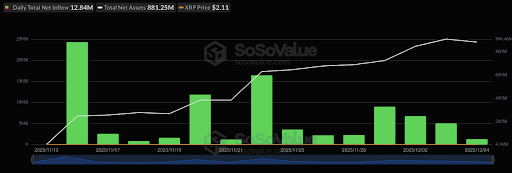
XRP ETFs have continued to experience skyrocketing growth and institutional demand, now rapidly closing in on the $1 billion inflow milestone. Over the past two weeks, all five XRP ETFs have recorded over $984.54 million in cumulative net inflows, just $15.46 million away from $1 billion. This explosive, accelerated growth has effectively solidified XRP’s position as the third-largest crypto ETF, behind Bitcoin and Ethereum.
Data from Sosovalue reports 15 consecutive days of positive flow, with the XRP ETF recording its highest single-day inflow on November 14 at $243.05 million. Over the last two weeks, all five XRP ETFs, including REX-Osprey, have seen notable inflows, reflecting growing institutional interest and demand.
According to crypto enthusiast @NADZOE93 on X, XRP has become the third cryptocurrency ever to surpass the $800 million ETF inflow threshold. She noted that while Spot Bitcoin ETFs reached this cap in just two days after their launch, Ethereum ETFs took 95 days. This officially positions XRP as the second-fastest crypto to hit the $800 million inflow mark.
Notably, strong inflows in the XRP ETF began on November 13 with the launch of Canary Capitals XRPC. A week later, Bitwise introduced its own XRP ETF, followed shortly by Grayscale and Franklin Templeton debuting their funds. Since then, investments have continued to pour in, with $26.17 million flowing in just yesterday alone, bringing the total to $887.12 million after 15 days of positive flow.
Crypto market analyst Neil Tolbert shared additional insights on the XRP ETF performance on X this week. He noted that five spot XRP ETFs are currently trading, with a combined $995 million in Assets Under Management. Canary Capital’s XRPC stands at the top of the market with $358.88 million, followed by Grayscale’s GXRP with $211.07 million, Bitwise’s ETF at $184.87 million, Franklin Templeton’s XRPZ at $132.3 million, and REX-Osprey at $108 million.
Tolbert has stated that more ETFs are reportedly in the pipeline, with institutional demand set to grow as traditional finance takes notice of XRP. With the race to a $1 billion inflow milestone heating up, XRP ETFs have already surpassed those of Solana and Dogecoin.
Institutions Accumulate Over 400 Million XRP Through ETFs
Institutional demand for XRP is reaching new heights as data from ETF tracker XRP Insights show that a whopping 425.76 million tokens have been officially locked. This surge in accumulation comes as the five currently launched XRP ETFs collectively reach $984.54 million in AUM.
This large amount of XRP held in ETFs shows how quickly institutions are adopting, as investors increasingly seek regulated, transparent ways to gain exposure to cryptocurrencies. Analysts have also warned that if ETFs continue to absorb XRP at such a rapid pace, it could trigger a supply shock as the number of tokens in circulation declines.

 Login
Login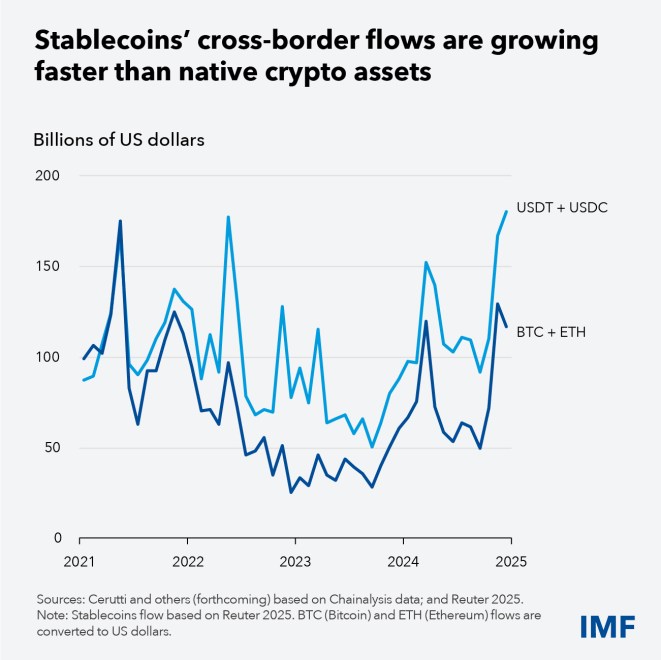













 Cloud Security solution, allows our customers to quickly identify potentially vulnerable workloads.