Reading view

There are new articles available, click to refresh the page.

Testing Early and Often Can Reduce Flaws in App Development

Security is too often an afterthought in the software development process. It’s easy to understand why: Application and software developers are tasked with getting rid of bugs and adding in new features in updates that must meet a grueling release schedule. 

Asking to include security testing before an update is deployed can bring up problems needing to be fixed. In an already tight timeline, that creates tension between developers and the security team. 

If you’re using traditional pentesting methods, the delays and disruption are too great to burden the development team, who are likely working a continuous integration and continuous delivery process (CI/CD). Or if you’re using an automatic scanner to detect potential vulnerabilities, you’re receiving a long list of low-level vulns that obscures the most critical issues to address first. 

Instead, continuous pentesting, or even scanning for a particular CVE, can harmonize development and security teams. And it’s increasingly important. A shocking 85% of commercial apps contain at least one critical vulnerability, according to a 2021 report, while 100% use open-source software, such as the now infamous Log4j. That’s not to knock on open-source software, but rather to say that a critical vulnerability can pop up at any time and it’s more likely to happen than not. 

If a critical vulnerability is found–or worse, exploited–the potential fines or settlement from a data breach could be astronomical. In the latest data breach settlement, T-Mobile agreed to pay $350 million to customers in a class action lawsuit and invest additional $150 million in their data security operations.

This is why many companies are hiring for development security operations (DevSecOps). The people in these roles work in concert with the development team to build a secure software development process into the existing deployment schedule. But with 700,000 infosec positions sitting open in the United States, it might be hard to find the right candidate. 

If you want to improve the security of your software and app development, here are some tips from Synack customers: 

  • Highlight only the most critical vulns to the dev team. The development team has time only to address what’s most important. Sorting through an endless list of vulns that might never be exploited won’t work. Synack delivers vulnerabilities that matter by incentivizing our researchers to focus on finding severe vulnerabilities.
  • Don’t shame, celebrate. Mistakes are inevitable. Instead of shaming or blaming the development team for a security flaw, cheer on the wins. Finding and fixing vulnerabilities before an update is released is a cause for celebration. Working together to protect the company’s reputation and your customers’ data is the shared goal. 
  • Embrace the pace. CI/CD isn’t going away and the key to deploying more secure apps and software is to find ways to work with developers. When vulns are found to be fixed, document the process for next time. And if there’s enough time, try testing for specific, relevant CVEs. Synack Red Team (SRT) members document their path to finding and exploiting vulnerabilities and can verify patches were implemented successfully. SRT security researchers can also test as narrow or broad a scope as you’d like with Synack’s testing offerings and catalog of specific checks, such as CVE and zero day checks.

Security is a vital component to all companies’ IT infrastructure, but it can’t stand in the way of the business. For more information about how Synack can help you integrate security checkpoints in your dev process, request a demo.

The post Testing Early and Often Can Reduce Flaws in App Development appeared first on Synack.

Overheard at the CISO Table: 4 Takeaways From Dinner Discussions

Wade Lance is the Field CISO for Synack. 

Picture this: You’re seated at a dinner table surrounded by a dozen security leaders. Appetizers are on the way, and the conversation starts to pick up. Your neighbor says something about the Russia-Ukraine conflict, while across the table, a few CISOs engage in a lively discussion about something they read in the Wall Street Journal. 

As field CISO for Synack, I’ve attended many such dinners with executives from a range of industries. The events offer a venue to speak frankly about security wins and challenges. Each CISO I’ve met on the road has brought unique perspectives on their most pressing cybersecurity concerns. Without naming any names, here are four themes I picked up on: 

Disaster readiness is urgently needed. To say Log4j was a wakeup call would be an understatement. Many CISOs were left scrambling to find on-demand expertise needed to respond to the open source vulnerability that seemed to be everywhere when it first appeared in the news last December. They lacked surge capacity to meet their cybersecurity needs at a critical time, as nation-state threats started exploiting Log4j before their own overworked teams could find and fix it.  One idea is to have a relationship with a Pentesting as a Service (PTaaS) partner so that surge capacity is immediately available in the same model that most organizations have with Incident Response partners.

Continuous penetration testing is great (on paper). Wouldn’t it be nice to have someone watching your back, ready to spring into action and find vulnerabilities at the drop of a hat? Sure, but is continuous pentesting really possible, let alone affordable? Getting to a place where top security researchers are constantly assessing their networks can seem like a mirage for organizations struggling to find cyber talent to fill 9-to-5 roles. But continuous development requires a new approach to security testing, so security leaders are looking at their options.

Auditors can be as motivating as malicious hackers. In 2022, it’s a truism that compliance does not equal security. CISOs understand that divide, but that doesn’t make it any easier to navigate. They need to keep auditors happy and keep hackers at bay if they want to stay off the front page of the Wall Street Journal as the next victim of a major hack. That means scaling security teams to juggle both shifting regulatory requirements and constantly evolving cyberthreats. Easier said than done.

Ditch the swag. OK, I’ll admit this one hurt a bit to hear. I love a YETI tumbler as much as the next security pro. But I also understand why CISOs–who know what’s at stake in our cyberthreat landscape–aren’t itching to wear branded socks or apply a Synack patch to their suits. This is a serious business!

By the time I steer the conversation back to Synack, I’ve heard fascinating and sometimes provocative viewpoints from the people on the front lines of security leadership. (At one dinner, I was flabbergasted when I heard an executive claim, “We’ve never had any breaches and don’t really consider ourselves a target.”) 

Here’s what Synack brings to the table:

  • Surge capacity. For the Log4js of the world, our global Synack Red Team of 1,500+ elite security researchers stands ready to bridge the cyber talent gap, augmenting your own organization’s infosec capabilities when major vulnerabilities drop. But this relationship needs to be in place before the next new vulnerability is discovered to engage researchers immediately, instead of waiting to get through the onboarding process with a new vendor.
  • Diverse perspectives. Synack Red Team members hail from over 80 countries and bring a depth of knowledge that can’t be replicated by in-house pentesters. Your diverse security needs call for diverse answers that just aren’t available from smaller, local teams.
  • Continuous and on-demand pentesting. Our Synack Platform is a one-stop shop where you can harness the talent of our Synack Red Team to find and remediate vulnerabilities that matter, generate clear, actionable reports, check off security tasks to assist with compliance and scale up tests as needed to keep up with your software development process. 

To find out more, you can contact us to schedule a demo here. Or maybe I’ll catch you around the dinner table on my next trip!

The post Overheard at the CISO Table: 4 Takeaways From Dinner Discussions appeared first on Synack.

Synack Triaging Prioritizes the Vulnerabilities that Matter

By: Synack

Putting the Most Critical Vulnerabilities First

Vulnerability testing, whether via an automatic scanning program or human-based penetration testing, can find an overwhelming number of vulnerabilities in your system as recent trends would suggest. Since 2017, record numbers of Common Vulnerabilities and Exposures (CVEs) have been reported, with 2022 on track to set a new high. 

Sorting through a record number of vulnerabilities to keep your organization secure is a daunting task without additional support and distillation.

The good news is that of all the vulnerabilities that might show up on a traditional vulnerability report, only around 5% of vulnerabilities discovered are ever exploited in the wild. And most of the exploited vulnerabilities are those with the highest CVSS (Common Vulnerability Scoring System) severity score of 9 or 10. 

So how do you know which vulnerabilities in your system need to be addressed right now, and which can be put on the back burner? Some vulnerabilities are an immediate risk to the business, while others are highly unlikely to be exploited. Prioritizing critical vulnerabilities can mean the difference between preventing an attack and responding to one.

Finding and triaging critical vulnerabilities is where Synack’s pentesting outperforms traditional models. We continuously prioritize impactful vulns for your organization, surfacing only vulnerabilities that are reproducible and show exploitability.  

The Synack Difference—The Vulnerability Operations Team

The Synack Platform is the only solution to harness the best in augmented intelligence for more effective, continuous pentesting. First, the Synack Red Team (SRT), a group of vetted researchers, conducts open vulnerability discovery, while our automated SmartScan provides broad attack surface coverage. Together, they find vulnerabilities across your attack surface.

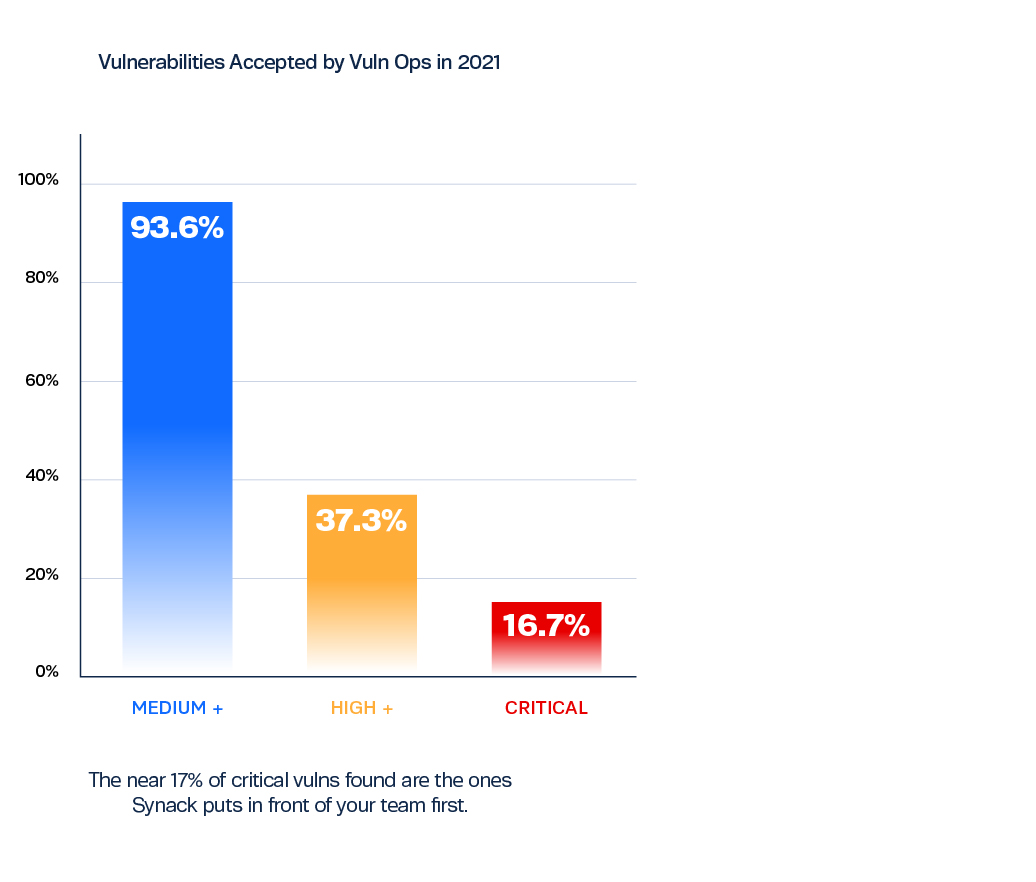
Next, the Synack Vulnerability Operations team assesses vulnerabilities found by the SRT and SmartScan by using a rigorous vetting process. Noise, such as duplicate submissions by SRT or non-replicable exploits, low-impact vulns, is kept to a minimum during penetration testing and you’re ultimately served vulnerabilities that present a clear risk.

This additional step to triaging is key to faster remediation and minimizing business risk. 

The Vulnerability Operations team is a group of seasoned security professionals with hacking expertise. They are full-time Synack employees with extensive vulnerability knowledge–they’ve seen tens of thousands of them. For the most accurate triaging, high impact vulnerabilities are often reviewed by multiple team members. So, when you get a vulnerability report from Synack, you know that it matters.

Remediating Exploitable Vulnerabilities with True Business Impact

The Vulnerability Ops team works alongside the SRT 365 days a year to bring order to the thousands of CVEs. When the team receives an initial vulnerability report, they will first validate the vulnerability by replicating it based on details provided in the report. When the vulnerability is confirmed, the Ops team proofreads and formats the report for utility and readability by a development team. Everything needed to reproduce the vulnerability is provided in each report.

After vulnerabilities are deemed exploitable and impactful, and the report has been detailed with steps to reproduce and suggestions on remediation, it will be published to the Synack Platform.

From there, the Synack Platform provides real-time findings on vulnerabilities found–their CVSS score, steps to remediate and evidence of the researcher’s finding. With this information you can address the vulnerabilities that are most important to your organization in a systematic and thorough manner.

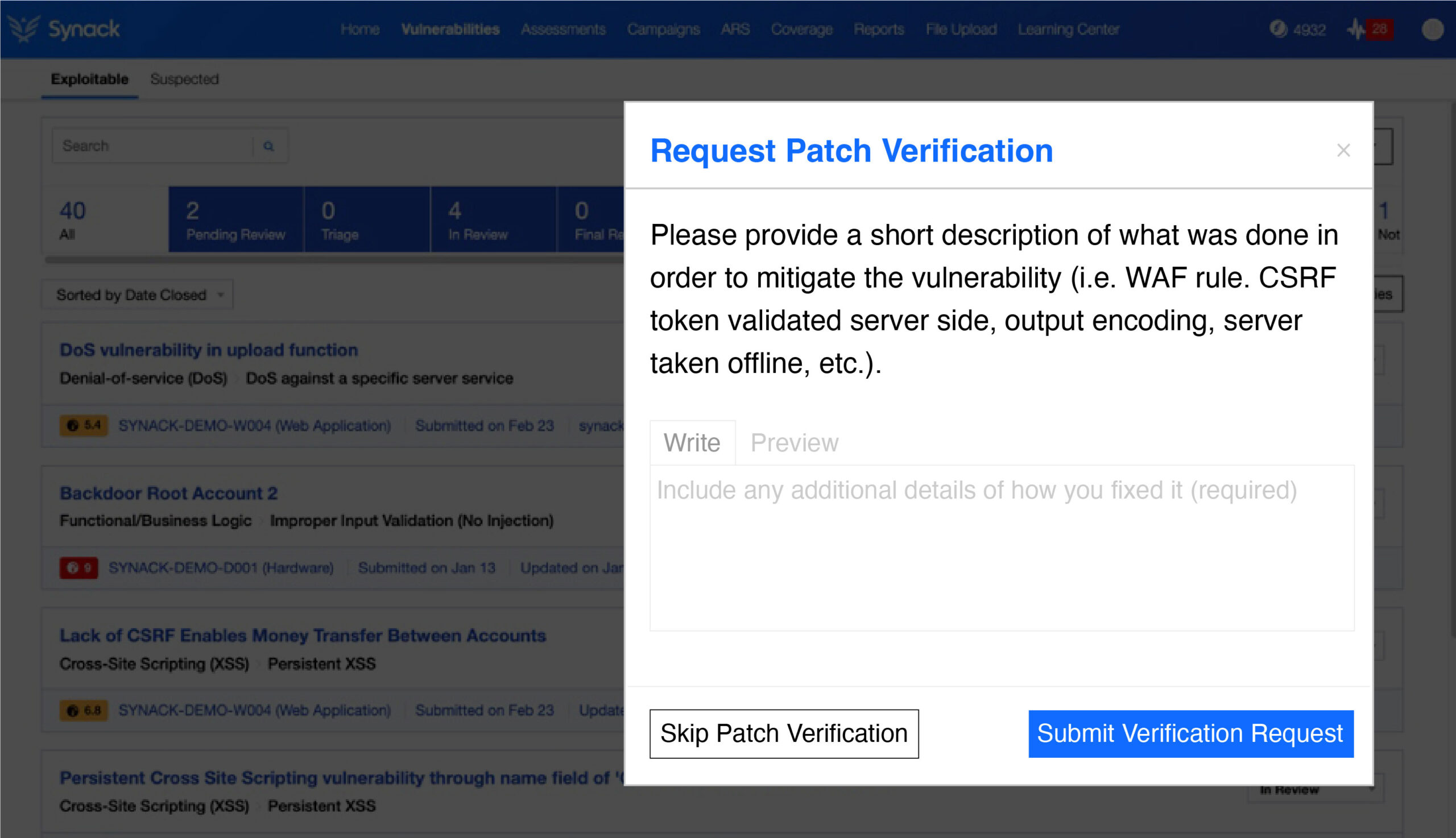
Through the Synack Platform, teams are also able to check if their remediation efforts were successful with Patch Verification. Patch Verification can be requested on-demand, and the researcher will provide further communications on the patch efficacy.

The Synack Platform facilitates delivery of vulnerabilities and
actions like submitting patch verification requests.


2021 Vulnerability Highlights

The six most popular types of vulnerabilities delivered to organizations were:

  • Cross-site Request Forgery (XSRF)
  • Authentication Permission
  • Information Disclosure
  • SQL Injection (SQLi)
  • Functional Business Logic
  • Authentication Session

Making the Most of Vulnerability Testing

Most organizations don’t have the resources to go chasing every vulnerability reported from initial testing. To further safeguard your organization, someone needs to determine which are true vulnerabilities and which of those are exploitable and at what level of criticality. That process is noise reduction, and it is essential for any cybersecurity operation to shoot for the highest level of noise reduction before proceeding to remediation. Synack, through the Vulnerability Operations, team can take on this task for you. 

Using Synack’s unique approach to continuous pentesting, your team will be able to proceed with confidence that their remediation efforts are critical to keeping the organization secure. Get started with Synack penetration testing today.

The post Synack Triaging Prioritizes the Vulnerabilities that Matter appeared first on Synack.

Get Ahead of Vulnerabilities With Proactive ASVS Benchmark Pentesting

By: Synack

Start With Pentesting to Harden Your Site Against Cyberattacks

Cybersecurity for web apps has never been more important than it is today. Websites and online applications are under constant attack by people and groups looking to penetrate systems to cause damage or steal vital information. And it’s not just criminals and mischief-makers; government-sponsored attackers are at work as well. Consider these cybersecurity statistics compiled by Patchstack:

  • A 2019 report found that security breaches had increased by 67% over the last five years.
  • 73% of black hat hackers said traditional firewall and antivirus security is irrelevant or obsolete.
  • A 2019 study found that hackers could attack users in 9 out of 10 web applications they analyzed.
  • Another 2019 study found that 46% of web applications have critical vulnerabilities, and a whopping 87% had “medium” security vulnerabilities.

 Even more, telling is a 2019 report that found that 47% of all hacked websites contained at least one backdoor, allowing hackers access to the website.  And the costs associated with data breaches continue to climb. The average cost of a data breach among companies surveyed in a 2021 IBM report reached $4.24 million per incident, the highest in 17 years.

 Security personnel has a number of tools at their disposal to thwart cyberattacks. One of the most valuable is pentesting — checking for vulnerabilities that could give a hacker access to the system. But although not as reactive as remediating a breach that has already occurred, traditional pentesting is still somewhat reactive in nature. You’re being proactive in checking for vulnerabilities that could potentially be used by an attacker, but the vulnerabilities already exist. It’s like calling in a plumber to check for leaks in your pipes that could potentially cause water damage. The leaks are expected to already be there and be found, just as the vulnerabilities are in a pentest. So, although a valuable tool, pentesting only takes you part of the way to a truly security-hardened organization. 

How ASVS Benchmarks Go Beyond Pentesting

What you need is a way to check your security posture for conditions that might lead to a future vulnerability and remediate those issues as well. Only then can you consider your site truly security-hardened. It’s like that plumber fixing all the leaks in your pipes, then going back and making a systematic check of your pipes for conditions that could lead to a leak, such as rusting, pipes located in places where they are likely to freeze or improperly connected pipes. 

ASVS provides for this by listing security conditions analogous to those that might lead to leaky pipes. This is how ASVS benchmarks enable proactive security.

Enhance Your Security Posture Further With ASVS Benchmark Tests

The Application Security Verification Standard (ASVS) was developed by the Open Web Application Security Project (OWASP) to help organizations examine the state of their cybersecurity. The primary aim of the ASVS Project was to normalize the range in the coverage and level of rigor available in the market when it comes to performing Web application security verification using a commercially-workable open standard. The standard provides a basis for testing application technical security controls and technical security controls in the environment that protect against vulnerabilities such as Cross-Site Scripting (XSS) and SQL injection.

The ASVS benchmark provides a compilation of security controls that are expected to be in place in a well-secured application. It also provides developers with a list of requirements for secure development. The ASVS does not provide a framework to check for vulnerabilities. Rather, it provides a framework to check for controls that prevent, and conditions that could lead to, exploitable vulnerabilities. Synack recommends performing ASVS benchmark testing as part of an ongoing security process for maximum cybersecurity.

OWASP lists the following as objectives achieved by ASVS:

  • Use as a metric — Provide application developers and application owners with a yardstick with which to assess the degree of trust that can be placed in their Web applications
  • Use as guidance — Provide guidance to security control developers as to what to build into security controls in order to satisfy application security requirements
  • Use during procurement — Provide a basis for specifying application security verification requirements in contracts.

When to Run ASVS Benchmark Tests

The ASVS framework is best suited for organizations that are relatively mature in their security posture. Since the tests don’t actually check for vulnerabilities, it is most appropriate to run ASVS tests after you have examined your system for existing vulnerabilities and remediated them through continuous and effective penetration testing. Once existing vulnerabilities have been discovered and remediated or resolved, then it is time to check your security controls for best practice implementations. Running the ASVS benchmark can then help the organization create a better defense in depth posture. 

Proactive Vulnerability Testing With Synack’s ASVS Benchmark Product

There are three levels of ASVS benchmarks available in the Synack Catalog – Basic, Standard, and Advanced.  You choose the Synack ASVS Campaign to run based on the level that is appropriate for the organization. Across levels, an ASVS Campaign can ensure that an application follows best practices to protect user data and prevent exploitation by adversaries. An ASVS Campaign does this while respecting the appropriate level of security for an application, one that thoroughly protects the application, while not hampering user experience or business needs.

This process to engage Synack to prevent vulnerabilities before they occur is unique. Testing the ASVS framework lets us look for and proactively address the systemic issues that let the vulnerabilities come to an exploitable state and unlock the door for an attacker. 

With an ASVS benchmark test, you will receive a detailed report from a researcher on the Synack Red Team, our community of global ethical hackers, regarding their findings on the security posture of your assets. Their mission is to evaluate your assets relative to the ASVS framework. The goal of this assessment is to determine if your security controls are adequate for the application use case your organization has.

This report can offer guidance on where efforts would be best applied to further harden and future-proof assets. It can also be used to show a year-over-year improvement in the asset hardness, and can help quantify the effectiveness with both the ASVS metrics and a reduction in vulnerability findings. Long-term, the ASVS campaign can help support a multi-year effort to reduce the attack surface and improve the controls in assets against flaws.

Complete an ASVS Assessment With Synack ASVS Campaigns for Maximum Security Posture

Completing an ASVS assessment for your organization is easy with Synack Campaigns.  The ASVS campaigns are listed in the Security Benchmark section of the Catalog. Once credits are purchased, you can activate your campaign on-demand any time in the Synack Platform.  

Synack researchers complete the missions specified by the ASVS benchmark tests. After completing them, your team can leverage Synack’s Custom Report feature for audit-ready reports that will provide you with a view of security issues discovered by our testing.

When you are comfortable that pentesting and resulting remediation has moved your site to a sufficiently secure security posture, evidenced by pentesting not finding a significant number of new vulnerabilities, then you can move on to running the Synack ASVS Campaign. After completing the ASVS Campaign and remediating any discovered issues, it’s time to set up a plan for periodic testing going forward. Then you can be assured that you have applied the most comprehensive security testing to protect your assets.

Learn What Synack ASVS Benchmarks Can do for You

To learn more about Synack ASVS Campaigns and how it can expose conditions that could lead to exploitable vulnerabilities, contact Synack at sales@synack.com.

The post Get Ahead of Vulnerabilities With Proactive ASVS Benchmark Pentesting appeared first on Synack.

How Synack Helps Organizations Comply with Directive 22-01

By: Synack

Government cybersecurity leaders know all too well that traditional pentesting is complex and doesn’t scale. The need to quickly resource up in order to effectively identify, triage and remediate vulnerabilities has become increasingly critical and, for most, a compliance requirement. 

Synack empowers government agencies with on-demand, continuous pentesting, pairing the platform’s vulnerability management and reporting capabilities with a diverse community of vetted and trusted researchers to find the vulnerabilities that matter. 

Synack also helps government security teams achieve the most effective vulnerability management possible to satisfy Binding Operational Directive (BOD) 22-01’s identification, evaluation and mitigation/remediation steps. The Synack approach also facilitates detailed vulnerability reporting that the agency can easily hand off to CISA if desired. 

Let’s quickly review what BOD 22-01 mandates, and how federal agencies can achieve compliance with help from Synack. 

CISA Binding Operational Directive 22-01—Reducing the Significant Risk of Known Exploited Vulnerabilities

Recent data breaches, most notably the 2020 cyber attack by Russian hackers that penetrated multiple U.S. government systems, have prompted the federal government to improve its efforts to protect the computer systems in its agencies and in third-party providers doing business with the government. As part of the process to improve the security of government systems, the Cybersecurity and Infrastructure Security Agency (CISA) issued Binding Operational Directive 22-01. 

CISA Directive 22-01 directs federal agencies and contractors to what they are required to do regarding the detection of and remediation for known exploitable vulnerabilities. The scope of this directive includes all software and hardware found on federal information systems managed on agency premises or hosted by third parties on the agency’s behalf. Required actions apply to any federal information system, including an information system used or operated by another entity on behalf of an agency, that collects, processes, stores, transmits, disseminates, or otherwise maintains agency information.

Directive 22-01 Compliance Requirements

In addition to establishing a catalog of known exploited vulnerabilities, Directive 22-01 establishes requirements for agencies to remediate these vulnerabilities. Required actions include: 

  • Establishment of 1) a process for ongoing remediation of vulnerabilities and 2) internal validation and enforcement procedures
  • Setting up of internal tracking and reporting
  • Remediation of each vulnerability within specified timelines
  • Reporting on vulnerability status to CISA

CISA’s Cybersecurity Incident & Vulnerability Response Playbooks describe a standard program for vulnerability management. The program steps are identification, evaluation, remediation and reporting.

  1. Identify reports on vulnerabilities that are actively exploited in the wild.
  2. Evaluate the system to determine if the vulnerability exists in the system, and if it does, how critical it is. If the vulnerability exists, determine if it has been exploited by said system.
  3. Mitigate and Remediate all exploited vulnerabilities in a timely manner. Mitigation refers to the steps the organization takes to stop a vulnerability from being exploited (e.g. taking systems offline, etc.) and Remediation refers to the steps taken to fix or remove the vulnerability (e.g. patch the system, etc.).
  4. Report to CISA. Reporting how vulnerabilities are being exploited can help the government understand which vulnerabilities are most critical to fix.

Evaluating Vulnerabilities with Synack

Synack finds exploitable vulnerabilities for customers through its unique blend of the best ethical hackers in the world, specialized researchers, a managed VDP, and the integration of its SmartScan product. SmartScan uses a combination of the latest tools, tactics and procedures to continuously scan your environment and watch for changes. It identifies potential vulnerabilities and engages the Synack Red Team (SRT) and Synack Operations to review suspected vulnerabilities. The SRT is a private and diverse community of vetted and trusted security researchers, bringing human ingenuity to the table and pairing it with the scalability of an automated vulnerability intelligence platform. 

If a suspected vulnerability is confirmed as exploitable, the SRT generates a detailed vulnerability report, with steps to reproduce and fix the vulnerability. Vulnerabilities are then triaged so that only actionable, exploitable vulnerabilities are presented – with severity information and priority information.

Mitigating and Remediating Vulnerabilities with Synack

Once the Synack team of researchers has verified the exploitability of the vulnerability, it leverages its expertise in understanding your applications and infrastructure. From that point, and in many cases, the SRT is able to recommend a fix with accompanying remediation guidance for addressing the vulnerability. And Synack goes one step further, verifying that the remediation, mitigation, or patch was implemented correctly and is effective.

Reporting to CISA

Synack’s detailed vulnerability reporting and analytics offer insight and coverage into the penetration testing process with clear metrics that convey vulnerability remediation and improved security posture. 

Comply with CISA Directive 22-01 with Help from Synack

CISA continues to add exploited vulnerabilities to its Known Exploited Vulnerabilities Catalog, and federal agencies are expecting urgent CVEs to pop up in the not-too-distant future. The recent rush to address the log4j vulnerability will come to mind for many. The Synack Red Team can aid organizations by rapidly responding to such situations.

To secure your agency’s attack surface and comply with the CISA Directive 22-01, a strong vulnerability management strategy is essential. The Synack solution combines the human ingenuity of the Synack Red Team (SRT) with Disclose (the Synack-managed VDP), along with the scalable nature of SmartScan, to continuously identify and triage exploitable vulnerabilities across web applications, mobile applications, and host-based infrastructure. Synack takes an adversarial approach to exploitation intelligence to show the enterprise where their most business-critical vulnerabilities are and how those vulnerabilities can be exploited by adversaries.


The post How Synack Helps Organizations Comply with Directive 22-01 appeared first on Synack.

❌