Reading view

There are new articles available, click to refresh the page.

Tether Debate Heats Up As Former Bank Analyst Refutes Hayes’ Claims

Arthur Hayes, the BitMEX co-founder, warned late last month that Tether’s shift into Bitcoin and gold could leave the stablecoin exposed if those assets tumble.

According to Hayes, a roughly 30% drop in Tether’s BTC and gold holdings could erase the company’s equity and leave USDT vulnerable.

His comments touched off fresh debate about how much of the company’s true financial strength is visible to the market.

The Tether folks are in the early innings of running a massive interest rate trade. How I read this audit is they think the Fed will cut rates which crushes their interest income. In response, they are buying gold and $BTC that should in theory moon as the price of money falls.… pic.twitter.com/ZGhQRP4SVF

— Arthur Hayes (@CryptoHayes) November 29, 2025

Tether Is Far Stronger Than It Looks: Former Citi Analyst

A former Citi research lead, who goes by the name “Joseph”, pushed back on Hayes’s scenario. Based on reports, Joseph said public attestations only show the assets that directly back outstanding USDT and do not capture the full corporate balance sheet.

I spent 100’s of hours writing research on tether for @Citi. @CryptoHayes missed a few key points.

1) 𝐓𝐡𝐞𝐢𝐫 𝐝𝐢𝐬𝐜𝐥𝐨𝐬𝐞𝐝 𝐚𝐬𝐬𝐞𝐭𝐬 =/ 𝐚𝐥𝐥 𝐜𝐨𝐫𝐩𝐨𝐫𝐚𝐭𝐞 𝐚𝐬𝐬𝐞𝐭𝐬

When tether generates $ they have a separate equity balance sheet which they don’t… https://t.co/pHSRr245Up

— Joseph (@JosephA140) November 30, 2025

He told reporters he spent hundreds of hours reviewing filings and market data and estimates Tether’s total equity could be in the $50–$100 billion range — a cushion much larger than what critics point to when they focus on attested reserves.

Reported Buffers

According to Joseph’s calculations, Tether holds about $120 billion in US Treasuries that are earning roughly 4%, which he says could generate about $10 billion a year in net income.

He also cited other corporate assets that are not part of public reserve snapshots — equity stakes, mining operations, and additional Bitcoin holdings — all of which, he argues, strengthen Tether’s overall capital position.

Paolo Ardoino, Tether’s CEO, has publicly cited roughly $30 billion in “group equity” as part of the firm’s buffer against shocks.

re: Tether FUD

From latest attestation announcement (Q3 2025):

“Tether will continue to maintain a multi-billion-dollar excess reserve buffer and an overall proprietary Group equity approaching $30 billion.”

Tether had (at end of Q3 2025) ~7B in excess equity (on top of the…

— Paolo Ardoino 🤖 (@paoloardoino) November 30, 2025

Hayes’s Warning And The Transparency Question

Hayes’s point, however, rests on a simple math worry: volatile assets can move fast, and marked declines would reduce the value of reserves.

He framed Tether’s move into Bitcoin and gold as a macro hedge against expected rate cuts, but said that hedge could backfire under a sharp sell-off.

Reports have noted that because attestations focus on backing for USDT supply, they may not reveal how much of the company’s other assets would be available in a crisis — a gap that keeps some investors uneasy.

What The Debate Means For Markets

The clash highlights two facts. One: there are sizable numbers involved — $120 billion in Treasuries, a roughly $30 billion equity figure cited by management, and the $50–$100 billion range estimated by Joseph.

Two: the core issue is disclosure. If Tether’s broader holdings can be marshalled quickly in a stress event, the company may handle big swings. If not, volatility could create trouble for short-term liquidity even if long-term equity is large.

Featured image from Pexels, chart from TradingView

Would A 30% Bitcoin Price Crash Be Devastating For Tether’s USDT? Here’s The Truth

Tether, the issuer of USDT, has long been considered one of the most stable assets in the crypto market, but a recent report suggests that a crash in the Bitcoin price could jeopardize the stablecoin’s solvency. Arthur Hayes, co-founder and CIO of BitMEX, has revealed that a portion of USDT’s reserves is allocated to BTC, potentially exposing it to heightened market volatility. 

Bitcoin Price Crash To Threaten Tether USDT Stability 

In a recent report shared on X earlier this week, Hayes outlined market risks that could have a devastating impact on Tether’s USDT. The BitMEX founder explained that the stablecoin issuer has been executing a large-scale interest rate trade, likely betting on a Federal Reserve (FED) rate cut

He stated that the stablecoin issuer has accumulated significant positions in Bitcoin and gold to hedge against falling interest income. As a result, Hayes has warned that if Tether’s positions in both gold and Bitcoin were to decline by roughly 30%, it could wipe out its entire equity, theoretically putting USDT at risk of insolvency

Since stablecoins are typically backed by the US dollar, the crypto founder has stated that a severe drop in Tether’s reserve value could trigger panic amongst USDT holders and crypto exchanges. In such a scenario, they might demand immediate insight into the stablecoin issuer’s balance sheet to gauge solvency risk. Hayes has also suggested that the mainstream media could further amplify the concerns, creating widespread market alarm.  

Analyst Fires Back Against Hayes’ USDT Claims

Following Hayes’ statements on X, Tether’s USDT has come under scrutiny, with crypto analysts debating the resilience of its reserves. A former Citi Research lead, Joseph Ayoub, challenged Hayes’ claims, arguing that even if Bitcoin and gold prices were to crash 30%, a USDT insolvency remains highly unlikely. 

He highlighted that the BitMEX co-founder had missed three key points in his post. Ayoub noted that Tether’s publicly disclosed assets do not represent the entirety of its corporate holdings. According to him, when Tether issues USDT, it maintains a separate equity balance sheet that is not publicly reported. The reserve numbers that are eventually disclosed are intended to show how USDT is backed. At the same time, the company maintains a balance sheet for equity investments, mining operations, corporate reserves, possibly more Bitcoin, and the rest distributed as dividends to shareholders.

Ayoub also described Tether’s core operations as highly profitable and efficient. He stated that the company holds over $100 billion in interest-yielding treasuries, generating roughly $10 billion in liquid profit annually while operating a relatively small team. The former Citi research lead estimated that the stablecoin issuer’s equity is likely valued at between $50 billion and $100 billion, providing it with a substantial cushion against losses in its crypto and gold holdings

Finally, Ayoub disclosed that Tether operates like traditional banks, maintaining only 5-10% of deposits in liquid assets, while the remaining 85% are held in longer-term investments. He also noted that the stablecoin issuer is significantly better collateralized than banks, adding that with their ability to print money, bankruptcy is virtually impossible.

Bitcoin

Tether Makes Bold Reserve Pivot Toward Bitcoin And Gold As Treasury Holdings Decline

In a strategic move, Tether has shifted its reserve strategy, reducing its exposure to treasuries while increasing allocations to Bitcoin and gold. The USDT issuer has shown a notable reduction in government debt exposure, paired with an expanded position in hard assets known for durability and independence from traditional financial systems. 

Treasury Exposure Drops Amid Changing Macro And Regulatory Landscape

Stablecoin giant, Tether, has reduced its US Treasury holdings and increased its Gold and Bitcoin reserves. CryptosRus reported on X that Tether is quietly repositioning itself for what the company expects to be the Federal Reserve’s (FED) next round of rate cuts.

Related Reading: Rumble At The Core: How Tether Plans To Dominate The US Stablecoin Market

According to BitMex founder Arthur Hayes, Tether’s latest reserve update shows a clear shift away from the US treasuries and deeper into BTC and gold, a sign that the company is positioning for a changing macro environment. Furthermore, the Standard & Poor (S&P) Global noted that Tether is now leaning more heavily into assets with larger price swings in value, warning that this mix could expose USDT if markets turn volatile. Meanwhile, the current S&P Global rating on Tether remains weak.

Bitcoin

Thus, Tether CEO Paolo Ardoino has pushed back, saying that the company holds no toxic assets. He claims that its rapid growth reflects a broader shift towards new financial systems that operate outside the traditional banking world.

Why Attempts To Break Tether Are Difficult In Practice

Crypto analyst Ted Pillows has also offered insight into the Tether Fear Uncertainty and Doubt (FUD) as it is making its usual rounds again. The narrative is latching onto the company’s latest attestation, showing a notable shift into Gold and Bitcoin to offset declining interest income. Meanwhile, if these risk assets drop by 30%, Tether’s equity buffer could evaporate, creating an environment where Tether will be insolvent, and panic will kick in.

Related Reading: Tether Targets $500 Billion Valuation In New Equity Offering Amid US Expansion Plans

However, Ted is steadfast and believes that Tether has been through a decade of this same FUD, and USDT is still sitting at $1.00. They’re fully liquid, but they operate on a fractional-reserve model, much like traditional banks. As long as redemptions remain normal, everything will work smoothly. A problem will only arise if there’s an irrational panic, and then liquidity stress could hit quickly. 

According to Ted, the USDT isn’t fully backed by cash, but it’s backed by a diverse portfolio that includes the US treasuries, yield-generating assets, and some risk assets. This is all scaled to a massive $174 billion stablecoin. “If someone wants to kill USDT, it’s possible, but I highly doubt it,” Ted noted.

Bitcoin

BitMEX Founder Warns Tether’s Bitcoin Bet Could Trigger USDT Collapse

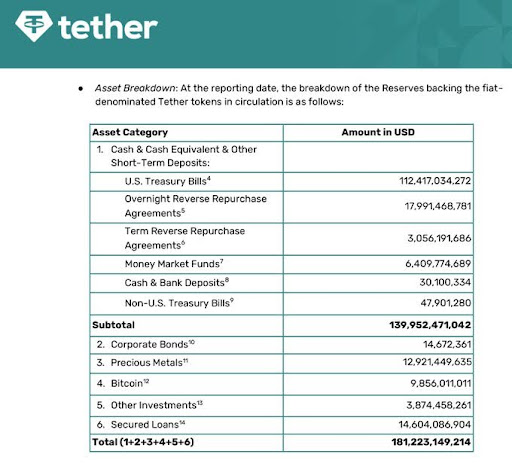
Tether’s latest Q3 2025 attestation reveals the stablecoin giant now holds approximately $22.8 billion in gold and Bitcoin, a diversification strategy that BitMEX founder Arthur Hayes warns could trigger USDT’s collapse.

CEO Paolo Ardoino announced the company maintains “a multi-billion-dollar excess reserve buffer and an overall proprietary Group equity approaching $30 billion,” but Hayes argues this diversification masks dangerous exposure to volatile assets.

Hayes contends Tether is positioning for Federal Reserve rate cuts that would crush their Treasury income.

The Tether folks are in the early innings of running a massive interest rate trade. How I read this audit is they think the Fed will cut rates which crushes their interest income. In response, they are buying gold and $BTC that should in theory moon as the price of money falls.… pic.twitter.com/ZGhQRP4SVF

— Arthur Hayes (@CryptoHayes) November 29, 2025

“The Tether folks are in the early innings of running a massive interest rate trade,” Hayes wrote, adding that “a roughly 30% decline in the gold + BTC position would wipe out their equity, and then USDT would be in theory insolvent.

Analyst Paul Barron noted that for every 25 basis point Fed decrease, USDT’s annual interest income drops approximately $318 million based on its $127 billion Treasury exposure.

Tether CEO Fires Back with Detailed Financial Disclosures

In a recent X Post, Ardoino swiftly countered Hayes’s insolvency claims with comprehensive data.

“Tether had (at end of Q3 2025) ~7B in excess equity (on top of the ~184.5B stablecoin reserves) + another ~23B in retained earnings as part of our Tether Group equity,” the CEO explained.

re: Tether FUD

From latest attestation announcement (Q3 2025):

"Tether will continue to maintain a multi-billion-dollar excess reserve buffer and an overall proprietary Group equity approaching $30 billion."

Tether had (at end of Q3 2025) ~7B in excess equity (on top of the…

— Paolo Ardoino 🤖 (@paoloardoino) November 30, 2025

Tether Group’s total assets reach approximately $215 billion against $184.5 billion in stablecoin liabilities, with gold and Bitcoin representing just 12.6% of reserves.

The CEO accused critics of deliberately misrepresenting Tether’s position.

“S&P made the same mistake of not considering the additional Group Equity nor the ~500M in monthly base profits generated by U.S Treasury yields alone,” Ardoino stated, suggesting “some influencers are either bad at math or have the incentive to push our competitors.

His defense comes after S&P Global downgraded USDT’s peg-stability rating from 4 to 5 on November 26, citing increased exposure to high-risk assets and persistent gaps in disclosure.

Industry Veterans Dismantle Tether’s Insolvency Claims

Joseph Ayoub, former head of digital asset research at Citi, noted that Tether’s disclosed assets don’t represent all corporate holdings.

“Their disclosed assets =/ all corporate assets,” he explained, noting Tether maintains a separate equity balance sheet comprising mining operations and corporate reserves that aren’t publicly reported.

I spent 100’s of hours writing research on tether for @Citi. @CryptoHayes missed a few key points.

1) 𝐓𝐡𝐞𝐢𝐫 𝐝𝐢𝐬𝐜𝐥𝐨𝐬𝐞𝐝 𝐚𝐬𝐬𝐞𝐭𝐬 =/ 𝐚𝐥𝐥 𝐜𝐨𝐫𝐩𝐨𝐫𝐚𝐭𝐞 𝐚𝐬𝐬𝐞𝐭𝐬

When tether generates $ they have a separate equity balance sheet which they don’t… https://t.co/pHSRr245Up

— Joseph (@JosephA140) November 30, 2025

With roughly $120 billion in interest-yielding Treasuries generating approximately 4% returns since 2023, Tether produces around $10 billion in liquid profit annually with just 150 employees.

Ayoub noted that banks operate on significantly lower fractional reserves of 5-15% in liquid assets compared to Tether’s overcollateralized structure.

His conclusion, “Tether isn’t going insolvent, quite the opposite; they own a money printing machine.

S&P Downgrade Sparks Fierce Industry Backlash

Ardoino responded defiantly to S&P’s rating action and recurrent criticism of Tether’s operational model.

“We wear your loathing with pride,” the CEO declared, positioning Tether as “the first overcapitalized company in the financial industry, with no toxic reserves” that proves “the traditional financial system is so broken that it’s becoming feared by the emperors with no clothes.”

He challenged banks to publish their reserve ratios, suggesting they likely consist of “3 olives and a half chewed gum.

Rumble CEO Chris Pavlovski added that “The S&P only attacks Tether, because Tether is challenging and beating the old financial guard at their own game.

The S&P only attacks Tether, because Tether is challenging and beating the old financial guard at their own game.

These old corporate entities cannot handle companies like Tether & Rumble taking their market share — their only recourse is to attack us because they’re losing. https://t.co/UUbaYpXAUq

— Chris Pavlovski 🏴‍☠️ (@chrispavlovski) November 26, 2025

The attacks surprised many, considering USDT maintained its peg through the 2018 crash, 2022 Terra/Luna collapse, and 2023 banking crisis.

Yet the downgrade carries serious implications.

With a “5” rating and MiCA regulations prohibiting USDT from EU exchanges, no major institutional fund can legally hold the stablecoin.

This could favor competitors like Circle’s USDC, PayPal’s PYUSD, or tokenized fiat alternatives, potentially shifting liquidity away from a company that generated more net profit than BlackRock last year and is tipped to surpass Saudi Aramco in profitability.

The post BitMEX Founder Warns Tether’s Bitcoin Bet Could Trigger USDT Collapse appeared first on Cryptonews.

Tether Pauses Bitcoin Purchases: World’s Largest Gold Buyer In Q3 With Over 120 Tons In Reserves

Tether, the issuer of the world’s most widely used stablecoin, USDT, has evolved over the years into one of the most profitable and resilient firms within the crypto space. 

Under the leadership of CEO Paolo Ardoino, Tether has broadened its focus beyond digital assets, becoming a significant player in the commodity market, particularly with substantial gold reserves.

Tether’s Gold Ambition

Recent reports from the Financial Times reveal that Tether has stirred the gold markets this year by becoming the largest holder of the precious metal outside of central banks. 

According to Bryce Elder’s analysis, the crypto firm’s stockpile is comparable to that of smaller central banks, such as those in Korea, Hungary, and Greece. Last quarter, the company’s gold acquisitions accounted for nearly 2% of total gold demand, equating to almost 12% of central bank purchases.

Sources indicate that Tether’s investments in gold reflect the belief among its insiders that the commodity serves as “a superior store of value” and a “better hedge against inflation” compared to digital currencies. 

Although Tether has significant holdings in Bitcoin, its investment in gold has surpassed its exposure to the leading cryptocurrency. Throughout the year, Tether purchased 26 tons of gold, bringing its total gold stockpile to over 116 tons. 

However, Tether’s ambitions in the gold sector extend beyond mere accumulation; the firm is actively pursuing deals related to gold royalty companies, which finance mining operations in exchange for a percentage of future revenues.

Plans To Dominate The Gold Royalty Space

In June, Tether Investments—responsible for managing the company’s profits—acquired a minority stake in Toronto-listed Elemental Altus for $105 million. An additional $100 million was invested in September amid Elemental’s merger with rival EMX, resulting in Tether holding a controlling stake in the company. 

Insiders suggest that the crypto giant has broader plans, aiming to consolidate small to mid-cap gold royalty firms to strengthen its position in the market. “Their goal is to keep consolidating the small to mid-cap gold royalty space,” said an insider familiar with Tether’s strategy. 

However, while some view this approach as savvy, others are skeptical, with one commodity industry executive labeling Tether as “the weirdest company I have ever dealt with.”

Gold royalties offer the company a unique advantage over traditional bullion; they provide fixed exposure to gold, insulating the stablecoin issuer from fluctuations in gold prices. Yet, amid these ventures, Tether has faced scrutiny regarding its financials. 

NewsBTC reported on Wednesday that S&P Global downgraded Tether’s assets to its lowest rating, “weak,” citing concerns over the firm’s rising exposure to high-risk reserve assets, which could undermine the collateral backing its stablecoin during a financial crisis.

According to a research note from S&P Global, this downgrade was part of a new assessment system introduced in 2023, which classifies stablecoins on a scale from 1 to 5 based on risk. 

The firm’s USDT stablecoin received a rating of “5 (weak),” reflecting a decline from its previous score of “4 (constrained).” Analysts expressed concerns regarding Tether’s limited transparency concerning the creditworthiness of its custodians and counterparties.

In response to the downgrade, the firm’s CEO, Paolo Ardoino, took to social media platform X (formerly Twitter) to address the concerns, stating, “We wear your loathing with pride.” 

He contended that traditional credit rating methodologies used by agencies like S&P stem from “outdated systems that have proven unreliable,” leading to renewed regulatory scrutiny of these legacy models.

Tether

Featured image from DALL-E, chart from TradingView.com 

Tether Is Buying Bitcoin’s Revolution, How Devastating Will The Consequences Be?

Bitcoin Magazine

Tether Is Buying Bitcoin’s Revolution, How Devastating Will The Consequences Be?

At a Glance

  • The GENIUS Act in the U.S. gave private stablecoin issuers a legal framework while stalling a government issued CBDC.
  • Tether, issuer of USDT, earned record profits and became one of the largest private holders of U.S. Treasuries.
  • The company’s cooperation with regulators and law-enforcement shows how stablecoins function as compliance rails, not as alternatives to them.
  • Many Bitcoin advocates now align with Tether’s ecosystem, unintentionally helping extend the fiat system they claim to resist.

Bitcoin’s Quiet Compromise

When the GENIUS Act became law on 18 July 2025, the crypto industry celebrated it as the end of regulatory uncertainty. The Act requires licensed stablecoin issuers to hold liquid reserves such as cash and U.S. Treasuries, publish monthly disclosures, and submit to federal or state supervision. At the same time, Congress shelved a federal central bank digital currency.

Supporters saw this as a victory for innovation, but critics called it a quiet federalization of private money. The United States no longer needs to issue its own digital dollar. It has simply delegated that function to private issuers operating under oversight. For Bitcoiners, whose movement was built around sound, decentralised money, that shift should have triggered alarm bells.

Tether’s Private Empire

The biggest beneficiary of this new framework is Tether Limited, whose USDT token dominates global stablecoin supply. In its Q2 2025 attestation, Tether Limited reported a net profit of approximately $4.9 billion and total exposure to U.S. Treasuries exceeding $127 billion. Treasury bills and reverse repo holdings. Its balance sheet showed nearly $120 billion in Treasuries, making Tether one of the world’s largest private holders of U.S. government debt.

Custody of those assets rests with Cantor Fitzgerald, the Wall Street firm led by Howard Lutnick. Lutnick has publicly defended the soundness of Tether’s reserves, confirming Cantor’s role as custodian while emphasizing that it holds no equity stake in the company. 

The connection is now more delicate: Lutnick was later nominated for a senior White House economic position overseeing elements of trade and financial regulation. That appointment places a federal policymaker in proximity to one of the largest private holders of U.S. government debt and the key custodian for a company whose dollar backed token depends on the U.S. Treasuries for profit. The optics are uncomfortable. What began as a business relationship now blurs into a potential conflict of interest, embedding Tether in Wall Street’s plumbing and within the political apparatus that governs it.

In effect, Tether has become a private central bank: issuing dollar liabilities, earning seigniorage, and distributing liquidity through the crypto economy, all while piggy backing on U.S. sovereign debt. Its profit per employee rivals the most profitable institutions in finance.

Surveillance by Proxy

Stablecoins promise fast, borderless payments; however, their architecture depends on compliance. Since December 2023, Tether has maintained a proactive wallet-freezing policy for addresses sanctioned by the U.S. Office of Foreign Assets Control. The company says it has frozen billions in tokens linked to illicit activity and now works directly with the U.S. Secret Service and FBI

This is not inherently sinister, it’s what regulators demand, but it means enforcement now operates within the money itself. The control lever no longer sits solely with banks, it resides in the smart contract of the token issuer.

As Tether expands USDT onto Bitcoin adjacent networks such as Liquid and the RGB protocol, the same compliance logic will travel with it. The more Bitcoin infrastructure hosts these tokens, the more identity, KYC, and whitelisting mechanisms will appear around Bitcoin wallets and payment channels. The network that once prided itself on neutrality risks becoming a conduit for surveillance grade rails.

The Political Economy of the Digital Dollar

The GENIUS Act’s passage also realigned the politics of digital currency. Its sponsors framed it as an anti-CBDC measure, arguing that private stablecoins preserve choice and limit government power. However, the result is nearly identical to what a central bank digital currency would achieve: programmable, trackable dollars, only administered by corporations instead of the Fed. Some analysts have called this the birth of a “CBDC by proxy.”

The policy also meshes neatly with fiscal priorities. Every USDT minted represents demand for short dated Treasuries, effectively financing the same government that stablecoin advocates claim to bypass. Tether’s profits flow from the interest rate paid on those securities, an invisible subsidy from public debt to private issuers.

By situating stablecoins within the traditional bond market, the U.S. has created a dollar based feedback loop: bitcoin demand supports Treasury issuance, and Treasury yields support bitcoin profitability. In that loop, decentralization is incidental.

Co-opting the Bitcoin Narrative

Within the Bitcoin community, opposition to altcoins remains strong, but sponsorships, event partnerships, and integrations show how quickly principle bends toward funding. Bitcoin conferences increasingly feature Tether executives and supporters on stage, often framed as “bridges” to adoption. 

A familiar refrain has emerged among those bitcoiners who take money from Tether,  ‘if stablecoins are inevitable, it’s better they be run by Bitcoiners’. Another popular defence is that Tether provides a lifeline for people in countries locked out of the dollar system or suffering from hyperinflation and collapsing economies. This is an emotionally persuasive narrative.  These convenient mantras turn compromise into virtue, allowing Bitcoiners to take sponsorships and funding from the same system they once swore to oppose.

That logic may offer comfort to some, but erodes clarity. USDT on Bitcoin does not make Bitcoin more sovereign; it makes the dollar more omnipresent. When Bitcoin developers or advocates align with Tether for sponsorship or exposure, they lend moral legitimacy to a system that thrives on fiat’s dominance. The irony is that Bitcoin’s fiercest defenders are now helping entrench the very structure it was built to escape.

Follow the Money

Tether’s scale gives it power in markets and in messaging. With billions in annual profits and deep links to Wall Street custodians, it can sponsor conferences, fund research, and influence narratives across the digital asset world. Its executives appear frequently at policy forums to present stablecoins as allies of innovation and freedom. Each appearance helps normalise the idea that regulated, dollar denominated tokens represent progress for Bitcoin.

But the money tells a different story. Each stablecoin transaction that settles in USDT extends the dollar system’s reach and perpetuates the weaponization of money. Every layer of compliance embeds surveillance deeper into the blockchain economy. And every Bitcoiner who accepts that trade off helps build a network where decentralization endures mostly as branding.

Bitcoin doesn’t need a conspiracy against it; it only needs its followers to forget what made it different. The GENIUS Act, the rise of Tether, and the regulatory preference for private rails all point to a future where digital cash exists, but never without permission. The Trojan horse is not Tether, it’s the belief that working with it preserves freedom.

In the end, too many Bitcoiners remain exactly where Tether wants them, still tethered to the system they are trying to escape.

This is a guest post by Plain Memo. Opinions expressed are entirely their own and do not necessarily reflect those of BTC Inc or Bitcoin Magazine.

This post Tether Is Buying Bitcoin’s Revolution, How Devastating Will The Consequences Be? first appeared on Bitcoin Magazine and is written by Plain Memo.

❌