❌

Reading view

There are new articles available, click to refresh the page.

So Long Firefox, Hello Vivaldi

It’s been twenty-three years since the day Phoenix was released, the web browser that eventually became Firefox. I downloaded it on the first day and installed it on my trusty HP Omnibook 800 laptop, and until this year I’ve used it ever since. Yet after all this time, I’m ready to abandon it for another browser. In the previous article in this series I went into my concerns over the direction being taken by Mozilla with respect to their inclusion of AI features and my worries about privacy in Firefox, and I explained why a plurality of browser engines is important for the Web. Now it’s time to follow me on my search for a replacement, and you may be surprised by one aspect of my eventual choice.

Where Do I Go From Here?
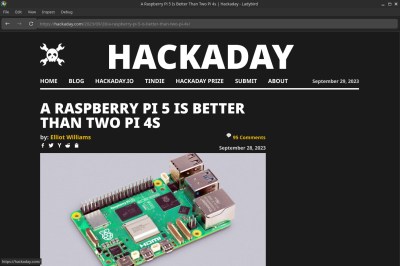
Hackaday in the Ladybird browser
It’s Hackaday, in Ladybird! (Ooof, that font.)

Happily for my own purposes, there are a range of Firefox alternatives which fulfill my browser needs without AI cruft and while allowing me to be a little more at peace with my data security and privacy. There’s Chromium of course even if it’s still way too close to Google for my liking, and there are a host of open-source WebKit and Blink based browsers too numerous to name here.

In the Gecko world that should be an easier jump for a Firefox escapee there are also several choices, for example LibreWolf, and Waterfox. In terms of other browser engines there’s the extremely promising but still early in development Ladybird, and the more mature Servo, which though it is available as a no-frills browser, bills itself as an embedded browser engine. I have not considered some other projects that are either lightweight browser engines, or ones not under significant active development.
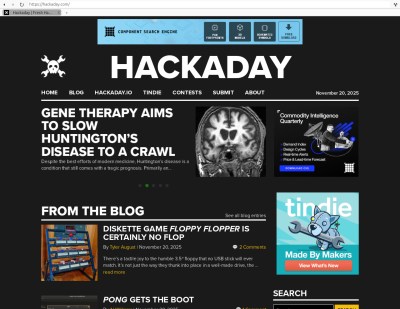
A screenshot of Hackaday in the servo browser engine.
It’s Hackaday, in Servo!

Over this summer and autumn then I have tried a huge number of different browsers. Every month or so I build the latest Ladybird and Servo; while I am hugely pleased to see progress they’re both still too buggy for my purposes. Servo is lightning-fast but sometimes likes to get stuck in mobile view, while Ladybird is really showing what it’s going to be but remains for now slow-as-treacle. These are ones to watch, and support.

I gave LibreWolf and Waterfox the most attention over the summer, both of which after the experience I’d describe as like Firefox but with mildly annoying bugs. The inability to video conference reliably is a show-stopper in my line of work, and since my eyesight is no longer what it once was I like my browsers to remember when I have zoomed in on a tab. Meanwhile Waterfox on Android is a great mobile browser, right up until it needs to open a link in another app, and fails. I’m used to the quirks of open-source software after 30+ years experimenting with Linux, but when it comes to productivity I can’t let my software disrupt the flow of Hackaday articles.

The Unexpected Choice
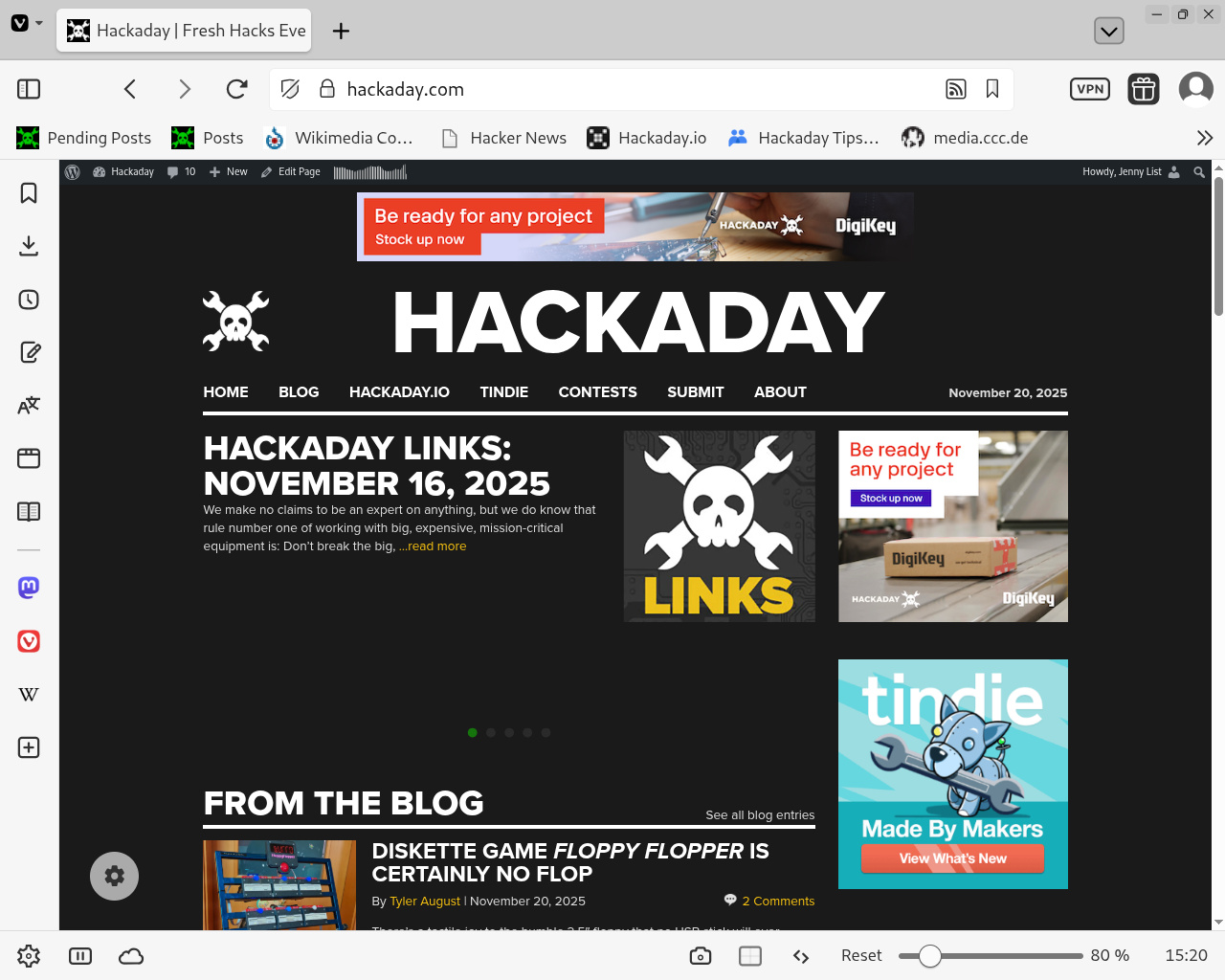
A screenshot of Hackaday, in the Vivaldi browser.
It’s Hackaday, in Vivaldi!

It might surprise you after all this open-source enthusiasm then, to see the browser I’ve ended up comfortable with. Vivaldi may be driven by the open-source Blink engine from Chromium and Chrome, but its proprietary front end doesn’t have an open-source licence.

It’s freeware, or free-as-in-beer, and I think the only such software I use. Why, I hear you ask? It’s an effort to produce a browser like Opera used to be in the old days, it’s European which is a significant consideration when it comes to data protection law, and it has (so far) maintained a commitment to privacy while not being evil in the Google motto sense.

It’s quick, I like its interface once the garish coloured default theme has been turned off, and above all, it Just Works. I have my browser back, and I can get on with writing. Should they turn evil I can dump them without a second thought, and hope by then Ladybird has matured enough to suit my needs.

It may not be a trend many of us particularly like, but here in 2025 there’s a sense that the browser has reduced our computers almost to the status of a terminal. It’s thus perhaps the most important piece of software on the device, and in that light I hope you can understand some of the concerns levelled in this series. If you’re reading this from Firefox HQ I’d implore you to follow my advice and go back to what made Firefox so great back in the day, but for the rest of you I’d like to canvass your views on my choice of a worthy replacement. As always, the comments are waiting.
So Long, Firefox, Part One

It’s likely that Hackaday readers have among them a greater than average number of people who can name one special thing they did on September 23rd, 2002. On that day a new web browser was released, Phoenix version 0.1, and it was a lightweight browser-only derivative of the hugely bloated Mozilla suite. Renamed a few times to become Firefox, it rose to challenge the once-mighty Microsoft Internet Explorer, only to in turn be overtaken by Google’s Chrome.

Now in 2025 it’s a minority browser with an estimated market share just over 2%, and it’s safe to say that Mozilla’s take on AI and the use of advertising data has put them at odds with many of us who’ve kept the faith since that September day 23 years ago. Over the last few months I’ve been actively chasing alternatives, and it’s with sadness that in November 2025, I can finally say I’m Firefox-free.

Just What Went Wrong?

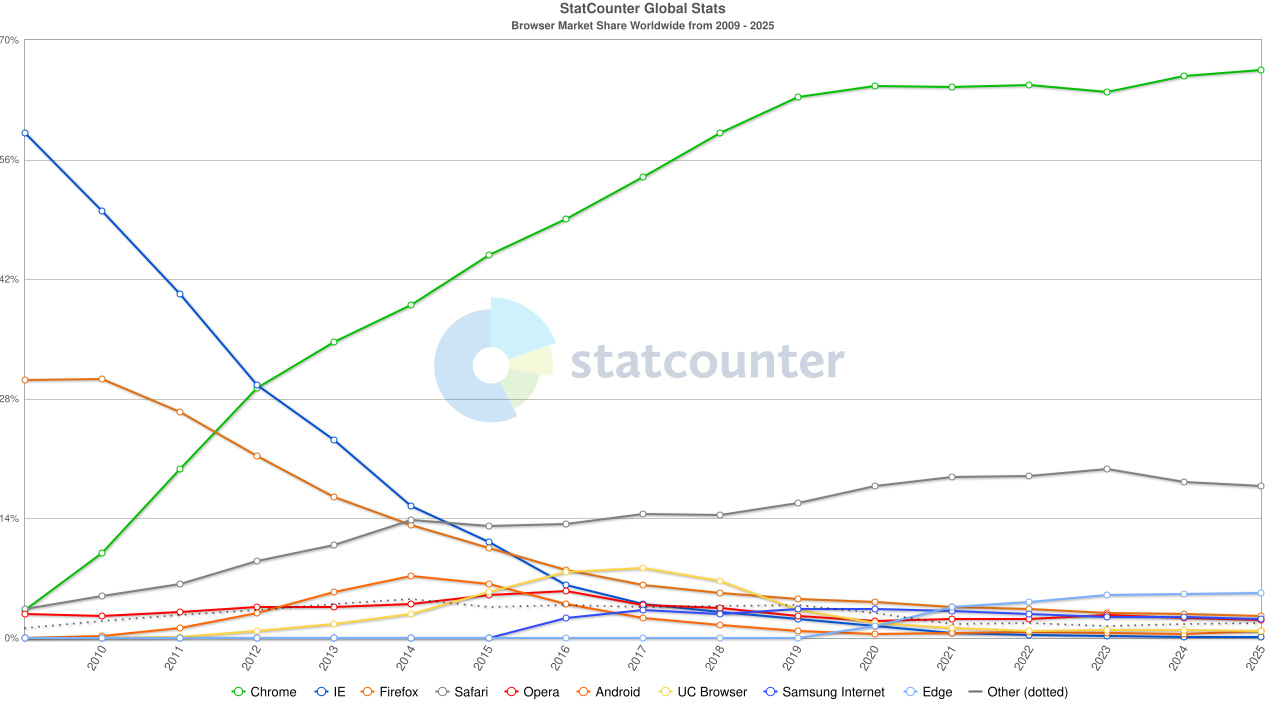
A graph of market share. On the left in 2009 MSIE has over 50% and Firefox around 30%, while today on the right, Chrome has nearly 70% with everything else in the weeds.
Browser market share, 2009 to 2025. Statcounter, CC BY-SA 3.0.

It was perhaps inevitable that Firefox would lose market share when faced with a challenger from a player with the economic muscle of Google. Chrome is everywhere, it’s the default browser in Android and ChromeOS, and when stacked up against the Internet Explorer of fifteen years or so ago it’s not difficult to see why it made for an easy switch. Chrome is good, it’s fast and responsive, it’s friendly, and the majority of end users either don’t care or don’t know enough to care that it’s Google’s way in to your data. When it first appeared, they still had the β€œDon’t be evil” aura to them, even if perhaps behind the warm and fuzzy feeling it had already worn away in the company itself.

If Firefox were destined to become a minority player then it could still be a successful one; after all, 2% of the global browser market still represents a huge number of users whose referrals to search engines return a decent income. But the key to being a success in any business is to know your customers, and sitting in front of this particular screen it’s difficult to escape the conclusion that Mozilla have lost touch with theirs. To understand this it’s necessary for all of us to look in the mirror and think for a moment about who uses Firefox.

Somewhere, A Group Of Users Are Being Ignored

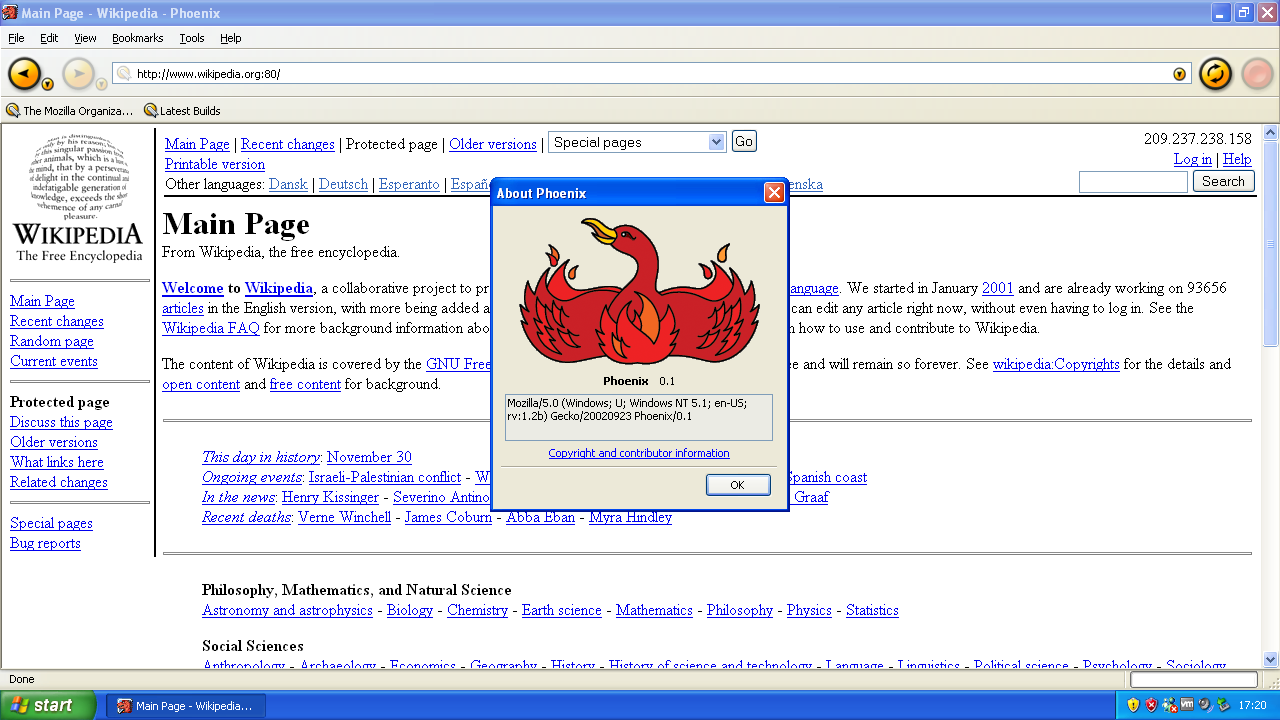
A screenshot of the first Phoenix browser in Windows XP.
Blink, and its name will change: Phoenix version 0.1. Mozilla Foundation; Microsoft, Inc., CC BY-SA 4.0.

A quick straw poll in my hackerspace revealed a majority of Firefox users, while the same straw poll among another group of my non-hackerspace friends revealed none. The former used Firefox because of open-source vibes, while the latter used Edge or Safari because it came with their computer, or Chrome on their phone and on their desktop because of Google services. Hackaday is not a global polling organisation, but we think it’s likely that the same trend would reveal itself more widely. If you’re in the technology space you might use Firefox, but if you aren’t you may not even have heard of it in 2025. It’s difficult to see that changing any time soon, to imagine some killer feature that would make those Chrome, Safari, and Edge users care enough to switch to Firefox.

To service and retain this loyal userbase then, you might imagine that Mozilla would address their needs and concerns with what made Phoenix a great first version back in 2002. A lightweight and versatile standards-compliant and open-source web browser with acceptable privacy standards, and without any other non-browser features attached to it. Just a browser, only a browser, and above all, a fast browser.

Instead, Mozilla appear to be following a course calculated to alarm rather than retain these users. Making themselves an AI-focused organisation, neglecting their once-unbeatable developer network, and trying to sneak data gathering into their products. They appear now to think of themselves as a fad-driven Valley startup rather than the custodians of a valuable open-source package, and unsurprisingly this is concerning to those of us who know something about what a browser does behind the scenes.

Why Is This Important?

A nasty piece of code to open different incompatible AJAX requests in different 2000s-era browsers.
If you have ever had to write code like this, you will know. Bret Taylor, CC-BY 2.5.

It is likely that I am preaching to the choir here, but it’sΒ important that there be a plurality of browsers in the world. And by that I mean not just a plurality of front-ends, but a plurality of browser engines. One of the reasons Phoenix appeared all those years ago was to challenge the dominance of Microsoft Internet Explorer, the tool by which the Redmond software company were trying to shape the online world to their tune. If you remember the browser wars of that era, you’ll have tales of incompatibilities seemingly baked in on purpose to break the chances of an open Web, and we were all poorer for it. Writing Javascript with a range of sections to deal with the quirks of different browser families is now largely a thing of the past, and for that you have the people who stuck with Firefox in the 2000s to thank.

The fear is that here in 2025 we are in an analogous situation to the early 2000s, with Google replacing Microsoft. Such is the dominance of Google Chrome and the WebKit-derived Blink engine which powers it, that in effect, Google have immense power to shape the Web just as Microsoft did back in the day. Do you trust them to live up to their now-retired mission statement and not be evil? We can’t say we do. Thus Firefox’s Gecko browser engine is of crucial importance, representing as it does the only any-way serious challenger to Blink and WebKit’s near-monopoly. That it is now tied to a Mozilla leadership treating it in so cavalier a manner does not bode well for the future of the Web.

So I’ve set out my stand here, that after twenty-three years, I’m ready to abandon Firefox. It’s not a decision that has been easy, because it’s important for all of us that there be a plurality of browsers, but such is the direction being taken by Mozilla that I am not anxious to sit idly by and constantly keep an eye out for new hidden privacy and AI features to turn off with obscure checkboxes. In the following piece I’ll take a look at my hunt for alternatives, and you may be surprised by the one I eventually picked.

Internet Archive Hits One Trillion Web Pages

Server racks branded with Internet Archive

In case you didn’t hear β€” on October 22, 2025, the Internet Archive, who host the Wayback Machine at archive.org, celebrated a milestone: one trillion web pages archived, for posterity.

Founded in 1996 by Brewster Kahle the organization and its facilities grew through the late nineties; in 2001 access to their archive was greatly improved by the introduction of the Wayback Machine. From their own website on Oct 21 2009 they explained their mission and purpose:

Most societies place importance on preserving artifacts of their culture and heritage. Without such artifacts, civilization has no memory and no mechanism to learn from its successes and failures. Our culture now produces more and more artifacts in digital form. The Archive’s mission is to help preserve those artifacts and create an Internet library for researchers, historians, and scholars.

We were curious about the Internet Archive technology. Storing a copy (in fact two copies!) of the internet is no mean feat, so we did some digging to find out how it’s done. The best information available is in this article from 2016: 20,000 Hard Drives on a Mission. They keep two copies of every β€œitem”, which are stored in Linux directories. In 2016 they had over 30 petabytes of content and were ingesting at a rate of 13 to 15 terabytes per day, web, and television being the most voluminous.

In 2016 they had around 20,000 individual disk drives, each housed in specialized computers called β€œdatanodes”. The datanodes have 36 data drives plus two operating system drives per machine. Datanodes are organized into racks of 10 machines, having 360 data drives per rack. These racks are interconnected via high-speed Ethernet to form a storage cluster.

Even though content storage tripled over 2012 to 2016, the count of disk drives stayed about the same; this is because of disk drive technology improvements. Datanodes that were once populated with 36 individual 2 terabyte drives are today filled with 8 terabyte drives, moving single node capacity from 72 terabytes (64.8 T formatted) to 288 terabytes (259.2 T formatted) in the same physical space. The evolution of disk density did not happen in a single step, so there are populations of 2, 3, 4, and 8 T drives in the storage clusters.

We will leave you with the visual styling of Hackaday Beta in 2004, and what an early google.com or amazon.com looked like back in the day. Super big shout out to the Internet Archive, thanks for providing such an invaluable service to our community, and congratulations on this excellent achievement.

❌