BitMine Immersion Technologies has added over 7,000 ether for roughly $19.8 million to its stash that currently accounts for more than 3% of the flagship altcoin’s total supply. Data tracked by on-chain analytics platform Lookonchain on Dec. 2 shows that…
Ethereum is trading above $3,050 after enduring weeks of intense selling pressure and a deep capitulation phase among short-term holders. While fear continues to dominate sentiment, new data suggests that market participation has remained surprisingly strong throughout the year. According to a CryptoQuant report by Arab Chain, Ethereum’s real-time trading volume across all major platforms highlights a pivotal period in its 2025 trajectory.
Throughout the year, ETH’s monthly trading activity fluctuated widely. Volume initially dipped into the $280–$380 billion range during the market’s early-year slowdown. However, a major resurgence followed mid-year, driven by heightened volatility, renewed institutional activity, and broader macro shifts. This surge pushed Ethereum’s total monthly trading volume to a cycle peak of over $599 billion in August—one of the strongest liquidity expansions in recent years.
Although activity cooled afterward, the market remained far from inactive. By the end of November, total trading volume still hovered around $375 billion, underscoring persistent engagement from both retail and institutional participants despite bearish price action.
Institutional Activity and Exchange Liquidity Strengthen Ethereum’s Market Structure
Arab Chain explains that the sharp rise in Ethereum’s trading volume reflects significantly improved market liquidity and strong trader engagement amid rapid price swings throughout 2025.
Volatility has been a defining feature of the year, and macroeconomic developments—from shifting futures positioning to broader risk sentiment—have amplified trading behavior. Large traders, in particular, have played an increasingly influential role, responding to futures market dynamics and macro shifts with high-volume transactions that fueled liquidity spikes.
Within this environment, Binance has remained the central hub for Ethereum trading. Data shows that ETH spot volume on Binance alone reached around $198 billion in November, underscoring the exchange’s unmatched influence over real-time liquidity flows and short-term price discovery.
Both institutional and retail traders continue to rely heavily on Binance’s depth, efficiency, and tight spreads, reinforcing its role as the dominant marketplace for major crypto assets.
Meanwhile, Ethereum exchange-traded funds (ETFs) have provided a parallel channel for institutional involvement. ETF trading volume climbed to nearly $35 billion in November, demonstrating substantial interest from traditional investors seeking regulated exposure to ETH.
This structured liquidity has added a stabilizing layer to the ecosystem, further strengthening Ethereum’s overall market profile during a period of heightened uncertainty.
Testing Support After a Deep Multi-Week Correction
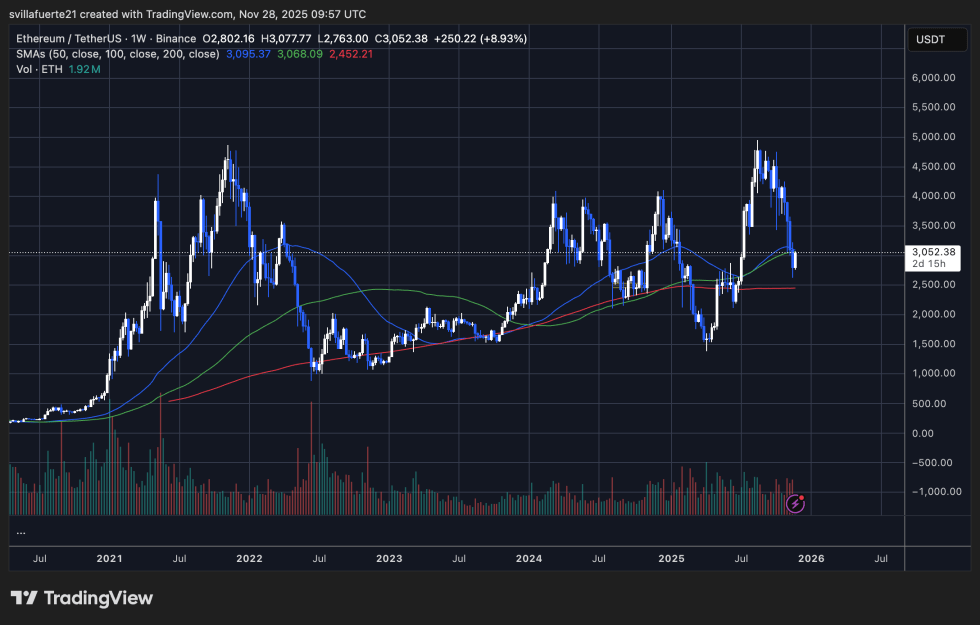
Ethereum is attempting to stabilize above the $3,000 level after a sharp multi-week decline that pushed the asset to its lowest point since early 2025. The weekly chart shows that ETH has bounced from a key confluence zone near the 200-week moving average, a historically important region where long-term investors often step in. This rebound suggests that buyers are defending structural support, but momentum remains fragile.
The chart reveals a clear breakdown from the mid-2025 uptrend, with price slipping below the 50-week and 100-week moving averages. These moving averages have now turned into overhead resistance, reflecting a shift in market sentiment. For ETH to regain bullish traction, reclaiming these moving averages will be crucial.
Despite the current bounce, the broader structure shows lower highs forming since the September peak, keeping Ethereum in a vulnerable position. Bulls must protect the $3,000 region and push toward a higher low to avoid a deeper retracement. The coming weeks will determine whether this is a temporary relief rally or the beginning of a larger recovery trend.
Featured image from ChatGPT, chart from TradingView.com
Ethereum price has broken out of a bullish reversal pattern as the supply of tokens held in exchanges continued to decline to a record low. According to data from crypto.news, Ethereum (ETH) price dropped for nearly two weeks from $3,633…
Canary’s fund is set to be the sixth single-crypto ETF if it launches.
The fund’s official website has gone live ahead of the anticipated debut.
Past ETFs launched during the government shutdown used automatic effectiveness rules.
The cryptocurrency market is poised for a new addition with the likely debut of the first spot XRP exchange-traded fund, issued by Canary Capital.
On Wednesday, Nasdaq confirmed it had accepted the Form 8-A filing for the Canary XRP ETF, under the ticker XRPC, signalling formal readiness to list the asset.
While the announcement stirred excitement among ETF watchers, the fund still lacks the US Securities and Exchange Commission’s final approval to begin trading.
This has left its launch in limbo, even as industry observers anticipate a possible debut on Thursday.
Canary’s ETF becomes the sixth single-asset crypto fund to reach this milestone following earlier approvals for Bitcoin, Ether, Solana, Litecoin and Hedera.
However, this fund’s progression highlights a more complex regulatory backdrop, influenced by recent shifts in SEC processes during the US government shutdown.
Certification clears Nasdaq listing, but trading awaits
Nasdaq formally notified the SEC that it had received and filed the Form 8-A for Canary’s XRP ETF.
Bloomberg’s ETF analyst Eric Balchunas shared the update on X, stating that “The official listing notice for XRPC has arrived from Nasdaq.”
Despite this progress, the ETF has not yet received the green light to commence trading. The letter issued by Nasdaq confirmed approval of the listing but did not equate to SEC authorisation.
Observers have clarified that the letter is a procedural step and part of the process to join the registrant’s request for the fund to become effective.
Some in the crypto community highlighted the difference, noting that the Nasdaq letter does not declare the fund effective but only acknowledges the listing certification.
The SEC has not issued an effectiveness order, which means trading cannot begin until that step is completed.
Canary’s XRP fund joins crypto ETF roster
Following the Nasdaq filing, Canary Capital launched its official website for the ETF.
Nate Geraci, president of NovaDius Wealth Management, posted about the development, signalling that Canary was likely to be the first to market with an XRP-backed ETF.
If approved, the XRPC ETF will join the growing roster of single-asset crypto ETFs now available to investors. These include Bitcoin, Ether, Solana, Litecoin and Hedera.
Eleanor Terrett of Crypto America also indicated on X that Nasdaq had cleared XRPC for a market open launch, which further raised expectations for an imminent debut. However, the fund cannot proceed to trading without confirmation from the SEC.
Canary’s ETF launch coincides with the recent end of the longest US government shutdown in history.
On Wednesday, President Donald Trump signed legislation that officially reopened government operations.
During the shutdown, ETFs for Solana, Litecoin and Hedera began trading under automatic effectiveness provisions.
These mechanisms allowed trading to begin without active SEC approval during periods when regulatory processes were delayed.
This approach was not used in earlier launches of Bitcoin and Ether ETFs, which both started trading only after formal authorisation from the regulator.
It remains unclear which approach the XRPC fund will follow.
Without a current effectiveness order, Canary’s ETF may be subject to additional delays, unless it qualifies under the same automatic provisions used during the shutdown period.
Launch window narrows as market watches SEC decision
Although Nasdaq has certified the listing and Canary’s infrastructure appears ready, the fate of the XRPC ETF ultimately depends on the SEC.
Canary’s website launch and market interest reflect growing anticipation, but trading cannot begin until regulators give their final approval.
Although Nasdaq certified the listing and Canary Capital launched its website, the fund did not begin trading immediately after 28 October, the initially anticipated date.
Without a final effectiveness order from the SEC, the ETF remains in limbo. Until that regulatory step is completed, XRPC cannot begin trading, and the market continues to await confirmation.

 Login
Login