Welcome to Edition 8.21 of the Rocket Report! We’re back after the Thanksgiving holiday with more launch news. Most of the big stories over the last couple of weeks came from abroad. Russian rockets and launch pads didn’t fare so well. China’s launch industry celebrated several key missions. SpaceX was busy, too, with seven launches over the last two weeks, six of them carrying more Starlink Internet satellites into orbit. We expect between 15 and 20 more orbital launch attempts worldwide before the end of the year.
As always, we welcome reader submissions. If you don’t want to miss an issue, please subscribe using the box below (the form will not appear on AMP-enabled versions of the site). Each report will include information on small-, medium-, and heavy-lift rockets, as well as a quick look ahead at the next three launches on the calendar.
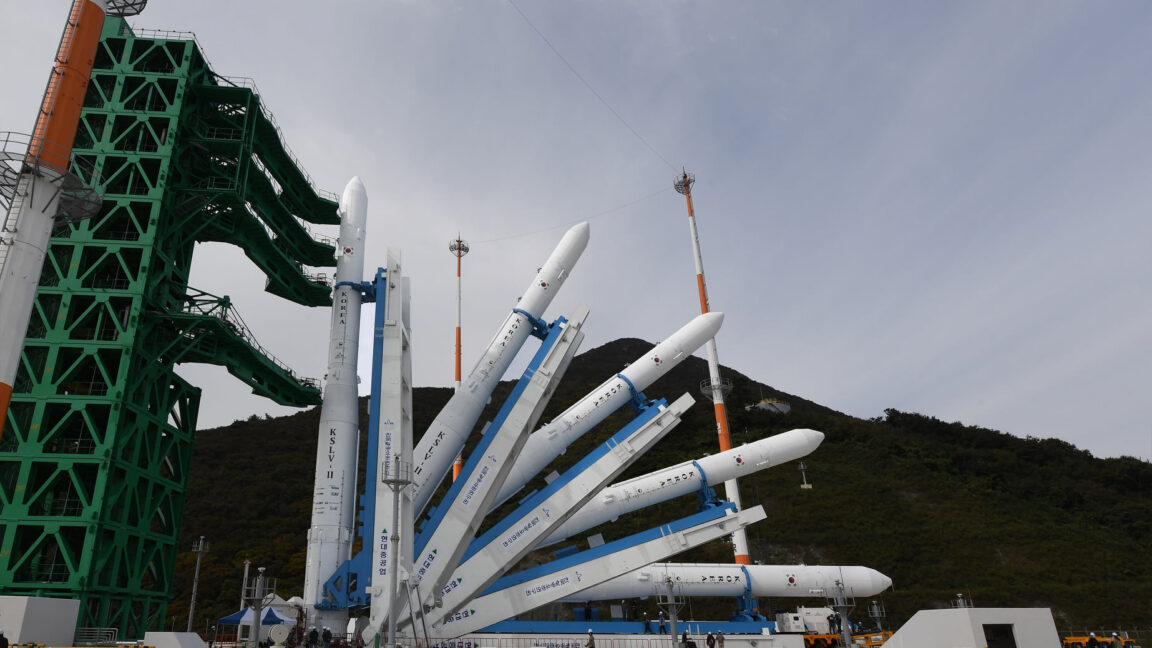
Another Sarmat failure. A Russian intercontinental ballistic missile (ICBM) fired from an underground silo on the country’s southern steppe on November 28 on a scheduled test to deliver a dummy warhead to a remote impact zone nearly 4,000 miles away. The missile didn’t even make it 4,000 feet, Ars reports. Russia’s military has been silent on the accident, but the missile’s crash was seen and heard for miles around the Dombarovsky air base in Orenburg Oblast near the Russian-Kazakh border. A video posted by the Russian blog site MilitaryRussia.ru on Telegram and widely shared on other social media platforms showed the missile veering off course immediately after launch before cartwheeling upside down, losing power, and then crashing a short distance from the launch site.
Woori Bank has begun displaying Bitcoin prices inside its main trading room in Seoul, placing the cryptocurrency alongside core financial indicators such as the won–dollar exchange rate and stock market data.
Key Takeaways:
Woori Bank is the first Korean commercial bank to display Bitcoin prices in its main trading room.
The move reflects Bitcoin’s rising role in global market sentiment as Korean banks expand deeper into digital asset infrastructure.
Upcoming regulations could position major banks like Woori as central players in South Korea’s future digital finance landscape.
The move marks the first time a commercial bank in South Korea has integrated a crypto price feed directly into its frontline dealing environment, the space where traders handle foreign exchange, bonds and derivatives.
Bitcoin Now Seen as Market Signal, Says Woori Bank Official
A Woori Bank official said the decision reflects the growing weight of digital assets in global finance, noting that Bitcoin has increasingly become a signal for broader market sentiment.
“As digital assets continue to grow in prominence and influence in global financial markets, we determined that they should be monitored as a key indicator to better read overall market trends,” the official said.
The update comes as Korean banks step deeper into digital asset infrastructure.
Hana Financial Group this week signed a partnership with Dunamu, operator of the Upbit exchange, to incorporate blockchain tools into services ranging from overseas remittances to financial data systems.
While Woori has yet to announce a formal partnership with a crypto exchange, senior executives have repeatedly indicated that the bank intends to expand into digital asset services.
CEO Jung Jin-wan said in October that payments and digital asset ecosystems are “increasingly interconnected,” suggesting the sector could open new revenue avenues for banks.
SOUTH KOREAN BANKING GIANT WOORI BANK JUST STARTED DISPLAYING #BITCOIN PRICE IN THEIR DEALING ROOM
Regulators are also shaping a clearer path. The government and ruling Democratic Party are examining a proposal that would restrict issuance of won-based stablecoins to bank-led consortia with majority bank ownership.
If enacted, the framework could position major lenders like Woori as central players in future stablecoin markets.
The frenzy was led by leveraged ETFs and high-growth stocks, as traders sought to ride Wall Street’s momentum amid optimism surrounding US tech resilience and domestic stimulus hopes.
South Korea to Extend Crypto Travel Rule to Sub-$700 Transactions
Last week, South Korea revealed that it is preparing one of its most aggressive crackdowns on cryptocurrency-related financial crime by expanding its travel rule requirements.
The new threshold covers transactions under 1 million won ($680), which until now allowed users to bypass identity checks by breaking transfers into smaller amounts
The Financial Intelligence Unit (FIU) will also introduce pre-emptive account-freezing powers in serious cases, allowing investigators to lock suspicious accounts before funds can be moved beyond recovery.
Officials said legislative amendments are expected to be submitted to the National Assembly in the first half of 2026, with South Korea also expanding coordination with global regulators such as the Financial Action Task Force to align with international standards.
As the sector continues to gain global momentum, Taiwanese authorities have announced that a locally issued stablecoin could be launched next year, pending the imminent approval of the country’s regulatory crypto framework and related legislation.
First Local Stablecoin To Debut Next Year
On Wednesday, Taiwan’s Financial Supervisory Commission (FSC) Chairman Peng Jin-long revealed that the island’s first regulated stablecoin could debut in the latter half of 2026, local news outlet Focus Taiwan reported.
The FSC chair affirmed that the Virtual Assets Service Act (VASA), which incorporates stablecoin regulation, could be passed during its third hearing in the next legislative session, scheduled for this week, after clearing initial reviews with a “high level of consensus.”
After the framework’s approval, stablecoin-centered regulations would be developed within six months, setting the launch of a locally issued token pegged to the New Taiwan Dollar (NTD) or the US Dollar (USD) to the second half of the year.
The VASA supports the efforts by Taiwanese authorities to establish a comprehensive crypto framework that promotes industry growth and safeguards investors. Last year, the FSC announced an overhaul of the Anti-Money Laundering (AML) framework to include crypto businesses, introducing stricter AML guidelines for Virtual Asset Service Providers (VASPs) and requiring all crypto firms to complete the AML registration by September 2025.
In January, Peng stated that investors could have a “convenient” entrance to crypto assets in the future through stablecoins, which could serve as a bridge between the country’s legal tender and virtual currency.
In March, the FSC published the finalized draft of its landmark crypto legislation, which the VASA’s draft proposed authorizing banks to issue stablecoins pegged to the New Taiwan Dollar or the US Dollar.
Meanwhile, Premier Cho Jung-tai and Central Bank Governor Yang Chin-long recently expressed support for a formal Bitcoin (BTC) policy, pledging to study the flagship cryptocurrency as a strategic reserve asset, accelerate pro-BTC rulemaking, and pilot treasury exposure through government-seized assets.
Taiwan Sets Financial Institutions’ Role
At the legislative hearing, the FSC’s chair highlighted that the bill’s draft draws from the European Union (EU)’s Markets in Crypto-Assets Regulation (MiCA). He explained that the Virtual Assets Service Act doesn’t require stablecoins to be issued exclusively by financial institutions, which has been a divisive topic in other jurisdictions.
As reported by Bitcoinist, South Korea’s long-awaited stablecoin legislation could be delayed until next year as the Korean Financial Services Commission clashes with the Bank of Korea (BOK) over the role of banks in the sector.
A local news media outlet recently noted that the BOK and regulators agree that financial institutions must be involved in the issuance of won-pegged tokens, but differ on the extent of their role.
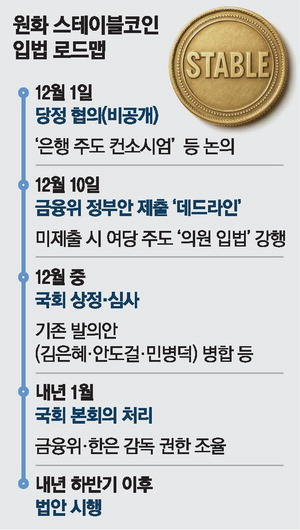
The central bank is pushing for a consortium of banks owning at least 51% of any stablecoin issuer seeking regulatory approval. Meanwhile, regulators are concerned that giving a majority stake to banks could reduce participation from tech companies and limit the market’s innovation. Earlier this week, authorities set December 10 as the deadline for the government to deliver a draft bill.
Unlike South Korea’s financial authorities, Focus Taiwan reported that the regulator and the central bank have agreed that only financial institutions will be allowed to issue stablecoins in the initial stage to reduce risk management, suggesting that companies could join at a later stage of the project.
South Korea’s long-running effort to build a stablecoin regulatory framework has reached a decisive moment, with lawmakers setting a firm December 10 deadline for the government to deliver a draft bill.
If regulators miss that date, key legislators say they will move ahead on their own, ending months of stalled negotiations over how a won-pegged stablecoin should be issued and who should be allowed to control it.
Seoul Divided Over Whether Banks or Tech Firms Should Lead Stablecoin Issuance
According to reports from Seoul, the ruling party issued what it described as a final notice to financial authorities, urging them to submit the government’s proposal for the so-called “Phase 2 Legislation on Digital Assets,” which focuses specifically on stablecoin oversight.
Political and financial officials held a closed-door meeting at the National Assembly on December 1, where the biggest point of contention resurfaced: whether banks must take the lead in issuing stablecoins or whether technology firms should be allowed a more active role.
Some lawmakers have argued for a minimum 50% bank stake, citing the Bank of Korea’s long-standing warnings that privately issued digital won tokens could affect monetary policy and destabilize the financial system.
Others, including parts of the ruling party and the Financial Services Commission (FSC), prefer lowering the barrier to allow fintech participation, saying excessive restrictions could limit innovation.
The FSC later issued a public statement clarifying that no final decision had been made on whether a consortium or a 51% bank stake would be permitted.
The regulator confirmed that stablecoin legislation was discussed during Monday’s policy consultation and that both sides agreed to prepare a government bill as soon as possible.
However, specifics remain unsettled, prolonging a delay that has already pushed expected timelines several times.
This debate has taken on broader urgency as rival political parties race to introduce their own drafts.
The National Assembly’s Political Affairs Committee is currently reviewing three separate bills, each proposing rules for issuance, collateral management, internal controls, and minimum capital requirements of about 5 billion won.
The bills differ on issues such as whether stablecoin issuers should be allowed to offer interest on holdings, reflecting ongoing disparities in policy direction.
New AML and Travel Rule Measures Add Pressure to South Korea’s Stablecoin Push
South Korea is also moving toward a tighter travel rule regime, with plans to extend reporting requirements to transactions under 1 million won to prevent users from bypassing identity checks.
Authorities have indicated that enhanced KYC rules and stricter oversight will accompany any new stablecoin system.
South Korea will extend its crypto Travel Rule to cover sub-$700 transactions, closing a loophole used to evade identity checks.#SouthKorea#Cryptohttps://t.co/LBJKNcmMQg
Meanwhile, the Bank of Korea has expressed fresh concerns. In an October report, the central bank warned that improperly collateralized stablecoins could trigger depegging events and disrupt capital flow management.
It argued again that only regulated financial institutions should issue stablecoins, stressing that non-bank issuers could effectively engage in deposit-like activities without the safeguards banks must follow.
Despite regulatory disagreements, the domestic market is already moving ahead. Naver Financial has completed development of a stablecoin wallet for Busan’s Dongbaek-jeon program, which will convert the city’s prepaid local currency into a blockchain-based token.
Naver Financial, the fintech arm of South Korean internet giant Naver, is preparing to roll out a stablecoin wallet in Busan.#SouthKorea#Cryptohttps://t.co/40QBNaXJ9C
KakaoBank has begun building infrastructure for a KRW-denominated “Kakao Coin,” indicating growing corporate interest in digital won products. Major banks have also explored a consortium-issued stablecoin targeted for late 2025 or early 2026.
These advancements show why lawmakers are determined to meet the current legislative window.
Despite being approved in 2020, Korea’s crypto tax law has been postponed multiple times and remains scheduled for 2027, with many of the required systems still incomplete.
South Korea's crypto tax implementation may face fourth delay as infrastructure gaps and regulatory uncertainties persist ahead of 2027 deadline.#SouthKorea#CryptoTaxhttps://t.co/ZbbTDNBfnY
South Korea has fallen behind major economies such as the United States, the European Union, and Japan, all of which have already formalized stablecoin structures.
Industry groups warn that further delays could weaken competitiveness, especially as dollar-based tokens like USDT continue to dominate global markets.
The new legislation builds on the Digital Asset Basic Act by adding detailed rules for stablecoin oversight.
The framework outlines how global stablecoins like USDT and USDC will be treated in Korea.
Officials warn delays could leave Korea behind other regions that tightened rules in 2025.
South Korea is taking a major step toward formalising how won-based stablecoins will be issued and supervised, after lawmakers settled a long-running dispute over who should control the process.
A closed-door meeting brought clarity to the core question of authority, with policymakers agreeing that banks should lead the effort while still allowing tech firms to participate.
The move comes at a time when crypto adoption is rising among people aged 20 to 50, and when global players continue to dominate stablecoin markets.
With a December deadline approaching, officials want to finalise a structure that supports innovation but keeps monetary stability at the centre of regulation.
Consortium model defines the role of banks and tech firms
A Dec. 1 report by Maeli Business Newspaper said lawmakers agreed on a consortium model where banks maintain majority control of stablecoin-issuing entities.
Tech companies will still be able to participate, but financial institutions will take the lead to reduce systemic risks.
The goal is to create a Korean-style stablecoin framework that mirrors the safeguards of traditional finance, with clear rules governing reserves, issuance, and supervision.
The model was designed to align with the Bank of Korea’s concerns about protecting the money supply.
It also provides a common structure for private companies, reducing the risk of fragmented products entering the market without consistent stability mechanisms.
By setting shared standards early, policymakers hope to shape a domestic stablecoin ecosystem that can support innovation without compromising financial security.
Government faces Dec. 10 deadline for its proposal
Senior Democratic Party lawmaker Kang Joon-hyun said the government must submit its proposal by Dec. 10. If it misses the deadline, lawmakers will move ahead with their own version of the bill.
The aim is to pass the legislation during the National Assembly’s January extraordinary session, after consultation with the ruling People Power Party and the president’s office.
This new act expands on the Digital Asset Basic Act passed earlier this year.
That earlier law established licensing rules for issuers, requirements for reserve protection, and compliance obligations for virtual asset service providers.
The upcoming bill fills in the remaining regulatory gaps by specifying how stablecoins should be managed when they operate like traditional financial instruments.
It also provides clearer guidance for US-based stablecoins such as USDT and USDC, which have become increasingly influential in Korea’s growing digital asset market.
Push to match progress in global markets
Officials warn that delays could leave Korean companies trailing behind their global competitors.
The US, EU, and Japan strengthened their stablecoin rules in 2025, creating a more defined landscape for exchanges and financial institutions.
Korean regulators want to avoid losing momentum, especially as domestic interest in crypto continues to rise.
The updated framework aims to reduce uncertainty for developers, financial firms, and exchanges.
By bringing digital assets closer to mainstream financial oversight, authorities hope to support responsible growth and give consumers access to well-regulated products.
The focus is on keeping the domestic market aligned with international standards while maintaining space for private-sector innovation.
Lawmakers discuss wider reforms on security and markets
The meeting also covered planned updates to financial security and capital-market rules.
After recent hacking incidents at major financial companies, officials intend to revise the Electronic Financial Transactions Act.
Proposed changes include tougher penalties and stronger enforcement following cyber breaches.
Lawmakers are also working with opposition parties on a set of capital-market reforms.
These include rules that would require mandatory tender offers in certain corporate situations.
They also plan to update share-allocation standards so that everyday investors have fairer access to offerings.
The goal is to improve transparency and strengthen market integrity as Korea reshapes its financial regulatory environment.
South Korea is pushing to finalize a new digital asset act by January, after ruling and opposition lawmakers agreed on a stablecoin framework that had stalled negotiations for months. Lawmakers met behind closed doors and settled the core dispute over…
South Korea is preparing one of its most aggressive crackdowns on cryptocurrency-related financial crime by expanding its travel rule requirements.
Key Takeaways:
South Korea will extend its crypto Travel Rule to cover sub-$700 transactions, closing a loophole used to evade identity checks.
Exchanges will be forced to apply full KYC to small transfers and face stricter financial and compliance reviews.
High-risk offshore platforms will be blocked, and criminals barred from owning stakes in licensed crypto firms.
The new threshold covers transactions under 1 million won ($680), which until now allowed users to bypass identity checks by breaking transfers into smaller amounts, according to Yonhap News.
South Korea’s FSC Chief Vows Crypto AML Push With Expanded Travel Rule
Financial Services Commission (FSC) Chairman Lee Eok-won confirmed the plan Wednesday during a briefing to the National Assembly’s Legislation and Judiciary Committee, saying authorities would tighten oversight on crypto rails increasingly used for money laundering and tax evasion.
“We will crack down on crypto money laundering […] expanding the Travel Rule to transactions under 1 million won,” Lee said.
Currently, South Korea’s travel rule largely applies to higher-value transfers, requiring exchanges to collect and exchange identifying information about senders and recipients.
The new proposal would eliminate that loophole, forcing crypto platforms to apply the same disclosure standards to smaller transactions that were often used to evade reporting.
Once the change is implemented, exchanges operating in South Korea will be required to gather full identity data on crypto users even for low-value trades and transfers.
Regulators believe this will significantly reduce the use of digital assets for overseas remittances tied to illegal activities and unreported income.
BREAKING: South Korea now suspects North Korea’s Lazarus Group is behind the recent hack on crypto exchange Upbit via Yonhap.
Lazarus has been linked to almost every major exploit in the last few years: • the WazirX attack • the Bybit breach • multiple bridge and… pic.twitter.com/l3CQFnXlp7
The FSC also plans to introduce tougher restrictions on so-called “high-risk” offshore exchanges that facilitate transactions for Korean users without being licensed domestically.
According to the regulator, these platforms will be blocked outright if they are deemed to pose heightened risks of fraud or money laundering.
In addition, crypto exchanges will face more intense reviews of their financial stability.
The government plans to widen the criteria for Virtual Asset Service Provider (VASP) registration, evaluating whether platforms have adequate reserves, internal controls and compliance systems in place.
New rules will also bar individuals with prior convictions for tax crimes or drug offenses from becoming major shareholders in licensed crypto firms, a move aimed at preventing criminal networks from gaining influence over regulated platforms.
South Korea to Grant FIU Pre-Emptive Freezing Powers
The Financial Intelligence Unit (FIU) will also introduce pre-emptive account-freezing powers in serious cases, allowing investigators to lock suspicious accounts before funds can be moved beyond recovery.
Officials said legislative amendments are expected to be submitted to the National Assembly in the first half of 2026, with South Korea also expanding coordination with global regulators such as the Financial Action Task Force to align with international standards.
Despite five years since the tax law’s initial approval in 2020 and three previous delays, authorities have failed to establish critical systems for transaction monitoring, income classification, and cross-border enforcement.
South Korean authorities suspect that the November Upbit hack may have been masterminded by the notorious Lazarus Group. Unnamed industry sources told local media that the North Korean state-backed hackers may have been behind the breach, as the recent attack…
Upbit, one of South Korea’s largest crypto exchanges, reported a major loss after a Solana-network hot wallet was emptied early on November 27, 2025.
According to reports, about 54 billion Korean won — roughly $36–37 million — was taken in what the company called an “abnormal withdrawal” detected at 04:42 KST.
Upbit Suspends Solana Services
According to the exchange, deposits and withdrawals for assets on the Solana chain were halted immediately after the breach was found.
Company engineers moved remaining Solana holdings into cold storage to limit further access. Some tokens were later frozen on-chain while investigators traced transfers.
Reports have disclosed that about 12 billion won (around $8–9 million) in LAYER tokens has been frozen so far.
NEW: UPBIT DISCLOSES ~$37M HACK ON SOLANA NETWORK – “TO PREVENT ANY DAMAGE TO MEMBER ASSETS, THE ENTIRE AMOUNT WILL BE COVERED BY UPBIT’S HOLDINGS. WE WOULD LIKE TO REITERATE THAT THIS WILL NOT AFFECT MEMBER ASSETS”
Based on reports from blockchain trackers and media outlets, the stolen assets included SOL and USDC along with many Solana-ecosystem tokens.
Stolen tickers reportedly include ACS, BONK, RAY, JUP, PYTH, ORCA, JTO, LAYER, RENDER, MOODENG, and TRUMP, among others.
The list is long, and tracking continues as some tokens move through multiple wallets. At this stage, several of the addresses holding the funds are under active monitoring.
Dunamu, Upbit’s parent company, has said the exchange will cover the full loss from its own reserves so that customer balances will not be reduced.
According to the company, this decision was made to protect users while the technical and forensic reviews are under way.
A security review of the deposit and withdrawal systems has been launched, and outside experts are reported to be assisting with the investigation.
Past Incidents And Timing Raise Questions
Reports note the timing was awkward: the breach came just after a high-profile corporate announcement involving Naver Financial on November 26, 2025.
Upbit is not new to major hacks; a 2019 attack cost the platform a large amount of ETH. Hot wallets, which are connected to the internet, remain a known weak point for centralized exchanges. That risk was exposed again here.
On-Chain Tracking And Recovery Hopes
Blockchain analysts are following the trail of transfers and identifying the wallets that received funds. Some tokens can be frozen if their issuers or governing authorities cooperate, which is how the reported LAYER freeze was achieved.
Still, many assets may be hard to recover, and legal routes can be slow. It was reported that the exchange attempted to freeze what it could while moving other assets offline.
What This Means For Users And Market Confidence
For now, Upbit users have been assured their funds are safe because the operator pledged to absorb the loss.
Market reaction could include temporary liquidity issues for certain Solana tokens listed on the platform while services remain limited.
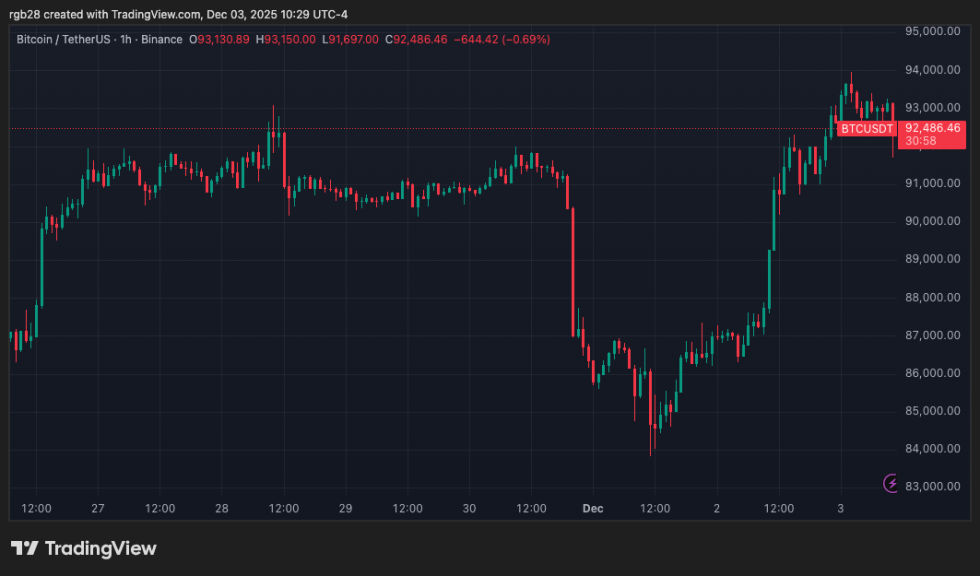
Featured image from Pixabay, chart from TradingView
South Korea’s financial sector was hit by a coordinated Russia–North Korea supply chain attack using Qilin ransomware, with 2 TB of sensitive banking data stolen. South Korea’s financial sector suffered a coordinated supply chain attack attributed to Russian and North…
About 54 billion won in tokens moved to an external wallet on Nov. 27.
Around 12 billion won in Solaire tokens have been frozen so far.
The breach coincided with Dunamu’s major merger plans with Naver.
Upbit, South Korea’s largest crypto exchange, is carrying out extensive security inspections after an early-morning breach on Nov. 27 led to unauthorised transfers of Solana-linked assets worth about 54 billion won.
The exchange halted all deposits and withdrawals as it began moving digital assets to cold storage and initiated a broader internal review.
The incident has renewed attention on how Solana-based tokens are secured across trading platforms and has placed pressure on Upbit to strengthen systems as the company enters a major corporate transition involving its parent firm, Dunamu.
Solana assets targeted in early transfer
The breach took place at around 4:42 am on Nov. 27 when Solana network assets, including SOL, USDC, and other smaller tokens, were moved to an external wallet without authorisation.
Upbit described the activity as abnormal withdrawals connected to the Solana network.
The exchange confirmed that roughly $37 million worth of digital assets had been affected.
Upbit immediately suspended services to stop further transfers.
It said it has identified the entire scale of the outflow and will fully compensate users by covering the amount with its own holdings.
Customer balances will not be touched as part of the reimbursement process.
To control risk, the exchange transferred assets to cold storage and started a systemwide inspection of its wallet operations, deposit channels, and withdrawal procedures.
These steps were taken to prevent any further unauthorised movement and to contain the situation while teams examined logs and asset flows.
System checks widen beyond the Solana network
Upbit said its investigation will not be restricted to the Solana ecosystem.
It is reviewing the stability and security of the complete deposit and withdrawal infrastructure. This includes a detailed audit of network connections, wallet systems, and digital asset storage methods.
The exchange has begun an emergency sweep of internal processes and is carrying out a full evaluation of whether other networks require additional protections.
Deposits and withdrawals will resume gradually once the inspections conclude and the company is satisfied with system security.
The timing has amplified industry attention.
The breach occurred one day after Dunamu announced plans for a multibillion-dollar merger with Naver’s fintech arm.
The deal, valued at about $10.3 billion, represents one of the largest corporate moves in Asia’s digital finance landscape.
Reports suggest it may support Upbit’s ambitions for a future Nasdaq listing, creating pressure for the company to demonstrate resilience during a sensitive transition.
Freeze efforts expand as authorities prepare response
Upbit has started on-chain measures to track and freeze the affected assets.
It said around 12 billion won in Solaire tokens have already been frozen, and it continues to work with related projects and institutions to stop further movement.
The exchange is tracing the remaining funds through blockchain monitoring tools and coordinating with partners to identify additional freeze points.
Authorities and law enforcement agencies are also expected to join the investigation.
Upbit has prepared to cooperate with official inquiries once they begin and has asked users to report any verified information linked to the suspicious transactions.
The company acknowledged the disruption caused by the suspension of services and repeated that member assets remain protected.
It also stressed that the entire outflow will be covered using the exchange’s own resources.
Major merger plans heighten timing pressure
The breach took place on the anniversary of a major incident in Upbit’s history.
In 2019, on the same date, the exchange lost 342,000 ETH in another high-profile theft.
South Korean investigators later connected the event to North Korean hackers.
The stolen Ether has since increased in value to over $1 billion and remains one of the largest crypto heists associated with the country.
With deposits and withdrawals still paused, Upbit plans to restore services in stages after it completes its full review.
The exchange said its priority is to secure its infrastructure across all supported networks and to strengthen safeguards around Solana-linked assets while recovery and freeze efforts continue.
Naver plans to acquire Dunamu in a KRW 20 trillion stock exchange.
Upbit controls around 70% of Korea’s crypto trading market.
Dunamu’s unlisted shares surpassed KRW 400,000 after the merger news.
South Korea’s crypto and fintech landscape is shifting rapidly as Naver prepares to acquire Dunamu in a landmark stock-swap merger that could reshape the country’s global ambitions.
The deal, expected to move through board approvals next week, places Upbit at the centre of Korea’s broader plan to expand into US capital markets.
The move has also revived momentum around a potential Nasdaq listing, with investors and analysts treating the merger as a structural reset that creates the most favourable environment yet for international expansion.
With market prices already reacting, the development signals a new phase for how Korea aims to position itself within the global crypto-fintech race.
This follows local confirmation that Naver Financial intends to acquire Dunamu through a KRW 20 trillion ($14.5 billion) stock exchange.
Once completed, the deal would make the Upbit operator a fully owned subsidiary of South Korea’s dominant internet group.
The merger would connect Naver’s broad fintech network with Upbit’s roughly 70% share of domestic crypto trading.
This creates a platform capable of operating on an international scale and opens new pathways for Upbit to expand beyond its core market.
The alignment of Naver’s technology reach with Dunamu’s blockchain capabilities is seen as a decisive advantage that supports long-term global integration.
Market signals reflect rising expectations
The financial markets have already responded to the merger’s implications.
Dunamu’s unlisted shares climbed above KRW 400,000 for the first time in more than three years.
Naver stock also surged nearly 20% in the days after news of the acquisition emerged.
These market movements reflect growing confidence that the merged entity will target an eventual entrance into the US capital markets.
Experts note that integrating Upbit under Naver creates a corporate structure that is more familiar to US regulators and therefore more suitable for a potential Nasdaq listing.
Research suggests that a listing could be possible as early as 2026, depending on broader market conditions.
Forecasts place the combined valuation of the Naver–Dunamu entity at around KRW 50 trillion, driven by Naver’s fintech scale and Dunamu’s blockchain infrastructure Giwa.
Upbit’s global momentum comes as competitors adjust their public-market plans.
Bithumb, the second-largest crypto exchange in Korea, has regained about 25% of its domestic market share and is reportedly preparing for its own listing attempt.
A new chapter for Asia’s crypto-fintech growth
If approved, the Naver–Dunamu merger could make Korea the first in Asia to attempt to bring a major crypto exchange to Nasdaq.
The development represents a significant step in the region’s broader move to compete more aggressively in global financial markets.
As Naver and Dunamu prepare to combine their strengths, Upbit is emerging as a central player in the next phase of Korea’s push toward international crypto-fintech leadership.
North Korea-linked KONNI hackers used KakaoTalk and Google Find Hub to spy on victims and remotely wipe Android devices in a targeted phishing campaign.
OPINION — President Trump’s meetings in East Asia last week did more to enhance our relationship with a few allies and partners in the region than the past fifteen years of talking about a “pivot to Asia”.
Yes, showing the flag and having the President interact with counterparts is an important part of diplomacy, at the highest level. It has impact because it shows that the U.S. cares about allies and partners, that the U.S. values this relationship and will be there for allies and partners, regardless of the cost.
So, Mr. Trump’s visit to the region was more than tariffs and trade. It was about relationships that principally deal with national security,
Mr. Trump’s meetings with Japan’s new Prime Minister, Sanae Takaichi, and South Korea’s President Lee Jae Myung were particularly noteworthy. The U.S. and Japan signed security and economic measures – and a Memorandum of Cooperation – to expand cooperation on shipbuilding and critical-minerals supply chains, an apparent initiative to reduce reliance on China for rare earth and other critical minerals. More importantly, it established a relationship with Japan’s new prime minister that will ensure we remain close allies.
With South Korea, U.S. approval to develop nuclear-powered submarines using U.S. technology and facilities was a major U.S. decision, with South Korea joining a select few states that operate nuclear-propulsion submarines. There are a few particulars related to the fuel and safeguard agreements that will have to be addressed, but the bottom line is that South Korea, within a few years, will have nuclear-powered submarines (with conventional weapons), a major enhancement of their deterrent capabilities. South Korea also committed to purchasing large quantities of U.S. energy – oil and gas – and a $350 billion trade and investment agreement.
The Cipher Brief brings expert-level context to national and global security stories. It’s never been more important to understand what’s happening in the world. Upgrade your access to exclusive content by becoming a subscriber.
The highly touted meeting of Mr. Trump with Chinese President Xi Jinping was important because it happened, while underwhelming for the substantive progress. Yes, China did agree to resume purchasing U.S. soybeans and agreed to suspend planned export restrictions on rare earth minerals for one year, while also committing to greater cooperation on the trafficking of fentanyl precursor chemicals into the U.S. In return, the U.S. reduced tariffs on Chinese products from 57% to 47%.
The U.S. also said it discussed the possible sale of U.S. computer chips to China, although not the newest AI chips. For many, Mr. Trump’s announcement that he will visit China in April 2026, with a subsequent trip to the U.S. by Mr. Xi was welcomed by many, hoping that a more robust dialogue with China would be in our respective countries’ interest.
Interestingly, there was no mention of Taiwan or potential conflict in the South China Sea. Apparently, the Trump-Xi meeting dealt exclusively with trade and fentanyl-related issues. Or, if these issues were discussed, both agreed that there would be no public statement documenting these discussions.
Mr. Trump’s visit to Malaysia, Japan and South Korea was an important visit of a U.S. president who prides himself on being a peacemaker. In Malaysia Mr. Trump witnessed the signing of a peace accord between Cambodia and Thailand that he personally brokered. Indeed, that’s how Mr. Trump started his five-day trip to East Asia. He ended it with a request that the U.S. and China help end the war in Ukraine. This has been a heavy lift for the U.S. and Mr. Trump personally, who tried to end this war. It’s also a challenge for China, given that China continues to buy Russian oil, and reportedly provides machine tools, semiconductors and other dual-use items that help Russia rebuild its defense industry.
Mr. Trump’s trip to East Asia was a success, especially for what he accomplished in South Korea and Japan.
This column by Cipher Brief Expert Ambassador Joseph DeTrani was first published in The Washington Times
Read more expert-driven national security insights, perspective and analysis in The Cipher Brief because National Security is Everyone’s Business.

 Login
Login
 SOUTH KOREAN BANKING GIANT WOORI BANK JUST STARTED DISPLAYING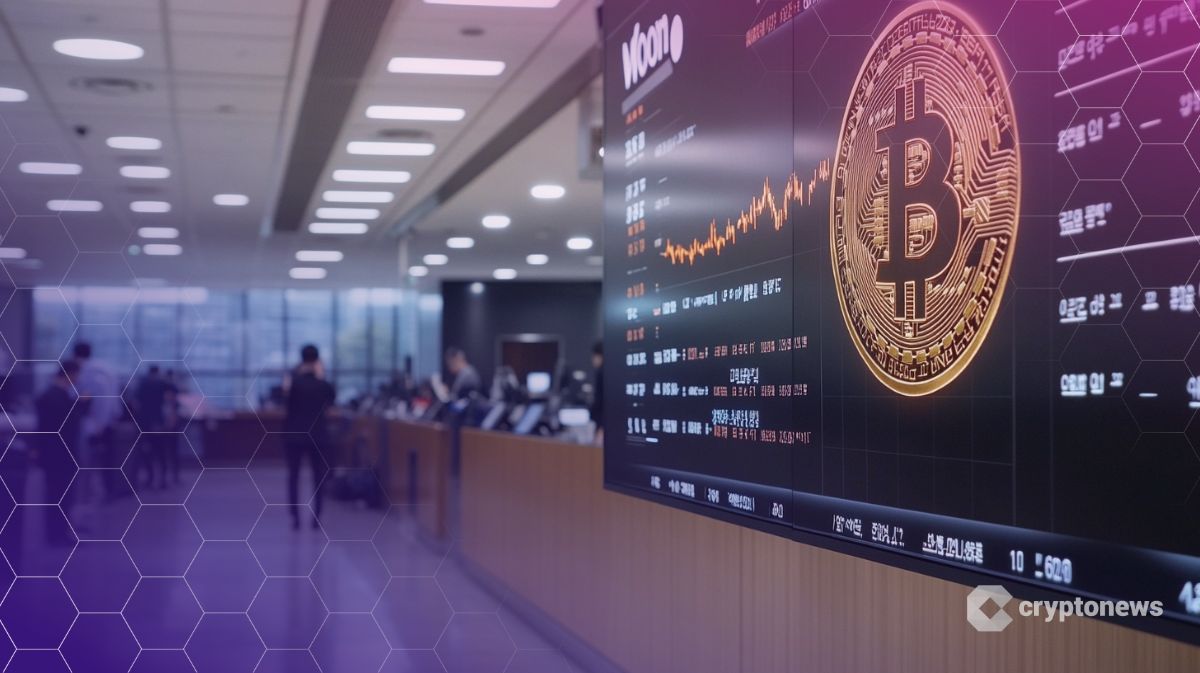
 South Korea will extend its crypto Travel Rule to cover sub-$700 transactions, closing a loophole used to evade identity checks.
 Naver Financial, the fintech arm of South Korean internet giant Naver, is preparing to roll out a stablecoin wallet in Busan.


 BREAKING: South Korea now suspects North Korea’s Lazarus Group is behind the recent hack on crypto exchange Upbit via Yonhap.