Reading view

There are new articles available, click to refresh the page.

NASA Wins Second Emmy Award for 2024 Total Solar Eclipse Broadcast

3 min read

Preparations for Next Moonwalk Simulations Underway (and Underwater)

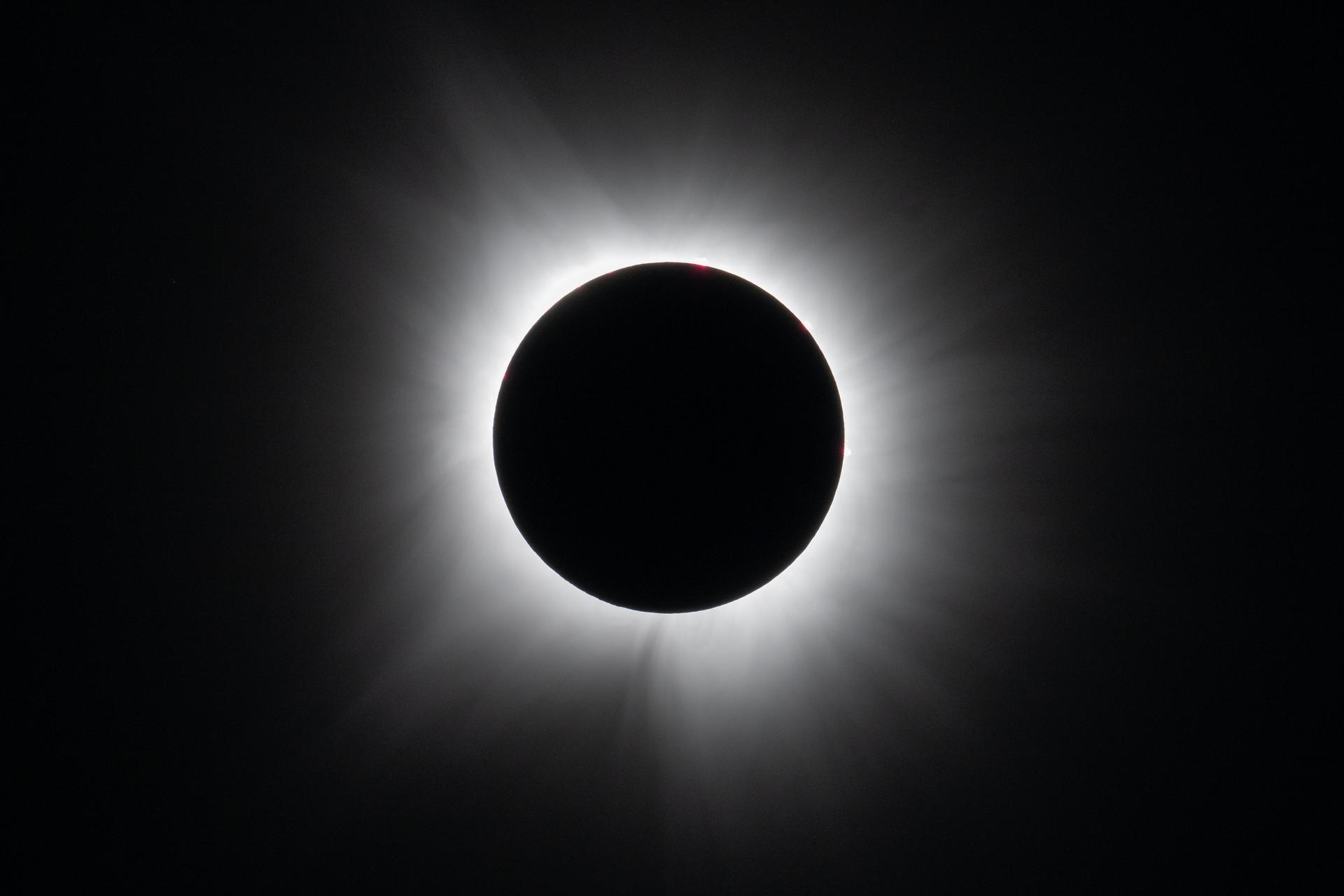
NASA’s broadcast of the April 8, 2024, total solar eclipse has won an Emmy Award for Excellence in Production Technology.

At the 76th Technology & Engineering Emmy Awards on Dec. 4, in New York City, the Academy of Television Arts & Sciences announced the win. Walt Lindblom and Sami Aziz accepted the award on behalf of the agency. For the broadcast, Lindblom served as the coordinating producer and Aziz served as the executive producer.

“By broadcasting the total solar eclipse, this team brought joy and wonder for our Sun, Moon, and Earth to viewers across America and the world,” said Will Boyington, associate administrator for the Office of Communications at NASA Headquarters in Washington. “Congratulations to the production team, whose efforts demonstrate the hard work and dedication to the sharing the marvel that makes our solar system something we strive to understand.” 

NASA’s live broadcast coverage of the 2024 total solar eclipse was the most complex live project ever produced by the agency. In total, NASA’s eclipse broadcasts garnered almost 40 million live and replay views across its own distribution channels, including on NASA+, the agency’s free streaming service. Externally, the agency’s main broadcast was picked up in 2,208 hits on 568 channels in 25 countries.

“Our unique place in the solar system allows us on Earth to witness one of the most spectacular science shows nature has to offer. NASA’s production team captured the action every step of the way across the path of totality, including the rare glimpse of the Sun’s corona,” said Nicky Fox, associate administrator for science at NASA Headquarters. “Congratulations to the NASA team for successfully showing the 2024 total solar eclipse through the eyes of NASA for the whole world to experience together.”

The broadcast spanned three hours, showcasing the eclipse across seven American states and two countries. From cities, parks, and stadiums, 11 hosts and correspondents provided on air commentary, interviews, and live coverage. Viewers tuned in from all over the world, including at watch parties in nine locations, from the Austin Public Library to New York’s Times Square. An interactive “Eclipse Board” provided real time data analysis as the Moon’s shadow crossed North America.

Live feeds from astronauts aboard the International Space Station and NASA’s WB-57 high-altitude research aircraft were brought in to provide rare and unique perspectives of the solar event. To make this possible, NASA deployed and enabled 67 cameras, 6 NASA Wide Area Network control rooms, 38 encoders, and 35 decoders. The team coordinated 20 live telescope feeds which represented 12 locations across the path of totality.

NASA’s eclipse broadcast won another Emmy award earlier this year at the 46th Annual News & Documentary Emmy Awards for Outstanding Live News Special. Additionally, the show received an Emmy nomination for Outstanding Show Open or Title Sequence – News. NASA’s eclipse communication and broadcast efforts also won two Webby Awards and two Webby People’s Voice Awards.

For more information about NASA, visit:

https://www.nasa.gov

Abbey Interrante / Karen Fox
Headquarters, Washington
301-201-0124 / 202-358-1600
abbey.a.interrante@nasa.gov / karen.c.fox@nasa.gov

💾

On April 8, 2024, North America's last total solar eclipse until 2045 moved across the continent. It made landfall in Mexico, crossed the United States from ...

What’s Up: November 2025 Skywatching Tips from NASA

Mars and Mercury cozy up, the Leonids sparkle, and Saturn’s rings are…disappearing? 

Mars and Mercury get close for a conjunction, the Leonid meteor shower delights, and Saturn’s rings are…disappearing?

Skywatching Highlights

  • Nov. 12: A conjunction between Mars and Mercury
  • Nov. 16-18: Leonid meteor shower peak viewing
  • Nov. 23: Saturn’s rings disappear

Transcript

Mars and Mercury have a cozy conjunction, the Leonid meteor shower delights, and Saturn’s rings are…disappearing?

That’s What’s Up for November.

Conjunction:

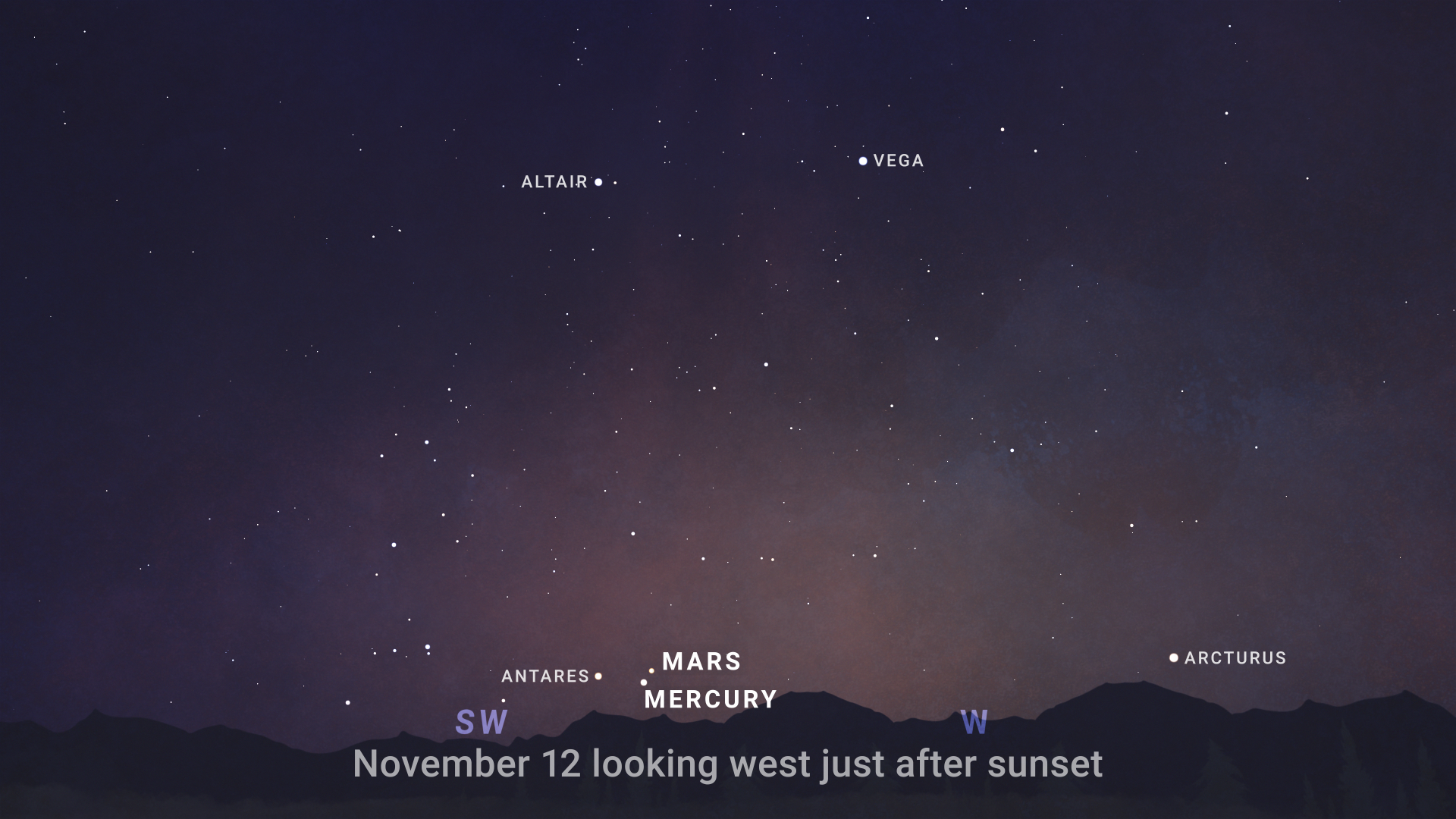
Mars and Mercury will cozy up together in the night sky just after sunset on November 12th.

The planets will experience what is known as a conjunction, meaning they appear close together in the sky from our view (even though in real life, Mars and Mercury are well over 100 million miles apart). 

But you can see these two long distance pals close together if you look slightly southwest just after sunset in the early evening sky on November 12th. 

A night sky view of the Mars-Mercury conjunction on November 12 just after sunset, looking west. Labeled stars include Antares, Altair, Vega, and Arcturus.
NASA/JPL-Caltech

Mars will be just to the right above Mercury, and you’ll know it’s Mars by its distinctive reddish-orange color.

Leonid Meteor Shower: 

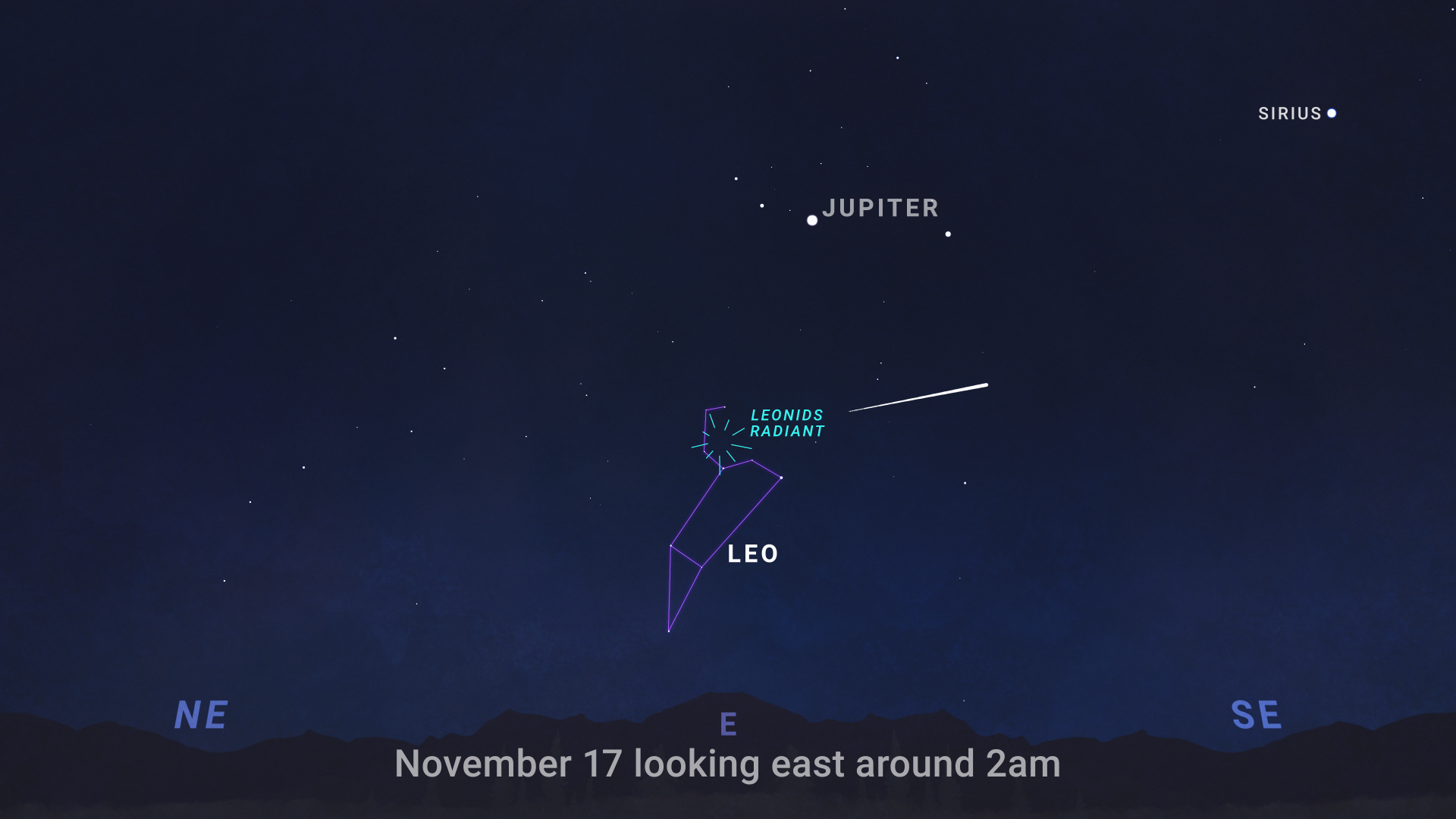
The Leonid meteor shower will sparkle across the skies this month, peaking on November 17th.

A night sky chart for the Leonids meteor shower on November 17 looking east around 2 am. It highlights the constellation Leo and the Leonids Radiant point. The planets Jupiter and the star Sirius are also visible.
NASA/JPL-Caltech

While the meteor shower stretches from November 3rd through December 2nd, it will be at its most visible late on the night of November 16th into the dawn of November 17th, even into the early morning of November 18th.

Look for meteors coming from the shower’s radiant point within the constellation Leo in the eastern sky.

With dark skies, you might see 10-15 meteors per hour with this shower which happens when we travel through the debris trailing the comet 55P/Tempel-Tuttle.

Saturn’s rings disappear

Saturn’s rings will disappear from view this November! 

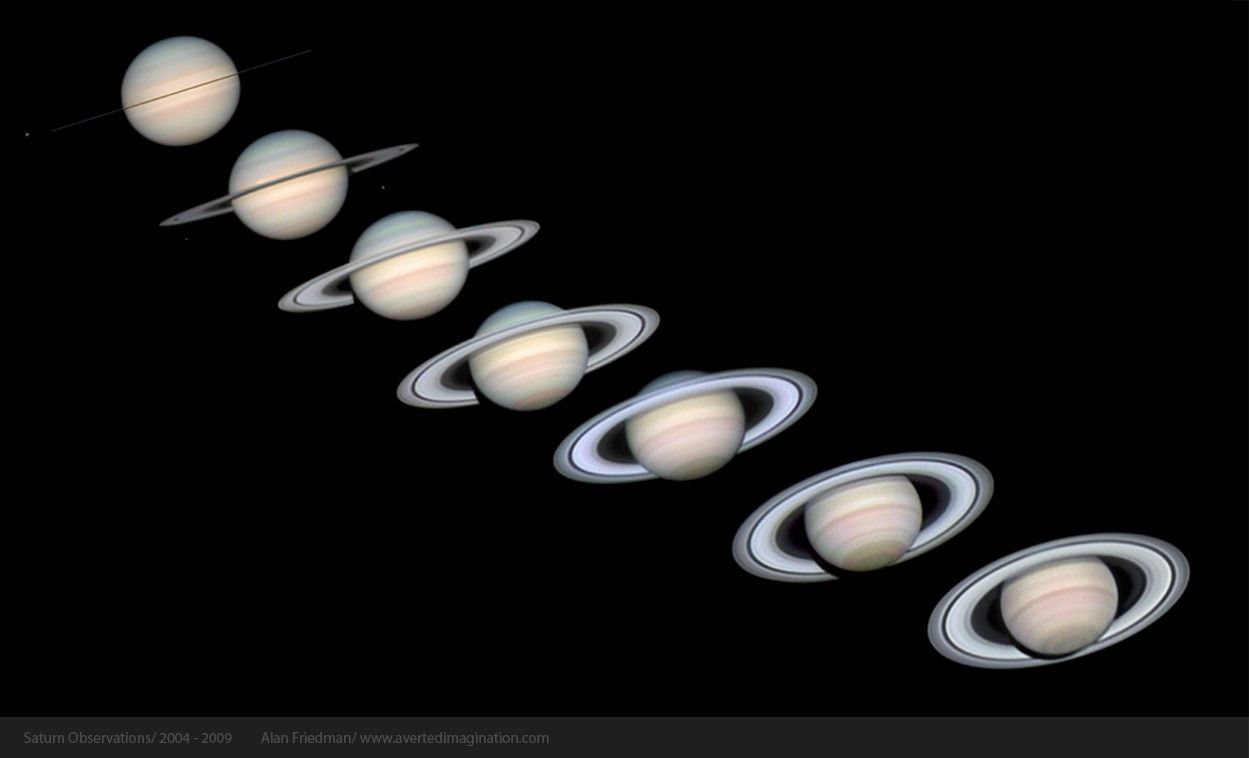
Saturn orbits the sun leaning at an angle of 26.7 degrees. This means that from our view, its rings shift up and down over time. 

On November 23, Saturn will be angled in such a way that its rings face us, and since they are so thin they’ll just disappear from view. 

A composite image of seven observations of Saturn from 2004 to 2009, showing the changing tilt of its rings from edge-on (top) to wide-open (bottom), illustrating Saturn's orbital motion.
Alan Friedman/avertedimagination.com

But don’t worry, the rings aren’t gone from view forever. As the planet continues to orbit, its rings will gradually become more visible again. 

Conclusion + Moon Phases

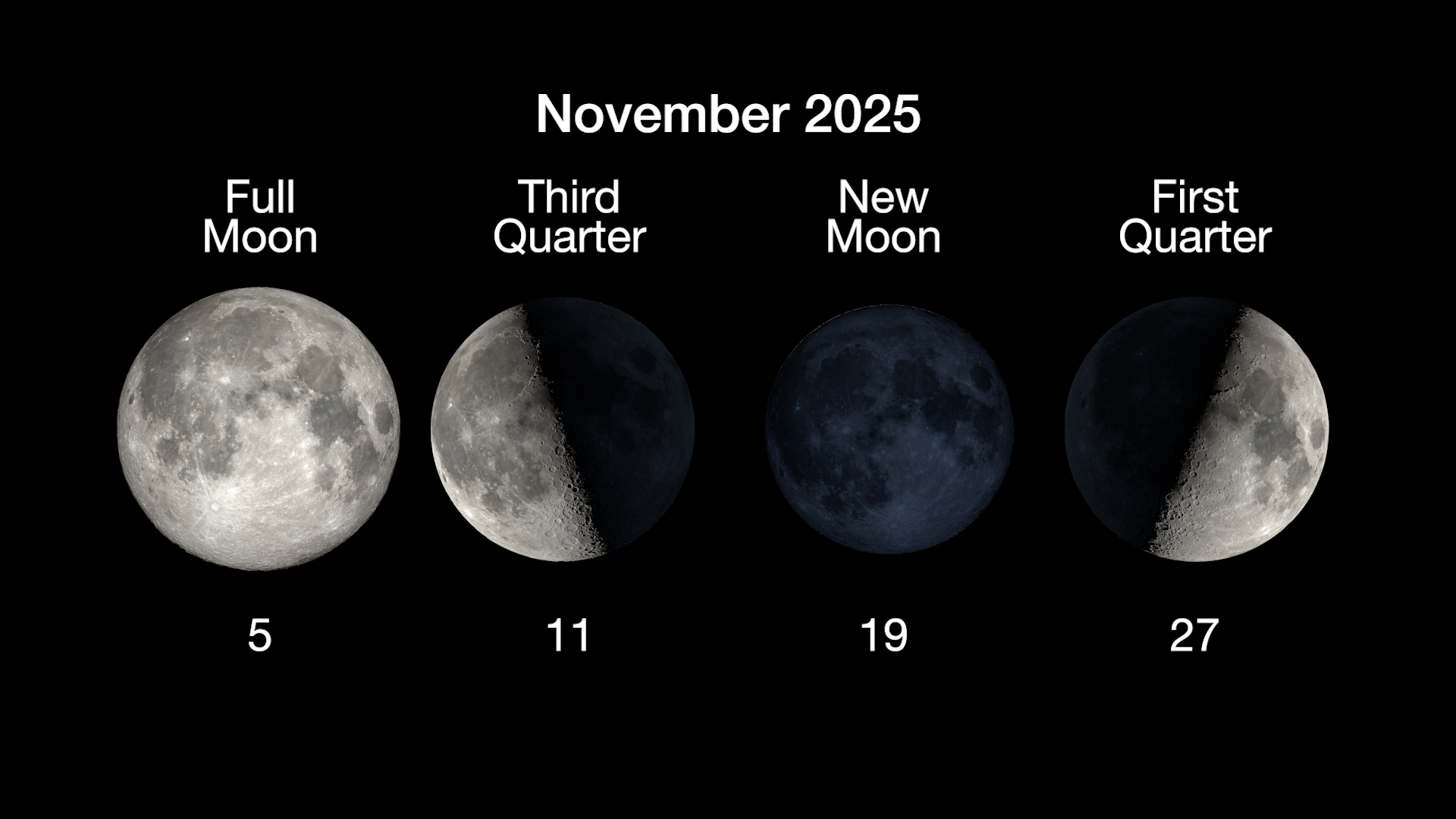
Here are the phases of the Moon for November.

An image showing the four primary Moon phases for November 2025. From left: Full Moon (Day 5), Third Quarter (Day 11), New Moon (Day 19), and First Quarter (Day 27), illustrating the cycle of lunar illumination.
NASA/JPL-Caltech

You can stay up to date on all of NASA’s missions exploring the solar system and beyond at science.nasa.gov.

I’m Chelsea Gohd from NASA’s Jet Propulsion Laboratory, and that’s What’s Up for this month.

Keep Exploring

Discover More Topics From NASA

La NASA compartirá imágenes del cometa 3I/ATLAS tomadas desde naves espaciales y telescopios

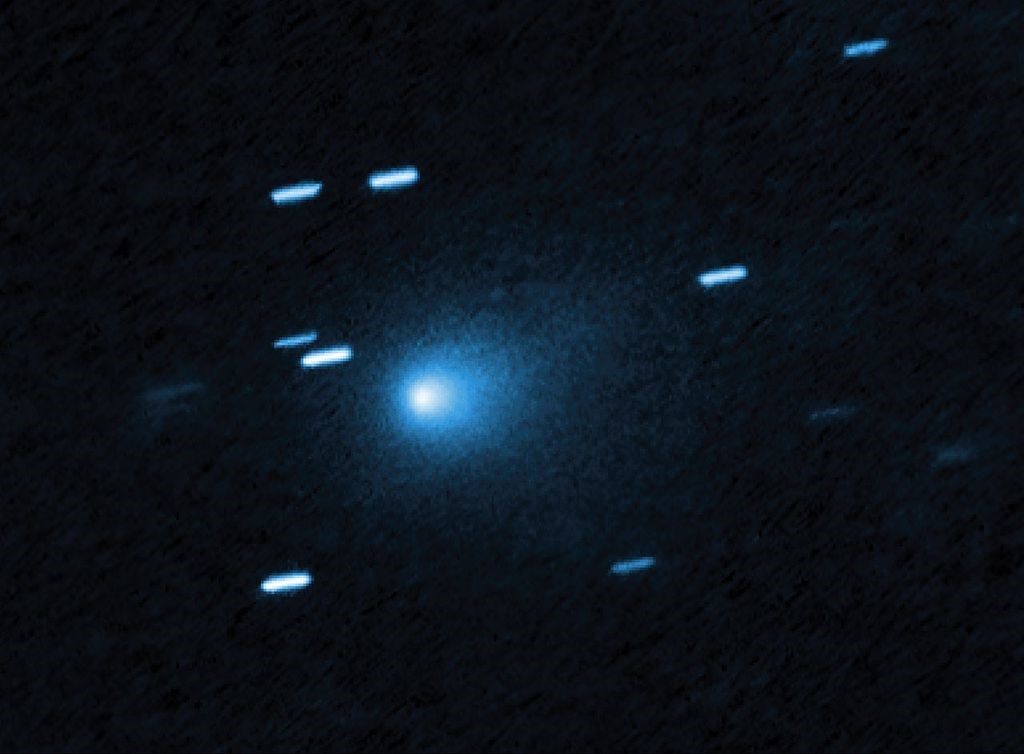
Hubble captured this image of the interstellar comet 3I/ATLAS on July 21, 2025, when the comet was 277 million miles from Earth. Hubble shows that the comet has a teardrop-shaped cocoon of dust coming off its solid, icy nucleus.
El telescopio espacial Hubble captó esta imagen del cometa interestelar 3I/ATLAS el 21 de julio de 2025, cuando el cometa se encontraba a 445 millones de kilómetros (277 millones de millas) de la Tierra. Hubble muestra que el cometa tiene una envoltura de polvo en forma de lágrima que se desprende de su núcleo sólido y helado.
Crédito: NASA, ESA, David Jewitt (UCLA); Procesamiento de imágenes: Joseph DePasquale (STScI)

Read this press release in English here.

La NASA ofrecerá un evento en vivo (en inglés) a las 3 p.m. EST del miércoles 19 de noviembre para compartir imágenes del cometa interestelar 3I/ATLAS captadas por varias misiones de la agencia. El evento tendrá lugar en el Centro de Vuelo Espacial Goddard de la NASA, en Greenbelt, Maryland.

El cometa 3I/ATLAS, descubierto el 1 de julio por el observatorio ATLAS (por las siglas en inglés de Sistema de Última Alerta de Impacto Terrestre de Asteroides), financiado por la NASA. El cometa es el tercer objeto identificado hasta la fecha que ha entrado en nuestro sistema solar procedente de otra parte de la galaxia. Aunque no supone ninguna amenaza para la Tierra y no se acercará a menos de 273 millones de kilómetros (170 millones de millas) de nuestro planeta, el cometa pasó a menos de 30 millones de kilómetros (19 millones de millas) de Marte a principios de octubre.

El evento se retransmitirá en NASA+, la aplicación de la NASA, el sitio web y el canal de YouTube de la agencia, y Amazon Prime.

Entre los participantes en la sesión informativa, que proceden de la sede central de la NASA en Washington, se encuentran:

  • Amit Kshatriya, administrador asociado de la NASA
  • Nicky Fox, administradora asociada, Dirección de Misiones Científicas
  • Shawn Domagal-Goldman, director interino, División de Astrofísica
  • Tom Statler, científico jefe para cuerpos pequeños del sistema solar.

Para participar virtualmente en el evento NASA Live, los miembros de los medios de comunicación deben enviar su nombre completo, afiliación mediática, dirección de correo electrónico y número de teléfono a más tardar dos horas antes del inicio del evento a Molly Wasser: molly.l.wasser@nasa.gov. Los miembros del público también podrán hacer preguntas utilizando #AskNASA en las redes sociales, y sus preguntas podrían ser respondidas, en inglés y en tiempo real, durante la transmisión. También contamos con un experto en la materia con disponibilidad limitada para entrevistas de seguimiento en español. Para solicitar una entrevista en español, póngase en contacto con María José Viñas: maria-jose.vinasgarcia@nasa.gov

Recursos de misiones científicas de la NASA proporcionan a Estados Unidos la capacidad única de observar a 3I/ATLAS prácticamente durante todo el tiempo que permanecerá en nuestra vecindad celeste y estudiar, con instrumentos científicos complementarios y desde diferentes direcciones, cómo se comporta el cometa. Estos instrumentos incluyen tanto naves espaciales en todo el sistema solar como observatorios terrestres.

Para más información sobre 3I/ATLAS, visite:

https://ciencia.nasa.gov/sistema-solar/cometa-3i-atlas/ (español)
https://go.nasa.gov/3I-ATLAS(inglés)

-fin-

Karen Fox / Molly Wasser / María José Viñas
Sede central, Washington
202-358-1600
karen.c.fox@nasa.gov / molly.l.wasser@nasa.gov / maria-jose.vinasgarcia@nasa.gov

NASA to Share Comet 3I/ATLAS Images From Spacecraft, Telescopes

Hubble captured this image of the interstellar comet 3I/ATLAS on July 21, 2025, when the comet was 277 million miles from Earth. Hubble shows that the comet has a teardrop-shaped cocoon of dust coming off its solid, icy nucleus.
Credit: NASA, ESA, David Jewitt (UCLA); Image Processing: Joseph DePasquale (STScI)

Lee este comunicado de prensa en español aquí.

NASA will host a live event at 3 p.m. EST, Wednesday, Nov. 19, to share imagery of the interstellar comet 3I/ATLAS collected by a number of the agency’s missions. The event will take place at NASA’s Goddard Space Flight Center in Greenbelt, Maryland.

Comet 3I/ATLAS, discovered by the NASA-funded ATLAS (Asteroid Terrestrial-impact Last Alert System) observatory on July 1, is only the third object ever identified as entering our solar system from elsewhere in the galaxy. While it poses no threat to Earth and will get no closer than 170 million miles to Earth, the comet flew within 19 million miles of Mars in early October.

The event will air on NASA+, the NASA app, the agency’s website and YouTube channel, and Amazon Prime.

Briefing participants include:

  • NASA Associate Administrator Amit Kshatriya
  • Nicky Fox, associate administrator, Science Mission Directorate
  • Shawn Domagal-Goldman, acting director, Astrophysics Division
  • Tom Statler, lead scientist for solar system small bodies

To participate virtually in the NASA Live event, members of the media must send their full name, media affiliation, email address, and phone number no later than two hours before the start of the event to Molly Wasser at: molly.l.wasser@nasa.gov. Members of the public also may ask questions, which may be answered in real time during the broadcast, by using #AskNASA on social media.

Assets within NASA’s science missions give the United States the unique capability to observe 3I/ATLAS almost the entire time it passes through our celestial neighborhood, and study – with complementary scientific instruments and from different directions – how the comet behaves. These assets include both spacecraft across the solar system, as well as ground-based observatories.

For more information on 3I/ATLAS, visit:

https://go.nasa.gov/3I-ATLAS

-end-

Karen Fox / Molly Wasser
Headquarters, Washington
202-358-1600
karen.c.fox@nasa.gov / molly.l.wasser@nasa.gov

What’s Up: October 2025 Skywatching Tips from NASA

A supermoon, and meteor showers from the Draconids and Orionids

A supermoon takes over the sky, the Draconid meteor shower peeks through, and the Orionid meteor shower shines bright.

Skywatching Highlights

  • Oct. 6: The October supermoon
  • Oct. 6-10: The Draconid meteor shower
  • Oct. 21: The Orionid meteor shower peaks (full duration Sept. 26 – Nov. 22)

Transcript

What’s Up for October? A Supermoon takes over, the Draconid meteor shower peeks through, and the Orionid meteors sparkle across the night sky.

The evening of October 6, look up and be amazed as the full moon is bigger and brighter because – it’s a supermoon!

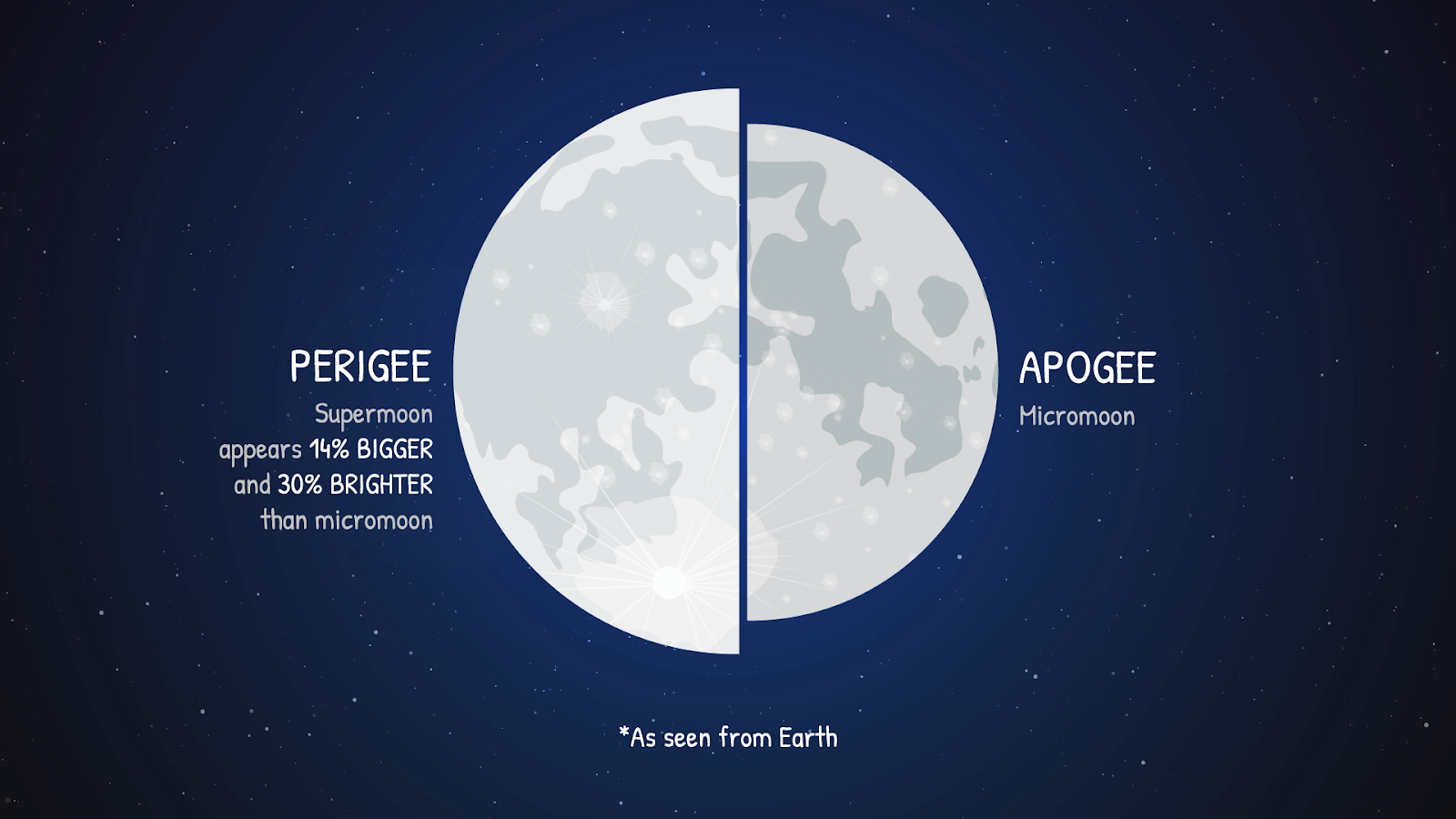
An illustrated infographic shows two halves of a moon against a dark blue sky background. On the left-hand side, the moon is larger, representing a supermoon during perigee as seen from Earth. On the right-hand side, the moon is smaller, representing a micromoon during apogee as seen from Earth.
Illustrated infographic showing the difference (as seen from Earth) between perigee, when a supermoon appears, and apogee, when a micromoon appears.
NASA/JPL-Caltech

This evening, the moon could appear to be about 30% brighter and up to 14% larger than a typical full moon. But why?

Supermoons happen when a new moon or a full moon coincides with “perigee,” which is when the moon is at its closest to Earth all month.

So this is an exceptionally close full moon! Which explains its spectacular appearance.

And what timing – while the supermoon appears on October 6th, just a couple of days before on October 4th is “International Observe the Moon Night”!

It’s an annual, worldwide event when Moon enthusiasts come together to enjoy our natural satellite.You can attend or host a moon-viewing party, or simply observe the Moon from wherever you are.

So look up, and celebrate the moon along with people all around the world!

The supermoon will light up the sky on October 6th, but if you luck into some dark sky between October 6th and 10th, you might witness the first of two October meteor showers – the Draconids!

The Draconid meteor shower comes from debris trailing the comet 21P Giacobini-Zinner burning up in Earth’s atmosphere

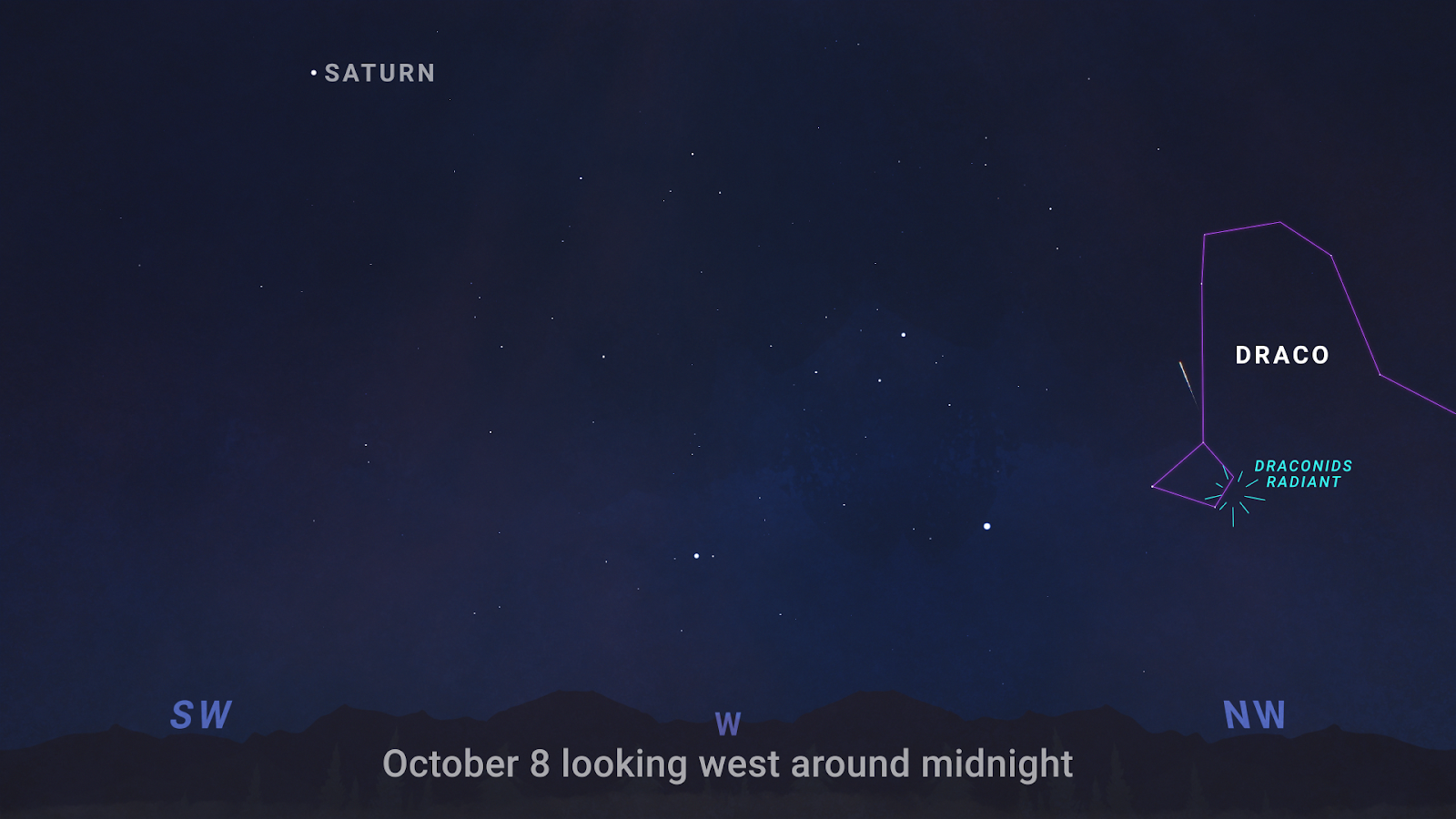
These meteors originate from nearby the head of the constellation Draco the dragon in the northern sky and the shower can produce up to 10 meteors per hour!

The Draconids peak around October 8th, but if you don’t see any, you can always blame the bright supermoon and wait a few weeks until the next meteor shower – the Orionids!

A star chart showing the Draconid meteor shower on October 8, looking west around midnight. The radiant of the shower is shown within the constellation Draco in the northwest sky, with the planet Saturn visible to the left.
Sky chart showing the Draconid meteor shower, including the radiant point of the shower and the Draco constellation where the meteors in the shower are often seen and stem from.
NASA/JPL-Caltech

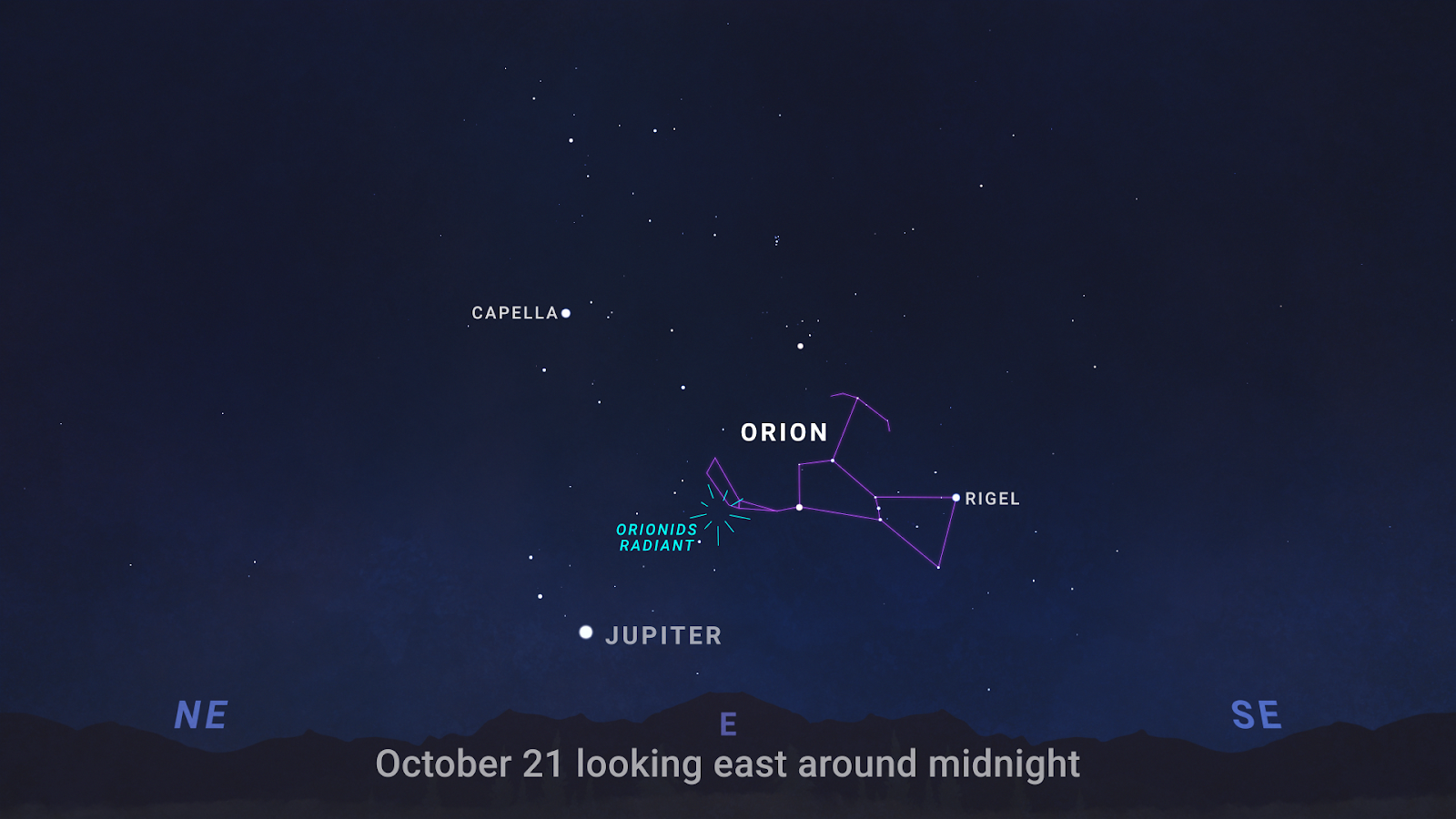
The Orionid meteor shower, peaking October 21, is set to put on a spectacular show, shooting about 20 meteors per hour across the night sky. 

This meteor shower happens when Earth travels through the debris trailing behind Halley’s Comet and it burns up in our atmosphere.

The full duration of the meteor shower stretches from September 26 to November 22, but your best bet to see meteors is on October 21 before midnight until around 2 am.

An illustrated sky chart shows a view of the western nighttime sky just around midnight. The scene features a twilight background with faint stars and labeled compass directions:
Sky chart showing the Orionid meteor shower, including the radiant point of the shower and the Orion constellation where the meteors in the shower are often seen and stem from.
NASA/JPL-Caltech

This is because, not only is this night the shower’s peak, it is also the October new moon, meaning the moon will be between the Earth and the Sun, making it dark and invisible to us.

With a moonless sky, you’re much more likely to catch a fireball careening through the night.

So find a dark location after the sun has set, look to the southeast sky (if you’re in the northern hemisphere) and the northeast (if you’re in the southern hemisphere) and enjoy!

Orionid meteors appear to come from the direction of the Orion constellation but you might catch them all across the sky.

Here are the phases of the Moon for October.

You can stay up to date on all of NASA’s missions exploring the solar system and beyond at science.nasa.gov.

I’m Chelsea Gohd from NASA’s Jet Propulsion Laboratory, and that’s What’s Up for this month.

Keep Exploring

Discover More Topics From NASA
New NASA Mission to Reveal Earth’s Invisible ‘Halo’

5 min read

New NASA Mission to Reveal Earth’s Invisible ‘Halo’

This story is also available in Spanish.

A new NASA mission will capture images of Earth’s invisible “halo,” the faint light given off by our planet’s outermost atmospheric layer, the exosphere, as it morphs and changes in response to the Sun. Understanding the physics of the exosphere is a key step toward forecasting dangerous conditions in near-Earth space, a requirement for protecting Artemis astronauts traveling through the region on the way to the Moon or on future trips to Mars. The Carruthers Geocorona Observatory will launch from NASA’s Kennedy Space Center in Florida no earlier than Tuesday, Sept. 23.

Revealing Earth’s invisible edge

In the early 1970s, scientists could only speculate about how far Earth’s atmosphere extended into space. The mystery was rooted in the exosphere, our atmosphere’s outermost layer, which begins some 300 miles up. Theorists conceived of it as a cloud of hydrogen atoms — the lightest element in existence — that had risen so high the atoms were actively escaping into space.

But the exosphere reveals itself only via a faint “halo” of ultraviolet light known as the geocorona. Pioneering scientist and engineer Dr. George Carruthers set himself the task of seeing it. After launching a few prototypes on test rockets, he developed an ultraviolet camera ready for a one-way trip to space.

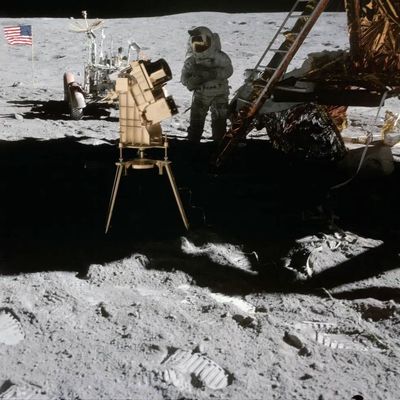
An astronaut stands on the Moon near a lunar module and scientific equipment, with an American flag and lunar rover in the background. The lunar surface is covered in footprints and gray dust.
Apollo 16 astronaut John Young is pictured on the lunar surface with George Carruthers’ gold-plated Far Ultraviolet Camera/Spectrograph, the first Moon-based observatory. The Lunar Module “Orion” is on the right and the Lunar Roving Vehicle is parked in the background next to the American flag.
NASA

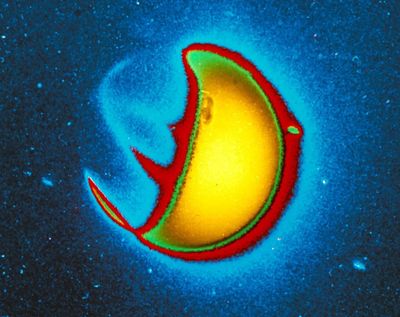
In April 1972, Apollo 16 astronauts placed Carruthers’ camera on the Moon’s Descartes Highlands, and humanity got its first glimpse of Earth’s geocorona. The images it produced were as stunning for what they captured as they were for what they didn’t.

“The camera wasn’t far enough away, being at the Moon, to get the entire field of view,” said Lara Waldrop, principal investigator for the Carruthers Geocorona Observatory. “And that was really shocking — that this light, fluffy cloud of hydrogen around the Earth could extend that far from the surface.” Waldrop leads the mission from the University of Illinois Urbana-Champaign, where George Carruthers was an alumnus.

A false-color, close-up image of Earth’s exosphere as captured by the Carruthers Geocorona Observatory against a dark blue background. The image shows a semicircle glowing yellow and outlined in red.
The first image of UV light from Earth’s outer atmosphere, the geocorona, taken from a telescope designed and built by George Carruthers. The telescope took the image while on the Moon during the Apollo 16 mission in 1972.
G. Carruthers (NRL) et al./Far UV Camera/NASA/Apollo 16

Our planet, in a new light

Today, the exosphere is thought to stretch at least halfway to the Moon. But the reasons for studying go beyond curiosity about its size.

As solar eruptions reach Earth, they hit the exosphere first, setting off a chain of reactions that sometimes culminate in dangerous space weather storms. Understanding the exosphere’s response is important to predicting and mitigating the effects of these storms. In addition, hydrogen — one of the atomic building blocks of water, or H2O — escapes through the exosphere. Mapping that escape process will shed light on why Earth retains water while other planets don’t, helping us find exoplanets, or planets outside our solar system, that might do the same.

NASA’s Carruthers Geocorona Observatory, named in honor of George Carruthers, is designed to capture the first continuous movies of Earth’s exosphere, revealing its full expanse and internal dynamics.

“We’ve never had a mission before that was dedicated to making exospheric observations,” said Alex Glocer, the Carruthers mission scientist at NASA’s Goddard Space Flight Center in Greenbelt, Maryland. “It’s really exciting that we’re going to get these measurements for the first time.”

Download this video from NASA’s Scientific Visualization Studio.

Journey to L1

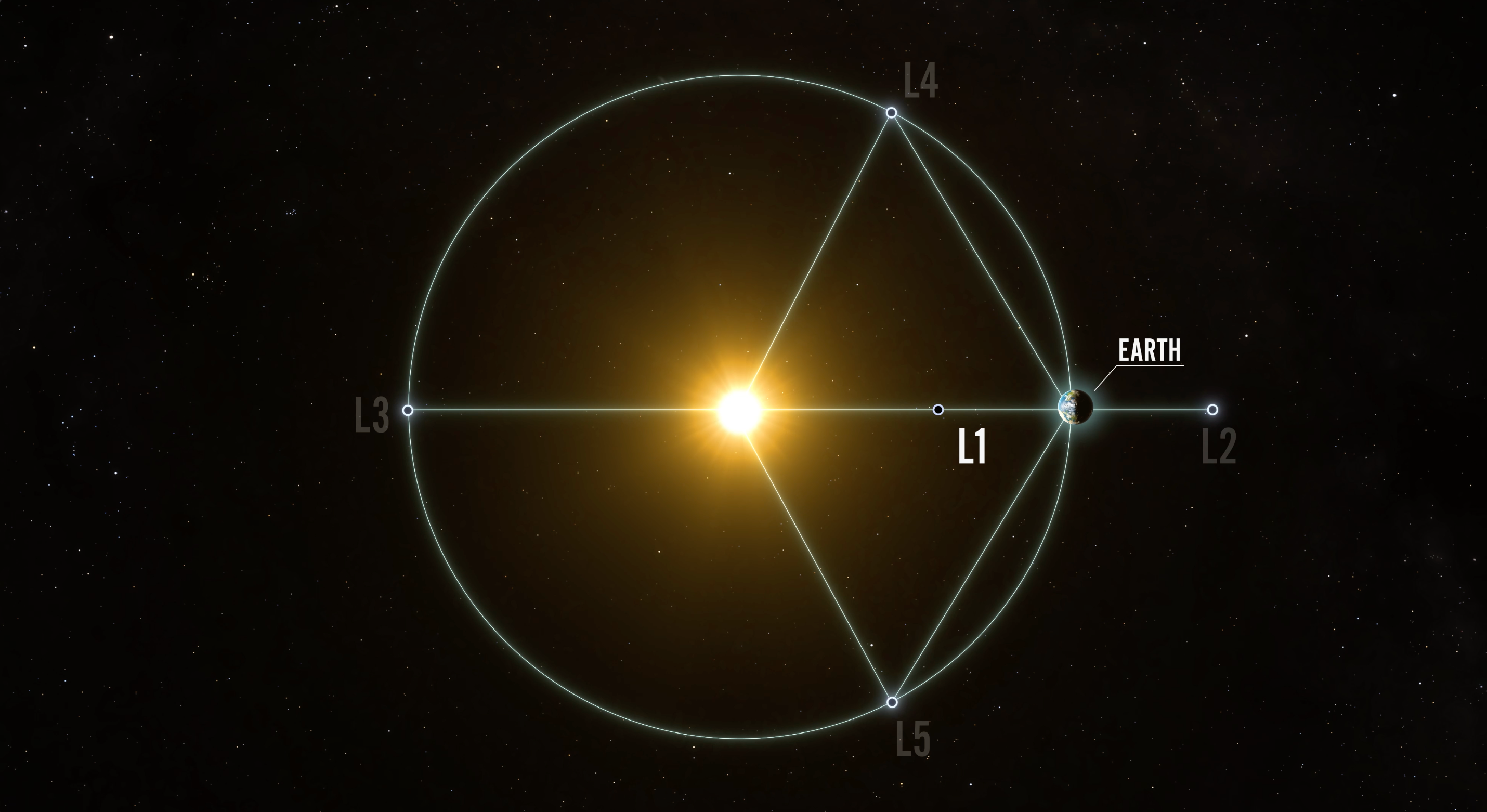
At 531 pounds and roughly the size of a loveseat sofa, the Carruthers spacecraft will launch aboard a SpaceX Falcon 9 rocket along with NASA’s IMAP (Interstellar Mapping and Acceleration Probe) spacecraft and the National Oceanic and Atmospheric Administration’s SWFO-L1 (Space Weather Follow On – Lagrange 1) space weather satellite. After launch, all three missions will commence a four-month cruise phase to Lagrange point 1 (L1), a location approximately 1 million miles closer to the Sun than Earth is. After a one-month period for science checkouts, Carruthers’ two-year science phase will begin in March 2026.

An artist’s concept showing a diagram including the Sun, Earth, and five labeled points (L1–L5) representing the Sun-Earth Lagrange Points, where gravitational forces balance in the Sun-Earth system, against the backdrop of space. L1, where the Carruthers spacecraft will orbit, is labeled with brighter, bold text. Earth is labeled as well.
Artist’s concept of the five Sun-Earth Lagrange points in space. At Lagrange points, the gravitational pull of two large masses counteract, allowing spacecraft to reduce fuel consumption needed to remain in position. The L1 point of the Earth-Sun system affords an uninterrupted view of the Sun and will be home to three new heliophysics missions in 2025: NASA’s Interstellar Mapping and Acceleration Probe (IMAP), NASA’s Carruthers Geocorona Observatory, and NOAA’s Space Weather Follow-On – Lagrange 1 (SWFO – L1).
NASA’s Conceptual Image Lab/Krystofer Kim

From L1, roughly four times farther away than the Moon, Carruthers will capture a comprehensive view of the exosphere using two ultraviolet cameras, a near-field imager and a wide-field imager.

“The near-field imager lets you zoom up really close to see how the exosphere is varying close to the planet,” Glocer said. “The wide-field imager lets you see the full scope and expanse of the exosphere, and how it’s changing far away from the Earth’s surface.”

The two imagers will together map hydrogen atoms as they move through the exosphere and ultimately out to space. But what we learn about atmospheric escape on our home planet applies far beyond it.

“Understanding how that works at Earth will greatly inform our understanding of exoplanets and how quickly their atmospheres can escape,” Waldrop said.

By studying the physics of Earth, the one planet we know that supports life, the Carruthers Geocorona Observatory can help us know what to look for elsewhere in the universe.

The Carruthers Geocorona Observatory mission is led by Lara Waldrop from the University of Illinois Urbana-Champaign. The Space Sciences Laboratory at the University of California, Berkeley leads mission implementation, design and development of the payload in collaboration with Utah State University’s Space Dynamics Laboratory. The Carruthers spacecraft was designed and built by BAE Systems. NASA’s Explorers and Heliophysics Projects Division at the agency’s Goddard Space Flight Center in Greenbelt, Maryland, manages the mission for the agency’s Heliophysics Division at NASA Headquarters in Washington.

By Miles Hatfield
NASA’s Goddard Space Flight Center, Greenbelt, Md.

Keep Exploring

Discover More Topics From NASA

Regions on Asteroid Explored by NASA’s Lucy Mission Get Official Names

The IAU (International Astronomical Union), an international non-governmental research organization and global naming authority for celestial objects, has approved official names for features on Donaldjohanson, an asteroid NASA’s Lucy spacecraft visited on April 20. In a nod to the fossilized inspiration for the names of the asteroid and spacecraft, the IAU’s selections recognize significant sites and discoveries on Earth that further our understanding of humanity’s origins.

The asteroid was named in 2015 after paleoanthropologist Donald Johanson, discoverer of one of the most famous fossils ever found of a female hominin, or ancient human ancestor, nicknamed Lucy. Just as the Lucy fossil revolutionized our understanding of human evolution, NASA’s Lucy mission aims to revolutionize our understanding of solar system evolution by studying at least eight Trojan asteroids that share an orbit with Jupiter.

The Lucy spacecraft cartoon character peeking out from behind an artistic rendering of the two-lobed asteroid Donaldjohanson with the words “Greetings from Donaldjohanson.”
Postcard commemorating NASA’s Lucy spacecraft April 20, 2025, encounter with the asteroid Donaldjohanson.
NASA’s Goddard Space Flight Center

Donaldjohanson, located in the main asteroid belt between the orbits of Mars and Jupiter, was a target for Lucy because it offered an opportunity for a comprehensive “dress rehearsal” for Lucy’s main mission, with all three of its science instruments carrying out observation sequences very similar to the ones that will occur at the Trojans.

After exploring the asteroid and getting to see its features up close, the Lucy science and engineering team proposed to name the asteroid’s surface features in recognition of significant paleoanthropological sites and discoveries, which the IAU accepted.

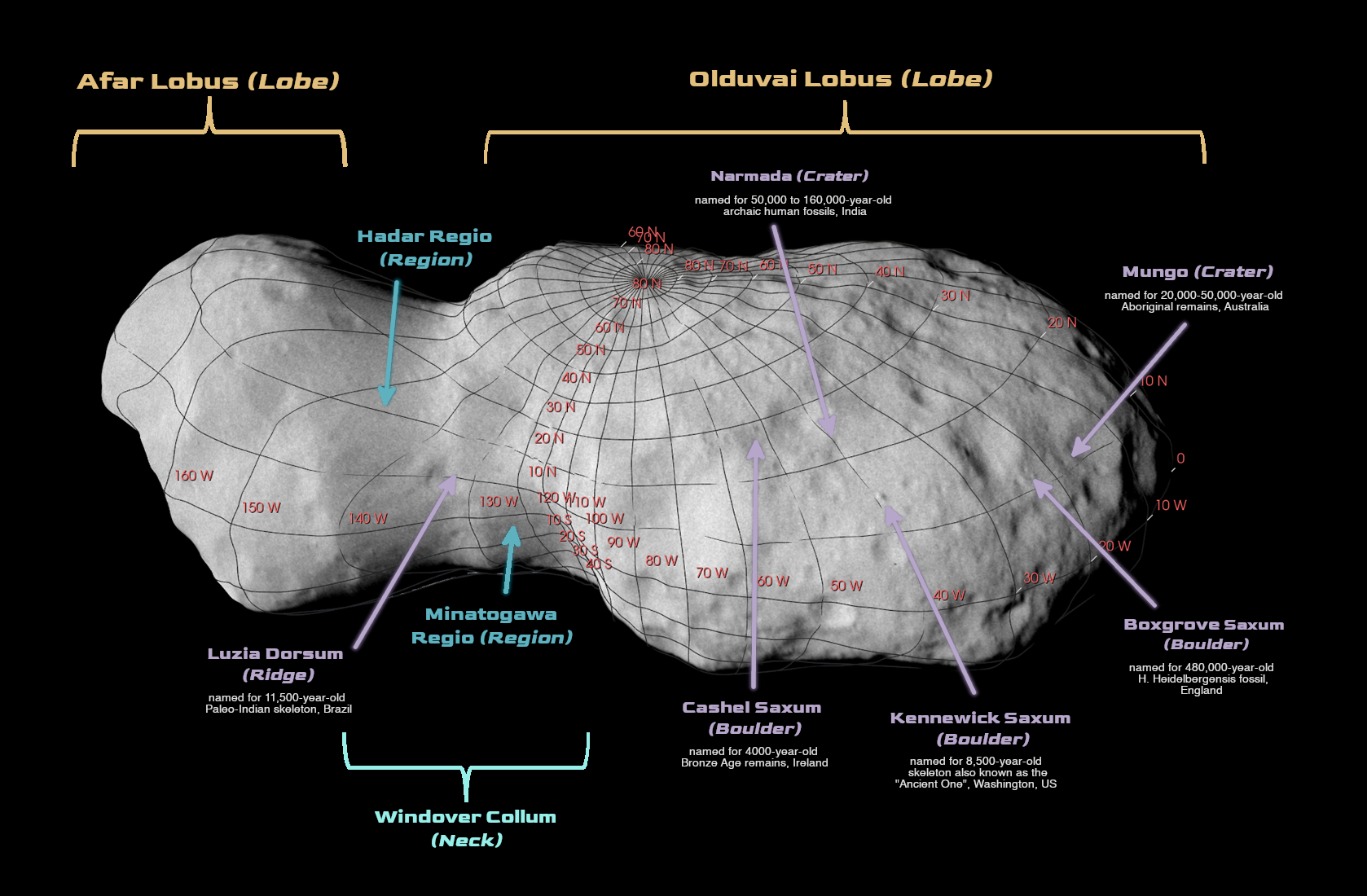
The smaller lobe is called Afar Lobus, after the Ethiopian region where Lucy and other hominin fossils were found. The larger lobe is named Olduvai Lobus, after the Tanzanian river gorge that has also yielded many important hominin discoveries.

The asteroid’s neck, Windover Collum, which joins those two lobes, is named after the Windover Archeological Site near Cape Canaveral Space Force Station in Florida — where NASA’s Lucy mission launched in 2021. Human remains and artifacts recovered from that site revolutionized our understanding of the people who lived in Florida around 7,300 years ago.

The asteroid Donaldjohanson with latitude and longitude lines and arrows indicating the names of various features on the surface.
Officially recognized names of geologic features on the asteroid Donaldjohanson.
NASA Goddard/SwRI/Johns Hopkins APL

Two smooth areas on the asteroid’s neck are named Hadar Regio, marking the specific site of Johanson’s discovery of the Lucy fossil, and Minatogawa Regio, after the location where the oldest known hominins in Japan were found. Select boulders and craters on Donaldjohanson are named after notable fossils ranging from pre-Homo sapiens hominins to ancient modern humans. The IAU also approved a coordinate system for mapping features on this uniquely shaped small world.

As of Sept. 9, the Lucy spacecraft was nearly 300 million miles (480 million km) from the Sun en route to its August 2027 encounter with its first Trojan asteroid called Eurybates. This places Lucy about three quarters of the way through the main asteroid belt. Since its encounter with Donaldjohanson, Lucy has been cruising without passing close to any other asteroids, and without requiring any trajectory correction maneuvers.

The team continues to carefully monitor the instruments and spacecraft as it travels farther from the Sun into a cooler environment.

Stay tuned at nasa.gov/lucy for more updates as Lucy continues its journey toward the never-before-explored Jupiter Trojan asteroids, and download a postcard commemorating the Donaldjohanson encounter.

By Katherine Kretke
Southwest Research Institute

Media Contact:

Lonnie Shekhtman

lonnie.shekhtman@nasa.gov

NASA’s Goddard Space Flight Center, Greenbelt, Md.

❌