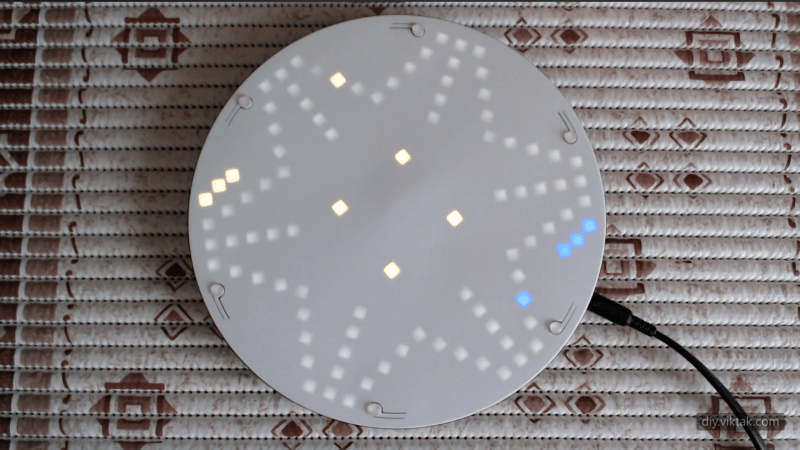
Like many classic board games, Ludo offers its players numerous opportunities to inflict frustration on other players. Despite this, [Viktor Takacs] apparently enjoys it, which motivated him to build a thoroughly modernized, LED-based, WiFi-enabled game board for it (GitHub repository).
The new game board is built inside a stylish 3D-printed enclosure with a thin white front face, under which the 115 LEDs sit. Seven LEDs in the center represent a die, and the rest mark out the track around the board and each user’s home row. Up to six people can play on the board, and different colors of the LEDs along the track represent their tokens’ positions. To prevent light leaks, a black plastic barrier surrounds each LED. Each player has one button to control their pieces, with a combination of long and short presses serving to select one of the possible actions.
The electronics themselves are mounted on seven circuit boards, which were divided into sections to reduce their size and therefore their manufacturing cost. For component placement reasons, [Viktor] used a barrel connector instead of USB, but for more general compatibility also created an adapter from USB-C to a barrel plug. The board is controlled by an ESP32-S3, which hosts a server that can be used to set game rules, configure player colors, save and load games, and view statistics for the game (who rolled the most sixes, who sent other players home most often, etc.).
If you prefer your games a bit more complex, we’ve also seen electronics added to Settlers of Catan. On a rather larger scale, there is also this LED-based board game which invites humans onto the board itself.
Google Chrome is rolling out updates to its autofill feature, giving the browser much deeper access to the data stored in your Google Account and Google Wallet. This move means consolidating even more of your personal information under Google's umbrella.
Mappa's theatrical hodgepodge of a compilation film and preview of 'Jujutsu Kaisen' season 3 showcases the inherent flaws of the popular supernatural shonen series more than its merits.
Ethereum has retraced from the $3,240 level and is now testing the $3,150 zone as support, a key area that traders are closely watching. Bulls are attempting to defend this level after a modest rebound, but uncertainty remains high as the market tries to establish direction following weeks of volatility and aggressive selling pressure. While some analysts view this consolidation as the early stages of a recovery, others warn that ETH may still be vulnerable to deeper pullbacks if momentum fails to strengthen.
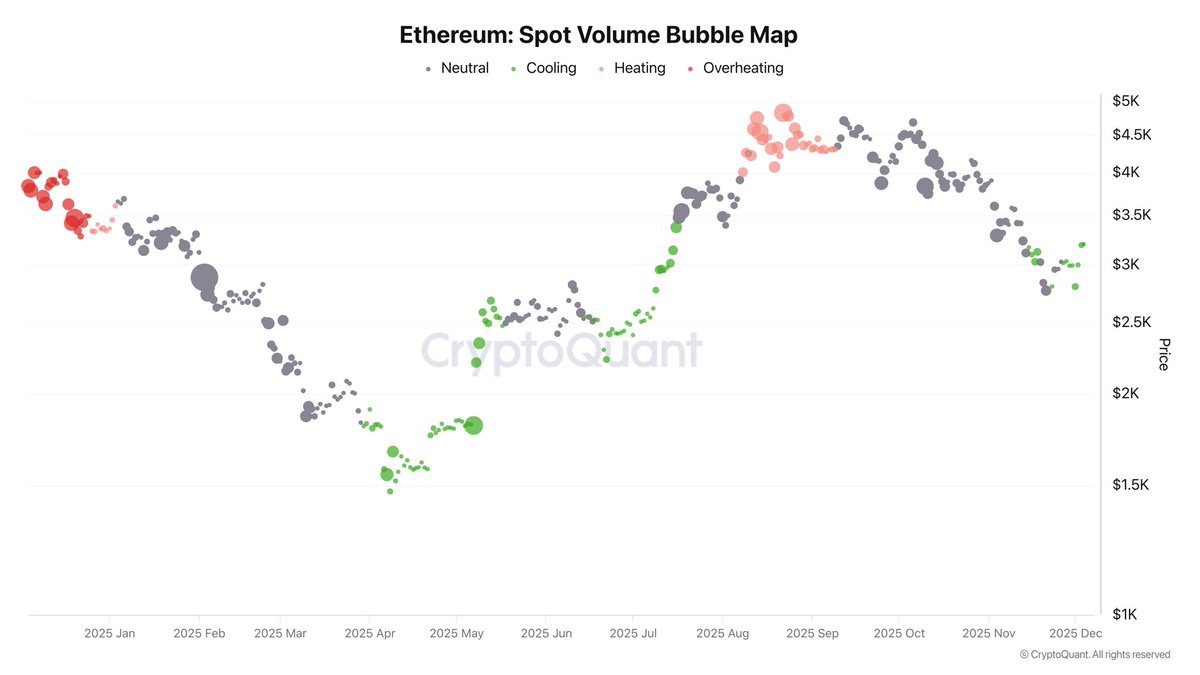
According to top analyst Darkfost, Ethereum’s recent price action is being shaped by a notable shift in market structure. Over the past few days, spot volumes have continued to decline, even as the price attempted a small recovery. This weakening in spot activity reduces the impact of actual buying and selling on the underlying asset, making futures markets increasingly influential in dictating short-term price direction.
As Darkfost explains, when spot volume thins out, futures often become the dominant driver of volatility. This dynamic can accelerate both upside and downside moves, depending on traders’ positioning. With Ethereum now sitting at a critical support level, the market awaits clearer signals to determine whether this rebound can evolve into a sustained recovery or merely represents a temporary pause in the downtrend.
Futures-Driven Momentum Raises the Stakes for Ethereum
Darkfost expands on this dynamic by noting that when spot volumes weaken to the extent seen over the past few days, the risk of heightened volatility increases sharply. Thin spot liquidity means fewer buy and sell orders are available to absorb sudden moves, allowing futures-driven momentum to exert an outsized influence on price. This environment often produces sharper swings and rapid directional shifts, as leveraged traders and algorithmic strategies dominate short-term market behavior.
For now, the futures market is tilting upward, providing a constructive force that is helping Ethereum hold above the $3,150 support zone. Darkfost emphasizes that this upward pressure from futures could work in the bulls’ favor, as volatility—if it expands to the upside—may push the spot market to follow the same trajectory.
In other words, a sustained futures-led rebound could act as the spark needed for a broader recovery, especially if spot buyers gain confidence and begin re-entering the market.
However, this setup cuts both ways. Without stronger spot participation, any reversal in futures positioning could quickly translate into accelerated downside pressure. For now, Ethereum sits in a delicate phase where volatility is both a potential catalyst and a potential threat, making the next few sessions crucial for determining the market’s short-term direction.
ETH Weekly Structure Holds Key Support
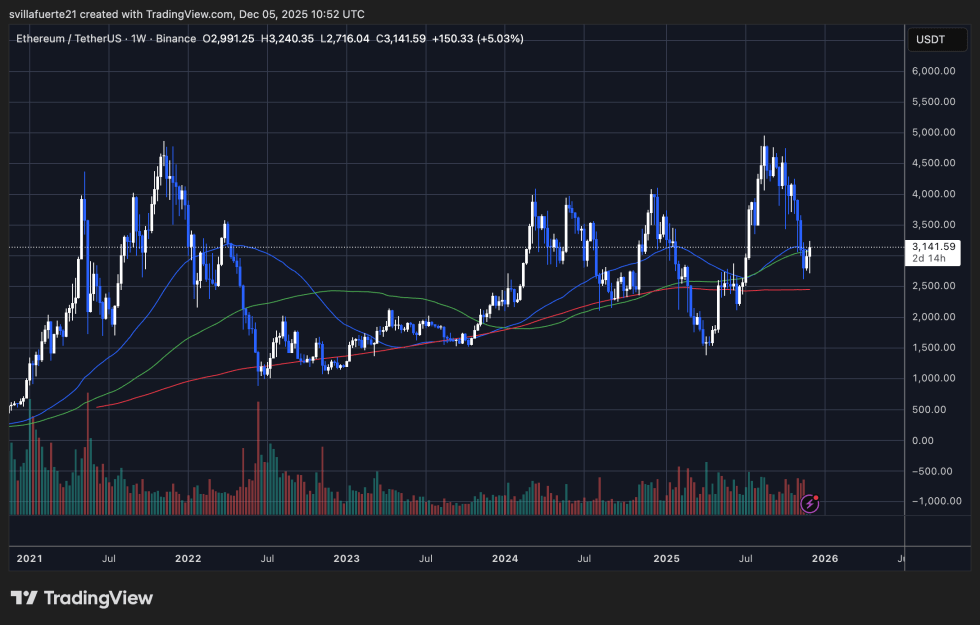
Ethereum’s weekly chart shows a market attempting to stabilize after a steep downturn from the $4,500 region. ETH has rebounded toward $3,140, reclaiming its 100-week moving average (green line) — a historically important support level that often defines the boundary between mid-term bullish and bearish phases. This bounce signals renewed demand at a critical zone, especially after the strong wick rejection seen near $2,700, where buyers stepped in aggressively.
However, Ethereum still faces meaningful resistance overhead. The 50-week moving average (blue line), now hovering near $3,400–$3,500, has flipped into resistance and remains the next major hurdle for bulls. A successful reclaim of this zone would materially improve ETH’s technical structure and open the door to a challenge of higher levels. Until then, the weekly trend remains neutral to slightly bearish.
Volume offers an encouraging signal: the recent rebound occurred with a noticeable uptick in buying activity compared to prior weeks, suggesting strengthened interest at these lower levels. Yet the broader structure shows a pattern of lower highs since August, meaning ETH must demonstrate follow-through to avoid slipping back into deeper consolidation.
Featured image from ChatGPT, chart from TradingView.com
Scrolling through Netflix's vast anime titles can feel like a daunting task, especially if you're like me and not knee-deep in the genre. The streaming service makes it easy to delve into classic and newer episodic series and movies, and you're sure to find something you like.
Chrome 143 fixes 13 security vulnerabilities, including four high-severity flaws, in a December desktop update rolling out to Windows, macOS, and Linux users.
Bluetooth is a well-worn technology that you might be tempted to write off in your smart home, especially if your server doesn’t already have Bluetooth capabilities. I wasn’t going to bother, but then I saw an opportunity to pick up a cheap adapter and gave it a shot.
Two Virginia brothers Muneeb and Sohaib Akhter, previously convicted of hacking the U.S. State Department, were rehired as federal contractors and are now charged with conspiring to steal sensitive data and destroy government databases after being fired. "Following the termination of their employment, the brothers allegedly sought to harm the company and its U.S. government customers by accessing computers without authorization, issuing commands to prevent others from modifying the databases before deletion, deleting databases, stealing information, and destroying evidence of their unlawful activities," the Justice Department said in a Wednesday press release. BleepingComputer reports: According to court documents, Muneeb Akhter deleted roughly 96 databases containing U.S. government information in February 2025, including Freedom of Information Act records and sensitive investigative documents from multiple federal agencies. One minute after deleting a Department of Homeland Security database, Muneeb Akhter also allegedly asked an artificial intelligence tool for instructions on clearing system logs after deleting a database.
The two defendants also allegedly ran commands to prevent others from modifying the targeted databases before deletion, and destroyed evidence of their activities. The prosecutors added that both men wiped company laptops before returning them to the contractor and discussed cleaning out their house in anticipation of a law enforcement search. The complaint also claims that Muneeb Akhter stole IRS information from a virtual machine, including federal tax data and identifying information for at least 450 individuals, and stole Equal Employment Opportunity Commission information after being fired by the government contractor.
Muneeb Akhter has been charged with conspiracy to commit computer fraud and destroy records, two counts of computer fraud, theft of U.S. government records, and two counts of aggravated identity theft. If found guilty, he faces a minimum of two years in prison for each aggravated identity theft count, with a maximum of 45 years on other charges. His brother, Sohaib, is charged with conspiracy to commit computer fraud and password trafficking, facing a maximum penalty of six years if convicted.
Chrome 143 fixes 13 security vulnerabilities, including four high-severity flaws, in a December desktop update rolling out to Windows, macOS, and Linux users.
I've never been a fan of Christmas lights, but I do love Matter, and that's the only reason I had any interest in the Govee Christmas Sparkle String Lights. But it's the fun I had with this product that makes it a welcome addition to this year's tree.
Qilin ransomware claims it stole internal data from the Church of Scientology, sharing 22 screenshots as proof. The breach remains unconfirmed by the organization.
Kohler is facing backlash after an engineer pointed out that the company’s new smart toilet cameras may not be as private as it wants people to believe. The discussion raises questions about Kohler’s use of the term “end-to-end encryption” (E2EE) and the inherent privacy limitations of a device that films the goings-on of a toilet bowl.
In October, Kohler announced its first “health” product, the Dekoda. Kohler’s announcement described the $599 device (it also requires a subscription that starts at $7 per month) as a toilet bowl attachment that uses “optical sensors and validated machine-learning algorithms” to deliver “valuable insights into your health and wellness.” The announcement added:
Data flows to the personalized Kohler Health app, giving users continuous, private awareness of key health and wellness indicators—right on their phone. Features like fingerprint authentication and end-to-end encryption are designed for user privacy and security.
The average person is most likely to be familiar with E2EE through messaging apps, like Signal. Messages sent via apps with E2EE are encrypted throughout transmission. Only the message’s sender and recipient can view the decrypted messages, which is intended to prevent third parties, including the app developer, from reading them.
Sophisticated online fraud techniques are growing more accessible to unskilled attackers, driven by AI tools and fraud-as-a-service platforms, according to Sumsub’s latest Identity Fraud Report.
Washington state regulators ordered Seattle-based cryptocurrency company Coinme to stop transmitting money for customers in the state, alleging the startup improperly claimed more than $8 million in customer funds as its own income.
The Washington State Department of Financial Institutions (DFI) announced Monday that it issued a temporary cease-and-desist order and statement of charges against Coinme, which lets people buy crypto with cash at kiosks nationwide and says it runs the largest crypto cash network in the world.
DFI said Coinme improperly treated more than $8 million owed to customers on unredeemed crypto “vouchers” as company income. The agency said Coinme did not adequately disclose how and when it would recognize those unredeemed amounts as revenue and failed to turn unclaimed funds over to the state as required under Washington’s unclaimed property laws.
DFI said those issues amount to unfair and deceptive practices and “unsafe and unsound” conduct that could lead to insolvency or loss of customer funds.
DFI also alleged that Coinme failed to maintain required financial reserves, filed inaccurate reports, and listed an inactive customer support phone number on vouchers for several months last year. The company had a negative tangible net worth at year-end 2022, 2023, and 2024, according to the charges.
The agency is seeking to revoke the company’s money transmitter license, impose a $300,000 fine, and ban CEO and co-founder Neil Bergquist from Washington’s money transmitter and currency-exchange industry for 10 years.
“Washington’s money transmission laws exist to protect consumers that rely on licensed companies to safely transmit funds,” DFI Director Charlie Clark said in a statement. “When our investigations reveal serious violations, we will take appropriate action.”
Coinme pushed back on the allegations, calling it an accounting dispute over a discontinued product. In a statement, the company said it eliminated the voucher system in August 2023 and now credits purchases instantly to customer accounts.
“Following professional guidance, we treated unredeemed voucher payments the same way major retailers treat unredeemed gift cards — a widely accepted accounting practice,” Ben Enea, Coinme’s chief compliance officer, said in a statement.
The company said all vouchers can still be redeemed at any time with no expiration date, and customers can request refunds in U.S. dollars if they prefer. Coinme noted that the unredeemed vouchers represent less than 1% of the more than $1 billion in transactions the company has processed since its 2014 founding.
Coinme also expressed frustration with the regulatory process, claiming it wasn’t contacted during the investigation and only learned of the concerns when the order was announced.
Under the temporary order, existing Washington customers can still withdraw their assets but no new business is permitted.
The company, which raised $10 million in 2021, was licensed by Washington state in April 2014 and soon after launched its first “Bitcoin ATM.” It now operates cryptocurrency kiosks through partnerships with MoneyGram and Coinstar.
Coinme said it has requested an administrative hearing to contest the order.
Home Assistant is amazing because it’s free, but it’s not always the easiest platform in the world to use. Though you can choose to pay for remote access by signing up to Home Assistant Cloud or go it alone with VPN access, there’s actually another easy way to add remote access to your smart home.

 Login
Login