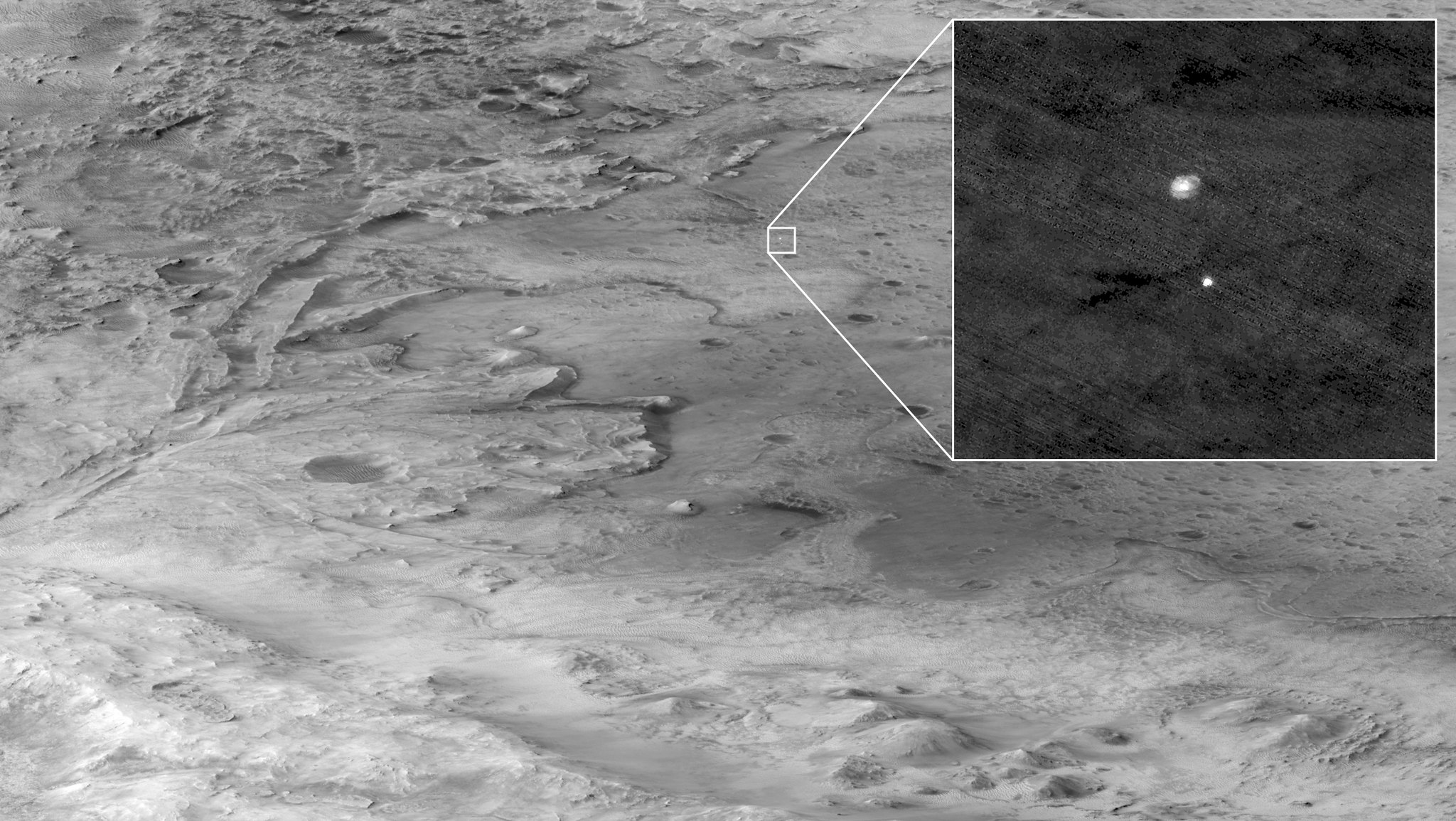
After reaching Mars with the Perseverance rover in early 2021, NASA’s Ingenuity helicopter proved a huge success as it exceeded expectations with an astonishing 72 flights across the Martian surface. But three years after entering the history books by becoming the first aircraft to achieve powered, controlled flight on another planet, Ingenuity sustained damage to […]
Three Martian dust devils can be seen near the rim of Jezero Crater in this short video made of images taken by a navigation camera aboard NASA’s Perseverance rover on Sept. 6, 2025. The microphone on the rover’s SuperCam previously captured audio when a dust devil passed over.
NASA/JPL-Caltech/SSI
Perseverance confirmed a long-suspected phenomenon in which electrical discharges and their associated shock waves can be born within Red Planet mini-twisters.
NASA’s Perseverance Mars rover has recorded the sounds of electrical discharges —sparks — and mini-sonic booms in dust devils on Mars. Long theorized, the phenomenon has now been confirmed through audio and electromagnetic recordings captured by the rover’s SuperCam microphone. The discovery, published Nov. 26 in the journal Nature, has implications for Martian atmospheric chemistry, climate, and habitability, and could help inform the design of future robotic and human missions to Mars.
A frequent occurrence on the Red Planet, dust devils form from rising and rotating columns of warm air. Air near the planet’s surface becomes heated by contact with the warmer ground and rises through the denser, cooler air above. As other air moves along the surface to take the place of the rising warmer air, it begins to rotate. When the incoming air rises into the column, it picks up speed like spinning ice skaters bringing their arms closer to their body. The air rushing in also picks up dust, and a dust devil is born.
SuperCam has recorded 55 distinct electrical events over the course of the mission, beginning on the mission’s 215thMartian day, or sol, in 2021. Sixteen have been recorded when dust devils passed directly over the rover.
Decades before Perseverance landed, scientists theorized that the friction generated by tiny dust grains swirling and rubbing against each other in Martian dust devils could generate enough of an electrical charge to eventually produce electrical arcs. Called the triboelectric effect, it’s the phenomenon at play when someone walks over a carpet in socks and then touches a metal doorknob, generating a spark. In fact, that is about the same level of discharge as what a Martian dust devil might produce.
“Triboelectric charging of sand and snow particles is well documented on Earth, particularly in desert regions, but it rarely results in actual electrical discharges,” said Baptiste Chide, a member of the Perseverance science team and a planetary scientist at L’Institut de Recherche en Astrophysique et Planétologie in France. “On Mars, the thin atmosphere makes the phenomenon far more likely, as the amount of charge required to generate sparks is much lower than what is required in Earth’s near-surface atmosphere.”
Perseverance’s SuperCam instrument carries a microphone to analyze the sounds of the instrument’s laser when it zaps rocks, but the team has also captured the sounds of wind and even the first audio recording of a Martian dust devil. Scientists knew it could pick up electromagnetic disturbance (static) and sounds of electrical discharges in the atmosphere. What they didn’t know was if such events happened frequently enough, or if the rover would ever be close enough, to record one. Then they began to assess data amassed over the mission, and it didn’t take long to find the telltale sounds of electrical activity.
The SuperCam microphone on NASA’s Perseverance captured this recording of the sounds of electrical discharge as a dust devil passed over the Mars rover on Oct. 12, 2024. The three crackles can be heard in between the sounds of the dust devil’s front and trailing walls. Credit: NASA/JPL-Caltech/LANL/CNES/CNRS/ISAE-Supaero
Crackle, pop
“We got some good ones where you can clearly hear the ‘snap’ sound of the spark,” said coauthor Ralph Lorenz, a Perseverance scientist at the Johns Hopkins Applied Physics Lab in Laurel, Maryland. “In the Sol 215 dust devil recording, you can hear not only the electrical sound, but also the wall of the dust devil moving over the rover. And in the Sol 1,296 dust devil, you hear all that plus some of the particles impacting the microphone.”
Thirty-five other discharges were associated with the passage of convective fronts during regional dust storms. These fronts feature intense turbulence that favor triboelectric charging and charge separation, which occurs when two objects touch, transfer electrons, and separate — the part of the triboelectric effect that results in a spark of static electricity.
Researchers found electrical discharges did not seem to increase during the seasons when dust storms, which globally increase the presence of atmospheric dust, are more common on Mars. This result suggests that electrical buildup is more closely tied to the localized, turbulent lifting of sand and dust rather than high dust density alone.
While exploring the rim of Jezero Crater on Mars, NASA’s Perseverance rover captured new images of multiple dust devils in January 2025. These captivating phenomena have been documented for decades by the agency’s Red Planet robotic explorers. Credit: NASA/JPL-Caltech/LANL/CNES/CNRS/INTA-CSIC/Space Science Institute/ISAE-Supaero/University of Arizona
Profound effects
The proof of these electrical discharges is a discovery that dramatically changes our understanding of Mars. Their presence means that the Martian atmosphere can become sufficiently charged to activate chemical reactions, leading to the creation of highly oxidizing compounds, such as chlorates and perchlorates. These strong substances can effectively destroy organic molecules (which constitute some of the components of life) on the surface and break down many atmospheric compounds, completely altering the overall chemical balance of the Martian atmosphere.
This discovery could also explain the puzzling ability of Martian methane to vanish rapidly, offering a crucial piece of the puzzle for understanding the constraints life may have faced and, therefore, the planet’s potential to be habitable.
Given the omnipresence of dust on Mars, the presence of electrical charges generated by particles rubbing together would seem likely to influence dust transport on Mars as well. How dust travels on Mars plays a central role in the planet’s climate but remains poorly understood.
Confirming the presence of electrostatic discharges will also help NASA understand potential risks to the electronic equipment of current robotic missions. That no adverse electrostatic discharge effects have been reported in several decades of Mars surface operations may attest to careful spacecraft grounding practices. The findings could also inform safety measures developed for future astronauts exploring the Red Planet.
More about Perseverance
Managed for NASA by Caltech, the Jet Propulsion Laboratory in Southern California built and manages operations of the Perseverance rover on behalf of the agency’s Science Mission Directorate as part of NASA’s Mars Exploration Program portfolio.
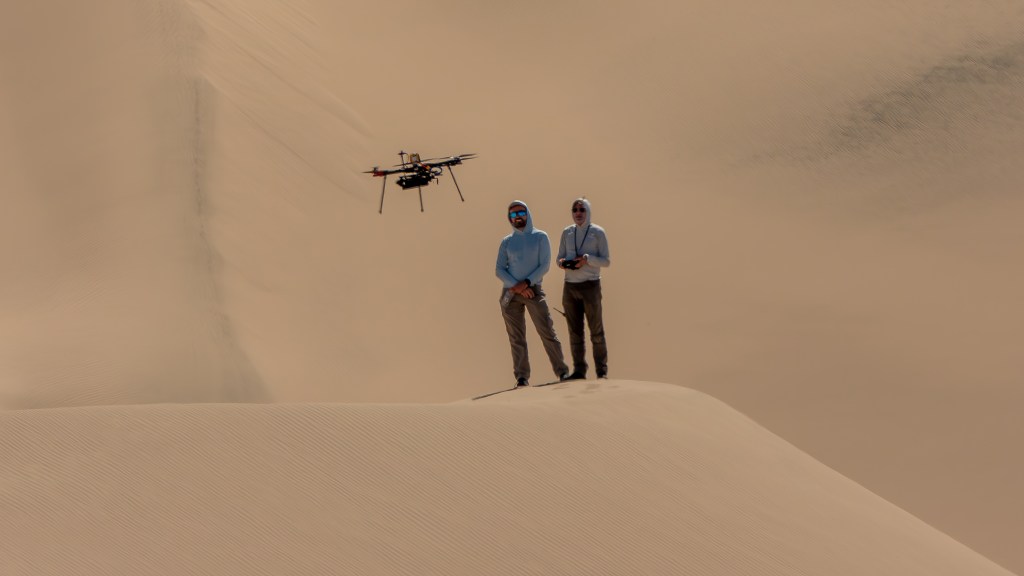
Researchers from NASA’s Jet Propulsion Laboratory in Southern California monitor a research drone in the Dumont Dunes area of the Mojave Desert in September as part of a test campaign to develop navigation software to guide future rotorcraft on Mars.
NASA/JPL-Caltech
A researcher monitors LASSIE-M (Legged Autonomous Surface Science In Analogue Environments for Mars), a robot being developed by NASA’s Johnson Space Center and other institutions, during testing this year at New Mexico’s White Sands National Park.
Justin Durner
This half-scale model of MERF (Mars Electric Reusable Flyer), a gliding robot being developed by NASA’s Langley Research Center, was flown this year to test new technologies for Mars exploration.
NASA
Next-generation drone flight software is just one of 25 technologies for the Red Planet that the space agency funded for development this year.
When NASA engineers want to test a concept for exploring the Red Planet, they have to find ways to create Mars-like conditions here on Earth. Then they test, tinker, and repeat.
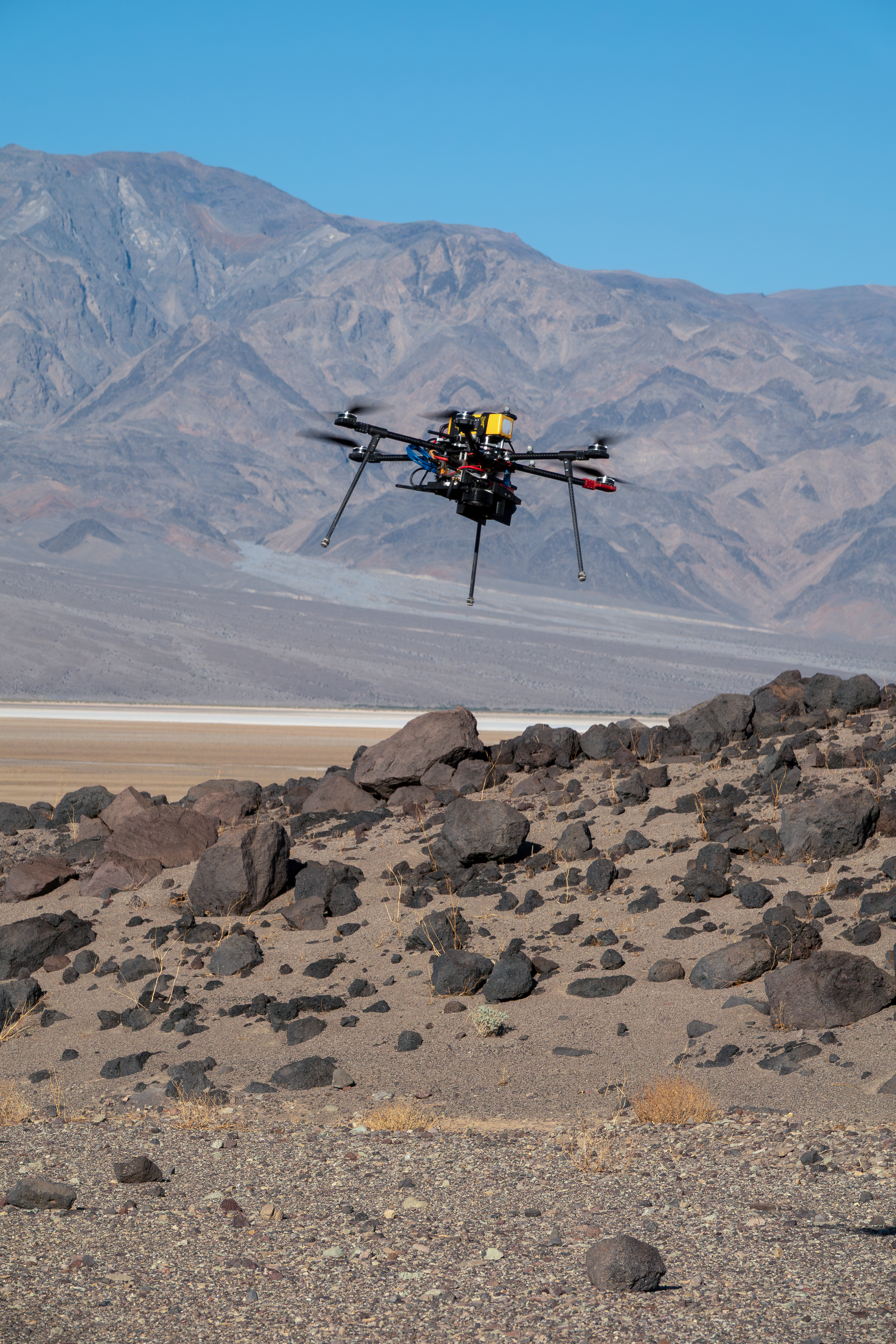
That’s why a team from NASA’s Jet Propulsion Laboratory in Southern California took three research drones to California’s Death Valley National Park and the Mojave Desert earlier this year. They needed barren, featureless desert dunes to hone navigation software. Called Extended Robust Aerial Autonomy, the work is just one of 25 projects funded by the agency’s Mars Exploration Program this past year to push the limits of future technologies. Similar dunes on Mars confused the navigation algorithm of NASA’s Ingenuity Mars Helicopter during several of its last flights, including its 72nd and final flight on the Red Planet.
“Ingenuity was designed to fly over well-textured terrain, estimating its motion by looking at visual features on the ground. But eventually it had to cross over blander areas where this became hard,” said Roland Brockers, a JPL researcher and drone pilot. “We want future vehicles to be more versatile and not have to worry about flying over challenging areas like these sand dunes.”
Whether it’s new navigation software, slope-scaling robotic scouts, or long-distance gliders, the technology being developed by the Mars Exploration Program envisions a future where robots can explore all on their own — or even help astronauts do their work.
Desert drones
NASA scientists and engineers have been going to Death Valley National Park since the 1970s, when the agency was preparing for the first Mars landings with the twin Viking spacecraft. Rubbly volcanic boulders on barren slopes earned one area the name Mars Hill, where much of this research has taken place. Almost half a century later, JPL engineers tested the Perseverance rover’s precision landing system by flying a component of it in a piloted helicopter over the park.
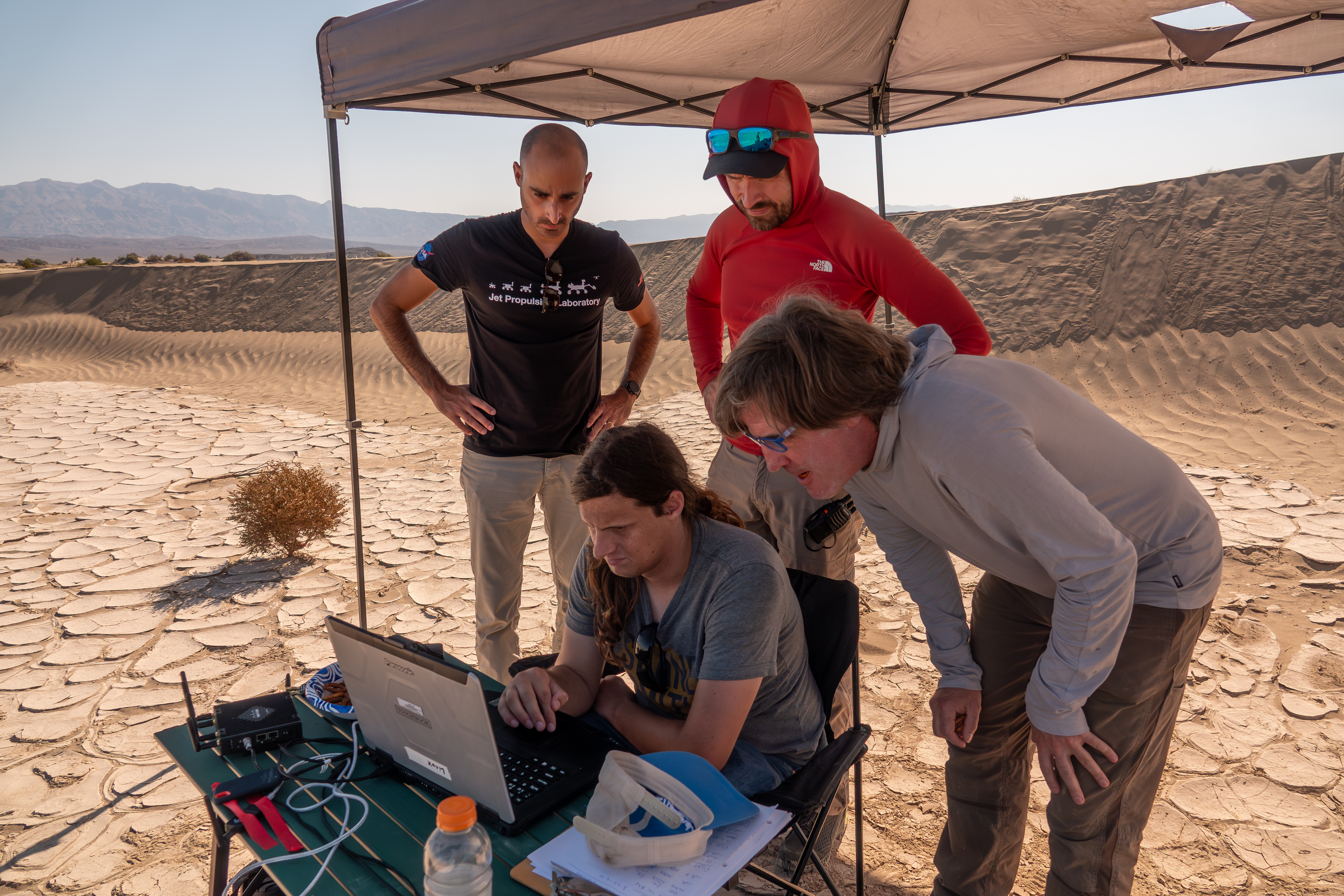
For the drone testing, engineers traveled to the park’s Mars Hill and Mesquite Flats Sand Dunes in late April and early September. The JPL team received only the third-ever license to fly research drones in Death Valley. Temperatures reached as high as 113 degrees Fahrenheit (45 degrees Celsius); gathered beneath a pop-up canopy, team members tracked the progress of their drones on a laptop.
JPL researchers gather under a pop-up tent in Death Valley National Park while monitoring the performance of a research drone equipped with navigation software for Mars.
NASA/JPL-Caltech
The test campaign has already resulted in useful findings, including how different camera filters help the drones track the ground and how new algorithms can guide them to safely land in cluttered terrain like Mars Hill’s.
“It’s incredibly exciting to see scientists using Death Valley as a proving ground for space exploration,” said Death Valley National Park Superintendent Mike Reynolds. “It’s a powerful reminder that the park is protected not just for its scenic beauty or recreational opportunities, but as a living laboratory that actively helps us understand desert environments and worlds beyond our own.”
For additional testing during the three-day excursion, the team ventured to the Mojave Desert’s Dumont Dunes. The site of mobility system tests for NASA’s Curiosity rover in 2012, the rippled dunes there offered a variation of the featureless terrain used to test the flight software in Death Valley.
“Field tests give you a much more comprehensive perspective than solely looking at computer models and limited satellite images,” said JPL’s Nathan Williams, a geologist on the team who previously helped operate Ingenuity. “Scientifically interesting features aren’t always located in the most benign places, so we want to be prepared to explore even more challenging terrains than Ingenuity did.”
One of three JPL drones used in recent tests flies over Mars Hill, a region of Death Valley National Park that has been visited by NASA Mars researchers since the 1970s, when the agency was preparing to land the twin Viking spacecraft on the Red Planet.
NASA/JPL-Caltech
Robot dogs
The California desert isn’t the only field site where Mars technology has been tested this year. In August, researchers from NASA’s Johnson Space Center in Houston ventured to New Mexico’s White Sands National Park, another desert location that has hosted NASA testing for decades.
They were there with a doglike robot called LASSIE-M (Legged Autonomous Surface Science In Analogue Environments for Mars). Motors in the robot’s legs measure physical properties of the surface that, when combined with other data, lets LASSIE-M shift gait as it encounters terrain that is softer, looser, or crustier — variations often indicative of scientifically interesting changes.
The team’s goal is to develop a robot that can scale rocky or sandy terrain — both of which can be hazardous to a rover — as it scouts ahead of humans and robots alike, using instruments to seek out new science.
Wings for Mars
Another Mars Exploration Program concept funded this past year is an autonomous robot that trades the compactness of the Ingenuity helicopter for the range that comes with wings. NASA’s Langley Research Center in Hampton, Virginia, has been developing the Mars Electric Reusable Flyer (MERF), which looks like a single wing with twin propellers that allow it to lift off vertically and hover in the air. (A fuselage and tail would be too heavy for this design.) While the flyer skims the sky at high speeds, instruments on its belly can map the surface.
At its full size, the MERF unfolds to be about as long as a small school bus. Langley engineers have been testing a half-scale prototype, sending it soaring across a field on the Virgina campus to study the design’s aerodynamics and the robot’s lightweight materials, which are critical to flying in Mars’ thin atmosphere.
With other projects focused on new forms of power generation, drills and sampling equipment, and cutting-edge autonomous software, there are many new ways for NASA to explore Mars in the future.
An anonymous reader shares a report: It is shocking but not surprising. Lightning crackles on Mars, scientists reported on Wednesday. What they observed, however, were not jagged, high-voltage bolts like those on Earth, arcing thousands of feet from cloud to ground. Rather, the phenomenon was more like the shock you feel when you scuff your feet on the carpet on a cold winter morning and then touch a metal doorknob.
"This is like mini-lightning on Mars," Baptiste Chide, a scientist at the Research Institute in Astrophysics and Planetary Science in Toulouse, France, said of the centimeter-scale electrical discharges. Dr. Chide and his colleagues reported the findings in a paper published on Wednesday in the journal Nature. The electrical sparks, although not as dramatically violent as on Earth, could play an important role in chemical reactions in the Martian atmosphere.
Preparations for Next Moonwalk Simulations Underway (and Underwater)
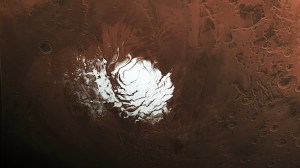
The European Space Agency’s Mars Express orbiter captured this view of Mars’ south polar ice cap Feb. 25, 2015. Three years later, the spacecraft detected a signal from the area to the right of the ice cap that scientists interpreted as an underground lake.
ESA/DLR/FU Berlin, CC BY-SA 3.0 IGO
Results from an enhanced radar technique have demonstrated improvement to sub-surface observations of Mars.
NASA’s Mars Reconnaissance Orbiter (MRO) has revisited and raised new questions about a mysterious feature buried beneath thousands of feet of ice at the Red Planet’s south pole. In a recent study, researchers conclude from data obtained using an innovative radar technique that an area on Mars suspected of being an underground lake is more likely to be a layer of rock and dust.
The 2018 discovery of the suspected lake set off a flurry of scientific activity, as water is closely linked with life in the solar system. While the latest findings indicate this feature is not a lake below the Martian surface, it does suggest that the same radar technique could be used to check for subsurface resources elsewhere on Mars, supporting future explorers.
The paper, published in Geophysical Research Letters on Nov. 17, was led by two of MRO’s Shallow Radar (SHARAD) instrument scientists, Gareth Morgan and Than Putzig, who are based at the Planetary Science Institute in Tucson, Arizona, and Lakewood, Colorado, respectively.
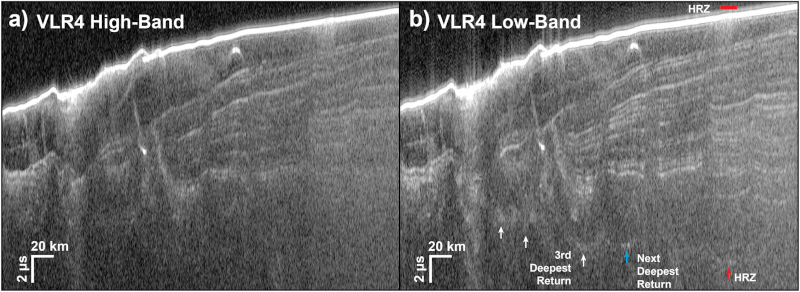
The observations were made by MRO with a special maneuver that rolls the spacecraft 120 degrees. Doing so enhances the power of SHARAD, enabling the radar’s signal to penetrate deeper underground and provide a clearer image of the subsurface. These “very large rolls” have proved so effective that scientists are eager to use them at previously observed sites where buried ice might exist.
This map shows the approximate area where in 2018 ESA’s Mars Express detected a signal the mission’s scientists interpreted as an underground lake. The red lines show the path of NASA’s Mars Reconnaissance Orbiter, which flew both directly overhead as well as over an adjacent region.
Credit: Planetary Science Institute
Morgan, Putzig, and fellow SHARAD team members had made multiple unsuccessful attempts to observe the area suspected of hosting a buried lake. Then the scientists partnered with the spacecraft’s operations team at NASA’s Jet Propulsion Laboratory in Southern California, which leads the mission, to develop the very large roll capability.
Because the radar’s antenna is at the back of MRO, the orbiter’s body obstructs its view and weakens the instrument’s sensitivity. After considerable work, engineers at JPL and Lockheed Martin Space in Littleton, Colorado, which built the spacecraft and supports its operations, developed commands for a 120-degree roll — a technique that requires careful planning to keep the spacecraft safe — to direct more of SHARAD’s signal at the surface.
Bright signal
On May 26, SHARAD performed a very large roll to finally pick up the signal in the target area, which spans about 12.5 miles (20 kilometers) and is buried under a slab of water ice almost 1 mile (1,500 meters) thick.
When a radar signal bounces off underground layers, the strength of its reflection depends on what the subsurface is made of. Most materials let the signal slip through or absorb it, making the return faint. Liquid water is special in that it produces a very reflective surface, sending back a very strong signal (imagine pointing a flashlight at a mirror).
That’s the kind of signal that was spotted from this area in 2018 by a team working with the Mars Advanced Radar for Subsurface and Ionospheric Sounding (MARSIS) instrument aboard the ESA (European Space Agency) Mars Express orbiter. To explain how such a body of water could remain liquid under all that ice, scientists have hypothesized it could be a briny lake, since high salt content can lower water’s freezing temperature.
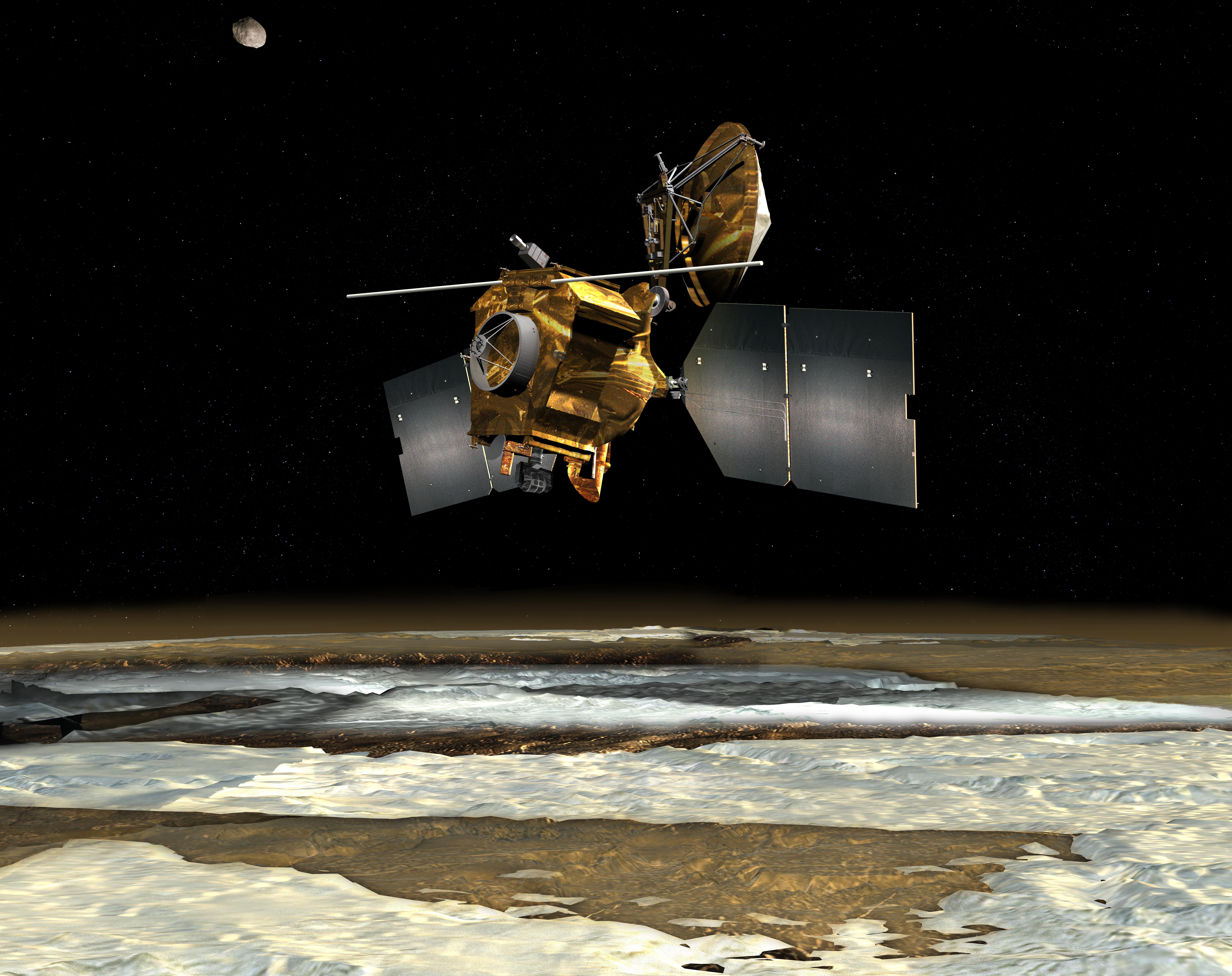
An antenna sticks out like whiskers from NASA’s Mars Reconnaissance Orbiter in this artist’s concept depicting the spacecraft, which has been orbiting the Red Planet since 2006. This antenna is part of SHARAD, a radar that peers below the Martian surface.
NASA/JPL-Caltech
“We’ve been observing this area with SHARAD for almost 20 years without seeing anything from those depths,” said Putzig. But once MRO achieved a very large roll over the precise area, the team was able to look much deeper. And rather than the bright signal MARSIS received, SHARAD detected a faint one. A different very-large-roll observation of an adjacent area didn’t detect a signal at all, suggesting something unique is causing a quirky radar signal at the exact spot MARSIS saw a signal.
“The lake hypothesis generated lots of creative work, which is exactly what exciting scientific discoveries are supposed to do,” said Morgan. “And while this new data won’t settle the debate, it makes it very hard to support the idea of a liquid water lake.”
Alternative explanations
Mars’ south pole has an ice cap sitting atop heavily cratered terrain, and most radar images of the area below the ice show lots of peaks and valleys. Morgan and Putzig said it’s possible that the bright signal MARSIS detected here may just be a rare smooth area — an ancient lava flow, for example.
Both scientists are excited to use the very large roll technique to reexamine other scientifically interesting regions of Mars. One such place is Medusae Fossae, a sprawling geologic formation on Mars’ equator that produces little radar return. While some scientists have suggested it’s composed of layers of volcanic ash, others have suggested the layers may include heaps of ice deep within.
“If it’s ice, that means there’s lots of water resources near the Martian equator, where you’d want to send humans,” said Putzig. “Because the equator is exposed to more sunlight, it’s warmer and ideal for astronauts to live and work.”
More about MRO
NASA’s Jet Propulsion Laboratory in Southern California manages MRO for the agency’s Science Mission Directorate in Washington as part of NASA’s Mars Exploration Program portfolio. Lockheed Martin Space in Denver built MRO and supports its operations. SHARAD was provided to the MRO mission by the Italian Space Agency (ASI).
We were as excited as anyone when MARSIS (the Mars Advanced Radar for Subsurface and Ionosphere Sounding) experiment announced there was possibly liquid water under the southern polar ice cap. If there is liquid water on Mars, it would make future exploration and colonization much more feasible. Unfortunately, SHARAD (the Shallow Radar) has a new trick that suggests the data may not indicate liquid water after all.
While the news is a bummer, the way scientists used SHARAD to confirm — or, in this case, deny — the water hypothesis was a worthy hack. The SHARAD antenna is on the Mars Reconnaissance Orbiter, but in a position that makes it difficult to obtain direct surface readings from Mars. To compensate, operators typically roll the spacecraft to give the omnidirectional antenna a clearer view of the ground. However, those rolls have been under 30 degrees.
Computer modelling indicated that rolls of 120 degrees would greatly improve the SHARAD data. So far, four of these “very large roll” or VLR maneuvers have allowed more detailed probes of the surface with SHARAD. Unfortunately the new data didn’t back up the early findings. Scientists now think the reflection may be just an unusually flat surface under the ice.
Of course, just because there might not be water in that location doesn’t mean there isn’t any at all. Want to live on Mars? There’s a lot to think about.
Preparations for Next Moonwalk Simulations Underway (and Underwater)
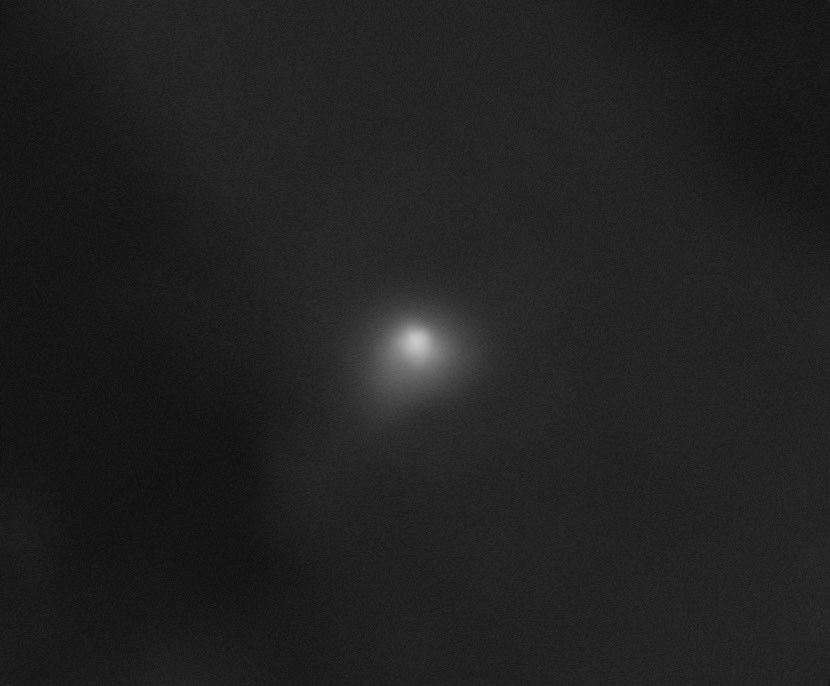
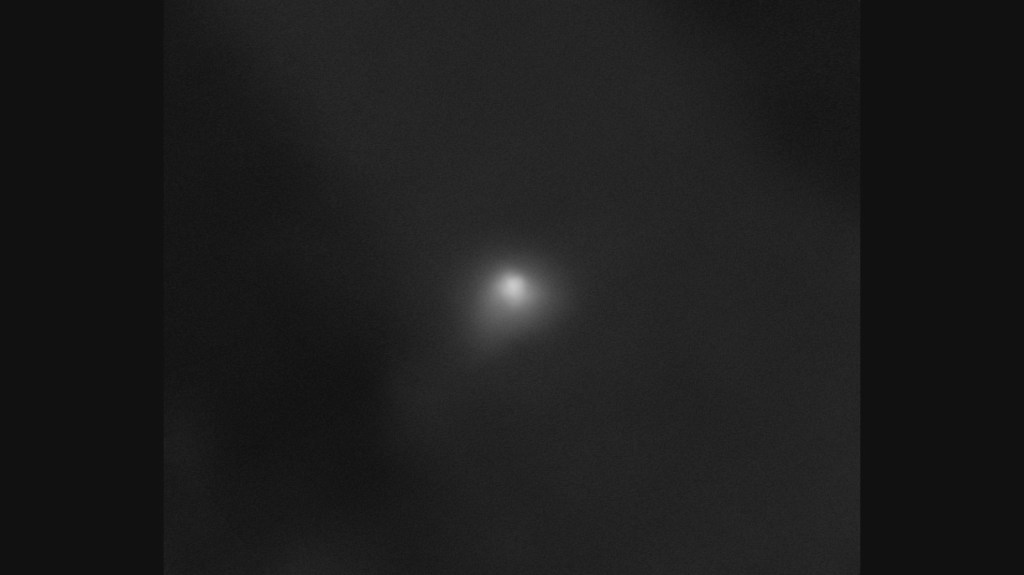
The High-Resolution Imaging Science Experiment (HiRISE) camera aboard NASA’s Mars Reconnaissance Orbiter captured this image of interstellar comet 3I/ATLAS on Oct. 2, 2025. At the time it was imaged, the comet was about 0.2 astronomical units (18.6 million miles, or 29.9 million kilometers) from the from the spacecraft.
NASA/JPL-Caltech/University of ArizonaNASA/JPL-Caltech/University of Arizona
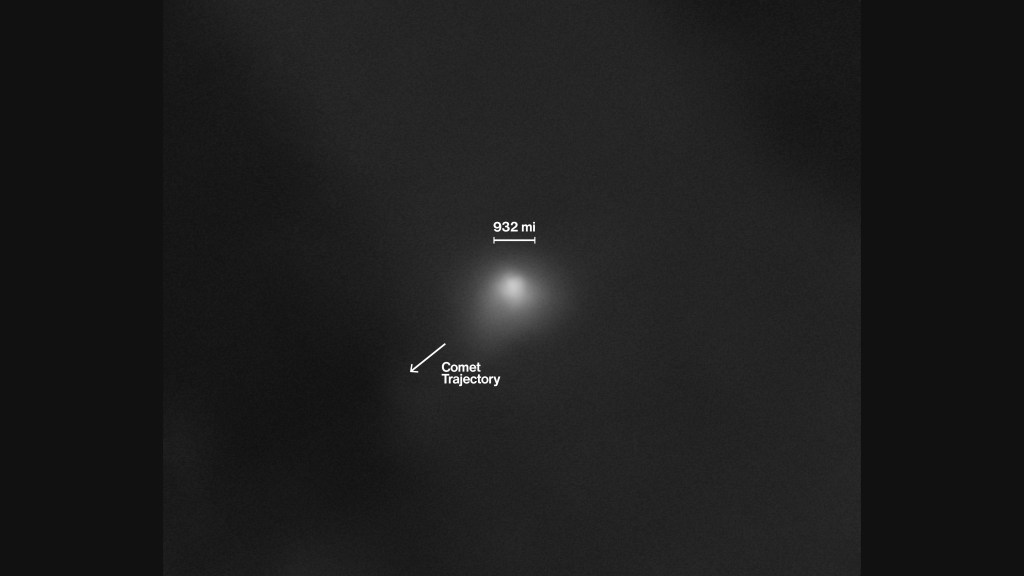
An annotated version of the image of 3I/ATLAS captured by NASA’s Mars Reconnaissance Orbiter shows the trajectory of the interstellar comet along with a scale bar. The image was captured by the spacecraft’s High Resolution Imaging Science Experiment (HiRISE) camera on Oct. 2, 2025.
NASA/JPL-Caltech/University of Arizona
Two orbiters and a rover captured images of the interstellar object — from the closest location any of the agency’s spacecraft may get — that could reveal new details.
At the start of October, three of NASA’s Mars spacecraft had front row seats to view 3I/ATLAS, only the third interstellar object so far discovered in our solar system. The Mars Reconnaissance Orbiter (MRO) snapped a close-up of the comet, while the MAVEN (Mars Atmosphere and Volatile EvolutioN) orbiter captured ultraviolet images and the Perseverance rover caught a faint glimpse as well.
Imagery from MRO will allow scientists to better estimate the comet’s size, and MAVEN’s images are unique among all observations this year in determining the chemical makeup of the comet and how much water vapor is released as the Sun warms the comet. These details will help scientists better understand the past, present, and future of this object.
HiRISE
The comet will be at its closest approach to Earth on Friday, Dec. 19. On Oct. 2, MRO observed 3I/ATLAS from 19 million miles (30 million kilometers) away, with one of the closest views that any NASA spacecraft or Earth-based telescopes are expected to get.
The orbiter’s team viewed the comet with a camera called HiRISE (the High Resolution Imaging Science Experiment), which normally points at the Martian surface. By rotating, MRO can point HiRISE at celestial objects as well — a technique used in 2014, when HiRISE joined MAVEN in studying another comet, called Siding Spring.
Captured at a scale of roughly 19 miles (30 kilometers) per pixel, 3I/ATLAS looks like a pixelated white ball on the HiRISE imagery. That ball is a cloud of dust and ice called the coma, which the comet shed as it continued its trajectory past Mars.
This ultraviolet image shows the halo of gas and dust, or coma, surrounding comet 3I/ATLAS as seen on Oct. 9, 2025, by NASA’s MAVEN spacecraft using its Imaging Ultraviolet Spectrograph. The brightest pixel at center indicates where the comet is. The surrounding bright pixels show where hydrogen atoms were detected coming from the comet.
NASA/Goddard/LASP/CU Boulder
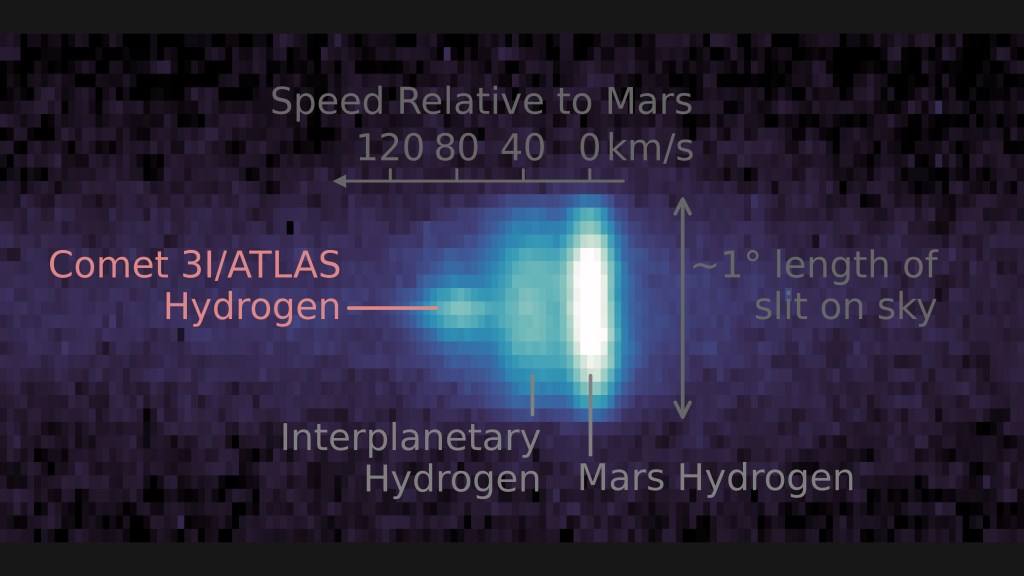
This annotated composite image showing hydrogen atoms from three sources, including 3I/ATLAS (at left), was captured Sept. 28, 2025, by NASA’s MAVEN orbiter using its Imaging Ultraviolet Spectrograph. Hydrogen emitted by Mars is the bright streak at right, with interplanetary hydrogen flowing through the solar system indicated by the dimmer streak in the middle.
NASA/Goddard/LASP/CU Boulder
“Observations of interstellar objects are still rare enough that we learn something new on every occasion,” said Shane Byrne, HiRISE principal investigator at the University of Arizona in Tucson. “We’re fortunate that 3I/ATLAS passed this close to Mars.”
Further study of the HiRISE imagery could help scientists estimate the size of the comet’s nucleus, its central core of ice and dust. More study also may reveal the size and color of particles within its coma.
“One of MRO’s biggest contributions to NASA’s work on Mars has been watching surface phenomena that only HiRISE can see,” said MRO’s project scientist Leslie Tamppari of NASA’s Jet Propulsion Laboratory in Southern California. “This is one of those occasions where we get to study a passing space object as well.”
Over the course of 10 days starting Sept. 27, MAVEN captured 3I/ATLAS in two unique ways with its Imaging Ultraviolet Spectrograph (IUVS) camera. First, IUVS took multiple images of the comet in several wavelengths, much like using various filters on a camera. Then it snapped high-resolution UV images to identify the hydrogen coming from 3I/ATLAS. Studying a combination of these images, scientists can identify a variety of molecules and better understand the comet’s composition.
“The images MAVEN captured truly are incredible,” said Shannon Curry, MAVEN’s principal investigator and research scientist at the Laboratory for Atmospheric and Space Physics (LASP) at the University of Colorado Boulder. “The detections we are seeing are significant, and we have only scraped the surface of our analysis.”
The IUVS data also offers an estimated upper limit of the comet’s ratio of deuterium (a heavy isotope of hydrogen) to regular hydrogen, a tracer of the comet’s origin and evolution. When the comet was at its closest to Mars, the team used more sensitive channels of IUVS to map different atoms and molecules in the comet’s coma, such as hydrogen and hydroxyl. Further study of the comet’s chemical makeup could reveal more about its origins and evolution.
“There was a lot of adrenaline when we saw what we’d captured,” said MAVEN’s deputy principal investigator, Justin Deighan, a LASP scientist and the lead on the mission’s comet 3I/ATLAS observations. “Every measurement we make of this comet helps to open up a new understanding of interstellar objects.”
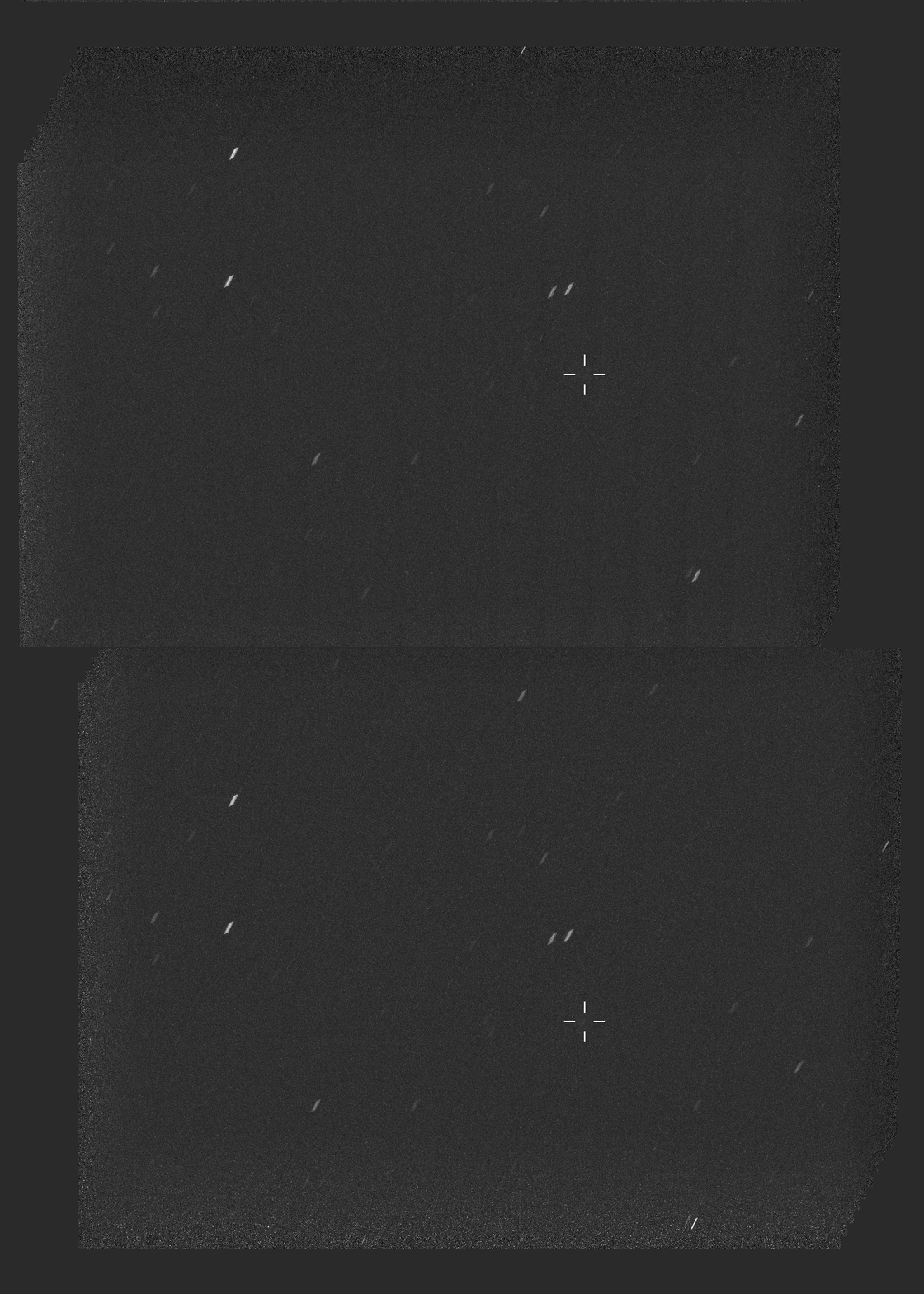
Interstellar comet 3I/ATLAS is seen as a faint smudge against a background starfield in two images taken by the Mastcam-Z instrument aboard NASA’s Perseverance Mars rover on Oct. 4, 2025. At the time it was imaged, the comet was about 19 million miles (30 million kilometers) from the rover, which was exploring the rim of the Red Planet’s Jezero Crater.
NASA/JPL-Caltech/ASU/MSSS
Perseverance
Far below the orbiters, on the Martian surface, NASA’s Perseverance rover also caught sight of 3I/ATLAS. On Oct. 4, the comet appeared as a faint smudge to the rover’s Mastcam-Z camera. The exposure had to be exceptionally long to detect such a faint object. Unlike telescopes that track objects as they move, Mastcam-Z is fixed in place during long exposures. This technique produces star trails that appear as streaks in the sky, though the comet itself is barely perceptible.
More about MRO, MAVEN, Perseverance
A division of Caltech in Pasadena, California, JPL manages MRO for NASA’s Science Mission Directorate in Washington as part of NASA’s Mars Exploration Program portfolio. The University of Arizona in Tucson operates MRO’s HiRISE, which was built by BAE Systems in Boulder, Colorado. Lockheed Martin Space in Denver built MRO and supports its operations.
The MAVEN mission, also part of NASA’s Mars Exploration Program portfolio, is led by the Laboratory for Atmospheric and Space Physics at the University of Colorado Boulder. It’s managed by NASA’s Goddard Space Flight Center in Greenbelt, Maryland. MAVEN was built and operated by Lockheed Martin Space in Littleton, Colorado, with navigation and network support from JPL.
JPL built and manages operations of the Perseverance rover on behalf of the agency’s Science Mission Directorate as part of NASA’s Mars Exploration Program portfolio.
To learn more about NASA’s observations of comet 3I/ATLAS, visit:
The first multi-spacecraft science mission to launch to Mars is now on its way, and catching a ride on the twin probes are the first kiwis to fly to the red planet.
NASA’s ESCAPADE (Escape and Plasma Acceleration and Dynamics Explorers) mission lifted off on a 22-month trip to Mars on Thursday aboard a New Glenn rocket. Once there, the identical satellites will enter Martian orbit to study in real time how space weather affects the planet’s hybrid magnetosphere and how the interaction drove Mars to lose its once-dense atmosphere.
Led by the Space Sciences Laboratory at the University of California, Berkeley—the two spacecraft are named “Blue” and “Gold” after the school’s colors—the ESCAPADE probes are the first Mars-bound vehicles to be designed, built, and tested by Rocket Lab, the end-to-end space company headquartered in California but founded in New Zealand.
The trouble-free launch of NASA’s Escapade probes, plus today’s first-ever recovery of a New Glenn booster, bolstered Blue Origin’s status as a worthy competitor for Elon Musk’s SpaceX, which has come to dominate the space industry. SpaceX is the only other company to bring back an orbital-class booster successfully.
Even Musk recognized the achievement: “Congratulations @JeffBezos and the @BlueOrigin team!” he wrote in a posting to X / Twitter, the social-media platform he owns.
New Glenn — which is named after John Glenn, the first American to go into orbit — rose from its launch pad at Cape Canaveral Space Force Station in Florida at 3:55 p.m. ET (12:55 p.m. PT). Today’s liftoff followed attempts earlier this week that had to be scratched, initially due to cloudy weather on Earth, and then due to a solar storm in space.
Even on the day of launch, the countdown had to be held and recycled a couple of times for unspecified reasons. But in the end, liftoff was gloriously nominal.
Minutes after New Glenn rose into the sky, the mission plan called for the rocket’s first-stage booster to fly itself back to a touchdown on a floating platform in the Atlantic that was named Jacklyn after Bezos’ late mother. Blue Origin’s first attempt to recover a New Glenn booster failed in January — but this time, the maneuver was successful.
That achievement was greeted by wild cheers from Blue Origin team members watching the webcast, including Jeff Bezos at Mission Control and a crowd at the company’s headquarters in Kent, Wash. The uncertainty about recovering the booster was reflected in the nickname it was given: “Never Tell Me the Odds.”
“Congratulations, Team Blue — you guys did it!” launch commentator Ariane Cornell, vice president of New Glenn strategy and business operations, said during the webcast. “What an incredible day for Blue Origin, for the space industry.”
Cornell’s co-host for the webcast, Tabitha Lipkin, was similarly enthused. “I think I hurt my hand on the table banging too much,” she said.
Meanwhile, New Glenn’s second stage pressed onward to orbit. A little more than half an hour after launch, the second stage deployed two robotic spacecraft for NASA’s Escapade mission to Mars. (The name for the $78.5 million mission is an acronym for “ESCApe and Plasma Acceleration and Dynamics Explorers.”)
The twin probes will follow a loitering, looping trajectory that includes an Earth flyby a year from now. That slingshot maneuver should provide an extra boost to put the spacecraft into Martian orbit in 2027. Once the probes have settled into synchronized orbits, they’ll fly in formation to map the Red Planet’s magnetic field, upper atmosphere and ionosphere in stereo. The science mission is due to last until 2029.
Scientists say Escapade should help NASA prepare for future crewed missions to Mars.
“Understanding how the ionosphere varies will be a really important part of understanding how to correct the distortions in radio signals that we will need to communicate with each other and to navigate on Mars,” principal investigator Robert Lillis, a space physicist at the University of California at Berkeley, said in a news release. Findings from Escapade could also help scientists work out ways to deal with the radiation risks associated with missions on Mars.
On the space science side of things, Escapade could shed light on the process by which Mars lost much of its atmosphere over the course of billions of years. “To understand how the solar wind drives different kinds of atmospheric escape is a key piece of the puzzle of the climate evolution of Mars,” Lillis said.
NASA put UC-Berkeley in charge of operating the probes, which have been named Blue and Gold in honor of Berkeley’s school colors. Rocket Lab USA built the spacecraft, and Blue Origin won the launch order in 2023, two years before New Glenn ever flew.
Escapade was originally scheduled for liftoff a year ago, but NASA postponed the start of the mission, citing the potential costs of a launch delay that “could be caused by a number of factors” — presumably including a scenario in which Blue Origin’s rocket wasn’t yet ready for liftoff. Additional delays arose as Blue Origin followed up on lessons learned from January’s first New Glenn launch.
In addition to launching the Escapade probes, New Glenn carried demonstration hardware for ViaSat’s HaloNet telemetry relay service. HaloNet was tested as part of a program aimed at switching space communication channels from NASA’s Tracking and Data Relay Satellite system, or TDRS, to commercial satellites.
In a post-launch news release, Blue Origin CEO Dave Limp said “we achieved full mission success today, and I am so proud of the team.”
“It turns out Never Tell Me The Odds had perfect odds — never before in history has a booster this large nailed the landing on the second try,” Limp said. “This is just the beginning as we rapidly scale our flight cadence and continue delivering for our customers.”
New Glenn is designed to send up to 45 metric tons of payload to low Earth orbit, and smaller payloads to destinations beyond Earth orbit. That makes the rocket more powerful than SpaceX’s workhorse Falcon 9 rocket (23 metric tons to LEO), but less powerful than the Falcon Heavy (64 metric tons) or Starship (100 to 150 metric tons). Starship is still in development; a modified version of that rocket is currently due to carry NASA astronauts on the lunar surface in the 2027-2028 time frame.
Jon Edwards, SpaceX’s vice president of Falcon launch vehicles, joined his boss in congratulating Blue Origin: “Recovering an orbital-class rocket is incredibly hard. Well done!” he wrote on X. “We as Americans should be very proud of what we are accomplishing in space.”
Acting NASA Administrator Sean Duffy added his congratulations. “This heliophysics mission will help reveal how Mars became a desert planet, and how solar eruptions affect the Martian surface,” Duffy said in a written statement. “Every launch of New Glenn provides data that will be essential when we launch MK-1 through Artemis. All of this information will be critical to protect future NASA explorers and invaluable as we evaluate how to deliver on President Trump’s vision of planting the Stars and Stripes on Mars.”
Sometime in the next few months, Blue Origin plans to use New Glenn to launch an uncrewed Blue Moon MK-1 lander to the moon’s south polar region. And thanks to today’s successful recovery at sea, there’s a chance that “Never Tell Me the Odds” could be reused as the first-stage booster for that launch.
Bezos and Limp both posted pictures and videos on social media with comments on the day’s achievements. Here are a few highlights:
Good overview of the landing. We nominally target a few hundred feet away from Jacklyn to avoid a severe impact if engines fail to start or start slowly. We’ll incrementally reduce that conservatism over time. We are all excited and grateful for yesterday. Amazing performance by… pic.twitter.com/DCEMsuSyPm
CAPE CANAVERAL, Florida—The second flight of Blue Origin’s New Glenn rocket was postponed again Wednesday as a supercharged wave of magnetized plasma from the Sun enveloped the Earth, triggering colorful auroral displays and concerns over possible impacts to communications, navigation, and power grids.
Solar storms like the one this week can also affect satellite operations. That is the worry that caused NASA to hold off on launching a pair of science probes from Cape Canaveral Space Force Station, Florida, on Wednesday aboard Blue Origin’s New Glenn rocket.
In a statement, Blue Origin said NASA, its customer on the upcoming launch, decided to postpone the mission to send the agency’s two ESCAPADE spacecraft on a journey to Mars.
Until now, the aerospace outfit Blue Origin was little more than a plaything for Amazon billionaire Jeff Bezos. The company’s New Shepard rocket has launched a few space tourists, but its upcoming New Glenn vehicle will have a shot at something more important. NASA has awarded Blue Origin a contract to launch a Mars mission next year, marking the firm’s first interplanetary launch.
NASA has chosen Blue Origin to handle launch services for the Escape and Plasma Acceleration and Dynamics Explorers (ESCAPADE) mission, which is part of the agency’s Venture-Class Acquisition of Dedicated and Rideshare (VADR) program. Blue Origin is one of 13 companies to get contracts under the program, designed to tolerate higher risk to allow for more innovation and lower overall costs.
Blue Origin has been developing New Glenn since 2012, announcing the vehicle in 2016, but it has yet to fly. When complete, New Glenn will be 322 feet (92 meters) tall with a diameter of 23 feet (9 meters). That’s larger in both dimensions than the Falcon 9 (70 x 3.7 meters). Like New Shepard, this rocket is designed to have a reusable first stage to reduce launch costs. It’s powered by seven BE-4 engines, a more powerful version of the oxygen and methane-fueled BE-3 used on New Shepard.
A render of what New Glenn may look like when finished.
The timeline is going to be tight — Blue Origin initially expected the first New Glenn launch to happen in 2020, but it has pushed it back several times. Currently, the rocket is slated to fly no earlier than Q4 of this year. NASA plans to launch the ESCAPADE about a year later, at the end of 2024. It’ll be up to Blue Origin to make sure its rocket is ready to go — projects in the VADR program call for less NASA oversight in order to save money.
Assuming Blue Origin comes through on its first interplanetary NASA contract, the ESCAPADE spacecraft will separate from the launch vehicle and spend 11 months coasting toward the red planet. Once there, the spacecraft will split into two identical orbiters, working together to analyze the planet’s magnetosphere. The mission will improve our understanding of how the solar wind interacts with Mars’ weak magnetic field. That’s important information to have if we ever intend to send humans to Mars, for either a quick jaunt or long-term colonization. Although, either one is probably a long way off.
The Perseverance Mars rover has been making headlines lately as it sets up a sample depot on the red planet and makes its way toward an ancient river delta. But its predecessor is still on Mars, too, and Curiosity is making its own discoveries even after more than a decade. As it ascends Mount Sharp, Curiosity has stumbled upon a fascinating rock formation — ripples left in ancient sediment by the planet’s long-lost water.
Curiosity arrived on Mars in 2012 and has been so successful that NASA opted to use its design as the base for Perseverance. It landed in Gale Crater and began making its way to Mount Sharp, the central peak of the crater. The rover was outfitted with instruments to assess the climate and geology of Mars to assess whether the conditions in the crater may have been compatible with life. Understanding the role of water in the planet’s distant past is a major element of the mission.
Last year, Curiosity reached the sulfate-bearing unit of Mount Sharp. This salt-rich region is believed to contain deposits left as the planet began drying up. However, the team didn’t expect to find evidence of waves. The rover has sent back images of a rippling texture in the rock, which was once sediment at the bottom of a body of water. “This is the best evidence of water and waves that we’ve seen in the entire mission,” said Ashwin Vasavada, Curiosity’s project scientist at NASA’s Jet Propulsion Laboratory.
Curiosity discovered the wave ripples about half a mile above the base of Mount Sharp in what has been termed the “Marker Band.” This layer of dark, hard rock stands out from the rest of the rusty landscape. The rock here is so hard that Curiosity has been unable to drill a sample of it. The team is still looking for an area with softer rock to get a sample for analysis. Unlike Perseverance, Curiosity is not outfitted with the hardware to save samples for a future return to Earth — it can only do science in its onboard laboratory. Curiosity will spend a little more time hunting for the right rocks in the Marker Band, but there are more discoveries awaiting higher on Mount Sharp.
The Curiosity team is looking ahead to a valley known as Gediz Vallis, which the rover could see from a distance at several points last year. NASA believes Gediz Vallis was carved by water, and there is evidence of wet landslides. This could be one of the youngest geological features on Mount Sharp. There is currently no planned end date for the Curiosity mission — it’ll keep rolling until its deformed, perforated wheels give out.
This image by NASA’s James Webb Space Telescope’s Near-Infrared Camera (NIRCam) features the central region of the Chamaeleon I dark molecular cloud, which resides 630 light years away. The cold, wispy cloud material (blue, center) is illuminated in the infrared by the glow of the young, outflowing protostar Ced 110 IRS 4 (orange, upper left). The light from numerous background stars, seen as orange dots behind the cloud, can be used to detect ices in the cloud, which absorb the starlight passing through them.
An international team of astronomers has reported the discovery of diverse ices in the darkest regions of a cold molecular cloud measured to date by studying this region. This result allows astronomers to examine the simple icy molecules that will be incorporated into future exoplanets, while opening a new window on the origin of more complex molecules that are the first step in the creation of the building blocks of life.
Hello, folks, and welcome back to your favorite Friday roundup of all the space news fit to print. This week we’ve got experimental rocket engines, a gigantic map, and galaxies galore. The James Webb Space Telescope found hydrogen in a galaxy more than eight billion light years away, and the coldest ice ever, but it’s currently down due to a software glitch.
Closer to home, Rocket Lab launched their Electron rocket from US soil for the first time. NASA came together for a day of remembrance that somehow managed to be both somber and ineffably sweet.
JWST Spots the Coldest Chamaeleon
If you wish to make an apple pie from scratch, you must first invent the universe. And somewhere along the way, you’ll need one of the ancient molecular clouds of dust and ice from which stars and habitable planets like Earth are born. This week, Webb scientists announced that the telescope has spotted just such a place. It’s a stellar nursery called the Chamaeleon I cloud, loaded with these primordial crystals. That’s the tableau you’re seeing in the image above — you can tell it’s from Webb by those iconic six-pointed stars. The ice contains traces of sulfur and ammonia, along with simple organic molecules like methanol. And at just ten degrees above absolute zero, it’s the coldest ice ever found.
“We simply couldn’t have observed these ices without Webb,” said Klaus Pontoppidan, a Webb project scientist involved in the research. “The ices show up as dips against a continuum of background starlight. In regions that are this cold and dense, much of the light from the background star is blocked, and Webb’s exquisite sensitivity was necessary to detect the starlight and therefore identify the ices in the molecular cloud.”
‘Virginia Is for Launch Lovers’: Rocket Lab Launches Electron Rocket From US Soil
Late Wednesday evening, aerospace startup Rocket Lab successfully launched its Electron rocket from NASA’s Wallops Flight Facility in Virginia. This was the 33rd launch of the Electron, but its first launch from American soil.
The Electron isn’t reusable — but in 2021, Rocket Lab announced the Neutron. Designed for reusability, the Neutron will have about a third of the lift capacity of a Falcon 9.
NASA ‘Rotating Detonation Engine’ Aces Hot Fire Tests
Speaking of 3D-printed rocket engines: NASA announced this week that it has successfully validated a next-gen rocket engine it hopes will revolutionize rocket design. The new engine generates thrust “using a supersonic combustion phenomenon known as a detonation.” And this is no experimental error — their full-scale alpha build produced more than 4,000 pounds of thrust at full throttle.
These engines get their name (rotating detonation rocket engine, or RDRE) from the unique way they produce thrust. Detonation waves echo around a circular chamber, wringing out every bit of energy from the rocket fuel. It’s great for efficiency, but it puts the whole system under extreme pressure. Undaunted, NASA turned to an advanced additive manufacturing process, even developing its own bespoke metal alloy for the task.
According to the agency, the RDRE incorporates the agency’s GRCop-42 copper alloy into a powder bed fusion (PBF) additive manufacturing process. PBF uses a laser or particle beam to seamlessly fuse ultra-fine particles. It’s a lot like the sintering process used to make the space shuttle rocket engines — and even they had to be actively cooled by the rockets’ own cryofuel, in order to withstand the unearthly temperatures and pressures of takeoff. If the design holds up, NASA intends to use RDRE in its efforts to establish a long-term presence off-planet.
Dark Energy Detector Plots Largest-Ever Map of Galaxy
Astronomers have created a gargantuan map of the Milky Way, using a telescope built to detect dark energy. Featuring more than three billion stars, it focuses on the galaxy’s orbital plane — a region notoriously difficult to study.
Earth’s atmosphere scatters starlight so that points of light turn into point clouds. So, the astronomers just dove right in. To isolate different stars and celestial objects, the group used some extra-snazzy math to get rid of noise. This allowed them to “paint in” the proper background, letting them tell one star from another.
Astronomers have released a gargantuan survey of the galactic plane of the Milky Way. The new dataset contains a staggering 3.32 billion celestial objects — arguably the largest such catalog so far. The data for this unprecedented survey were taken with the US Department of Energy-fabricated Dark Energy Camera at the NSF’s Cerro Tololo Inter-American Observatory in Chile, a Program of NOIRLab. Credit: Saydjari et al., via NoirLab
“One of the main reasons for the success of DECaPS2 is that we simply pointed at a region with an extraordinarily high density of stars and were careful about identifying sources that appear nearly on top of each other,” said Andrew Saydjari, lead author on the (open-access!) paper accompanying the gigantic map. “Doing so allowed us to produce the largest such catalog ever from a single camera, in terms of the number of objects observed.”
Experts: Milky Way Too Large for Its “Cosmological Wall”
The history of astronomy has been all about recognizing that our place in the universe isn’t all that special. We’ve gone from the center of all existence to just another planet orbiting an average star in one of billions and billions of galaxies. However, a new simulation hints that there might be something special about the Milky Way after all.
Yepun, one of the four Unit Telescopes of the Very Large Telescope (VLT) at the European Southern Observatory, studies the center of the Milky Way. Yepun’s laser beam creates an artificial “guide star” to calibrate the telescope’s adaptive optics. Image: ESO/Yuri Beletsky
The model suggests that the Milky Way is far larger than it should be, based on the scale of the “cosmological wall”: an incomprehensibly huge semi-planar structure occupied by the Milky Way and other galaxies in the Local Group.
Scientists Detect Atomic Hydrogen in Most Distant Galaxy Ever
An international team of astronomers announces the discovery of cold atomic hydrogen, more than eight billion light-years from Earth. Cooler than ionized plasma but warmer than molecular hydrogen gas, atomic hydrogen is the raw fuel of coalescing stars. The researchers used gravitational lensing to spot the telltale — but deeply redshifted — 21cm line.
Webb Spies Centaur Chariklo’s Delicate Rings
Named for the daughter of Apollo, Chariklo is a centaur: a Kuiper belt object that orbits out past Saturn. It’s the first of its kind ever found with a confirmed ring system. The thing really is tiny; it’s about 160 miles in diameter and has less than two percent the mass of Earth. But a new report from Webb shows even that much mass is enough to sustain two slender rings, for a time.
In a remarkable stroke of scientific luck, the telescope was pointed just right to catch Chariklo as it passed in front of a star. When it did, the star’s light fluttered in a way that betrayed the presence of the rings.
Chariklo has two thin rings — the first rings ever detected (in 2013) around a small Solar System object. When Webb observed the occultation, scientists measured dips in the brightness of the star. These dips corresponded exactly as predicted to the shadows of Chariklo’s rings. pic.twitter.com/sqH08v1lOB
Nothing less than delighted, the astronomers report that Chariklo’s rings are two and four miles wide, respectively. But the asteroid actually has something in common with the Chamaeleon I cloud. Chariklo’s surface is covered in exotic phases of water ice that only Webb can see.
Principal investigator Dean Hines added, “Because high-energy particles transform ice from crystalline into amorphous states, detection of crystalline ice indicates that the Chariklo system experiences continuous micro-collisions that either expose pristine material or trigger crystallization processes.” It’ll be up to the JWST to find out more.
Software Glitch Brings JWST Down for Maintenance
Unfortunately, observations of Chariklo and other celestial bodies will have to wait a while. The JWST had a software glitch this week. Per NASA, the telescope’s Near Infrared Imager and Slitless Spectrograph (NIRISS) “experienced a communications delay within the instrument, causing its flight software to time out.” Unfortunately, this led to a software gridlock.
The telescope is unavailable for science observations because NASA and the Canadian Space Agency are doing root-cause analysis to figure out and fix the problem. But NASA emphasizes that the telescope is fine. There’s no damage and no indication of any danger. If it’s a software problem, it may well be a software fix.
Perseverance Files First Weather Report
Now that it’s been on Mars for a while, the Perseverance rover has filed an authoritative report on Martian weather. The number one takeaway: It’s cold on the Red Planet! The average surface temperature is -67C.
It’s also windy on Mars. Since Mars has an atmosphere, it has surface weather. It also has an axial tilt, so it has seasons, just like Earth. Dust storms can envelop Mars’ entire northern hemisphere.
Plumes of darker, subsurface dust waft to the surface when the sun warms Martian sands beneath transparent sheets of ice. Mars’ shifting winds then blow these plumes of dust into V-shaped patterns. Astronomers are using the plumes to learn more about Mars’ weather and surface climate. Image: NASA
Perseverance is covered in a suite of sensors that constantly monitor wind speed and direction, atmospheric pressure, temperature, humidity, and dust. Together, they make the rover’s Mars Environmental Dynamics Analyzer (MEDA).
Here, you can see the MEDA sensors extending from the rover’s mast below the iconic ChemCam.
“The dust devils are more abundant at Jezero than elsewhere on Mars and can be very large, forming whirlwinds more than 100 meters in diameter. With MEDA we have been able to characterize not only their general aspects (size and abundance) but also to unravel how these whirlwinds function,” says Ricardo Hueso, of the MEDA team.
Perseverance has captured numerous dust devils as they sweep through Jezero Crater. However, to get that data, MEDA’s exposed sensors also face damage from the harsh radiation environment, extreme temperature swings, and the ever-present Martian dust. A dust devil in January of last year kicked up enough debris that it damaged one of MEDA’s wind instruments. Still, the rover perseveres.
NASA’s Bittersweet 2023 Day of Remembrance
Every year, NASA holds a memorial for staff, astronauts, and alumni who have died. 2023’s Day of Remembrance holds a somber significance, as Feb. 1 is the 20th anniversary of the Columbia disaster. Unfortunately, this year’s fallen also included Apollo 7 pilot Walt Cunningham, who passed earlier this month. Cunningham was the last surviving member of the Apollo 7 crew.
As in years past, NASA staff gathered this week at space centers and labs around the country, to honor the sacrifices of those who have given their lives in pursuit of exploration and discovery. But they did it in a way only NASA could do. They held nationwide town-hall safety meetings, to reflect on and improve NASA’s aerospace safety culture.
Ask not for whom the safety alarm tolls; it tolls for thee. NASA safety-culture town hall meeting at its Washington headquarters after the Arlington memorial service. Image: NASA/Keegan Barber via NASA HQ Flickr
What a fitting way to honor lives lost, while still reaching for the stars. Town-hall safety culture meetings. We love you guys. Never change.
Psyche Mission Now Targeting October 2023 Launch
Steady as she goes: After a year’s delay and a missed launch window, NASA’s Psyche mission team is getting the spacecraft in shape to launch this year. In a blog post, the agency said, “After a one-year delay to complete critical testing, the Psyche project is targeting an October 2023 launch on a SpaceX Falcon Heavy rocket.”
When it launches, Psyche will carry a technology demo for NASA’s shiny new Deep Space Optical Communications (DSOC) network. DSOC systems will use lasers for high-bandwidth communications between Earth and the Moon, Mars, and beyond. Beyond a deluge of scientific data, NASA expects that the network will be able to handle high-def images and video.
Skywatchers Corner
Comet C/2022 E3 (ZTF) is a long-period comet that last visited Earth in the time of the Neanderthals. Now it’s back for another close approach. And although we didn’t know this when we found it last year, it turns out the comet’s tail glows pale green, like a luna moth under a streetlight.
The robin’s-egg glow of Comet C/2022 E3 (ZTF)’s tail shines against its twin tails. Image: Dan Bartlett/NASA
At first, astronomers thought it might require binoculars to catch a glimpse of the thing. However, as ExtremeTech’s Adrianna Nine writes, the comet is now visible to the naked eye in places across much of the Northern Hemisphere.
Our verdant visitor will continue its brightening trend while it sails toward Earth. It will make its closest approach to us on February 2: perhaps too soon for a Valentine’s Day spectacular, but right on time for Imbolc, Candlemas, and Groundhog Day.
The Perseverance rover has spent almost two Earth years on Mars, which is just a single Martian year. With a full seasonal cycle in the books, researchers from the University of the Basque Country in Madrid have released the first detailed weather report from Perseverance. The study, published in Nature Geoscience, explores how temperature, wind speed, and atmospheric pressure vary over time in Jezero Crater.
Perseverance is equipped with seven major scientific instruments, including the MEDA (Mars Environmental Dynamics Analyzer). This tool is under the supervision of researcher José Antonio Rodríguez-Manfredi, who works at the university’s Centre for Astrobiology (CAB). MEDA includes sensors that can monitor temperature, pressure, wind speed, humidity, and dust concentrations.
Jezero Crater is near the planet’s equator, but it never gets very warm there. Perseverance reports the average temperature is -67 degrees Fahrenheit (-55 degrees Celsius), but the temperature swings wildly throughout the day, with temperatures between 50 and 60 degrees Celsius warmer during the day than at night. As temperatures drop off at night, so does the wind. The CAB researchers report that heating of the thin Martian atmosphere generates turbulent air movements due to convection. When the sun sets, the air settles. Perseverance recorded strong winds moving to the southeast during the day, reaching speeds of 82 feet (25 meters) per second. In the afternoon, winds dropped to just 13 feet (4 meters) per second, and the wind often died completely from 4 to 6 a.m. local time.
Here, you can see the MEDA sensors extending from the rover’s mast below the iconic ChemCam.
Pressure sensors in MEDA show a marked change throughout the year. The daily thermal cycle causes its own fluctuations, of course, but the melting and refreezing of the planet’s carbon dioxide ice caps produce a denser atmosphere during the Martian summer and a thinner one in the winter.
NASA chose Jezero Crater as the landing zone because there’s a huge ancient river delta inside it that could contain evidence of ancient life. As it turns out, Jezero Crater also has an extraordinary number of whirlwinds (or dust devils, if you prefer) compared with other regions on Mars. Perseverance regularly detected very large whirlwinds measuring more than 328 feet (100 meters) in diameter.
While it’s nice to have a weather report from another world, it’s more than a novelty. A better understanding of the Martian atmosphere will help NASA plan future automated missions, as well as hypothetical future crewed Mars landings. Perseverance can pave the way while it searches for its next prized rock sample.

 Login
Login