The singular SEC allegation that the judge considered credible concerns the failure of controls embedded in SolarWinds products.
For its part, SolarWinds has consistently maintained that the SEC’s allegations were fundamentally flawed, outside of its area of expertise, and a ‘trick’ designed to allow for a rewrite of the law.
Why it matters
For some time, the SEC has pursued new policies intended to hold businesses accountable for cyber security practices; an understandable and reasonable objective.
In this instance, the SEC said that claims made to investors in regards to cyber security practices had been misleading and false – across a three year period.
The SEC’s indictment also mentioned falsified reports on internal controls, incomplete disclosure of the cyber attack, negligence around “red flags” and existing risks, and more.
But what caught the attention of many in the cyber security community was that, in an unprecedented maneuver, the SEC aimed to hold CISO Timothy Brown personally liable.
This case has been closely watched among cyber security professionals and was widely seen as precedent-setting for future potential software supply chain attack events.
Timothy Brown’s clearance
In the end, the court ruling does not hold CISO Timothy Brown personally liable for the breach.
“Holding CISOs personally liable, especially those CISOs that do not hold a position on the executive committee, is deeply flawed and would have set a precedent that would be counterproductive and weaken the security posture of organizations,” says Fred Kwong, Ph.D, vice president andCISO of DeVry University.
Despite the fact that this court ruling may loosen some CISO constraints, “you need to be honest about your security posture,” says Kwong.
The remaining claim against the company, which will be scrutinized further in court, indicates that there is a basis on which to conclude that CISOs do have certain disclosure obligations under the federal securities laws.
Further details
The SolarWinds incident, as its come to be known, has cost SolarWinds tens of millions of dollars. In 2023, the company settled a shareholder lawsuit to the tune of $26 million.
A spokesperson for SolarWinds has stated that the company is “pleased” with Judge Engelmayer’s decision to dismiss most of the SEC’s claims. The company plans to demonstrate why the remaining claim is “factually inaccurate” at the next opportunity. For expert insights into and analyses of the SolarWinds case, please see CyberTalk.org’s past coverage. Lastly, to receive cyber security thought leadership articles, groundbreaking research and emerging threat analyses each week, subscribe to the CyberTalk.org newsletter.
Cybersecurity remains a very important topic and point of concern for many CIOs, CISOs, and their customers. To meet these important concerns, AWS has developed a primary set of services customers should use to aid in protecting their accounts. Amazon GuardDuty, AWS Security Hub, AWS Config, and AWS Well-Architected reviews help customers maintain a strong security posture over their AWS accounts. As more organizations deploy to the cloud, especially if they are doing so quickly, and they have not yet implemented the recommended AWS Services, there may be a need to conduct a rapid security assessment of the cloud environment.
With that in mind, we have worked to develop an inexpensive, easy to deploy, secure, and fast solution to provide our customers two (2) security assessment reports. These security assessments are from the open source projects “Prowler” and “ScoutSuite.” Each of these projects conduct an assessment based on AWS best practices and can help quickly identify any potential risk areas in a customer’s deployed environment. If you are interested in conducting these assessments on a continuous basis, AWS recommends enabling Security Hub’s Foundational Security Best P ractices standard. If you are interested in integrating your Prowler assessment results with Security Hub, you can also do that from Prowler natively following instructions here.
In addition, we have developed custom modules that speak to customer concerns around threats and misconfigurations of those issues, currently this includes checks for ransomware specific findings.
ARCHITECTURE OVERVIEW
Overview - Open Source project checks
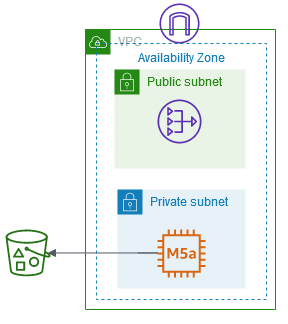
The architecture we deploy is a very simple VPC with two (2) subnets, one (1) NAT Gateway, one (1) EC2 instance, and one (1) S3 Bucket. The EC2 instance is using Amazon Linux 2 (the latest published AMI), that is patched on boot, pulls down the two projects (Prowler and ScoutSuite), runs the assessments and then delivers the reports to the S3 Bucket. The EC2 instances does not deploy with any EC2 Key Pair, does not have any open ingress rules on its Security Group, and is placed in the Private Subnet so it does not have direct internet access. After completion of the assessment and the delivery of the reports the system can be terminated.
The deployment is accomplished through the use of CloudFormation. A single CloudFormation template is used to launch a few other templates (in a modular approach). No parameters (user input) is required and the automated build out of the environment will take on average less than 10 minutes to complete. These templates are provided for review in this Github repository.
Once the EC2 Instance has been created and begins, the two assessments it will take somewhere around 40 minutes to complete. At the end of the assessments and after the two reports are delivered to the S3 Bucket the Instance will automatically shutdown, You may at this time safely terminate the Instance.
This is the location where the reports will be delivered
It will take about 40 minutes for the reports to show up
Open source security Assessments
These security assessments are from the open source projects “Prowler” and “ScoutSuite.” Each of these projects conduct an assessment based on AWS best practices and can help quickly identify any potential risk areas in a customer’s deployed environment.
Prowler follows guidelines of the CIS Amazon Web Services Foundations Benchmark (49 checks) and has 40 additional checks including related to GDPR and HIPAA, in total Prowler offers over 160 checks.
ScoutSuite has been around since 2012, originally a Scout, then Scout2, and now ScoutSuite. This will provide a set of files that can be viewed in your browser and conducts a wide range of checks
When enabled, this module will deploy separate functions that can help customers with evaluating their environment for ransomware infection and susceptibility to ransomware damage.
What will be created
AWS Core security services enabled
Checks for AWS security service enablement in all regions where applicable (GuardDuty, SecurityHub)
Checks for EC2 instances that can not be managed with SSM
Checks for Stale IAM roles that have been granted S3 access but have not used them in the last 60 days
Checks for S3 deny public access enablement
Checks to see if DNSSEC is enabled for public hosted zones in Amazon Route 53
Checks to see if logging is enabled for services relevant to ransomware (i.e. CloudFront, Lambda, Route53 Query Logging, and Route 53 Resolver Logging).
Checks to see if Route 53 Resolver DNS Firewall is enabled across all relevant regions
Checks to see if there are any Access Keys that have not been used in last 90 days
► SolarWinds module
When enabled, this module will deploy separate functions that can help customers with evaluating their environment for SolarWinds vulnerability. The checks are based on CISA Alert AA20-352A from Appendix A & B.
Note: Prior to enablement of this module, please read the module documentation which reviews the steps that need to be completed prior to using this module.
Note: This module MUST be run separately as its own stack, select the S3 URL SelfServiceSecSolar.yml to deploy
What will be created
Athena query - AA20352A IP IOC
This Athena query will scan your VPC flow logs for IP addresses from the CISA AA20-352A.
This is a systems manager automation document that will scan Windows EC2 instances for impacted .dll files from CISA AA20-352A.
Route53 DNS resolver query - AA20352A DNS IOC
This Athena query will scan your DNS logs for customers that have enabled DNS query logging
Frequently Asked Questions (FAQ)
Is there a cost?
Yes. This should normally cost less than $1 for an hour of use.
Is this a continuous monitoring and reporting tool?
No. This is a one-time assessment, we urge customers to leverage tooling like AWS SecurityHub for Ongoing assessments.
Why does the CloudFormation service error when deleting the stack?
You must remove the objects (reports) out of the S3 bucket first
Does this integrate with GuardDuty, Security Hub, CloudWatch, etc.?
Not at this time. In a future sprint we plan to incorporate integration with AWS services like Security Hub and GuardDuty. However, you can follow the instructions in this blog to integrate Prowler and Security Hub.
How do I remediate the issues in the reports?
Generally, the issues should be described in the report with readily identifiable corrections. Please follow up with the public documentation for each tool (Prowler and ScoutSuite) as well. If this is insufficient, please reach out to your AWS Account team and we will be more than happy to help you understand the reports and work towards remediating issues.
Cybersecurity remains a very important topic and point of concern for many CIOs, CISOs, and their customers. To meet these important concerns, AWS has developed a primary set of services customers should use to aid in protecting their accounts. Amazon GuardDuty, AWS Security Hub, AWS Config, and AWS Well-Architected reviews help customers maintain a strong security posture over their AWS accounts. As more organizations deploy to the cloud, especially if they are doing so quickly, and they have not yet implemented the recommended AWS Services, there may be a need to conduct a rapid security assessment of the cloud environment.
With that in mind, we have worked to develop an inexpensive, easy to deploy, secure, and fast solution to provide our customers two (2) security assessment reports. These security assessments are from the open source projects “Prowler” and “ScoutSuite.” Each of these projects conduct an assessment based on AWS best practices and can help quickly identify any potential risk areas in a customer’s deployed environment. If you are interested in conducting these assessments on a continuous basis, AWS recommends enabling Security Hub’s Foundational Security Best P ractices standard. If you are interested in integrating your Prowler assessment results with Security Hub, you can also do that from Prowler natively following instructions here.
In addition, we have developed custom modules that speak to customer concerns around threats and misconfigurations of those issues, currently this includes checks for ransomware specific findings.
ARCHITECTURE OVERVIEW
Overview - Open Source project checks
The architecture we deploy is a very simple VPC with two (2) subnets, one (1) NAT Gateway, one (1) EC2 instance, and one (1) S3 Bucket. The EC2 instance is using Amazon Linux 2 (the latest published AMI), that is patched on boot, pulls down the two projects (Prowler and ScoutSuite), runs the assessments and then delivers the reports to the S3 Bucket. The EC2 instances does not deploy with any EC2 Key Pair, does not have any open ingress rules on its Security Group, and is placed in the Private Subnet so it does not have direct internet access. After completion of the assessment and the delivery of the reports the system can be terminated.
The deployment is accomplished through the use of CloudFormation. A single CloudFormation template is used to launch a few other templates (in a modular approach). No parameters (user input) is required and the automated build out of the environment will take on average less than 10 minutes to complete. These templates are provided for review in this Github repository.
Once the EC2 Instance has been created and begins, the two assessments it will take somewhere around 40 minutes to complete. At the end of the assessments and after the two reports are delivered to the S3 Bucket the Instance will automatically shutdown, You may at this time safely terminate the Instance.
This is the location where the reports will be delivered
It will take about 40 minutes for the reports to show up
Open source security Assessments
These security assessments are from the open source projects “Prowler” and “ScoutSuite.” Each of these projects conduct an assessment based on AWS best practices and can help quickly identify any potential risk areas in a customer’s deployed environment.
Prowler follows guidelines of the CIS Amazon Web Services Foundations Benchmark (49 checks) and has 40 additional checks including related to GDPR and HIPAA, in total Prowler offers over 160 checks.
ScoutSuite has been around since 2012, originally a Scout, then Scout2, and now ScoutSuite. This will provide a set of files that can be viewed in your browser and conducts a wide range of checks
When enabled, this module will deploy separate functions that can help customers with evaluating their environment for ransomware infection and susceptibility to ransomware damage.
What will be created
AWS Core security services enabled
Checks for AWS security service enablement in all regions where applicable (GuardDuty, SecurityHub)
Checks for EC2 instances that can not be managed with SSM
Checks for Stale IAM roles that have been granted S3 access but have not used them in the last 60 days
Checks for S3 deny public access enablement
Checks to see if DNSSEC is enabled for public hosted zones in Amazon Route 53
Checks to see if logging is enabled for services relevant to ransomware (i.e. CloudFront, Lambda, Route53 Query Logging, and Route 53 Resolver Logging).
Checks to see if Route 53 Resolver DNS Firewall is enabled across all relevant regions
Checks to see if there are any Access Keys that have not been used in last 90 days
► SolarWinds module
When enabled, this module will deploy separate functions that can help customers with evaluating their environment for SolarWinds vulnerability. The checks are based on CISA Alert AA20-352A from Appendix A & B.
Note: Prior to enablement of this module, please read the module documentation which reviews the steps that need to be completed prior to using this module.
Note: This module MUST be run separately as its own stack, select the S3 URL SelfServiceSecSolar.yml to deploy
What will be created
Athena query - AA20352A IP IOC
This Athena query will scan your VPC flow logs for IP addresses from the CISA AA20-352A.
This is a systems manager automation document that will scan Windows EC2 instances for impacted .dll files from CISA AA20-352A.
Route53 DNS resolver query - AA20352A DNS IOC
This Athena query will scan your DNS logs for customers that have enabled DNS query logging
Frequently Asked Questions (FAQ)
Is there a cost?
Yes. This should normally cost less than $1 for an hour of use.
Is this a continuous monitoring and reporting tool?
No. This is a one-time assessment, we urge customers to leverage tooling like AWS SecurityHub for Ongoing assessments.
Why does the CloudFormation service error when deleting the stack?
You must remove the objects (reports) out of the S3 bucket first
Does this integrate with GuardDuty, Security Hub, CloudWatch, etc.?
Not at this time. In a future sprint we plan to incorporate integration with AWS services like Security Hub and GuardDuty. However, you can follow the instructions in this blog to integrate Prowler and Security Hub.
How do I remediate the issues in the reports?
Generally, the issues should be described in the report with readily identifiable corrections. Please follow up with the public documentation for each tool (Prowler and ScoutSuite) as well. If this is insufficient, please reach out to your AWS Account team and we will be more than happy to help you understand the reports and work towards remediating issues.
NVIDIA. Samsung. Microsoft. Okta. Globant. At least one of these Lapsus$ targets could be in your company’s tech supply chain. Regardless, these high-profile attacks highlight how interconnected and dependent IT systems become as companies grow and innovate, and the need to secure your supply chain.
Lapsus$, a global cybercrime group, has a tendency to go deep into a major tech vendor’s networks, find sensitive data and leak it. The breached data so far has included authentication credentials and encryption keys.
In the case of Lapsus$, they used a smaller vendor as a means of compromising a bigger target, like Okta, which then created a domino effect of having access to hundreds or thousands more credentials of those companies that contract with the bigger company. We saw a similar strategy with SolarWinds, wherein SolarWinds was breached and a vulnerability was pushed to its customers within a software update, leading to additional breaches. The risk of a breach is on both entry and exit: which vendors might lead to a breach within your network and which of your customers might then be breached?
The City of London police arrested several individuals who are alleged to be members of Lapsus$. But Lapsus$ struck Globant after the arrests, which indicates there may be many members who are continuing to execute cyber attacks.
Lapsus$ isn’t the first cybercrime group to wreak havoc upon vendor supply chains, and they definitely won’t be the last. Unfortunately, security researchers know that the proliferation of critical vulnerabilities is growing rapidly, and so too are the number of cyber attackers exploiting them. According to the CVE database, 18,325 vulnerabilities were added in 2020, and 20,149 in 2021. More than 6,000 vulnerabilities have been added in the first quarter of 2022. If this year continues at that rate, we’ll end 2022 with over 24,000 new vulnerabilities.
Traditional, point-in-time pentesting can’t keep up with the pace. When you add the complexity of cloud networks and diverse supply chains to the mix, it’s inevitable to lose visibility into your network’s security.
Cloud networks have been a boon for business, allowing companies to scale IT systems quickly and efficiently. But this also means that companies can add publicly accessible cloud services at will, with little oversight from the security team. Then factor in all of your vendors that provide services and infrastructure beyond security. Their vulnerabilities are also your company’s vulnerabilities. When cybercrime groups like Lapsus$ attack them, they’re also attacking your business up the chain.
You need a solution that will empower your security team to quickly find vulnerabilities wherever they emerge in your supply chain and remediate them with ease.
Synack combines an automated scanner, SmartScan, with the human intelligence of more than 1,500 carefully vetted security researchers from the Synack Red Team to find critical vulnerabilities across your network and tech supply chain. That combination of automation and human intelligence is at the core of the Synack Platform’s ability to bring you a better way to pentest. Within the Synack Platform, you can also request on-demand checks for specific vulns, like the OWASP top 10, or new critical CVEs when they appear, such as log4j.
It’s the most efficient and thorough way to conduct on-demand pentests in today’s complex computer. A few point-in-time pentests per year conducted by just a few people, simply to meet compliance, doesn’t cut it anymore. With densely networked supply chains and rapidly multiplying cloud services, new vulnerabilities are implemented faster than ever before. Whether Lapsus$ strikes one of your vendors, or one of many cybercrime groups that will inevitably emerge, your organization will be ready to defend against the evolving cyber threat landscape.

 Login
Login