VR has revolutionized the way healthcare operates. It lets the professionals to learn & enhance their skills without actually operating a patient. It has eminently raised the training methods to a different level from theoretical & video training. It helps to learn new procedures &simplify the usage of medical tools, equipment’s in risk free setting.
VR helps the Doctors to diagnose without the surgery or real cuts. It also helps in remote surgery, i.e., when it’s difficult to get the professional in time at operation location. Through remote telesurgery, a surgeon performs the procedure which helps save a life in dire need.
VR has so many benefits and can be used in varied sectors, not only for the training purposes of Dentists, Nurses or different types of Surgeries, but also to treat phobias, post- traumatic stress, Autism etc.
Here is an Infographic which elaborates the usage of VR in Healthcare.
Originally posted 2017-02-27 18:49:42. Republished by Blog Post Promoter
The term used for the delivery of film and TV content via the Internet is OTT, or over-the-top and does not require users to subscribe to traditional cable or satellite TV. Want to operate your own OTT video service? Here is a glimpse at what to keep in mind.The term used for the delivery of film and TV content via the Internet is OTT, or over-the-top and does not require users to subscribe to traditional cable or satellite TV. Want to operate your own OTT video service? Here is a glimpse at what to keep in mind.
Supported OTT video delivery protocol(s)
Below are some formats on how OTT video is delivered to your device today.
(Data from respondents from companies operating 0, services -multiple 8 single choice questions)
Technical challenges in offering OTT services
Part of the reason OTT did not develop more quickly than it did vs traditional cable was due to the tech challenge of delivering large amounts of content over the web. Today, we have that capability.
Quality of service and experience, bandwidth limitation, player/UI functionality, device support, search/discovery functionality, security, scalability, player window for live linear content, and traffic spikes are all big challenges still faced with offering OTT services today. Some areas just don’t have the capability of providing the bandwidth needed, some countries are poor and residents do not have access to required devices, and others prone to hackers and attacks.
As with everything else available on the Internet, one of many crucial aspects is maintaining OTT security strategies across all networks & devices. Some of these security elements to consider include:
Authentication
Geoblocking/geofencing
DRM (multiple and single schemes)
Access control
Tokenization
Other
Devices & Apps – Potential points of delivery?
Distribution of streaming video is still a challenge in 2016 but getting better and better as more streaming devices become available on the market and as broadband connections improve in areas that once did no have good service.
Devices that streaming video can reach
There are numerous devices out on the market today that streaming video can reach. Smartphones have majority share of the market at almost 70%, followed by tablets at 50%, and PC’s and laptops at 40%. Smart TV’s 14%, Apple TV 9%, Google Chromecast 8%, Roku 8%, Amazon Firestick 3%, Tivo 1% and Boxee 1% and new and upcoming devices also have a good amount of users using their devices. Sticks and boxes 31%, are currently used more than Smart TVs at 14%, but these numbers are continuously changing as TV’s now ship out with Smart TV functionality.
Devices that apps can reach Devices that can support apps include the following:
Tablets (90%)
Desktops/Laptops (88.6%)
Smartphones (87.1%)
Internet/Streaming STB (55.4%)
Smart TVs (47.1%)
Game Consoles (33.2%)
Business – Where does the revenue come from?
Revenue from OTT comes from subscriptions and monetization. The US online video market is by far the largest, bringing in 8.5 billion in 2015, with projected growth of 50% every year.
Part of the reason OTT did not develop more quickly than it did vs traditional cable was due to the tech challenge of delivering large amounts of content over the web. Today, we have that capability and are seeing it spread more and more.
OTT can largely be broken down into three different revenue models:
SVOD (subscription-based services such as Netflix and Hulu)
AVOD (free and ad-supported services such as Crackle and Hulu)
TVOD (transactional services such as iTunes, Vimeo On Demand and Amazon Instant Video that allow users to pay for individual pieces of content).
While in 2016, it is still easier for most households to keep the existing model of paying their cable provider, people are more and more converting to the streaming video and on demand model, like Netflix. Besides Netflix, here are some others:
In this dynamic market a modular, variable and open solution that meets all of the specific requirements – today and tomorrow – will be vastly superior to a static, proprietary backend.
Infographic brought to you by Siemens Convergence Creators Source: http://www.convergence-creators.siemens.com/ott-streaming-video-management.html
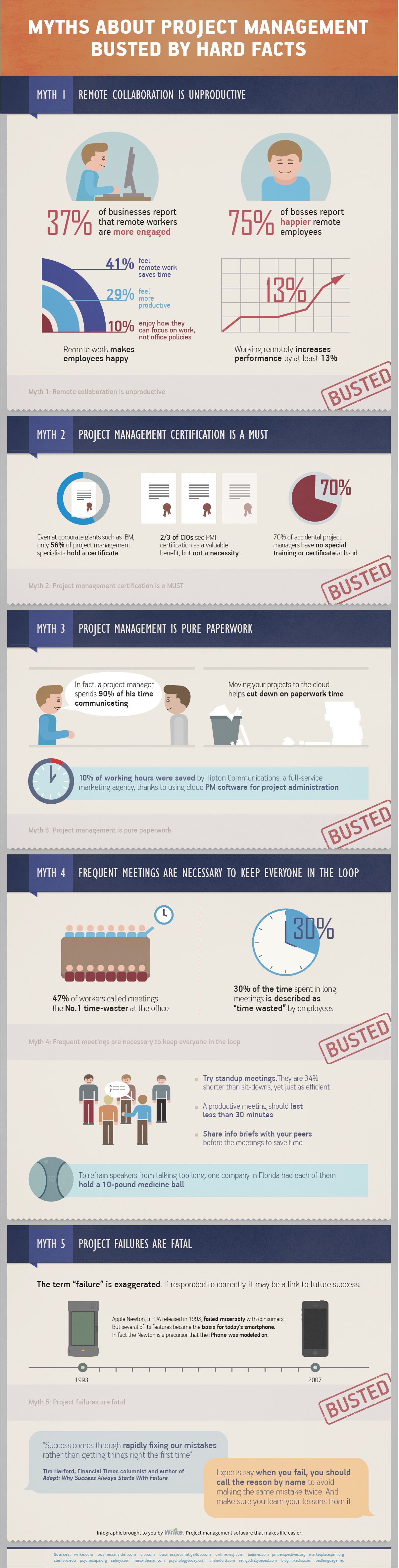
37% of businesses report that remote workers are more engaged
75% of bosses report happier remote employees
41% feel remote work saves time
29% feel more productive
10% enjoy how they can focus on work, not office policies
Remote work makes employees happy
Working remotely increases performance by at least 13%
MYTH 2 – PROJECT MANAGEMENT CERTIFICATION IS A MUST
Even at corporate giants such as IBM, only 56% of project management specialists hold a certificate
2/3 of ClOs see PMI certification as a valuable benefit, but not a necessity
70% of accidental project managers have no special training or certificate at hand
MYTH 3 – PROJECT MANAGEMENT IS PURE PAPERWORK
In fact, a project manager spends 90% of his time communicating
Moving your projects to the cloud helps cut down on paperwork time
10% of working hours were saved by Tipton Communications, a full-service marketing agency, thanks to using cloud PM software for project administration
MYTH 4 – FREQUENT MEETINGS ARE NECESSARY TO KEEP EVERYONE IN THE LOOP
47% of workers called meetings the No.1 time-waster at the office
30% of the time spent in long meetings is described as “time wasted” by employees
Try standup meetings.They are 34% shorter than sit-downs, yet just as efficient
A productive meeting should last less than 30 minutes
Share info briefs with your peers before the meetings to save time
To refrain speakers from talking too long, one company in Florida had each of them hold a 10-pound medicine ball
MYTH 5 – PROJECT FAILURES ARE FATAL
The term “failure” is exaggerated. If responded to correctly, it may be a link to future success.
Apple Newton, a PDA released in 1993, failed miserably with consumers. But several of its features became the basis for today’s smartphone. In fact the Newton is a precursor that the iPhone was modeled on.
“Success comes through rapidly fixing our mistakes rather than getting things right the first time” Tim Harford, Financial Times columnist and author of Adapt: Why Success Always Starts With Failure
Experts say when you fail, you should call the reason by name to avoid making the same mistake twice. And make sure you learn your lessons from it.
Myths About Project Management Busted By Hard Facts (Infographic)
Cloud storage is a fantastic concept, particularly in an age where we expect to be able to access files from anywhere at any time. Also, it can be a godsend when disk space on your hardware is at a premium, so the question should not be ‘Will I use cloud storage?’ but rather ‘What cloud storage provider will I use?’.
This infographic from ERS IT Solutions can help with addressing that latter question. It examines six of the main cloud storage platforms, comparing key factors such as maximum file size, free storage capacity, the cost of paid plans and the operating systems with which they are compatible. It also outlines the primary plus and minus points of each one so that you have a very straightforward guide to what these cloud platforms are like.
If you’re unfamiliar with cloud storage and you just want something that is easy to use and doesn’t require huge volumes of storage, Dropbox or Google Drive are perfect for you. They are simple to navigate and files can be uploaded with ease, while Dropbox is bound to work on pretty much every operating system.
For those who are more skilled or experienced with cloud storage, iCloud Drive is worth considering. Its interface is quite complex to understand, but once mastered it is a joy to use. If you’re using cloud storage exclusively for professional purposes, Box has a massive range of business tools such as collaboration and file privacy control. It’s best avoided if you’re only using cloud casually, though, as it can be tricky and unwieldy.
Learn more about these and other cloud storage platforms in the infographic below.
Originally posted 2017-11-03 18:35:23. Republished by Blog Post Promoter
Mobile devices have become an integral part of seafarers’ lives, both at land and sea; after all they are always mobile. Mobile apps are especially convenient for seafarers because they enable data sharing and storage, to help the interact with land and stay safe at sea. With the improvement of communications, Information Technology is evolving for seafarers.
Here are 12 must have Maritime apps for download today:
This application is Anchor watch, position logger, SMS alarm and Sound Alarm and it monitors device’s current location and inform you if the location of the device moves to far away from the set anchor. In that case, it will sound an alarm and (if you select so) send an SMS.Download Anchor WatchNamed best knot-tying app by Outside Magazine! Learn to tie knots the fun and easy way from the creators of the web’s #1 knot site. Animated Knots by Grog is simply the best, most comprehensive teaching and reference tool for boaters, climbers, fishermen, scouts and hobbyists. Watch knots tie themselves in simple step-by-step photo animations, or go frame-by-frame as you learn each knot. Tap the info button to get detailed descriptions about each knot’s correct use, advantages and disadvantages, and other information.Download Animated KnotsLooking for the most accurate Wind Forecast on the web? Trust the world leader – PredictWind • Highest resolution on the web. • Choice of top sailors and wind experts. • Incredible detail with tables, graphs and maps. • Zoom in on high resolution forecast maps. Incredibly powerful tools: • Weather Routing: showing you the fastest route with wind conditions. • Trip Planner: showing you the best day for departure. • Observations: real time live observations with graphs. • Forecast Alerts: get notified of the conditions that matter to you. • GPS Tracking: lets friends & family view your position and track.Download PredictWind AppHundreds of pages of boating information on your iPhone,iPod Touch or iPad! The Boater’s Pocket Reference caters to all levels of boating expertise with a wide variety of content including 800 illustrations and photographs and a myriad of charts and graphs. Boater’s Pocket Reference is a popular and useful printed book and the app is even better.Download Boater’s Pocket ReferenceMX Mariner is a basic mobile marine navigator / chart plotter featuring quilted offline raster marine charts.Download MX Mariner – Marine ChartsThe International Maritime Organization estimates that 90 % of the world’s trade is moved around the planet by sea. Get information for world ports easy and fast. This application contains more than 4000 ports in 191 countries. Fast searching capabilities by either country or port search selection aided by quick sorting tooltips.Download Maritime World PortsHazcheck DGL Lite is a FREE mobile app for those that need quick and easy access to IMDG Code information contained in the dangerous goods list. The app now includes both Amendment 36-12 and Amendment 37-14 IMDG Code data (2015 is a dual amendment when either can be used).Download Hazcheck DGL Lite(Look up a Ship and Find an Inspector/Union) into one great app that provides a one stop shop for seafarers in search of vessel information, contact details for ITF inspectors/affiliates and the ITF Helpline.Download ITF SeafarersShore Leave is an application thought for seafarers. Are you approaching a new port? Searching for the nearest seafarers’ centre? Looking for reliable transport to the city? Shore Leave is what you need. Store all seafarers’ centre contact details into your android phone, and keep them always with you, wherever you go. Once you arrive in a port, just switch on your phone, open Shore Leave, and in few clicks you will be able to get in touch with the nearest seafarers’ centre. Shore Leave is working properly without any internet connection.Download Shore LeaveEquasis is a non-profit and public-driven international organization that promotes quality shipping and maritime safety through transparency and free access to the relevant information.Download Equasis MobileThis app is aimed at providing a platform acceptable for everyone to provide and share the best knowledge available on cargo transportation, thereby hoping to contribute to awareness and prevention of loss.Download CargoHandbookThe International Regulations for Preventing Collisions at Sea 1972, also known as “COLREGs”, “Rules of the Road” or “RoR”, prescribe rules to be followed by ships and other vessels at sea in order to prevent collisions between two or more vessels.Download IMO Collision Regulations
Originally posted 2015-08-31 06:49:45. Republished by Blog Post Promoter
If you’re new to Project Management, the number of different methodologies (and acronyms) can be mind-boggling. We’ve broken 16 common project management methodologies into bite-sized pieces to help you choose the best approach for your next project.
ADAPTIVE PROJECT FRAMEWORK (APF)
Improves the project at every stage by learning from the previous stage’s results. By defining project goals and regularly reviewing project scope, managers can deliver the highest possible business value for the customer.
AGILE
Adapts to change, capitalizes on trends, and creates a dynamic team through collaboration 4 and flexibility. Stakeholders review the project LL.at each stage so teams can make the right adjustments, creating high-quality products „ that meet customer need.
BENEFITS REALIZATION
Defines success as achieving a desired benefit. If clients want to increase sales by 15% and hire you to develop new CRM software, the project isn’t complete until sales are up 15% – even if you deliver the desired CRM on time and within budget.
CRITICAL CHAIN PROJECT MANAGEMENT (CCPM)
Avoids project delays by identifying a “critical chain” of tasks, reserving resources for those tasks. Since schedules are built around resource availability the project timeline may be longer, but there’s less chance of missing important deadlines.
CRITICAL PATH METHOD
Determines your project’s shortest timeline so you can adjust to shifting deadlines. By identifying the project’s most essential tasks, you can estimate completion dates, dependencies, milestones, and deliverables. And compare what should be happening with what is happening every day.
EVENT CHAIN METHODOLOGY
Helps recognize and plan for potential risks. Monte Carlo Analysis and Event Chain Diagrams help determine the probability of certain risks and their potential impact. Visualizing the relationship between external events and project tasks helps create realistic plans.
EXTREME PROGRAMMING (XP)
Features short development cycles, frequent releases, and open communication with stakeholders. Teams focus on collaboration and efficiency, writing the simplest possible code to produce the desired feature, avoiding burnout and low-quality deliverables.
Produces a slow and steady stream of deliverables through continuous workflow. Managers often use a whiteboard or sticky notes to represent progress and uncover process problems. By understanding where time is wasted, teams can improve productivity.
LEAN
Delivers high-value, high-quality work with less manpower, money, and time. Lean cuts waste by eliminating bottlenecks, focusing on customer value, and continually improving processes. Use Lean to cut budgets, meet quick deadlines, and get big results with a small team.
LEAN SIX SIGMA
Comb-nes Lean’s efficiency with Six Sigma’s statistics-based process improvement. By defining how work actually gets done, teams eliminate waste and focus on delivering the highest possible value to clients.
Ensures that every project has business justification and will contribute value. Planning begins by identifying a clear need, targeted customer, realistic benefits, and accurate cost assessment.
Blends project planning with environmental sustainability measures. Want to go green? PRiSM is for you. Reduce energy, waste management, and distribution costs, all while reducing your environmental footprint
PROCESS-BASED PROJECT MANAGEMENT
Guarantees every project furthers the company’s mission. Before project kick-off, the plan is analyzed to see if it will live up to the mission statement; if not, all strategies and goals are adjusted. Every action adds value to an organization’s strategic vision.
SCRUM
Emphasizes productivity, focus and collaboration so teams can build high-quality deliverables quickly and adapt to change easily. Teams work in short sprints for maximum efficiency, plus they can test new iterations quickly and fix mistakes right away.
SIX SIGMA
Improves processes and product quality by reducing defects or bugs. A rating of “six sigma” means that 99.99966% of what’s produced is defect-free. By examining the entire production process, you can find possible improvements even before defects appear.
WATERFALL
Breaks projects down into a series of sequential tasks. With clearly defined goals and a set timeline, teams work through tasks in order, completing each one before moving on to the next in line. And extensive planning means accurate timelines and budgets.

 Login
Login



 Infographic brought to you by