 Login
LoginOur Favorite Science Books to Gift This Year

The smartest gifts are often the smartest books.


OpenAI may soon be forced to explain why it deleted a pair of controversial datasets composed of pirated books, and the stakes could not be higher.
At the heart of a class-action lawsuit from authors alleging that ChatGPT was illegally trained on their works, OpenAI’s decision to delete the datasets could end up being a deciding factor that gives the authors the win.
It’s undisputed that OpenAI deleted the datasets, known as “Books 1” and “Books 2,” prior to ChatGPT’s release in 2022. Created by former OpenAI employees in 2021, the datasets were built by scraping the open web and seizing the bulk of its data from a shadow library called Library Genesis (LibGen).


© wenmei Zhou | DigitalVision Vectors
How rule-based finance automation reduces manual work and speeds up processing.
The post What are automated workflows in accounting, and how do they save time? appeared first on Digital Trends.


Automatically convert values using the latest exchange rates, track gains or losses, and produce automated reports across markets.
The post How does multi-currency support help businesses manage global transactions? appeared first on Digital Trends.

How online access strengthens collaboration, consistency, and security for distributed accounting teams.
The post How does cloud access make QuickBooks easier to use for remote teams? appeared first on Digital Trends.

A step-by-step guide to streamlined inventory management for SMEs.
The post How do small businesses manage inventory efficiently with QuickBooks? appeared first on Digital Trends.

It’s been a month since Rewiring Democracy: How AI Will Transform Our Politics, Government, and Citizenship was published. From what we know, sales are good.
Some of the book’s forty-three chapters are available online: chapters 2, 12, 28, 34, 38, and 41.
We need more reviews—six on Amazon is not enough, and no one has yet posted a viral TikTok review. One review was published in Nature and another on the RSA Conference website, but more would be better. If you’ve read the book, please leave a review somewhere.
My coauthor and I have been doing all sort of book events, both online and in person. This ...
The post More on Rewiring Democracy appeared first on Security Boulevard.
Earlier this year, Google announced the end of its efforts to get Steam running on Chromebooks, but it’s not done trying to make these low-power laptops into gaming machines. Google has teamed up with Nvidia to offer a version of GeForce Now cloud streaming that is perplexingly limited in some ways and generous in others. Starting today, anyone who buys a Chromebook will get a free year of a new service called GeForce Now Fast Pass. There are no ads and less waiting for server slots, but you don’t get to play very long.
Back before Google killed its Stadia game streaming service, it would often throw in a few months of the Pro subscription with Chromebook purchases. In the absence of its own gaming platform, Google has turned to Nvidia to level up Chromebook gaming. GeForce Now (GFN), which has been around in one form or another for more than a decade, allows you to render games on a remote server and stream the video output to the device of your choice. It works on computers, phones, TVs, and yes, Chromebooks.
The new Chromebook feature is not the same GeForce Now subscription you can get from Nvidia. Fast Pass, which is exclusive to Chromebooks, includes a mishmash of limits and bonuses that make it a pretty strange offering. Fast Pass is based on the free tier of GeForce Now, but users will get priority access to server slots. So no queuing for five or 10 minutes to start playing. It also lacks the ads that Nvidia’s standard free tier includes. Fast Pass also uses the more powerful RTX servers, which are otherwise limited to the $10-per-month ($100 yearly) Performance tier.


© Asus
Science fiction has long speculated about the possibility of first contact with an alien species from a distant world and how we might be able to communicate with them. But what if we simply don’t have enough common ground for that to even be possible? An alien species is bound to be biologically very different, and their language will be shaped by their home environment, broader culture, and even how they perceive the universe. They might not even share the same math and physics. These and other fascinating questions are the focus of an entertaining new book, Do Aliens Speak Physics? And Other Questions About Science and the Nature of Reality.
Co-author Daniel Whiteson is a particle physicist at the University of California, Irvine, who has worked on the ATLAS collaboration at CERN’s Large Hadron Collider. He’s also a gifted science communicator who previously co-authored two books with cartoonist Jorge Cham of PhD Comics fame: 2018’s We Have No Idea and 2021’s Frequently Asked Questions About the Universe. (The pair also co-hosted a podcast from 2018 to 2024, Daniel and Jorge Explain the Universe.) This time around, cartoonist Andy Warner provided the illustrations, and Whiteson and Warner charmingly dedicate their book to “all the alien scientists we have yet to meet.”
Whiteson has long been interested in the philosophy of physics. “I’m not the kind of physicist who’s like, ‘whatever, let’s just measure stuff,'” he told Ars. “The thing that always excited me about physics was this implicit promise that we were doing something universal, that we were learning things that were true on other planets. But the more I learned, the more concerned I became that this might have been oversold. None are fundamental, and we don’t understand why anything emerges. Can we separate the human lens from the thing we’re looking at? We don’t know in the end how much that lens is distorting what we see or defining what we’re looking at. So that was the fundamental question I always wanted to explore.”
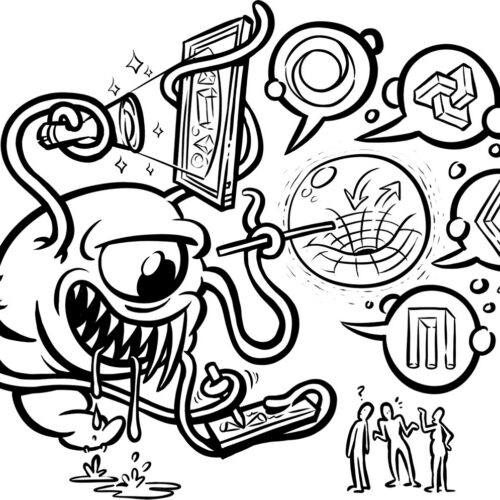
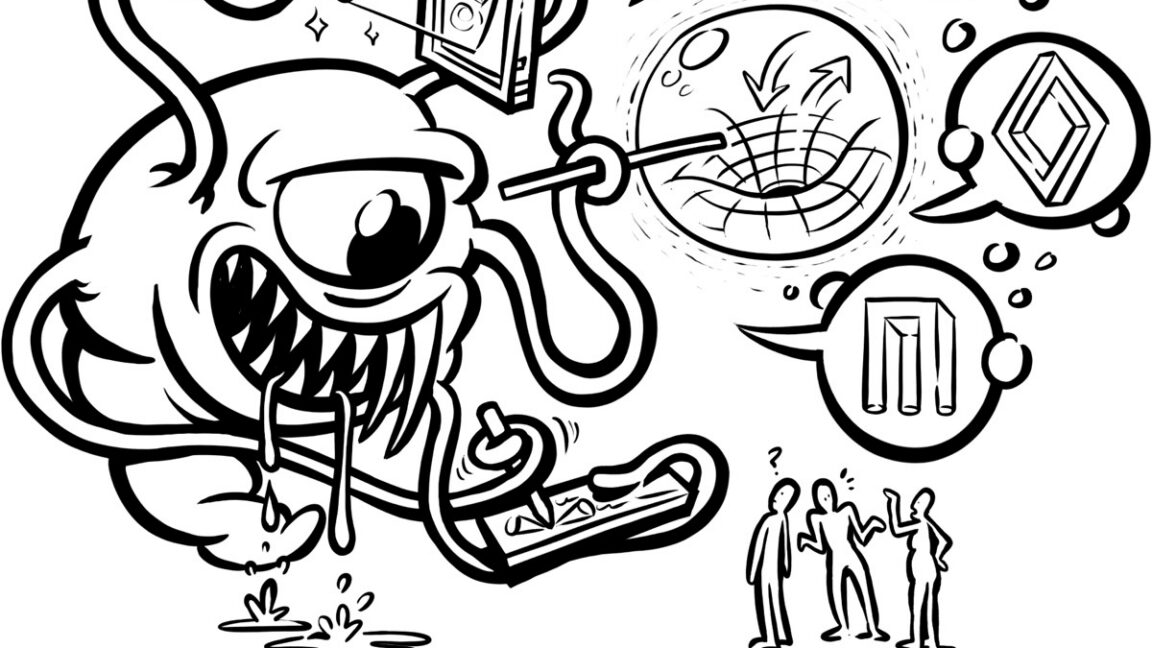
© Andy Warner
Bitcoin Magazine

What Is Money?
For many people, their first sense of Bitcoin is that it is magic internet money—something easily ignored and certainly not worth the time needed to understand it. Many of the people I talk to about Bitcoin say that their “plan” is just to ignore it until it goes away. As we will learn throughout this book, that isn’t really an option. Most people also laugh when presented with their first opportunity to exchange “real money” for bitcoin. But bitcoin is real money; better money than any of us have had in our lifetimes—and it is so much more.
Both Bitcoin the network and bitcoin the digital token can be hard to define because they don’t just replace one thing and make it better. Bitcoin is the new, better version of gold from the ground and the paper dollar bill. Bitcoin is also the new, better version of your savings account and your checking account and your credit card. It is also the new, better way to send money internationally and to buy a cup of coffee down the block. Bitcoin doesn’t just replace the hard asset money and the currency, but also the payment rails, the political monetary policy, and even the central bank—all in one fell swoop. It is a completely new thing.
To truly understand Bitcoin, you must understand the thing it aims to replace: money. What is money? Oddly enough, despite its centrality to almost everything we do, we rarely pause to consider the question. But we have to if we really want to understand what Bitcoin actually is.
In the most fundamental form, money is any object that is used for some combination of the following purposes:
1. A medium of exchange (folks can buy stuff with it);
2. A unit of account (folks can reliably use it to price stuff); and
3. A store of value (folks can buy stuff with it later).
Over the years, many different objects have been used as money: sea shells, salt, large stones, gold, and the $20 Federal Reserve Note currently in your wallet. If you’re reading this book in prison, you might use cigarettes or packets of ramen as money. I encourage you to reflect on how and why people naturally converge on forms of money based on the time and circumstances they find themselves in and how technology has always played a role in the development of new money. Some things make better money than others. As we will see, the paper money and its digital copy you use every day is the latest form of money, but it isn’t the best—in fact it is far from the ideal.

To be considered a good form of money—something that accomplishes the three purposes listed above well—an object must have some combination of the following fairly intuitive properties:
1. Durability (It has to last, not spoil or deteriorate);
2. Portability (You have to be able to move it around);
3. Divisibility and Aggregability (You need to be able to buy little things and big things too);
4. Fungibility (The units need to be uniform);
5. Scarcity (If there’s a lot of something, it won’t maintain value);
6. Acceptability (People have to want it for you to use it); and
7. Verifiability (You don’t want a lot of counterfeit money).
You or I may have other properties that we think should be added to the list. For example, I think good money should be created fairly. But this is the list that economists have used for generations. In fact, the Federal Reserve Bank of St. Louis lists these properties in the teachers’ resources section of their website12 and uses them to argue—correctly—that US dollars are better money than a cow. A cow seems like a low bar, but maybe they only want to make the arguments they can win.
Each of these properties economists use to decide how good something is as money is measured on a scale; none of them is a binary “yes” or “no.” If an object fulfills many of these properties, it would make for a good form of money. From this list, it is trivial to see what your intuition already tells you. Bananas would make a horrible form of money and coins made of gold would probably serve the purpose well. But what about the $20 bill in your wallet? What about bitcoin?
In a head-to-head competition, the $20 bill easily beats bitcoin in category #6: Acceptability. But acceptability can change and has many times throughout history, and the gap is narrowing every year as more establishments accept bitcoin. It’s not too hard to imagine that gap closing substantially over time. On a technicality, the dollar also has a slight edge in category #4: Fungibility. But this is only a small difference that most people would not notice, and technological methods already exist that close this gap completely.
As we will see as the rest of this section unfolds, Bitcoin walks away with the lead over dollars in all of the other categories. It’s not even close. Bitcoin is not just a little but a lot more Durable, Portable, Divisible/Aggregable, Scarce, and Verifiable. These aren’t properties I cherry-picked because they make Bitcoin look good. These are the old textbook properties economists have used for “good money” forever. We can add to this list the fact that since Bitcoin is natively digital and programmable, it seems like a better form of money right now and for the future. Nor is Bitcoin just better than the dollar: when comparing Bitcoin to other forms of money (e.g., gold) it still demolishes the competition across most or all of the categories. It’s simply the best money that humans have ever created.
Before I explain why that is true, I want to pause and make sure we also understand what money isn’t. You will notice that the properties listed above for something to serve as good money do not require the item to have a physical form you can hold in your hand. Nor do the properties suggest that something used as money needs to have some other intrinsic value. Nor do the properties suggest that money must be issued by a government. All three of these things are often cited as reasons why Bitcoin cannot be real money, yet none of them really have anything to do with the actual definition of money. These are things people reference because they are important to their experience with money, but they aren’t intrinsic to that experience. Just like how what has served as money has changed over time, so too has our experience with money.
For example: It is not necessary for money to have a physical form that can be touched or held. Indeed, you have never held most of the dollars you have earned, spent, and saved in the last 20 years. They have just been numbers on a screen. Digital money, dollars or otherwise, is perfectly functional as money. And the same is true of Bitcoin; just because you can’t touch it doesn’t mean it’s not real either. Hopefully this is reassuring, since this is typically the very first argument offered by well-meaning folks when they first start to grapple with Bitcoin. But the simple fact is that you don’t need to be able to touch something for it to be a good form of money.
Nor is it necessary for money to have an intrinsic value. In fact, because money is used to communicate price information from one market participant to another, it is better that it not have other use cases. Money having intrinsic value would add “noise” to the signal and make every economic decision more difficult. Imagine having to weigh every purchase you make with your money against the value of its other uses. It would cause economic activity to grind to a halt as everyone debated whether to use the money they had for purchasing goods or this other use. Some people don’t realize that the numbers on their screens that represent the dollars in their bank account don’t have an intrinsic value either. Bitcoin’s lack of intrinsic value is another very common argument launched against it, when in fact that turns out to be a valuable feature and not a bug. The fact that Bitcoin doesn’t have some other intrinsic value means it is able to provide price information for economic decisions without noise or manipulation.
Finally, it is not necessary that money be issued by a government. For many centuries it wasn’t. People would use various media of exchange and stores of value without the government interceding in any way. It was only in the last couple of centuries that it made sense for governments to get into the money game when it was difficult to trust and verify the purity and weights of coinage. Stamping the king’s face onto a coin served a purpose at that point. Since then, the intertwining of government and money has been so complete that most folks have a hard time imagining that money can be something separate from the government. This misunderstanding has repeatedly been manipulated for the sole benefit of the government that controls the issuance of money. But despite our experience, there is no need for money to be issued by the state to be valid. Bitcoin is the best hope humanity has of severing the ties between government and money.
At the very least it will serve as a check on how the governments discharge their responsibility as stewards of monetary policy.
The good news is that people understand the seven properties of good money listed above on an intuitive level. In other words, people do not need to read an economic textbook to recognize “good” money. They just start gravitating toward it over time. People won’t need to know why Bitcoin is better to know that it is better. Our recent monetary experiment with unbacked paper money is only 50 years old, and paper money owes most of its success to the privileged legal status paper money enjoys through the governments that issue it. But absent coercion people will always choose a better form of money, as shown by the fact that they did for thousands of years by using gold. Before Bitcoin had been invented, Jörg Guido Hülsmann explained, in his book The Ethics of Money Production, that in the case of “gold and silver—and whatever else free men might discover and develop for monetary services . . . there is a natural tendency in the market to spread the use of the most useful monies over the entire world.”13 Bitcoin is better money and because of that, Bitcoin adoption is very likely to grow and spread for the foreseeable future.
This article is an excerpt from A Progressive’s Case for Bitcoin: New Revised Updated Edition, available now for pre-order at a discounted price of $21 through November 15, 2025.
12 Federal Reserve Bank of St. Louis, “Functions of Money,” Economic Lowdown Podcast, https://www.stlouisfed.org/education/economic-lowdown-podcast-series/episode-9-functions-of-money.
13 Jörg Guido Hülsmann, The Ethics of Money Production (Auburn, Ala.: Ludwig von Mises Institute, 2008), 197.
This post What Is Money? first appeared on Bitcoin Magazine and is written by Jason Maier.
When Silicon Thinks Faster Than Flesh

They say the chips think faster now, a trillion choices in a breath, broadband wide as highways, while hands that built the world sit idle in the waiting room of obsolescence.
Who works when work is just a memory uploaded to machines that never sleep, never ask for raises, never dream?
They’ll give us income, universal, a basic promise, monthly bread, but whose hand controls the faucet? Whose finger on the valve decides if we eat or beg?
The government, they say, will tax the titans, route the river from their vaults into our cups. Trust us, they say. We’ll be fair, they say.
But I’ve seen power and power doesn’t share unless someone is watching, unless someone can say no.
So here’s the question that should keep us awake: Who decides the numbers? Who writes the code? Who checks the checkers?
We need our people at that table, not later, not when we’re already hungry, not when dependence has made us quiet, but now, while we still have leverage, while we can still demand to see the blueprints of our own tomorrow.

A citizen council, elected, accountable, with power to audit, to veto, to verify that justice isn’t just a promise whispered down from towers but a right we enforce ourselves.
The future is being written in boardrooms we can’t enter, in algorithms we can’t read.
and if we don’t demand a seat at that table now, we’ll inherit a world where someone else decides if we deserve to live.
2140 The Rise of Bitcoin Citadels Chronicles Genesis
When Silicon Thinks Faster Than Flesh was originally published in Coinmonks on Medium, where people are continuing the conversation by highlighting and responding to this story.

When Marissa Coughlin left her latest tech job to open a romance bookstore and crafting hub in Seattle, she didn’t leave technology behind completely.
In fact, alongside her partner, Constantine Vetoshev, who still works in tech, artificial intelligence has become a major player in this next chapter of their lives.
Coughlin worked in a variety of communications and content roles for companies including Airbnb, Textio, Highspot, and most recently, T-Mobile. Vetoshev is a software developer at Brook.ai, a Seattle-area health technology startup that uses AI to help clinical teams deliver remote care.
Both big readers, the pair first started looking at spaces and developing a bookstore business plan in 2023. But with two small children, they were waiting for better timing. When a space became available on Market Street in Seattle’s Ballard neighborhood they finally made the leap, and opened Swoon City last month.
While Coughlin has no interest in seeing AI used to write the books or illustrate the covers that line her shelves, she’s a big believer in how the technology can help the back end of the business.
“I think more businesses should be using this stuff, especially small businesses, if they can figure out how to tap into it,” Coughlin said. “It’s super useful, but you have to know that it’s there and what it can do, and be a little bit creative and figure out the solutions.”
Here are some of the ways Swoon City is tapping into AI, leveraging Coughlin and Vetoshev’s know-how:

“I feel like there’s a lot of things that we’ve created for this store that other people who might be curious about doing something like this could tap into and be able to leverage for their own stuff,” Coughlin said.
Vetoshev said he can come home from his day job, put the kids to bed and then focus on something that needs to be built for the store.
“A couple of hours of work with a [large language] model, and we’re off to the races,” he said.
The technology is all in service of a genre that is exploding, especially among young readers.
Romance is the leading growth category for the total print book market thus far in 2025, and the volume for the category has more than doubled compared to four years ago, with 51 million units sold in the past 12 months, according to industry analysis.
NPR credited romance interest driven by Gen Z readers, especially on BookTok, a subcommunity of TikTok for recommending, reviewing, and discussing books.
Swoon City is hoping to follow in the successful footsteps of The Ripped Bodice, an independent brick-and-mortar romance bookstore with locations in Los Angeles and Brooklyn, N.Y.
Coughlin looks forward to bringing people together not just around books, but by hosting various events and building out crafting classes for embroidery, stained glass, jewelry making and more.
“I feel like part of what was exciting for a romance bookstore is the community, because it is often not a genre that’s as well respected in the book community, even though it’s huge,” she said.

From empty offices in 2020 to AI colleagues in 2025, the way we work has been completely rewired over the past five years. Our guest on this week’s GeekWire Podcast studies these changes closely along with her colleagues at Microsoft.
Colette Stallbaumer is the co-founder of Microsoft WorkLab, general manager of Microsoft 365 Copilot, and the author of the new book, WorkLab: Five years that shook the business world and sparked an AI-first future, from Microsoft’s 8080 Books.
As Stallbaumer explains in the book, the five-year period starting with the pandemic and continuing to the current era of AI represents one continuous transformation in the way we work, and it’s not over yet.
“Change is the only constant—shifting norms that once took decades to unfold now materialize in months or weeks,” she writes. “As we look to the next five years, it’s nearly impossible to imagine how much more work will change.”
Listen below for our conversation, recorded on Microsoft’s Redmond campus. Subscribe on Apple or Spotify, and continue reading for key insights from the conversation.
The ‘Hollywood model’ of teams: “What we’re seeing is this movement in teams, where we’ll stand up a small squad of people who bring their own domain expertise, but also have AI added into the mix. They come together just like you would to produce a film. A group of people comes together to produce a blockbuster, and then you disperse and go back to your day job.”
The concept of the ‘frontier firm’: “They’re not adding AI as an ingredient. AI is the business model. It’s the core. And these frontier firms can have a small number of people using AI in this way, generating a pretty high run rate. So it’s a whole new way to think about shipping, creating, and innovating.”

The fallacy of ‘AI strategy’: “The idea that you just need to have an ‘AI strategy’ is a bit of a fallacy. Really, you kind of want to start with the business problem and then apply AI. … Where are you spending the most and where do you have the biggest challenges? Those are great areas to actually think about putting AI to work for you.”
Adapting to AI: “You have to build the habit and build the muscle to work in this new way and have that moment of, ‘Oh, wait, I don’t actually need to do this.’ “
The biggest risk related to AI: “The biggest risk is not AI in and of itself. It’s that people won’t evolve fast enough with AI. It’s the human risk and ability to actually start to really use these new tools and build the habit.”
Human creativity and AI: “It still takes that spark and that seed of creativity. And then when you combine it with these new tools, that’s where I have a lot of hope and optimism for what people are going to be able to do and invent in the future.”
Audio editing by Curt Milton.
Subscribe to GeekWire in Apple Podcasts, Spotify, or wherever you listen.

Jamie Siminoff has lived the American Dream in many ways — recovering from an unsuccessful appearance on Shark Tank to ultimately sell smart doorbell company Ring to Amazon for a reported $1 billion in 2018.

But as with most entrepreneurial journeys, the reality was far less glamorous. Siminoff promises to tell the unvarnished story in his debut book, Ding Dong: How Ring Went From Shark Tank Reject to Everyone’s Front Door, due out Nov. 10.
“I never set out to write a book, but after a decade of chaos, failure, wins, and everything in between, I realized this is a story worth telling,” Siminoff said in the announcement, describing Ding Dong as the “raw, true story” of building Ring, including nearly running out of money multiple times.
He added, “My hope is that it gives anyone out there chasing something big a little more fuel to keep going. Because sometimes being ‘too dumb to fail’ is exactly what gets you through.”
Siminoff rejoined the Seattle tech giant earlier this year after stepping away in 2023. He’s now vice president of product, overseeing the company’s home security camera business and related devices including Ring, Blink, Amazon Key, and Amazon Sidewalk.
Preorders for the book are now open on Amazon.
Bitcoin Magazine
A Peaceful Revolution
I consider myself a progressive person because I look around the world and I see that it is not just, fair, equitable, or peaceful. I have always looked for ways to make the world better, and I have always done that from within the systems I recognized as broken. For most of my adult life, I have expected the government (one example of a broken system) to make rules and laws that nudge the system closer to justice, fairness, equity, and peace. Isn’t that the best we can hope for?
One reason why I encourage you to learn about Bitcoin is so you can question the current system through another lens. Learning more about how and why Bitcoin works is only one half of the journey. Bitcoin also provides an opportunity to examine the unexamined, study the water around us, and ask tough questions about the systems we have always lived with. It presents the opportunity to ask questions we never really ask. What is money? Who controls it and how? Who should control it? Learning about Bitcoin empowers you to imagine what things might be like if we replace a structure we intuitively know is unjust but have never had the vocabulary to question before.
The idea that the monetary system might one day be all the way fixed has never seemed like a real possibility. The idea that the entire system could be replaced—the water around us that we don’t notice—has never been a possibility either. Yet while many of my liberal friends are very adept at pointing out systemic inequities, proposals for systemic change to replace the systems that cause those unfairnesses are few and far between. Certainly financial and monetary systems are systems that one doesn’t usually examine, but a better understanding of Bitcoin interestingly offers you a better understanding of the systems it seeks to replace, and why incremental change won’t fundamentally address its unfairnesses. It also allows you to imagine, perhaps for the first time, a world without those inequities.
The world is controlled by political, social, economic, and military systems that both create and depend on the hegemony of the United States dollar. Unfairness, inequity, and violence are woven into the fabric of these systems. They are inexorable parts of those systems, not just unfortunate externalities that exist on top of otherwise healthy structures. To take just one example, wealth inequality is not just an unfortunate thing that happens because some greedy people break the rules and get away with it. It is a necessary and integrated feature of a system that depends on a hegemonic United States dollar being a global reserve asset (see Chapter 7). But now, for the first time in human history, we have a potential monetary invention that could overhaul the system, not just tweak it from within to be a little more fair.
In my experience, the more a person knows about the legacy financial system, the more they dislike it. Henry Ford is credited, most likely incorrectly, with having said, “It is well enough that people of the nation do not understand our banking and monetary system, for if they did, I believe there would be a revolution before tomorrow morning.”5 Bitcoin could be the nudge to help you learn about our banking and monetary system and start a peaceful revolution.
Want the full argument? Dive deeper in A Progressive’s Case for Bitcoin New Revised Updated Edition — get your copy here.
5: “The Truth Is Out: Money Is Just Created, and the Banks Are Rolling in It,” Underground Network, accessed November 29, 2022, https://underground.net/money/the-truth-is-out-and-the-banks-are-rolling-in-it/.
This post A Peaceful Revolution first appeared on Bitcoin Magazine and is written by Jason Maier.
Published 2022 | Fiction
A boy caught between the real and an ‘alternate reality’, ‘Out of the Woods’ by Neikehienuo Mepfhu-o takes a look at the struggles that mental health illnesses bring with them – for the person and their immediate family members.
During a recent trip to Nagaland, I decided to pick up a book or two written by local authors, and ‘Out of the Woods’ by Neikehienuo Mepfhu-o was one among them. One of the key reasons to pick up the book was the book blurb – there was no tiptoeing around the subject of the book, no promises of happy endings and salvations, no hiding the fact that this could be (and is) a painful read.
Out of the Woods is a book that may act as a trigger for individuals who have dealt with mental health issues – themselves or as support for families. Because Neikehienuo Mepfhu-o captures the emotional turmoil not only of the afflicted but the immediate family too. It took me a good while to read through the book as it brought back memories from the days when I was diagnosed with anxiety and depression, the battle that ensued and the struggles that my immediate family, especially my parents faced in the interim.
Neikehienuo Mepfhu-o’s ‘Out of the Woods’ is the story of a family struggling to cope with the trials and tribulations that village life brings with it while also grappling with the trauma of caring for a growing teen who is struggling to find his place in the real world that collides with the alternate world he lives in. The book traverses through the life of this family that is caught in an endless, harsh loop of loss, pain, trauma, the struggle to find the cause’ to the boy’s ‘behaviour’ and the penultimate discovery of the road to healing.
One of the highlights of the books is the strong hold the writer has on the language (which could be contributed to the fact that she is an educator based in Kohima and has won an award for a previous book). The author uses simple language as effectively as a painter uses a paintbrush – her words transport you from the eerily peaceful and happy alternate world the boy lives in while effectively drawing out a picture of the home and world the boy inhabits with his family. She uses words to explain to the readers the thoughts and emotions that rush through the boy’s mind, in vivid contrast to the helpless anguish and frustration of the family that is tied together by their love for him. What is disturbing – and true – is that it is this very love and resultant uncertainty that govern their lives and threaten to break them apart. The book is a deep dive into the mind of a young boy dealing with an undiagnosed mental health disorder.
I keep writing ‘the boy’ because that is what he is through the book – ‘the boy’ – and that, in my opinion, works to create an awareness that the teenager and the family could be anyone, in any part of the world.
The relatives, the villagers, the pastor and other sources that claim they can help the child act as a commentary on the society’s struggles to accept the reality of mental health issues. This would, perhaps, be more pronounced in pockets that continue to remain relatively disconnected from the rest of the woke and allegedly more aware world.
So, does this mean Out of the Woods is without its follies? The very strength of the author works against the book – the words. By the time you reach the halfway mark, you may be hit by the ‘this is repetitive’ thought because it is for several pages. Thankfully, there is a shift from the normal to the parallel reality which shocks the reader out of the lull.
Another aspect that did not work for me is the end – the journey from the intervention, to seeking medical help and the manner in which the doctor explains the situation as also the boy’s return to ‘normalcy’ is not fulfilling from the reader point of view. Personally, tighter editing could have definitely helped the cause of this book.
However, for the sheer gumption required to write an entire novel that depicts the emotional trauma and exhaustion of mental health, Neikehienuo Mepfhu-o’s Out of the Woods is definitely a book I’d suggest you pick up.

The Network’s Hidden Battlefield: Rethinking Cybersecurity Defense Modern cyber threats are no longer knocking at the perimeter – they’re already inside. The traditional security paradigm has fundamentally shifted, and CISOs...
The post Innovator Spotlight: Corelight appeared first on Cyber Defense Magazine.
Published 2022 | Fiction
A boy caught between the real and an ‘alternate reality’, ‘Out of the Woods’ by Neikehienuo Mepfhu-o takes a look at the struggles that mental health illnesses bring with them – for the person and their immediate family members.
During a recent trip to Nagaland, I decided to pick up a book or two written by local authors, and ‘Out of the Woods’ by Neikehienuo Mepfhu-o was one among them. One of the key reasons to pick up the book was the book blurb – there was no tiptoeing around the subject of the book, no promises of happy endings and salvations, no hiding the fact that this could be (and is) a painful read.
Out of the Woods is a book that may act as a trigger for individuals who have dealt with mental health issues – themselves or as support for families. Because Neikehienuo Mepfhu-o captures the emotional turmoil not only of the afflicted but the immediate family too. It took me a good while to read through the book as it brought back memories from the days when I was diagnosed with anxiety and depression, the battle that ensued and the struggles that my immediate family, especially my parents faced in the interim.
Neikehienuo Mepfhu-o’s ‘Out of the Woods’ is the story of a family struggling to cope with the trials and tribulations that village life brings with it while also grappling with the trauma of caring for a growing teen who is struggling to find his place in the real world that collides with the alternate world he lives in. The book traverses through the life of this family that is caught in an endless, harsh loop of loss, pain, trauma, the struggle to find the cause’ to the boy’s ‘behaviour’ and the penultimate discovery of the road to healing.
One of the highlights of the books is the strong hold the writer has on the language (which could be contributed to the fact that she is an educator based in Kohima and has won an award for a previous book). The author uses simple language as effectively as a painter uses a paintbrush – her words transport you from the eerily peaceful and happy alternate world the boy lives in while effectively drawing out a picture of the home and world the boy inhabits with his family. She uses words to explain to the readers the thoughts and emotions that rush through the boy’s mind, in vivid contrast to the helpless anguish and frustration of the family that is tied together by their love for him. What is disturbing – and true – is that it is this very love and resultant uncertainty that govern their lives and threaten to break them apart. The book is a deep dive into the mind of a young boy dealing with an undiagnosed mental health disorder.
I keep writing ‘the boy’ because that is what he is through the book – ‘the boy’ – and that, in my opinion, works to create an awareness that the teenager and the family could be anyone, in any part of the world.
The relatives, the villagers, the pastor and other sources that claim they can help the child act as a commentary on the society’s struggles to accept the reality of mental health issues. This would, perhaps, be more pronounced in pockets that continue to remain relatively disconnected from the rest of the woke and allegedly more aware world.
So, does this mean Out of the Woods is without its follies? The very strength of the author works against the book – the words. By the time you reach the halfway mark, you may be hit by the ‘this is repetitive’ thought because it is for several pages. Thankfully, there is a shift from the normal to the parallel reality which shocks the reader out of the lull.
Another aspect that did not work for me is the end – the journey from the intervention, to seeking medical help and the manner in which the doctor explains the situation as also the boy’s return to ‘normalcy’ is not fulfilling from the reader point of view. Personally, tighter editing could have definitely helped the cause of this book.
However, for the sheer gumption required to write an entire novel that depicts the emotional trauma and exhaustion of mental health, Neikehienuo Mepfhu-o’s Out of the Woods is definitely a book I’d suggest you pick up.


