Reading view

There are new articles available, click to refresh the page.

BlackRock Exec Says Bitcoin ETFs Becoming A Major Revenue Source Was A ‘Big Surprise’

Spot Bitcoin ETFs (exchange-traded funds) are one of the biggest narratives and have been a game-changer in the cryptocurrency space in the past two years. With these investment products, people get to participate in the cryptocurrency market without having to directly own the digital assets.

Interestingly, one of the biggest winners—that often gets overlooked—has been the issuers, especially as the crypto industry has seen increased institutional adoption since the Bitcoin ETFs launched. According to the firm’s executive, the BTC exchange-traded funds becoming the major source of revenue for BlackRock, the world’s largest asset manager, was not envisioned.

BlackRock’s Bitcoin Funds Outweighing Expectations 

At the Blockchain Conference 2025 in São Paulo on Friday, November 28, BlackRock’s business development director in Brazil, Cristiano Castro, told reporters that the Bitcoin ETFs are the largest revenue source for their company. According to the executive, this development came as a “big surprise” to the asset management firm.

Castro said in a statement:

We were very optimistic when we launched, but we didn’t believe it would reach such proportions. Just to give you an idea, it [IBIT in the US and IBIT39 in Brazil – the asset’s reference names] came very close to US$100 billion [in allocation].

This feat is notable for the Bitcoin ETFs, especially considering that BlackRock offers more than 1,400 exchange-traded products globally and has a whopping $13.4 trillion in assets under management. The US-based Bitcoin fund (with the IBIT ticker) has over $70.7 billion in net assets, becoming the first ETF to reach the $70-billion mark (doing so in June 2025).

While the US Bitcoin ETF market has somewhat slowed down, BlackRock’s IBIT still continues to outpace other ETFs launched in recent years. As earlier reports suggested, IBIT had managed to generate roughly $245 million in annual fees as of October 2025.

Bitcoin ETF Outflows ‘Perfectly Normal’ – Castro

When asked about the recent outflows from BlackRock’s Bitcoin ETF as the market leader’s value fell, the director stated that there are zero surprises in that trend. “ETFs are very liquid and powerful instruments, and they serve precisely to allow people to allocate their capital and manage their cash flow,” Castro noted.

The BlackRock director said that the withdrawals are expected, considering that the product is heavily owned by retail investors, who are reactionary in nature to price corrections. On Friday, the iShares Bitcoin Trust saw a net outflow of $113.72 million, bringing the weekly record to a negative $137.01 million and the fund to its fifth-consecutive week of withdrawals.

Bitcoin ETFs

Featured image from Getty Images, chart from TradingView

Bitcoin Spot ETFs Break 4-Week Negative Streak With $70M Weekly Net Inflows

The US Bitcoin Spot ETFs have produced a positive turnaround following four prior weeks of consistent outflows. In line with Bitcoin’s price recovery, these investment funds also ended a bleeding month of losses on a moderately positive note.

Bitcoin Spot ETFs Begin Recovery From Red November

According to the ETF tracking site, SoSoValue, Bitcoin Spot ETFs registered a net inflow of $70.05 million in the last week of November, to provide relief to a rather draining month. Notably, this reported figure represents the first positive netflow in four weeks, stretching since the last week of October. In analyzing individual ETF performance, BlackRock’s IBIT, valued at $51.55 per share, was largely unaffected by Bitcoin’s recovery, resulting in net outflows of $137.01 million. However, its cumulative net inflow still stands at $62.57 billion, retaining its status as the undisputed market leader. 

Other ETFs that also remained under bearish influence include Bitwise’s BITB and VanEck’s HODL, with aggregate outflows of $18.10 million and $36.95 million, respectively. On the other hand, the majority of the positive momentum came from Fidelity’s FBTC, which registered net inflows valued at around $230.44 million. Meanwhile, Grayscale’s duo GBTC and BTC, alongside Ark Invest’s ARKB, recorded a combined $31.65 million in net deposits.

Other funds such as Invesco’s BTCO, Valkyrie’s BRRR, Franklin Templeton’s EZBC, WisdomTree’s BTCW, and Hashdex’s DEFI recorded no significant netflow. Following this recent modest recovery, the Bitcoin spot ETFs closed November with total net outflows of $3.48 billion. At the time of writing, the cumulative total net inflow for these investment funds stands at $57.71 billion, while total net assets are valued at $119.39 billion, representing 6.56% of the Bitcoin market cap.

Ethereum ETFs Not Excluded From Recovery Party 

According to SoSoValue, the Ethereum Spot ETFs also experienced a market rebound following three consecutive weeks of outflows. Over the last week, these products attracted net deposits of $312.62 million to bring the cumulative total net inflows to $12.94 billion.

BlackRock’s ETHA and Fidelity’s FETH accounted for the majority of this positive netflow with net deposits of $257.18 million and $45.3 million, respectively. The Ethereum Spot ETFs now boast of total net assets of $19.14 billion, representing 5.19% of ETH’s market cap. At press time, Ethereum continues to trade at $2,991 after a minor 1.64% decline in the past day. Meanwhile, Bitcoin remains in consolidation around $90,840.

Bitcoin Spot ETFs

Bitcoin Maxi Says ATH Back On The Table After 40x Derivatives Surge

Bitcoin may be closing in on a new all-time high after moves in the derivatives market and fresh buying from large holders, according to market watchers and on-chain data.

Max Keiser, a long-time Bitcoin advocate, pointed to a filing by Nasdaq to increase options limits for BlackRock’s IBIT to 1 million contracts — a jump that represents roughly a 40x expansion from prior levels — as a key development that could remove barriers to bigger institutional flows.

Options Market Expands Significantly

According to Nasdaq paperwork and public commentary, the previous 25,000 contract cap had been seen by some as too small for rising volume.

Market experts argued that earlier limits were “discriminatorily small” and suggested that 400,000 contracts would be a more reasonable baseline given current demand.

Some described the change as a move that could place IBIT into a mega-cap derivatives category, unlocking follow-on effects for how banks and funds structure exposure to bitcoin.

I first explained this in 2017:

Now that BTC derivatives market was just expanded by 40x

New ATH’s are in play.

**November 2, 2017**

Max Keiser first discussed Bitcoin market makers needing to expand their inventory to support higher prices in this X post: “Wall St traders… https://t.co/aBQ5DdSDay

— Max Keiser (@maxkeiser) November 27, 2025

Banks And Market Makers React

Market makers will be able to hedge larger positions without hitting the old size wall, which can lower spreads and deepen available liquidity.

Based on reports, that also means banks can build structured notes that use IBIT as a reference without tripping existing risk caps — and JPMorgan is reportedly preparing Bitcoin-backed structured notes that would track BlackRock IBIT.

Those products could channel steady, institutional flows into the market rather than one-off spikes.

On-Chain Buyers Step In

According to Glassnode’s Accumulation Trend Score by cohort, holders of 10,000 BTC or more have flipped to net accumulation and now show a score of 0.8, signaling strong buying.

The 1,000 to 10,000 BTC group has also turned positive for the first time since September, while the 100 to 1,000 BTC cohort has been in active accumulation since October and continued buying through recent declines. Even retail holders with less than 1 BTC are showing their strongest accumulation since July.

Price Action And Value Zones

Bitcoin’s price behavior supports the buying narrative. The token fell into the low $80,000 area that served as support in May and then climbed back above $90,000 quickly, which many traders took as a sign that the market sees value in the $80,000 zone.

Based on reports, the average cost basis for US spot bitcoin ETFs was near $82,000, and that figure has been cited as a reason institutions found the dip attractive.

Market Risks And Short-Term Noise

Keiser had warned previously that when size limits blocked hedging, the market would be prone to pullbacks — and some analysts say that is part of the reason for recent volatility.

Expanding the options cap allows volume sellers to enter more smoothly, which could reduce erratic swings but will not erase market risk.

Price spikes are still possible and downside moves remain a real threat if flows slow or macro conditions shift.

Featured image from Gemini, chart from TradingView

Abu Dhabi Tripled Its Bitcoin Bet In Q3 Before the Crypto Market Crash

Bitcoin Magazine

Abu Dhabi Tripled Its Bitcoin Bet In Q3 Before the Crypto Market Crash

The Abu Dhabi Investment Council (ADIC) expanded its exposure to Bitcoin ahead of the cryptocurrency’s sharp downturn, more than tripling its stake in BlackRock’s iShares Bitcoin Trust (IBIT) during the third quarter, regulatory filings show.

ADIC — an independently run investment unit within Mubadala Investment Co. — increased its holdings to nearly 8 million IBIT shares as of Sept. 30. 

The position was valued at about $518 million at the time, up from 2.4 million shares three months earlier, according to Bloomberg reporting

The accumulation by the Abu Dhabi council came just weeks before Bitcoin surged to a record high in early October and then slid below $92,000 as leveraged bets unwound across the market.

The Abu Dhabi council says the move is part of a broader, long-term diversification strategy. A spokesperson described Bitcoin as a digital counterpart to gold and said the allocation is intended to sit alongside the fund’s traditional store-of-value assets.

The buying wasn’t isolated. Mubadala separately reported holding 8.7 million IBIT shares valued at $567 million at the end of the third quarter, unchanged from the prior filing. 

Other major institutions, including Harvard, also added to IBIT positions in the same period.

Still, investor appetite has cooled since the October selloff. U.S. spot Bitcoin ETFs have seen roughly $3.1 billion in outflows so far in November, according to Bloomberg data.

IBIT alone suffered a single-day record of $523 million in redemptions after Bitcoin broke below a key price level that left many ETF investors underwater.

JUST IN: 🇦🇪 Abu Dhabi has tripled their position in #Bitcoin, Bloomberg reports 👀 pic.twitter.com/KYVBIa4qbV

— Bitcoin Magazine (@BitcoinMagazine) November 19, 2025

Abu Dhabi’s bitcoin moves 

ADIC’s increased allocation is notable given Abu Dhabi’s financial reach and its growing ambition to establish itself as a global crypto hub. The emirate’s wealth funds collectively oversee more than $1.7 trillion, and Mubadala has already been a major player in the region’s digital-asset expansion.

Earlier this year, MGX — a tech investment firm backed by Mubadala — acquired a $2 billion stake in Binance using a stablecoin tied to the family of U.S. President Donald Trump.

Inside ADIC, the push into Bitcoin aligns with a broader shift toward global expansion. The council, initially created in 2007 and later folded under Mubadala’s structure, continues to operate with its own mandate and investment strategy. 

It has recently strengthened its leadership team, adding executives such as Alain Carrier, former head of international business at Canada Pension Plan Investment Board, and Ben Samild, previously the investment chief at Australia’s sovereign wealth fund, according to Bloomberg. 

While crypto’s volatility remains a concern for global investors, Abu Dhabi’s stance underscores a different calculus: large sovereign funds are increasingly comfortable treating Bitcoin as a long-term strategic asset. 

Other governments are moving in the same direction. El Salvador added more than $100 million in Bitcoin this week, the Czech central bank disclosed its first crypto purchase, and Kazakhstan is building a national cryptocurrency reserve fund that could reach $1 billion.

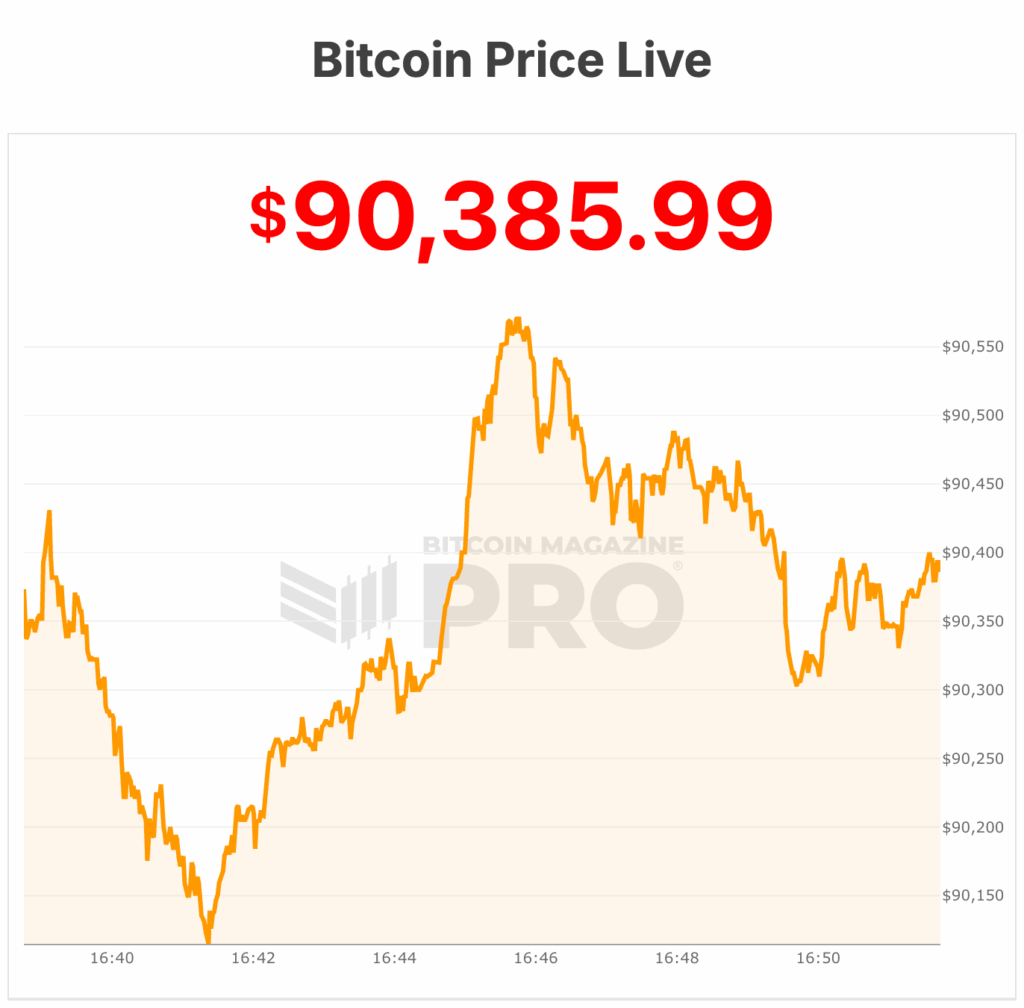
Bitcoin’s price is currently at the $90,300 range.

This post Abu Dhabi Tripled Its Bitcoin Bet In Q3 Before the Crypto Market Crash first appeared on Bitcoin Magazine and is written by Micah Zimmerman.

❌