❌

Reading view

There are new articles available, click to refresh the page.

USB DAC Comes With Graphic EQ

By: Lewin Day

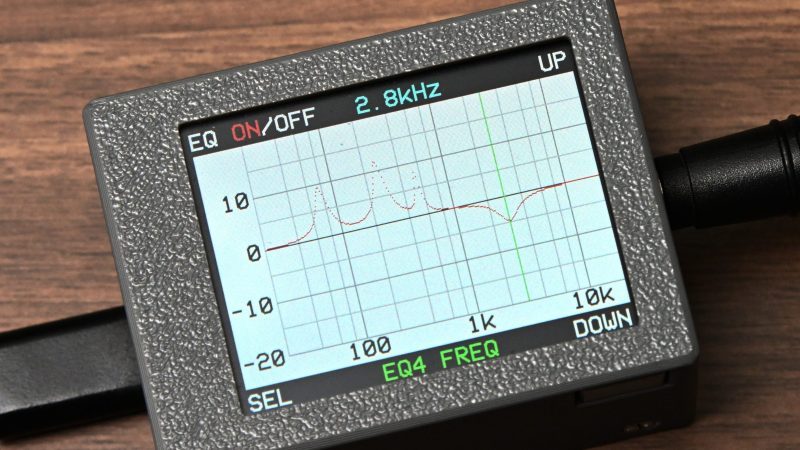
[shiura] had a problem β€” they wanted a nice high-quality audio output for their computer, but they didn’t fancy any of the DACs that were readily available on the market. They specifically wanted one that was affordable, capable, and included a graphic equalizer so they could simply hook it up to a regular amplifier and dial in the perfect sound. When they couldn’t find such a device, they decided to build their own.

The build is based around a Raspberry Pi Pico, chosen for its feature set that makes it easy to configure as a USB audio device. It’s paired with a Waveshare Pico Audio module, which is based on the PCM5101A stereo DAC and slots neatly on top of the microcontroller board. An SPI-controlled LCD screen was also fitted in order to display the graphic equalizer interface that [shiura] whipped up. The project write-up explains the code required to implement the equalizer in detail. A four-channel equalizer was possible on the original Pi Pico (RP2040), while upgrading to a more powerful Pi Pico 2 (RP2350) allowed implementing eight channels in total.

If you’re looking to build a digital audio system with the ability to do some equalization to suit your listening room, this might be a project of interest to you. We’ve featured other projects in this realm before, too.
Measuring Earth’s Rotation with Two Gyroscopes

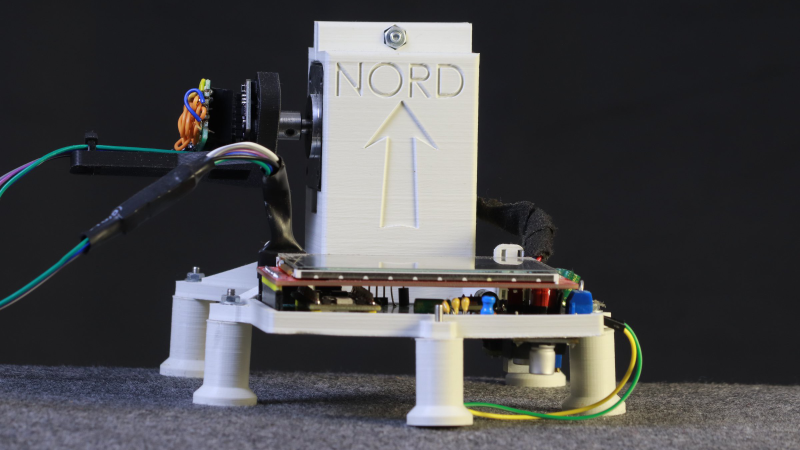
A 3D-printed assembly standing on short legs is visible. A portion extends upward with the word "Nord" sunk into it. Cables extend from one side of the upright portion, and a side view of a circuit board is visible at the front of the assembly.

We’ve probably all had a few conversations with people who hold eccentric scientific ideas, and most of the time they yield nothing more than frustration and perhaps a headache. In [Bertrand Selva]’s case, however, a conversation with a flat-earth believer yielded a device that uses a pair of gyroscopes to detect earth’s rotation, demonstrating that rotation exists without the bulkiness of a Foucalt pendulum.

[Bertrand] built his apparatus around a pair of BMI160 MEMS gyroscopes, which have a least significant bit for angular velocity corresponding to 0.0038 degrees per second, while the earth rotates at 0.00416 degrees per second. To extract such a small signal from all the noise in the measurements, the device makes measurements with the sensors in four different positions to detect and eliminate the bias of the sensors and the influence of the gravitational field. Before running a test, [Bertrand] oriented the sensors toward true north, then had a stepper motor cycle the sensors through the four positions, while a Raspberry Pi Pico records 128 measurements at each position. It might run the cycle as many as 200 times, with error tending to decrease as the number of cycles increases.

A Kalman filter processes the raw data and extracts the signal, which came within two percent of the true rotational velocity. [Bertrand] found that the accuracy was strongly dependent on how well the system was aligned to true north. Indeed, the alignment effect was so strong that he could use it as a compass.

In the end, the system didn’t convince [Bertrand]’s neighbor, but it’s an impressive demonstration nonetheless. This system is a bit simpler, but it’s also possible to measure the earth’s rotation using a PlayStation. For higher precision, check out how the standards organizations manage these measurements.

The Simplest Ultrasound Sensor Module, Minus the Module

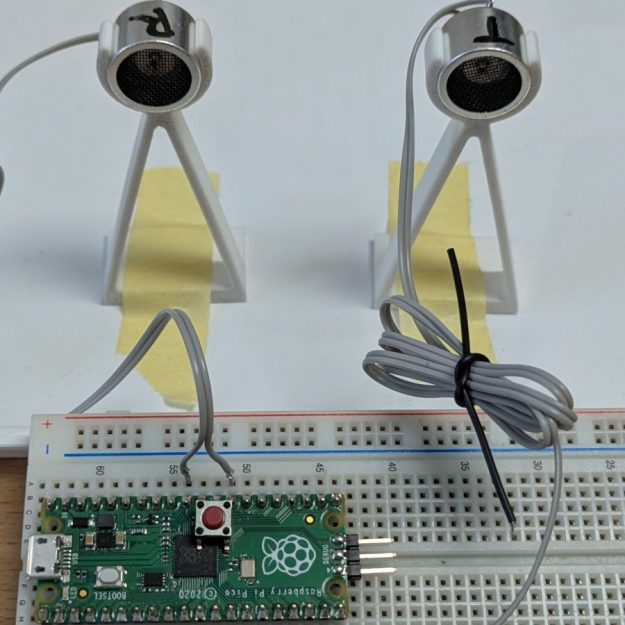
Just about every β€œgetting started with microcontrollers” kit, Arduino or otherwise, includes an ultrasonic distance sensor module. Given the power of microcontrollers these days, it was only a matter of time before someone asked: β€œCould I do better without the module?” Well, [Martin Pittermann] asked, and his answer, at least with the Pi Pico, is a resounding β€œYes”. A micro and a couple of transducers can offer a better view of the world.

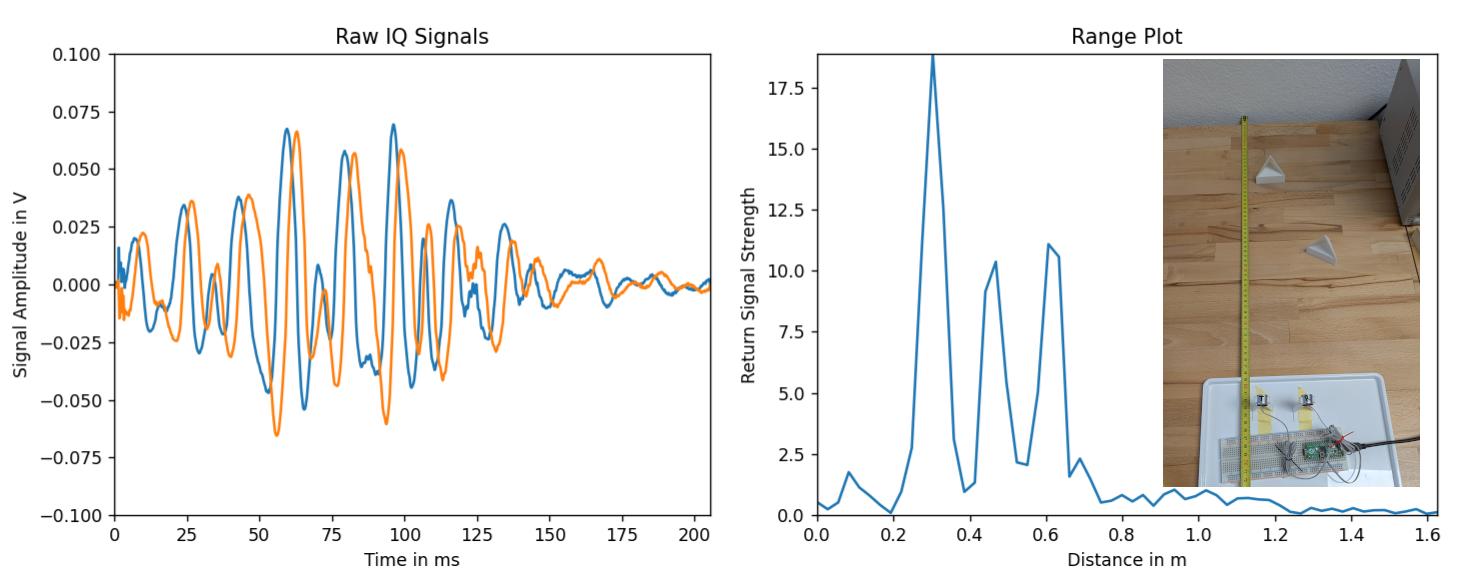
The project isn’t really about removing the extra circuitry on the SR-HC0, since there really isn’t that much to start. [Martin] wanted to know just how far he could push ultrasound scanning technology using RADAR signal processing techniques. Instead of bat-like chirps, [Martin] is using something called Frequency-Modulated Continuous Wave, which comes from RADAR and is exactly what it sounds like. The transmitter emits a continuous carrier wave with a varying frequency modulation, and the received wave is compared to see when it must have been sent. That gives you the time of flight, and the usual math gives you a distance.

The raw IQ signals translate into a range plot giving distances to everything in view.

Since he’s inspired by RADAR, it’s no surprise perhaps that [Martin]’s project reminds us of SDR, and the write-up gets right into the signal-processing code. Does it work better than a chirping module? Well, aside from using fewer parts, [Martin] can generate a full range plot for all objects in the arc of the sensor’s emissions out to 4 meters using just the Pico. [Martin] points out that it wouldn’t take much amplification to get a greater range. He’s not finished yet, though β€” the real goal here is to measure wind speed, which means he’s going to have to go full Doppler. We look forward to it.

This isn’t the first time we’ve seen the Pico doing fun stuff at these frequencies, and Doppler RADAR is a thing hackers do, so why not ultrasound?

❌