Reading view

There are new articles available, click to refresh the page.

Gold Buys Hit New Highs — Is Bitcoin About To Join The Party?

Reports have disclosed that central banks around the globe have stepped up purchases of gold this year, with one month standing out. In October 2025, officials bought 53 tons of gold, a level that analysts say is the highest monthly demand seen this year. These moves reflect growing concern about inflation, weaker currencies and rising geopolitical risk.

Central Bank Buying Surges

According to data cited by financial outlets, 2025 is on track to be the fourth-highest year this century for institutional gold accumulation when measured net year-to-date through October. Analysts at Deutsche Bank put gold’s share of central-bank reserves at about 24%, a level not seen since the 1990s. Those figures help explain why governments that once moved away from bullion are returning to it now.

Bitcoin Enters The Conversation

Some banks and market researchers are now asking whether Bitcoin could play a similar role for national treasuries. Based on reports from major financial firms, Deutsche Bank projects that Bitcoin could appear on central-bank balance sheets by 2030 as a complementary reserve asset.

Central banks are ramping up gold purchases:

Global central banks purchased +53 tonnes of gold in October, the most since November 2024.

This marks a +194% jump compared to July, and the 3rd-straight monthly acceleration.

In the first 10 months of the year, central banks have… pic.twitter.com/7pZWyEjjvf

— The Kobeissi Letter (@KobeissiLetter) December 4, 2025

Bitcoin’s market profile has changed: liquidity has risen, and price swings have been less extreme during recent months even though volatility remains higher than older reserve assets. Bitcoin also reached a record above $123,500 in recent trading, a price point that has captured wide attention.

A Few Banks Are Testing The Idea

A small number of central banks are now at least studying the idea more seriously. The Czech National Bank, for example, has discussed the possibility of a “test allocation” to learn how crypto might behave inside a reserve mix. Those conversations tend to focus on custody, accounting rules and how to report gains or losses, rather than immediate buying.

On Gold & Bitcoin: Why Officials Are Cautious

Risk is the main reason most central banks have not moved faster. Bitcoin still shows larger price swings than standard reserve assets, and global rules for how to hold and audit crypto are not uniform. Based on expert commentary, regulators and auditors would need clear guidance before many central banks felt comfortable adding crypto to official reserves.

What This Could Mean For Markets

If even a handful of national banks were to allocate a small share of reserves to Bitcoin, demand could rise sharply and change how markets view the asset. A modest sovereign allocation would not replace gold or the US dollar, but it could give Bitcoin a stronger role as a hedge for countries facing currency weakness or rising inflation. At the same time, such a move would push more work into custody and compliance services, which would have to scale up quickly.

Gold buying by central banks is already significant — 53 tons in one month and about 24% of reserves in gold for some — and that Bitcoin is being discussed as a possible next step for some policymakers. The path from discussion to adoption is uncertain, and many technical and legal questions remain. Still, the debate has moved from theory to test runs and official reports, making this one of the more closely watched trends in global finance this year.

Featured image from Unsplash, chart from TradingView

New Crypto Bank Launches In The US – CEO’s Remarks And Contrasts With Signature Bank

A new player has emerged in the world of cryptocurrency banking, with a team of former executives from the collapsed Signature Bank at the helm. The establishment of N3XT comes nearly three years after Signature Bank’s downfall in March 2023, which significantly impacted the crypto industry.

Former Signature Bank Leaders Establish N3XT

According to a report by Reuters, the newly founded blockchain-based bank aims to facilitate instant US dollar payments around the clock, led by Scott Shay, who served as the founder and chairman of the Signature Bank. Jeffrey Wallis, the former director of digital assets at Signature, will take on the role of CEO at N3XT.

Per the report, N3XT will operate under a special-purpose bank charter in Wyoming and has decided to avoid typical lending activities, which were at the heart of the collapsed Signature Bank. 

“Every dollar of deposits will be backed by cash or short-term U.S. Treasuries,” Wallis explained, noting that the bank will publish its reserve holdings daily. 

This sets N3XT apart from its predecessor, Signature Bank, especially given that its reserves will be held with custodial partners, though Wallis did not disclose their names. 

Importantly, N3XT will not be insured by the Federal Deposit Insurance Corporation (FDIC) since Wyoming special-purpose banks are not required to obtain such insurance.

The collapse of Signature Bank, along with the failures of Silvergate Bank and Silicon Valley Bank, pointed to a troubling trend among banks with significant uninsured deposits and ties to the cryptocurrency sector. Rising interest rates and a loss of depositor confidence culminated in bank runs that led to their downfall.

Solutions For Crypto Clients 

Addressing concerns about the safety of client assets, Wallis reassured potential customers in the crypto industry, stating, “We do not lend against our balance sheet, so clients always have confidence that their capital is available to them and is never at risk.” 

He emphasized that the newly established  bank is designed to offer a new and “unique banking structure,” ensuring that clients’ liquidity is readily accessible according to their economic needs.

Wallis further distinguished N3XT’s approach to risk management from that of Signature Bank, which was criticized for “poor management” and a focus on “rapid, unrestrained growth” with little attention to risk. 

“We are not making any lending decisions with the balance sheet,” Wallis reiterated. “We are keeping our clients’ assets in full liquid form.” N3XT will reportedly focus on catering to crypto clients, many of whom Wallis mentioned are already in the onboarding process.

Crypto

As of this writing, Bitcoin (BTC), the market’s leading crypto, is trading at $92,834. It has consolidated above the key $90,000 support level for the past few days, sparking new hopes for a potential recovery above $100,000 by the end of the year. 

Featured image from DALL-E, chart from TradingView.com 

Banks Are Rushing Into Stablecoins in 2025, Despite Adoption Being Years Away

What began as a niche innovation within crypto markets is now shaping the future of payments. From major U.S. institutions to global players, banks are recognizing that stablecoins—blockchain-based tokens pegged to fiat currency—offer efficiency gains that legacy systems can’t match.

The GENIUS Act in the United States and the Markets in Crypto-Assets (MiCA) Regulation in Europe have further accelerated this trend. These regulatory frameworks define stablecoins and outline who may issue them, including insured depository institutions like banks and credit unions, as well as qualified nonbanks.

The GENIUS Act is getting signed today, bringing clear rules of the road for stablecoins.

Here's why stablecoins are better money, how they're better for people and businesses, and the mental models you can use to understand them.

My master thread on stablecoins.

👇 pic.twitter.com/qIV5DHpkJE

— Sam Broner (@SamBroner) July 18, 2025

Why Banks Are Exploring Stablecoin Adoption in 2025

“Payments are a huge part of banks’ business,” said Paul Brody, global blockchain lead at EY, in an interview with Cryptonews.

“Now that banks are authorized to enter the market, they can serve the consumer and enterprise users that are looking for much lower costs on their payments, especially cross-border payments,” Brody added.

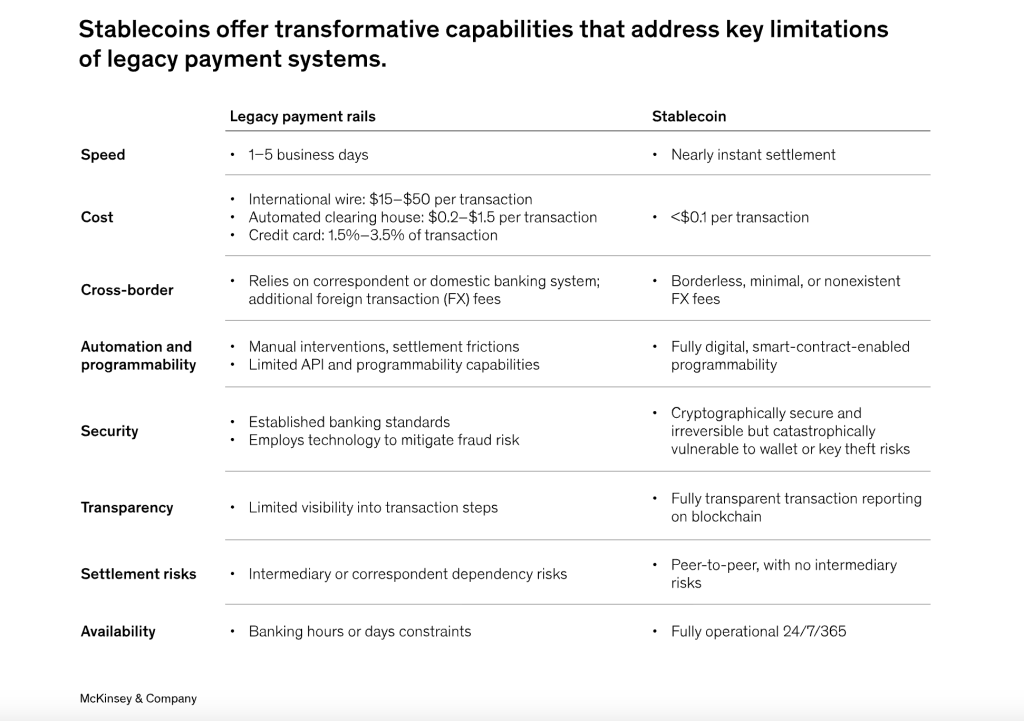
According to EY’s survey of over 250 financial services companies, reducing costs on cross-border transactions with partners and suppliers is the top priority. McKinsey & Company reports that stablecoin transactions can offer near-instant settlement, which has major implications for corporate treasury and global payments.

“Just over 50% of large financial institutions say they plan to be doing or testing this in some manner in the coming 12 months, which is an extraordinarily high rate of uptake,” Brody mentioned.

Source: McKinsey & Company

Banks Currently Looking at Stablecoin Implementation

Several banks are moving from exploration to action. On November 25, 2025, U.S. Bank announced a pilot issuing a custom stablecoin on the Stellar network in collaboration with PwC and the Stellar Development Foundation (SDF).

José Fernández da Ponte, president and chief growth officer at SDF, told Cryptonews that blockchain technology makes business sense for institutions like U.S. Bank. He explained that transactions that cost thousands of dollars on legacy rails cost just a fraction of that on Stellar.

“Settlement times are also cut from days to approximately five seconds, reducing counterparty risk and intermediary fees financial institutions have to pay to move money across the globe,” he added.

The Stellar network is already partnering with enterprise financial institutions like WisdomTree, Franklin Templeton, PayPal, and MoneyGram. Fernández da Ponte shared that next year, Stellar expects to see more growth in the ecosystem as institutions explore moving on-chain.

Other major banks, including Citi, Barclays, Bank of America, and more, have also announced plans to explore and potentially adopt their own stablecoins moving forward.

Beyond banks, Ripple announced that its USD-backed stablecoin RLUSD is now recognized as an Accepted Fiat-Referenced Token by Abu Dhabi’s Financial Services Regulatory Authority, allowing licensed companies to use it for permitted activities.

Compliance and trust are non-negotiables for institutional finance.

That's why $RLUSD has been greenlisted by Abu Dhabi’s FSRA, enabling its use as collateral on exchanges, for lending, and on prime brokerage platforms within @ADGlobalMarket—the international financial centre of…

— Ripple (@Ripple) November 27, 2025

Financial services giant Visa recently announced that it is expanding its stablecoin settlement capabilities across Central and Eastern Europe, the Middle East, and Africa (CEMEA) through a new partnership with digital assets platform Aquanow.

According to Visa, the integration of Aquanow’s digital asset infrastructure with Visa’s technology stack will allow issuers and acquirers across the CEMEA region to quickly settle transactions using approved stablecoins like USDC.

Adoption Takes Off, But Real Use Cases Years Away

Despite growing institutional interest, experts caution that mainstream adoption is still a few years away. Brody believes that it will take at least one to two years of network effects before banks and stablecoin usage increase.

“The benefits of stablecoins include speed, low cost, and full programmability,” he said. “But the biggest challenges are that there are still too few companies and countries connected to this expanding network and far too few foreign exchange currencies as well.”

Mike Villano, senior vice president of enterprise innovation at U.S. Bank, further noted that privacy remains a primary concern.

“One issue we hope to continue to work on with Stellar in future phases is privacy. One of the things a US Bank would expect when we deliver a product to market will be to maintain the privacy of some of the balances on a blockchain.”

November also marked a turning point for the overall stablecoin sector. A report from CoinDesk published on Nov. 26 found that the total market capitalization of stablecoins contracted 1.48% to $303 billion.

The report notes that this $4.54 billion contraction marks the steepest monthly decline since the collapse of FTX in November 2022. This demonstrates a combination of stablecoin outflows and weakening digital asset prices, suggesting a broader withdrawal of liquidity and capital from the crypto markets.

The Long-term Outlook

Industry leaders remain optimistic, though. Danny Lim, co-founder of Pundi X and Pundi AI, believes that stablecoin outflows will not impact real-world use cases. Lim told Cryptonews that bank-issued stablecoins are not meant to replace USDT or USDC, but rather to change who is willing to come on board.

“If banks issue stablecoins on public or permissioned chains, merchants get the same 24/7 settlement speed and on-chain finality as today’s public stablecoins, but with a known regulated counterparty, deposit protection, full AML/KYC, and clear domestic rules behind the token,” he said.

Lim added that in regions like Turkey and South Africa, where Pundi X has been active for years, consumers are using stablecoins like USDT and USDC for everyday remittances, savings, and protection against currency swings. He explained that a bank-issued stablecoin will likely push this further by adding regulated on and off ramps, local Know Your Customer (KYC,) and a sense of safety that appeals to more traditional families and small businesses.

The post Banks Are Rushing Into Stablecoins in 2025, Despite Adoption Being Years Away appeared first on Cryptonews.

U.S. Regulator Allows Banks to Hold Crypto for Blockchain Fees

Bitcoin Magazine

U.S. Regulator Allows Banks to Hold Crypto for Blockchain Fees

The U.S. Office of the Comptroller of the Currency (OCC) has given national banks the green light to hold crypto on their balance sheets for the purpose of paying blockchain network fees. 

The guidance, issued in interpretive letter No. 1186 today, also allows banks to keep crypto on hand to test internal or third-party crypto platforms.

Blockchain networks require native tokens to process transactions. These fees, often called “gas fees,” are unavoidable. 

The OCC said banks can hold the tokens they reasonably anticipate needing. This could include paying fees as part of crypto custody services or facilitating client transactions. The goal is to reduce reliance on third-party providers and lower operational risks.

“Paying network fees is a necessary part of doing business on blockchain networks,” the OCC said. “Holding crypto for this purpose is permissible when it supports otherwise lawful banking activities.”

‘Incidental’ banking uses

The guidance emphasizes that these activities are “incidental to the business of banking.” That phrase has weight in regulatory language. It means banks can do it legally, as long as the activity helps them serve customers or operate efficiently. 

The OCC even drew parallels to historical banking practices, like holding foreign currency, banknotes, or shares in payment systems to facilitate transactions. 

In other words, banks have always needed to hold certain assets to do business. Crypto is just the latest form.

Banks are expected to manage risks carefully. They must track operational, market, liquidity, cybersecurity, and legal risks. The amount of crypto held should remain minimal relative to the bank’s capital.

The letter comes under the leadership of Comptroller Jonathan Gould, a Trump appointee confirmed in July 2025. Under his tenure, the OCC has become more crypto-friendly. Earlier guidance allowed banks to act as nodes on blockchain networks, offer crypto custody services, and work with stablecoins.

Meanwhile, broader rules for stablecoin issuers under the GENIUS Act are still being drafted. But the OCC’s move signals that U.S. regulators are willing to let banks participate in crypto safely and efficiently.

As more banks explore digital assets, this guidance could accelerate adoption. It bridges traditional finance and blockchain, giving banks a clearer path to integrate crypto into everyday operations.

Earlier this year, the OCC issued guidance (Interpretive Letter 1184) allowing national banks and federal savings associations to offer cryptocurrency custody and trading services.

Essentially, banks can buy and sell digital assets on behalf of customers, outsource crypto activities to third parties, and provide related services like recordkeeping, tax reporting, and compliance.

This post U.S. Regulator Allows Banks to Hold Crypto for Blockchain Fees first appeared on Bitcoin Magazine and is written by Micah Zimmerman.

SoFi to Launch Bitcoin and Crypto Trading, Eyes Record Year 

Bitcoin Magazine

SoFi to Launch Bitcoin and Crypto Trading, Eyes Record Year 

SoFi Technologies (NASDAQ: SOFI) raised its full-year profit forecast on Tuesday after reporting record third-quarter results that beat Wall Street expectations, driven by fee revenue and more user growth across its financial products.

CEO Anthony Noto said the company remains on track to launch crypto trading by the end of the year, with plans to roll out its own SoFi USD stablecoin in the first half of 2026 — marking its biggest step yet into the digital asset economy.

SoFi said adjusted revenue climbed 38% year-over-year to $950 million, surpassing analyst estimates of $886.6 million.

This move echoes that of banking giant Morgan Stanley. Earlier this quarter, Morgan Stanley announced plans for crypto trading for retail clients on its E*Trade platform, partnering with Zerohash for liquidity, custody, and settlement. 

Adjusted profit for SoFi more than doubled to $0.11 per share in the three months ended September 30, topping expectations of $0.08 per share. Shares of SoFi rose 3.8% in pre-market trading following the announcement, according to Reuters reporting. 

JUST IN: 🇺🇸 Fintech giant SoFi to launch #Bitcoin and crypto trading this year. pic.twitter.com/TlnAMa0IFW

— Bitcoin Magazine (@BitcoinMagazine) October 28, 2025

SoFi’s pivot to Bitcoin

Founded as a student loan refinancing startup, SoFi has evolved into a full-scale financial services platform offering products ranging from IPO investing to credit cards and high-yield savings accounts. 

The company now boasts a market capitalization of roughly $36 billion, cementing its position among the leading players in the fintech sector.

Earlier this year in June, SoFi announced that it had reintroduced spot crypto trading and launched plans for a blockchain-based global remittance service after halting crypto services in 2023 due to regulatory constraints. 

The company said SoFi members would again be able to buy, sell, and hold cryptocurrencies such as Bitcoin within its platform. 

In addition to reinstating crypto trading, SoFi revealed a new self-serve international money transfer feature, expected to go live soon.

The service would let SoFi Money users send funds across dozens of countries directly from the SoFi app, with transfers conducted over secure blockchain networks. 

Recipients would receive local currency instantly, with full fee and exchange-rate transparency provided upfront and 24/7 access to transactions.

Back in June, CEO Anthony Noto said SoFi viewed blockchain and crypto as central to the future of financial services, emphasizing the company’s goal of offering members more control and flexibility across their financial lives. 

This post SoFi to Launch Bitcoin and Crypto Trading, Eyes Record Year  first appeared on Bitcoin Magazine and is written by Micah Zimmerman.

Evolving cyber security in the financial services sector

By: slandau

EXECUTIVE SUMMARY:

The financial sector is a leading target for cyber criminals and cyber criminal attacks. Markedly improving the sector’s cyber security and resilience capabilities are a must. While the sector does have a comparatively high level of cyber security maturity, security gaps invariably persist and threaten to subvert systems.

As Check Point CISO Pete Nicoletti has noted, attackers only need to get it right once in order to catalyze strongly negative, systemic consequences that could send shockwaves throughout companies and lives across the globe.

In this article, discover financial sector trends, challenges and recommendations that can transform how you see and respond to the current cyber threat landscape.

Industry trends

  • According to a newly emergent report, 65% of financial services sector organizations have endured cyber attacks.
  • The median ransom demand is $2 million. Mean recovery costs have soared to roughly $2.6 million – up from $2.2 million in 2023.
  • The size of extreme losses has quadrupled since 2017, to $2.5 billion.

The potential for losses is substantial, especially when multiplied in order to account for downstream effects.

Industry challenges

The majority of financial leaders lack confidence in their organization’s cyber security capabilities, according to the latest research.

Eighty-percent of financial service firm leaders say that they’re unable to lead future planning efforts effectively due to concerns regarding their organization’s abilities to thwart a cyber attack.

There is a significant gap between where financial sector institutions want to be with cyber security and where the industry is right now.

Preparing for disruption

Beyond cyber security, financial sector groups need to concern themselves with business continuity in the event of disruption — which is perhaps more likely than not.

“While cyber incidents will occur, the financial sector needs the capacity to deliver critical business services during these disruptions,” writes the International Monetary Fund.

A major disruption – the financial sector equivalent of the Colonial Pipeline attack – could disable infrastructure, erode confidence in the financial system, or lead to bank runs and market selloffs.

To put the idea into sharper relief, in December of 2023, the Central Bank of Lesotho experienced outages after a cyber attack. While the public did not suffer financial losses, the national payment system could not honor inter-bank transactions for some time.

Industry recommendations

Organizations need innovative approaches to cyber security — approaches that prevent the latest and most sophisticated threats. Approaches that fend off disaster from a distance.

In 2023, nearly 30 different malware families targeted 1,800 banking applications across 61 different nations.

At Check Point, our AI-powered, cloud-delivered cyber security architecture addresses everything — networks, endpoints, cloud environments and mobile devices via a unified approach.

We’ve helped thousands of organizations, like yours, mitigate risks and expand business resilience. Learn more here.

For additional financial services insights, please see CyberTalk.org’s past coverage. Lastly, to receive cyber security thought leadership articles, groundbreaking research and emerging threat analyses each week, subscribe to the CyberTalk.org newsletter.


The post Evolving cyber security in the financial services sector appeared first on CyberTalk.

❌