❌

Reading view

There are new articles available, click to refresh the page.

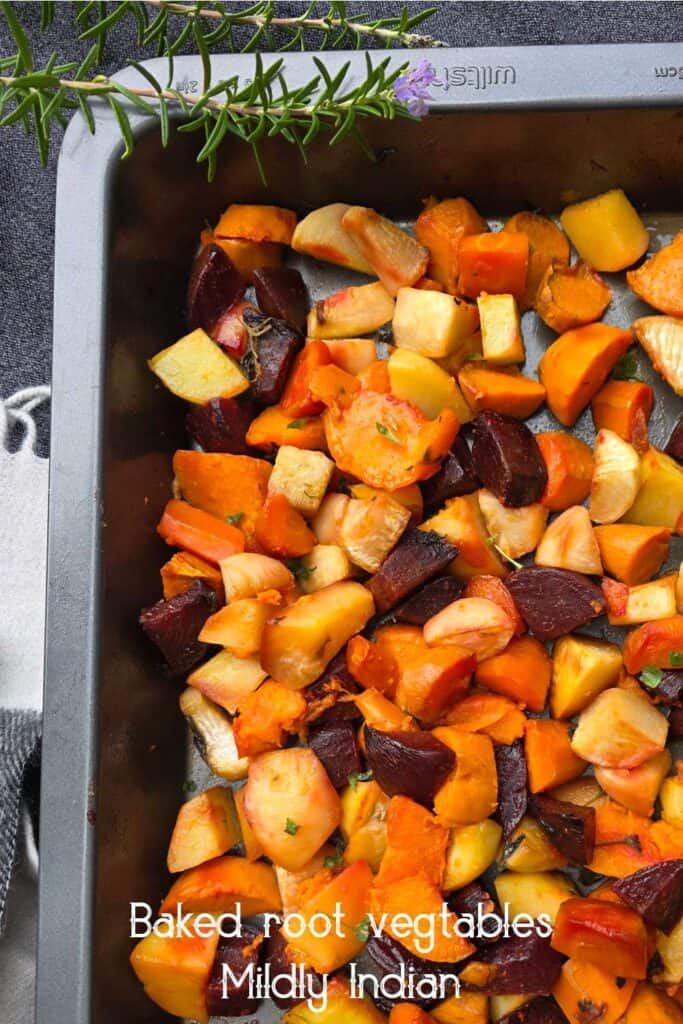
Baked root vegetables

baked root vegetables
Why would you skip a platterful of colourful vegetables, that are a perfect side, salad or morning hash? Enjoy the starchy bites of roasted goodness.
It is a small respite from the numerous Indian festivals and the chill in the air is still hanging around. Therefore a perfect time to get that platter or baked root vegetables out. I like baked root vegetables a bit more than pan roasted ones for the following reasons
  • They are one pot so much less effort.
  • The starchier sweetness improves your baking adding a ton more cozy feeling.
  • When I bake my kitchen is warm at the same time.
  • It is a recipe that you can do as a big batch with minimal prep and have all week long in the fridge.
  • It pairs well with pasta, rice or any grains,can be rolled as wraps or made into a salad.

Ingredients for baked root vegetables.

The vegetables: the baked vegetable tray is one recipe that allows you so much flexibility in terms of what you can have. You can make it as colourful as you like or as monochrome as you prefer. Here is a list of vegetables I like to throw into the tray.

  • Sweet potatoes
  • Carrot
  • Turnip
  • Potato
  • Radish
  • Swedes
  • Beetroot

For roasting: Olive oil, salt and herbs are the ones that work. The herbs I have chosen is rosemary and oregano. You can use thyme or basil as well.Β 

Lets make baked root vegetables

The baked vegetables is the best use of a roasting tray.

Prep the vegetables: choose starchy tough vegetables to start with. Wash thoroughly. Cut them into big chunks or dices as you prefer. Keep the beets separately. The carrots, potato sweet potato, radish, parsnip, swedes, turnip can all go together.

Coat them in flavours. Since the vegetables are going to be soft and bland, it is best to coat them with flavours. Sprinkle salt, pepper abd drizzle oil and toss them well. For flavours I prefer to add fresh study herbs that just dont burn away. Rosemary, oregano and thyme are my first choice. Go with what feels natural to you. You can replace the pepper with chilli flakes if you like the heat. Lets the vegetable mix sit while you preheat the oven
Ensure that the beets are coated and kept separate.

Bake: preheat the oven at 180 degrees for 10 minutes. Place the vegetables on a roasting tray. Spread them out evenly. Poke in pieces of beets into the gaps so they cook along. Roast the vegetables for 35 to 40 minutes at 180 degrees Celsius on heat both from up and down. Half way through the time, flip the vegetables over to ensure even roasting. After about 35 minutes the vegetables will be ready and fork tender. Remove from heat and direct to the table. Or cool and proceed for storage.
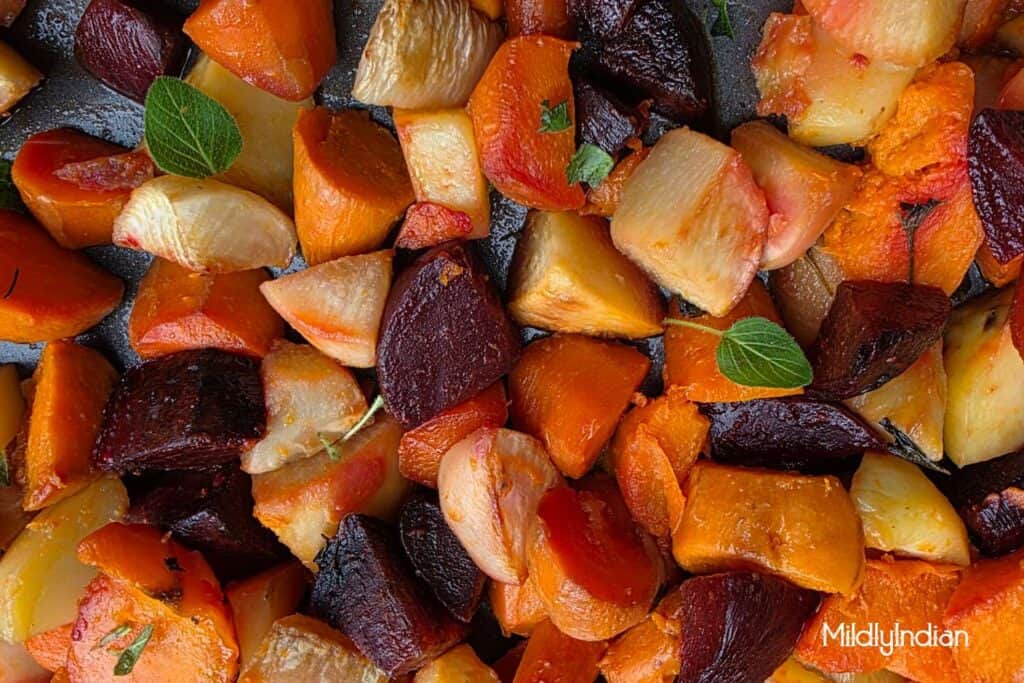
baked vegetables

Meal prep and storage

The baked root vegetables are wonderful to add bulk to any meal or in the lunch box.

Is this a vegan recipe?

Baked root vegetable is an excellent vegan platter. It is filling, a mix of good healthy fibre and carbs and perfect for any vegan meal.

How to make baked root vegetables into a salad?

Once you have the baked veggies in meal prep you can have a hearty salad with it. For the dressing I prepare a generous mix of lemon and lime juice with some pepper and salt. Then you need some freshness. Chop up some tomatoes, a cucumber and handful of oregano, mint and parsley. Add all this into the mixing bowl with double the quantity of baked vegetables. Pour the dressing over it. Toss well and serve immediately. They are great sides to meals and double up as salads. You can add a bunch to your breakfasts to as hash.

How do you ensure the beets don’t leech the colour all over?

There are a couple of ways you can achieve this. If you peel chop and place the beets separately, then place them on the tray to bake it will have zero leaching.
Another method is to ensure you add the beets right at the end, a quick toss in the oil and salt and straight into the oven.

Print

Baked root vegetables

Course Main Dish
Cuisine Baking, gluten free, Vegan
Keyword pot luck recipes, vegetarian barbecue, Winter warmers
Prep Time 10 minutes
Cook Time 30 minutes
Servings 6

Equipment

  • baking trays
  • Cutting board
  • Knife

Ingredients

  • 3 medium sized carrots
  • 1 large sweet potato
  • 1 turnip
  • 1 swedes
  • 1 large beetroot
  • 1 medium sized potatoes
  • 2 tbsp olive oil
  • salt to taste
  • 1 sprig rosemary
  • 5-7 leaves oregano

Instructions

  • Wash, peel and cut the vegetables into big chunks.
  • Add them to the baking tray.
  • Tuck in rosemary and oregano.
  • Spinkle salt and drizzle oilve oil and massage it in.
  • Preheat the oven at 180 degrees for 10 minutes.
  • Place the tray in the oven to bake.
  • Bake for 30 minutes.
  • About 15 minutes in turn the vegetables for even baking.
  • After 30 minutes, check if the vegetables are fork tender.
  • The vegetables are then ready to be served.

Other baked recipes from us that make a good mealprep

Baked whole cauliflower

Dried peas nuggets

Baked veggie sheek kebabs

Paneer puffs

Stay connected

Hope you enjoy making this batch of low effort baked root vegetables. When you make your batch using this recipe, do share your thoughts and improvements in the comments below.
Pin this for later.
Stay subscribed see you in the next post.Β 

baked root vegetables

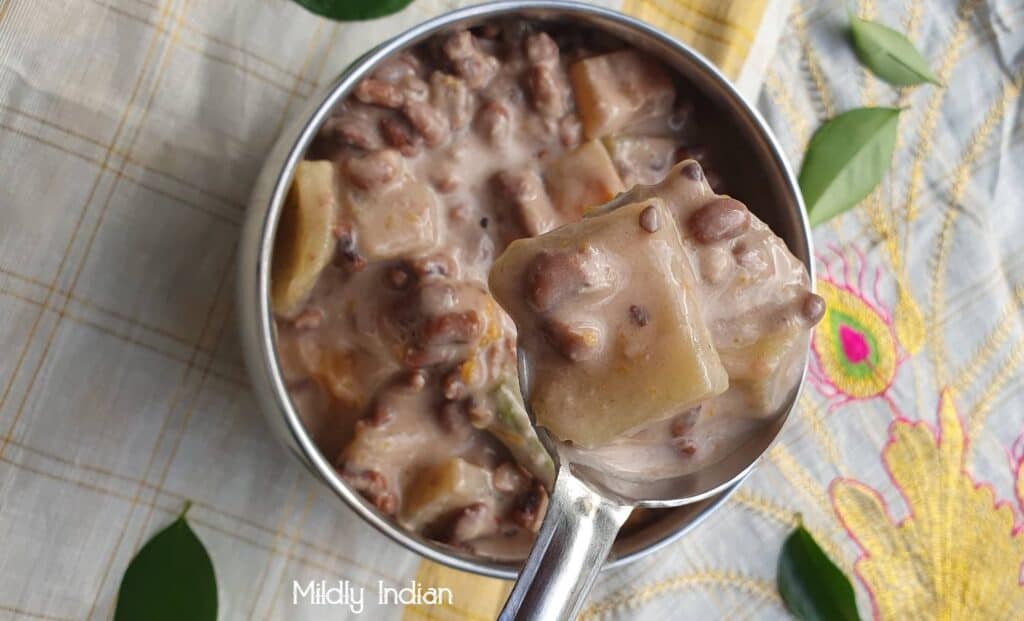
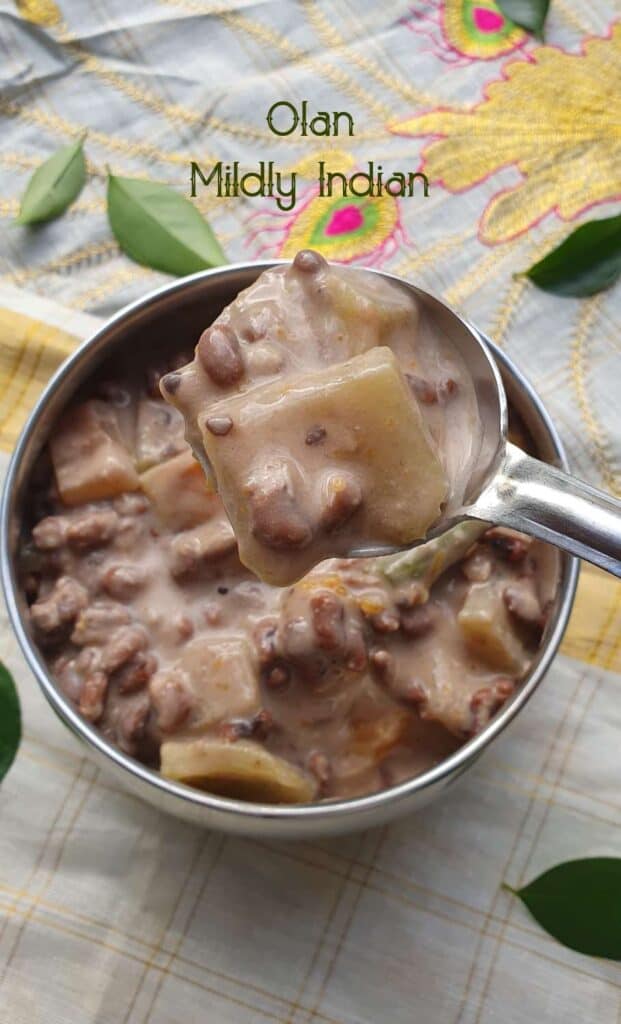
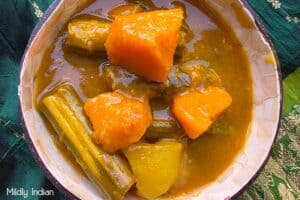
Sadhya olan | gourds and cowpea stew

Kerala sadhya recipe

The banana leaf sadhya made for Onam, Vishu or any of the Kerala festivals has an array of side dishes that are served on the top half of the leaf. Some of these we have posted earlier
Aviyal
Thoran
Pachadi
Kichadi
Erisherry
Mango pickle
However, the mildest, creamy yet simple olan is missed if it is not on the leaf. Have you made it?

What is olan?

Olan is a slow cooked stew made with gourds cooked in coconut milk. It is a mild creamy curry that predominantly uses ashgourd and pumpkins. Depending on regional variations you will find yard long green beans (payar) or cooked cowpeas added to it. It is flavoured gently with salt,curry leaves and slit greenΒ  chillies. Unlike a lot of Kerala dishes it doesn’t have a mustard tempering, rather a good tablespoon of pure coconut oil stirred in as soon as it is removed from the heat for that roundeness and fragrance you experience.

How is sadhya olan different from regular olan?

If you are familiar with Kerala recipes, you will know that olan is one that is probably the least made in most houses. This is because the regular olan is a runny curry with less complex flavours. HoweverΒ  the sadhya olan with the creaminess from the coconut milk and the cooked cowpeas is a thicker version which never runs. Though mild it has a well flavoured along with the semi mashed vegetables. The key to making the sadhya style olan is managing the liquid content.

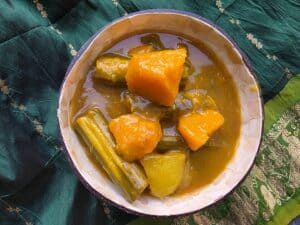
sadhya olan

Ingredients to make olan

Vegetables: since this is a mild stew with gourds and pumpkins, so they make the bulk of this recipe. the withte fleshed wintermelon ( elavan) is preferred over the giant ash gourds. The pumpkin adds a it of colour and sweetness. if you cant get the wintermelon, bottle gourd, watermelon peel or chayote work well too.
Bean: the creamy composition works because of the earthy flavours from the cooked cowpeas. Cowpeas have an earthy flavour and are perfect for this mild recipe.
Coconut milk: coconut milk is the cooking liquid here. At first the this cococnut milk is used to cook the gourds in. At the final stages, string the thick coconut milk or coconut cream. this ensures that the final result is thick olan and it is creamy.
Seasoning: Salt is the only seasoning here.
Spices: this is a mild stew and uses no spices. The single green chilli added is for fragrance, not heat. This is opional.
Oil: the final roundedness of the recipe comes from half tsp of coconut oil stirred in at the end. This is an optional step, but brings the flavour exactly like the one in the sadhya.

Mealprep this mild gourd stew

The gourd stew or olan is a great recipe to mealplan. It stays good for a few days under refrigeration. They do freeze good, but not great. The gourds do go a bit limp upon thawing the frozen one. So add it to your mealprep not much to your freezer list.

What pairs well with sadhya olan?

Sadhya olan is a great accompaniment to the banana leaf meal or a South Indian thali. It pairs well with idiyappam (string hoppers), steamed breads or chappathi. In a great rush week, Olan is perfect with some toasts or just as such warmed in a bowl resembling a chunky soup.

Lets make Sadhya Olan

Print

Sadhya Olan

Course Side Dish
Cuisine diabetic friendly, Kerala, South indian
Keyword curry recipes, Indian vegetarian dinner, Kerala recipes
Prep Time 20 minutes
Cook Time 20 minutes
to prep and cook cowpeas 6 hours 20 minutes
Total Time 7 hours
Servings 4 people

Equipment

  • 1 Kadai Thick bottomed wok
  • 1 Pressure cooker

Ingredients

for cooking cowpeas

  • 3 tbsp cowpeas
  • 2 cups drinking water

for cooking the curry

  • 250 gram wintermelon Ash gourd
  • 100 gram pumpkin
  • salt to taste
  • 1 medium green chilli
  • 5 curry leaves
  • 1/2 cup coconut milk thinned out, see notes above.

To finish the olan

  • 1 tsp coconut oil
  • 2 tbsp coconut cream

Instructions

To cook the cowpeas

  • Wash and soak the cowpeas for 6 hours or overnight.
  • Drain and add fresh water.
  • Pressure cook the cowpeas for 10 minutes in high pressure. Release the pressure naturally.
  • Drain the cooked cowpeas and save the cooking liquid.

to make the olan

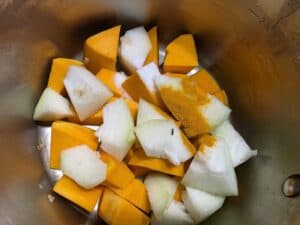
  • Wash and peel the ashgourd ( winter melon) and pumpkin.
  • Slice into 1inch slices.
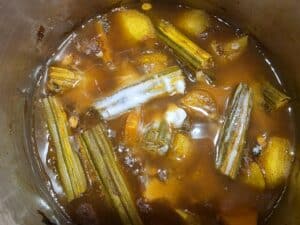
  • Add to the khadai, with a slit green chilli, salt and curry leaves.
  • Mix the coconut milk with a bit of water to thin it out. Don't add a lot of water as the winter melon and pumpkin will leech a lot of water when cooking.
  • Add this to the khadai. mix well.
  • Set his to cook on a low heat. cover and cook for 10 minutes.
  • Open the lid, mix well and add the drained cow peas.
  • Slow cook it till the liquid is absorbed well, You can mash the cowpeas a bit as they cook
  • Stir in the coconut cream and coconut oil.
  • Remove off the heat. Cover and keep for 10 minutes
  • The olan is ready to be served.

Stay connected

Hope you had a great Onasadhya. If you are looking for the best organizational tips to make sadhya, do check out our post
Guide to Sadhya.
When you make this olan recipe, do share your thoughts in the discussion below. We would love to hear from you.Β  If you like to share or save this recipe, here is the pin link.

Sadhya olan pin for later.

See you in the next post.

Kerala sadhya olan

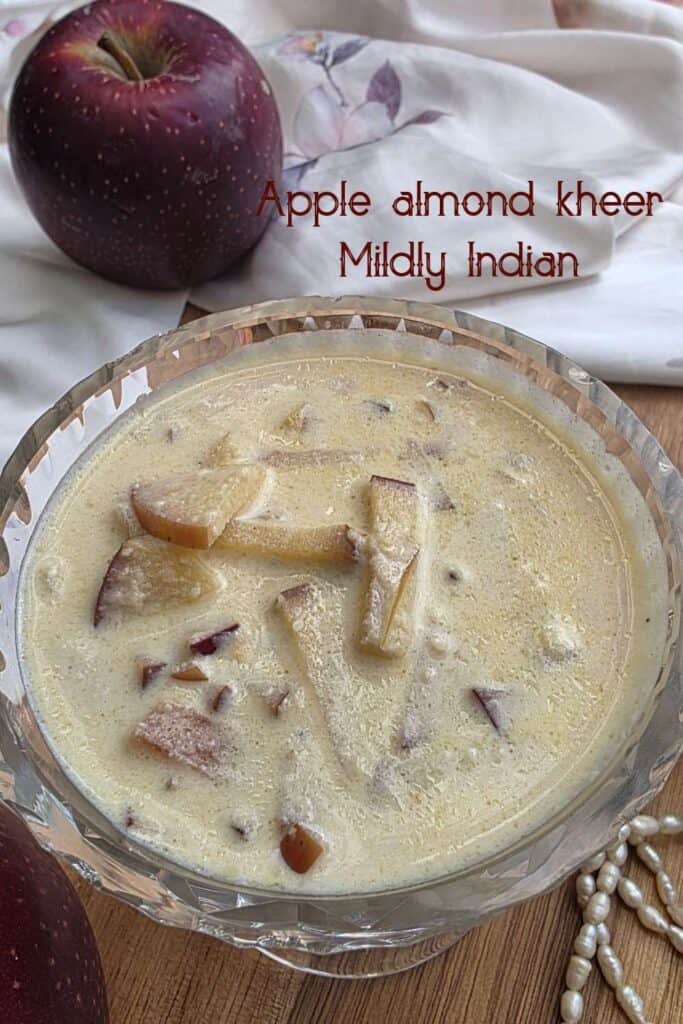
Apple almond kheer

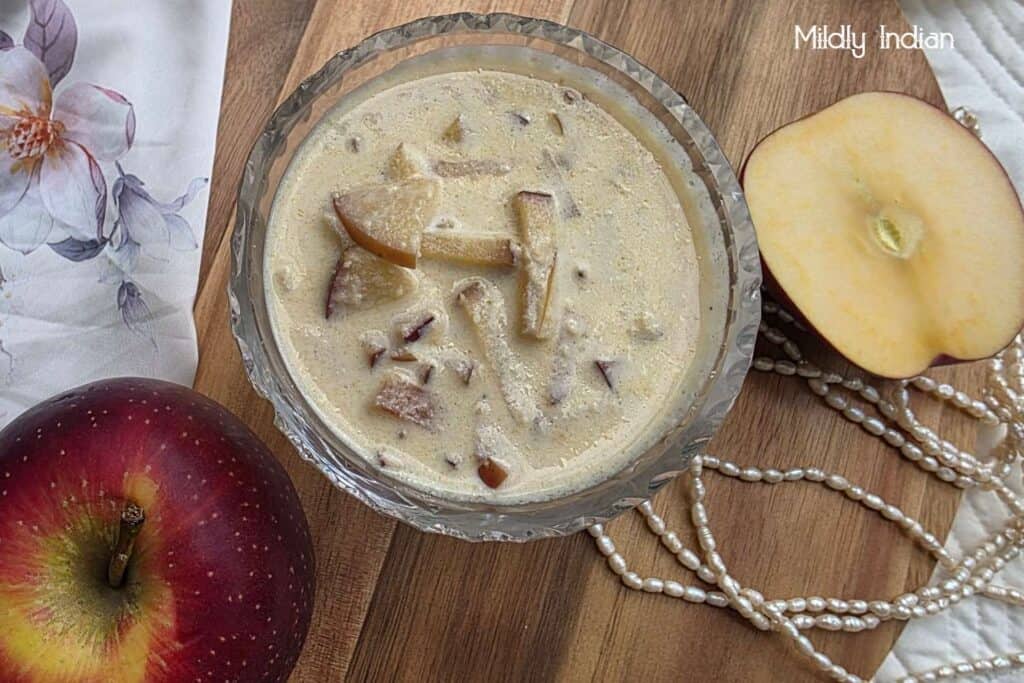
apple almond kheer

Apple almond kheer is a delightful no sugar added Indian style dessert fit for any festival. Flavoured and thickened with almond flour it is a quick and easy recipe that is perfect for beginners.

I amΒ  not good when it comes to viral recipe trials. By the time I decide buy the ingredients and try it, the trend is over!
Clearly,it needs much more devotion and promptness. So that is an area we shall leave it to the enthusiastic experts. However there is one recipe I have been wanting to try and was waiting for the apple season to come. Enjoy my version of the apple kheer with no added sugar.Β 

What is apple kheer?

Made with full fat milk that’s slow cooks rice grits,Β  kheer is a must tryΒ  dessert. This is traditionally served in festivalsΒ  and grand IndianΒ  weddings. We have added a whole collection of kheer in our post- Payasam pathaman and kheer
Apple kheer a fusion dessertΒ  that embodies the idea of a kheer but has apples and almond flour to flavour and thicken. It is not a super sweet version , rather one to share at dinners or home gatherings.

Is this diabetic friendly apple kheer?

I make this with no added sugar or sweetener, just the sweetness from the apples making it a bit more on the diabetic friendly Indian dessert side. Please be aware that the apples are sweet enough, so moderate the portion size.

Ingredients to make almond apple kheer

Apple: crunchy sweet apples are the base flavour for this kheer. Personally, I like pink lady or red apples to make this kheer. I would avoid tart green apples as they can be too sour and may split the milk.

Butter or ghee:To kick off the caramelization and the colour on the apples, unsalted bautter or a small amount of ghee is helpful.You can use coconut oil if you are making it vegan.Β 

Almond flour: the almond flour gives a rabdi like feeling to the kheer. I use the blanched almond flour. If you don’t have these you can grind a few almonds or soak them and grind with the milk. Instead of almonds you can used any nuts of your preference like cashews, pistachios. Melon seeds or puffed makhana(lily seeds) powder also taste good and thicken the kheer easily.

Milk: full cream milk is best suited for this recipe. It has the right consistency and doesn’t easily split the milk when adding the sauteed apples. I would avoid almond milk to make this kheer among the plant based ones as it easily splits. You could use coconut or soy as well.

Sweetener: I have actually not added any in this recipe as the apples were super sweet and we like a mild sweetness for our kheer. You can add sugar as the milk boils. If adding jaggery syrup or maple syrup add it after you remove from heat. Alternatively date paste will be lovely in this kheer.

Spices: the common sweet spices used in Indian desserts are saffron and cardamom. I have used a few strands of saffron and powdered cardamom to finish the recipe.

almond apple kheer

Let’s make almond apple kheer

It does take a few steps to make this kheer, however, it is not a hard recipe to follow some absolutely recommend beginners to try it.

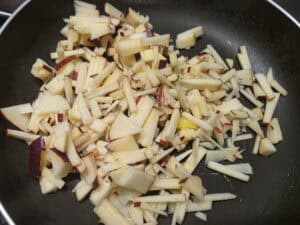
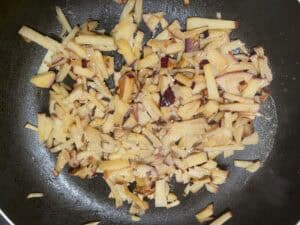
To prep the Apple: the Apple can be chopped like I have done or grated to have a smoother kheer. It is optional to peel the apple as this will be all about mouth feel. I leave the peels in as it gives a good bite.Β Once prepped add the apples to a pan with a touch of unsalted butter. On a low heat let this mix cook down and caramelize. Ensure that this is a low heat process. You can cover the apples for a minute if you feel they are dry. This captures the water from the juices allowing the apples to steam.

Boil the milk: in a separate sauce pan,Β  boil the milk. As it bubbles and boils, stir in the almond flour.
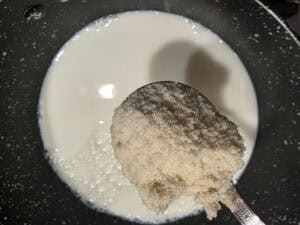
Thicken the milk the almond flour is the thickening agent. When the milk has started boiling and rising a bit, lower the heat to a simmer. Sprinkle the almond flour on the boiling milk. Stir well ensuring it is lump free. Let this cook down for about 5 to 6 minutes with stirring in between.

Add the apples: add the cooked apples into the mix and mix well. You can take off the heat at this point.

Flavouring the kheer: sprinkle cardamom powder and a few kesar strands and mix well.Β  At this stage my kheer is done. If you prefer to add sugar or jaggery syrup do so at this stage and mix well.

Print

Apple almond kheer

Apple almond kheer is a delightful no sugar added Indian style dessert fit for any festival. Flavoured and thickened with almond flour it is a quick and easy recipe that is perfect for beginners.
Course Desserts
Cuisine Indian
Keyword almond flour recipes, easy Indian sweets, festival offerings, Ganesh chaturthi recipes, Indian desserts
Prep Time 15 minutes
Cook Time 25 minutes
Servings 4 people

Equipment

  • saucepan
  • frying pan

Ingredients

to caramelize the apples

  • 2 medium apples sweet variety
  • 1 tsp ghee

to make the kheer

  • 3 cups milk
  • 2 tbsp almond flour.
  • 1 small green cardamom
  • 2-3 strands saffron

Instructions

  • Wash and chop the apples into small bits ( or grate them).
  • Add these into a frying pan along with a tsp of ghee.
  • Set this on a low heat and let this slowly cook and caramelize.
  • Saute this a few minutes once so it does not catch the bottom.
  • Into the saucepan add the milk and boil on a low heat.
  • Once it bubble up and boils stir in the almond flour with now lump and let this cook down on a simmer.
  • Add the cardamom and saffron at this stage.
  • When the almond flour swells and reaches a rabdi consistency, add the caramelized apples and remove from heat.
  • Mix well and let the kheer sit for 10 minutes.
  • You can serve the warm kheer at this point or cool and chill for later.

Is this a vegan kheer?

If you are using plant based milks the recipe can easily be turned vegan. Coconut milk or soy tastes good. For sauteeing and caramelizing the butter, coconut oil is best.Β 

Can we make this with other fruits?

Of courseΒ  you can change the fruits to make a variety of kheer. Mango ,jackfruit or plantain banana will be my first choice.
You can try dates and dried figs too. When using sweet dry fruits adjust the sugar accordingly.

Other quick try kheers

Sabudhana kheer
Sweet potato kheer
Mothichoor ladoo kheer
Rajgira kheer
Manipuri black rice kheer

Stay connected

When you try out this almond apple kheer, let us know in comments how much you liked it. Share it with family and friends.
Pin this link from here
See you in the next post

apple kheer

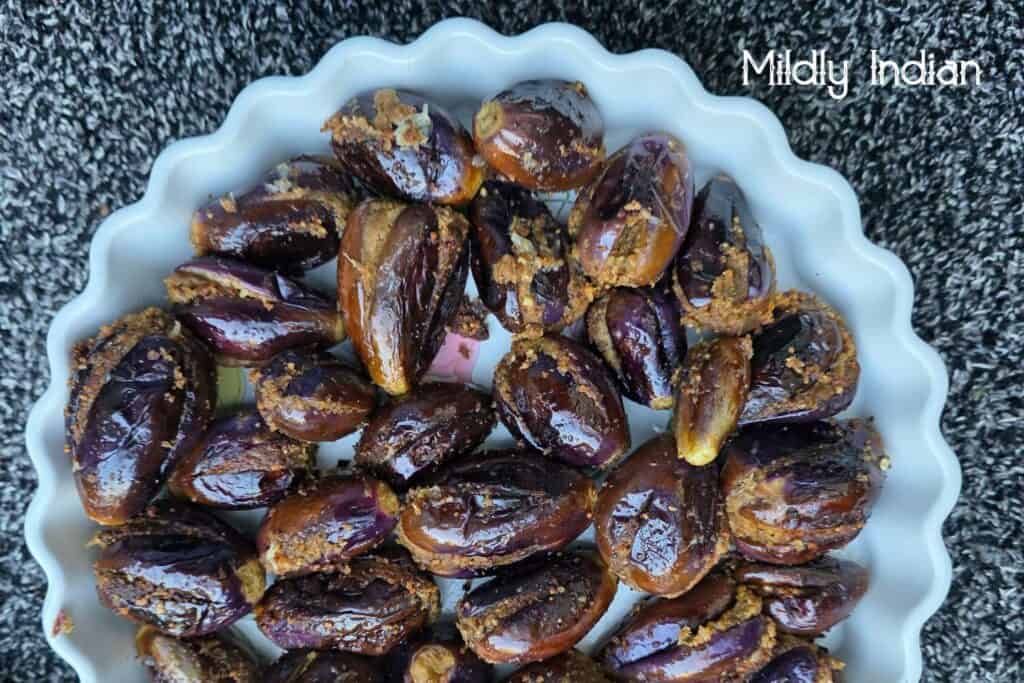
Bharwan baingan | Peanut stuffed eggplant

Stuffed eggplants

The moment you place a plate of stuffed vegetables feel so much more special that just stir frying.
This is the magic of bharwan. It is not vegetable specific and can be seen in most dominant cuisine styles.
In Indian recipes as well you will come across a large number of vegetables served as roasted or curries with stuffed produce. Okra, capsicum, bottlegourd, eggplants, chillies, bittermelon, lemons,Β  mushrooms, you name it, there will be a lipsmacking stuffed version of it.
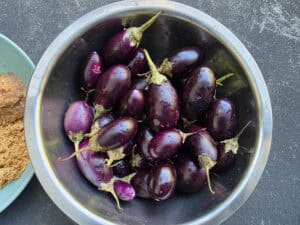
Thats when we got these baby brinjals!!Β That too farmfresh baby brinjal (eggplant) spotted in the market deserves a wholesome approach. Here is my version of the tastiest stuffed baby eggplant.

What is a brinjal?

Brinjal, eggplants and aubergine are all the same.

The fruits of Solanum melongena is a sturdy shrub that grows easily. The fruits come in various shapes and colours. Some are deep purple and large and used for roasting. Some green or varigated, some elongated like a zucchini and some round like a little ball. The flavor profile is nearly the same. All can be roasted, boiled or grilled and rarely eaten raw.

Here are some recipes we have previously tried with eggplants.
Kashmir doudh wagun
Kerala vazhuthananga mezhukkuperatti
Srilankan wambat moju
Chettinad kathrikka podi varuval

Ingredients to make this peanut masala stuffed brinjals

Unlike the popular dry masala stuffed baingan recipe, this is one that uses fresh ground pastes and roasted peanuts. This makes the eggplants succulent ans keepsΒ theΒ moisture as it roasts.

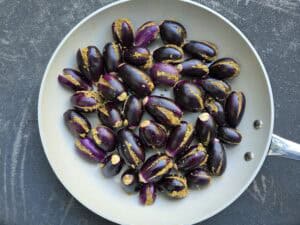
Brinjal: since eggplants come in various sizes for this recipe what you need is small baby oval or rounded eggplants. The colour or variety is up to you it can be purple, variegated or the white variety. While coosing the eggplants for this recipe, ensure that they are all even sized so you can get them cooked evenly.

Peanut: roasted peanuts form the bulk of the filling.this not only gives the nutty creaminess but also makes this recipe much more nutritious. You can use peeled peanuts of keep in the skin on. Peanut butter is not suitable becoz of the oil content.Β 

Onion: the red onion provides the base masala flavour.Usually I prefer this and a smooth paste so it is easier to stuff the eggplant. You can choose shallots or white onions to make the same. Shallots will be a bit sweeter.

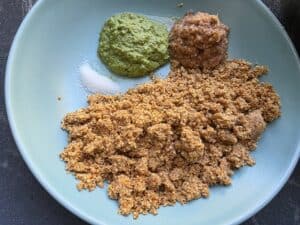
Fresh masala base: the true flavour of the recipe comes from the fresh pastes that are made. This is a combination of fresh ginger root, garlic and green chillies. When made a paste together, they create fresh and robust flavour paste. This combined with the peanuts make the stuffing so tasty.

Lemon juice: the final splash of Lemon juice once the recipe is done provides a summery freshness to the recipe. You can have lime, lemon or tart orange juice to make this shine.

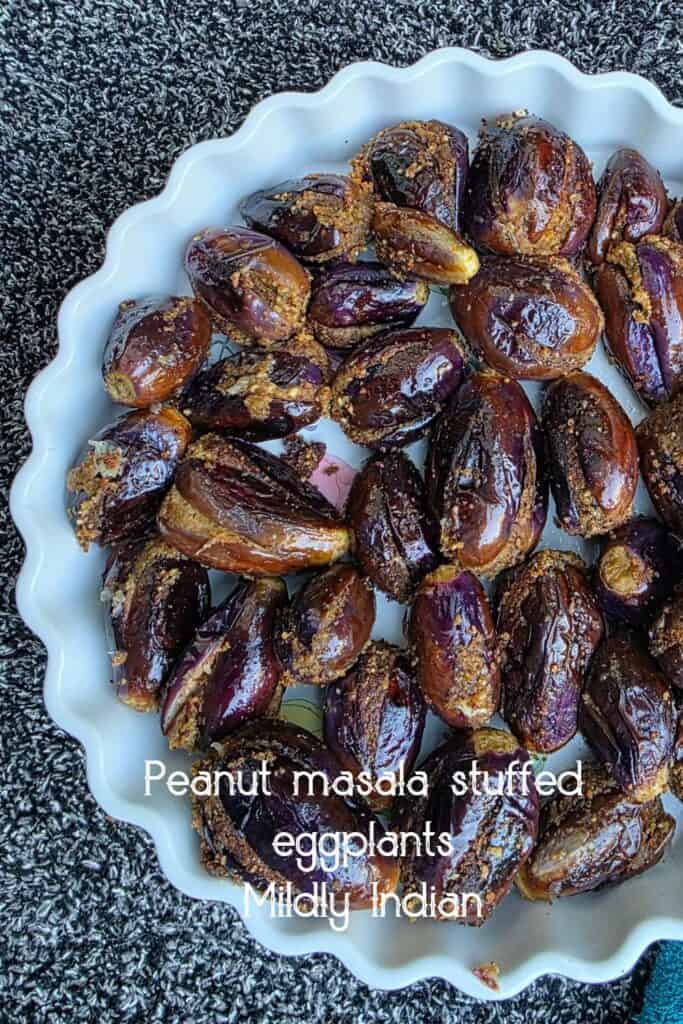
eggplants with stuffing
Lets make bharwan baingan

The recipe is a bit of work between prepping the brinjals and making the masala paste. However, once that part is completed, it is fairly a easy process. Check the notes below so you can actually make it in larger quantities for meal prep.Β 

Print

Peanut masala stuffed eggplants

Course Appetizer, Side Dish
Cuisine Indian
Keyword Indian vegetarian dinner, Lunch recipes, stuffed recipes
Prep Time 30 minutes
Cook Time 30 minutes
Servings 0

Equipment

  • frying pan
  • measuring cups and spoons
  • Knife

Ingredients

  • 20 small eggplant

for the onion paste

  • 2 medium red onion

for the fresh masala paste

  • 1 inch fresh ginger root
  • 3 medium green chilli serrano
  • 5-6 cloves garlic peeled
  • salt to taste you can adjust later after mixing the peanuts.

for the peanut base

  • 1 cup peanuts roasted and crushed

For roasting

  • 4-6 tbsp cooking oil use as necessary.

Instructions

  • Crush the roasted peanuts to a coarse blend and set it aside.
  • Make a fresh paste of green chillies, garlic and ginger and set this aside.
  • Mince or coarse grind the onions and set this aside.
  • Wash and remove the stalk of the baby eggplants.
  • Slit them lengthwise in two perpendicular strokes, still keeping them intact at the base.
  • Mix together the peanuts, the fresh masala paste and the onion paste to make the stuffing.
  • Check and adjust the salt. Add a pinch higher as this flavours the eggplants too.
  • Stuff this mix into the eggplants.
  • Heat the frying pan on medium and brush oil on the pan.
  • Place the stuffed eggplants in the pan as it heats up.
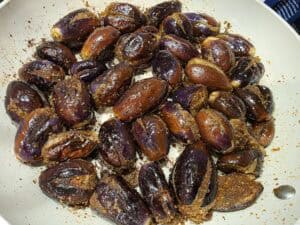
  • Turn and roast till all sides are seared.
  • Lower the heat and cover the pan to allow the eggplants to cook.
  • After 5- minutes open the pan and spray some oil on the eggplants.
  • Slow roast the eggplants, constantly turning them.
  • once the eggplants are ready the are a bit squishy, still hold shape.
  • Transfer to a serving platter and enjoy.

Mealprep the stuffed brinjal

Stuffed brinjal stays good in the refrigertor for up to a week, so we highly recommend this recipe to add to your meal prep. Though it takes a bit of time, if you have a large quantity of eggplants, do not hesitate to make a big batch and freeze for later. Complete the roasting process and cool before freezing. In this way, eggplants wont leach and the result when you thaw it back up is as good as the fresh ones. Freeze as a single layer first and then store them in a container. This ensures they do not stick to each other.Β 

Collaboration

As bloggers we always draw inspiration and ideas from each other and support in the growth and enthusiasm. This time in the Shh cooking secretly group we are exploring stuffed vegetables recipes which have such a huge variety to offer.Check just one more, stuffed capsicum from The mad scientist kitchen.

Stay connected

Stuffed brinjal recipes are a favorite for us in our house. When you try this version of peanut filled, stuffed eggplants do let us know how you liked this recipe in the comments below. The recipe my sound similar to Bharali vangi, however is far different in flavour.Β 

We would love to hear from you in the comments below.

Pin this for later.

See you in the next post.

Masala stuffed eggplants

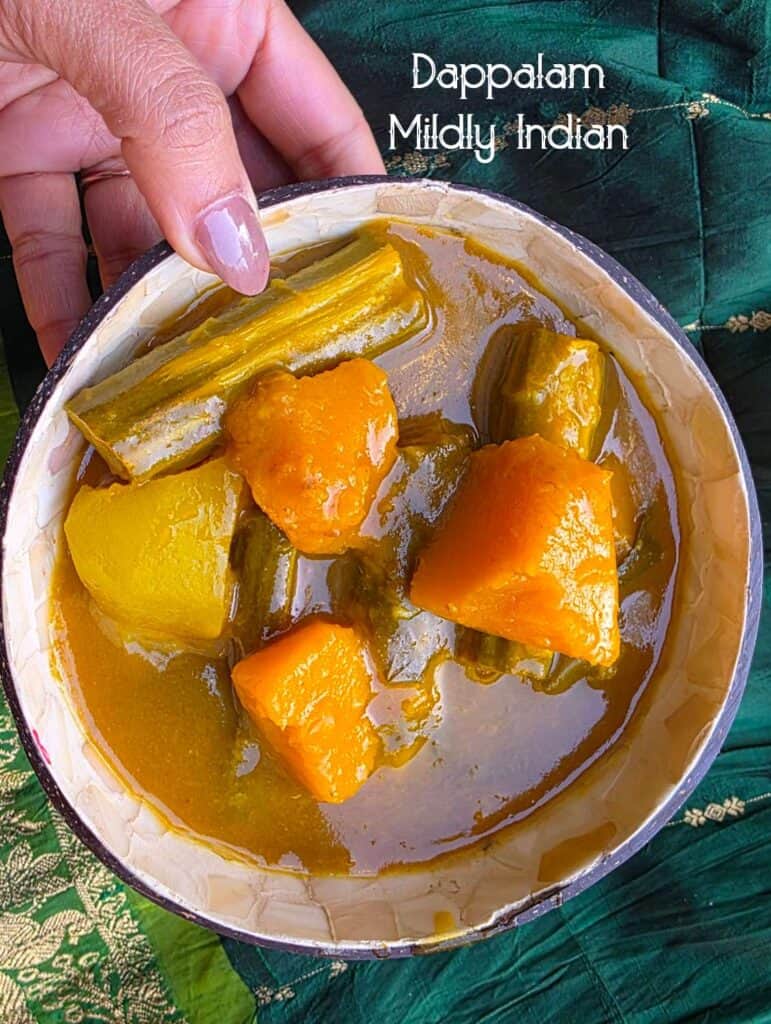
Dappalam | Andhra vegetable stew

Dappalam

The winter blustery nights should be renamed as stay at home curry nights.

I am talking about the curries that feel like home, not the greasy,masala heavy ones. The aloo curry, lauki ki sabji or the tofu curry, these are the ones that i seeing this group. There is one more that I love to make on the coldest nights,Andhra style dappalam. There is no particular explanationΒ  why dappalm on winter nights other than comfort. If you havent tried this Indian curry, today is your day.

What is Dappalam?

Dappalam or mukkala pulusu is a tangy, stew made with pumpkin, sweet potato, moringa pods, eggplants, yams and ashgourds to be served with rice. This light and low calorie curry is from the andhra cuisine. It is a lentil free, gluten free and nut free stew.

Is dappalam same as sambhar?

Dappalam is very different from sambhar both in flavour and ingredients. Though the vegetables used and the tamarind feels the same,dappalam does not use any cooked dals to thicken it. It is thickened using rice flour.Β  Dappalam also doesn’t use any spice mix unlike sambhar which needs sambhar podi or the ground paste.

Ingredients to make dappalam

Vegetables: most vegetables that feature in Southindian curries can be used in this curry as well. Pumpkin, wintermelon, bottle gourd, ridge gourd, small eggplants, tomato, moringa pods all work well in this recipe. You can add spinach, moringa leaves, methi leaves can also be great additionally. The spiciness is added in two fold using green chillies and later on as chilli powder. Serrano peppers provide a good flavour here.

Tamarind: the tanginess is what keeps the curry interesting. Dry tamarind soaked and pulp extracted is the commonly added one. You can use storebought tamarind paste. If adding the paste ensure you stir in a little at a time as it is stronger in intensity than fresh pulp.

Spices: not much of whole spices or.spice mixes are made for this recipe.Β  What goes in is salt turmeric powder amd red chilli powder. Choose your red chilli powder based on the heat you prefer. It can be mild Kashmmiri chilli or sick thikat lal. You can also.vhoose between paprika or cayenne.

Jaggery: the balance of the heat from the chillies is well balanced by a bit of jaggery that is added.
Infact the jaggery also enhances the sourness from the tamarind.

Rice flour: rice flour thickens the gravy to a pouring consistency. This can be white or red rice flour..ensure it is a fine ground powder. Glutinous rice flour is not useful to make this as it will make the gravy a bit jelly like (not pleasant to have).

Mukkala pulusu

Lets make this mukkala pulusu

The mukkala pulusu is a easy curry eveΒ  for beginners to master as you canΒ  keep adjusting the spices as the curry boils.

  • Wash peel and cut the vegetables chosen into chunks.
  • Soak the tamarind in warm water and set it aside to extract the pulp.
  • After 10 minutes , crush with hand and extract the tamarind pulp.
  • Add the vegetables into a cooking pot with turmeric and salt.
  • Add the tamarind pulp and mix well.
  • Add just enough water to submerge the vegetables.and cook them on medium heat.
  • Add red chilli powder and jaggery as the vegetables start to become soft.
  • Cover and cook this till the vegetables are soft.
  • MakeΒ  a slurry of the rice flour.
  • Pour this into the curry while constantly stirring.
  • Let this slow boil and thicken the curry
  • When it is a pouring consistency and the curry appears glossy, it is ready.
  • Remove from heat and serve.Β 

What pairs well with dappalam?

Dappalam with steaming hot cooked rice (white or red), lettuce veppudu and some sago vadam is our Sunday meal. Don’t forget the dollop of ghee on the hot rice to get the authentic flavour.Β  You can pair this with soft rotis, fluffy set dosa, string hoppers or idlies too.

Is dappalam a vegan recipe?

Yes Dappalam is a wonderful vegan stew recipe. It is loaded with vegetables andΒ  is free from dairyΒ  nuts and gluten.

When is Dappalam made in Andhra cuisine?

Dappalam is often made during the Sankranthi festival as a part of the elaborate meal. You can swap the sambhar out of a banana leaf meal to add this or in the south Indian thali.Β 

Print

Dappalam recipe

Course Side Dish
Cuisine Indian, South indian
Keyword curry recipes, Indian vegetarian dinner, Lunch recipes, Winter warmers
Prep Time 15 minutes
Cook Time 25 minutes
Total Time 40 minutes
Servings 0

Equipment

  • deep pot

Ingredients

for the tamarind pulp

  • 1 lime sized ball tamarind
  • 1 cup drinking water

for the curry

  • 2 cups mixed vegetable pumpkin, wintermelon, moringa pods
  • 2 medium green chilli
  • 1 tsp red chilli powder
  • 1/2 tsp turmeric powder
  • salt to taste
  • 3 tbsp jaggery crushed
  • 10 curry leaves
  • 2 cup drinking water
  • 1 tbsp Raw rice flour

for the tempering

  • 1 tbsp Sesame oil
  • 1 tsp mustard seeds
  • 5 curry leaves
  • 1 pinch Asafoetida

Instructions

  • Soak the tamarind in water for 15 to 20 minutes.
  • Squeeze and extract the pulp.
  • Chop the vegetables into big pieces
  • Add to the deep pot with turmeric, salt and the tamarind extract.
  • Add water and cook the vegetables..
  • Once they are fork tender add the rice flour slurry.
  • Mix well and let the curry cook further to thicken.
  • Once the curry looks glossy, it is ready to be served.

Other south indian curries

Thengarachukuzhambu
Kulith saar
Manga pachadi
Aviyal kuzhambu

Stay connected

Hope your curry nights will be easier with dappalam. Let us know in the comments how you served this curry.
Pin for later
Stay subscribed and see you in the next post

Mixed veg dappalam

Omavalli thokku | Indian borage pickle

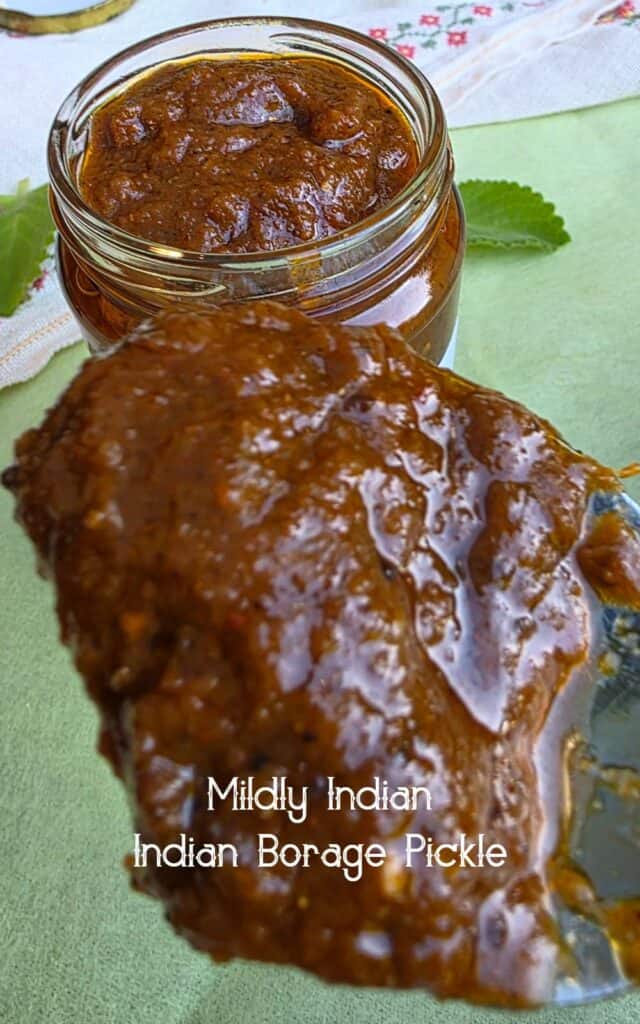
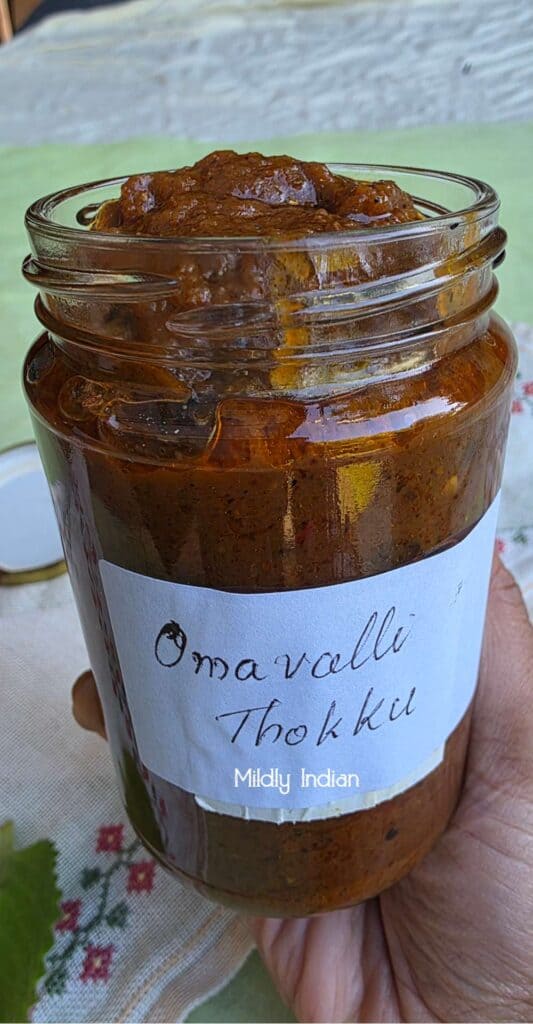
omavalli thokku.

Thankfully that Indian borage plant, that was generously shared by my husband’s cousin is happily growing. We have made so much chutney and rasam with these leaves.I have some more leaves to make new recipes. Since it is winter, the leaf growth will be slow. So I am salvaging some of the excess leaves to make a thokku and keep for a few days so the plant can be left alone to be its best. So here is omavalli thokku.

What is a thokku?

Thokku is a borderline between pickle and chutney. It is spicy, roasted in oil and has a lot ground vegetables with spices and seasoning. It is a long standing version when compared to a chutney. The common varieties are tomato thokku, gongura leaves thokku or mango thokku. It is different from a thogayal as there are hardly any lentils used in this recipe. Thokku is used in the place of a pickle in the South Indian meal. They taste great with thair saadam or as a dip for idlies and dosas.

Ingredients to make the omavalli thokku

Omavalli leaves: fresh fleshy leaves of Indian borage plant isΒ  a key ingredient in this recipe. They have a slight peppery flavour laced with an oregano smell. The leaves wont give much volume to the thokku but is key to the taste and flavour. We don’t have much swaps here without altering the flavour. However, you can make mint or coriander thokku the same way.

Shallots and garlic : since it is a thokku recipe is like to store and use both for rice based meals and for idly dosa breakfasts, I add shallots and garlic for flavour. These also provide a good fragrance along with the omavalli leaves.

Tomato:here is volume and sourness that is needed for the thokku. Fresh tomatoes are the best. However, they are not the best at the moment in season so plain canned one will make the cut. You can choose just plain ones or the ones that are peeled and chopped. It is important to make sure they don’t have any salt or seasoning added to them.

Tamarind: to pack in a thokku punch you need a small lime sized ball of dried tamarind. You can swap this with about a teaspoon of prepared tamarind pulp.

Spices and seasonings: salty and spicy with a hint of sour is the aim of the best thokku. So let’s start with salt. You can use seasalt, table salt or the rocksalt crystals. My parents believe in rock salt. I have used generic salt from the supermarket.

For the colour and heat dry red chillies are used. I have chosen the bydgai variety to lower the heat index and just add flavour and colour. You can choose the variety you have at home for Indian cooking. Red chilli powder is fine to be used too. Paprika will not be useful, cayanne is ok.Β 

Fenugreek seeds add a distinct aroma to the thokku. It is a usual ingredient in south Indian pickles.

Oil:sesame oil into a generous amount is needed to make this. The oil not only allows to cook and roast the thokku, but also acts as a preservative forming a layer on top. This cuts off aerobes and prevents the thokku from going moldy. Oil is added first at tempering and a second portion almost at finishing stages.

For tempering: mustard seeds, curry leaves and dry red chillies are needed for tempering the oil. I prefer to grind the curry leaves along with the omavalli leaves as i don’t get a lot here.

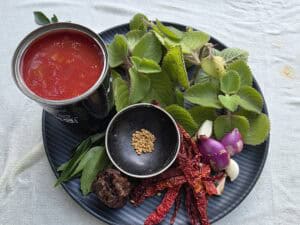
ingredients for the thokku

Lets make Indian borage pickle.

Though the ingredient list was a bit long, the making steps are simple. Slow cooking is the best hence the time taken is a bit for the best results.

Prep the ingredients: wash, drain and check the Indian borage leaves. Peel as set aside shallots and garlic to go with the blend. I have used canned tomatoes, however you can use fresh ones to make the blend.

Grind the mix:into the blender add the shallots,garlic, curry leaves, omavalli leaves, tamarind, chillies and fenugreek seeds. Add the tomatoes and blend to a smooth paste.

Tempering: add the half the quantity of sesame oil into the deep pot and set on medium heat. Add mustard seeds,dry red chillies and fenugreek seeds to it and let the mustard splutter.

Slow cooking: once the mustard seeds crackle, add the blend paste. Mix well so the the oil mixes in well. Add salt, asafoetida,Β  pepper powder and slow cool this on a low heat. Mix intermittently and as it thickens add the rest of the oil. Cook it the oil starts showing up on the surface. Keep mixing and cooking till it is like a paste. At this stage the thokku is ready.

Storing: Remove from heat and cool it down. Transfer to dry bottles and once completely cooled, press down a bit so the oil layer is on the top covering the paste.Β  Seal and store in a dark corner of the pantry.

What pairs well with omavalli thokku?

The reason I store thokku is because you can spice up a lot of lunch box ideas within minutes. So here are my best combos.

  • I like the lunchbox with thokku rice and cauliflower mezhukkuperatti. As a fusion I make thokku pasta with loads of vegetables. I use a spoon of thokku in stirfries and kadamba poriyal.
  • As a classic sit down meal, steamed rice with kootu, some vattal or vadam and this thokku is a soulful end to a massive week.
  • Dont limit the thokku to just home meals. Try a wrap with baked veggies and the thokku spread on the wrap. Ooo, yum!!

ajwain pattha achar

How to store Indian borage pickle?

The thokku stays well for upto three months. Ensure you transfer them warm into clean, dry glass bottles.
If you have made a huge batch remove a small portion into a smaller bottle to use often.this helps to reduce contamination of the bigger stock.
Use a dry spoon to remove a serving of pickle and don’t leave the pickle open for long.

Print

Omavalli thokku

Course Pickles
Cuisine Fusion, South indian
Keyword chutneys and podi, Indian vegetarian dinner, Pickle recipes
Prep Time 15 minutes
Cook Time 40 minutes
Servings 0

Equipment

  • deep pot
  • blender

Ingredients

  • 200 grams indian borage leaves
  • 400 grams tomatoes canned
  • 6-8 small shallots
  • 3-4 pods garlic ( optional)
  • 10 curry leaves
  • 1/2 tsp fenugreek seeds
  • 6-8 dry red chillies
  • 1 lime sized tamarind
  • salt to taste
  • crushed black pepper

for tempering

  • 3 tbsp sesame oil
  • 1 tsp mustard seeds
  • 2 long dry red chillies

finishing touches

  • 1/4 cup Sesame oil

Instructions

  • Peel the shallots and garlic, wash and set aside.
  • Wash and pat dry the Indian borage leaves.
  • Into the blender add the shallots, borage leaves, can of tomatoes, fenugreek, curry leaves, chillies and tamarind.
  • Blend them to form a smooth paste.
  • Into the deep pot, add the sesame oil and heat on medium warmth.
  • As the oil heats up add the mustard seeds and pieces of red chillies and let them sizzle and fry up.
  • Once the mustard splutters, add the blended mix and mix well.
  • Add salt and crushed black pepper and mix well.
  • Turn down the heat to low and let the mix cook.
  • Stir occasionally and let the mix bubble up and cook down slowly.
  • As the mix cooks down, add the rest of the oil.
  • Mix again and as the oil surfaces, the pickle is ready.

Other pickle ideas

Here are a few ideas that you can make and keep for a long while. Click on each of these highlights to take you to the respective recipe.

Stay connected

If you have not grown an Indian borage plant,I highly recommend one. They don’t rely on your green thumb,hardy and live well. In addition to making them as food the leaves can be seeped as tea.
When you have a lot of leaves, try this recipe and let us know what you think.
Pin this for later.
indian borage pickleStay subscribed and see you in the next post.
Sabudhana Kheer | Indian sago pearls dessert

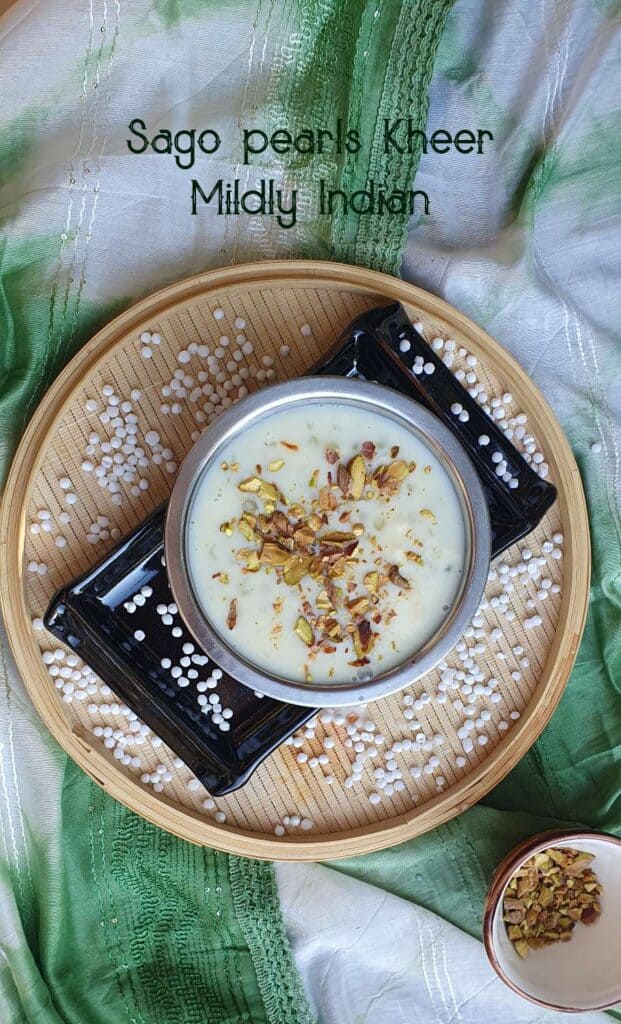
Sabudhana kheer
The sabudhana kheer is literally tapioca pearls boiled in milk. Yet, it tastes simply divine in some households and mediocre in othersΒ  if you are curious like I was here are the best collated ideas to make the best tasting sabudhana kheer.

What is sabhudhana kheer?

Sabudhana kheer is a creamy milk basedΒ  dessert popular in India and Pakistan. The recipe uses tapioca pearls cooked in milk and is flavoured with nuts, seeds and saffron. Made during festivals like Holi, Shivrathri, Diwali and Ramzan the dessert is either served warm or chilled.
In the south of India, the same is served slightly more liquid and warm. This is javarisi payasam or sago payasam.
As you travel towards Asian countries, you will find very similar dessert versions of this sago kheer like the Ginataang bayabas we made from Filipino cuisine.

Ingredients to make sabhdhana kheer

Sago pearls:medium sized tapioca pearls are the ones I use for making sago kheer. Choose the ones that have a milky centre. This cooks better than the glassy ones.
Milk: full cream milk is best for the recipe as it gives the desired creaminess to the kheer. Since you will be cooking to reduce a fair bit of this milk, you can use evaporated milk combined with the full cream milk too. Skim milk does make a fairly decent kheer, but it doesn’t have the full bodied flavour. Among plant based milks, I prefer coconut milk or cashew milk to make this recipe.
Sugar: Regular sugar is often preferred to make this kheer. Caramel syrup, dates syrup or stevia are excellent replacements.
Saffron:the fragrance of he saffron in this kheer is delightful, so don’t skip. It doesn’t matter if you choose the long stamens or the short. The saffron infused milk slightly turns the colour of the kheer toΒ  creamy colour then white.
Cardamom: The cardamom fragrance in any kheer is just divine. Use the seeds of green cardamom is what you use. You can powder this with some sugar and store to stir into the kheer.
Nuts and seeds: Pistachios, almonds, melon seeds and cashews are the best for this recipe. Crush the almonds and pistachios to add to the kheer.
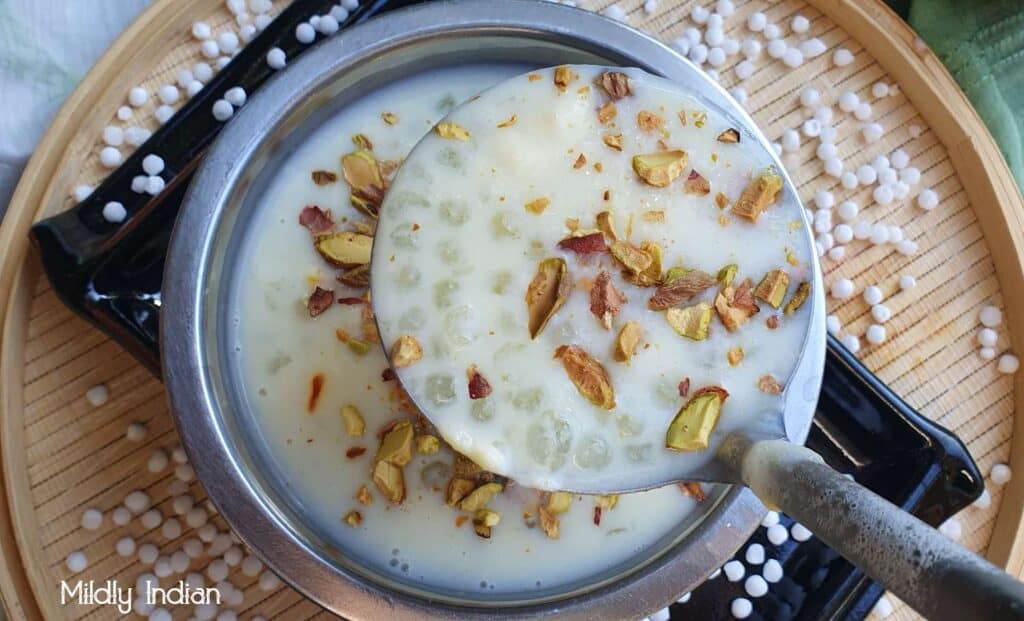
sabudhana kheer
Let’s make sabhdhana kheer
Boil the milk:Β to get the best results, slow cook and reduce 4 cups of milk to half the volume. Use a thick bottomed vessel and constant stirring. This ensures that the kheer has a creamy consistency.
Soak the sago pearls: The sago pearls are a bit hard to start with. I prefer to soak them for 2 hours before cooking to reduce time on the stove. You can use hot water to soak them for half hour as well. The pearls when soaked will be soft and double in size.
Cool the pearls in milk: once soaked, cook on a slow heat. Once the water reduces, add the milk and slow cook till the tapioca pearls are cooked well. The center of the pearls will be glassy when cooked well.
Add the sugar: Once the sago is cooked in the milk remove from heat and add the sugar.
Add the aromatics and nuts: Stir in the cardamom powder and the crushed nuts. Mix well and the kheer is ready.

What are the best tips to make sabhdhana kheer better?

Sabudhana kheer is a very simple. However the most delicious sabudhana kheer recipes have a few little tweaks that elevate them.
  • Cooking down the milk: reducing the milk actually brings forth a creamy density. This flaours the tapicoa pearls really well.
  • Evaporated milk cuts down a fair bit of the cooking time. It also doesn’t take away from the flavour.
  • In certain recipes for the kheer you will find the addition of milk powder. This again increases the creaminess of the milk.
  • Soak the tapioca pearls: it is no fun to bite into a hard centered tapioca pearl. So ensure you wash and then soak the tapioca pearls for a couple of hours

Is jaggery suitable to be added to this kheer instead of sugar?

You can certainly use jaggery in the place of sugar to make this recipe. If using jaggery, do not add it like you do with sugar. Instead dissole the jaggery in a bit of warm water and make a syrup. oil the syrup and remove the impruitirs that skim on top. When the cooking process for the kheer is finished, add the jaggery syrup after you remove the kheer from the heat. This will ensure the kheer is not curdled.

Meal prep for this kheer

If serving chilled the kheer has a fantastic jelly like mouth feel. It stays God in the fridge for up to a week. If serving later,it is a good idea to make this kheer thinner as the tapioca pearls sit in the milk and swell a bit more.

Serving ideas for sabhudhana kheer

As said before, this kheer can be served warm or cold.
If serving warm: serving in small sized glasses topped with crushed nuts and a spoon to enjoy this dessert warm.
If serving cold: the traditional serving style is shallow bowls with a spoon. However you can make it into a parfait style using crushed nuts, chopped fruits, pieces of jelly etc layered with the chilled kheer. This is perfect for summer months. You can also add pieces of jilebi or jamun for the festive days to create fusion kheer dessert.

Can I make this kheer vegan?

If using coconut milk in place of regular milk you have made this kheer vegan easily. Since the coconut milk doesn’t curdle upon boiling it makes it easy to get this dessert creamy. You could try the same with oat milk too if you prefer.

Can I make this a sugar free dessert?

If you replace the sugar used in this recipe as stevia, monk fruit or aspartame, then you have a sugar free dessert. However, don’t add these to boil, rather make the kheer completely without sugar and then stir in the sugar free before serving. This ensure that the slight bitterness you feel with the sugar free is not accentuated.
Print

Sabudhana kheer

The sabudhana kheer is literally tapioca pearls boiled in milk. Yet, it tastes simply divine in some households and mediocre in othersΒ  if you are curious like I was here are the best collated ideas to make the best tasting sabudhana kheer.
Course Desserts
Cuisine gluten free, Indian
Keyword festival offerings, iftar recipes, Indian desserts, pot luck recipes
Prep Time 10 minutes
Cook Time 20 minutes
soaking time 2 hours
Total Time 2 hours 30 minutes
Servings 4 people

Equipment

  • deep pot
  • measuring cups and spoons

Ingredients

  • 1/2 cup tapioca pearls
  • 1 cup water
  • 4 cups milk
  • 1/4 tsp green cardamom powder
  • 1/4 cup Assorted nuts crushed

Instructions

  • Wash and soak the sago (tapioca pearls).
  • Once it is swollen and has doubled in size it is ready to cook.
  • Boil the milk and reduce to half the volume. Ensure you are contantly stirring and scraping the solids that accumulate on the sides.
  • Add the soaked tapioca pearls and water to a deep pot and bring to a slow boil
  • Half way through add the milk and let the sago boil till the center turns glassy of each pearl.
  • Don't miss to keep stirring at this stage as it can catch the bottom easily.
  • Stir in the sugar, cardamom powder and mix well.
  • Remove from heat and stir in the crushed nuts .
  • Once he sugar is dissolved the kheer is ready to be served.
Stay connected
We make sabudhana kheer for any festivals and sometimes just on a whim. It is that easy and provides a comforting feeling always.Β 
Hope you like making this recipe.
Pin this kheer for later.
Stay subscribed and see you in the next post.
sago pearls kheer

Pumpkin and soft tofu broth

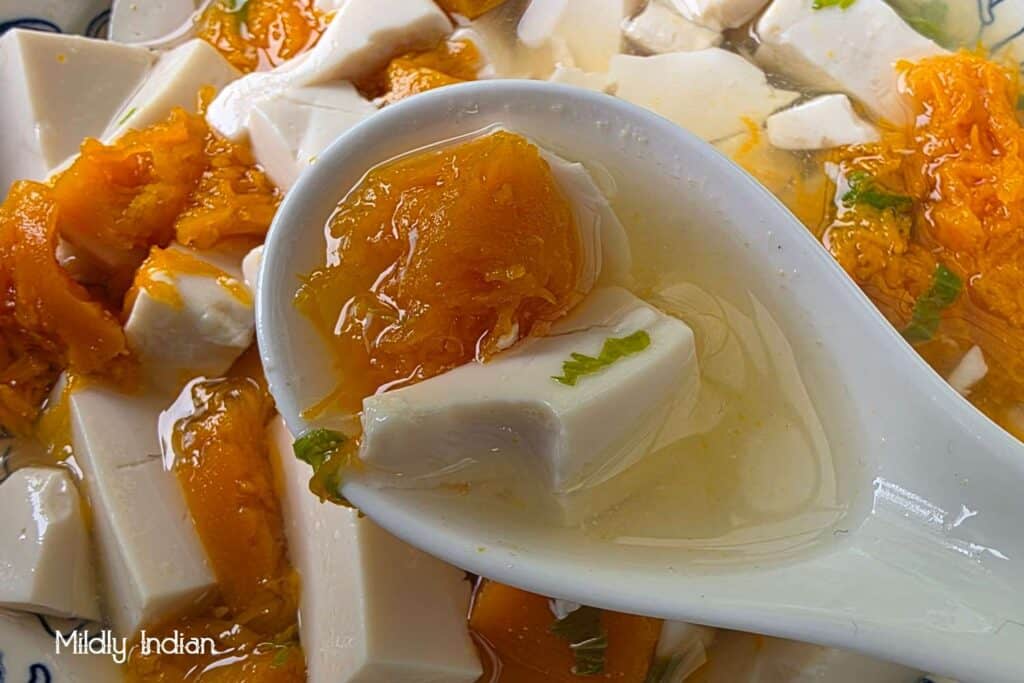
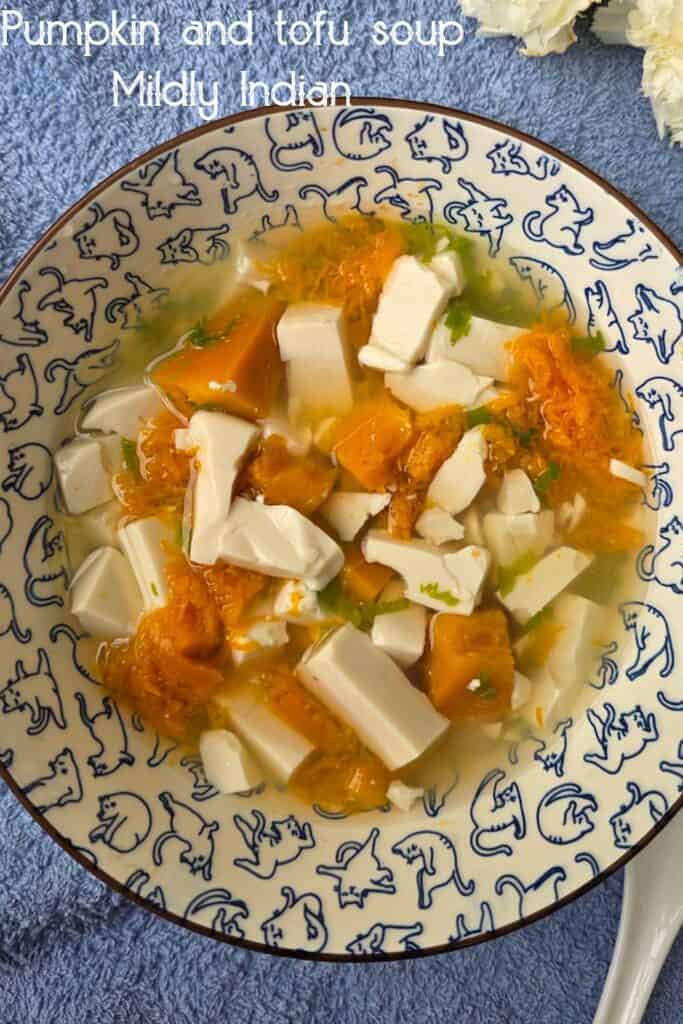
tofu pumpkin soup

Enjoy sipping this warm broth with pumpkin and soft tofu through winter months or as you recover.

Ever since her braces the tooth sensitivities are high and my daughter looks for something fillingΒ  yet soothing. That’s when we devised this soft tofu and pumpkin broth soup that has been a winner.
Served warm, the soup has a lot of liquid and soft cooked pumpkin pieces. The soft tofu can be added chunky or broken down to form more of an egg drop soup consistency. This is a bowl of pure comfort and nourishment at the same time. It is a beginner recipe that is needs a chopping board, knife and a cooking pot only. It is,

  • low calorie
  • gluten free
  • devoid of nuts
  • dairy free.

Ingredients for the pumpkin soft tofu soup

Pumpkin: the chunks of pumpkin give the body to this soup. Any variety is fine as long as they soften when cooked. I like the Japanese variety somehow as it has a smoother mouth feel. It is perfectly OK to swap this to butternut squash as well .

Soft tofu : this is the softness and the uniqueness of this soup. When cooked,the soft tofu assumes a soft jelly like texture. It cannot be swapped for firm tofu as it feels clunky. So no swaps please on the soft tofu.

Seasonings: Salt and pepper is plenty to right make this soup good. Yet I have a secret ingredient you should try.

Dried mushroom powder: This brings forth a soothing umami flavours to the dish. I choose the powder as at the moment my daughter finds it difficult to chew. If not you can add a few chopped pieces of shitake or brown Swiss. I would totally avoid enoki as it will make the soup a bit slimy and with the soft tofu it us not a great mouthfeel.

Broth : to be clear,Β  I cook the soup in water. However you will get a much more depth of flavour if you use a vegetable broth. If using the broth be mindful not to add salt till you have tested the salt levels.

Herbs: you can finish off this soup with herbs if you like. You can add chopped coriander leaves, chives or scallions.

pumpkin tofu broth

Let’s make pumpkin soft tofu soup

This will be one of the easiest ways you will make a soup.

Prep the pumpkin: this is probably the most time consuming process in this whole recipe. Peel and chop the pumpkin into chunks. You can dice smaller if you like. Frozen pumpkin cubes work well too.

Cook the pumpkin in broth: into a cooking pot add the broth (or water) and the pumpkin cubes. Cover and cook till the pumpkin is soft and mashable.

Add the soft tofu: remove the block of tofu from the packaging. Cut them into cubes. once the pumpkin is cooked add the tofu into the soup. Simmer and cook for 5 minutes till the tofu steams well. Instead of cubes you can crush the tofu and add. This soup will resemble the egg drop soup.

Season and serve: adjust the salt and sprinkle some pepper into the soup and remove from heat. The soup is ready to be served. Serve warm.

Variations to the soup.

At times we like to spice it up a bit with this soup, so a teaspoon of sambal chilli paste or Thai curry paste into the broth adds a ton of flavour and a variation from the regular.

Likewise, along with the pumpkin, you can add any vegetable you choose. This adds a bit more variety to this broth. You could try zucchini, broccoli, cabbage or winter melon will be good in the recipe.

Meal prep and lunch boxes

The soup broth definitely tastes the best when warm. However, it can be prepared ahead. It stays good for up to 3 days. I wont recommend freezing the soup as it is nit worth that effort.

Print

pumpkin tofu broth

Course Appetizer, Main Dish
Cuisine Asian
Keyword easy soup recipes, Lunch recipes, Tofu recipes
Prep Time 10 minutes
Cook Time 10 minutes
Servings 2 people

Equipment

  • deep pot

Ingredients

  • 3 cups broth vegetable
  • 1 cup pumpkin diced
  • 1 block tofu soft or silken tofu
  • 1 tsp dry mushroom powder
  • 2-3 slice fresh ginger root
  • salt to taste

Instructions

  • Add the broth to the pot, add pumpkin, ginger slices and place on medium heat.
  • When the mushroom is fork tender, sprinkle the mushroom powder.
  • Dice and add the soft tofu. Mix gently.
  • Let the soup simmer.
  • Taste test and adjust salt.
  • The soup is ready to be served.

Other soup recipes that are handy when having braces.

Broccoli and peas soup
Cherry tomato soup
Avocado cold soup
Carrot and celery soup

Stay connected

The pumpkin and soft tofu broth is a simple recipe. It is a perfect winter comfort or a bowl when you are just under the weather. Let me know if you like this version of a simple soup in the discussion below.
Pin this recipe for later.
Stay subscribed and see you in the next post.Β 

tofu pumpkin broth

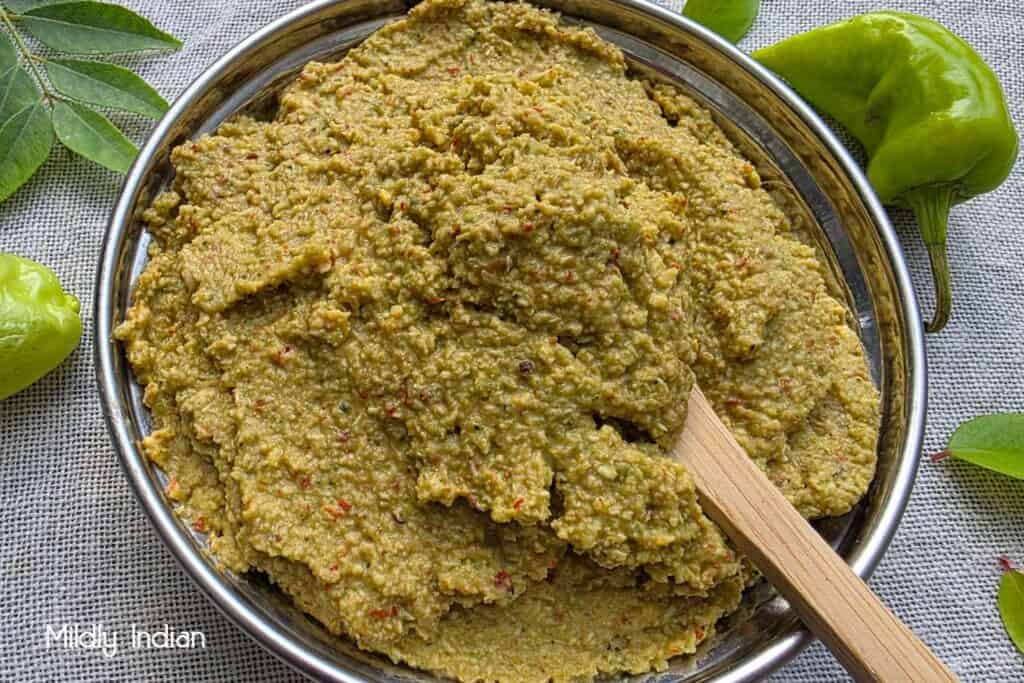
Peerkangai thol thogayal | ridgegourd chutney

Peerkangai thol thoyayal

Enjoy a lipsmacking thogayal made with dals and peels of the ridge gourd in traditional south Indian flavour. Pair it with meals of your choice to wow, your family.

What I see as a difference between home cooks and chefs is not just in the size of meals that we make. Chefs have to keep up with so many of our taste factors, cost control and visual appeal. Home cooks, do know the people they cook for, so fairly easier for them to play around with the ingredients to suit the home needs. Moreover, home cooks can focus on ensuring the best of nutrition from best of produce.What do you think

Here is an age old recipe that a lot of South Indian home cooks rely on, peerkangai thol thogayal.

What is peerkangai thol thogayal?

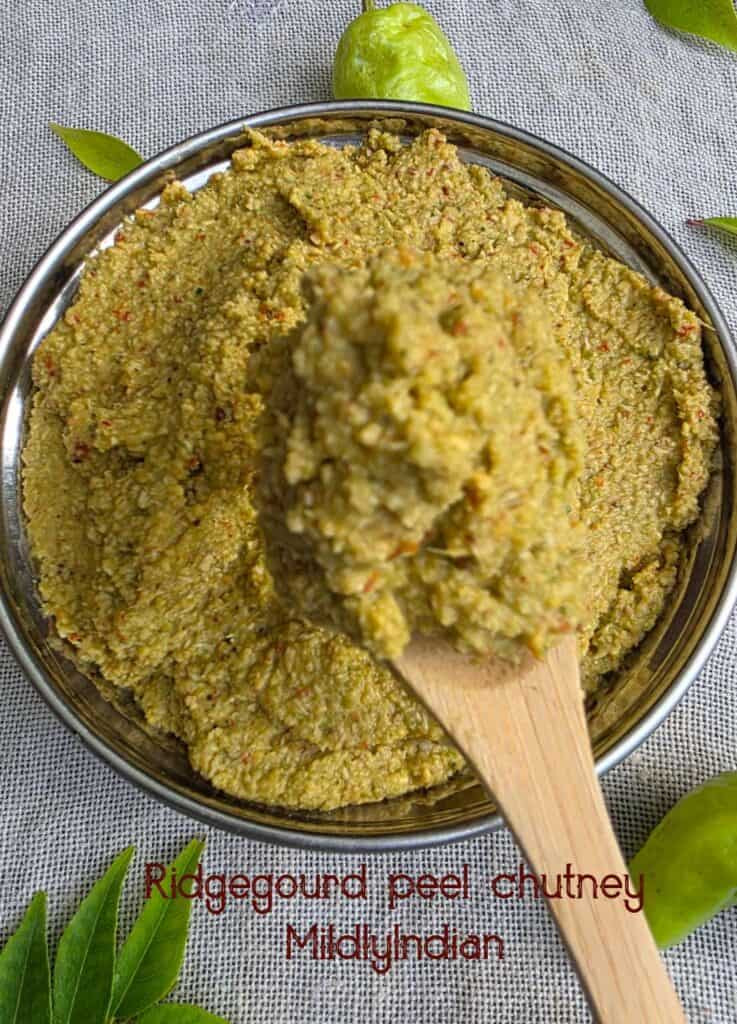
Peerkangai thol is the peel of ridgegrord. This along with roasted lentils, spices, coconut and tamarind is ground into a coarse paste. This is peerkangai thogayal or ridgegourd chutney. It is a popular recipe among all South Indian states and has a few different names, peechinga chutney in Kerala, beerakaya pachadi in Telugu,Β  heerakai chutney in Kannada.Β  Often paired with steamed rice, a dollop of ghee and some stirfried vegetables on the side, the recipe is a classic homestyle one.
The recipe as such is

  • Vegan
  • Gluten free
  • Onion and garlic free
  • No nightshade added
  • And dairy free

Β 

peerkangai thogayal

Ingredients from ridge gourd chutney

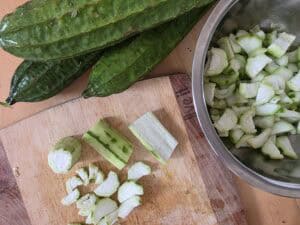
Β Angled loofah or ridge gourd belongs to the cucumber family. The tough outer skin has predominant ridges. The gourd as such has soft flesh that is cooked into curries or stirfries. The peel is the one we have used to make this recipe

Dals: the dals add volume and depth of flavour to this recipe. I use a mix of skinned black gram dal (urad dal) and chick pea dal(channa dal). When roasted thr dals and ground the dals add the necessary volume to the dish.
Spices:there is very minimal spices in the recipe. Red dried chillies are a huge part if the flavour. The second main flavour comes from curry leaves. Along with the salt, the small pinch of asafoetida added offsets any need for garlic or onion.
Coconut: grated coconut added a softness. The milky flavour of the coconut works well with the ridgegourd. Tamarind: there is a slight hint of sourness that you experience while having this recipe. This comes frontiers dried tamarind that is added andΒ  ground along with the ingredients. It adds a zesty flavour to the dish when having with grains or breads.

Let’s make peerkangai thogayal

The recipe is a medium intensity one where the roasting of dals is the one that can go wrong as it burns easily.

Prep the peerkangai: the peel of the ridge gourd is the one used to make this recipe. However, the ridges have a tough fiber running through them that needs to be removed.

  • Wash and pat dry the riodge gourd.
  • Using a knife or peeler approach of the pointed ridges. This js where the fibres are.
  • Press down the peeler and remove the green skin completely. Save this part of this chutney. Save the spongy part to make kootu or stirfry.

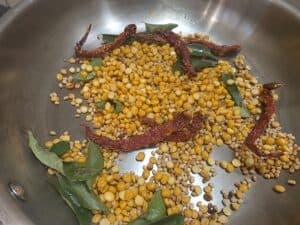
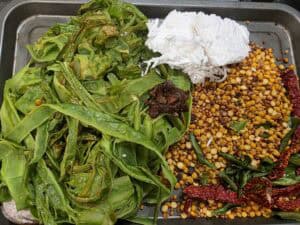
Roast the dals and spices: in a heavy bottomed pan, add the urad dal and channa dal and a tsp of coconut oil. Dry roast this on low heat. Add the curry leaves and red chillies as the dals start turning golden and roast all together till the chillies are crisp and the dals deep golden. Remove this from heat on to a plate and set it aside.

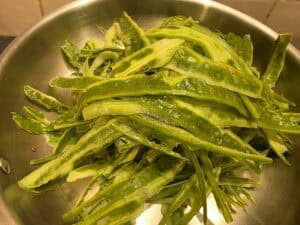
Roast the peerkangai thol: Add the skin. Stir fry this till the peels look deep green and vibrant. Remove and add to the same plate. Let this cool down as well.

Grind the thogayal: once cooler to handle add the roasted dals, chilli,curry leaves, sauteed ridgegourd peel, tamarind, salt and coconut to the food processor and blend into a coarse mix.
Remove the coarse ground mix to a bowl and the thogayal is ready to be served.

peerkangai thogayal

Best pairings with peerkangai thol thogayal

Here are a few ideas for you to try with this thogayal
Peerkangai thogayal with steamed rice, a small spoon of ghee and poriyal on the side is one great Sunday meal.
At home, we like this as a side to rasam rice and often with some kootu.
Alternatively, you can use this as a dip for idlies, dosa etc too.
We use this as a spread for wraps and sandwiches. Pretty much the thogayal and cheese sandwich is a great try. Use someΒ  grana padano orΒ  aged cheddar instead of saltier ones like feta.

Meal prep and lunch boxes

Thogayal stays well in the fridge for up to a week without any issues. It also freezes so well, that we often rely on a frozen block for quick lunches. We love thogayal cheese sandwiches for our lunch box. You could also use it to stirfry the rice with, like we made ghee podi rice.

Print

Peerkangai thogayal

Enjoy a lipsmacking thogayal made with dals and peels of the ridge gourd in traditional south Indian flavour. Pair it with meals of your choice to wow, your family.
Course Appetizer, Side Dish
Cuisine South indian
Keyword beans and legumes, chutneys and podi, Indian vegetarian dinner, leftover recipes
Prep Time 15 minutes
Cook Time 20 minutes
Servings 8 people

Equipment

  • Kadai
  • mixing bowls and spoons.

Ingredients

  • 3 medium ridge gourd
  • 4 tbsp urad dal
  • 4 tbsp channa dal
  • 6 dry red chillies
  • 8 tbsp grated coconut
  • 1 small lime sized ball tamarind
  • salt to taste

Instructions

  • Wash and remove the fibers of ridge gourd.
  • Remove the peels and set them aside.
  • In a pan roast the dals, curry leaves and red chillies.
  • Once they are golden brown, remove on to a plate.
  • Roast the peel of ridge gourd.
  • Let all this cool.
  • Add the coconut, lemon and salt.
  • Grind this mix to a coarse mix.
  • Remove into a bowl and serve.

Other chutneys and thogayals

Thogayals, chammandi and chutneys are a big part of South Indian meals. Here are a couple of ideas
Thenga chammandi
Curry leaves thogayal
Doddapathra chutney
Mango chammandhi
Watermelon rind thogayal

Stay connected

The comfort of hot rasam on a plate with steamed rice and a ball of this thogayal is Sunday for us. We enjoy it as a meal together that screams simplicity yet home.Hope you enjoy making this chutney as much as we love bring it to you. If you make it slightly different tell us your version, we always love to try different ones .
Pin this for later
See you in the next post.Β 

ridge gourd thogayal

Elaichi doodh | Cardamom milk

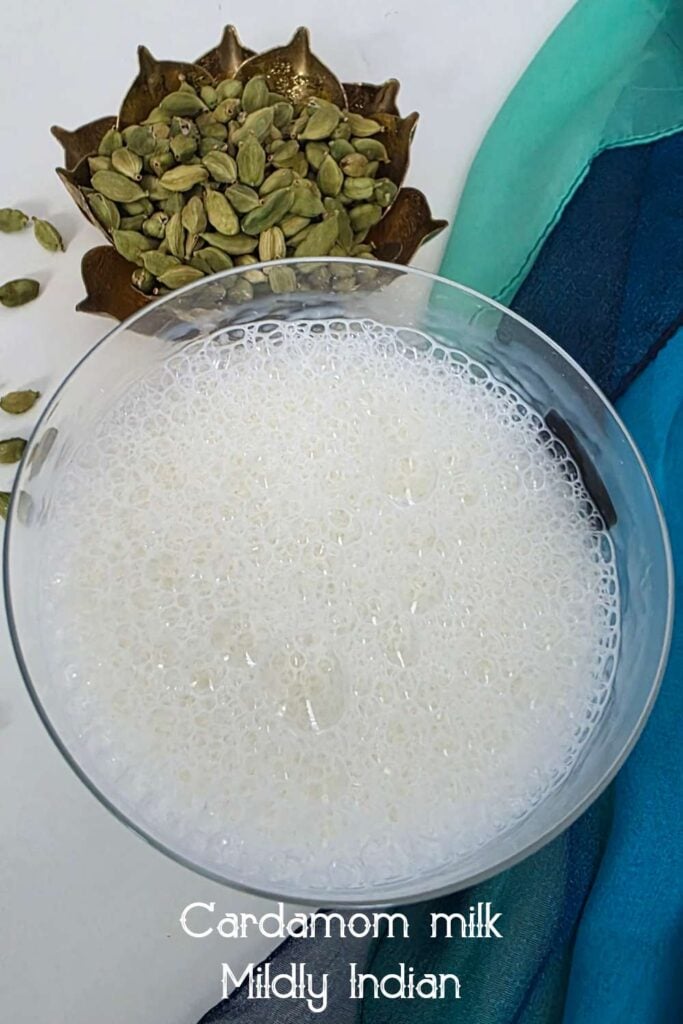
cardamom milk recipe

Milk is not one of my favorite drinks. I always disliked a cup of milk whether you add sweetness to it or not. So, when I was little my mum devised a few clever ways to make me have some. The one that I did not put up much of a fight with was for the warm cup of cardamom milk during the cooler months. As the slow autumn chill is coming through here currently, I had a sudden urge to try this elaichi doodh back again.

What is cardamom milk?

Cardamom milk is an excellent winter warm drink where steamed or boiled milk is infused with the aroma and flavour of cardamom. This elevates it from just being a drink to a copy dessert like feeling. It is also the same recipe called as cardamom moon milk.

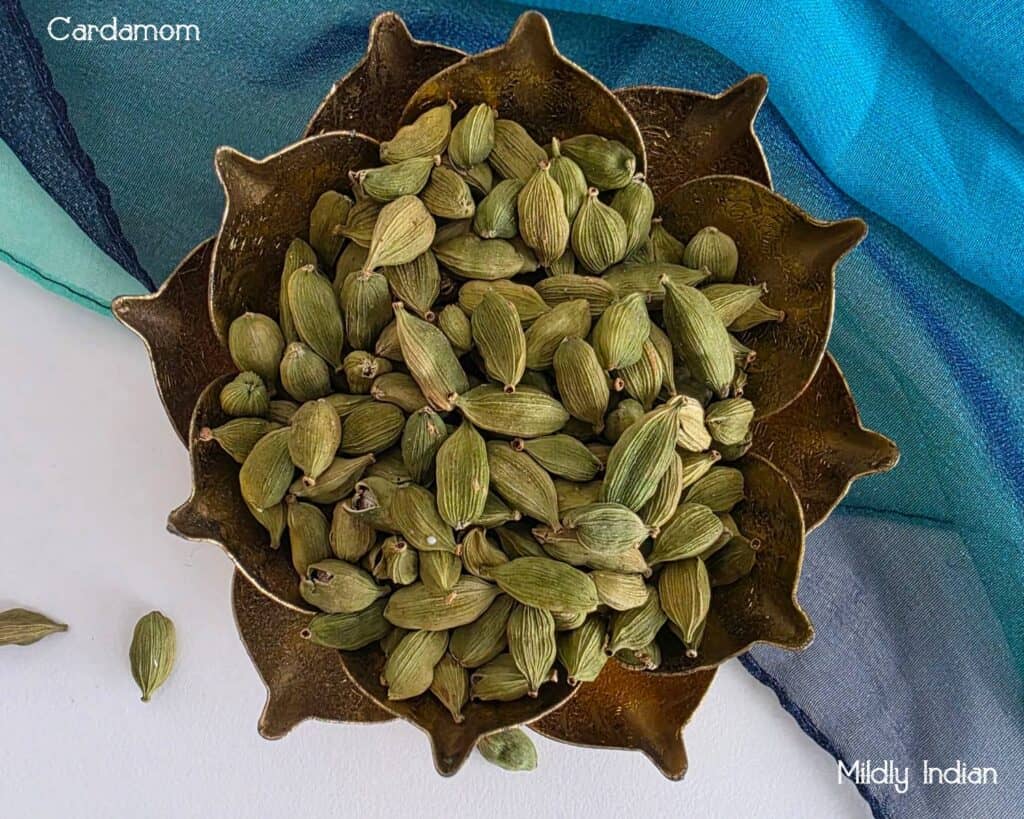
Cardamom pods

Ingredients to make elaichi doodh

Milk: classic elaichi doodh used full cream milk. However, it is up to you to use skim, lactose free or half and half milk or plant milk like soy or oat. Ensure you have a thick bottomed pan to boil it in.

Cardamom: green cardamom pods are the ones used in the recipe. When you buy them,ensure they look deep sage green or slate green and are so fragrant as soon as you open the pack. The skin is discarded (use in curries or to make tea) andΒ  the seeds are ground to add to the milk.

Sweetener: this can be entirely your choice. Honey, cane sugar, stevia, monk fruit or add none if you prefer it that way.

Let’s make cardamom milk

Making cardamom milk is as simple as slow boiling the milk and stirring in the cardamom powder and sweetener .

  • Remove the seeds from the cardamom pods.
  • Crush them well.
  • Slow boil the milk till it is bubbly and frothy.
  • Stir in the cardamom and remove from heat.
  • Stir in the sweetener. If using honey, wait till the milk cools down a bit.
  • Pour into cups and serve warm.

Will cardamom milk induce sleep?

Cardamom as a spiceΒ  is a soothing relaxant. Along with milk that is well known for inducing sleep the Cardamom milk combination makes it and excellent combination. It certainly is not a remedy for sleeplessness.Β 

Can elaichi milk be vegan?

If you are following this recipe with soy milk, oat milk etc,Β  the recipe naturally becomes vegan, however you don’t want honey in the recipe.

Can we serve this chillied?

Absolutely, pop them into small bottles and leave them in thr refrigerator. If using UHT milk, it will stay for almost a week with no issues.

Print

Cardamom milk

Enjoy the soothing warmth of cardamom milk as the winter chill slowly starts to show up.
Course Desserts, Drinks, Sweets and savories
Cuisine Indian, South indian
Keyword Indian drink recipes, Winter warmers
Prep Time 10 minutes
Cook Time 15 minutes
Servings 2 cups

Equipment

  • saucepan thick bottomed

Ingredients

  • 2 cups full cream milk
  • 2 green cardamom
  • 2 tbsp honey

Instructions

  • Peel the cardamom pod and extract the seeds.
  • Crush the seeds into a fine powder.
  • Bring the milk to slow boil,
  • Add the cardamom powder.
  • Once warm and bubbling, remove from heat and stir in the sweetener ( honey)
  • Pour into cups and serve.

Milk recipes from this blog

Kesar doodh – aromatic saffron milk

Mexican Atole | Hot corn drink

Ulundhu paal | blackgram drink

Jeera milagu Kashayam paal | spiced milk

Stay connected

Hope you are a better milk lover than I am and enjoy this recipe more often. Let us know if you have some soothing warm drink recipes like this that you absolutely love in the comments below.

Pin this for later

Stay subscribed and see you in the next post.Β 

Elaichi doodh

Mor milagai vattal | Yogurt cured chillies

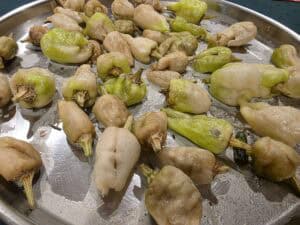
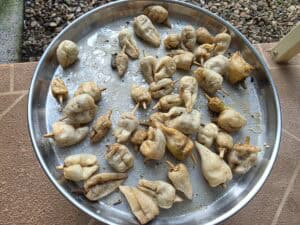
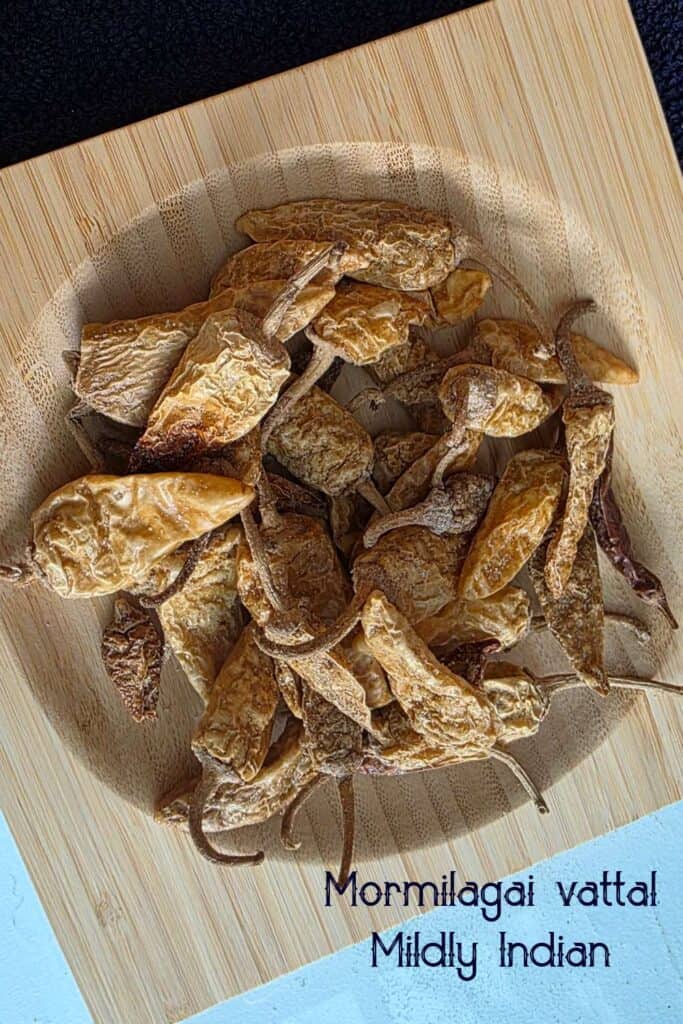
Mor milagai vattal

Till the covid lock downs came i never realised my food tastes really good coz amma send the bases needed for the nice meal. So the sambhar podi, rasam podi, vattals and vadams needed to make a south Indian meal all were perfect as amma made them. This lack of skill really was a big gap that I couldn’t help learning to bridge. With ammas guidance vattals were the first try, then the sago vadams and then slowly trickier ones like mor milagai. This year as I was making some of these recipes I remembered to take images of mormiliagi to share with you.

What is mor milagai?

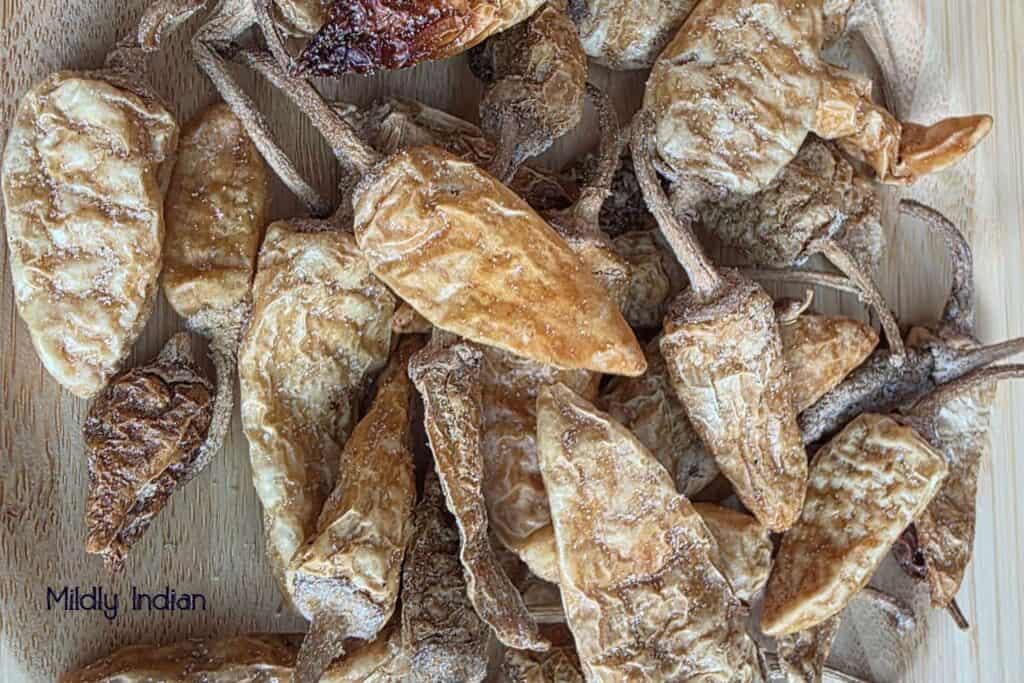
Sundried chilli pickle made in south Indian homes and served with lunch or dinner. These chillies literally are translated as buttermilk chillies. The chillies are marinated in traditional buttermilk. This infuses the flavours of the yogurt, tenderises it and reduces the heat of the chillies. The marinated chillies are sundried and the stored. To add to a meal, these are deep fried.

Ingredients to make mor milagai

The mor milagai vattal doesn’t require much, just three ingredients.

Chillies: green chillies are the main ingredient of this recipe. Ideally slight plump but spicy chillies are used for the recipe. However, you can use jalapeno or Serrano peppers too to make this recipe.Β  Slightly plump thin walled chillies are the best as they dry fast and are delicious.

Traditional yogurt :natural set yogurt is what makes this recipe best. Ideally slightly sour yogurt is preferred as it makes the chillies less intense after marinating. Churn the yogurt with a bit of water to aid in the marination.

Salt: crystal salt or table salt is best to use here. You don’t need anything fancy.

yogurt cured chilli

Let’s make yogurt cured chilli

This is probably the part that is going to test your patience and bit.

  • Wash and clean the chillies and pat them down with a kitchen towel.
  • Trim the stalks with a scissors so you a centimeter above the stalk.
  • Slit the chillies and set them aside.
  • In a jar mix together yogurt water and salt.
  • Shake it up till it becomes evenly incorporated.
  • Soak the slit chillies in this mix. Shake up the mix well and leave it overnight to soak.
  • Drain the chillies the next day morning and dry the chillies in sun. Place the remain liquid in fridge.
  • In the evening, place the partially dried chillies back in the buttermilk solution.
  • Dry them again the next day.
  • This process repeats t0 about 3 to 4 days till the buttermilk milk mix is almost over. And the chillies semi dry.
  • For the next couple of days, sun dry the chillies till they are crisp.
  • Once well dried, store in air tight bottles.
  • To deep fry, heat oil in a small wok. Once the oil is hot or sizzles when a small piece of the chilli is dropped in it, place 3 to 4 chillies at a time and roast till it us crispy.
  • Drain from the oil and the chillies are ready for your meal.

Storing the sundried chillies

Sun dried vattals and vadams are best stored in a dry box with a tight lid and away from moisture. When removing some for use, ensure your hands are dry. In about 3 to 4 months it is best to sun the vattal again so it remains crisp and moisture free.

How to use the mor milagai vattal?

Once the yogurt cured chillies are completely dry, you can prep fry them in hot oil as needed for the meals. Alternatively you can airfry them too.

Serving ideas for mor milagai

Fried mor milagai can be served with papads in any South Indian meal. Commonly paired with Thair saadam, koozhu , or ulundhu saadam, it provides a crunch and a heat kick to these nutrients dense lunches.
The mor milagai vattal is a perfect addition to the South Indian tempering when making poriyal too as it is slightly less pungent than the dried red chillies.

Print

Mor milagai vattal

Yogurt cured chiiles that are sun dried and stored to be fried as a condiment for lunch.
Course Pickles, Preserves, Traditional
Cuisine Indian, South indian
Keyword Fermented foods, summer recipes, sun dried recipe
Prep Time 10 minutes
soaking and drying time 7 days
Servings 0

Ingredients

  • 1 cup Green chillies plump ones
  • 1 cup buttermilk traditional ( cultured )
  • 1 tbsp Rock salt

Instructions

  • Wash and pat dry the chillies.
  • Slice the stalk about a centimeter above each chilli
  • Slit the chillies and set them aside till the soaking mixture is ready.
  • Into a clean bottle add the butter milk and salt and shake together till the salt dissolves well.
  • Add the prepared chillies into the mix and shake well.
  • Let this soak over night or for up to 24 hours.
  • Remove the chillies and spread on a plate.
  • Sun dry for the day.
  • In the evening, place the chillies back in the marinating butter milk mix.
  • Remove from the mix and dry again in sun.
  • Repeat this process for 3 to 4 days.
  • The sundry the chillies, till they are completely dry and crispy.
  • Store this in an airtightbox till needed.

For using the chillies

  • Deep fry a few chillies in hot oil. Drain when the colour changes and the chillies stop sizzling.
  • Drain the chillies from the oil and serve with meals.

Other sundried vattals from our blogΒ 

Sago fryums

Lotus root vattal

Mango vattalΒ 

Kumbalanga vattalΒ 

Stay connected

Mor milagai vattal is a traditional South Indian recipe that few make at home. It is not hard, but a slow task so keep up the patience and try atleast once.Β  Let us know in the discussion below how your batch turned out with our recipe. Share the idea with friends and family.

Pin this for later

Stay subscribed and see you in the next post.
mor milagai vattal
❌