
❌

Reading view

There are new articles available, click to refresh the page.

Griddle vs Grill: Which is Better for Cooking Outdoors?

Cooking outdoors has become increasingly popular in recent years, and it’s no surprise why. Cooking outdoors allows you to enjoy the fresh air, sunshine, and company of friends and family while preparing delicious meals. Oh, and let’s not forget flavor!

Two of the most popular cooking options for outdoor cooking are griddles and grills. In this post, I will compare these two cooking appliances, and we’ll take a look at the pros and cons of both cooking methods and help you determine which one is the best for you.

Griddle Grill

Griddles are flat, solid, hot plate-like surfaces that sit on top of a stove, grill, or purpose-built cooker. The traditional outdoor griddle is typically a gas grill with a flat metal cooking surface, or β€œgriddle.” In simple terms, take a gas grill, eliminate the grates, and add a metal plate on top of the burners.Β 

They are typically made from cast iron or stainless steel and are great for cooking pancakes, eggs, bacon, and other breakfast foods.Β 

Griddles are also great for cooking burgers, steaks, and chicken breasts. With a griddle, you can cook large amounts of food at once, which makes it great for feeding a crowd.

Some Quick Facts about griddles:

These facts highlight just some of the benefits and versatility of griddles as a cooking tool. Whether you’re a professional chef or a home cook, a griddle can be a valuable addition to your cooking arsenal.

  1. Cast iron griddles are often considered to be very efficient cookers because they heat evenly, are durable, and can be seasoned to enhance their non-stick qualities.
  2. Griddles are great for cooking small size, soft and liquid foods.
  3. Griddles are great for cooking breakfast foods, such as pancakes, eggs, and bacon, but they can also be used for cooking a variety of other foods, such as grilled sandwiches, stir-fry, and even pizzas.
  4. Griddles are often designed with grease traps to collect excess fat and oils, but do not let as much food β€œjuices” out as grill grates.
  5. Griddles come in a range of sizes, from small single-serving griddles to large, commercial-sized griddles that can accommodate multiple food items at once.
  6. Griddles can be seasoned to create a non-stick surface, which makes cooking and cleaning a breeze.
  7. Griddles are often easier to clean than traditional grills, as they have a flat surface and are typically made from non-porous materials like cast iron or stainless steel.

Griddle Pros and Cons

Pros:

  1. Large Cooking Surface: Griddles have a large cooking surface, which makes them great for cooking large amounts of food at once.
  2. Even Heating: Griddles heat evenly, which means that your food will cook evenly, without any hot spots.
  3. Versatile Cooking: Griddles can be used to cook a wide variety of foods, from breakfast foods to steaks and burgers.
  4. Easy to Clean: Griddles are easy to clean because they are flat and smooth. Simply wipe them down with a damp cloth after cooking.

Cons:

  1. Expensive: Griddles can be expensive, especially those made from high-quality materials such as cast iron or stainless steel.
  2. Heavy: LargeΒ  griddles are heavy, which makes them difficult to move around.
  3. Limited Cooking Options: Griddles are limited in the types of cooking they can do. They can’t be used for roasting or smoking meats, for example.Β 
  4. Griddles do not create the β€œconvection heating” effects most grills can do to cook large cuts of meat.
  5. Can’t smoke meats.

BBQ Grills ( charcoal grill, gas, and pellet grill )

Grills are cooking devices that use an open flame, charcoal, propane, or wood pellets to cook food. They are typically made from stainless steel, cast iron, or aluminum and come in a variety of sizes and shapes. Grills are great for cooking burgers, steaks, chicken, and large meats, as well as vegetables and fruits.

With the right skills and equipment, even an inexpensive gas grill can cook just about anything you can think of.

Some Quick Facts About Grills:

These facts highlight some of the benefits and versatility of grills as cooking tool. Whether you’re a seasoned griller or just starting out, a grill can be a valuable tool for creating delicious, flame-grilled meals and smoke meats

  1. Grills come in a range of sizes, from small portable grills to large, permanent outdoor grilling stations.
  2. Grills can be fueled by gas, charcoal, electricity and pellets.
  3. Charcoal grills are often considered the best for imparting that signature smoky flavor to food.
  4. Gas grills are convenient and easy to start, but can be more expensive in the long run due to the cost of propane.
  5. Electric grills are great for indoor cooking, but may not be as powerful as gas or charcoal grills.
  6. Grills come in a variety of materials, including stainless steel, cast iron, and porcelain-coated steel.
  7. Grills typically have a grate or cooking surface that allows grease and oils to drain away from food, preventing flare-ups and keeping food healthy.
  8. Grills often have adjustable cooking grates and better temperature controls to cook food to perfection.
  9. Grills typically require a higher degree of maintenance than griddles, as they need to be cleaned regularly to prevent food from sticking and to remove grease buildup.

Grill Pros and Cons

Pros:

  1. Versatile Cooking: Grills can be used to cook a wide variety of foods, from meats and vegetables to fruits and bread.
  2. Flame Grilling: Grilling over an open flame adds flavor to your food that can’t be achieved with a griddle.
  3. Affordable: Grills are often more affordable than griddles, especially those made from more basic materials such as aluminum and other composites.
  4. Portable: Small two burner grills are portable, which makes them great for camping and other outdoor activities.

Cons:

  1. Limited Cooking Surface: Some grills have a limited cooking surface, which means that you may need to cook your food in batches.
  2. Uneven Heating: Grills can heat unevenly, which can result in some food cooking faster than others.
  3. Requires Constant Attention: Grilling over an open flame requires constant attention, as food can easily burn if not tended to properly.
  4. Some grills can be expensive.

Which is Better for Cooking Outdoors? A grill or a griddleΒ 

The answer to this question depends on your cooking needs and preferences. If you are looking for a versatile cooking option that can be used to cook a wide variety of foods but do not have the need to smoke or roast large cuts of meat, a griddle may be the better option for you.

However, if you are looking for that signature flame-grilled flavor and enjoy the art of grilling, a grill might be the way to go. Also consider a grill if you want to smoke meats or enjoy the flavors of charcoal or wood pellets.

Ultimately, it’s a matter of personal preference and what you’ll be using it for. Both griddles and grills have their pros and cons, but they can both be great options for cooking outdoors. If you’re looking to feed a large crowd and cook smaller-sized foods, a griddle might be the best option, while if you want to enjoy a more traditional grilling experience, a grill might be the better choice.

If you’re still not sure which option is right for you, consider purchasing a combination griddle/grill. These versatile cooking devices allow you to enjoy the best of both worlds, giving you the option to cook with a griddle or a grill, depending on what you’re in the mood for.

Key Takeaways

In conclusion, griddles and grills both have their advantages and disadvantages, but both are great options for outdoor cooking. Consider your personal cooking needs and preferences, and choose the option that works best for you. Whether you choose a griddle, a grill, or a combination of the two, you’re sure to enjoy cooking outdoors and creating delicious meals for yourself and your loved ones.

How to Clean a Flat Top Grill or Griddle: 3 Different methods and easy steps

In this guide, I will show you how to clean a flat top grill, more commonly known as a griddle. I own a Blackstone griddle and have tested various methods for removing food debris, old grease, and fat from its surface.Β 

There are many β€œsuggestions” on the Internet. People have come up with creative names and made up methods to get clicks, but these are three true and tested methods I use to clean my flat top grill surface and keep it in good shape.

How to Clean a Flat Top Grill: Three Effective, Simple Methods

Β These are natural methods without using chemicals or special tools or any other nonsense. I have tested these methods to confirm their effectiveness, and as you can see in my video above, when it comes to cleaning Β a flat-top grill, simple does it, and you do not need to overspend on fancy cleaning tools or cleaning products.

Method #1: Scrape and clean, add oil ( after each use )

Routine Cleaning – This method is your daily routine cleaning, sort of speaking. This is the method you want to apply after each use of your griddle. This method consists of, after your food is cooked and you are done using the griddle, turn off the burners and scrape the grill top with a spatula, griddle scraper, or any flat scraper.Β 

Scrape the food and grease towards the grease collector. Grab a paper towel or a piece of cloth and wipe the top clean and apply a small coat of cooking oil.Β 

Remember, after you’re done scraping and wiping the girdle, apply a small coat of cooking oil or vegetable oil to the flat top.

Method #2: Spray Water, Scrape and clean, add oil ( deep cleaning )

Deep cleaning – I only recommend this method when things like sauces, caramelized sugar, BBQ sauce, and anything sticky have gunked up on the grill top. This deep clean method also works when there is excess grease build up. However, you will remove more of the original seasoning coating you applied when you first got the flat top grill.Β 

The key here is to turn off the burners and allow the grill top to cool down to at least 300 degrees. This technique consists of spraying or pouring small amounts of water onto a hot flat-top grill.Β  As the water comes into contact with the hot surface, it will boil and steam, loosening and removing food and grease deposits.

However, because metal can expand and contract in response to thermal changes, you do not want the flat top of your griddle to be too hot to prevent warping and damage. A Blackstone flat top grill is made out of steel, Blackstone still recommends using water to clean their flat top grills only below 300 degrees.Β 

However, other brands may use stainless steel or even thin metal for their tops, which are susceptible to warping.

So apply this method, simply remove any leftover food, turn off the burners, and let the griddle cool down to about 300 degrees. Spray or pour a small amount of water over a six-inch wide section of the flap-top grill at a time.Β 

Spray water, scrape, and move to the next spot. Again, spray water every six inches, scrape food and grease towards the grease collector, rinse and repeat. To avoid β€œshocking” too much of the large surface area of a flat top when using water, you should clean it in small sessions.

Once you are done cleaning the flat top, grab some paper towels or a cloth rag and wipe clean the griddle. Lastly, apply a small amount of cooking or vegetable oil, and now you have a clean flat top grill.Β 

The cool thing about this technique is that boiling water and steam do all the work of separating grease from the medal and reducing scraping.

The downside of this method is that it removes more of the oil coating required to keep flat tops rust-free and non-stick. So is important, after using this cleaning method, to apply a good coating of oil. This method is going to leave you with a good, clean flat top grill.

Method #3: White vinegar spray, Scrape and Clean, add Oil

Even Deeper clean – This method is good for situations when the laptop grill is extremely dirty or has been left out outside or neglected for some time. This method removes a lot of the oil coating, so it is important to reapply oil immediately after cleaning.

Similar to the other methods, apply some vinegar and water to a hot grill top, scrape the food and grease residue off, rinse with water, and apply oil. I like to β€œre-season” the griddle after applying this cleaning method.Β 

These are the steps to cleaning your flat top grill or griddle.

Once you are done cooking food on the griddle, go ahead and turn off the burners. As the grill cools down, grab a scraper or spatula and scrape off any food residue from the flat top grill. A grill scraper, spatula, or bench scraper are all tools you need to cook and also clean a flat top grill.

After cleaning the flat top grill with the scraper, apply a thin layer of oil to the cooking surface using paper towels or a clean cloth rag. Cover the entire surface with cooking oil to keep the grill surface β€œseasoned” and rust-free and to preserve its nonstick nature.

Total Time: 5 minutes

Step #1: Scrape

Scraping the griddle top

The first step in cleaning a flat-top grill is always to discard food and residue while the grill is still hot and after cooking has concluded. Scraping a flat-top grill while it is still hot prevents residue from sticking and settling on the grill’s surface. Once food residues have cooled on the grill’s surface, they are much more difficult to remove, and additional scraping is required.

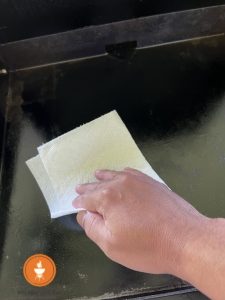
Step #2: Wipe clean

wiping the griddle clean

Wipe clean. Always use paper towels, a rag, or a damp cloth to wipe the grill’s surface after scraping it. The purpose of this step is to use the rag to clean and absorb small particles left behind by the scraper.

Step #3: Oil or season your flat top grill

This is an important step and it serves two purposes. First, the oil is a natural way to lubricate and keep your flat top grill top β€œseasoned”. This will keep away rust. Second, oil acts as a natural non-stick coating for your flat top grill. So the next time you use the grill, less food will stick to the grill’s surface.

Supply:

  • Water
  • Vegetable oil

Tools:

  • Scraper
  • Spatula
  • Squeeze Bottles for Water

Materials: Paper towels Paper Towels Cooking oil, vegetable oil

Storing your griddle and keeping it clean

When it’s time to store the griddle, it’s important to take a few extra steps to keep it in top shape. Here are a few tips for storing your griddle to keep it clean and rust free.Β 

Ensure that the griddle is thoroughly cleaned and oiled before storing it. This means that you have applied the steps we discussed above and the griddle is clean before storing it.

Oil prevents rust and ensures that the grill is prepared for its next use.

Lastly, use a dry or slightly oiled piece of cloth to protect the exterior of the grill from rust, which is especially important if you plan to store the griddle outside. Try to store your griddle in a dry, indoor location.Β 

Tips for keeping your flat top grill griddle in top shape

Cleaning it after use – Many people create more work for themselves by failing to clean the grille immediately after use. I know we all want to jump in and start eating, but cleaning your flat top grill immediately after cooking is a lot easier than cleaning it when it is cold. Plus, your griddle will be ready for its next cooking session.

While the griddle is hot, right after you use it, is the easiest way to clean it and keep it clean.

Don’t use brushes on your griddle. I know it is tempting, but you will likely damage the grill’s surface.

Avoid using soap when possible. Soap should only be used when you first unbox your griddle to remove manufacturing oils and contaminants and then season your flat top grill. On rare occasions where the flat top grill has been neglected for a long time and you need to revive it, you can use soap, but you will need to β€œseason” the griddle with a couple layers of oil.Β 

Q&A

Do you use soap to clean your griddle?

No, I do not. I only use soap to clean the griddle surface when the grill is new. This is to remove manufacturing contaminants.Β 

How to clean a blackstone flat top grill?

The steps for cleaning a Blackstone griddle are no different than for any other flat top grill. Scrape, wipe, and oil.Β 

Why do I need to apply cooking oil to the flat top grill’s surface?

Cooking oil acts as a natural lubricant for the cooking surface and will protect the flat top grill surface from rusting.

Conclusion

Maintaining your flat-top griddle is easier than you think. A daily cleaning routine and cleaning the grill after each use will suffice for the majority of individuals. The best way to maintain the grill is to clean it as soon as you are finished cooking.Β 

However, if your grill needs a little bit more extra cleaning, you can use water or even a vinegar water mixture to remove excess oil grease and burnt up sugar. One point that you must remember is that it is extremely important to keep the flat-top griddle oiled and seasoned to extend its lifetime and keep rust away.Β 

πŸ’Ύ

This is a quick video to showing three easy methods to clean your griddle or flat top grill.The full article can be found at www.bbqgrillacademy.com/how-to-c...
❌