Reading view

There are new articles available, click to refresh the page.

Poland Stalls MiCA-Style Crypto Rules as Lawmakers Fail to Override Presidential Veto

Poland’s efforts to align its crypto market with the European Union’s Markets in Crypto-Assets framework have hit a major political roadblock after lawmakers failed to override a presidential veto on a sweeping digital-asset bill.

This leaves the country as the last EU member without a national MiCA-style regime.

According to a Bloomberg report, the vote was held in the lower house of parliament on Friday, falling short of the three-fifths majority required to overturn President Karol Nawrocki’s decision to reject the legislation.

The outcome halts Prime Minister Donald Tusk’s push to place Poland’s crypto sector under tight regulatory control and forces the government to restart the legislative process from scratch.

Tusk Flags Crypto as National Security Threat Amid Russia Sabotage Claims

Tusk had framed the bill as a national security measure in the days leading up to the vote.

Addressing parliament, he said the unregulated crypto market had become a conduit for money laundering and foreign interference, including activity linked to Russia and Belarus.

He told lawmakers that Polish authorities had identified “several hundred” foreign entities operating in the domestic crypto market and warned that Russian intelligence and organized crime groups were exploiting digital assets for covert financing.

Government officials have tied those concerns to recent security incidents.

Last month, Warsaw blamed Russia for a blast on a key railway route used for supply traffic to Ukraine, an allegation Moscow dismissed.

Polish security services have also cited cases of underground groups allegedly paid in cryptocurrencies to carry out sabotage activities inside the country.

⚔ Russia is using cryptocurrencies to pay saboteurs carrying out hybrid attacks across the European Union, according to a Polish security official. #Russia #Cryptohttps://t.co/MsOjIZjSfu

— Cryptonews.com (@cryptonews) October 14, 2025

The veto has deepened an already sharp political confrontation between Nawrocki, a nationalist conservative, and Tusk’s pro-European coalition.

The president rejected the bill earlier this month, arguing that it went far beyond EU requirements and threatened civil liberties, property rights, and the stability of the state.

📜 Polish President Karol Nawrocki vetoed a sweeping crypto law, saying it threatens property rights and personal freedoms.#Crypto #Regulationhttps://t.co/BXYSh74MPF

— Cryptonews.com (@cryptonews) December 2, 2025

The blocked law would have implemented MiCA-style rules in Poland, introducing licensing for crypto-asset service providers, investor protection standards, stablecoin reserve requirements, market abuse bans, and strict anti-money laundering controls.

It also proposed granting authorities the power to block crypto-related websites through administrative orders, a provision the president described as opaque and vulnerable to abuse.

Political Tensions Rise After Poland Blocks Sweeping Crypto Oversight Bill

Nawrocki also criticized the scale of the bill, which exceeded 100 pages, contrasting it with far shorter implementing laws in neighboring Czechia and Slovakia.

He warned that heavy supervisory fees and added domestic restrictions would drive Polish crypto firms to register in other EU countries, costing Poland tax revenue and talent.

His chief of staff, Zbigniew Bogucki, said on Friday that the president is open to regulation as long as future proposals are not excessively restrictive.

The failure to override the veto leaves crypto companies operating in Poland without a clear national legal framework ahead of the EU’s July 1, 2026, MiCA compliance deadline.

The political dispute has increasingly drawn in industry players.

Nawrocki has portrayed himself as a defender of the crypto sector and was endorsed before his election by Kristi Noem, a senior U.S. official, at a conference in southeast Poland sponsored by trading platform Zondacrypto.

🇵🇱 Poland has elected Karol Nawrocki, a conservative who says crypto should be “born in freedom, not buried in red tape.”#poland #cryptohttps://t.co/BVJXhQBnrK

— Cryptonews.com (@cryptonews) June 2, 2025

The exchange later stated that it accepts no Russian clients and fully complies with anti-money laundering rules.

Foreign Minister Radosław Sikorski added another dimension to the dispute on Friday, saying on radio RMF FM that the crypto industry sponsors figures across the right wing of Polish politics, explaining the sharp resistance to tighter oversight.

The veto follows months of turbulence around crypto regulation in Poland. In September, lawmakers had initially passed the bill, triggering strong backlash from industry leaders who warned that Poland’s version of MiCA amounted to overregulation.

Zondacrypto’s chief executive at the time described it as a “step backwards” that risked criminalizing core blockchain development activity.

The post Poland Stalls MiCA-Style Crypto Rules as Lawmakers Fail to Override Presidential Veto appeared first on Cryptonews.
EU Wants ESMA to Oversee Crypto Like the SEC Does in US

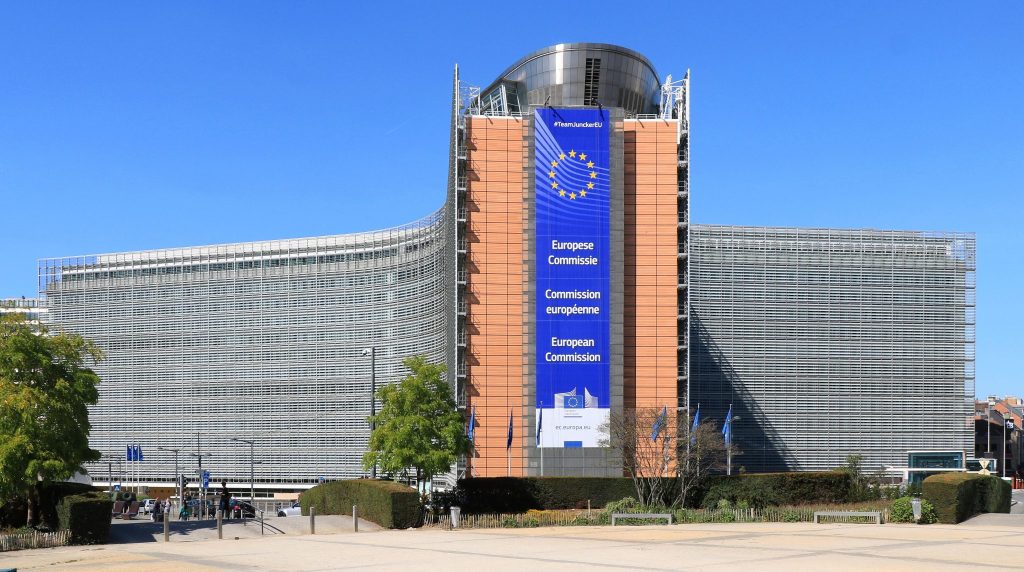
The European Commission formally proposed transferring direct supervision of all crypto asset service providers to the European Securities and Markets Authority.

This supervision was previously placed under the Markets in Crypto-Assets framework, with the licensing authority working with national regulators.

The legislative package aims to eliminate regulatory fragmentation across 27 member states by granting ESMA powers comparable to those of the U.S. Securities and Exchange Commission over U.S. markets.

The proposal arrives just nine months after its announcement in the Savings and Investments Union strategy.

The strategy highlighted the political urgency behind capital markets integration as Europe confronts competitive pressures from U.S. financial markets.

EU Wants ESMA to Oversee Crypto - European Commission Building
Source: Wikipedia

Centralized Powers Target Cross-Border Efficiency

ESMA would gain authority to directly authorize crypto firms seeking to operate across the bloc, replacing the passporting system, where companies secure approval in one jurisdiction before expanding throughout the EU.

The regulator would also assume oversight of significant trading venues, central counterparties, and central securities depositories alongside its expanded crypto mandate.

The Commission’s framework introduces “Pan-European Market Operator” status to streamline corporate structures into a single licensing format while enhancing ESMA’s coordination role in asset management.

Officials positioned the changes as essential for responding to emerging risks and addressing inconsistencies from fragmented national approaches.

The package simultaneously addresses barriers to distributed ledger technology by amending the DLT Pilot Regulation to increase proportionality and provide legal certainty for blockchain adoption.

Member states will see directives converted into regulations to reduce national discretions that enable regulatory gold-plating.

Member States Split Over Sovereignty Concerns

France backed the centralization push after Bank of France Governor François Villeroy de Galhau warned that the current passporting model creates regulatory loopholes due to uneven oversight.

This framework would benefit from much stricter regulation of the multi-issuance of the same stablecoin within and outside the European Union, to reduce arbitrage risks in times of stress,” he said in October.

Germany also recently signaled openness to expanded ESMA powers following years of opposition, while ECB President Christine Lagarde endorsed centralized supervision as essential for European competitiveness against the United States.

Just last month, ESMA Chair Verena Ross highlighted the inefficiency of national regulators building 27 separate crypto frameworks when centralized resources could achieve better alignment.

European Commission proposes transferring crypto exchange supervision from national regulators to ESMA in bid to standardize oversight across the bloc.#Europe #ESMA #MiCAhttps://t.co/ND271lQ1n3

— Cryptonews.com (@cryptonews) November 3, 2025

While others seem to be geared toward the idea, Luxembourg Finance Minister Gilles Roth rejected the shift, stating that his country prefers “supervisory convergence rather than creating a costly and ineffective centralized model.

In fact, Malta’s Financial Services Authority warned that centralization would introduce bureaucratic layers that would hinder competitiveness, at a time when the EU is striving to enhance its global position.

Industry groups raised concerns about disrupting MiCA’s rollout before it is fully implemented.

Reopening MiCA at this stage would introduce legal uncertainty, risk delaying the authorization process, and divert attention and resources from the practical task of consistent implementation,said Robert Kopitsch, secretary general of Blockchain for Europe.

Implementation Timeline Faces Political Hurdles

The European Parliament and Council must approve the proposals through negotiations, where maintaining package unity remains crucial for establishing a genuine single market across the investment chain.

Officials expect Parliament to adopt a legislative framework position by May 2026, while member states aim for general agreement by year-end.

ESMA will begin overseeing equity and bond price consolidation, alongside ESG ratings, from 2026 onward, with oversight of cryptocurrency extending the regulator’s authority as Europe pursues tighter market integration.

The Commission emphasized that the reforms address fragmentation that raises costs for cross-border trades, a significant obstacle for startups scaling in Europe rather than the U.S.

The initiative forms part of broader efforts to complete the EU’s capital markets union, after data-sharing rules published on November 26 established strict requirements for how crypto firms must collect, store, and report user information to tax authorities, starting January 2026.

🇪🇺 EU’s new crypto data-sharing rules will force exchanges and service providers to share user data and transaction records.#EU #CryptoPrivacyhttps://t.co/YoIDXmgNvm

— Cryptonews.com (@cryptonews) November 27, 2025

The Transfer of Funds Regulation, which extends the travel rule to crypto, takes effect on December 30 and requires exchanges to identify transaction participants, including self-hosted wallet interactions.

The post EU Wants ESMA to Oversee Crypto Like the SEC Does in US appeared first on Cryptonews.

IMF Warns: Fragmented Stablecoin Rules Create “Roadblocks” – New Guidelines Released

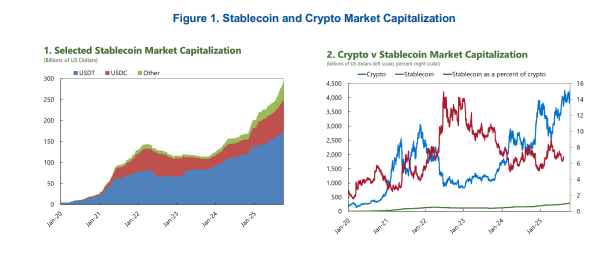
The International Monetary Fund on Thursday released a new global assessment of the stablecoin market, warning that fragmented regulatory frameworks across countries are now creating structural “roadblocks” that threaten financial stability, weaken oversight, and slow the development of cross-border payments.

In its report titled “Understanding Stablecoins,” the IMF reviewed how major economies, including the United States, the United Kingdom, the European Union, and Japan, regulate stablecoins and found that national approaches remain widely inconsistent.

Stablecoins have the potential to reshape cross-border payments and capital flows. They offer opportunities, but also bring new risks—financial integrity, regulatory oversight, consumer protection, capital flow management, monetary sovereignty, and more. Learn more:… pic.twitter.com/cOlZKuqLDF

— IMF (@IMFNews) December 4, 2025

While some countries treat stablecoins as securities, others regulate them as payment instruments, permit only bank-issued tokens, or leave large parts of the market unregulated.

Stablecoins Are Moving Faster Than Regulators Can Track, IMF Warns

The IMF said this regulatory patchwork allows stablecoins to move across borders faster than oversight can follow.

Issuers can operate from lightly regulated jurisdictions while serving users in stricter markets, limiting authorities’ ability to monitor reserves, redemptions, liquidity management, and anti-money laundering controls.

The fund warned that this creates regulatory arbitrage and weakens global supervision.

The report also pointed to technical fragmentation. Stablecoins increasingly operate across different blockchains and exchanges that are not always interoperable.

According to the IMF, this lack of coordination raises transaction costs, slows market development, and creates barriers to efficient global payments.

Differences in national regulatory treatment further complicate cross-border usage and settlement.

Source: IMF

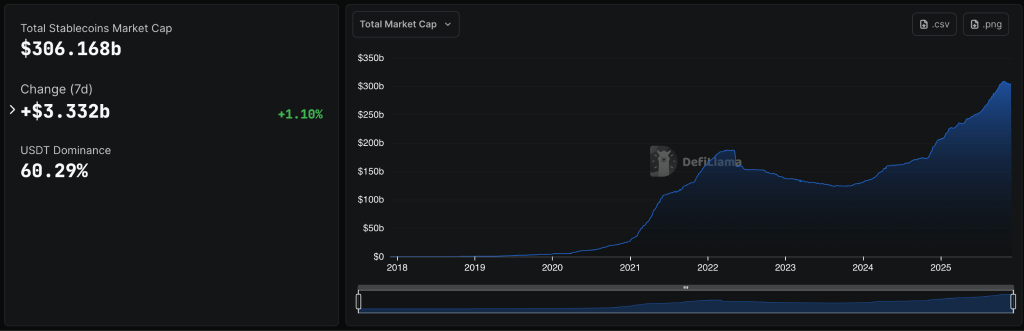
Stablecoins remain dominated by U.S. dollar-denominated tokens. The IMF said the global stablecoin market is now worth more than $300 billion. Tether’s USDT and Circle’s USDC make up the majority of that supply. About 40% of USDC’s reserves are held in short-term U.S. treasuries, while roughly 75% of USDT’s reserves are in short-term treasuries, with another 5% held in Bitcoin.

The concentration of reserves in government debt markets links stablecoins directly to traditional financial systems

Widespread use of foreign-currency stablecoins can weaken domestic monetary control, lower demand for local currency, and accelerate digital dollarization. Stablecoins also make it easier to bypass capital controls through unhosted wallets and offshore platforms.

In addition to monetary concerns, the fund cited broader financial stability concerns. Large-scale redemptions could force rapid sales of Treasury bills and repo assets, potentially disrupting short-term funding markets that are critical for monetary policy transmission.

The IMF also noted that the increasing interconnection between stablecoin issuers, banks, custodians, crypto exchanges, and funds also increases the risk of contagion spreading from digital markets into the wider financial system.

IMF Urges Unified Stablecoin Regulation as Cross-Border Risks Grow

To address these risks, the IMF released new global policy guidelines intended to reduce fragmentation. It called for harmonized definitions of stablecoins, consistent rules for reserve assets, and shared cross-border monitoring frameworks.

The fund said issuers should be subject to the principle of “same activity, same risk, same regulation,” regardless of whether the issuer is a bank, fintech company, or crypto platform.

The IMF also said stablecoins should be backed only by high-quality liquid assets such as short-term government securities, with strict limits on risky holdings. Issuers must guarantee full one-to-one redemption at par, on demand, at all times.

Strong international coordination on anti-money laundering enforcement, licensing, and supervision of large global stablecoin arrangements was also included in the new guidance.

The IMF’s warning comes as regulatory pressure is rising worldwide. In Europe, the European Central Bank recently warned that stablecoins, despite their small footprint in the euro area, now pose spillover risks due to their growing ties to U.S. Treasury markets.

🇪🇺 The ECB warns that stablecoins are growing fast, now topping $280B, with rising spillover risks as USDT and USDC dominate 90% of the market. #Stablecoins #ECBhttps://t.co/ef16HZzqYL

— Cryptonews.com (@cryptonews) November 24, 2025

The European Systemic Risk Board has also called for urgent safeguards against cross-border stablecoin structures operating under the EU’s MiCA framework.

In China, the central bank has described stablecoins as a threat to financial stability and monetary sovereignty, while the Bank of England and Basel regulators are reassessing how banks should hold capital against stablecoin exposure as usage expands.

The IMF concluded that without consistent global regulation, stablecoins could bypass national safeguards, destabilize vulnerable economies, and transmit financial shocks across borders at high speed.

The post IMF Warns: Fragmented Stablecoin Rules Create “Roadblocks” – New Guidelines Released appeared first on Cryptonews.

“First Time Ever”: CFTC Greenlights Spot Crypto Trading on Regulated U.S. Exchanges

For the first time in the United States, spot cryptocurrency trading is set to take place on federally regulated futures exchanges, a step that reshapes how digital assets fit into the country’s financial system.

The update was announced on Thursday by Acting Chair of the Commodity Futures Trading Commission (CFTC), Caroline Pham. She said that exchanges registered with the agency will soon be allowed to list spot crypto products, following months of behind-the-scenes coordination among U.S. regulators.

The move also reflects guidance from the President’s Working Group on Digital Asset Markets.

Pham Calls Spot Crypto Approval on U.S. Exchanges a “Historic Moment”

Pham described the announcement as a historic moment, saying spot crypto will now be able to trade on exchanges that have operated under strict federal standards for nearly a century.

She said the goal is to give U.S. investors access to familiar, well-regulated venues that already enforce strong protections and market safeguards.

🚨 You can now trade listed spot crypto on @CFTC exchanges. We’re working smarter and faster to protect Americans who deserve safe U.S. markets, not offshore exchanges 🇺🇸 https://t.co/2yNTjDsCFV

— Caroline D. Pham (@CarolineDPham) December 4, 2025

Until now, the CFTC’s role in crypto has mostly centered on derivatives such as futures and options.

Spot markets, the direct buying and selling of assets, fell mostly outside its jurisdiction, pushing significant trading activity to offshore platforms with looser rules.

Under the new framework, the CFTC will apply its existing authority to oversee spot trading for digital assets it considers commodities, including Bitcoin and Ethereum.

The change also folds leveraged retail crypto trades into the same regulated exchange system that has long governed traditional commodities markets.

The decision also reflects growing regulatory cooperation in Washington. In early September, the CFTC and the Securities and Exchange Commission issued a joint statement clarifying that exchanges registered with either agency are not barred from supporting certain spot crypto trades.

🔎 Spot crypto trading is moving closer to mainstream finance after the SEC and CFTC cleared registered exchanges to facilitate certain spot products.#SpotCrypto #SEC #CFTChttps://t.co/5C5uy800Ju

— Cryptonews.com (@cryptonews) September 3, 2025

That guidance eased longstanding jurisdictional tensions between the two regulators.

Pham said the approval ties into the CFTC’s wider Crypto Sprint initiative, which spans several areas of digital finance.

The program includes work on tokenized collateral, the use of stablecoins in derivatives markets, and updates to clearing, settlement, and recordkeeping rules using blockchain-based systems.

The change also responds to years of pressure from the crypto industry for clearer rules. Under current law, leveraged retail commodity trades must take place on registered exchanges and involve physical delivery of the asset within 28 days.

That requirement created uncertainty for crypto markets and pushed much of the activity overseas. Allowing spot and leveraged crypto trading on Designated Contract Markets offers a regulated option within the U.S. system.

CFTC in Talks With CME, Coinbase, and Others as Crypto Market Oversight Expands

Several major platforms have already held talks with the CFTC about launching products under the new framework. These include CME Group, Cboe Futures Exchange, ICE Futures, Coinbase Derivatives, Kalshi, and Polymarket U.S.

Earlier this month, Pham confirmed that the agency was in direct discussions with multiple firms seeking approval for spot and leveraged crypto offerings.

📈 The CFTC is reportedly set to approve leveraged crypto trading on regulated U.S. exchanges next month. Acting Chair @CarolineDPham confirmed talks are underway to bring these products under the agency's oversight.
#crypto #regulation https://t.co/wSaWVJ4lEh

— Cryptonews.com (@cryptonews) November 10, 2025

The policy change is unfolding at a time when the CFTC itself is going through a leadership transition. Pham took over as acting chair in January after former Chair Rostin Behnam stepped down.

She is set to leave once the Senate confirms President Donald Trump’s nominee, Michael Selig, whose confirmation vote is now moving toward the full chamber.

Meanwhile, lawmakers in Congress are advancing legislation that could officially place crypto spot markets under the CFTC’s primary supervision. As those plans take shape, some lawmakers have questioned whether the agency has the manpower to manage the expanded duties.

Right now, the CFTC employs just over 500 staff members, a small figure compared with the more than 4,000 employees at the Securities and Exchange Commission.

Outside of its enforcement role, the agency is also stepping up its work with the private sector.

In November, Pham announced plans to launch a new CEO Innovation Council and opened public nominations to help shape future policy on digital assets and prediction markets.

The post “First Time Ever”: CFTC Greenlights Spot Crypto Trading on Regulated U.S. Exchanges appeared first on Cryptonews.

Record $12M Crypto Donation to Reform Rocks UK Politics as Government Weighs Ban

Reform UK has landed its biggest donation yet, after receiving £9 million ($12 million) from crypto investor and aviation businessman Christopher Harborne, according to newly released figures from the Electoral Commission.

The sum is now the largest single political donation ever made by a living person to a UK political party.

Harborne, a British investor living in Thailand, has long been active in UK political donations. He donated heavily to the Conservatives during Boris Johnson’s time in office and also supported the Brexit Party, which later became Reform UK, in both 2019 and 2020.

Two companies tied to him, AML Global and Sherriff Group, operate in the private aviation sector.

Harborne’s £9M donation Reshapes UK as Crypto Money Enters UK Politics

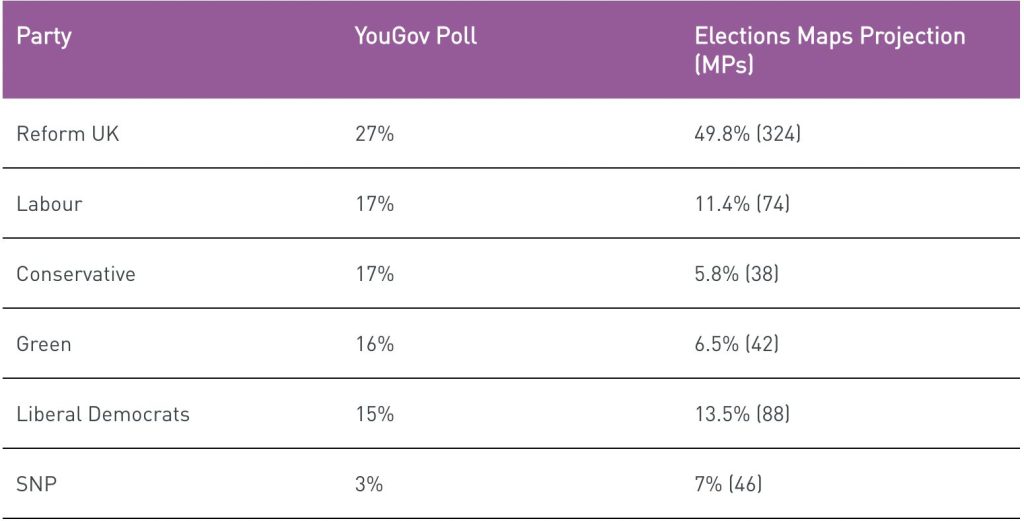
Harborne’s donation comes at a time when, as the next general election is not due until 2029, but local elections are scheduled for May. It also comes as Reform UK has remained at the top of several national opinion polls since the spring.

Harborne’s £9 million donation breaks the previous record of £8 million, which was set in 2019 by supermarket heir Lord David Sainsbury in support of the Liberal Democrats.

Separately, Lord John Sainsbury left £10 million to the Conservatives through his will in 2022.

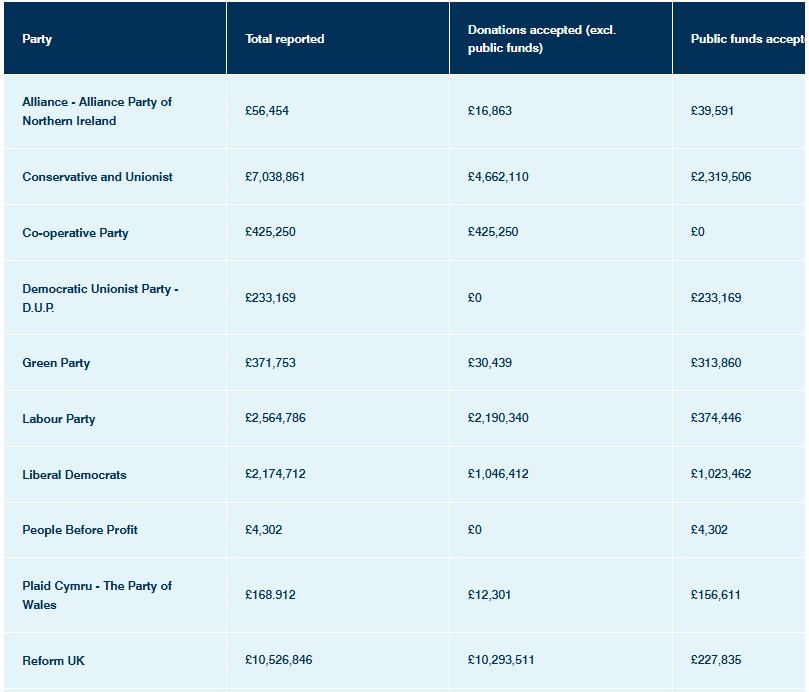
Figures released by the UK Electoral Commission show that Reform UK raised more than £10.2 million between July and September, over twice the amount collected by the Conservatives in the same period, which brought in £4.6 million.

Source: Electoral Commission UK

Labour brought in £2.1 million, and the Liberal Democrats reported £1 million. This makes it the first full quarter in which Reform will outpace Conservatives in fundraising since the general election in 2024.

Still, the longer-term numbers slightly favor the Conservatives, showing that since July 2024, they have raised around £14.4 million in total, compared with Reform’s £13.5 million.

Conservative leader Kemi Badenoch downplayed the impact of Harborne’s contribution, describing it as a “one-off” and insisting her party remains stronger when it comes to steady, repeat donors

Beyond fundraising, the donation has reignited debate around the role of cryptocurrency in UK politics.

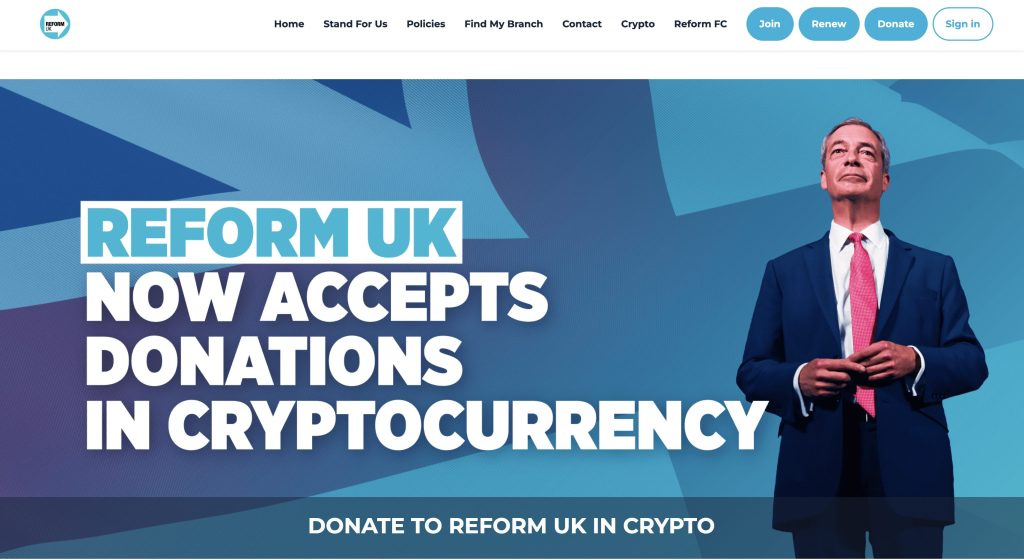
In May, Reform leader Nigel Farage announced that the party would begin accepting Bitcoin donations, making it the first UK political party to do so.

The party later launched a dedicated digital donation portal and confirmed that it had already received a small number of crypto contributions, the first recorded instance of such donations in British political history.

Foreign Influence Fears Drive UK Review of Crypto Political Funding

That decision is now under increasing political scrutiny. The UK government says it’s now looking into whether cryptocurrency donations should be blocked entirely for political parties.

While no formal proposal has been confirmed, officials say discussions are underway across Whitehall about it, driven by rising concerns over transparency and the risk of foreign interference in British politics.

🚨 UK considers crypto political donation ban, threatening @Nifel_Farage Reform UK’s campaign and fundraising amid foreign interference and money-laundering concerns.#UKPolitics #ReformUK https://t.co/WBR07U05bb

— Cryptonews.com (@cryptonews) December 2, 2025

Additionally, security specialists caution that while blockchain records are public, the real origin of funds can still be obscured through layered wallets, intermediaries, and offshore structures.

The debate gained urgency after former Reform Wales leader Nathan Gill was convicted and sentenced to over 10 years in prison for accepting payments to push pro-Russian narratives while serving as a Member of the European Parliament.

The Ministry of Housing, Communities and Local Government, which is leading work on the Elections Bill, has also warned that existing rules leave the political system exposed to covert foreign influence.

Proposed changes are expected to focus on donations funneled through shell companies and to introduce stricter risk checks for politically sensitive contributions.

The discussion unfolds as the UK moves ahead with its wider digital asset rules. On December 3, Parliament passed a law recognizing cryptocurrencies and stablecoins as legal property for the first time under UK law.

The post Record $12M Crypto Donation to Reform Rocks UK Politics as Government Weighs Ban appeared first on Cryptonews.

Florida Court Revives $80M Binance Lawsuit Over Stolen Bitcoin Claims

A Florida appeals court has reinstated a lawsuit accusing Binance of failing to freeze and recover roughly $80 million worth of stolen Bitcoin, reopening a case that had previously been dismissed over jurisdictional grounds.

According to Bloomberg Law, Florida’s Third District Court of Appeal ruled Wednesday that the lower court erred when it concluded it lacked personal jurisdiction over Binance Holdings Inc.

According to Bloomberg Law, Florida’s Third District Court of Appeal ruled Wednesday that a user who alleges roughly $80 million in BTC was stolen on Binance may revive a state-level lawsuit, finding the trial court erred in concluding it lacked personal jurisdiction over…

— Wu Blockchain (@WuBlockchain) December 4, 2025

The decision allows the plaintiff to proceed with a state-level lawsuit alleging that Binance failed to act quickly after the theft was reported.

Appeals Court Reverses Dismissal Saying Use of AWS Ties Binance to Florida

The case stems from a 2022 incident in which the plaintiff, identified as Michael Osterer, reported that about 1,000 Bitcoin was stolen from his wallet.

He claims the hackers transferred the funds to a Binance account, where the assets were converted and withdrawn before the exchange intervened.

Osterer alleges that Binance was negligent, breached its contractual duties, and enabled the laundering of stolen property by failing to freeze the assets promptly.

Osterer is seeking the full value of the stolen Bitcoin, estimated at roughly $80 million, along with interest. In 2023, he also attempted to expand the case into a class action on behalf of other victims whose stolen assets were allegedly routed through Binance.

A trial court initially dismissed the lawsuit after determining that Binance, which operates offshore, did not have sufficient connections to Florida to be sued in the state.

The appeals court overturned that finding, ruling that Binance’s U.S.-facing affiliates and its reliance on U.S. infrastructure were enough to establish jurisdiction.

The court specifically pointed to the exchange’s use of Amazon Web Services and its U.S. operational footprint as valid contacts with Florida.

The decision sends the case back to trial court, where Osterer will again be allowed to argue his claims under Florida state law.

The ruling adds to legal pressure on offshore crypto exchanges that have previously relied on jurisdictional defenses to block U.S. lawsuits involving stolen assets.

Binance may still seek to appeal the ruling or attempt to shift the dispute into arbitration, a strategy the company has pursued in other U.S. cases.

Even After Zhao’s Pardon, Binance Faces Fresh Legal Heat in the U.S.

The revived lawsuit comes as Binance continues to face sustained legal scrutiny in the United States. In November, the exchange and its founder, Changpeng Zhao, were named in a federal lawsuit filed by the families of victims of the October 2023 Hamas attack.

🔫 Families of the Hamas 2023 attack victims have sued Binance and CZ for facilitating $1 billion in crypto to the accounts of terror groups.#HamasCryptoFunding #Binance #ChangpengZhaohttps://t.co/lLG1d5D75l

— Cryptonews.com (@cryptonews) November 25, 2025

The plaintiffs accused Binance of knowingly facilitating crypto transactions tied to the militant group and helping move more than $1 billion through accounts linked to terrorist organizations.

Binance has denied the allegations and said it complies with international sanctions laws.

Earlier this year, Binance also sought to dismiss a separate class action brought by U.S. investors in California, arguing that an arbitration clause in its user agreement required private dispute resolution.

That case is tied to broader securities law claims alleging the exchange promoted unregistered crypto tokens and misled investors.

⚖ Binance is trying to dismiss a U.S. class action lawsuit, saying users agreed to arbitration—not court.#Binance #Securities #CryptoLawsuithttps://t.co/c8VGpdC7CI

— Cryptonews.com (@cryptonews) May 20, 2025

Binance’s legal disputes in the United States have already led to some of the largest settlements in crypto history. In November 2023, the exchange agreed to pay $4.3 billion to resolve charges brought by the DOJ over violations of the Bank Secrecy Act.

Also, CZ pleaded guilty to a related criminal offense and accepted a separate $150 million personal settlement. Binance also paid $2.7 billion to settle a civil case with the Commodity Futures Trading Commission.

In May 2025, the U.S. Securities and Exchange Commission dropped its civil enforcement lawsuit against Binance and Zhao, bringing an end to a legal battle that had lasted more than two years.

Months later, in October, President Donald Trump issued a pardon to Zhao, wiping away the criminal conviction tied to the Justice Department case.

The post Florida Court Revives $80M Binance Lawsuit Over Stolen Bitcoin Claims appeared first on Cryptonews.

Polymarket Is Back: Crypto Prediction Giant Relaunches in U.S. With CFTC Green Light

Polymarket is preparing to relaunch in the United States after receiving regulatory clearance from the U.S. Commodity Futures Trading Commission.

This marks the platform’s official return to the American market after nearly three years of regulatory exclusion.

On Wednesday, the CFTC confirmed it had issued a no-action letter covering QCX LLC, a designated contract market, and QC Clearing LLC, a derivatives clearing organization.

Both entities were acquired by Polymarket earlier this year as part of its plan to re-enter the U.S. legally.

.@CFTC Staff Issues No-Action Letter Regarding Event Contracts: https://t.co/uglKQN5EX4

— CFTC (@CFTC) September 3, 2025

The agency’s Division of Market Oversight and Division of Clearing and Risk issued a no-action letter granting temporary relief from certain swap data reporting and recordkeeping requirements tied to event contracts, including binary options and variable payout transactions.

With CFTC Nod and QCX Deal, Polymarket Prepares U.S. Relaunch

Under the terms of the letter, the CFTC said it would not recommend enforcement action against the two entities or their participants for failing to comply with specific swap-related reporting obligations, so long as the activity falls within narrow conditions outlined in the approval.

Additionally, the relief does not exempt the companies from broader regulatory compliance but removes a key barrier to launching compliant prediction markets in the U.S.

Polymarket founder and CEO Shayne Coplan confirmed the development in a post on X, stating that the platform had received “the green light to go live in the USA.”

Polymarket has been given the green light to go live in the USA by the @CFTC.

Credit to the Commission and Staff for their impressive work. This process has been accomplished in record timing.

Stay tuned https://t.co/NVziTixpqO

— Shayne Coplan 🦅 (@shayne_coplan) September 3, 2025

He credited the CFTC and its staff for completing the process in what he described as record time, adding that the company would share further updates soon.

The clearance caps a long regulatory journey for Polymarket. In 2022, the CFTC fined the platform $1.4 million for operating an unregistered derivatives exchange and ordered it to block U.S. users.

While Polymarket officially exited the U.S. market, regulators later investigated whether Americans continued accessing the site through VPNs.

That probe escalated in November 2024, when the FBI raided Coplan’s Manhattan residence and seized electronic devices.

👮‍♀️ FBI agents have reportedly seized Polymarket CEO Shayne Coplan’s phone and electronics, following a raid at his Manhattan residence.#FBIraid #Polymarket #ShayneCoplanhttps://t.co/FoAECymNsu

— Cryptonews.com (@cryptonews) November 14, 2024

In July, both the Department of Justice and the CFTC closed their investigations into Polymarket without pursuing further enforcement action.

The conclusion of those probes removed the final legal overhang blocking Polymarket’s U.S. return.

Days after the investigations ended, Polymarket acquired Florida-based derivatives exchange QCX and its clearing arm QC Clearing for $112 million.

🤝 @Polymarket has acquired Florida-based derivatives exchange QCX and its affiliated clearinghouse QC Clearing, together known as QCEX.#Polymarket #QCEXhttps://t.co/HjbqfUxhSD

— Cryptonews.com (@cryptonews) July 22, 2025

The acquisition gave Polymarket a licensed designated contract market and a regulated clearinghouse, allowing it to operate within the same framework as federally supervised U.S. trading venues.

Despite the U.S. ban, Polymarket expanded rapidly overseas. In the first half of 2025 alone, users placed roughly $6 billion in wagers on outcomes.

Polymarket Quietly Begins U.S. Trading After Receiving CFTC Designation

The platform gained global attention during the 2024 U.S. election cycle after its markets closely tracked Donald Trump’s winning odds.

In November, Polymarket disclosed that it had received an amended designation order from the CFTC, formally allowing it to operate as a regulated U.S. exchange.

🇺🇸 Prediction market platform Polymarket says it has received an Amended Order of Designation from the CFTC.#Crypto #CFTChttps://t.co/H44tIIxPaz

— Cryptonews.com (@cryptonews) November 25, 2025

The approval allows intermediated trading through futures commission merchants and allows brokerages to onboard customers directly, placing Polymarket within the same regulatory framework as other federally supervised trading venues.

The company also said it has implemented upgraded market surveillance, clearing procedures, and regulatory reporting systems ahead of a full public relaunch.

The platform has also continued to attract institutional and political attention. In August, Donald Trump Jr. joined Polymarket’s advisory board after his venture firm, 1789 Capital, invested tens of millions of dollars into the company.

📊 Polymarket has received investment from @1789Capital, with @DonaldJTrumpJr joining its advisory board. #Trup #polymarkethttps://t.co/71jO0emJHh

— Cryptonews.com (@cryptonews) August 27, 2025

Polymarket has also entered a partnership with Elon Musk’s X platform to integrate prediction markets with xAI’s Grok chatbot.

By November, Coplan confirmed that Polymarket had begun live testing of its U.S. exchange in a limited beta, quietly onboarding selected users and matching real trades as it completed final regulatory steps.

More recently, the platform introduced a 4% annualized yield on certain long-term political and geopolitical contracts, including markets tied to the 2028 U.S. presidential election.

The post Polymarket Is Back: Crypto Prediction Giant Relaunches in U.S. With CFTC Green Light appeared first on Cryptonews.

SEC Blocks 5x Leveraged Crypto ETFs in Sweeping Crackdown – Are High-Risk Funds Dead?

The U.S. Securities and Exchange Commission has stepped in to stop the launch of some of the most aggressive exchange-traded funds ever proposed in the country.

The products were designed to deliver three to five times the daily performance of stocks and cryptocurrencies, pushing the limits of how much risk regulators are willing to allow.

The SEC has stopped ProShares from launching new 3× leveraged crypto funds.
They proposed

3× Bitcoin,
3× Ether,
3× Solana,
3× XRP.

The SEC says the funds break leverage rules, so ProShares must fix the filings or withdraw them.
Nothing moves forward until they do.… pic.twitter.com/SXlYAHKgkZ

— 𝗕𝗮𝗻𝗸XRP (@BankXRP) December 3, 2025

ETF Issuers Pull Filings After SEC Flags Leverage Rule Violations

On Tuesday, the agency issued nine warning letters to major ETF providers, including Direxion, ProShares, and Tidal Financial.

In the letters, the SEC said it would not review the filings unless the firms addressed serious regulatory concerns.

At the center of the issue is Rule 18f-4 under the Investment Company Act of 1940, which limits how much leverage a fund can use.

The rule caps a fund’s value-at-risk exposure at 200% of its reference benchmark, a level several of the proposed products appear to exceed.

The targeted funds used derivatives to magnify daily returns. Some were linked to highly volatile assets such as Bitcoin, Ether, Nvidia, and Tesla, with exposure of up to five times the daily move.

No 5x single-stock or crypto ETF has ever been approved in the U.S., and even 3x products have long faced strict limits from regulators.

The SEC told issuers to either adjust their strategies to meet legal requirements or withdraw their filings altogether.

Within a day of the letters being posted, ProShares moved to pull several of its 3x and crypto-related ETF applications.

Market analysts say the SEC’s latest move shows a clear effort to rein in ETF issuers that have been testing the limits of leverage rules.

The filings under scrutiny were widely viewed as attempts to stretch existing regulations to push higher-risk products into the market, an approach the agency has consistently resisted.

SEC Challenges High-Risk ETF Strategies as Leveraged Funds Hit $162 Billion

The decision also interrupts what had been one of the most permissive periods for ETF approvals in U.S. history.

Over the past year, the SEC approved spot Bitcoin and Ethereum ETFs, crypto yield products, and a wave of structured funds built around options income, partial leverage, and downside protection.

🔥 The SEC’s green light of spot Bitcoin ETFs opens the floodgates for issuers, but Bitcoin's price has so far stayed flat, defying expectations. When will we see bullish price action? #CryptoNews #BTCETFhttps://t.co/6mKK9Vdam2

— Cryptonews.com (@cryptonews) January 10, 2024

Even during October’s government shutdown, ETF filings continued to surge despite the agency operating with reduced staff.

Several issuers pressed even further. 21Shares submitted an application for a leveraged fund tied to the Hyperliquid token.

Volatility Shares went a step beyond, filing the first proposals for 5x leveraged ETFs linked to both stocks and cryptocurrencies, applications that quickly drew regulatory attention.

With its latest response, the SEC has effectively drawn a boundary on how far leverage will be allowed to go.

Leveraged ETFs have grown rapidly in popularity among retail traders, particularly after speculative activity surged during the pandemic. Total assets across leveraged funds now stand at roughly $162 billion.

The largest of these products, the ProShares UltraPro QQQ, which targets three times the daily return of the Nasdaq 100, has risen nearly 40% this year and holds more than $31 billion in assets.

However, losses across other products show the risks. The Defiance Daily Target 2x Long MicroStrategy ETF is down more than 83% this year, while a similar 2x fund tied to Super Micro has fallen over 60%.

Another metric of the SEC’s concerns was the speed at which it made its warning letters public.

The notices were released on the same day they were issued, a rare step for correspondence that is typically disclosed weeks later. The agency declined further comment, citing the ongoing review process.

Looks like SEC is pushing back on all the 3x and 5x filings, calling them out on the loophole they were trying to use, to get around the 200% VAR, and "requests them to revise the obj and strategy to be consistent with 18f-4 or withdrawal" Honestly, it's for the best. I'm as… pic.twitter.com/J8p6o1ND2B

— Eric Balchunas (@EricBalchunas) December 2, 2025

Bloomberg ETF analyst Eric Balchunas said the SEC is now directly challenging strategies it believes exploit technical gaps in leverage limits, leaving issuers facing a clear choice: adjust their products or abandon them.

The action also coincides with renewed warnings from former SEC Chair Gary Gensler, who continues to caution that most crypto-linked assets remain highly speculative despite growing institutional interest.

The post SEC Blocks 5x Leveraged Crypto ETFs in Sweeping Crackdown – Are High-Risk Funds Dead? appeared first on Cryptonews.

DOJ Seizes Burma Crypto Scam Domain After Victims Lost Millions in Fake Trading Scheme

The U.S. Department of Justice (DOJ) has taken down a web domain linked to a major crypto investment scam operating out of Burma, targeting people in the United States.

The site, tickmilleas(dot)com, was allegedly run by operators inside the Tai Chang scam compound, also known as Casino Kosai, in the village of Kyaukhat.

Investigators say the website pretended to be a legitimate trading platform but instead pulled victims into a coordinated and highly deceptive crypto scheme.

Federal Agencies Remove Thousands of Accounts, Apps in Crackdown on Tai Chang Scam Network

An affidavit supporting the seizure links the Tai Chang compound to the Democratic Karen Benevolent Army and the Trans Asia International Holding Group Thailand Company Limited.

Justice Department Announces Seizure of Tai Chang Scam Compound Domain Used in Cryptocurrency Investment Fraud https://t.co/VcpnUrjpyb

— Criminal Division (@DOJCrimDiv) December 3, 2025

The department said both groups were sanctioned last year for ties to Chinese organized crime and their involvement in setting up scam centers across Southeast Asia.

The domain seizure follows the recent launch of the District of Columbia’s Scam Center Strike Force and the takedown of two other domains tied to the same operation.

Victims told the FBI that the tickmilleas(dot)com platform showed fake profits, staged deposits, and other fabricated data meant to make it look like their trades were performing well.

Scammers reportedly walked victims through these fake trades to build trust, even though the entire system was controlled behind the scenes.

Although the domain was only registered in early November 2025, investigators have already identified several victims who lost money within weeks.

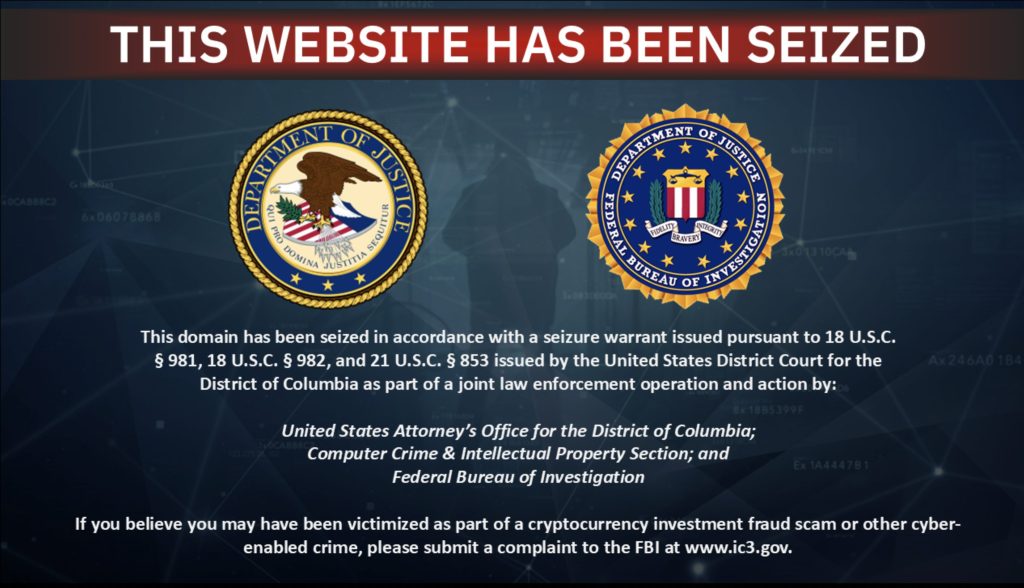
The DOJ has since replaced the site with a notice telling visitors the domain has been seized.

Source: Tickmilleas.com

The affidavit also says the domain directed people to download scam mobile apps from Google Play and the Apple App Store.

After receiving warnings from the FBI, both companies removed several apps linked to the operation.

Meta also took down more than 2,000 connected accounts after receiving information about the Tai Chang network.

Federal officials say these actions reflect growing concern about crypto-related investment scams, which remain one of the most damaging categories of online crime in the United States.

In 2024, the FBI’s Internet Crime Complaint Center recorded more than 41,000 complaints tied to crypto investment fraud, totaling an estimated $5.8 billion in losses.

DOJ Intensifies Crypto Crime Crackdown With New Charges, Seizures, and Sanctions

The action comes during a period of intense federal activity against crypto-related crime.

On November 20, prosecutors unsealed charges against former Olympic snowboarder Ryan Wedding, accusing him of running a Tether-based laundering network for drug money and allegedly ordering the murder of a federal witness in Colombia earlier this year.

🏂 Former Olympic snowboarder Ryan Wedding is facing criminal charges in an international crypto-related scheme.#RyanWedding #DOJhttps://t.co/SIbcmvuL4j

— Cryptonews.com (@cryptonews) November 21, 2025

A few days earlier, on November 14, the DOJ announced the sentencing of Travis Ford, the CEO of Wolf Capital Crypto Trading, who received a five-year prison sentence for running a $9.4 million investment scam advertised as offering daily returns of up to two percent.

Federal investigators also moved to seize more than $15 million in USDT connected to North Korea’s APT38 hacking unit, which they say carried out several major crypto exchange breaches in 2023.

👮 The US DOJ is seeking to seize over $15 million in USDT tied to North Korean state-backed hacking unit APT38.#NorthKorea #Cryptohttps://t.co/LdPBVFKOhG

— Cryptonews.com (@cryptonews) November 16, 2025

The FBI seized the funds in March 2025 and is now asking a court for permission to return the assets to the victims.

In a separate case, prosecutors secured guilty pleas from five people accused of helping North Korean IT workers secretly obtain jobs in U.S. companies.

Other recent enforcement steps include a civil forfeiture case tied to $584,741 in USDT linked to an Iranian national accused of supporting the Islamic Revolutionary Guard Corps’ drone program.

Additionally, in September, the DOJ sanctioned 19 entities in Myanmar and Cambodia for running forced-labor scam compounds used to operate large-scale crypto fraud networks.

The post DOJ Seizes Burma Crypto Scam Domain After Victims Lost Millions in Fake Trading Scheme appeared first on Cryptonews.

Rep. Steil Demands Regulators Fast-Track GENIUS Act as Stablecoin Law Deadline Looms

Regulators are facing growing pressure from Congress to accelerate implementation of the United States’ new stablecoin law, with Rep. Bryan Steil warning that the one-year rulemaking deadline is approaching.

During a House Financial Services Committee hearing on Tuesday, Steil urged agency heads to provide concrete updates on their progress in rolling out the Guiding and Establishing National Innovation for U.S. Stablecoins Act, which President Donald Trump signed into law on July 18.

FDIC to Publish First GENIUS Act Proposal This Month as Multi-Agency Effort Begins

The Genius Act, signed into law on July 18, 2025, is the first U.S. statute to impose a unified federal structure on stablecoin issuers.

The law gives regulators until July 18, 2026, to complete the full set of implementing rules, although the framework will not take effect until the earlier of two dates: January 18, 2027, or 120 days after final regulations are published.

That timeline pressurizes agencies preparing the first wave of proposals.

Steil said the committee has seen cases where Congress passes a bill but implementing regulations arrive late or stall.

🚨Breaking Crypto Update🚨
⁰NCUA Chair @kylehauptman confirms we are on track to implement the GENIUS Act by July 18. pic.twitter.com/Elvgme0f75

— Bryan Steil (@RepBryanSteil) December 2, 2025

He told regulators that delivering the GENIUS Act on schedule is essential, especially as stablecoins play an increasingly important role in global dollar liquidity and digital-asset markets.

During the exchange, NCUA Chairman Kyle Hauptman assured lawmakers that the credit union regulator expects its first GENIUS-related rulemaking to focus on the application process for issuers.

Hauptman said the agencies involved understand the July deadline and are working to meet it.

The hearing brought together leaders from the Federal Reserve, the Office of the Comptroller of the Currency, the National Credit Union Administration, and the Federal Deposit Insurance Corporation.

In prepared remarks released before the hearing, FDIC Acting Chair Travis Hill said his agency expects to publish its first proposal later this month, establishing the application process for stablecoin issuers supervised by the FDIC.

✅ The Federal Deposit Insurance Corporation will publish its first US stablecoin rule framework later this month.#Stablecoin #FDIChttps://t.co/yuIdMYcRek

— Cryptonews.com (@cryptonews) December 2, 2025

Hill said the FDIC’s responsibilities extend well beyond licensing, noting that the law tasks his agency with defining the capital, liquidity, and reserve standards that bank-issued stablecoins must meet.

He said a separate proposal detailing prudential standards is planned for early next year, setting up a two-step regulatory rollout.

GENIUS Act Moves Forward Alongside CLARITY Act and Anti-CBDC Proposals

The GENIUS Act would require stablecoin issuers to maintain one-to-one backing with U.S. dollars or high-quality liquid assets and introduce annual audits for firms whose tokens exceed a $50 billion market cap.

It also outlines the first federal standards for foreign-issued stablecoins, giving Washington a clearer framework for overseeing offshore projects.

Federal agencies have already begun laying groundwork for implementation.

The Treasury Department has opened multiple public consultations to gather industry input on stablecoin rule designed and how illicit-finance risks should be monitored.

🏦 The U.S. Treasury is calling on the public for feedback on how financial institutions can prevent crypto risks as part of the GENIUS Act. #Treasury #GENIUSActhttps://t.co/7Bu5ExndQt

— Cryptonews.com (@cryptonews) August 19, 2025

Treasury Secretary Scott Bessent said the feedback will shape ongoing research into compliance tools, including their effectiveness and privacy impact.

He called the GENIUS Act “essential” to maintaining U.S. leadership in the stablecoin market.

The legislative process, however, continues to feature political flashpoints.

During the latest hearing, Rep. Maxine Waters raised concerns about whether a sitting president should hold business interests in sectors they regulate, referencing President Trump’s link to the World Liberty Financial project.

She said the situation highlights unresolved conflict-of-interest questions that Congress must address.

Regulatory momentum is advancing in parallel with broader market-structure efforts on Capitol Hill.

The House passed its digital-asset package, the CLARITY Act, earlier this year, assigning oversight responsibilities between the Commodity Futures Trading Commission and the Securities and Exchange Commission based on token classifications.

🇺🇸 GENIUS Act, Anti-CBDC Act, and CLARITY Act pass crucial procedural vote 215-211 in Congress after Trump's decisive Oval Office intervention rescues stalled crypto agenda.#GeniusAct #Trumphttps://t.co/Lm2tCBbimp

— Cryptonews.com (@cryptonews) July 16, 2025

The bill still awaits Senate consideration, and analysts say its prospects remain unclear.

Another key proposal, the Anti-CBDC Surveillance State Act, is also pending in the Senate.

It would bar the Federal Reserve from issuing a retail central bank digital currency without explicit congressional authorization, a step supporters argue is necessary to safeguard financial privacy.

The post Rep. Steil Demands Regulators Fast-Track GENIUS Act as Stablecoin Law Deadline Looms appeared first on Cryptonews.

UK Eyes Crypto Political Donation Ban, Threatening Farage’s Reform War Chest

The British government is weighing plans to ban cryptocurrency donations to political parties, a development that could hit Nigel Farage’s Reform UK just months after it became the first party in the country to accept digital assets.

The proposal, now under active discussion inside Whitehall, is being considered as part of the forthcoming Elections Bill, according to multiple people familiar with the talks.

Although the government did not confirm the plan outright, it said more details would be set out when the bill is published.

Calls Grow to Restrict Digital Asset Contributions to UK Political Parties

The possibility of a prohibition comes as Reform UK continues to position itself as the most crypto-friendly political force in the country.

Earlier this year, Farage opened the door to digital asset contributions and launched a dedicated donations portal.

Source: Reform Party

He has described the move as part of a broader “crypto revolution” in Britain and has repeatedly told industry audiences that he is the “only hope” for UK crypto businesses.

In October, he told Reuters the party had already received “a couple” of crypto donations after notifying the Electoral Commission, showing the first time such a contribution had ever been recorded in British politics.

For now, the value of those donations has not been disclosed. The debate over crypto political financing has also grown more intense as Reform surges in national polls and the Labour government faces mounting questions about foreign interference.

Source: Electoral Reform

Transparency experts have warned that digital assets, while publicly traceable on-chain, can mask the true origin of funds when moved through multiple wallets.

Tom Keatinge, director at RUSI, noted that crypto transfers allow money to cross borders into the UK “much easier” than through traditional banking, raising concerns about illicit financing, especially under a system that already bans foreign political donations in almost all circumstances.

Calls for stricter oversight have come from multiple quarters, including former Cabinet Office Minister Pat McFadden, Business Select Committee Chair Liam Byrne, and Phil Brickell, chair of the All-Party Parliamentary Group on Anti-Corruption and Fair Tax.

🚫 UK Cabinet Office Minister Pat McFadden has called for election officials to consider banning political donations made in digital currencies. #Crypto #UKhttps://t.co/qhoReMm5hG

— Cryptonews.com (@cryptonews) July 18, 2025

Lawmakers have argued that existing regulations are insufficient to prevent misuse of cryptocurrency in political donations, noting the potential for anonymity and the difficulty in tracing the original source of funds.

High-Profile MEP Case Sparks Calls for Tighter Electoral Finance Rules in UK

Their warnings have been amplified by recent national security concerns, particularly after former Reform Wales leader Nathan Gill was jailed for more than ten years for accepting payments to make pro-Russian statements while serving as an MEP.

Farage has distanced himself from Gill, calling him a “bad apple,” but the case has intensified calls for tougher rules on political funding.

The Ministry of Housing, Communities and Local Government, responsible for the Elections Bill, stated that the political finance system inherited by the U.K. had left democracy vulnerable to foreign influence.

Officials emphasized that new rules, including those potentially targeting crypto donations, would aim to protect electoral integrity while allowing parties to fund their campaigns responsibly.

The Elections Bill is expected to include new requirements for parties and donors, including restrictions on shell-company contributions and mandatory risk assessments for donations that could expose campaigns to foreign interference.

The UK’s caution stands in sharp contrast to the United States, where digital asset donations have become a major force in federal elections.

American crypto-backed PACs poured more than $190 million into the 2024 cycle, aided by clear reporting rules under the Federal Election Commission.

💰 A cryptocurrency-backed super PAC, Fairshake, is heading into the upcoming midterm elections with more than $140 million in the bank.#Fairshake #PAChttps://t.co/7AE1JZjV2Y

— Cryptonews.com (@cryptonews) July 15, 2025

In Britain, crypto’s political footprint remains minimal. No major party mentioned digital assets in its manifesto during the 2024 general election, and the total number of reported crypto donations remains close to zero.

The post UK Eyes Crypto Political Donation Ban, Threatening Farage’s Reform War Chest appeared first on Cryptonews.

Polish President Vetoes Strict Crypto Regulation Bill, Citing Threat to Freedom

By: Amin Ayan

Poland’s president has blocked a sweeping set of rules for the country’s crypto sector, dealing a blow to the government’s push for tighter oversight.

Key Takeaways:

  • Polish President Karol Nawrocki vetoed a sweeping crypto law, saying it threatens property rights and personal freedoms.
  • The blocked bill would have imposed strict oversight, including powers to block crypto websites.
  • The decision has renewed debate over whether regulation protects users or pushes firms abroad.

Karol Nawrocki vetoed the Crypto-Asset Market Act on Monday, arguing that its provisions “genuinely threaten the freedoms of Poles, their property, and the stability of the state,” according to a statement from the presidential office.

The move immediately split opinion in Warsaw, with crypto supporters applauding the decision and senior officials accusing the president of opening the door to disorder.

Government Pushes Tough Oversight for Poland’s Crypto Market

Introduced in June, the bill sought to place Poland’s digital-asset industry under strict supervisory control.

Supporters inside government said the measures were needed to protect consumers from fraud and abusive practices.

However, critics, including opposition lawmaker Tomasz Mentzen, had predicted that the president would refuse to sign it after it cleared parliament, describing the draft as a blunt instrument that punished legitimate firms alongside bad actors.

The president’s office highlighted several flashpoints. One was a clause that would give authorities wide powers to block websites linked to crypto activity.

Prezydent RP @NawrockiKn odmówił podpisania ustawy o rynku kryptoaktywów.

‼ Zdaniem Prezydenta, zawetowane przepisy realnie zagrażają wolnościom Polaków, ich majątkowi i stabilności państwa. https://t.co/ZBXaZg5uQI pic.twitter.com/27n7gpAayF

— Kancelaria Prezydenta RP (@prezydentpl) December 1, 2025

“Domain-blocking laws are opaque and can lead to abuse,” the statement said, warning that such tools risk being used beyond their original purpose.

Nawrocki added that the legislation was so dense that it undermined transparency, particularly when set against leaner frameworks in neighboring Czechia, Slovakia and Hungary.

Overly tight rules, he added, would simply drive companies, and tax revenues, to more welcoming jurisdictions such as Lithuania and Malta.

The president also pointed to high oversight fees baked into the bill, arguing they would deter startups while favoring large foreign firms and banks.

“This is a reversal of logic, killing off a competitive market and a serious threat to innovation,” he said.

Polish Ministers Slam President’s Crypto Veto

Meanwhile, members of the government moved quickly to condemn the veto.

Finance Minister Andrzej Domański accused the president of having “chosen chaos,” while Foreign Minister Radosław Sikorski warned that the absence of new controls would leave savers exposed if markets turn.

Crypto advocates pushed back, saying the blame for scams and losses rests with enforcement failures, not with the rejection of a single statute.

Economist Krzysztof Piech argued that Poland is not operating in a regulatory vacuum, noting that the EU’s Markets in Crypto-Assets law will bring union-wide investor safeguards from July 2026.

Jakie dobre, konkretne wytłumaczenie, o co chodziło w tej ustawie…
Z dedykacją dla całej koalicji rządzącej, która krypto nie ogarnia, ale głosuje tak musi.
Od 1 lipca 2026 cały polski rynek będzie uregulowany i nadzorowany – nawet bez żadnej ustawy. Jesteśmy bowiem w UE. https://t.co/YCiLmut4xp

— Krzysztof Piech (@krzysztof_piech) December 1, 2025

In October, Sławomir Cenckiewicz, head of Poland’s National Security Bureau, said Russia is using cryptocurrencies to pay saboteurs carrying out hybrid attacks across the European Union.

The method, he said, allows Moscow to conceal financial flows and evade detection by Western intelligence services.

Cenckiewicz said the FT that Russia’s military intelligence agency, the GRU, has been using crypto to finance operations ranging from sabotage to cyberattacks on critical infrastructure.

The post Polish President Vetoes Strict Crypto Regulation Bill, Citing Threat to Freedom appeared first on Cryptonews.

Coinbase Hit With Record 12,716 Government Requests in 2025

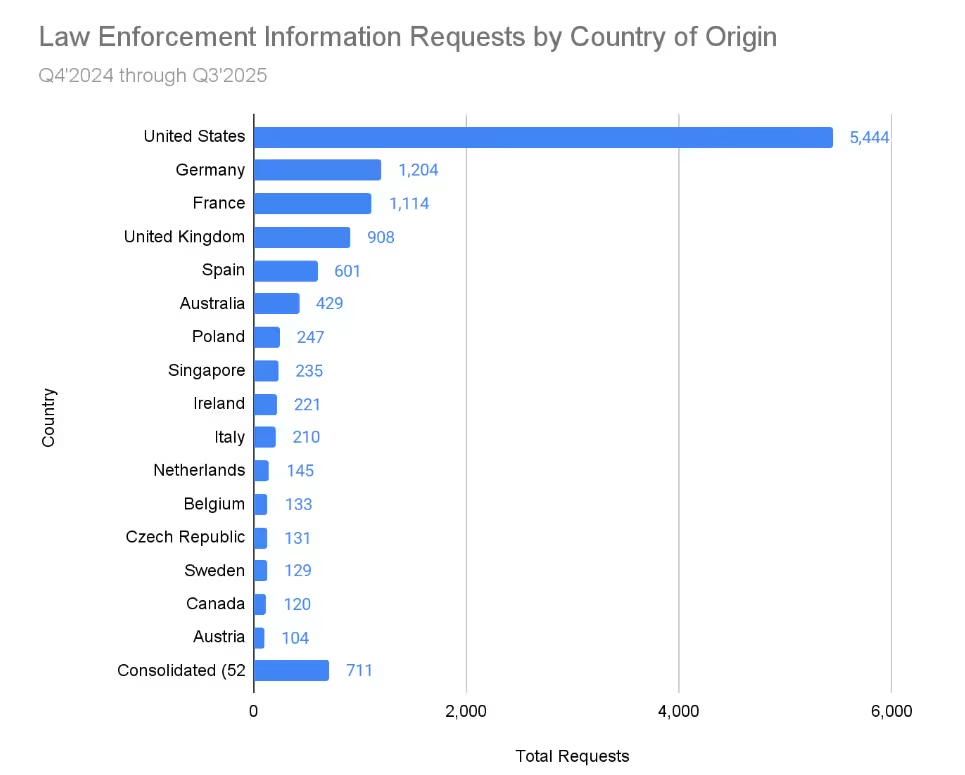
Coinbase received 12,716 government and law enforcement information requests between October 2024 and September 2025, marking a 19% year-over-year increase and the highest volume in the exchange’s history.

International requests accounted for 53% of the total, a new high, with France leading jurisdictions outside the U.S. with a 111% surge in demand for customer data.

The surge comes as Coinbase expands operations across more than 100 countries amid heightened regulatory scrutiny following major compliance failures in Europe and a damaging cybersecurity breach earlier this year.

The exchange’s seventh annual Transparency Report, published by Chief Legal Officer Paul Grewal, points out the growing global pressure on crypto platforms to balance user privacy with legal obligations.

Coinbase Law enforcement requests by country of origin
Source: Coinbase

France Drives International Demand, U.S. Still Dominates

The United States remained the largest single source of requests, followed by Germany, the United Kingdom, France, Spain, and Australia.

These six countries combined accounted for roughly 80% of all law enforcement requests globally.

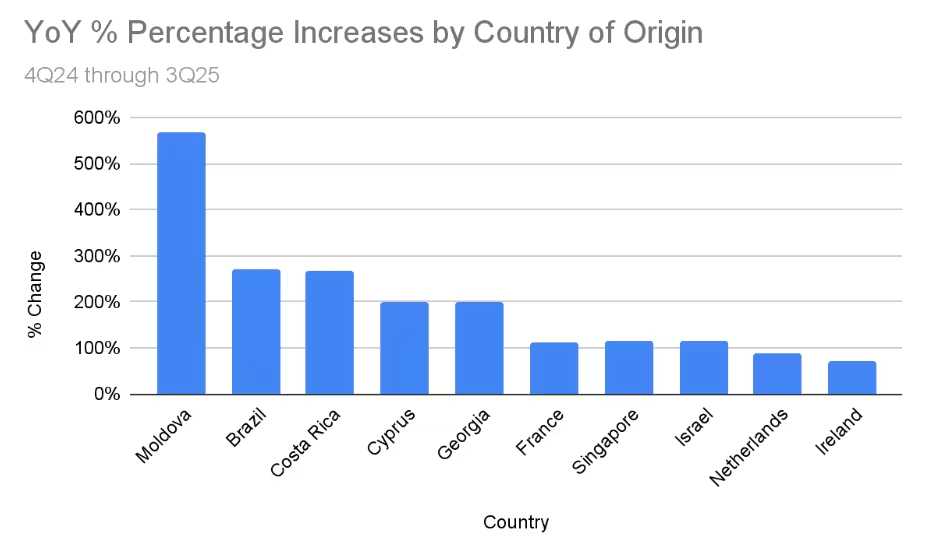
France saw the sharpest increase among major jurisdictions, with requests jumping 111% from the prior reporting period.

The U.K. and Spain also posted double-digit gains, rising 16% and 27% respectively. Germany, Sweden, and South Korea recorded decreases, with South Korea’s requests dropping 67%.

Requests from Moldova and Brazil increased by factors of 5.7 and 2.7, while Australia’s volume remained nearly flat with just a 1% uptick.

Coinbase YOY% increases by country of origin
Source: Coinbase

Despite fluctuations across different markets, total request volume has stayed within the 10,000 to 13,000 range annually over the past four years.

Compliance Under Fire After Fines and Data Breach

The rising demand for user data comes amid regulatory penalties and internal security lapses that have damaged Coinbase’s compliance reputation.

In November, the exchange’s European arm agreed to pay €21.5 million to Ireland’s Central Bank after coding errors left 31% of transactions, worth more than $202 billion, unscreened for money laundering between 2021 and 2022.

The malfunction affected five of 21 transaction-monitoring scenarios, forcing Coinbase to reanalyze 185,000 transactions and file 2,700 suspicious transaction reports.

⚠ Coinbase Europe was fined €21.5M after tech errors left 30M transactions unmonitored, breaching AML rules. #Ireland #AML #Coinbasehttps://t.co/IdrCGSLhBp
— Cryptonews.com (@cryptonews) November 6, 2025

Just last year, Coinbase’s UK subsidiary was fined £3.5 million by the Financial Conduct Authority for onboarding over 13,000 high-risk customers in violation of a voluntary restriction, facilitating nearly $226 million in transfers.

In May, the exchange disclosed a cyberattack compromising the personal data of at least 69,461 customers, including government-issued IDs and email addresses, after hackers bribed customer service staff.

The breach, which was not disclosed until weeks after discovery, triggered at least six class-action lawsuits and a Justice Department investigation.

Shareholders later filed a separate suit alleging that Coinbase and its CEO, Brian Armstrong, failed to promptly disclose both the breach and the UK compliance violation, contributing to a 7.2% drop in the company’s stock.

Coinbase Expands Compliance as SEC Pressure Eases

Coinbase emphasized in its latest report that it reviews each request on a case-by-case basis and seeks to narrow overly broad demands.

The exchange stated that it seeks to provide anonymized or aggregated data whenever possible, rather than exposing individual customer information.

Requests received do not always result in data being produced, and the company maintains that it does not grant governments direct access to its systems.

The report arrives as Coinbase benefits from a dramatic shift in U.S. regulatory posture.

Great news!

After years of litigation, millions of your taxpayer dollars spent, and irreparable harm done to the country, we reached an agreement with SEC staff to dismiss their litigation against Coinbase. Once approved by the Commission (which we're told to expect next week)… pic.twitter.com/IlnoBs7N6n

— Brian Armstrong (@brian_armstrong) February 21, 2025

In March, the Securities and Exchange Commission agreed to drop its years-long enforcement action against the exchange, which had accused Coinbase of operating as an unregistered securities platform.

The dismissal followed similar moves by the SEC to abandon cases against Kraken, Robinhood, and Consensys after Paul Atkins replaced Gary Gensler as chair in January.

Additionally, back in September, Atkins pledged to replace what he called a “shoot first and ask questions later” approach with advance notices and clearer guidance for crypto firms.

The post Coinbase Hit With Record 12,716 Government Requests in 2025 appeared first on Cryptonews.

South Korea’s Stablecoin Bill Faces Dec. 10 Deadline – or Lawmakers Act Alone

South Korea’s long-running effort to build a stablecoin regulatory framework has reached a decisive moment, with lawmakers setting a firm December 10 deadline for the government to deliver a draft bill.

If regulators miss that date, key legislators say they will move ahead on their own, ending months of stalled negotiations over how a won-pegged stablecoin should be issued and who should be allowed to control it.

Seoul Divided Over Whether Banks or Tech Firms Should Lead Stablecoin Issuance

According to reports from Seoul, the ruling party issued what it described as a final notice to financial authorities, urging them to submit the government’s proposal for the so-called “Phase 2 Legislation on Digital Assets,” which focuses specifically on stablecoin oversight.

Source: MK News

Political and financial officials held a closed-door meeting at the National Assembly on December 1, where the biggest point of contention resurfaced: whether banks must take the lead in issuing stablecoins or whether technology firms should be allowed a more active role.

Some lawmakers have argued for a minimum 50% bank stake, citing the Bank of Korea’s long-standing warnings that privately issued digital won tokens could affect monetary policy and destabilize the financial system.

Others, including parts of the ruling party and the Financial Services Commission (FSC), prefer lowering the barrier to allow fintech participation, saying excessive restrictions could limit innovation.

The FSC later issued a public statement clarifying that no final decision had been made on whether a consortium or a 51% bank stake would be permitted.

The regulator confirmed that stablecoin legislation was discussed during Monday’s policy consultation and that both sides agreed to prepare a government bill as soon as possible.

However, specifics remain unsettled, prolonging a delay that has already pushed expected timelines several times.

This debate has taken on broader urgency as rival political parties race to introduce their own drafts.

The National Assembly’s Political Affairs Committee is currently reviewing three separate bills, each proposing rules for issuance, collateral management, internal controls, and minimum capital requirements of about 5 billion won.

The bills differ on issues such as whether stablecoin issuers should be allowed to offer interest on holdings, reflecting ongoing disparities in policy direction.

New AML and Travel Rule Measures Add Pressure to South Korea’s Stablecoin Push

The pressure is further intensified by parallel regulatory developments across government. The Financial Intelligence Unit is reorganizing its anti-money laundering protocols for stablecoins and preparing research that will shape future AML guidelines.

🇰🇷 FIU has commissioned a comprehensive report for December this year; wants new AML guidelines for stablecoin issuers.#SouthKorea #StablecoinRegulationshttps://t.co/CzXbun21ia

— Cryptonews.com (@cryptonews) August 19, 2025

South Korea is also moving toward a tighter travel rule regime, with plans to extend reporting requirements to transactions under 1 million won to prevent users from bypassing identity checks.

Authorities have indicated that enhanced KYC rules and stricter oversight will accompany any new stablecoin system.

📜 South Korea will extend its crypto Travel Rule to cover sub-$700 transactions, closing a loophole used to evade identity checks.#SouthKorea #Cryptohttps://t.co/LBJKNcmMQg

— Cryptonews.com (@cryptonews) November 28, 2025

Meanwhile, the Bank of Korea has expressed fresh concerns. In an October report, the central bank warned that improperly collateralized stablecoins could trigger depegging events and disrupt capital flow management.

It argued again that only regulated financial institutions should issue stablecoins, stressing that non-bank issuers could effectively engage in deposit-like activities without the safeguards banks must follow.

Despite regulatory disagreements, the domestic market is already moving ahead. Naver Financial has completed development of a stablecoin wallet for Busan’s Dongbaek-jeon program, which will convert the city’s prepaid local currency into a blockchain-based token.

🚀 Naver Financial, the fintech arm of South Korean internet giant Naver, is preparing to roll out a stablecoin wallet in Busan.#SouthKorea #Cryptohttps://t.co/40QBNaXJ9C

— Cryptonews.com (@cryptonews) November 25, 2025

KakaoBank has begun building infrastructure for a KRW-denominated “Kakao Coin,” indicating growing corporate interest in digital won products. Major banks have also explored a consortium-issued stablecoin targeted for late 2025 or early 2026.

These advancements show why lawmakers are determined to meet the current legislative window.

However, the regulatory uncertainty mirrors other delays in South Korea’s digital asset agenda, including the country’s virtual asset taxation regime.

Despite being approved in 2020, Korea’s crypto tax law has been postponed multiple times and remains scheduled for 2027, with many of the required systems still incomplete.

🇰🇷 South Korea's crypto tax implementation may face fourth delay as infrastructure gaps and regulatory uncertainties persist ahead of 2027 deadline.#SouthKorea #CryptoTaxhttps://t.co/ZbbTDNBfnY

— Cryptonews.com (@cryptonews) November 24, 2025

South Korea has fallen behind major economies such as the United States, the European Union, and Japan, all of which have already formalized stablecoin structures.

Industry groups warn that further delays could weaken competitiveness, especially as dollar-based tokens like USDT continue to dominate global markets.

The post South Korea’s Stablecoin Bill Faces Dec. 10 Deadline – or Lawmakers Act Alone appeared first on Cryptonews.

China Doubles Down on Crypto Ban After Detecting New Trading Activity

China’s central bank has reasserted its strict prohibition on crypto trading following signs of renewed speculation in virtual assets.

The People’s Bank of China convened a high-level meeting on November 28, 2025, with 13 government agencies to coordinate enforcement and crack down on illegal digital currency activities that have recently resurfaced despite years of sweeping bans.

The meeting specifically flagged stablecoins as posing risks for money laundering, fraud, and illegal cross-border fund transfers.

Officials emphasized that virtual currencies lack legal tender status and cannot function as money in China’s markets, while related business activities constitute illegal financial conduct that undermines economic stability.

China Doubles Down on Crypto Ban After Detecting New Trading Activity
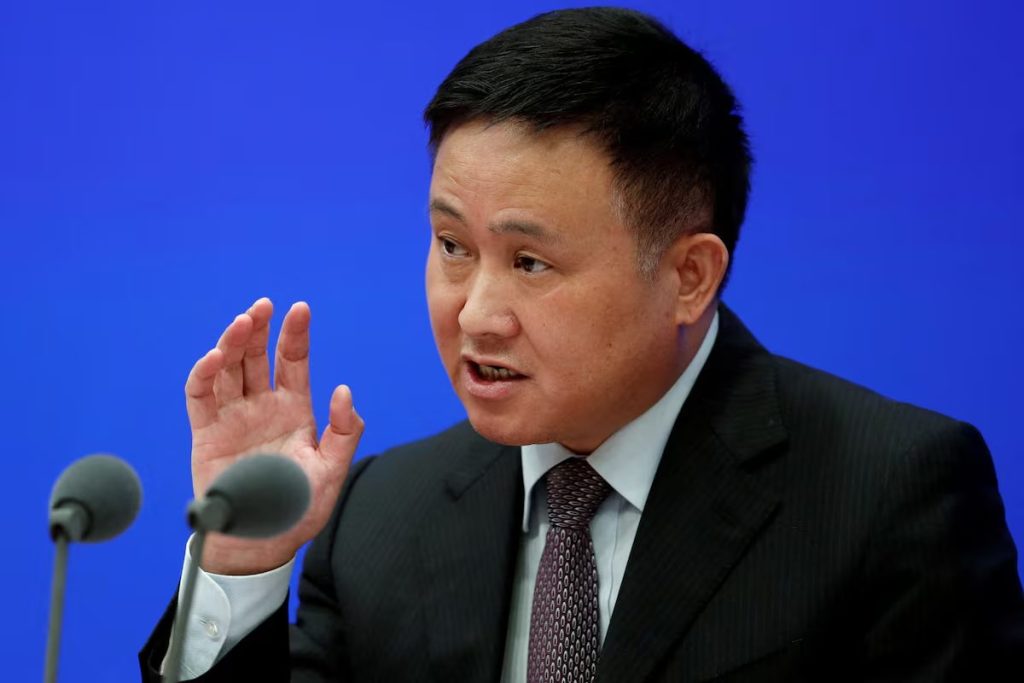
Source: Pan Gongsheng, Central Bank Governor. | Source: Reuters

Hong Kong Stocks Tumble on Central Bank Warning

According to Reuters, Hong Kong-listed companies with crypto exposure saw sharp losses following the announcement of a renewed crackdown.

Yunfeng Financial Group, which has been expanding into tokenization businesses, dropped more than 10% in early Monday trading. Bright Smart Securities fell roughly 7%, while digital-asset platform OSL Group lost over 5%.

The selloff reflected market fears that Beijing’s hardline stance could derail Hong Kong’s ambitions to become a digital asset hub.

The city passed stablecoin legislation in May and received expressions of interest from more than 40 firms seeking licenses under its new regulatory framework, including major financial institutions like Circle and Standard Chartered.

Liu Honglin, founder of Man Kun Law Firm, said the central bank statement “has erased any ambiguity, speculation and illusions” around China’s stablecoin policies, noting that “regulators have drawn a concrete red line on what used to be a vague borderline.

Underground Mining and Enforcement Challenges Persist

Despite China’s comprehensive ban on crypto trading and mining since 2021, enforcement remains difficult.

Recent data from Luxor’s Global Hashrate Map shows China still accounts for 14.05% of Bitcoin’s total computing power, or roughly 145 exahashes per second, placing it third globally behind the United States and Russia.

Authorities have uncovered multiple underground operations in recent months.

China was once the undisputed center for Bitcoin mining. Known for its cheap power and access to leading hardware manufacturers, all of this positioned China as a leader in global Bitcoin mining. However, this changed when mining was banned by the Chin…https://t.co/pdUtTHeFKw

— Cryptonews.com (@cryptonews) October 23, 2025

In February, police dismantled a cross-border banking network that laundered over $136 million using crypto to bypass financial regulations.

Investigators noted that 18 out of 49 underground banking cases in 2023 involved digital currency transactions, demonstrating how criminals adapt to exploit digital assets.

The central bank has also ordered social media platforms to shut down accounts promoting crypto trading.

In May, the Cyberspace Administration of China closed more than a dozen accounts on Weibo, Douyin, and WeChat that were spreading false information and inducing citizens to participate in virtual currency transactions through offshore exchanges.

Similarly, in August, Chinese regulators instructed brokerages and research institutions to halt the publication of studies or the hosting of seminars on stablecoins.

Local governments in Beijing, Suzhou, and Zhejiang have issued warnings about illicit fundraising linked to virtual currencies.

At the same time, over-the-counter crypto trading volumes reached an estimated $75 billion in the first nine months of 2024.

Stablecoins Draw Intensified Regulatory Scrutiny

Chinese officials have expressed particular concern about the global expansion of dollar-backed stablecoins, which they view as a strategic threat to the renminbi’s internationalization.

The sector’s total market capitalization surpasses $300 billion, with Tether and USD Coin processing over $27 trillion in settlements over the past year.

China Doubles Down on Crypto Ban After Detecting New Trading Activity
Source: DefiLlama

Pan Gongsheng, governor of the People’s Bank of China, previously warned that stablecoins “have amplified weaknesses in the global financial system” and fail to meet basic requirements for customer identification and anti-money laundering controls.

The central bank has blocked major Chinese tech firms, including Ant Group and JD.com, from issuing stablecoins in Hong Kong, arguing that currency issuance must remain a state monopoly.

Wang Yongli, former deputy governor of the Bank of China, wrote in June that the dominance of USD-pegged stablecoins “poses a strategic challenge” to the renminbi’s internationalization, warning that China’s efforts to promote its currency abroad could face “serious obstacles” without competitive digital alternatives.

The meeting concluded with officials vowing to deepen coordination across agencies, improve monitoring capabilities, and severely crack down on illegal activities to protect citizens’ property and maintain economic order.

Beijing continues promoting its state-backed digital yuan as the only legitimate alternative to private cryptocurrencies while maintaining zero tolerance for them.

The post China Doubles Down on Crypto Ban After Detecting New Trading Activity appeared first on Cryptonews.

Uzbekistan Legalizes Stablecoins for Payments and Tokenized Stocks in Massive 2026 Overhaul

Uzbekistan is preparing to integrate stablecoins into its formal payment system and allow the issuance of tokenized stocks and bonds under a tightly regulated framework starting in 2026, according to local media reports.

The plan positions the country to become one of Central Asia’s most structured environments for regulated digital-asset activity.

It also represents a major shift for a jurisdiction that once imposed broad restrictions on crypto use but has spent recent years building a more controlled and supervised system for the sector.

Uzbekistan Prepares Licensed Exchanges for Tokenized Securities Trading in 2026

According to a Friday report by local news outlet Kun, under the new rules, a special legal regime will take effect on January 1, 2026, introducing a regulatory sandbox managed by the National Agency for Perspective Projects together with the central bank.

The sandbox will allow stablecoins to be tested as a means of payment inside a controlled environment, where authorities will monitor risk, market behavior, and technical implementation.

Pilot programs will also explore a distributed-ledger-based payment system and develop a regulated market for tokenized equities and bonds.

Starting the same day, legal entities registered in Uzbekistan will be permitted to issue tokenized securities, with licensed stock exchanges preparing dedicated trading platforms to support placement and circulation.

The move follows months of review. In September, central bank chairman Timur Ishmetov said stablecoins could be approved for payments but only under strict oversight given their potential impact on monetary policy.

He cautioned that expectations for digital currencies often exceed their practical use in mature payment systems, yet confirmed the bank will continue testing various models, including a wholesale CBDC designed to speed interbank settlements rather than serve the public.

The decree builds on Uzbekistan’s ongoing regulatory framework, which, since January 2023, has required all crypto transactions by residents to flow through locally licensed crypto asset service providers.

These rules ban anonymous transactions, prohibit the use of foreign exchanges, require mandatory customer identification, and mandate that providers store transaction data for at least five years.

Crypto is treated as an asset rather than legal tender, though stablecoins will now become the first category permitted for payment use inside a controlled model.

Mining remains legal but regulated, with companies required to use solar energy and register with the agency.

New Rules Coincide With Industry Push to Standardize Blockchain Payments

The new stablecoin law follows a series of cost adjustments for the industry. In March 2024, monthly fees for crypto exchanges were doubled to roughly $20,000 as part of a wider effort to tighten the market and ensure compliance.

Uzbekistan has maintained a highly supervised approach even as activity grows. In 2024, nearly 1.5% of the population held cryptocurrency, and licensed domestic providers processed more than $1 billion in transactions.

The country ranked 33rd globally in adoption, leading Central Asia alongside Kazakhstan and Kyrgyzstan, which have each pursued their own approaches to mining, payments, and licensing.

Source: Rise Research

The global context surrounding payments is also changing. Throughout 2025, several major jurisdictions formalized oversight for stablecoins.

The European Union began implementing its broad MiCA rules, the United States advanced federal legislation through the GENIUS Act, and regions such as Hong Kong and the UAE launched licensing systems that bring stablecoin issuers under direct supervision.

Canada proposed its Stablecoin Act, while South Africa, Kenya, and Brazil advanced frameworks for stablecoin usage in commerce and cross-border settlement.

🇨🇦 Canada has moved to finalize stablecoin rules before its federal budget on Nov. 4, as officials seek alignment with the U.S. #Canada #stablecoinhttps://t.co/ICdUGsTA3a

— Cryptonews.com (@cryptonews) October 27, 2025

These steps have come as blockchain-based payments continue to scale, with on-chain settlement volume surpassing levels seen in traditional card networks.

Another industry milestone came as Fireblocks, Polygon Labs, Mysten Labs, Solana Foundation, TON Foundation, Stellar Development Foundation, and Monad Foundation formed the Blockchain Payments Consortium intended to standardize how digital assets move across networks.

The post Uzbekistan Legalizes Stablecoins for Payments and Tokenized Stocks in Massive 2026 Overhaul appeared first on Cryptonews.

Weekly Crypto Regulation Roundup: SEC Clears Solana’s Fuse Token and Trump Eyes Crypto-Friendly Fed Chair

It’s been another consequential week in Washington and beyond, with U.S. regulators sending mixed but meaningful signs across crypto, AI, and financial policy. From the SEC greenlighting a Solana-based token to the prospect of a crypto-friendly Federal Reserve chair, the regulatory climate is shifting fast—particularly as policymakers grapple with emerging technologies that are outpacing existing frameworks.

SEC Grants Fuse a Rare No-Action Letter

The big headline came from the U.S. Securities and Exchange Commission, which issued a no-action letter to Solana-based DePIN project Fuse—an unusual step for a blockchain project looking for clarity around token sales.

👨🏻‍⚖️ The SEC granted @fuseenergy a no-action letter, confirming it will not recommend enforcement if the FUSE token is sold as described.#SEC #Cryptohttps://t.co/crv9LwdICN

— Cryptonews.com (@cryptonews) November 25, 2025

Fuse asked the SEC’s Division of Corporation Finance on Nov. 19 to confirm it would not recommend enforcement action over the offer and sale of its FUSE token. The project emphasized that FUSE isn’t pitched as a speculative asset: it’s strictly a network participation token, distributed as a reward to users who maintain the protocol’s decentralized infrastructure. The SEC agreed.

In a letter signed by deputy chief counsel Jonathan Ingram, the regulator stated it would not pursue enforcement “based on the facts presented” if Fuse adheres to the guardrails it outlined.

Additionally, the token can only be redeemed through third-party venues at market rates, showing the SEC’s focus on removing any investment-like characteristics.

This marks the second DePIN-related no-action letter in recent months. While not precedent-setting, the decision is a useful datapoint: when tokens are tightly scoped to utility and distribution is controlled, the SEC appears more open to relief. For projects building real-world infrastructure on-chain, it’s one of the clearest regulatory signs we’ve seen in months.

Trump’s Top Fed Pick Has Deep Crypto Ties

Crypto markets may soon have a sympathetic voice at the very top of U.S. monetary policy. Kevin Hassett—director of the White House National Economic Council and longtime Trump ally—has emerged as the leading candidate to replace Jerome Powell as Federal Reserve chair.

🏛 Kevin Hassett, director of the National Economic Council, has emerged as Trump’s top Fed chair contender, putting a crypto-linked ally within reach of leading the central bank.#KevinHassett #FedChair https://t.co/Oa59lRry11
— Cryptonews.com (@cryptonews) November 26, 2025

What’s striking is Hassett’s history with digital assets. He has publicly engaged with the crypto sector, consulted with policy groups connected to the space, and indicated openness to digital-asset innovation.

Trump’s advisers describe him as someone whom the president trusts deeply on interest-rate policy—particularly on the question of cutting more aggressively than Powell. Hassett has also reportedly indicated he would accept the role if selected.

If appointed, this would be the most crypto-friendly Fed chair in U.S. history. While the Fed is not a crypto regulator, its stance on dollar liquidity, stablecoins, and payment systems has enormous downstream effects. A pro-innovation chair could spur greater openness across other agencies—or at the very least, reduce friction.

Bipartisan Bill Targets Rising AI-Powered Fraud

AI-generated scams are surging, and Congress is taking notice. This week, lawmakers introduced the AI Fraud Deterrence Act, a bipartisan proposal from Rep. Ted Lieu (D-CA) and Rep. Neal Dunn (R-FL). The bill seeks to impose tougher penalties on crimes committed using artificial intelligence—particularly impersonation schemes, deepfakes, automated theft, and coordinated fraud rings.

🚨 U.S. lawmakers propose the AI Fraud Deterrence Act against rising AI‑powered fraud and deepfake scams.#AIFraud #CyberSecurityhttps://t.co/ciWFO9LUcf

— Cryptonews.com (@cryptonews) November 26, 2025

The legislation is also explicitly tied to financial markets and crypto, where AI-powered fraud is growing at an alarming rate. High-profile cases involving deepfake video scams, impersonation bots, and automated phishing rings have intensified pressure on lawmakers to intervene.

The bill’s broader message is clear: manipulation, impersonation, and automated fraud using AI tools will face harsher federal consequences. Expect this framework to evolve quickly, given the sharp rise in AI-driven schemes across exchanges and Web3 platforms.

CFTC Pushes for New Prediction Markets Framework

Finally, at the CFTC, Commissioner Caroline Pham is making moves to bring prediction markets into sharper regulatory focus.

Pham announced that the agency is seeking nominations for its new CEO Innovation Council, a body designed to advise on emerging markets and frontier financial technologies. One of the council’s early priorities will be the rapidly evolving prediction markets sector—a space that has grown too large and too influential for federal regulators to ignore.

🏛 CFTC Commissioner Caroline Pham is looking for nominations to join the agency's new CEO Innovation Council.#CFTC #CarolinePhamhttps://t.co/1CDTrZtFyU

— Cryptonews.com (@cryptonews) November 26, 2025

Through a Nov. 25 press release, Pham invited public nominations and encouraged industry stakeholders to propose topics the council should prioritize. With prediction markets increasingly touching politics, finance, sports, and crypto, the CFTC is clearly preparing a more structured approach.

This comes as platforms like Polymarket continue to expand and attract mainstream attention, forcing regulators to reconsider how forecasting markets fit within existing derivatives law.

The Big Picture

From the SEC’s cautious openness to utility-focused tokens, to Congress tightening the screws on AI-based crime, to the CFTC’s attempt to modernize its oversight, the regulatory ecosystem is shifting in real time.

But the most consequential development may be Trump’s apparent interest in appointing a Fed chair aligned with crypto innovation. That appointment would reverberate through every corner of financial policy—from stablecoins to global dollar rails to payments innovation.

The post Weekly Crypto Regulation Roundup: SEC Clears Solana’s Fuse Token and Trump Eyes Crypto-Friendly Fed Chair appeared first on Cryptonews.

KuCoin EU Gains MiCAR Approval to Roll Out Digital Asset Services in Europe

KuCoin has secured a major regulatory victory in Europe with its announcement that KuCoin EU Exchange GmbH (KuCoin EU) has obtained a Markets in Crypto-Assets Regulation (MiCAR) license in Austria.

Big news for Europe, bigger news for the world! 🌍 KuCoin EU is now officially MiCAR-compliant and approved by the Austrian FMA! Secure, regulated crypto access is coming to the EU very soon.

The future of crypto is global and compliant. Let’s go! 🚀#KuCoin #MiCARpic.twitter.com/UgeQGRFJpf

— KuCoin (@kucoincom) November 28, 2025

The approval allows KuCoin EU to provide fully compliant digital asset services across 29 countries in the European Economic Area (EEA), excluding Malta.

MiCAR is recognized for its rigorous standards and harmonized rules, designed to enhance investor protection, platform transparency, and market stability. By achieving full authorization through its Austrian entity, KuCoin demonstrates its commitment to operating responsibly within trusted regulatory regimes.

The MiCAR license follows a series of recent compliance milestones, including KuCoin’s securing of AUSTRAC Digital Currency Exchange Registration in Australia in November, alongside ongoing upgrades to its global compliance infrastructure across multiple jurisdictions.

With this new approval, KuCoin EU said it is positioned to roll out secure, transparent, and compliant digital asset services to millions of European users under a unified regulatory framework—an offering that many exchanges have yet to achieve.

Leaders Point Out MiCAR as a Defining Moment for KuCoin

BC Wong, CEO of KuCoin, called the approval a major achievement for the company’s long-term Trust and Compliance strategy. “Securing the MiCAR license with our local entity in Austria is a defining milestone,” Wong said. “Europe’s MiCAR framework represents one of the highest regulatory standards worldwide, and we are proud to meet this benchmark.”

As part of our $2B Trust Project, KuCoin will continue building transparent, credible, and security-driven Web3 infrastructure that strengthens user trust and supports responsible industry growth.”

KuCoin stated that its regulatory progress is supported by a robust trust architecture, including SOC 2 Type II, ISO 27001:2022, ISO 27701, and CCSS certifications, as well as independent Proof-of-Reserves audits—all of which reinforce its “Trust First. Trade Next.” philosophy.

New EU Platform Coming Soon as Users Transition

With MiCAR authorization secured, KuCoin EU is preparing to launch a fully compliant European platform. Users across the EEA, except for Malta, will soon receive early-access updates and onboarding information. Moving forward, new user registrations will no longer be supported through KuCoin Global.

The MiCAR license marks not just a new chapter for KuCoin in Europe, but also a broader shift toward a safer, more transparent, and more regulated digital asset ecosystem worldwide.

Bybit Secures Austria’s MiCA License

Earlier this year, Bybit, the world’s second-largest crypto exchange by trading volume, officially planted its flag in Europe. The company has also received a MiCAR license from Austria’s Financial Market Authority, as stated in a May 29 news release.

The post KuCoin EU Gains MiCAR Approval to Roll Out Digital Asset Services in Europe appeared first on Cryptonews.

Turkmenistan Legalizes Crypto in Historic 2026 Shift – But State Retains “Tight” Control

Turkmenistan has made a historic move by legalizing cryptocurrency under a tightly controlled framework, indicating a major policy shift for one of the world’s most closed economies.

According to a report from local outlet Business Turkmenistan, on November 28, President Serdar Berdimuhamedov signed legislation that will take effect in 2026, establishing a regulated environment for the cryptocurrency industry while maintaining strict state oversight.

New Law Opens Door for Digital Assets and Mining, But Central Bank Maintains Tight Control

The law sets out licensing requirements for crypto exchanges and custodial services, mandates know-your-client and anti-money laundering protocols, and obliges firms to use cold storage solutions for digital assets.

Credit institutions are barred from offering crypto services, and the state reserves the authority to halt, void, or mandate refunds of token issuances. Cryptocurrency mining and mining pool operations must also be registered, and covert activities are explicitly prohibited.

The legislation empowers the central bank to authorize distributed ledgers or operate its own infrastructure, effectively steering participants toward permissioned and surveilled networks.

Despite these regulatory openings, the law maintains that cryptocurrencies will not be recognized as legal tender, currency, or securities.

It categorizes digital assets into “backed” and “unbacked,” with regulators tasked with defining liquidity conditions, settlement protocols, and emergency redemption for backed tokens.

The move follows a November 21 government meeting in which Deputy Chairman of the Cabinet of Ministers Hojamyrat Geldimyradov outlined the technological, legal, and organizational foundations for introducing digital assets.

A proposal to establish a special State Commission dedicated to the sector was also submitted.

Turkmenistan has long enforced a strict ban on cryptocurrency activity, prohibiting trading, mining, and the use of digital assets.

Authorities routinely raided illegal mining operations and seized equipment, though underground activity persisted via VPNs and peer-to-peer platforms.

The measures are intended to preserve control over the national currency, the Turkmenistani manat, and reduce risks from speculative investment and illicit transactions.

Severe internet restrictions and government surveillance further isolated citizens from global crypto markets.

A landlocked former Soviet republic with around 7.6 million people in 2025, Turkmenistan relies heavily on natural gas exports.

Its politics are dominated by a centralized presidential system, widely considered authoritarian, and the country maintains strict media and internet controls, including bans on platforms like X and Telegram.

Ashgabat, the capital, is known for its white marble architecture and the world’s largest indoor Ferris wheel.

Countries Worldwide Step Up Digital Asset Oversight Amid Growing Markets

The country’s adoption of regulated cryptocurrency comes amid a global wave of legislative activity. In 2025 alone, several nations introduced or expanded frameworks to oversee digital assets.

Earlier this year, Vanuatu enacted the Virtual Asset Service Provider Act, establishing licensing and oversight for crypto businesses.

Pakistan opened its market to international crypto exchanges under the newly formed Pakistan Virtual Assets Regulatory Authority, seeking to provide legal clarity and curb illicit finance.

🇵🇰 Pakistan is inviting overseas crypto firms to apply for licenses under its new regulator, a step to bring order to a fast-growing digital economy.#Pakistan #CryptoLicensehttps://t.co/OwnwgyeF07

— Cryptonews.com (@cryptonews) September 15, 2025

In Europe, Poland has passed a strict crypto law aligned with the EU’s MiCA framework, while the UK Financial Conduct Authority has accelerated crypto application approvals for firms such as BlackRock and Standard Chartered.

🇵🇱 Poland’s crypto-asset market bill advances to the Senate, introducing licensing, fines up to 10M PLN, and potential prison terms. #cryptobill #Polandhttps://t.co/a8R1O4iGBc

— Cryptonews.com (@cryptonews) September 29, 2025

The United Kingdom’s tax authority floated measures easing capital gains obligations for decentralized finance participants, while Bank of England officials showed alignment with U.S. stablecoin regulation.

Additionally, Sweden’s central bank governor, Erik Thedéen, acknowledged potential adjustments to Basel Committee rules governing crypto exposures.

📢 Basel Committee faces calls to reform strict stablecoin capital rules as U.S., U.K., and Japan resist current framework.#Stablecoin #US #UKhttps://t.co/wuvO8UE0sz

— Cryptonews.com (@cryptonews) November 19, 2025

Each of these steps reflects a growing international recognition of tokenized finance and the necessity of integrating digital assets within formal financial systems.

Turkmenistan’s legislation, therefore, positions the country within this broader international trend while reflecting its longstanding emphasis on state control.

The post Turkmenistan Legalizes Crypto in Historic 2026 Shift – But State Retains “Tight” Control appeared first on Cryptonews.

IMF Warns Tokenized Markets Trigger ‘Flash Crashes’ — Is Government Control Next?

The International Monetary Fund (IMF) has issued one of its strongest warnings yet on the rapid rise of tokenized markets, arguing that the technology could reshape global finance in unpredictable ways.

In a new explainer video published on its X account, the IMF said tokenization offers clear benefits such as cheaper and faster market infrastructure.

Tokenization can make financial markets faster and cheaper but efficiencies from new technologies often come with new risks. Watch our latest video to learn more. pic.twitter.com/hBsQxlhHFh

— IMF (@IMFNews) November 28, 2025

But it cautioned that the same features driving efficiency could also introduce new forms of volatility, including flash-crash-style events triggered by automated, instant settlement.

The video frames tokenization as the next major step in the evolution of money, comparing programmable digital tokens to earlier milestones such as shells, coins, banknotes, and today’s digital payments.

IMF Says Fragmented Tokenized Platforms Could Undermine Liquidity

According to IMF researchers, early models show “significant cost savings,” with near-instant settlement reducing asset-management expenses by as much as 20%, echoing estimates from institutions like J.P. Morgan.

However, speed brings risk. The IMF pointed to the 2010 flash crash that wiped out nearly $1 trillion in minutes, warning that tokenized markets, driven by smart contracts and automated execution, could amplify similar shocks.

Interconnected contracts, it said, may behave “like falling dominoes” during stress, turning localized disruptions into broader systemic events.

The IMF also warns of fragmentation if multiple tokenized platforms emerge without interoperability, weakening liquidity and limiting tokenization’s efficiencies.

The IMF argues that coordination and open systems are essential to prevent isolated ecosystems that cannot trade or settle with one another.

The institution also reminds that governments have never stepped aside during major shifts in the monetary system.

From the Bretton Woods restructuring in 1944 to the collapse of the gold standard three decades later, public institutions have repeatedly reshaped global finance when new models created new pressures.

“If history is any guide,” the IMF said, governments could take “a more active role” as tokenization expands.

Regulators Worldwide Move to Rein In Tokenized Assets Amid Rapid Growth

The IMF’s reminder of these turning points suggests tokenization could be heading toward a similar era of deeper state involvement.

Authorities aim to build legal and operational frameworks that manage risk rather than restrict tokenization outright.

Regulators worldwide, including the EU, Singapore, the U.K., and the United States, are clarifying how tokenized real-world assets should be treated, with most expected to fall under securities rules.

New requirements focus on investor protection and upgraded security standards for platforms operating smart-contract-based systems.

The push for clearer rules is expected to accelerate institutional adoption and deepen links between tokenized markets and traditional finance.

Governments are also becoming participants, with initiatives such as Singapore’s trials of tokenized government bills and wholesale CBDC transactions.

Regulators worldwide are already preparing for that shift. In August, the World Federation of Exchanges urged the U.S. SEC, the European ESMA, and IOSCO to tighten oversight of tokenized equities, warning that many offerings “mimic” stocks without offering shareholder rights or market safeguards.

🏦 The World Federation of Exchanges (WFE) warned global regulators that tokenized stocks “mimic” equities without offering shareholder rights or market trading safeguards.#WFE #TokenizedStocks #BlockchainTokenshttps://t.co/3UxpywsfMs

— Cryptonews.com (@cryptonews) August 26, 2025

Europe, one of the fastest-growing hubs for tokenized fixed-income assets, has also raised concerns. ESMA Executive Director Natasha Cazenave recently said tokenization could transform the region’s markets, but only if investor protections, settlement rules, and legal frameworks evolve with it.

Europe now hosts more than half of global tokenized fixed-income issuance, and officials are testing new structures, including state-backed tokenized debt and models linking distributed-ledger platforms to central-bank systems.

🇪🇺 Tokenized securities trading gets a boost as @boersestuttgart completes @ecb blockchain tests, highlighting the benefits of efficiency, security, and reduced costs.#Securities #ECB #Tokenizationhttps://t.co/CyguveVgJr

— Cryptonews.com (@cryptonews) October 1, 2024

Private-sector expectations are rising as well. In October, former TD Ameritrade chairman Joe Moglia predicted that “every financial asset” will be tokenized within five years.

The post IMF Warns Tokenized Markets Trigger ‘Flash Crashes’ — Is Government Control Next? appeared first on Cryptonews.

❌