Reading view

There are new articles available, click to refresh the page.

Scam Alert: The Alarming Reality Behind 2025’s Explosion in Digital Fraud 

Latest research from McAfee Labs just announced and the numbers are staggering. If you think you’re immune to scams because you’re “too smart” or “too careful,” you might want to think again. Scammers have stepped up their game in 2025, and they’re coming for everyone. 

The Job Scam Tsunami That’s Crushing Dreams

Let’s start with the most shocking stat: job-related scams exploded by over 1,000% from May through late July 2025. Yes, you read that right. One thousand percent. 

Think about that for a moment. In a world where finding decent work feels harder than ever, scammers are weaponizing our most basic need for employment. They’re not just sending random “work from home” nonsense anymore. These criminals are getting sophisticated, using terms like “resume,” “recruit,” “maternity,” and “paternity” to exploit our hopes around benefits and career opportunities. 

Here’s the brutal reality: Nearly 1 in 3 Americans have received a job offer scam by text message. That means if you’re in a group of three people, at least one of you has been targeted. Even more disturbing? 45% of Americans have either experienced a job search scam personally or know someone who has. This isn’t some distant threat anymore, it’s hitting close to home. 

Shopping Scams Are Playing the Long Game

Amazon Prime Day was a goldmine for scammers. Text scams in the shopping category jumped 250% from May to late July, with much of that spike happening right around Prime Day. Coincidence? Absolutely not. 

Scammers know exactly when we’re most vulnerable. They know we’re hunting for deals, expecting delivery notifications, and clicking faster than we’re thinking. Amazon and Apple are the top brand names being impersonated because, let’s face it, we all interact with these companies constantly. 

Shopping email scams climbed 60% during this same period, with Amazon holding the top spot, Target moving into second place, and Apple rounding out the top three. The fact that Target surged into the number two spot tells us something important: scammers are diversifying their approach and studying our shopping habits more carefully than we might be studying theirs. 

Your Money Is Under Siege

Personal finance scams aren’t just growing, they’re surging nearly 150% from May to late July. Email scams in this category literally doubled between June and July. The top bait words? “Loan” and “money.” Because nothing says desperation like targeting people who are already financially stressed. 

Credit cards topped the list of email scam keywords, which makes perfect sense. In an economy where everyone’s feeling pinched, the promise of easy credit or debt relief hits different. URL-based finance scams rose 10% in July alone, proving that scammers are hitting us from every digital angle. 

Tech Scams Are Getting Personal

Here’s what’s really clever (in a completely evil way): technology scams grew 40% in text messages and saw a staggering 160% increase in email scams across June and July. Apple dominated the scam landscape, but here’s the kicker: Nvidia drove much of the late-July growth. 

Think about why that matters. Nvidia isn’t just any tech company; it’s the company behind the AI revolution everyone’s talking about. Scammers are literally using our fascination with AI and cutting-edge tech against us. They’re banking on our FOMO around technology trends. 

The Psychology Behind the Surge

Let’s step back and think critically about what’s really happening here. These aren’t random increases. Scammers are becoming more sophisticated, more targeted, and more successful because they’re exploiting fundamental human psychology: 

Economic anxiety: With inflation concerns and job market uncertainty, financial scams hit when people are most vulnerable. 

Technology overwhelm: As tech evolves rapidly, scammers exploit our confusion and excitement about new developments. 

Social proof manipulation: Using trusted brand names like Apple, Amazon, and Target because we’ve been conditioned to trust these companies. 

Timing exploitation: Hitting during Prime Day, benefit enrollment periods, and job hunting seasons when our guard is down. 

But there’s another layer we need to call out, the long-term impact of falling for a fake job. When you’re unemployed, every lead matters. Chasing a fraudulent one doesn’t just waste time; it effectively pauses your real job search. Many people say job hunting is a full-time job in itself, so losing that time can feel like being pushed back to square one. That setback compounds stress and deepens the economic anxiety you were already feeling. It’s not just about losing money, it’s about losing momentum, confidence, and critical opportunities in a competitive market. 

What This Means for You Right Now

Advice like “just be careful” doesn’t cut it anymore. Scammers have leveled up, and their tactics are sophisticated enough to fool even the smartest of people. That’s why having the right tools and awareness matters more than ever. Staying informed isn’t about fear, it’s about empowerment. The more you know, the harder it is for scammers to win. 

For job seekers: If someone contacts you about a job you didn’t apply for, especially mentioning benefits or asking for personal information upfront, pump the brakes. Real recruiters don’t typically lead with benefit details or ask for sensitive data in initial communications. 

For online shoppers: Those delivery notifications and deal alerts you’re getting? Slow down before clicking. Go directly to the retailer’s official website or app instead of clicking links in texts or emails. 

For anyone with financial concerns: If an offer sounds too good to be true (instant loans, credit repair miracles, investment opportunities), it probably is. When you’re stressed about money, that’s exactly when scammers strike hardest. 

For tech enthusiasts: Being excited about new technology is great, but scammers are counting on that excitement to make you click faster than you think. Always verify tech-related communications through official channels. 

The Bottom Line

The data is crystal clear: scams aren’t just increasing, they’re exploding across every category that matters to everyday people. Job hunting, shopping, managing money, staying current with technology. These criminals are systematically targeting the most essential aspects of modern life. 

But here’s what the scammers don’t want you to know: awareness is your best defense. They rely on speed, emotion, and distraction. The moment you slow down, verify independently, and think critically, their whole game falls apart. 

The 2025 scam landscape isn’t just more dangerous, it’s more personal. These aren’t random attempts anymore. They’re calculated attacks designed to hit you exactly when and where you’re most likely to let your guard down. To help job hunters and others, McAfee has launched Scam Detector, an all-in-one protection solution to help keep you safer across text, email and video. McAfee’s Scam Detector runs continuously in the background across all your devices, analyzing incoming emails, texts, and videos to detect potential scams in real-time. When it detects something suspicious, you get an instant alert that explains what raised the red flag and walks you through the specific tactics scammers use, so you can spot similar attempts on your own. For job seekers, Scam Detector can be an invaluable tool to help prevent fraudulent scams.

Stay sharp out there. Your financial security, career prospects, and digital safety depend on it. 


The post Scam Alert: The Alarming Reality Behind 2025’s Explosion in Digital Fraud  appeared first on McAfee Blog.

How a Tech Expert Lost $13,000 to a Job Scam

Sam M. has spent more than 20 years building websites, testing systems, and managing technology projects. He knows code, he understands how the internet works, and he’s trained to spot digital red flags. None of that stopped him from losing $13,000 to scammers.

“I’ve been around long enough that I should have seen it coming,” Sam admits. “But when you’re looking for work, you’ve got blinders on. You just want something to work out.”

His story reflects a growing reality. McAfee data shows that job-related scams have exploded by over 1,000% from May through July 2025, making Sam part of a massive wave of Americans facing increasingly sophisticated employment fraud. But here’s what’s empowering: with the right protection, these scams can be spotted before they hit you and your wallet.

The Perfect Setup

Sam’s scam started with what looked like a legitimate opportunity: a polished website offering part-time work reviewing products online. The site had all the right elements: professional design, user authentication, and a logical process. Even his wife, who warned him that “if it sounds too good to be true, it probably is,” had to admit the pay rates weren’t unrealistic.

“I thought it was worth a try,” Sam said. “I’ve built websites, and this one looked okay. You had to log in, authenticate. Everything seemed legit.”

This sophisticated approach reflects how job scammers have evolved. They’re no longer sending obviously fake emails with spelling errors. Today’s scammers study real job platforms, mimic legitimate processes, and exploit the specific language that job seekers expect to see. McAfee’s analysis shows scammers are particularly focused on benefits-related terms like “resume,” “recruit,” “maternity,” and “paternity” to make their offers sound more credible. The good news? Advanced scam detection technology can automatically identify these sophisticated tactics before you even encounter them.

The Hook and the Trap

The scam followed a classic pattern – establish trust, then exploit it. Sam was paired with a trainer, guided through reviewing products, asked to upload screenshots. Then came the crucial moment.

“That first payout, a couple hundred dollars, hooked me,” Sam recalled. “I thought, this is working. This is real.”

But once Sam was invested, the ground shifted. A “special product” appeared, and suddenly his account showed a negative balance. The trainer explained he needed to deposit money to continue. It seemed reasonable at first, but it was the beginning of a financial death spiral.

“They kept telling me, ‘Just a little more and you’ll unlock it,'” Sam said. “And I kept chasing it.”

This “advance fee” model has become increasingly common in job scams. Victims are asked to pay for training materials, background checks, or equipment. Each payment is followed by a request for more money, creating a cycle that’s psychologically difficult to break.

The Scope of the Problem

Sam’s experience fits into a much larger crisis, but understanding the scope helps us stay ahead of it. According to McAfee data, 45% of Americans say they’ve either personally experienced a job search scam or know someone who has. That means nearly half the country has been touched by employment fraud in some way.

The reach extends beyond individual stories. Nearly 1 in 3 Americans (31%) report receiving job offer scams via text message, showing how these schemes have moved beyond email into our daily conversations. People now receive an average of 14 scam messages daily across all platforms. Email job scams alone rose 60% between June and July 2025, with “resume” being the most frequently used lure word. But here’s what’s encouraging: when scams can be identified automatically, people can stay one step ahead of scammers before any damage occurs.

The Real Cost

By the time Sam extracted himself from the scam, he was down more than $13,000. His loss reflects broader trends: McAfee research shows scam victims lose an average of $1,471 per scam, with $12 billion reported lost to fraud in 2024 alone, up 21% from the previous year. But the financial loss wasn’t the worst part for Sam.

“I was furious at them, but also at myself,” he said. “I’m supposed to know better. I felt stupid. I felt worn out.”

This emotional impact extends beyond individual embarrassment. These schemes attack people when they’re already vulnerable, turning the search for legitimate work into another source of stress and suspicion.

“It wears you down,” Sam explained. “Every time you think you’ve found something good, it turns out to be a scam. You get beat down again. And you start to wonder if you’ll ever find something real.”

The solution isn’t to stop trusting altogether. It’s having the right tools to confidently distinguish between what’s real and what’s fake before you click.

Staying One Step Ahead

Despite his losses, Sam maintains perspective about his situation. He knows people who’ve lost everything to scams, including their homes and savings.

“As hard as this was, I didn’t lose everything,” he said. “My family’s life didn’t have to change. Others aren’t so lucky.”

Now Sam sticks to established job platforms like LinkedIn and Glassdoor, avoiding websites that promise easy money. He’s also committed to sharing his story as a warning to others.

“I got caught, I admit it,” he said. “But I’m not the only one. And if telling my story helps someone else stop before it’s too late, then it’s worth it.”

The reality is that in today’s digital landscape, where people receive 14 scam messages daily, individual vigilance alone isn’t enough. What’s needed is automatic protection that works in the background, identifying suspicious texts, emails, and videos before you even encounter them. McAfee’s Scam Detector provides exactly that: real or fake? Scam Detector knows.

Know What’s Real Before You Click

Sam’s experience highlights several warning signs that job seekers should recognize, but modern scam protection goes far beyond manual vigilance:

Traditional Warning Signs:

  • Upfront payments (legitimate employers don’t ask employees to pay for the privilege of working)
  • Vague job descriptions (real jobs have specific requirements and clear responsibilities)
  • Pressure tactics (scammers often create artificial urgency to prevent careful consideration)
  • Too-good-to-be-true pay (research typical salaries for similar roles in your area)
  • Poor communication (legitimate companies use professional email addresses and clear contact information)

Lightning-fast alerts: With McAfee’s Scam Detector, you get automatic alerts about suspicious texts, emails, and videos before you click. The technology automatically identifies risky messages using advanced AI, so you don’t have to wonder what’s real and what’s fake online.

The explosive growth in job scams, with their 1,000%+ increase over just a few months, shows this challenge isn’t disappearing. But as scam technology evolves, so does scam protection. Intelligence and experience alone aren’t enough to combat well-crafted deception, but automatic detection technology can identify these sophisticated schemes before they reach you.

Sam’s story reminds us that anyone can be targeted, but with the right protection, you can spot scams before they hit you and your wallet. In a job market where people receive multiple suspicious messages daily, confidence comes from knowing you have technology working in the background to distinguish what’s real from what’s fake. With proactive scam protection designed with you in mind, you can enjoy the peace of a scam-free search and focus on finding legitimate opportunities. Real or fake? You’ll know before you click.

The post How a Tech Expert Lost $13,000 to a Job Scam appeared first on McAfee Blog.

Stolen with a Click: The Booming Business of PayPal Scams

In today’s digital age, online payment platforms like PayPal have become essential tools for our everyday transactions. Unfortunately, they’ve also become prime targets for cybercriminals looking to steal personal information and money. McAfee Labs has uncovered a concerning trend with a spike in PayPal-related scams, with February 2025 seeing a dramatic seven-fold increase in fraudulent emails compared to January. 

The Current PayPal Scam Landscape 

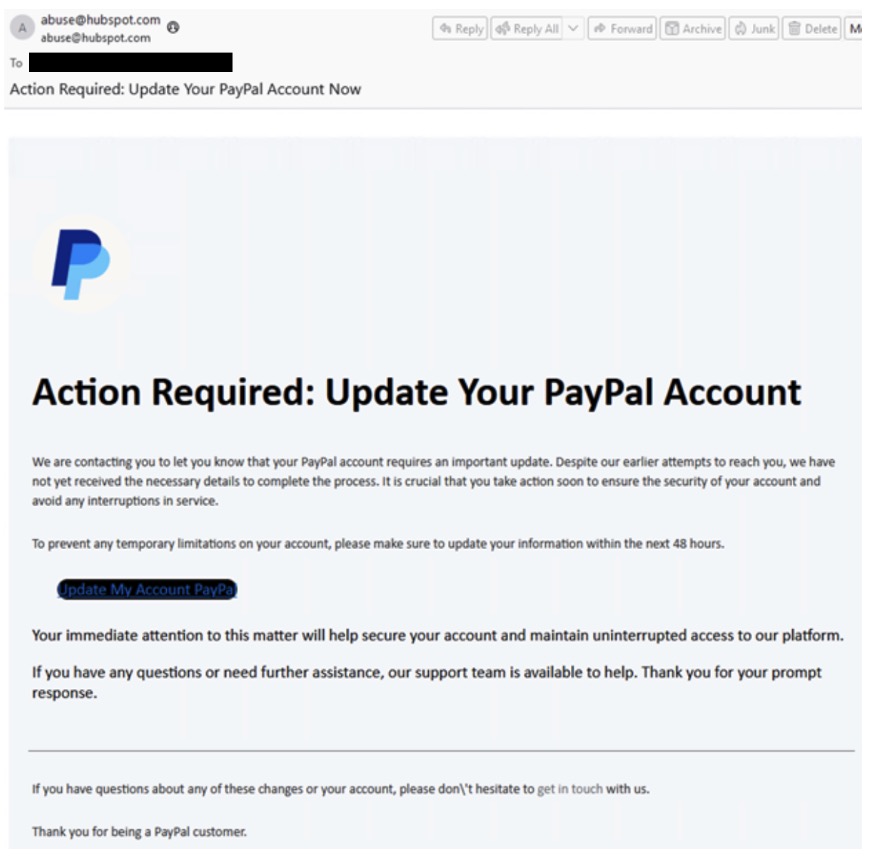
While PayPal works diligently to protect its users, scammers are constantly evolving their tactics. The recent surge has been traced to a single, highly effective campaign where attackers send official-looking emails with “Action Required” warnings, demanding users update their account details within 48 hours or face account suspension. 

Figure 1. Phishing email example which generated over 600+ emails in a single day


Unlike some scams, which target multiple communication channels, McAfee Labs found that this particular campaign has focused primarily on email. 

Common Types of PayPal Scams to Watch For 

Scammers use several approaches when impersonating PayPal, including: 

  • Account suspension notices requiring immediate “reinstatement” 
  • Fake PayPal gift card offers 
  • Fraudulent invoices for purchases you never made 
  • Deceptive surveys promising payments 
  • Fake customer support scams about billing issues 
  • Phony payment confirmations or requests 

Red Flags That Reveal PayPal Scams 

Learning to spot these scams can save you from becoming a victim. Watch for these warning signs: 

  • Links to websites that aren’t official PayPal domains 
  • Emails not originating from PayPal.com 
  • Messages claiming you’ve been charged for unknown products, urging you to call “customer service” 
  • Emails containing images of PayPal receipts or invoices rather than actual PayPal formatting 

Real-World Examples: What These Scams Look Like 

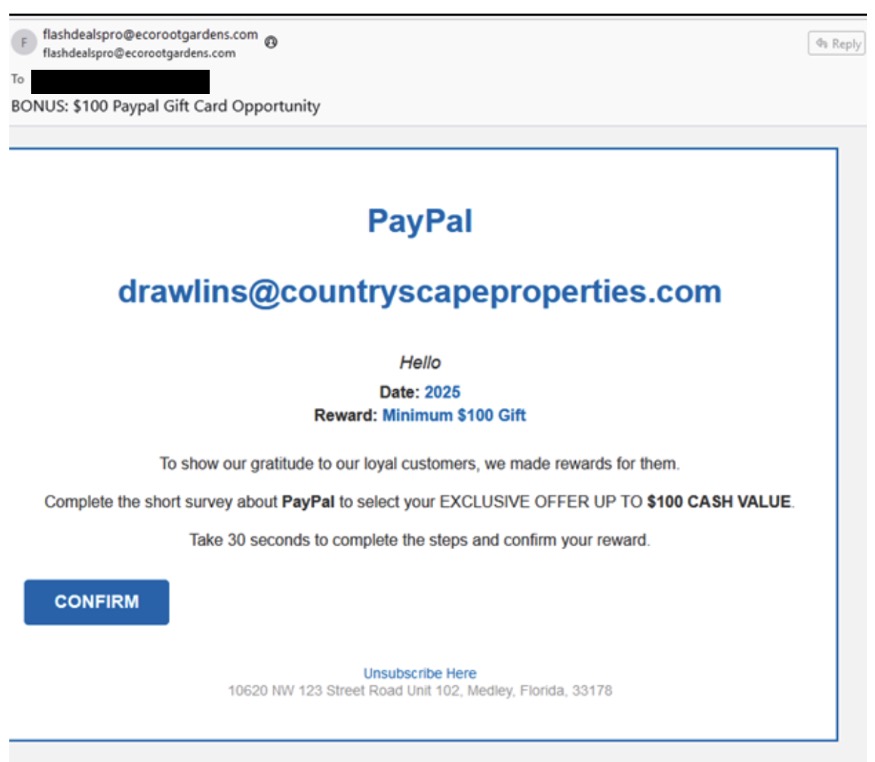
These emails (see below) threatened account suspension or incentivize users, creating urgency to manipulate recipients into clicking malicious links. 


Figure 2. While some scams threaten the user with account closures, others incentivize them with payments for surveys


Other common scenarios include fake gift card promotions, phony invoices with unauthorized charges, and bogus billing corrections requiring you to call non-official phone numbers. 

How to Protect Yourself from PayPal Scams 

Now for the most important part – here’s how you can keep yourself safe:  

  1. Verify all communications directly with PayPal. Never click links in emails or texts claiming to be from PayPal. Instead, open a new browser window and log in directly at PayPal.com, or use the official PayPal app to check for notifications. 
  2. Scrutinize web addresses and email senders. Legitimate PayPal emails will come from addresses ending in @paypal.com. Be wary of similar-looking domains like paypal-account.me or service-ppal.com. 
  3. Never call phone numbers provided in suspicious messages. If you need to contact PayPal support, use only the official contact methods listed on their website: https://www.paypal.com/us/cshelp/contact-us 
  4. If an email says it’s from services@paypal.com proceed with vigilance. Some scammers spoof email addresses or use real PayPal tools like their invoices to fool you.
  5. Check your PayPal account regularly. Frequent monitoring allows you to spot unauthorized activity quickly and report it before significant damage occurs. 
  6. Be skeptical of urgency and threats. Legitimate companies don’t typically threaten immediate account closure or demand urgent action within short timeframes like 28 hours. 
  7. Use PayPal’s built-in security features. Familiarize yourself with PayPal’s security center and take advantage of their fraud protection tools. 
  8. Report suspicious activity immediately. If you receive a suspicious message or notice unauthorized activity, report it to PayPal and change your password right away. 
  9. Turn on two-factor authentication. If you do so, if someone gets your password, they still can’t access your account without a code sent to your phone or authenticator 
  10. Skip messages that offer gift cards or say you’ll get paid for filling out a survey. PayPal doesn’t typically send these, but scammers often do.  

Remember, cybercriminals rely on creating a sense of panic and urgency to cloud your judgment. Taking a moment to verify communications through official channels is your best defense against these increasingly sophisticated scams. Online protection with McAfee+ will keep you one step ahead of phishing scams. 

The post Stolen with a Click: The Booming Business of PayPal Scams appeared first on McAfee Blog.

❌