Reading view

There are new articles available, click to refresh the page.

Exploits and vulnerabilities in Q3 2025

In the third quarter, attackers continued to exploit security flaws in WinRAR, while the total number of registered vulnerabilities grew again. In this report, we examine statistics on published vulnerabilities and exploits, the most common security issues impacting Windows and Linux, and the vulnerabilities being leveraged in APT attacks that lead to the launch of widespread C2 frameworks. The report utilizes anonymized Kaspersky Security Network data, which was consensually provided by our users, as well as information from open sources.

Statistics on registered vulnerabilities

This section contains statistics on registered vulnerabilities. The data is taken from cve.org.

Let us consider the number of registered CVEs by month for the last five years up to and including the third quarter of 2025.

Total published vulnerabilities by month from 2021 through 2025 (download)

As can be seen from the chart, the monthly number of vulnerabilities published in the third quarter of 2025 remains above the figures recorded in previous years. The three-month total saw over 1000 more published vulnerabilities year over year. The end of the quarter sets a rising trend in the number of registered CVEs, and we anticipate this growth to continue into the fourth quarter. Still, the overall number of published vulnerabilities is likely to drop slightly relative to the September figure by year-end

A look at the monthly distribution of vulnerabilities rated as critical upon registration (CVSS > 8.9) suggests that this metric was marginally lower in the third quarter than the 2024 figure.

Total number of critical vulnerabilities published each month from 2021 to 2025 (download)

Exploitation statistics

This section contains exploitation statistics for Q3 2025. The data draws on open sources and our telemetry.

Windows and Linux vulnerability exploitation

In Q3 2025, as before, the most common exploits targeted vulnerable Microsoft Office products.

Most Windows exploits detected by Kaspersky solutions targeted the following vulnerabilities:

  • CVE-2018-0802: a remote code execution vulnerability in the Equation Editor component
  • CVE-2017-11882: another remote code execution vulnerability, also affecting Equation Editor
  • CVE-2017-0199: a vulnerability in Microsoft Office and WordPad that allows an attacker to assume control of the system

These vulnerabilities historically have been exploited by threat actors more frequently than others, as discussed in previous reports. In the third quarter, we also observed threat actors actively exploiting Directory Traversal vulnerabilities that arise during archive unpacking in WinRAR. While the originally published exploits for these vulnerabilities are not applicable in the wild, attackers have adapted them for their needs.

  • CVE-2023-38831: a vulnerability in WinRAR that involves improper handling of objects within archive contents We discussed this vulnerability in detail in a 2024 report.
  • CVE-2025-6218 (ZDI-CAN-27198): a vulnerability that enables an attacker to specify a relative path and extract files into an arbitrary directory. A malicious actor can extract the archive into a system application or startup directory to execute malicious code. For a more detailed analysis of the vulnerability, see our Q2 2025 report.
  • CVE-2025-8088: a zero-day vulnerability similar to CVE-2025-6128, discovered during an analysis of APT attacks The attackers used NTFS Streams to circumvent controls on the directory into which files were unpacked. We will take a closer look at this vulnerability below.

It should be pointed out that vulnerabilities discovered in 2025 are rapidly catching up in popularity to those found in 2023.

All the CVEs mentioned can be exploited to gain initial access to vulnerable systems. We recommend promptly installing updates for the relevant software.

Dynamics of the number of Windows users encountering exploits, Q1 2023 — Q3 2025. The number of users who encountered exploits in Q1 2023 is taken as 100% (download)

According to our telemetry, the number of Windows users who encountered exploits increased in the third quarter compared to the previous reporting period. However, this figure is lower than that of Q3 2024.

For Linux devices, exploits for the following OS kernel vulnerabilities were detected most frequently:

  • CVE-2022-0847, also known as Dirty Pipe: a vulnerability that allows privilege escalation and enables attackers to take control of running applications
  • CVE-2019-13272: a vulnerability caused by improper handling of privilege inheritance, which can be exploited to achieve privilege escalation
  • CVE-2021-22555: a heap overflow vulnerability in the Netfilter kernel subsystem. The widespread exploitation of this vulnerability is due to its use of popular memory modification techniques: manipulating “msg_msg” primitives, which leads to a Use-After-Free security flaw.

Dynamics of the number of Linux users encountering exploits, Q1 2023 — Q3 2025. The number of users who encountered exploits in Q1 2023 is taken as 100% (download)

A look at the number of users who encountered exploits suggests that it continues to grow, and in Q3 2025, it already exceeds the Q1 2023 figure by more than six times.

It is critically important to install security patches for the Linux operating system, as it is attracting more and more attention from threat actors each year – primarily due to the growing number of user devices running Linux.

Most common published exploits

In Q3 2025, exploits targeting operating system vulnerabilities continue to predominate over those targeting other software types that we track as part of our monitoring of public research, news, and PoCs. That said, the share of browser exploits significantly increased in the third quarter, matching the share of exploits in other software not part of the operating system.

Distribution of published exploits by platform, Q1 2025 (download)

Distribution of published exploits by platform, Q2 2025 (download)

Distribution of published exploits by platform, Q3 2025 (download)

It is noteworthy that no new public exploits for Microsoft Office products appeared in Q3 2025, just as none did in Q2. However, PoCs for vulnerabilities in Microsoft SharePoint were disclosed. Since these same vulnerabilities also affect OS components, we categorized them under operating system vulnerabilities.

Vulnerability exploitation in APT attacks

We analyzed data on vulnerabilities that were exploited in APT attacks during Q3 2025. The following rankings draw on our telemetry, research, and open-source data.

TOP 10 vulnerabilities exploited in APT attacks, Q3 2025 (download)

APT attacks in Q3 2025 were dominated by zero-day vulnerabilities, which were uncovered during investigations of isolated incidents. A large wave of exploitation followed their public disclosure. Judging by the list of software containing these vulnerabilities, we are witnessing the emergence of a new go-to toolkit for gaining initial access into infrastructure and executing code both on edge devices and within operating systems. It bears mentioning that long-standing vulnerabilities, such as CVE-2017-11882, allow for the use of various data formats and exploit obfuscation to bypass detection. By contrast, most new vulnerabilities require a specific input data format, which facilitates exploit detection and enables more precise tracking of their use in protected infrastructures. Nevertheless, the risk of exploitation remains quite high, so we strongly recommend applying updates already released by vendors.

C2 frameworks

In this section, we will look at the most popular C2 frameworks used by threat actors and analyze the vulnerabilities whose exploits interacted with C2 agents in APT attacks.

The chart below shows the frequency of known C2 framework usage in attacks on users during the third quarter of 2025, according to open sources.

Top 10 C2 frameworks used by APT groups to compromise user systems in Q3 2025 (download)

Metasploit, whose share increased compared to Q2, tops the list of the most prevalent C2 frameworks from the past quarter. It is followed by Sliver and Mythic. The Empire framework also reappeared on the list after being inactive in the previous reporting period. What stands out is that Adaptix C2, although fairly new, was almost immediately embraced by attackers in real-world scenarios. Analyzed sources and samples of malicious C2 agents revealed that the following vulnerabilities were used to launch them and subsequently move within the victim’s network:

  • CVE-2020-1472, also known as ZeroLogon, allows for compromising a vulnerable operating system and executing commands as a privileged user.
  • CVE-2021-34527, also known as PrintNightmare, exploits flaws in the Windows print spooler subsystem, also enabling remote access to a vulnerable OS and high-privilege command execution.
  • CVE-2025-6218 or CVE-2025-8088 are similar Directory Traversal vulnerabilities that allow extracting files from an archive to a predefined path without the archiving utility notifying the user. The first was discovered by researchers but subsequently weaponized by attackers. The second is a zero-day vulnerability.

Interesting vulnerabilities

This section highlights the most noteworthy vulnerabilities that were publicly disclosed in Q3 2025 and have a publicly available description.

ToolShell (CVE-2025-49704 and CVE-2025-49706, CVE-2025-53770 and CVE-2025-53771): insecure deserialization and an authentication bypass

ToolShell refers to a set of vulnerabilities in Microsoft SharePoint that allow attackers to bypass authentication and gain full control over the server.

  • CVE-2025-49704 involves insecure deserialization of untrusted data, enabling attackers to execute malicious code on a vulnerable server.
  • CVE-2025-49706 allows access to the server by bypassing authentication.
  • CVE-2025-53770 is a patch bypass for CVE-2025-49704.
  • CVE-2025-53771 is a patch bypass for CVE-2025-49706.

These vulnerabilities form one of threat actors’ combinations of choice, as they allow for compromising accessible SharePoint servers with just a few requests. Importantly, they were all patched back in July, which further underscores the importance of promptly installing critical patches. A detailed description of the ToolShell vulnerabilities can be found in our blog.

CVE-2025-8088: a directory traversal vulnerability in WinRAR

CVE-2025-8088 is very similar to CVE-2025-6218, which we discussed in our previous report. In both cases, attackers use relative paths to trick WinRAR into extracting archive contents into system directories. This version of the vulnerability differs only in that the attacker exploits Alternate Data Streams (ADS) and can use environment variables in the extraction path.

CVE-2025-41244: a privilege escalation vulnerability in VMware Aria Operations and VMware Tools

Details about this vulnerability were presented by researchers who claim it was used in real-world attacks in 2024.

At the core of the vulnerability lies the fact that an attacker can substitute the command used to launch the Service Discovery component of the VMware Aria tooling or the VMware Tools utility suite. This leads to the unprivileged attacker gaining unlimited privileges on the virtual machine. The vulnerability stems from an incorrect regular expression within the get-versions.sh script in the Service Discovery component, which is responsible for identifying the service version and runs every time a new command is passed.

Conclusion and advice

The number of recorded vulnerabilities continued to rise in Q3 2025, with some being almost immediately weaponized by attackers. The trend is likely to continue in the future.

The most common exploits for Windows are primarily used for initial system access. Furthermore, it is at this stage that APT groups are actively exploiting new vulnerabilities. To hinder attackers’ access to infrastructure, organizations should regularly audit systems for vulnerabilities and apply patches in a timely manner. These measures can be simplified and automated with Kaspersky Systems Management. Kaspersky Symphony can provide comprehensive and flexible protection against cyberattacks of any complexity.


ToolShell: a story of five vulnerabilities in Microsoft SharePoint

On July 19–20, 2025, various security companies and national CERTs published alerts about active exploitation of on-premise SharePoint servers. According to the reports, observed attacks did not require authentication, allowed attackers to gain full control over the infected servers, and were performed using an exploit chain of two vulnerabilities: CVE-2025-49704 and CVE-2025-49706, publicly named “ToolShell”. Additionally, on the same dates, Microsoft released out-of-band security patches for the vulnerabilities CVE-2025-53770 and CVE-2025-53771, aimed at addressing the security bypasses of previously issued fixes for CVE-2025-49704 and CVE-2025-49706. The release of the new, “proper” updates has caused confusion about exactly which vulnerabilities attackers are exploiting and whether they are using zero-day exploits.

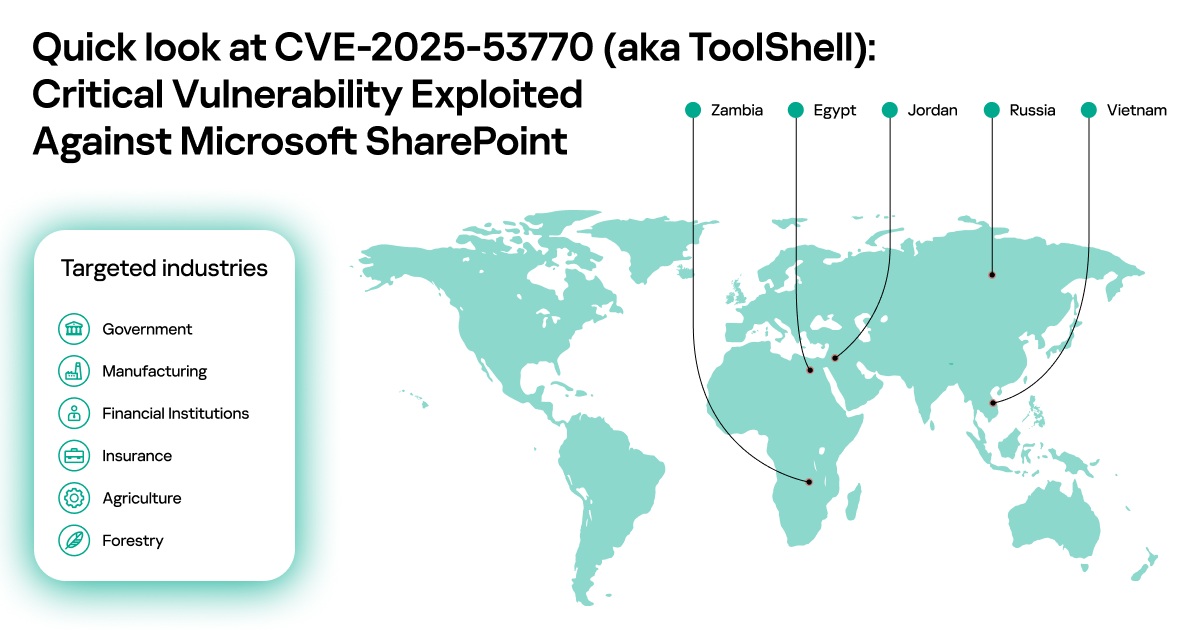
Kaspersky products proactively detected and blocked malicious activity linked to these attacks, which allowed us to gather statistics about the timeframe and spread of this campaign. Our statistics show that widespread exploitation started on July 18, 2025, and attackers targeted servers across the world in Egypt, Jordan, Russia, Vietnam, and Zambia. Entities across multiple sectors were affected: government, finance, manufacturing, forestry, and agriculture.

Quick look at CVE-2025-53770

While analyzing all artifacts related to these attacks, which were detected by our products and public information provided by external researchers, we found a dump of a POST request that was claimed to contain the malicious payload used in these attacks. After performing our own analysis, we were able to confirm that this dump indeed contained the malicious payload detected by our technologies, and that sending this single request to an affected SharePoint installation was enough to execute the malicious payload there.

Our analysis of the exploit showed that it did rely on vulnerabilities fixed under CVE-2025-49704 and CVE-2025-49706, but by changing just one byte in the request, we were able to bypass those fixes.

In this post, we provide detailed information about CVE-2025-49704, CVE-2025-49706, CVE-2025-53770, CVE-2025-53771, and one related vulnerability. Since the exploit code is already published online, is very easy to use, and poses a significant risk, we encourage all organizations to install the necessary updates.

The exploit

Our research started with an analysis of a POST request dump associated with this wave of attacks on SharePoint servers.

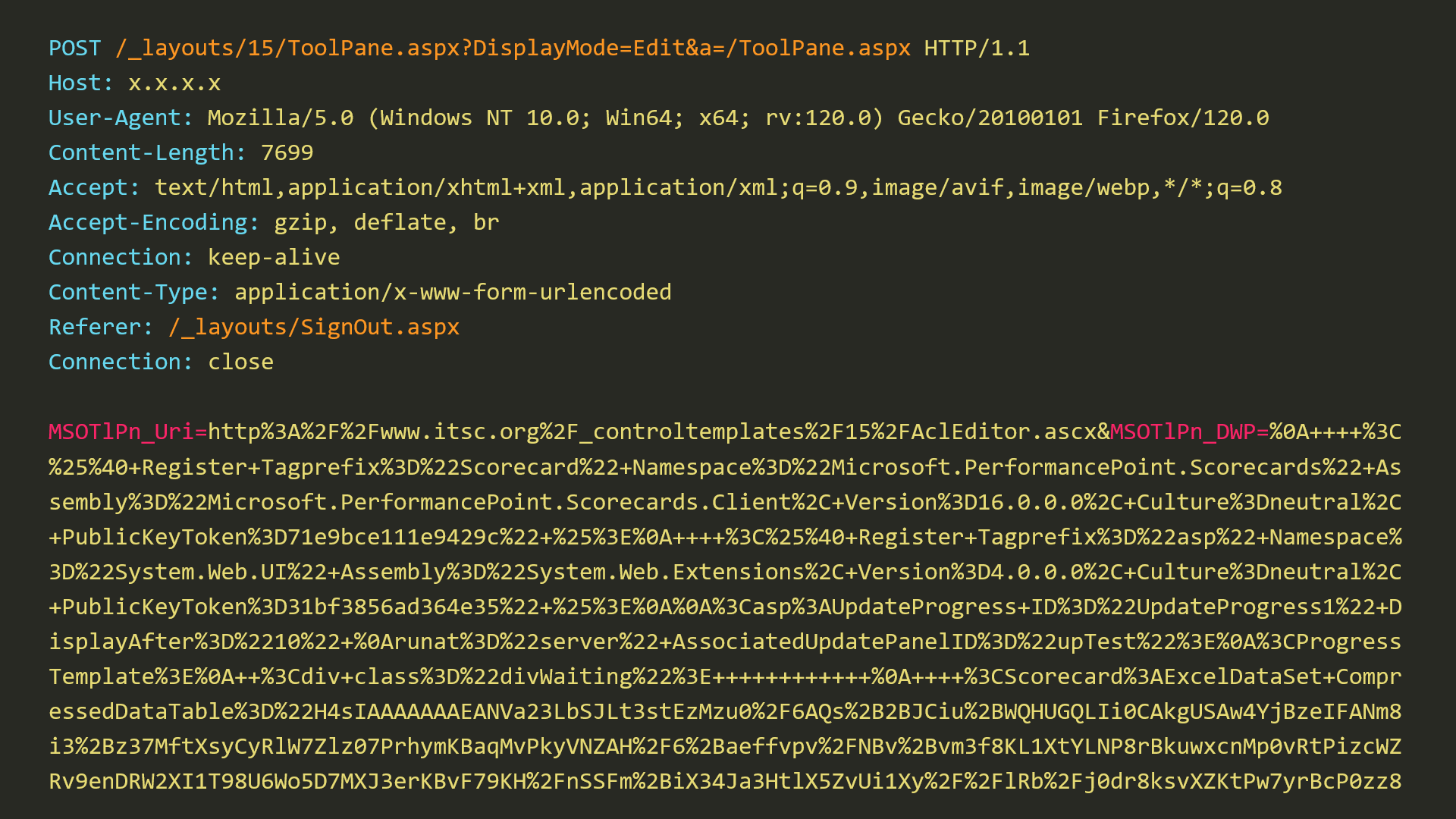
Snippet of the exploit POST request

Snippet of the exploit POST request

We can see that this POST request targets the “/_layouts/15/ToolPane.aspx” endpoint and embeds two parameters: “MSOtlPn_Uri” and “MSOtlPn_DWP”. Looking at the code of ToolPane.aspx, we can see that this file itself does not contain much functionality and most of its code is located in the ToolPane class of the Microsoft.SharePoint.WebPartPages namespace in Microsoft.SharePoint.dll. Looking at this class reveals the code that works with the two parameters present in the exploit. However, accessing this endpoint under normal conditions is not possible without bypassing authentication on the attacked SharePoint server. This is where the first Microsoft SharePoint Server Spoofing Vulnerability CVE-2025-49706 comes into play.

CVE-2025-49706

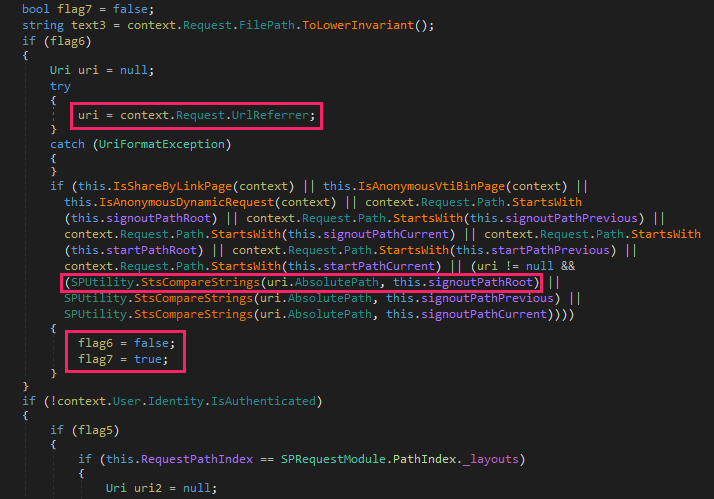
This vulnerability is present in the method PostAuthenticateRequestHandler, in Microsoft.SharePoint.dll. SharePoint requires Internet Information Services (IIS) to be configured in integrated mode. In this mode, the IIS and ASP.NET authentication stages are unified. As a result, the outcome of IIS authentication is not determined until the PostAuthenticateRequest stage, at which point both the ASP.NET and IIS authentication methods have been completed. Therefore, the PostAuthenticateRequestHandler method utilizes a series of flags to track potential authentication violations. A logic bug in this method enables an authentication bypass if the “Referrer” header of the HTTP request is equal to “/_layouts/SignOut.aspx”, “/_layouts/14/SignOut.aspx”, or “/_layouts/15/SignOut.aspx” using case insensitive comparison.

Vulnerable code in PostAuthenticateRequestHandler method

Vulnerable code in PostAuthenticateRequestHandler method (Microsoft.SharePoint.dll version 16.0.10417.20018)

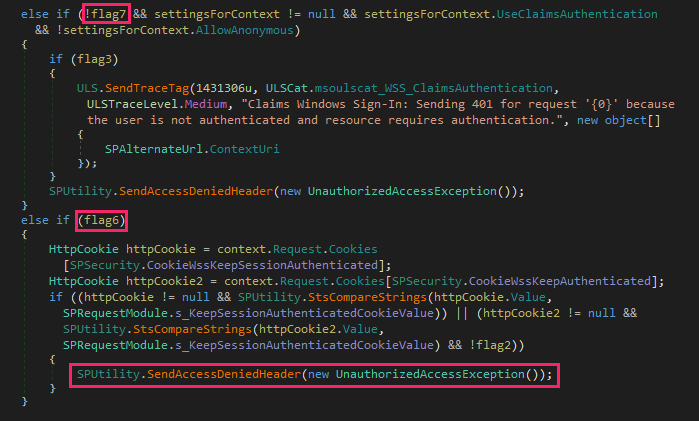
The code displayed in the image above handles the sign-out request and is also triggered when the sign-out page is specified as the referrer. When flag6 is set to false and flag7 is set to true, both conditional branches that could potentially throw an “Unauthorized Access” exception are bypassed.

Unauthorized access checks bypassed by the exploit

Unauthorized access checks bypassed by the exploit

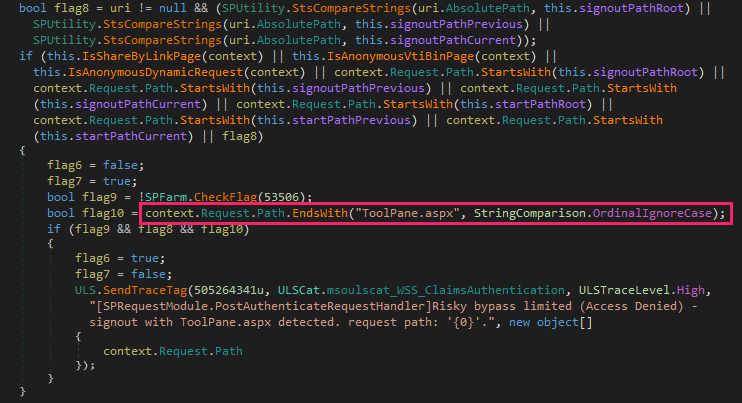
On July 8, 2025, Microsoft released an update that addressed this vulnerability by introducing additional checks to detect the usage of the “ToolPane.aspx” endpoint with the sign-out page specified as the referrer.

CVE-2025-49706 fix (Microsoft.SharePoint.dll version 16.0.10417.20027)

CVE-2025-49706 fix (Microsoft.SharePoint.dll version 16.0.10417.20027)

The added check uses case insensitive comparison to verify if the requested path ends with “ToolPane.aspx”. Is it possible to bypass this check, say, by using a different endpoint? Our testing has shown that this check can be easily bypassed.

CVE-2025-53771

We were able to successfully bypass the patch for vulnerability CVE-2025-49706 by adding just one byte to the exploit POST request. All that was required to bypass this patch was to add a “/” (slash) to the end of the requested “ToolPane.aspx” path.

Bypass for CVE-2025-49706 fix

Bypass for CVE-2025-49706 fix

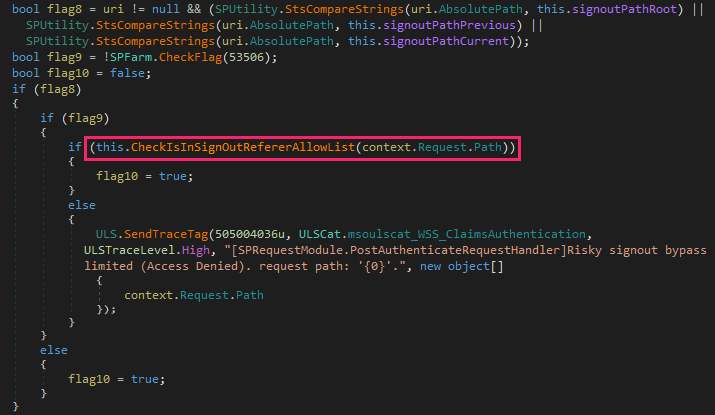
On July 20, 2025, Microsoft released an update that fixed this bypass as CVE-2025-53771. This fix replaces the “ToolPane.aspx” check to instead check whether the requested path is in the list of paths allowed for use with the sign-out page specified as the referrer.

CVE-2025-53771 fix (Microsoft.SharePoint.dll version 16.0.10417.20037)

CVE-2025-53771 fix (Microsoft.SharePoint.dll version 16.0.10417.20037)

This allowlist includes the following paths: “/_layouts/15/SignOut.aspx”, “/_layouts/15/1033/initstrings.js”, “/_layouts/15/init.js”, “/_layouts/15/theming.js”, “/ScriptResource.axd”, “/_layouts/15/blank.js”, “/ScriptResource.axd”, “/WebResource.axd”, “/_layouts/15/1033/styles/corev15.css”, “/_layouts/15/1033/styles/error.css”, “/_layouts/15/images/favicon.ico”, “/_layouts/15/1033/strings.js”, “/_layouts/15/core.js”, and it can contain additional paths added by the administrator.

While testing the CVE-2025-49706 bypass with the July 8, 2025 updates installed on our SharePoint debugging stand, we noticed some strange behavior. Not only did the bypass of CVE-2025-49706 work, but the entire exploit chain did! But wait! Didn’t the attackers use an additional Microsoft SharePoint Remote Code Execution Vulnerability CVE-2025-49704, which was supposed to be fixed in the same update? To understand why the entire exploit chain worked in our case, let’s take a look at the vulnerability CVE-2025-49704 and how it was fixed.

CVE-2025-49704

CVE-2025-49704 is an untrusted data deserialization vulnerability that exists due to improper validation of XML content. Looking at the exploit POST request, we can see that it contains two URL encoded parameters: “MSOtlPn_Uri” and “MSOtlPn_DWP”. We can see how they are handled by examining the code of the method GetPartPreviewAndPropertiesFromMarkup in Microsoft.SharePoint.dll. A quick analysis reveals that “MSOtlPn_Uri”  is a page URL that might be pointing to an any file in the CONTROLTEMPLATES folder and the parameter “MSOtlPn_DWP” contains something known as WebPart markup. This markup contains special directives that can be used to execute safe controls on a server and has a format very similar to XML.

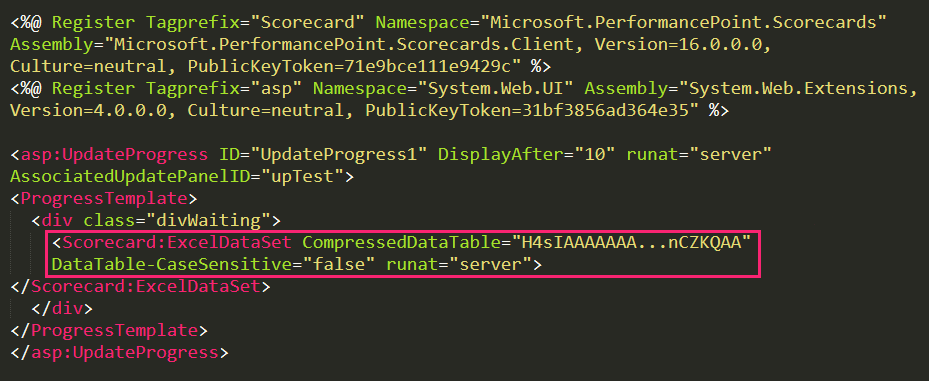
WebPart markup used by the attackers

WebPart markup used by the attackers

While this “XML” included in the “MSOtlPn_DWP” parameter does not itself contain a vulnerability, it allows attackers to instantiate the ExcelDataSet control from Microsoft.PerformancePoint.Scorecards.Client.dll with CompressedDataTable property set to malicious payload and trigger its processing using DataTable property getter.

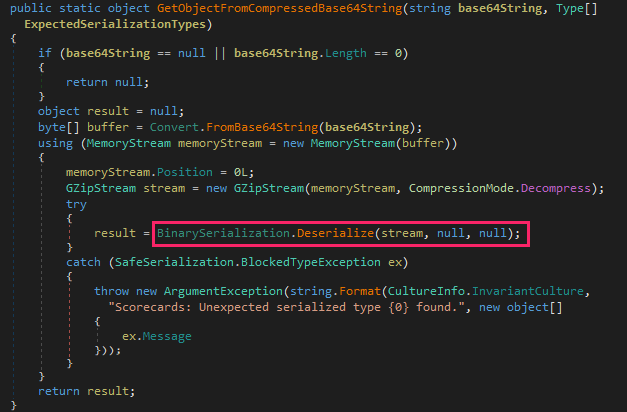
Code of the method that handles the contents of ExcelDataSet's CompressedDataTable property in the DataTable property getter

Code of the method that handles the contents of ExcelDataSet’s CompressedDataTable property in the DataTable property getter

Looking at the code of the ExcelDataSet’s DataTable property getter in Microsoft.PerformancePoint.Scorecards.Client.dll, we find the method GetObjectFromCompressedBase64String, responsible for deserialization of CompressedDataTable property contents. The data provided as Base64 string is decoded, unzipped, and passed to the BinarySerialization.Deserialize method from Microsoft.SharePoint.dll.

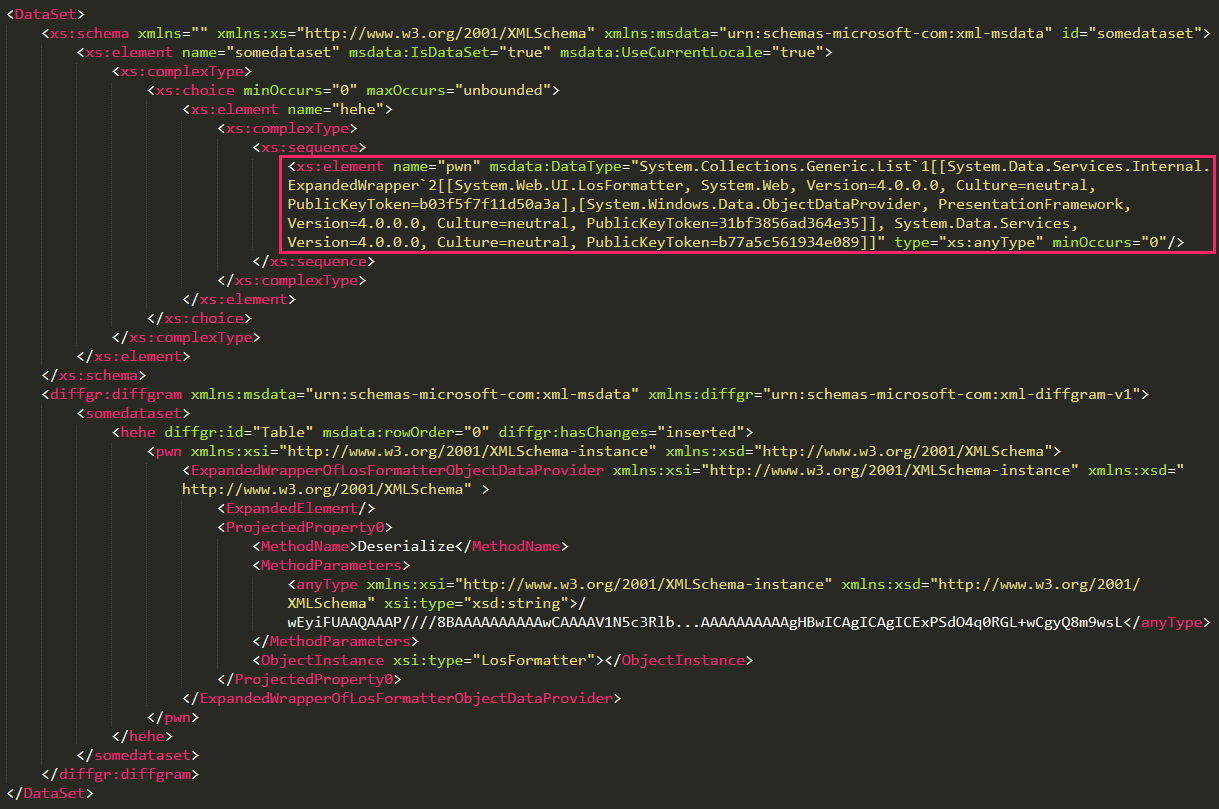
DataSet with XML content exploiting CVE-2025-49704 (deserialized)

DataSet with XML content exploiting CVE-2025-49704 (deserialized)

Attackers use this method to provide a malicious DataSet whose deserialized content is shown in the image above. It contains an XML with an element of dangerous type "System.Collections.Generic.List`1[[System.Data.Services.Internal.ExpandedWrapper`2[...], System.Data.Services, Version=4.0.0.0, Culture=neutral, PublicKeyToken=b77a5c561934e089]]", which allows attackers to execute arbitrary methods with the help of the well-known ExpandedWrapper technique aimed at exploitation of unsafe XML deserialization in applications based on the .NET framework. In fact, this shouldn’t be possible, since BinarySerialization.Deserialize in Microsoft.SharePoint.dll uses a special XmlValidator designed to protect against this technique by checking the types of all elements present in the provided XML and ensuring that they are on the list of allowed types. However, the exploit bypasses this check by placing the ExpandedWrapper object into the list.

Now, to find out why the exploit worked on our SharePoint debugging stand with the July 8, 2025 updates installed, let’s take a look at how this vulnerability was fixed. In this patch, Microsoft did not really fix the vulnerability but only mitigated it by adding the new AddExcelDataSetToSafeControls class to the Microsoft.SharePoint.Upgrade namespace. This class contains new code that modifies the web.config file and marks the Microsoft.PerformancePoint.Scorecards.ExcelDataSet control as unsafe. Because SharePoint does not execute this code on its own after installing updates, the only way to achieve the security effect was to manually run a configuration upgrade using the SharePoint Products Configuration Wizard tool. Notably, the security guidance for CVE-2025-49704 does not mention the need for this step, which means at least some SharePoint administrators may skip it. Meanwhile, anyone who installed this update but did not manually perform a configuration upgrade remained vulnerable.

CVE-2025-53770

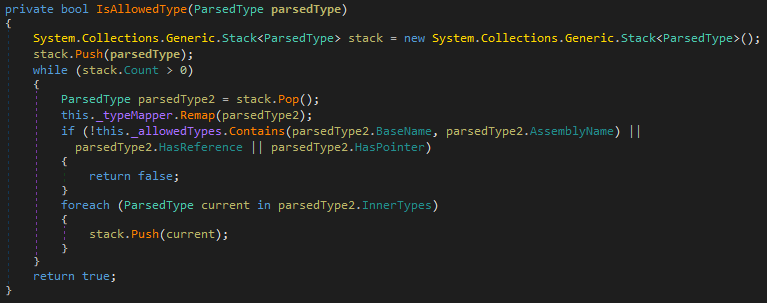
On July 20, 2025, Microsoft released an update with a proper fix for the CVE-2025-49704 vulnerability. This patch introduces an updated XmlValidator that now properly validates element types in XML, preventing exploitation of this vulnerability without requiring a configuration upgrade and, more importantly, addressing the root cause and preventing exploitation of the same vulnerability through controls other than Microsoft.PerformancePoint.Scorecards.ExcelDataSet.

Code of new type verifier in updated XmlValidator

Code of new type verifier in updated XmlValidator

CVE-2020-1147

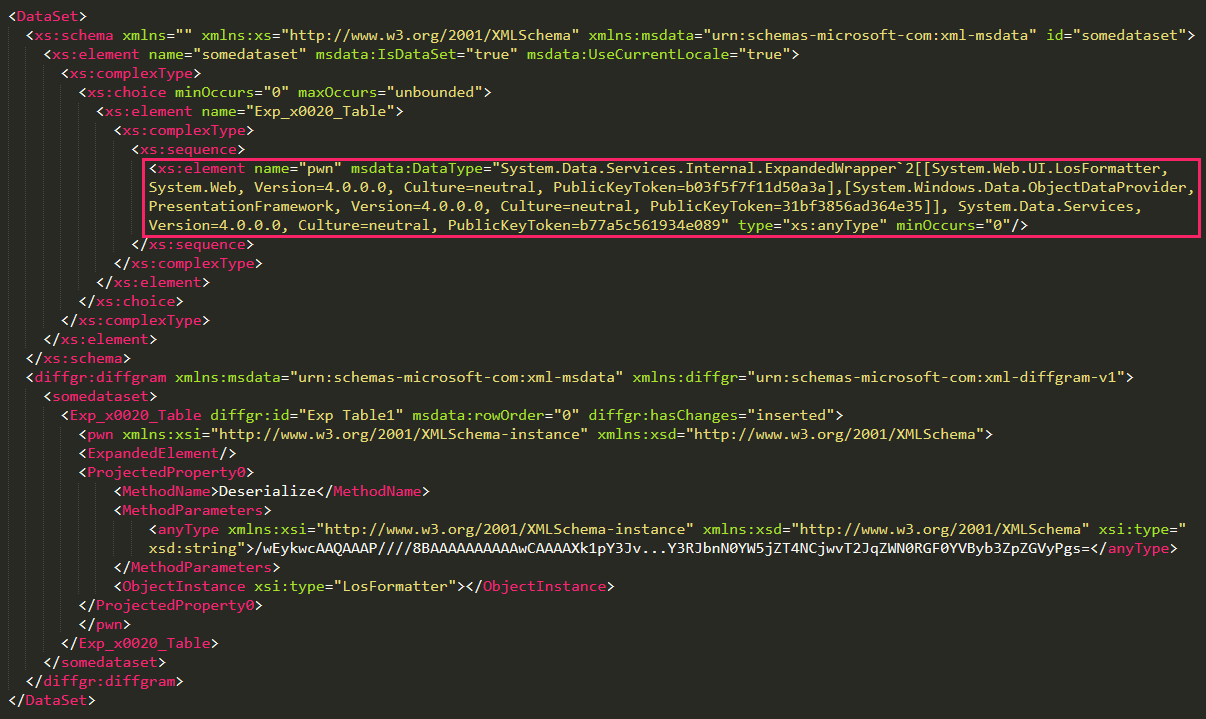
Readers familiar with previous SharePoint exploits might feel that the vulnerability CVE-2025-49704/CVE-2025-53770 and the exploit used by the attackers looks very familiar and very similar to the older .NET Framework, SharePoint Server, and Visual Studio Remote Code Execution Vulnerability CVE-2020-1147. In fact, if we compare the exploit for CVE-2020-1147 and an exploit for CVE-2025-49704/CVE-2025-53770, we can see that they are almost identical. The only difference is that in the exploit for CVE-2025-49704/CVE-2025-53770, the dangerous ExpandedWrapper object is placed in the list. This makes CVE-2025-53770 an updated fix for CVE-2020-1147.

DataSet with XML content exploiting CVE-2020-1147

DataSet with XML content exploiting CVE-2020-1147

Conclusions

Despite the fact that patches for the ToolShell vulnerabilities are now available for deployment, we assess that this chain of exploits will continue being used by attackers for a long time. We have been observing the same situation with other notorious vulnerabilities, such as ProxyLogon, PrintNightmare, or EternalBlue. While they have been known for years, many threat actors still continue leveraging them in their attacks to compromise unpatched systems. We expect the ToolShell vulnerabilities to follow the same fate, as they can be exploited with extremely low effort and allow full control over the vulnerable server.

To stay better protected against threats like ToolShell, we as a community should learn lessons from previous events in the industry related to critical vulnerabilities. Specifically, the speed of applying security patches nowadays is the most important factor when it comes to fighting such vulnerabilities. Since public exploits for these dangerous vulnerabilities appear very soon after vulnerability announcements, it is paramount to install patches as soon as possible, as a gap of even a few hours can make a critical difference.

At the same time, it is important to protect enterprise networks against zero-day exploits, which can be leveraged when there is no available public patch for vulnerabilities. In this regard, it is critical to equip machines with reliable cybersecurity solutions that have proven effective in combatting ToolShell attacks before they were publicly disclosed.

Behaviour detection EDR

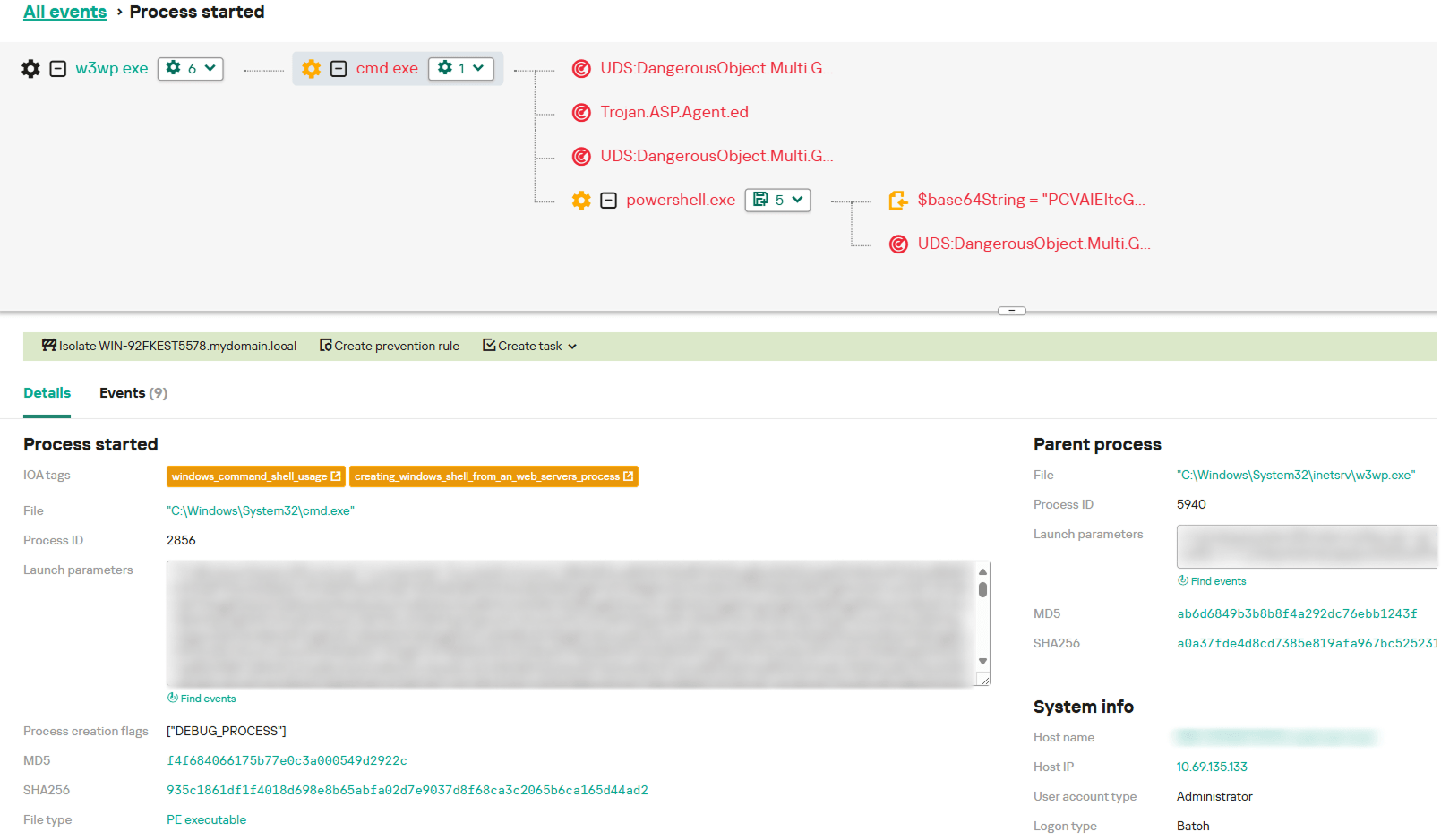
Kaspersky Next with its Behaviour detection component proactively protects against  exploitation of these vulnerabilities. Additionally, it is able to detect exploitation and the subsequent malicious activity.

Kaspersky products detect the exploits and malware used in these attacks with the following verdicts:

  • UDS:DangerousObject.Multi.Generic
  • PDM:Exploit.Win32.Generic
  • PDM:Trojan.Win32.Generic
  • HEUR:Trojan.MSIL.Agent.gen
  • ASP.Agent.*
  • PowerShell.Agent.*

❌