Reading view

There are new articles available, click to refresh the page.

The Security Landscape of Mobile Apps in Africa

CyLab-Africa researchers partner with mobile security provider for summer collaboration experience

Researchers from CyLab-Africa and the Upanzi Network recently partnered with the mobile security provider Approov to explore the security of common financial services apps used across Africa. After surveying 224 popular financial applications, the researchers found that 95 percent of these Android apps exposed secrets that can be used to reveal personal and financial data. Across these applications, approximately 272 million users have the potential to be victims of the security flaws.

The post The Security Landscape of Mobile Apps in Africa appeared first on Security Boulevard.

APIs Are the Retail Engine: How to Secure Them This Black Friday

By: Tim Erlin

Can you ever imagine the impact on your business if it went offline on Black Friday or Cyber Monday due to a cyberattack?  Black Friday is the biggest day in the retail calendar. It’s also the riskiest. As you gear up for huge surges in online traffic, ask yourself: have you protected the APIs on [...]

The post APIs Are the Retail Engine: How to Secure Them This Black Friday appeared first on Wallarm.

The post APIs Are the Retail Engine: How to Secure Them This Black Friday appeared first on Security Boulevard.

Black Friday Fraud: The Hidden Threat in Mobile Commerce

Every year, Black Friday drives a surge of online purchases—but it also opens the floodgates for fraud. While most conversations focus on phishing emails or sketchy websites, the real cybersecurity frontline for e-commerce lies behind the scenes: mobile apps. Developers, not consumers, hold the power to stop many of these attacks—but only if they understand how today’s fraudsters exploit mobile APIs.

The post Black Friday Fraud: The Hidden Threat in Mobile Commerce appeared first on Security Boulevard.

The Security Landscape of Mobile Apps in Africa

CyLab-Africa researchers partner with mobile security provider for summer collaboration experience

Researchers from CyLab-Africa and the Upanzi Network recently partnered with the mobile security provider Approov to explore the security of common financial services apps used across Africa. After surveying 224 popular financial applications, the researchers found that 95 percent of these Android apps exposed secrets that can be used to reveal personal and financial data. Across these applications, approximately 272 million users have the potential to be victims of the security flaws.

The Carnegie Mellon University Africa team included alumni and a current student who are all working as researchers with CyLab-Africa in Rwanda: Theoneste Byagutangaza (MSIT '23), Trevor Henry Chiboora (MSIT '23), Joel Jefferson Musiime (MSIT '24), and Lenah Chacha (MSIT '17). The project was part of a summer collaboration experience where the CyLab-Africa researchers received guidance and mentorship from Approov. CyLab-Africa co-directors Assane Gueye and Giulia Fanti served as advisors for this project

"Participating in this project was a rewarding yet challenging experience. It involved in-depth research into the consequences of secret key leaks, which proved to be a formidable task initially. However, collaborating with a diverse team enriched my problem-solving skills, honed during my time as a student at CMU, and made the project a valuable learning opportunity," says Byagutangaza.

The team selected and investigated Android applications from countries in North, Central, Eastern, Western, and Southern Africa and categorized the security threats into "high," "medium," and "low" severity. The majority of the threats fell into the high (18 percent) and medium (72 percent) categories. A high severity classification was used for vulnerabilities that could potentially lead to unauthorized access, data breaches, and compromised user privacy. Medium severity was used for secrets that if exposed, could potentially compromise the confidentiality of user data and application functionality.

The Carnegie Mellon University Africa team: Theoneste Byagutangaza (MSIT '23), Trevor Henry Chiboora (MSIT '23), Joel Jefferson Musiime (MSIT '24), and Lenah Chacha (MSIT '17).

"Being new in the field of mobile security, this project was a good learning experience as it gave me an understanding on the design and deployment of mobile apps from a security perspective," says Musiime. "Collaborating with the experienced team at Approov in the field of mobile security greatly aided my learning process, as they were always ready and willing to offer guidance and support throughout the research."

The work culminated in a report which draws comparisons between other regions and Africa, pinpointing trends, commonalities, and disparities pertaining to the exposure of secret keys in a mobile application’s binary package. For example, they found that apps deployed in West Africa were the most exposed in terms of high severity secret exposure (20 percent) and Southern Africa the least (only 6 percent).

"The project report holds significant value for a wide audience, including product owners, developers, and everyday users. It not only sheds light on security concerns related to secrets and API keys in Android packages but also provides valuable recommendations for mitigating these issues," says Chiboora.

The post The Security Landscape of Mobile Apps in Africa appeared first on Security Boulevard.

Don’t Let API Penetration Testing Fall Through the Cracks

By: Synack

API (application programming interface) cybersecurity isn’t as thorough as it needs to be. When it comes to pentesting, web APIs are often lumped in with web applications, despite 90% of web applications having a larger attack surface exposed via APIs than user interfaces, according to Gartner. However, that kind of testing doesn’t cover the full spectrum of APIs, potentially leaving vulnerabilities undiscovered. As APIs become both increasingly important and increasingly vulnerable, it’s more important than ever to keep your APIs secure.

APIs vs. Web Applications

APIs are how software programs talk to each other. APIs are interfaces that allow software programs to transmit data to other software programs. Integrating applications via APIs allows one piece of software to access and use the capabilities of another. In today’s increasingly connected digital world, it’s no surprise that APIs are becoming more and more prevalent.

When most people think of APIs, what they’re really thinking about are APIs  exposed via a web application UI, usually by means of an HTTP-based web server. A web application is any application program that is stored remotely and delivered via the internet through a browser interface. 

APIs, however, connect and power everything from mobile applications, to cloud-based services, to internal applications, partner platforms and more. An organization’s APIs may be more numerous than those that can be enumerated through browsing a web application.

Differences in Pentesting

Frequently, organizations that perform pentesting on their web applications assume that a clean bill of health for web applications means that their APIs are just as secure. Unfortunately, that isn’t the case. An effective API security testing strategy requires understanding the differences between web application testing and API security testing. 

Web application security mostly focuses on threats like injection attacks, cross-site scripting and buffer overflows. Meanwhile, API breaches typically occur through issues with authorization and authentication, which lets cyber attackers get access to business logic or data.

Web application pentesting isn’t sufficient for testing APIs. Web application testing usually only covers the API calls made by the application, though APIs have a much broader range of functioning than that.

To begin a web application pentest, you provide your pentesters with a list of and they test all of the fields associated with these URLs. Some of these fields will have APIs behind them, allowing them to communicate with something. If the pentesters find a vulnerability here, that’s an API vulnerability – and that kind of API vulnerability will be caught. However, any APIs that aren’t connected to a field won’t be tested.

Most organizations have more APIs than just the ones attached to web application fields. Any time an application needs to talk to another application or to a database, that’s an API that might still be vulnerable. While a web application pentest won’t be able to test these APIs, an API pentest will.

The Importance of API Pentesting

Unlike web applications, APIs have direct access to endpoints, and cyber attackers can manipulate the data that these endpoints accept. So, it’s important to make sure that your APIs are just as thoroughly tested as your web applications. By performing separate pentesting for APIs and web applications, you make sure that you have your attack surface covered.

Synack can help. To learn more about the importance of pentesting for APIs, read this white paper and visit our API security solution page.

The post Don’t Let API Penetration Testing Fall Through the Cracks appeared first on Synack.

Minimize Noise With Human-Led API Pentesting

Last week, we released a new API Pentesting product that allows you to test your headless API endpoints through the Synack Platform. Before the release, we conducted more than 100 requests for headless API pentests, indicating a growing need from our customers. This new capability provides an opportunity to get human-led testing and proof-of-coverage on this critical and sprawling part of the attack surface.

Testing APIs Through Web Applications Versus Headless Testing

For years, Synack has found exploitable API vulnerabilities through web applications. However, as Gartner notes, 90% of web applications now have a larger attack surface exposed via APIs than through the user interface. Performing web app pentests is no longer adequate for securing the API attack surface, hence the need for the new headless API pentest from Synack. 

Our API pentesting product allows you to activate researchers from the Synack Red Team (SRT) to pentest your API endpoints, headless or otherwise. These researchers have proven API testing skills and will provide thorough testing coverage with less noise than automated solutions.  

The Synack Difference: Human-led Coverage and Results

Automated API scanners and testing solutions can provide many false positives and noise. With our human-led pentesting, we leverage the creativity and diverse perspectives of global researchers to provide meaningful testing coverage and find the vulnerabilities that matter. SRT researchers are compensated for completing the check and are also paid for any exploitable vulnerability findings to ensure a thorough, incentive-driven test.  

Additionally, each submitted vulnerability is vetted by an in-house team called Vulnerability Operations. This reduces noise and prevents teams from wasting time on false positives. 

Write-ups for the testing done on each endpoint will be made available in real time and are also vetted by vulnerability operations. The reports can also be easily exported to PDFs for convenient sharing with compliance auditors or other audiences. 

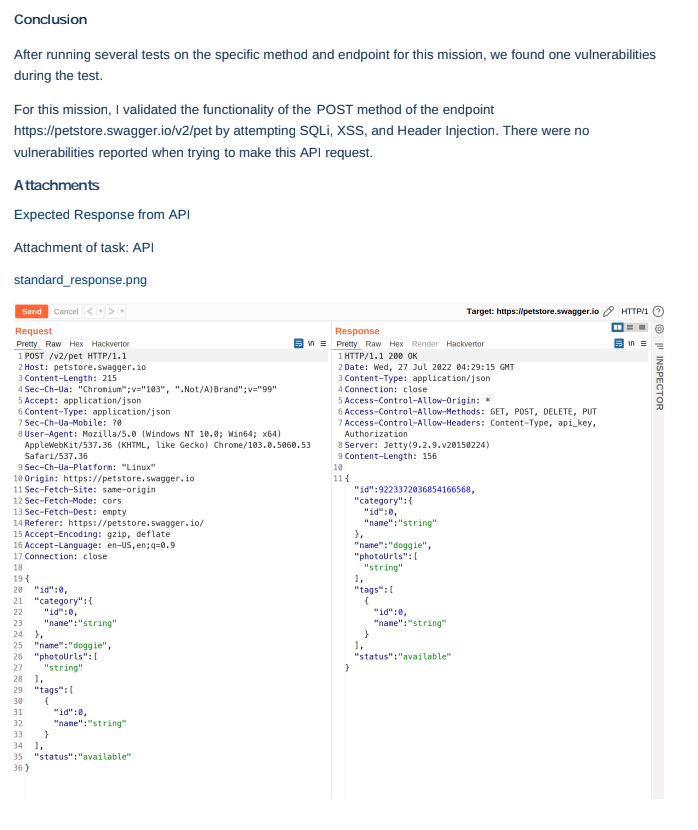
These reports showcase a level of detail and thoroughness not found in automated solutions. Each API endpoint will be accompanied by descriptions of the attacks attempted, complete with screenshots of the work performed. Check out one of our sample API pentest reports.

Screenshot from exportable PDF report

How It Works

Through the Assessment Creation Wizard (ACW) found within the Synack Platform, you can now upload your API documentation (Postman, OpenAPI Spec 3.0, JSON) and create a new API assessment. 

For each specified endpoint in your API, a “Mission” will be generated and sent out for claiming among those in the SRT with proven API testing experience. The “Mission” asks the researcher to check the endpoint for vulnerabilities like those listed in the OWASP API Top 10, while recording their efforts with screenshots and detailed write-ups. Vulnerabilities tested for include:

  • Broken Object Level Authorization
  • Broken User Authentication
  • Excessive Data Exposure
  • Broken Function Level Authorization
  • Mass Assignment
  • Security Misconfiguration
  • Injection

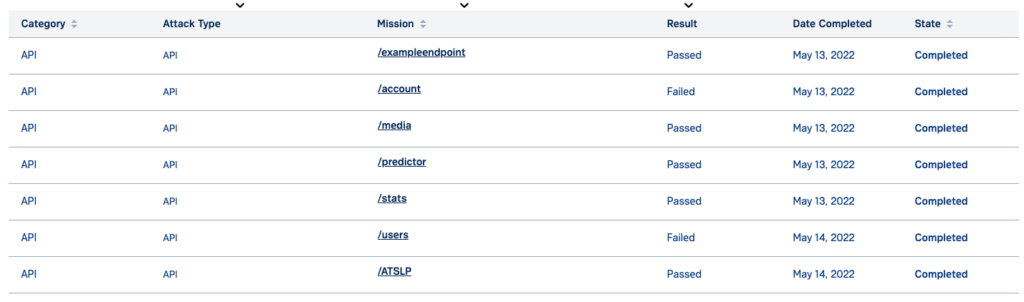
Proof-of-coverage reports, as well as exploitable vulnerability findings, will be surfaced in real-time for each endpoint within the Synack Platform.

Real-time results in platform

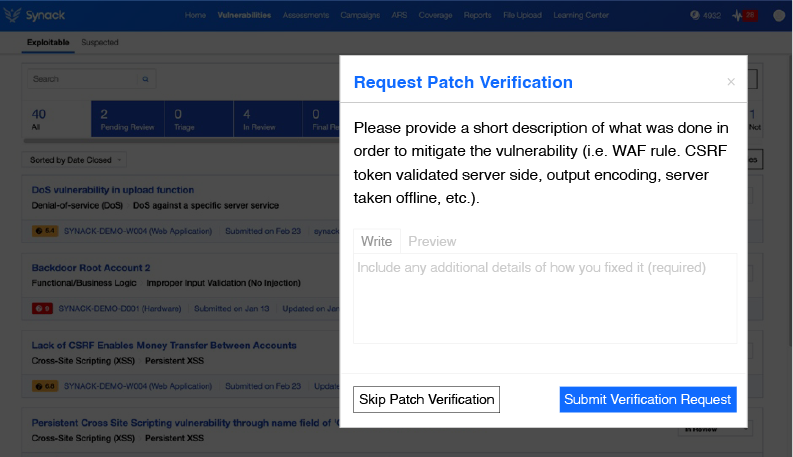
Through the Synack Platform, an exploitable vulnerability finding can be quickly viewed in the “vulnerabilities” tab, which rolls up finding from all of your Synack testing activities. With a given vulnerability, you can comment back and forth with the researcher who submitted the finding, as well as request patch verification to ensure patch efficacy. 

Retesting On-demand

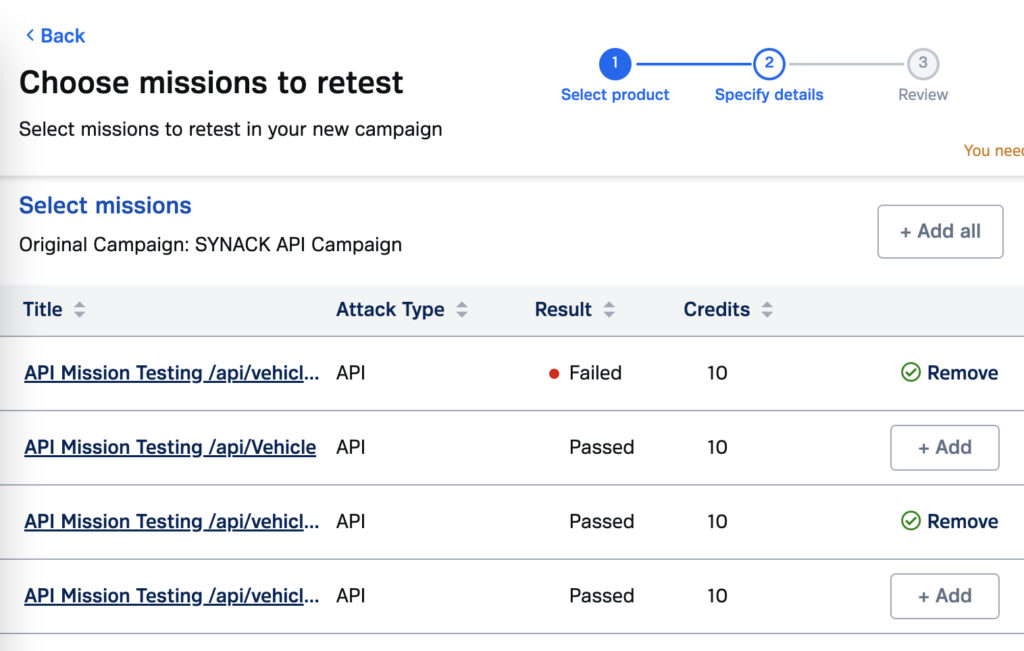
As long as you’re on the Synack Platform, you have on-demand access to the Synack Red Team. To that end, APIs previously tested can be retested at the push of a button. Simply use the convenient “retesting” workflow to select the endpoints you want to retest and press submit. This will start a new test on the specified endpoints, sending out the work once more to the SRT and producing fresh proof-of-coverage reports. This can be powerful to test after an update to an API or meet a recurring compliance requirement.

Get Started

Get started today by downloading our API pentesting data sheet.

The post Minimize Noise With Human-Led API Pentesting appeared first on Synack.

Synack Expands Security Platform with Adversarial API Pentesting

By: Synack

Synack, the premier security testing platform, has launched an API pentesting capability powered by its global community of elite security researchers. Organizations can now rely on the Synack platform for continuous pentesting coverage across “headless” API endpoints that lack a user interface and are increasingly exposed to attackers.

“Synack’s human-led, adversarial approach is ideal for testing APIs that form the backbone of society’s digital transformation,” said Synack CTO and co-founder Mark Kuhr, a former National Security Agency cybersecurity expert. “We are thrilled to offer customers a unique, scalable way to secure this growing area of their attack surfaces.”

Gartner estimates API abuses will be the most common source of data breaches in enterprise web applications this year. Synack enables organizations to verify exploitable API vulnerabilities like broken authorization and authentication–noted in the OWASP API top 10–can’t be abused by malicious hackers.

“Many organizations are struggling to find the top-tier cyber talent needed to root out API-specific vulnerabilities,” said Peter Blanks, Chief Product Officer at Synack. “We’re excited to extend our Synack platform to provide human-powered offensive security testing on APIs.”

Synack’s headless API capability builds on years of API pentesting experience through web and mobile applications. The new platform features allow customers to enter API documentation to guide testing scope and coverage. Next, researchers with the Synack Red Team attempt to exploit API endpoints in the way a real external adversary would.

Of the Synack Red Team’s over 1,500 global members, only those with proven API testing skills are activated on API requests, reducing noise. Synack’s Special Projects division led over 100 successful pentests against headless APIs in 2022, providing customers with critical proof-of-coverage reports while validating researchers’ API expertise.

Vulnerability submissions and testing reports are routed through Synack’s Vulnerability Operations team for a rigorous vetting process before being displayed in the platform, minimizing false positives and ensuring high-quality results.

For more information about Synack’s API security testing, visit our Solutions page.

The post Synack Expands Security Platform with Adversarial API Pentesting appeared first on Synack.

X-Force Report: No Shortage of Resources Aimed at Hacking Cloud Environments

As cybercriminals remain steadfast in their pursuit of unsuspecting ways to infiltrate today’s businesses, a new report by IBM Security X-Force highlights the top tactics of cybercriminals, the open doors users are leaving for them and the burgeoning marketplace for stolen cloud resources on the dark web. The big takeaway from the data is businesses still control their own destiny when it comes to cloud security. Misconfigurations across applications, databases and policies could have stopped two-thirds of breached cloud environments observed by IBM in this year’s report.

IBM’s 2021 X-Force Cloud Security Threat Landscape Report has expanded from the 2020 report with new and more robust data, spanning Q2 2020 through Q2 2021. Data sets we used include dark web analysis, IBM Security X-Force Red penetration testing data, IBM Security Services metrics, X-Force Incident Response analysis and X-Force Threat Intelligence research. This expanded dataset gave us an unprecedented view across the whole technology estate to make connections for improving security. Here are some quick highlights:

  • Configure it Out — Two out of three breached cloud environments studied were caused by improperly configured Application Programming Interface (APIs). X-Force incident responders also observed virtual machines with default security settings that were erroneously exposed to the Internet, including misconfigured platforms and insufficiently enforced network controls.
  • Rulebreakers Lead to Compromise — X-Force Red found password and policy violations in the vast majority of cloud penetration tests conducted over the past year. The team also observed a significant growth in the severity of vulnerabilities in cloud-deployed applications, while the number of disclosed vulnerabilities in cloud-deployed applications rocketed 150% over the last five years.
  • Automatic for the Cybercriminals — With nearly 30,000 compromised cloud accounts for sale at bargain prices on dark web marketplaces and Remote Desktop Protocol accounting for 70% of cloud resources for sale, cybercriminals have turnkey options to further automate their access to cloud environments.
  • All Eyes on Ransomware & Cryptomining — Cryptominers and ransomware remain the top dropped malware into cloud environments, accounting for over 50% of detected system compromises, based on the data analyzed.
Download the report

Modernization Is the New Firewall

More and more businesses are recognizing the business value of hybrid cloud and distributing their data across a diverse infrastructure. In fact, the 2021 Cost of a Data Breach Report revealed that breached organizations implementing a primarily public or private cloud approach suffered approximately $1 million more in breach costs than organizations with a hybrid cloud approach.

With businesses seeking heterogeneous environments to distribute their workloads and better control where their most critical data is stored, modernization of those applications is becoming a point of control for security. The report is putting a spotlight on security policies that don’t encompass the cloud, increasing the security risks businesses are facing in disconnected environments. Here are a few examples:

  • The Perfect Pivot — As enterprises struggle to monitor and detect cloud threats, cloud environments today. This has contributed to threat actors pivoting from on-premise into cloud environments, making this one of the most frequently observed infection vectors targeting cloud environments — accounting for 23% of incidents IBM responded to in 2020.
  • API Exposure — Another top infection vector we identified was improperly configured assets. Two-thirds of studied incidents involved improperly configured APIs. APIs lacking authentication controls can allow anyone, including threat actors, access to potentially sensitive information. On the other side, APIs being granted access to too much data can also result in inadvertent disclosures.

Many businesses don’t have the same level of confidence and expertise when configuring security controls in cloud computing environments compared to on-premise, which leads to a fragmented and more complex security environment that is tough to manage. Organizations need to manage their distributed infrastructure as one single environment to eliminate complexity and achieve better network visibility from cloud to edge and back. By modernizing their mission critical workloads, not only will security teams achieve speedier data recovery, but they will also gain a vastly more holistic pool of insights around threats to their organization that can inform and accelerate their response.

Trust That Attackers Will Succeed & Hold the Line

Evidence is mounting every day that the perimeter has been obliterated and the findings in the report just add to that corpus of data. That is why taking a zero trust approach is growing in popularity and urgency. It removes the element of surprise and allows security teams to get ahead of any lack of preparedness to respond. By applying this framework, organizations can better protect their hybrid cloud infrastructure, enabling them to control all access to their environments and to monitor cloud activity and proper configurations. This way organizations can go on offense with their defense, uncovering risky behaviors and enforcing privacy regulation controls and least privilege access. Here’s some of the evidence derived from the report:

  • Powerless Policy — Our research suggests that two-thirds of studied breaches into cloud environments would have likely been prevented by more robust hardening of systems, such as properly implementing security policies and patching.
  • Lurking in the Shadows — “Shadow IT”, cloud instances or resources that have not gone through an organization’s official channels, indicate that many organizations aren’t meeting today’s baseline security standards. In fact, X-Force estimates the use of shadow IT contributed to over 50% of studied data exposures.
  • Password is “admin 1” — The report illustrates X-Force Red data accumulated over the last year, revealing that the vast majority of the team’s penetration tests into various cloud environments found issues with either passwords or policy adherence.

The recycling use of these attack vectors emphasizes that threat actors are repetitively relying on human error for a way into the organization. It’s imperative that businesses and security teams operate with the assumption of compromise to hold the line.

Dark Web Flea Markets Selling Cloud Access

Cloud resources are providing an excess of corporate footholds to cyber actors, drawing attention to the tens of thousands of cloud accounts available for sale on illicit marketplaces at a bargain. The report reveals that nearly 30,000 compromised cloud accounts are on display on the dark web, with sales offers that range from a few dollars to over $15,000 (depending on geography, amount of credit on the account and level of account access) and enticing refund policies to sway buyers’ purchasing power.

But that’s not the only cloud “tool” for sale on dark web markets with our analysis highlighting that Remote Desktop Protocol (RDP) accounts for more than 70% of cloud resources for sale — a remote access method that greatly exceeds any other vector being marketed. While illicit marketplaces are the optimal shopping grounds for threat actors in need of cloud hacks, concerning us the most is a persistent pattern in which weak security controls and protocols — preventable forms of vulnerability — are repeatedly exploited for illicit access.

To read our comprehensive findings and learn about detailed actions organizations can take to protect their cloud environments, review our 2021 X-Force Cloud Security Threat Landscape here.

Want to hear from an expert? Schedule a consultation with an X-Force team member and register for our cloud security webinar to learn more.

The post X-Force Report: No Shortage of Resources Aimed at Hacking Cloud Environments appeared first on Security Intelligence.

❌