Reading view

There are new articles available, click to refresh the page.

Federal judge blocks imminent State Dept layoffs, as unions seek to reverse RIFs at other agencies

A federal judge in San Francisco is temporarily blocking the State Department from finalizing hundreds of employee layoffs.

Judge Susan Illston approved a temporary restraining order on Thursday, preventing the department from officially terminating more than 200 employees, most of them Foreign Service officers.

Separately, federal employee unions are asking the U.S. District Court for the Northern District of California to reverse more layoffs than agencies have allowed under a spending deal that ended the recent government shutdown.

The American Federation of Government Employees and the American Foreign Service Association filed the emergency request for a temporary restraining order to bar the “imminent and unlawful execution” of reduction in force notices the State Department sent this summer.

“The severe threats to the public presented by the imminent State Department actions necessitate a temporary pause to protect the status quo for plaintiffs and the employees they represent who are adversely impacted by these imminent separations,” the emergency request states.

The emergency request is part of an ongoing lawsuit that unions filed on the eve of the government shutdown, which blocked the Trump administration from conducting widespread layoffs during a lapse in congressional funds.

The amended lawsuit states that several agencies, including the State Department, aren’t fully adhering to a provision in the shutdown-ending spending bill that temporarily blocked the Trump administration from carrying out layoffs.

The nonprofit Democracy Forward, which is also part of the lawsuit, said the amended lawsuit seeks to reverse “other unlawful RIF actions” at the Small Business Administration and the General Services Administration, as well as the departments of Education and Defense.

“Those RIFs would violate the federal legislation that ended the federal government shutdown, which prohibits implementation of any RIFs through January 30,” the amended complaint states.

The continuing resolution Congress passed on Nov. 12 states that “any reduction in force proposed, noticed, initiated, executed, implemented, or otherwise taken by an executive agency between October 1, 2025, and the date of enactment, shall have no force or effect.”

It also states that between Nov. 12, 2025 and Jan. 30, 2026, “no federal funds may be used to initiate, carry out, implement, or otherwise notice a reduction in force to reduce the number of employees within any department.”

Agencies, however, have followed a narrower interpretation of the stopgap spending bill, and have only reinstated federal employees who received RIF notices between Oct. 1 and Nov. 12. The amended lawsuit states that interpretation of the continuing resolution “is significantly under-inclusive.”

Agencies recently told a federal court that they rescinded shutdown-era RIF notices for more than 3,600 employees.

The State Department sent RIF notices to nearly 1,350 employees in July. Most of those employees were officially separated from the agency in September.

But this Friday, Dec. 5, the department plans to officially remove nearly 250 Foreign Service employees and several civil service employees whose separation dates were postponed, because they recently gave birth or faced medical issues.

The State Department claims that the continuing resolution’s layoff protections only apply to RIF notices that went out after Oct. 1.

“Defendants are wrong,” the amended complaint states. “The plain language of the continuing resolution prohibits any actions implementing any RIFs of any employees at any agency between November 12, 2025 and January 30, 2026, and requires recission of any previously issued RIF notices (regardless of when they were issued) if the RIFs were implemented during the shutdown.”

The amended lawsuit also takes issue with how the State Department modified the official separation date for impacted employees.

Foreign Service employees were originally told they would be separated from the agency on Nov. 10,  when the agency was still affected by the government shutdown. But on that date, employees received a notice from the department’s human resources offices that said they would remain on administrative leave so the agency could correct “administrative errors.”

On Monday evening, employees received a notice that said they will be officially separated from the State Department this Friday.

“The RIF notices were not reissued, and employees received nothing further from the State Department regarding the now-expired RIF notices until December 1, 2025,” the amended lawsuit states.

The State Department’s notice to employees cites “formal written guidance” from the Office of Management and Budget and the Justice Department’s Office of Legal Counsel regarding RIFs that had been issued prior to the shutdown, but further implemented during or after the shutdown. The unions leading the lawsuit say that formal written guidance hasn’t been made publicly available.

“During the shutdown, the State Department continued to implement the stages of these RIFs in preparation for final separation of the employees, including by processing personnel paperwork in advance of the planned separations,” the amended complaint states.

The unions claim that without a temporary restraining order, State Department employees and their families will suffer “irreparable harm,” including a loss of income and health insurance benefits.

“For many of these employees, the imminent loss of employment means a sustained loss of income and benefits in a job market already flooded with unemployed former State Department and USAID employees,” the amended complaint states.

AFGE National President Everett Kelley said in a statement that “Congress clearly stated that no federal employees should lose their jobs due to a reduction-in-force for the duration of the continuing resolution.”

“This means that no RIF should be issued or acted upon, and any RIF terminations that occurred during the shutdown must be reversed,” Kelley said.

AFSA President John Dinkelman said in a statement that these “unlawful separations reveal a callous indifference to the rule of law and the people who carry out America’s diplomatic mission every day.”

The post Federal judge blocks imminent State Dept layoffs, as unions seek to reverse RIFs at other agencies first appeared on Federal News Network.
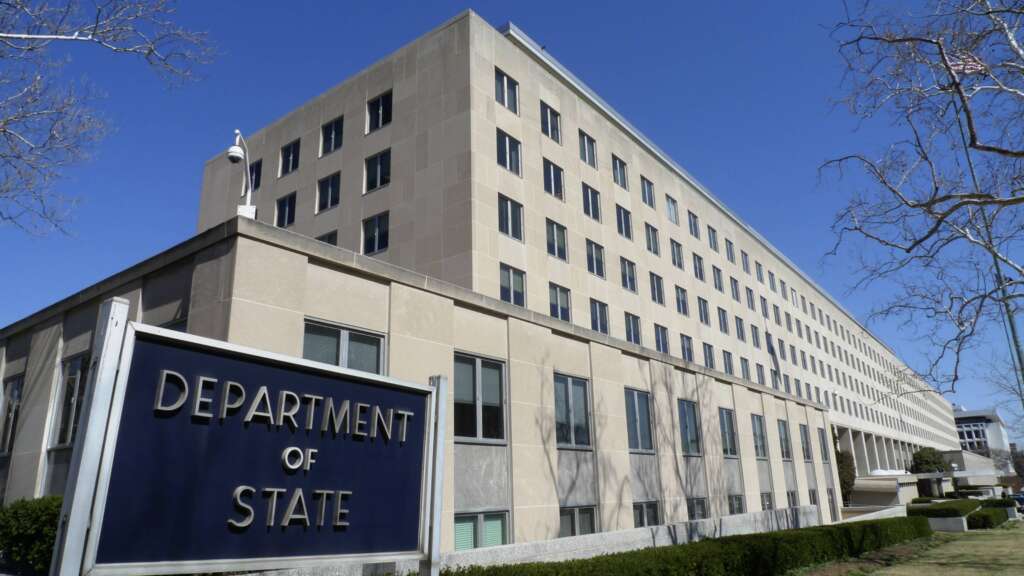
© AP Photo/J. Scott Applewhite, File

FILE - The Harry S. Truman Building, headquarters for the State Department, is seen in Washington, March 9, 2009. (AP Photo/J. Scott Applewhite, File)

OPM touts new training programs, aligned with Trump administration’s federal workforce reshaping

The Office of Personnel Management has launched a new training series, designed to educate senior executives in the federal workforce, while incorporating common themes from the Trump administration on “accountability,” performance management and adherence to the president’s priorities.

Two new training programs that OPM announced last week are targeted toward both career and political members of the Senior Executive Service, as well as GS-14 and GS-15 federal employees. The trainings largely reflect the Trump administration’s reshaping of the federal workforce this year, according to OPM Director Scott Kupor.

“We’re trying to move towards a performance-based culture in government. It’s only fair if we’re going to do that, that we give people the tools and the training necessary, so that they understand very clearly what they’re held accountable to,” Kupor said Friday in an interview with Federal News Network. “Now we have a mechanism ultimately to, as part of their performance review, make sure that [federal executives] are adhering to those principles.”

Through the new programs, OPM is aiming to inform senior leaders in more depth how the Trump administration has changed various federal workforce policies, and how senior leaders can best embed those changes at agencies.

As an example, Kupor pointed to the administration’s overhauls of the government’s performance management system. In February, OPM updated performance standards for the SES, to set much stricter limits on how many SES members can be rated as high performers, and make adherence to the president’s policies the “most critical element” of their performance reviews.

“For things that are within the bailiwick of what we expect managers to do, that are now represented in the form of executive orders, we want to make sure people really do understand both the derivation of those, as well as how we think about the appropriate implementation of those policies,” Kupor said.

In a memo last week, OPM called on agencies to encourage their senior leaders to sign up for the optional training programs, which are available governmentwide. Agencies have until Dec. 19 to inform executives that the trainings are open for registration on OPM’s website.

Details of OPM’s development programs

OPM’s two new programs for training federal executives differ in both content and cost. One of the new trainings, called the “Senior Executive Development Program,” uses a combination of video modules and “podcast-style discussions” among federal experts. It will train executives on topics like “constitutional governance,” budget, policy and strategic human capital management, according to OPM’s memo.

The SEDP is a fully online course that executives can complete at their own pace, for a tuition cost of $1,500.

OPM’s other new training program, called “Leadership for an Efficient and Accountable Government,” includes a combination of in-person and online trainings, costing $8,500 per registrant for the 80-hour course. OPM said the LEAG program is focused on “efficiency” and “accountability,” and includes modules centered on “President Trump’s executive orders and other executive branch priorities.”

“LEAG participants will gain essential skills to bridge policy and implementation, drive efficiency, uphold accountability, and expand their impact as senior leaders serving the American people,” OPM wrote in its memo.

Although both programs are optional, OPM still told agencies to “set the expectation” that all career SES members should at least complete training modules on “returning to founding principles” and “implementing administration priorities” within the next year.

Marcus Hill, president of the Senior Executives Association, said there is a continuous need for training among SES members, to “strengthen their ability to manage people, programs and resources responsibly.”

“Above all, these programs should reinforce what every federal leader swears to uphold: the obligation to ‘support and defend the Constitution of the United States’ and to ‘faithfully discharge the duties of the office’ to which they were appointed,” Hill said in a statement. “Understanding the legal and constitutional framework in which we operate is fundamental to maintaining public trust and carrying out our responsibilities with integrity.”

Next steps for federal workforce training

In part, OPM’s two new programs appear to replace prior opportunities from the Federal Executive Institute. The FEI was a long-time training program OPM ran for federal employees governmentwide — until President Donald Trump directed the dismantling of FEI in February.

When initially announcing plans to launch new trainings in August, OPM said the upcoming SES programs would be “radically different” from what existed previously through FEI.

Kupor told Federal News Network that FEI “was lacking in a couple areas,” and argued that the cost of the program surpassed its overall value to senior executives.

“It literally had a physical campus to it, so it required people to be away from office for several days in order to do it,” Kupor said. “Unfortunately, it was prohibitive both in terms of dollars, as well as just people’s time.”

Earlier this year, OPM eliminated its Center for Leadership Development through a reduction in force (RIF). The office was previously responsible for running various training and development programs for the federal workforce, but in the absence of CLD, the new training programs are being run through OPM’s Human Resources Solutions office, in partnership with the director’s office.

Some workforce experts, however, have previously questioned OPM’s internal capacity to manage new training programs. Since January, the agency has reduced its workforce by about one-third, as part of the Trump administration’s efforts to reduce headcount across government.

Jason Briefel, a federal workforce policy expert, said he generally considers the idea of a governmentwide SES training program from OPM to be a positive development. But he expressed reservations about what the trainings would actually entail — and what types of results the programs may deliver.

“With agencies shrinking their workforces, and with more demands being placed on executive leaders, how will they balance actually doing the training, and then applying what they’ve learned, while still trying to do their job?” Briefel said.

Briefel also questioned whether agencies would have the budget to afford the new OPM trainings, as most are still operating under a continuing resolution and uncertain of their long-term funding options.

Moving forward, Kupor said OPM plans to update the training modules over time, as well as expand the program to add more development opportunities for other sectors of the federal workforce.

“We will need help from external parties to do that — OPM doesn’t have this view that we need to own and develop everything,” Kupor said. “There are plenty of organizations external to OPM who, to the extent they have ways in which they can help us further develop the curriculum, we’re very open to that.”

The post OPM touts new training programs, aligned with Trump administration’s federal workforce reshaping first appeared on Federal News Network.

© AP Photo/Mark Schiefelbein

Scott Kupor, left, President Donald Trump's pick to be Director of the Office of Personnel Management, speaks as Eric Ueland, right, Trump's pick to be Deputy Director for Management at the Office of Management and Budget, listens during a hearing of the Senate Committee on Homeland Security and Governmental Affairs on Capitol Hill, Thursday, April 3, 2025, in Washington. (AP Photo/Mark Schiefelbein)

More than 3,600 feds get notice their shutdown RIFs are rescinded

Last week’s conclusion of the record-breaking government shutdown was great news for federal employees in general. But for a few thousand specific feds, it was even better news. They’d been told they were about to lose their jobs completely, and as of Friday, almost all of them have now had those notices formally rescinded.

Filings the Justice Department submitted to a federal court in San Francisco on Friday indicate that each of the more than 3,000 federal workers who had received reduction in force (RIF) notices after the shutdown began have now been formally notified that those RIFs have been cancelled.

That action came as a result of several provisions in the continuing resolution Congress passed last week to reopen the government. The legislation provided that not only any RIF notice an agency issued on Oct. 1 or later “shall have no force or effect,” but it also barred federal agencies from using any funding to conduct any further RIFs for as long as the current CR is in effect.

Those same RIFs were the subject of a union lawsuit that had already resulted in a preliminary injunction putting the layoffs on hold. But the Trump administration argues the continuing resolution means there’s no longer a need to litigate over whether the RIFs were legal in the first place.

“In light of these developments, defendants believe this case is moot,” attorneys wrote in a filing Friday.

In all, agency-by-agency filings show the administration attempted to fire a total of 3,605 employees during the shutdown — with RIF notices ranging from more than 1,300 at the Internal Revenue Service to 54 at the Cybersecurity and Infrastructure Security Agency.

(Story continues below table)

Agencies updated their filings on Friday to indicate that they had complied with the directive Congress included in the CR to notify each employee that their RIF notices have been withdrawn.

However, there is some doubt as to the fate of 299 positions in the Department of Education’s civil rights division. Although the department notified those workers on Oct. 14 — a time period during which Congress undid all other RIF notices — the government argues that those specific notices were first issued in March, and consequently weren’t covered by the continuing resolution.

“Although the March 2025 RIF group of OCR employees is an entirely separate group from the 137 OCR employees to whom October 10 RIF notices were issued, and finalizing the March 2025 RIF does not involve issuing or implementing a RIF during and because of the shutdown, ED has paused separating the March RIF OCR employees pursuant to this court’s preliminary injunction pending clarification from the court that the current preliminary injunction does not encompass ED’s March 2025 RIF,” Jacqueline Clay, the department’s chief human capital officer wrote in a declaration.


The post More than 3,600 feds get notice their shutdown RIFs are rescinded first appeared on Federal News Network.

© The Associated Press

FILE - The U.S. Department of Education building is seen in Washington, Tuesday, Dec. 3, 2024. (AP Photo/Jose Luis Magana, File)

Laid-off GSA employees push for reinstatement, citing RIF protections in shutdown-ending deal

More federal employees who received layoff notices just before the government shutdown are looking to get their jobs back, on the grounds that Congress intended to reinstate them.

Recently laid-off employees at the General Services Administration are calling on the agency to rescind their reduction in force (RIF) notices, citing language in the recently passed continuing resolution that directed agencies to rescind the RIFs.

Attorneys at Gilbert Employment Law, in a letter sent to GSA’s leadership on Wednesday, said their clients, 35 GSA employees who were formally separated from the agency on Oct. 6, should be reinstated.

The GSA employees received their RIF notices on Sept. 24.

The continuing resolution gave agencies until Nov. 18 to notify eligible employees that their RIF notices were being rescinded.

According to the letter, GSA has not sent any RIF rescission notices to the 35 GSA employees, “and has instead taken the position that they will not be reinstated.”

“This is a violation of the statute,” the attorneys wrote.

Guidance from the Office of Personnel Management directed agencies to reinstate employees “affected by a RIF notice issued between October 1, 2025 and November 12, 2025.”

“The clear intent of the Act was to reverse all RIF actions — including separations — taken during the shutdown, not just the issuance of RIF notices,” the attorneys wrote.

Federal News Network has reached out to GSA for comment.

Soon after Congress passed a spending bill last week to end the government shutdown, agencies and unions took a closer look at language ordering agencies to put some layoff notices on hold until the end of January 2026.

The spending deal that Congress passed on Nov. 12 to end the government shutdown states that, “any reduction in force proposed, noticed, initiated, executed, implemented, or otherwise taken by an executive agency between October 1, 2025, and the date of enactment, shall have no force or effect.”

The Small Business Administration told dozens of recently laid-off employees this week that they could get their jobs back, but rescinded that offer a day later.

SBA sent RIF notices to 77 employees on Sept. 29, just before the government shutdown.

An SBA spokesperson told Federal News Network on Tuesday that the agency “has determined that the most recent continuing resolution signed into law does not apply to any RIFs executed by the SBA.”

“Therefore, the RIF in question, affecting 77 positions, remains,” the spokesperson said.

Federal News Network spoke with three SBA employees whose RIFs were briefly rescinded.

The employees said attorneys with the American Federation of Government Employees argued that SBA’s RIF notices were covered by the continuing resolution and should be rescinded, because the separation date for employees falls between Oct. 1 and Jan. 30.

One employee said they were told by their supervisor to still come into work on Wednesday, even though SBA’s most recent message told them the RIF notices were still in effect.

“There still seemed to be confusion,” the employee said.

Other unions are also making the case for reinstatement.

The American Foreign Service Association said last week that its interpretation of the spending deal passed by Congress would block the State Department from moving forward with layoff notices it sent to more than 1,300 employees this summer.

“The shutdown just ended for now, but there were a ton of RIFs that happened during the shutdown,” AFGE General Counsel Thomas Dargon told AFSA members in a virtual meeting Thursday. “AFGE filed a lawsuit over that, and we’ve just been hard at work trying to fight back where we can in the courts.”

The spending package passed by Congress states that between the date of enactment and Jan. 30, 2026, “no federal funds may be used to initiate, carry out, implement or otherwise notice a reduction in force to reduce the number of employees within any department, agency or office of the federal government.”

“We understand that Congress intended for this language to apply to as many federal employees as possible, including those who received layoff notices from the State Department on July 11,” AFSA wrote.

AFSA wrote in a follow-up post that it is awaiting details “on how the continuing resolution will be implemented and what it means for Foreign Service members affected by the July layoffs at State.”

The post Laid-off GSA employees push for reinstatement, citing RIF protections in shutdown-ending deal first appeared on Federal News Network.

© Saul Loeb/AFP via Getty Images

SBA told laid-off employees they could get their jobs back. It rescinded that offer a day later  

The Small Business Administration told dozens of recently laid-off employees this week that they could get their jobs back, but rescinded that offer a day later.

SBA sent reduction in force notices to 77 employees on Sept. 29, just before the government shutdown. On Monday, the agency’s top HR official told impacted staff that those RIF notices have been rescinded.

“This letter is to formally rescind the reduction in force (RIF) notice dated 9/29/25,” SBA’s Chief Human Capital Officer John Serpa told employees in a Nov. 18 notice obtained by Federal News Network. “You are being reinstated to your position of record with the Small Business Administration (SBA).”

The notice gave laid-off employees until Wednesday to return to the office, if they wished to have their jobs back. If not, employees were given the option to retire or resign.

But a day later, the same SBA official said the layoffs will remain in effect.

“Notwithstanding any prior communication from U.S. Small Business Administration, the Sept. 29, 2025 RIF notice and termination affecting your position will remain in effect,” Serpa wrote.

The RIF rescissions and their immediate recall stem from competing interpretations of verbiage in the shutdown-ending spending deal Congress passed last week, which also put the Trump administration’s latest round of governmentwide layoffs on hold for now.

An SBA spokesperson told Federal News Network on Tuesday evening that the agency “has determined that the most recent continuing resolution signed into law does not apply to any RIFs executed by the SBA.”

“Therefore, the RIF in question, affecting 77 positions, remains,” the spokesperson said.

The spending deal that Congress passed on Nov. 12 to end the government shutdown states that, “any reduction in force proposed, noticed, initiated, executed, implemented, or otherwise taken by an executive agency between October 1, 2025, and the date of enactment, shall have no force or effect.”

SBA’s layoffs were also not included in a federal judge’s preliminary injunction that blocked the Trump administration from proceeding with layoffs during the 43-day government shutdown.

U.S. District Court Judge Susan Illston, in an Oct. 28 court proceeding, told parties in the lawsuit that her preliminary injunction “does not apply to RIF notices issued before the shutdown,” including those sent to SBA employees.

“The record may reflect that many employees of the Small Business Administration have been contacting the court. But it appears that the RIFs that they’re subject to went out on September 29 or 30, prior to the government shutdown. They would not be covered by this preliminary injunction,” Illston said.

SBA unveiled plans in March to cut its workforce by 43%. The agency expected to cut about 2,700 positions from its 6,500-employee workforce, mostly through voluntary separation incentives, as well as terminating pandemic-era and other term-appointment positions. SBA said it would only seek a limited number of layoffs through a nonvoluntary RIF.

SBA Administrator Kelly Loeffler said at the time that workforce cuts were needed to reduce “mission creep” and employees no longer needed to support pandemic-era stimulus programs.

An SBA employee told Federal News Network that union attorneys argued that SBA’s layoffs should be protected by the continuing resolution passed by Congress, because their separation dates would fall between Oct. 1 and Jan. 30.

Other unions have also made that case. The American Foreign Service Association said last week that its interpretation of the spending deal passed by Congress would block the State Department from moving forward with layoff notices it sent to more than 1,300 employees this summer.

The spending package passed by Congress states that between the date of enactment and Jan. 30, 2026, “no federal funds may be used to initiate, carry out, implement or otherwise notice a reduction in force to reduce the number of employees within any department, agency or office of the federal government.”

“We understand that Congress intended for this language to apply to as many federal employees as possible, including those who received layoff notices from the State Department on July 11,” AFSA wrote. “Given that the department set the separation date for the July 11 layoffs as today, Nov. 10, those actions should not move forward. We have written to the department to urge them to halt these actions immediately.”

AFSA wrote in a follow-up post that it is awaiting details “on how the continuing resolution will be implemented and what it means for Foreign Service members affected by the July layoffs at State.”

The post SBA told laid-off employees they could get their jobs back. It rescinded that offer a day later   first appeared on Federal News Network.

© Federal News Network

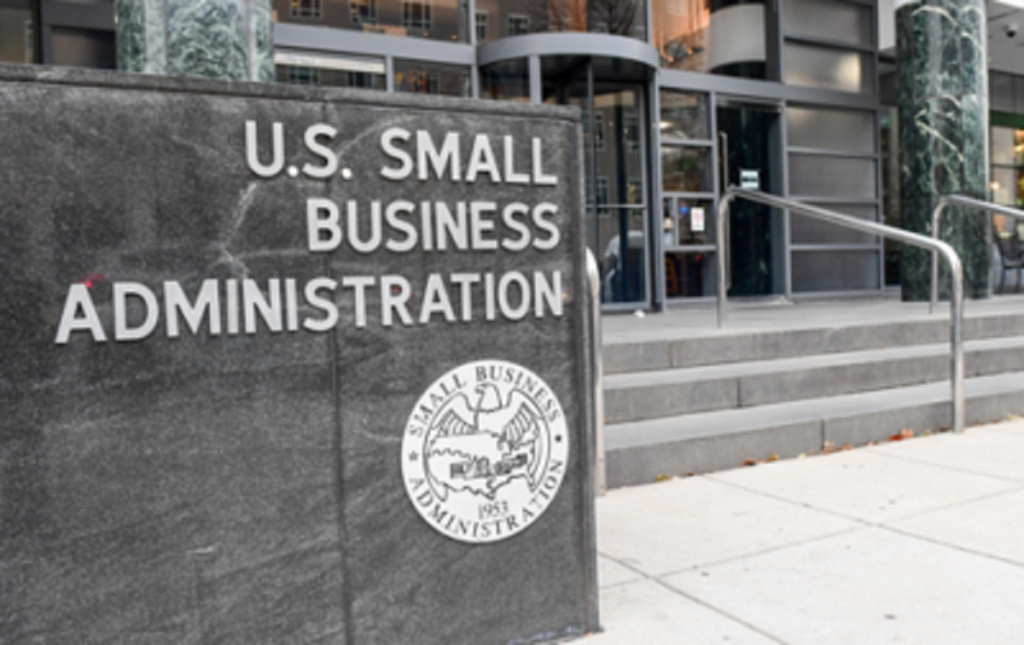
Small Business Administration building

Education Dept soft-launches employee reassignments to other agencies, in latest step of closure plans

The Education Department, in the latest step of the Trump administration’s plan to dismantle the agency, has begun transferring its employees to other federal agencies.

The department said Tuesday that it signed six new interagency agreements to transfer some of its programs and employees to the departments of Labor, Interior, State and Health and Human Services, in order “to break up the federal education bureaucracy.”

Education Secretary Linda McMahon told employees in an all-hands meeting that the department is soft-launching plans to reassign its work to other parts of the federal government, before calling on Congress to permanently shutter the agency.

McMahon, in a transcript obtained by Federal News Network, told employees that Education is currently transferring its employees out to other agencies “on a temporary basis.”

That temporary reorganization, she said, will give the Education Department a proof-of-concept to show lawmakers. At that point, the Trump administration will call on Congress to pass legislation that will officially shut down the department and codify the reorganization.

The department, she added, has already transferred 13 employees to the Labor Department, “so that we can be more efficient and economical,” and that more interagency agreements will soon be signed to transfer other staff.

McMahon said the Education Department’s budget still covers those 13 detailed employees, and that the Education and Labor Departments are currently “co-managing” them.

McMahon told employees that she has spoken to members of Congress about this reorganization plan, and is planning to move programs out of the Education Department “on a temporary basis” for now. But in the end, she said the Trump administration’s goal is to find enough votes in Congress “to close the Department of Education.”

“If it has worked, and we have proven that this is the best way to do it, then we’ll ask Congress to codify this and make it a permanent move out of the Department of Education into whatever agency that program has gone into,” McMahon told employees.

President Donald Trump signed an executive order in March, calling for the dismantling of the Education Department. McMahon told lawmakers during her confirmation hearing that the Education Department is set up by Congress, and “it clearly cannot be shut down without it.”

The department, so far this year, has lost about half of its employees through mass layoffs and voluntary separation incentives.

McMahon didn’t mention immediate layoffs or workforce reductions as part of this phase of the reorganization plans, but acknowledged shutdown-era layoffs could return in early 2026.

McMahon said the Education Department has cancelled reduction-in-force notices it sent to about 20% of its remaining workforce during the 43-day government shutdown.

The continuing resolution passed by Congress and signed by Trump put those RIF notices on hold at least through Jan. 30, 2026.

But beyond that point, McMahon acknowledged that RIFs may return.

“Moving forward, that creates unrest. It creates uncertainty for all of you, and I understand that,” she told employees. “I know how difficult it is to make decisions that, from my perspective, are going to affect people’s lives and their livelihood and their teams and what they’re working on. And it is not an easy decision.”

McMahon said a majority of the public didn’t support plans to close the Education Department, when the Trump administration first announced its plans. However, she said the majority of the public does support shifting these programs to other agencies to make them more efficient.

“When the goal will be to have congressional votes to close the Department of Education, we are not closing education. We’re lifting education up, and each of us in this room has a chance to be part of history, and that this is part of our legacy,” she said.

The six interagency agreements will move billions of dollars in grant programs to other agencies. The Labor Department, in particular, will oversee much of the federal funding that will go to K-12 schools, including grants for schools serving low-income communities.

The department says states and schools shouldn’t expect any disruptions to their funding, except that federal funds will now come from the Labor Department.

“The funding will not change. That may flow through a different account or a different building,” McMahon told employees.

The reorganization would move two of the Education Department’s largest programs, the Office of Elementary and Secondary Education and Office of Postsecondary Education, to the Labor Department.

However, the Education Department will still retain student loan oversight and accreditation of colleges to ensure they are eligible to receive students’ federal financial aid.

Critics of the reorganization say that the agencies taking on Education programs and personnel don’t have expertise in these policy areas, and that the transfer could disrupt some of its essential programs.

“That national mission is weakened when its core functions are scattered across other federal or state agencies that are not equipped or positioned to provide the same support and services as ED staff,” AFGE Local 252 President Rachel Gittleman said.

The Associated Press contributed to this story

The post Education Dept soft-launches employee reassignments to other agencies, in latest step of closure plans first appeared on Federal News Network.

© AP Photo/Ben Curtis

FILE - Secretary of Education Linda McMahon speaks to reporters at the White House in Washington, Thursday, March 20, 2025. (AP Photo/Ben Curtis, File)

Agencies prepare to bring back furloughed staff, rescind layoffs as shutdown comes to an end

Agencies are telling furloughed federal employees that they’re expected to show up Thursday morning, now that House lawmakers have ended the longest government shutdown.

Many of these federal employees have been on furlough for the past six weeks, and face a considerable backlog of work upon their return.

At least 670,000 federal employees have been furloughed, and 730,000 employees have been working without pay during the shutdown.

The spending plan passed by the House on Wednesday evening includes back pay for furloughed federal employees and those who worked without pay during the shutdown.

The Senate passed the shutdown-ending spending plan on Monday. The spending package includes a continuing resolution that will keep many agencies funded at current spending levels until Jan. 30, 2026.

Lawmakers also approved FY 2026 funding for the Agriculture Department, the Department of Veterans Affairs, military construction and the legislative branch.

The deal also reserves layoffs for about 4,000 federal employees and protects employees from further layoffs through Jan. 30.

In response, the IRS is in the process of rescinding layoff notices that were sent to mostly human resources and IT employees last month.

The Department of Health and Human Services told employees in an email Wednesday evening that it is “hopeful that the Democrat-led government shutdown may conclude today.”

“Please monitor the news closely and be prepared to return to work if Congress passes the appropriations bill this evening, and President Trump subsequently signs the bill into law,” the HHS email states.

The email, obtained by Federal News Network, states that all HHS employees who were furloughed must report for duty at their official duty station on Nov. 13, if the bill is signed into law on Wednesday night or Thursday morning.

“We deeply appreciate your patience, cooperation, and resilience during this challenging time. Thank you and your teams for your dedication and continued service on behalf of the American people,” the email states.

The Census Bureau is also directing its employees to return to work.

“If you’ve been following, it seems like a return to work is in view,” a bureau manager told employees on Wednesday. “Even in the absence of an [Emergency Notification System] message, we should expect to go to work tomorrow, if the President signs off.”

Meanwhile, the IRS chief human capital office (CHCO) is in the process of rescinding reduction in force notices that were sent to employees on Oct. 10, according to two IRS employees.

An IRS program manager told employees on Wednesday that “when the government reopens, CHCO will be sending RIF recession letters.”

IRS employees told Federal News Network that the layoffs put additional stress on an already beleaguered agency, which is looking to hire and train a substantial number of employees ahead of next year’s filing season.

The IRS is in the middle of preparations for next year’s filing season, which involves more work than usual, because the agency must implement the One Big, Beautiful Bill Act that Congress passed this summer.

An IRS program manager told staff that they “should continue to monitor the news, as we know we are getting closer to reopening and transitioning into the reactivation phase.”

The IRS has already lost about 25% of its workforce so far this year, largely through voluntary incentives.

More than 4,000 federal employees across the government received RIF notices in mid-October, following guidance from the White House that encouraged agencies to move forward with layoffs in the event of a funding lapse.

But those RIF notices will be reversed, as part of the deal to end the government shutdown.

The bill states that between the date of enactment and Jan. 30, no federal funds may be used “to initiate, carry out, implement, or otherwise notice a reduction in force to reduce the number of employees within any department, agency, or office of the federal government.”

White House Press Secretary Karoline Leavitt told reporters on Wednesday that “President Trump looks forward to finally ending this devastating Democrat shutdown with his signature, and we hope that signing will take place later tonight.”

Even with the rollback of the shutdown layoffs, Leavitt said the Trump administration has still taken major steps to “reduce the size of our federal bureaucracy.”

The post Agencies prepare to bring back furloughed staff, rescind layoffs as shutdown comes to an end first appeared on Federal News Network.

© Jory Heckman/Federal News Network

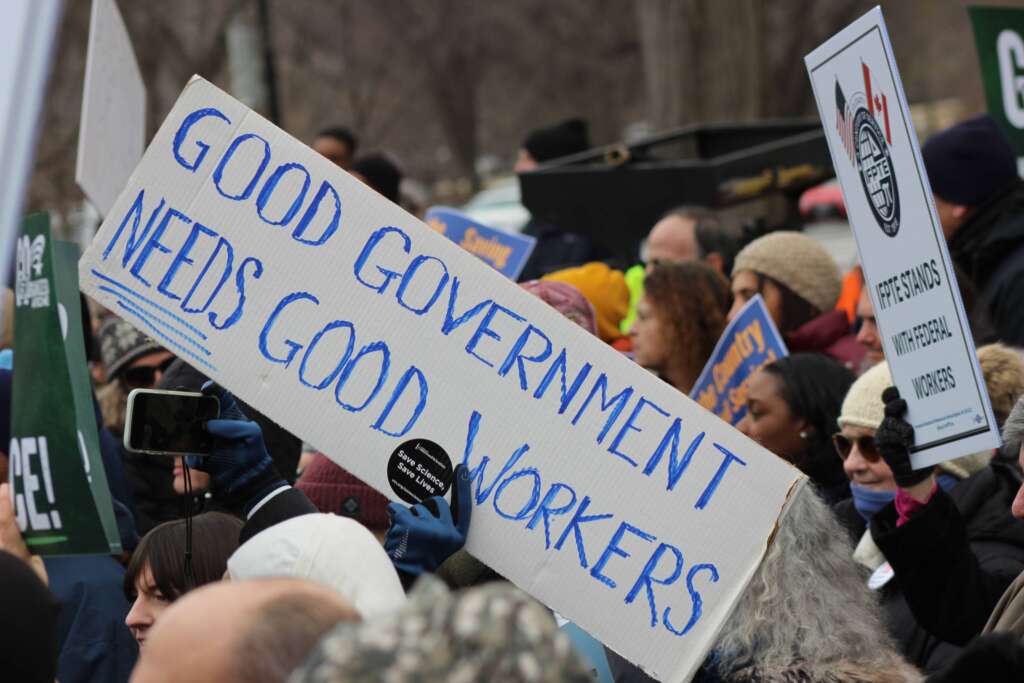
Federal workforce rally

Shutdown-ending deal stops severance freeze for laid-off federal employees

A deal to end the longest government shutdown, expected to pass the House later today and head to President Donald Trump’s desk, rescinds layoff notices sent to thousands of federal employees in October.

The spending plan doesn’t bring back jobs for former federal employees who received reduction-in-force (RIF) notices earlier this year and who have officially separated from the government. But it does mean their severance payments, which have been on hold since the start of the shutdown, will resume.

Former federal employees say the nearly month-and-a-half freeze on severance payments has been a less visible part of the shutdown’s financial impact, and added to the emotional toll felt by those who lost their jobs under the Trump administration.

The severance payment freeze has had a major impact on former employees at the Department of Health and Human Services.

HHS sent RIF notices to 10,000 employees in April, and another 10,000 HHS employees left the department through voluntary separation incentives. Last month, HHS sought to lay off nearly 950 additional employees, but those RIF notices are expected to be rescinded.

Thomas Nagy, Jr, HHS chief human capital officer and deputy assistant secretary for human resources, told former employees in an email obtained by Federal News Network that, “due to the current lapse in appropriations, you will not be receiving any further severance payments until funding is restored.”

Nagy told laid-off workers that they may see a “temporary debt” on their leave and earnings statement, because severance payments have been stopped, retroactive to the beginning of the lapse in appropriations.

He added that the department’s payroll provider, the Defense Finance and Accounting Service, “will initiate no collections actions, and that no funds will be withdrawn from your bank account,” and that HHS will resume payments “as soon as it is legally and operationally possible to do so.”

‘There is nobody we can ask’ 

A laid-off HHS employee’s latest leave and earnings statement, shared with Federal News Network, does not include her severance payment. Instead, it shows that she owes the agency nearly $4,000.

The employee, who requested anonymity to avoid retaliation, said no funds had been withdrawn from her account, but said the notice raised more questions than it answered.

“I have no idea if this means this is actually going to be collected from me at some point, or if this is just an error,” she said.

Aside from boilerplate emails, the former HHS employee said she received no further communication from the department. She said she’s not sure who else to contact at HHS, because her entire supervisory chain also received RIF notices, or were reassigned to different agencies within HHS.

“I don’t actually know anybody who I can ask anymore,” the former employee said, “There is nobody we can ask. That’s really upsetting.”

Federal News Network has heard from several other former HHS employees who saw negative amounts on their latest leave and earnings statements. None received any notice asking them to repay any amount.

HHS Press Secretary Emily Hilliard told Federal News Network in a statement that “severance payments may only continue for employees in organizations exempt from furlough based on their funding source.”

To comply with the Anti-Deficiency Act, agencies have suspended severance payments for the duration of the shutdown. It’s not immediately clear how soon those severance payments will resume, once the shutdown ends.

The Office of Personnel Management, in updated guidance sent ahead of the shutdown, told agencies that “no funds may be authorized for severance payments for days during the lapse until an appropriation is enacted.”

A Nov. 5 memo from the HHS Office of Human Capital Management, sent to Food and Drug Administration managers and supervisors, states that HHS “has suspended all severance payments to former employees due to the current lapse in appropriations.”

The memo, obtained by Federal News Network, states that the suspension of severance payments started for the pay period ending Nov. 1, and “affects all HHS organizations.”

“Due to funding constraints across multiple HHS organizations, HHS Office of Human Resources directed a department-wide suspension of all severance payments through the end of the appropriations lapse,” the memo states. “Former employees will receive retroactive severance payments once the appropriations lapse ends.”

The memo directed human resources staff at other HHS components to notify all former employees about the hold on severance payments by Nov. 7.

More than 1.4 million federal employees missed two full paychecks, and received a partial paycheck during the 43-day government shutdown. The Congressional Budget Office estimates the shutdown will cost the federal government at least $7 billion, and up to $14 billion.

Shutdown RIFs will be rescinded

More than 4,000 federal employees across the government received RIF notices in mid-October, following guidance from the White House that encouraged agencies to move forward with layoffs in the event of a funding lapse. But those RIF notices will be reversed, as part of the deal to end the government shutdown.

The bill states that between the date of enactment and Jan. 30, no federal funds may be used “to initiate, carry out, implement, or otherwise notice a reduction in force to reduce the number of employees within any department, agency, or office of the federal government.”

The Senate passed the shutdown-ending spending plan on Monday, and the House is expected to pass the bill on Wednesday. The bill includes a continuing resolution that will keep many agencies funded at current spending levels until Jan. 30, 2026.

Most, but not all, of those RIF actions have been on hold because of a preliminary injunction granted by a district court judge last month. Federal unions sued the Trump administration over the layoffs, alleging that they violated the Administrative Procedure Act. Unlike most lawsuits, the Trump administration did not appeal the district court’s ruling.

White House Press Secretary Karoline Leavitt told reporters on Wednesday that the administration “is very hopeful that this shutdown is going to come to an end.”

“President Trump looks forward to finally ending this devastating Democrat shutdown with his signature, and we hope that signing will take place later tonight,” Leavitt said.

Even with the rollback of the shutdown layoffs, Leavitt said the Trump administration has still taken major steps to “reduce the size of our federal bureaucracy.”

The Partnership for Public Service estimates that more than 211,000 employees have left the federal workforce this year, either through layoffs or voluntary incentives

“We’ve done a lot of great work on that front, and we will continue to. But obviously, the President’s main priority was to reopen the federal government and get people back to work, and that’s what this deal accomplishes,” Leavitt said.

The post Shutdown-ending deal stops severance freeze for laid-off federal employees first appeared on Federal News Network.

© AP Photo/Alex Brandon

President Donald Trump speaks after signing an executive order regarding TikTok in the Oval Office at the White House, Thursday, Sept. 25, 2025, in Washington. (AP Photo/Alex Brandon)
❌