Have you ever wondered what goes into making it possible to use the restroom at 30,000 feet (10,000 m)? [Jason Torchinsky] at the Autopian recently gave us an interesting look at the history of the loftiest of loos.
The first airline toilets were little more than buckets behind a curtain, but eventually the joys of indoor plumbing took to the skies. Several interim solutions like relief tubes that sent waste out into the wild blue yonder or simple chemical toilets that held waste like a flying porta-potty predated actual flush toilets, however. Then, in the 1980s, commercial aircraft started getting vacuum-driven toilets that reduce the amount of water needed, and thus the weight of the system.
These vacuum-assisted aircraft toilets have PTFE-lined bowls that are rinsed with blue cleaning fluid that helps everything flow down the drain when you flush. The waste and fluid goes into a central waste tank that is emptied into a “honey truck” while at the airport. While “blue ice” falling from the sky happens on occasion, it is rare that the waste tanks leak and drop frozen excrement from the sky, which is a lot better than when the lavatory was a funnel and tube.
The longest ever flight used a much simpler toilet, and given the aerospace industry’s love of 3D printing, maybe a 3D printed toilet is what’s coming to an airplane lavatory near you?
Preparations for Next Moonwalk Simulations Underway (and Underwater)
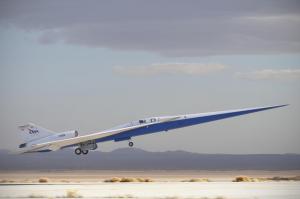
After years of design, development, and testing, NASA’s X-59 quiet supersonic research aircraft took to the skies for the first time Oct. 28, marking a historic moment for the field of aeronautics research and the agency’s Quesst mission.
The X-59, designed to fly at supersonic speeds and reduce the sound of loud sonic booms to quieter sonic thumps, took off at 11:14 a.m. EDT and flew for 67 minutes. The flight represents a major step toward quiet supersonic flight over land.
“Once again, NASA and America are leading the way for the future of flight,” said acting NASA Administrator Sean Duffy. “The X-59 is the first of its kind, and a major breakthrough in America’s push toward commercial air travel that’s both quiet and faster than ever before. Thanks to the X-59 team’s innovation and hard work, we’re revolutionizing air travel. This machine is a prime example of the kind of ingenuity and dedication America produces.”
Following a short taxi from contractor Lockheed Martin’s Skunk Works facility, NASA X-59 test pilot Nils Larson approached U.S. Air Force Plant 42’s runway in Palmdale, California, where he completed final system checks and called the tower for clearance.
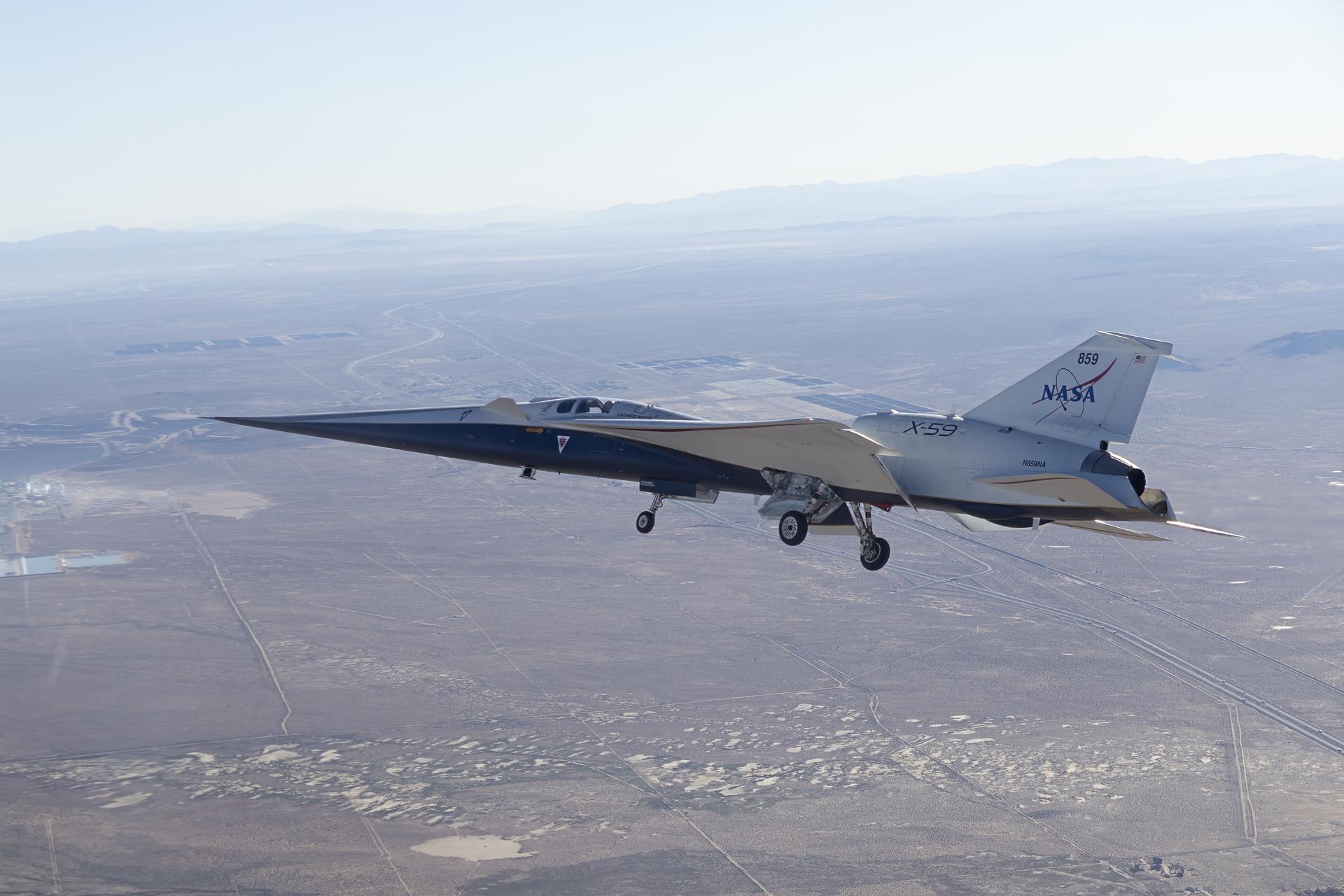
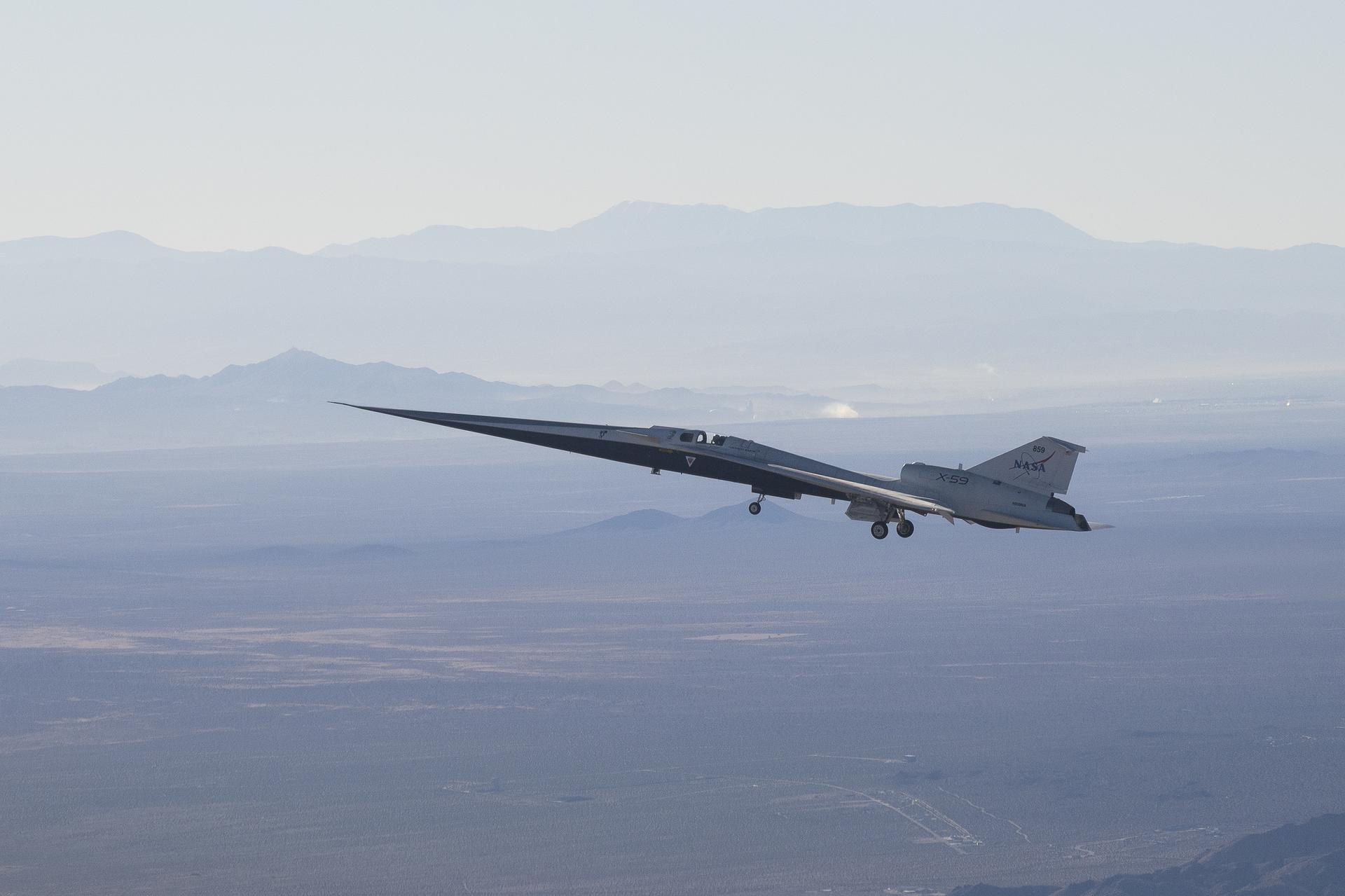
NASA’s X-59 quiet supersonic research aircraft cruises above Palmdale and Edwards, California, during its first flight, Tuesday, Oct. 28, 2025. The aircraft traveled to NASA’s Armstrong Flight Research Center in Edwards, California.
NASA/Lori Losey
Then, with a deep breath, steady hands, and confidence in the labor of the X-59’s team, Larson advanced his throttle, picking up speed and beginning his climb – joining the few who have taken off in an experimental aircraft for the first time.
“All the training, all the planning that you’ve done prepares you,” Larson said. “And there is a time when you realize the weight of the moment. But then the mission takes over. The checklist starts. And it’s almost like you don’t even realize until it’s all over – it’s done.”
The X-59’s first flight went as planned, with the aircraft operating slower than the speed of sound at 230 mph and a maximum altitude of about 12,000 feet, conditions that allowed the team to conduct in-flight system and performance checks. As is typical for an experimental aircraft’s first flight, landing gear was kept down the entire time while the team focused on ensuring the aircraft’s airworthiness and safety.
The aircraft traveled north to Edwards Air Force Base, circled before landing, and taxied to its new home at NASA’s Armstrong Flight Research Center in Edwards, California, officially marking the transition from ground testing to flight operations.
“In this industry, there’s nothing like a first flight,” said Brad Flick, center director of NASA Armstrong. “But there’s no recipe for how to fly an X-plane. You’ve got to figure it out, and adapt, and do the right thing, and make the right decisions.”
NASA’s X-59 quiet supersonic research aircraft flies above Palmdale and Edwards, California, on its first flight Tuesday, Oct. 28, 2025. The aircraft traveled to NASA’s Armstrong Flight Research Center in Edwards, California, where it will begin flight testing for NASA’s Quesst mission, which aims to demonstrate quiet supersonic flight over land.
NASA/Jim Ross
Historic flight
The X-59 is the centerpiece of NASA’s Quesst mission and its first flight connects with the agency’s roots of flying bold, experimental aircraft.
“The X-59 is the first major, piloted X-plane NASA has built and flown in over 20 years – a unique, purpose-built aircraft,” said Bob Pearce, NASA associate administrator for the Aeronautics Research Mission Directorate. “This aircraft represents a validation of what NASA Aeronautics exists to do, which is to envision the future of flight and deliver it in ways that serve U.S. aviation and the public.”
NASA Armstrong has a long history of flying X-planes that pushed the edges of flight. In 1947, the X-1 broke the sound barrier. More than a decade later, the X-15 pushed speed and altitude to new extremes. Starting in the 1960s, the X-24 shaped how we understand re-entry from space, and in the 1980s the X-29 tested forward-swept wings that challenged aerodynamic limits.
Each of those aircraft helped answer a question about aeronautics. The X-59 continues that tradition with a mission focused on sound – reducing loud sonic booms to sonic thumps barely audible on the ground. The X-59 was built for one purpose: to prove that supersonic flight over land can be quiet enough for public acceptance.
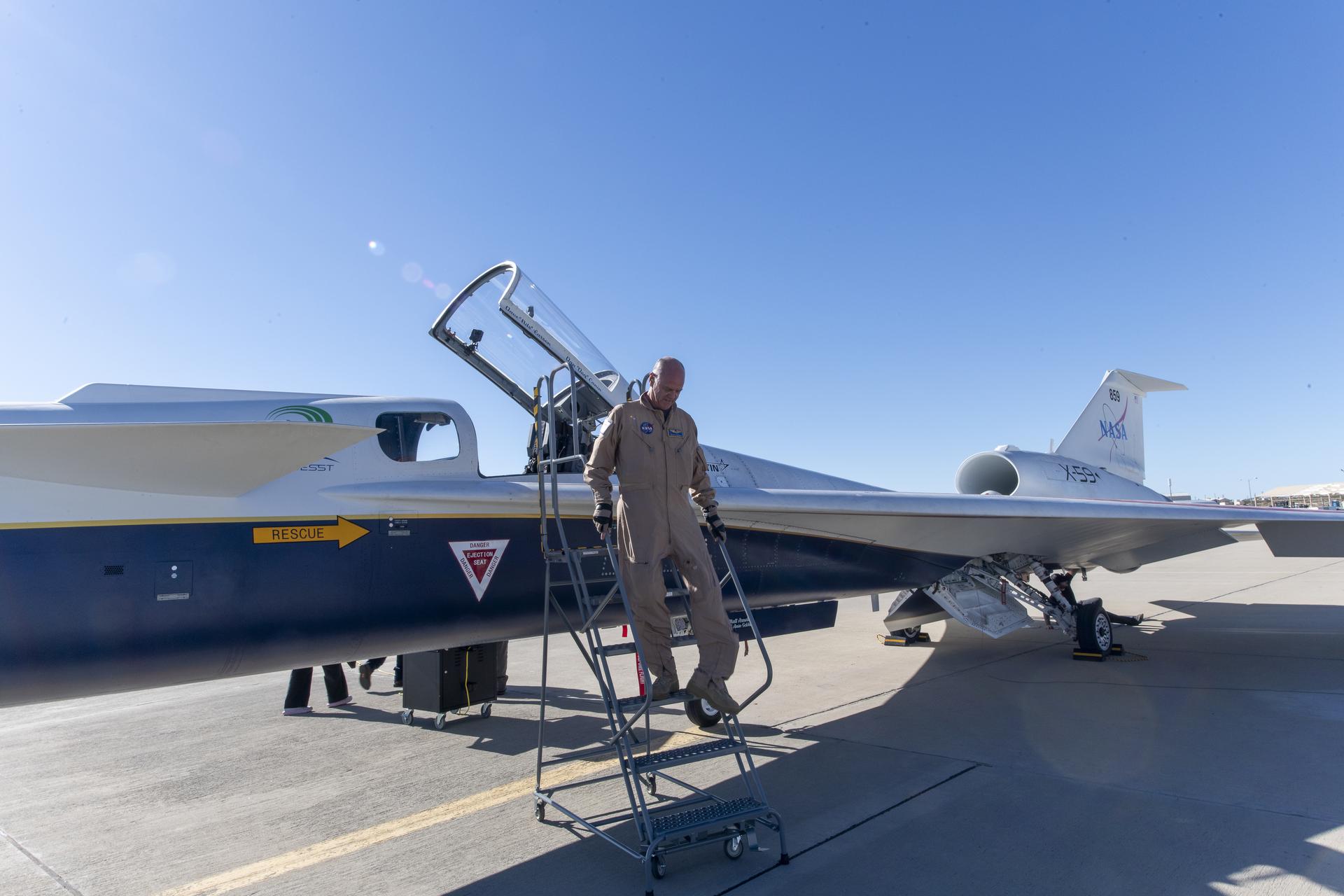
NASA test pilot Nils Larson steps out of the X-59 after successfully completing the aircraft’s first flight Tuesday, Oct. 28, 2025. The mission marked a key milestone in advancing NASA’s Quesst mission to enable quiet supersonic flight over land.
NASA/Genaro Vavuris
Next steps
Getting off the ground was only the beginning for the X-59. The team is now preparing the aircraft for full flight testing, evaluating how it will handle and, eventually, how its design will shape shock waves, which typically result in a sonic boom, in supersonic flight. The X-59 will eventually reach its target cruising speed of about 925 mph (Mach 1.4) at 55,000 feet.
The aircraft’s design sits at the center of that testing, shaping and distributing shock-wave formation. Its engine is mounted on top of the fuselage – the main body of the aircraft – to redirect air flow upward and away from the ground.
The cockpit sits mid-fuselage, with no forward-facing window. Instead, NASA developed an eXternal Vision System – cameras and advanced high-definition displays that allow the pilot to see ahead and below the aircraft, which is particularly critical during landing.
These design choices reflect years of research and modeling – all focused on changing how the quieter sonic thump from a supersonic aircraft will be perceived by people on the ground.
NASA’s goal is to gather community response data to support the development of new standards for acceptable levels of sound from commercial supersonic flight over land. To do this, NASA will fly the X-59 over different U.S. communities, collecting ground measurement data and survey input from residents to better understand people’s perception of the X-59’s sonic thump.
“Most X-planes only live in the restricted airspace here on center,” Flick said. “This one is going to go out and fly around the country.”
When the X-59 lifted off the ground for the first time, it carried a piece of NASA’s history back into the air. And with it, a reminder that advancing aeronautics remains central to NASA’s mission.
NASA’s X-59 quiet supersonic research aircraft took to the skies for the first time Tuesday, Oct. 28, 2025, departing from Lockheed Martin’s Skunk Works faci...
Jared Serbu Don’t need to dig into all of the details that went into the source selection here, but if you could give me, just give our listeners a minute or two on this new platform and what makes it such a step forward from the platforms it’s replacing, that would that would help us out greatly for the rest of the conversation.
Ryan Ehinger Yeah, and I could go ahead and give an industry perspective on that. And this is Ryan. So really back in the 2012, 2013 timeframe, we were looking to differentiate capability for the warfighter in terms of vertical lift capability by going twice as fast and twice as far. And a lot of that was under the future vertical lift program effort. And so we started with a demonstrator concept called the V-280 Valor. That really captured a lot of lessons learned from previous tilt rotor experience that Bell had, and it really leveraged that to fly a demonstrator in 2017, accumulate about 215 flight hours on it, and I think inform the Army on tilt rotor technology and requirements that could be met by that technology to support their eventual solicitation and down select of a tilt rotor for supporting the future long-range assault aircraft program.
Jared Serbu Great. Anything to add on that, Colonel?
Col. Jeffrey Poquette Yeah, it’s very similar in that the Army was looking for something that provided transformational speed and range over the current Black Hawk fleet. And then additionally, the government really wanted the aircraft to be an open system. So the ability to upgrade the aircraft in the future quickly, cheaply, without necessarily having to go to any one particular vendor. So the open system is another key part of the platform.
Jared Serbu Got it. And so at this point looking forward, the ask from the Secretary, as I understand it, is to get a prototype up and running by next fiscal year, which is pretty ambitious. So talk us through a bit some of the key things that you’re going to be doing to meet that schedule.
Ryan Ehinger Yeah, we’ve been laser focused on acceleration and getting a prototype out there next year. And so a lot of the work that we’ve been doing is taking the success that we had on the V-280 demonstrator, applying a lot of the items from that in terms of configuration and critical technologies, applying that to a design meeting the requirements for the future long range assault aircraft. And so what we’ve been working on with the government team is first and foremost establishing a foundation of an all digital design, incorporating using model-based systems engineering, but incorporating, as Jeff mentioned, the modular open systems approach. So a lot of the design work that we’ve been doing with the government to date has resulted in more than 90% of our engineering being released and a significant amount of work going on across the industrial base related to building hardware to support that first, and not just the first prototype, but the first six or eight prototypes that will be coming out of the program. But we’d look to complete that in early FY 27, that first prototype.
Jared Serbu Colonel, from the government side, what sorts of risks does that aggressive schedule potentially introduce for you, and what are some of the things that you’re looking to do to manage that?
Col. Jeffrey Poquette Yeah, I think initially when we were asked to accelerate, our concern was, okay, if we start working now while we’re still in the middle of the design process, the chance is always there that we could end up building a prototype that doesn’t do what we need it to do. The reason why we’re okay with that and are willing to accept some of that risk is exactly for the reasons that Ryan mentioned. The V-280 demonstrator gives us a lot of confidence in tilt rotor technology. We know Bell knows how to do it. The open system is something that they’re fully on board with. And then the digital engineering and the digital environment provides the government a lot of insight into the design itself as it’s occurring. Other things that we’ve agreed to do was allowed Bell to pursue some commercial best practices when it comes to safety of flight on some of the early prototypes and being able to leverage FAA certifications instead of Army airworthiness certifications, while in the background we’ll continue to work Army airworthiness. So that is a little bit of an elevated risk, but one that the Army was willing to accept. Some of the digital engineering and technical deliverables, we’ve deferred the actual delivery of the items. However, what we’ve decided to do is really work together as an integrated team. So my team of a hundred or so engineers very often are down there out in the Dallas-Fort Worth area, working side by side along Bell engineers. So we have the insight of working along the way. Bell has the ability to ask questions and make adjustments and they get feedback very quickly, as opposed to maybe earlier it was about handing over technical deliverables for very thorough reviews. So we’ve kind of accelerated our review process, other things. The supply chain is always a concern and the Secretary asked us to leverage the Defense Production Act. So we are engaged with the Army and soon to be the Department of War on how we can potentially get some elevated priority on our program when it comes to the Defense Production Act.
Ryan Ehinger Yeah, and I do think that approach is working well, and I do appreciate when people ask us the question about risk associated with acceleration because it gives us a chance to kind of walk through why I think we’re in a uniquely favorable position to accelerate. And part of it we talked about was the demonstrator and going 215 flight hours and all the data we were able to capture from that successful effort, but then also looking at the steps that we go through from early digital engineering and digital design where we have fly-throughs leveraging virtual reality and augmented reality. We bring the maintainers into that virtual environment and have them simulate maintenance of the aircraft very, very early in the design phase so that we don’t have discoveries, three, five, ten years later as we’re trying to sustain the platform. A lot of that gets baked in early. And then from the standpoint of getting to first flight and flight test activity, we spend a lot of time trying to get discoveries as early as possible in the process. And how we do that is by doing a lot of component-based testing, whether it’s fatigue testing, vibration testing, things of that nature at the component level. And then we integrate all of those components, aside from the structure, but all the systems, a pilot in the loop, all the software in a weapon systems integration lab. And we have that facility down in Arlington, Texas, and the pilot will fly a fully integrated set of systems on the ground for months and months and months, proving out the software and proving out the integration of these components before we ever step foot in an aircraft. So we get a lot of opportunity to reduce risk and learn these lessons early in the program before we’ve started making even some of those accelerated LRIP aircraft.
Jared Serbu Digital engineering’s come up a few times in the conversation so far, and I’m wondering if either or both of you want to give some concrete examples of some of the work that you’ve been able to do in that virtual world and save time that way versus things that, in a previous era, would have had to be done purely in a physical world.
Ryan Ehinger Yeah, just to give a couple examples and then I’ll pass it to to Jeff. But I mentioned the maintainers, and being able to have maintainers, in some cases it’s veterans that we’ve brought over from the services into Bell that have done this for their first career and now they’re spending their second career, so to speak, making sure we get it right. But they actually have virtual, I’ll say tools and toolboxes, and they work to maintain that aircraft. And they’ll come to the engineering team after a test run and say, look, I had to remove three things to get to the part I was trying to fix, and it gives us an opportunity to fix that and make sure that number one, keep things from failing, but if something does fail, let’s make sure it fails in a benign way and in a way that we can replace it and repair it in the field and as easily as possible. And the digital engineering, and I think Jeff will probably touch on this, it is an investment. And it’s an investment early on that allows you to also take all these digital artifacts as kind of one source of truth and use them to support your tech pubs and your manuals, and again that sustainment and logistics tail that the aircraft will have for decades to come. But it all goes back to that initial investment in digital engineering and that single source of truth. And I’ll pass it to Jeff.
Col. Jeffrey Poquette Yeah, we’re really proud of the fact that this program was born digital. So we are clearly leading the way for defense acquisitions. We’re a digital engineering pathfinder for the department. Like Ryan said, I think there’s perhaps a misnomer out there that the investment in digital engineering somehow means that you get to go fast while you’re designing. And I always say, look, this is an investment in time. So it doesn’t necessarily mean that we are designing faster. What it means is when we complete the design and then build it, you can actually test faster because there’s a lot more that’s right with the aircraft. You’re a lot closer to what you wanted to get. The model-based systems engineering approach has allowed us and allowed Bell to really come up with a design that we’re very confident won’t miss any of the key requirements. In the past, it would be hard to know whether you were going to miss satisfying a requirement until you got to test. And then if it happened to be a big expensive miss during test, then you’re now iterating in the test environment. The goal was to really iterate in this digital and MDSE environment such that when you build the prototypes, you can have a test program that’s half as long as a traditional aircraft test program that has occurred in the past. So that’s really what we’re getting at. MDSE and digital engineering go hand in hand. My engineers can go right to their computer and workstations and look at the design in real time. And that has never been able to be done before when you do things the old way.
Jared Serbu On that requirements piece, I’d love to hear you both talk through a bit about the extent to which, if at all, requirements have needed to be changed in order to meet that go faster directive. And if the answer’s no, tell us a bit about why not.
Col. Jeffrey Poquette I’ll take that one. Look, this aircraft is made up of hundreds and hundreds of requirements and they’re tiered into different buckets. None of the most important requirements to include things that are deeply important to the Army, like MOSA, have had to be trade off. Might we have to trade some weight, take on a little bit of extra weight to include some provisions to ensure that the aircraft is truly modular and can handle the SOCOM variant and handle the medevac requirement? Might we have had to make those kinds of decisions? Absolutely. Are there certain things in the requirements document that are deep down in the in the requirement that might not be on the first aircraft? Probably. But that’s not what we’re seeking. We’re not seeking perfection. The Secretary and the Chief made it very clear. We’re not trying to get it absolutely perfect. What we need to do is deliver transformational capability. That’s what we mean when we talk about the speed and range twice as far, twice as fast, and the ability to handle the MOSA architecture and the open system. If we get that, we’re going to have a very, very good first iteration of the aircraft. And by the same token, the open systems architecture will allow us to go in and upgrade anything that needs upgrading. When you go faster, you might have to trade off requirements. We haven’t had any big decision event like that yet, but it is certainly something that we might have to think about in the future.
Ryan Ehinger Yeah, and I would echo that. I think we’re very proud of where we’re looking relative to the requirements for the platform and the capability it will provide the warfighter. And I’ll just go back to the, I’ll say, head start we had relative to tilt rotor technology being being mature and giving us a good foundation to start with.
Jared Serbu Last thing here, and I don’t want to look too far down the road, but now’s the time to start thinking about these things obviously, and obviously you have been already thinking about sustainment, but specifically, what do things like that open systems architecture, having that engineering data, having all of that digital engineering data in hand, do for you, down the road when you get to a sustainment phase on a platform like this?
Col. Jeffrey Poquette I’ll take this one initially. So sustainment is one of the things we’ve been thinking about very early on in the program. When we went to our development decision, Milestone B, I would say nearly half of the very extensive and rigorous documentation we had to submit to the Army and the Department of War was focused on the lifecycle sustainment plan. So it’s very much a key element of the program. I would say one quarter of my office are logisticians that focus on things like training, on maintenance and that kind of thing. Ryan mentioned the digital environment, being able to look at the design through virtual means with virtual headsets or augmented reality, that kind of thing. That has given us the ability to provide feedback so we get it right the first time. And then having access to certain data rights allows the Army to write training so that the training meets the Army’s standards. It allows us to make decisions on what components we want to overhaul in the depot out there in Corpus Christi. Most importantly, I would say, is maintenance and ensuring that we have a good understanding about when parts will need to be replaced. I think all the work that Bell has done has allowed us to have a lot more insight into when components would need to be overhauled and replaced. Digital twins will be developed. So every tail number in the Army out there will have its own digital twin that will reside and can be accessed by my office so that if there is a problem in the field, my logisticians and former maintainers will be able to look at that digital twin and have a really good snapshot of what’s going on with the aircraft. And like Ryan said, it all comes down to having a single source of truth. In the past, documents would get shoveled over email, and eventually, inevitably, someone would end up with an out-of-date or not the current version of what you’re supposed to be looking at. This eliminates a lot of that churn, and I really see the sustainment of this aircraft is going to be a big part of why we call this aircraft affordable. As you know, sustainment, for the lifecycle of a program, we consider about 70% of the cost of the lifecycle of the program to be due to the sustainment phase. So it’s very important to us that we reduce those sustainment costs. And kind of final point here, you typically can estimate the sustainment burden of an aircraft based on its weight. And while the MV-75 isn’t especially light, it’s on the heavier side when you compare it to heavier lift aircraft like Chinook. We have a much, we’ve predicted through simulations and modeling that the sustainment is going to be much, much less than aircraft of its size and weight.
Ryan Ehinger Yeah, I think that’s a good point. And I would just say from an industry standpoint, programmatically and I’ll even say culturally, we’ve approached this clean sheet development in a different way that I think provides a lot more tools for the user, for the Army to maintain this long term. And some of the things that Jeff mentioned related to the correlation between weight and maintenance cost or weight and cost in general. I’d like to think we’re breaking some of those cost curves with this because of a lot of the tools that we’ve used, and quite frankly because of some of the newer technologies that are available today that weren’t available when some of the currently fielded aircraft were developed.
A crew member walks past U.S. Army UH-60M Black Hawk helicopters that will participate in an upcoming military parade commemorating the Army's 250th anniversary and coinciding with President Donald Trump's 79th birthday, at Joint Base Andrews, Md., Thursday, June 12, 2025. (AP Photo/Mark Schiefelbein)
A major Microsoft outage has disrupted Azure, Microsoft 365, Xbox, and Minecraft worldwide after a configuration failure, with services now gradually recovering.
Preparations for Next Moonwalk Simulations Underway (and Underwater)
Recent airborne science flights to Greenland are improving NASA’s understanding of space weather by measuring radiation exposure to air travelers and validating global radiation maps used in flight path planning. This unique data also has value beyond the Earth as a celestial roadmap for using the same instrumentation to monitor radiation levels for travelers entering Mars’ atmosphere and for upcoming lunar exploration.
NASA’s Space Weather Aviation Radiation (SWXRAD) aircraft flight campaign took place August 25-28 and conducted two five-hour flights in Nuuk, Greenland. Based out of NASA’s Langley Research Center in Hampton, Virginia, the mission gathered dosimetry measurements, or the radiation dose level, to air travelers from cosmic radiation. Cosmic radiation is caused by high-energy particles from outer space that originate from our Sun during eruptive events like solar flares and from events farther away, like supernovae in our Milky Way galaxy and beyond.
Science team partners from Honeywell reviewing dosimeter data on board NASA’s B200 King Air during a flight over Nuuk, Greenland.
NASA/Guillaume Gronoff
“With NASA spacecraft and astronauts exploring the Moon, Mars, and beyond, we support critical research to understand – and ultimately predict – the impacts of space weather across the solar system,” said Jamie Favors, director of NASA’s Space Weather Program at NASA Headquarters in Washington. “Though this project is focused on aviation applications on Earth, NAIRAS could be part of the next generation of tools supporting Artemis missions to the Moon and eventually human missions to Mars.”
Jamie Favors, NASA Space Weather Program director, and Chris Mertens, SWXRAD principal investigator, discussing a dosimeter at NASA’s Langley Research Center as specialized instruments are integrated onto NASA’s B200 King Air aircraft before deploying to Greenland.
NASA/Mark Knopp
NASA’s Nowcast of Aerospace Ionizing Radiation System, or NAIRAS, is the modeling system being enhanced by the SWXRAD airborne science flights. The model features real-time global maps of the hazardous radiation in the atmosphere and creates exposure predictions for aircraft and spacecraft.
NASA’s B200 King Air on the runway in Goose Bay, Canada, a stop during the flight to Nuuk, Greenland.
NASA/Guillaume Gronoff
“The radiation exposure is maximum at the poles and minimum at the equator because of the effect of Earth’s magnetic field. In the polar regions, the magnetic field lines are directed into or out of the Earth, so there’s no deflection or shielding by the fields of the radiation environment that you see everywhere else.” explained Chris Mertens, principal investigator of SWXRAD at NASA Langley. “Greenland is a region where the shielding of cosmic radiation by Earth’s magnetic field is zero.”
That means flight crews and travelers on polar flights from the U.S. to Asia or from the U.S. to Europe are exposed to higher levels of radiation.
Frozen and rocky terrain in the Polar region observed from above Nuuk, Greenland during NASA’s SWXRAD science flights.
NASA/Guillaume Gronoff
The data gathered in Greenland will be compared to the NAIRAS modeling, which bases its computation on sources around the globe that include neutron monitors and instruments that measure solar wind parameters and the magnetic field along with spaceborne data from instruments like the NOAA GOES series of satellites.
“If the new data doesn’t agree, we have to go back and look at why that is,” said Mertens. “In the radiation environment, one of the biggest uncertainties is the effect of Earth’s magnetic field. So, this mission eliminates that variable in the model and enables us to concentrate on other areas, like characterizing the particles that are coming in from space into the atmosphere, and then the transport and interactions with the atmosphere.”
An aerial view of Nuuk, Greenland.
NASA/Guillaume Gronoff
The SWXRAD science team flew aboard NASA’s B200 King Air with five researchers and crew members. In the coming months, the team will focus on measurement data quality checks, quantitative modeling comparisons, and a validation study between current NAIRAS data and the new aircraft dosimeter measurements.
All of this information is endeavoring to protect pilots and passengers on Earth from the health risks associated with radiation exposure while using NASA’s existing science capabilities to safely bring astronauts to the Moon and Mars.
Northern Lights, or auroras, seen over the city of Nuuk, Greenland. Auroras are considered space weather and are easily visible effects of activity from the Sun interacting with the magnetosphere and Earth’s atmosphere.
NASA/Guillaume Gronoff
“Once you get to Mars and even the transit out to Mars, there would be times where we don’t have any data sets to really understand what the environment is out there,” said Favors. “So we’re starting to think about not only how do we get ready for those humans on Mars, but also what data do we need to bring with them? So we’re feeding this data into models exactly like NAIRAS. This model is thinking about Mars in the same way it’s thinking about Earth.”
The SWXRAD flight mission is funded through NASA’s Science Mission Directorate Heliophysics Division. NASA’s Space Weather Program Office is hosted at NASA Langley and facilitates researchers in the creation of new tools to predict space weather and to understand space weather effects on Earth’s infrastructure, technology, and society.
For more information on NASA Heliophysics and NAIRAS modeling visit:
This module takes the often-confusing topic of Windows persistence and turns it into a pragmatic playbook you can use during real engagements. In this part we start small and build up: short-lived shell loops that are easy to launch from any user context, autostart locations and registry Run keys that provide reliable logon-time execution, scheduled tasks that offer precise timing and powerful run-as options, Windows services that deliver the most durable, pre-logon persistence, and in-memory techniques that minimize on-disk traces.
Techniques are shown with privileged # and non-privileged $ examples, so you can see what’s possible from the access you already have. Every method shows the balance between how secret it is, whether it stays after a restart, and what permissions you need to make it work.
Ultimately this module is designed to be immediately useful in the ongoing cyber conflict context. It is compact with repeatable techniques for maintaining access when appropriate.
Shell
Persistence can be achieved directly from a command prompt by creating a small looping construct that repeatedly launches a reverse or bind shell and then pauses for a fixed interval. The technique relies on a persistent cmd.exe process that keeps retrying the connection instead of using service registration or scheduled tasks. It’s a quick, user-space way to try to maintain an interactive foothold while the process lives. The example command is:
This runs a new command shell to execute the quoted loop. The for /L construct is used to execute the loop body repeatedly. In practice the parameters chosen here make the body run continuously. Inside the loop the nc.exe invocation attempts to connect back to the C2.
The chained ping -n 60 127.0.0.1 acts as a simple portable sleep to insert a roughly one-minute delay between connection attempts.
Pros: allows a controllable retry interval and can be launched from any user account without special privileges.
Cons: the loop stops on reboot, logoff, or if the shell/window is closed, so it does not survive reboots.
This method is useful when you already have an interactive session and want a low-effort way to keep trying to reconnect, but it’s a volatile form of persistence. Treat it as temporary rather than reliable long-term access. From a defensive perspective, repeated processes with outbound network connections are a high-value detection signal.
Autostart
Autostart locations are the canonical Windows persistence vectors because the operating system itself will execute items placed there at user logon or system startup. The two typical approaches shown are copying an executable into a Startup folder and creating entries under the Run registry keys. Below are two separate techniques you can use depending on your privileges:
Placing an executable (or a shortcut to it) in a per-user Startupfolder causes the Windows shell to launch that item when the specific user signs in. Using the ProgramData (all-users) Startup folder causes the item to be launched for any interactive login.
Writing a value into HKCU\Software\Microsoft\Windows\CurrentVersion\Run registers a command line that will be executed at logon for the current user and can usually be created without elevated privileges. Writing into HKLM\Software\Microsoft\Windows\CurrentVersion\Run creates a machine-wide autorun and requires administrative rights.
Pros: survives reboots and will automatically run at each interactive logon (per-user or machine-wide), providing reliable persistence across sessions.
Cons: startup autoruns have no fine-grained execution interval (they only run at logon) and are a well-known, easily monitored location, making them more likely to be detected and removed.
Services
Using a Windows service to hold a backdoor is more robust than a simple autostart because the Service Control Manager (SCM) will manage the process lifecycle for you. Services can be configured to start at boot, run before any user logs on, run under powerful accounts (LocalSystem, NetworkService, or a specified user), and automatically restart if they crash. Creating a service requires administrative privileges, but once installed it provides a durable, system-integrated persistence mechanism that survives reboots and can recover from failures without manual intervention.
The first line uses sc create to register a new service named persistence. The binPath= argument provides the command line the service manager will run when starting the service. In practice this should be a quoted path that includes any required arguments, and many administrators prefer absolute paths to avoid ambiguity.start= auto sets the service start type to automatic so SCM will attempt to launch it during system boot.
The second line configures the service recovery policy with sc failure: reset= 0 configures the failure count reset interval (here set to zero, meaning the failure count does not automatically reset after a timeout), and actions= restart/60000/restart/60000/restart/60000 tells the SCM to attempt a restart after 60,000 milliseconds (60 seconds) on the first, second and subsequent failures. This allows the service to be automatically relaunched if it crashes or is killed.
The third line, sc start persistence, instructs SCM to start the service immediately.
Pros: survives reboot, runs before user logon, can run under powerful system accounts, and can be configured with automatic restart intervals via the service recovery options.
Cons: creating or modifying services requires administrative privileges and is highly visible and auditable (service creation, service starts/stops and related events are logged and commonly monitored by endpoint protection and EDR solutions).
Scheduled Tasks
Scheduled tasks are a convenient and flexible way to maintain access because the Windows Task Scheduler supports a wide variety of triggers, run-as accounts, and recovery behavior. Compared with simple autostart locations, scheduled tasks allow precise control over when and how often a program runs, can run under powerful system accounts, and survive reboots. Creating or modifying scheduled tasks normally requires administrative privileges.
Here the schtasks /create creates a new scheduled task named persistence. The /ru SYSTEM argument tells Task Scheduler to run the job as the SYSTEM account (no password required for well-known service accounts), which gives the payload high privileges at runtime. The /sc MINUTE /MO 1 options set the schedule type to “minute” with a modifier of 1, meaning the task is scheduled to run every minute. /tn persistence gives the task its name, and /tr "..." specifies the exact command line the task will execute when triggered. Because Task Scheduler runs scheduled jobs independently of an interactive user session, the task will execute even when no one is logged in, and it will persist across reboots until removed.
Pros: survives reboot and provides a tightly controlled, repeatable execution interval (you can schedule per-minute, hourly, daily, on specific events, or create complex triggers), and tasks can be configured to run under high-privilege accounts such as SYSTEM.
Cons: creating or modifying scheduled tasks typically requires administrative privileges and Task Scheduler events are auditable and commonly monitored by enterprise defenses.
In-Memory
In-memory persistence refers to techniques that load malicious code directly into a running process’s memory without writing a persistent binary to disk. The goal is to maintain a live foothold while minimizing on-disk artifacts that antiviruses and file-based scanners typically inspect. A common pattern is to craft a payload that is intended to execute only in RAM and then use some form of process injection (for example, creating a remote thread in a legitimate process, reflective DLL loading, or other in-memory execution primitives) to run that payload inside a benign host process. The technique is often used for short-lived stealthy access, post-exploitation lateral movement, or when the attacker wants to avoid leaving forensic traces on disk.
Pros: extremely low on-disk footprint and difficult for traditional antivirus to detect, since there is no persistent executable to scan and many memory-only operations generate minimal file or registry artifacts.
Cons: does not survive a reboot and requires a mechanism to get code into a process’s memory (which is often noisy and produces behavioral telemetry that modern endpoint detection and response solutions can flag).
Defenders may monitor for anomalous process behavior such as unexpected parent/child relationships, unusual modules loaded into long-lived system processes, creation of remote threads, or unusual memory protections being changed at runtime.
Summary
We explored different basic Windows persistence options by comparing durability, visibility, and privilege requirements: simple shell loops let you keep retrying a connection from a user shell without elevation but stop at logoff or reboot. Autostart provides reliable logon-time execution and can be per-user or machine-wide depending on privileges. Scheduled tasks give precise, repeatable execution (including SYSTEM) and survive reboots. Services offer the most durable, pre-logon, auto-restarting system-level persistence but require administrative rights and are highly auditable. In-memory techniques avoid on-disk artifacts and are stealthier but do not persist across reboots and often produce behavioral telemetry. The core trade-off is that greater restart resilience and privilege typically mean more detectable forensic signals, defenders should therefore watch for repeated outbound connection patterns, unexpected autoruns, newly created services or scheduled tasks, and anomalous in-memory activity.
In the first part of Advanced Windows Persistence, we will dive into advanced techniques that will leverage the Configs, Debugger, GFlags and WMI.
We enjoyed the best of both worlds when an intercultural wedding was celebrated in the family a month ago . Fun and frolic , music and dance , flowers and lights , food and beverages dotted with various religious ceremonies kept both guests and hosts on toes .
It was a two day wedding commencing with Ganseh pooja . After Haldi , Mehndi and a grand Welcome Lunch, Ring Ceremony and Sangeet Ceremony followed . Finally the DJ party took over and rocked through the night . The next morning the groom's family chose a time slot before the Mayra Ceremony to conduct the traditional Maalai Maatral (Exchange of garlands) and Knnoonjal ( Swing ) ceremonies. Many a time these two traditional customs are rushed through with great tension as the Muhurtam time would be closing in soon .
But in this wedding the Muhurtam was scheduled at 9.30 P.M. Hence we had lot of time for conducting the rituals at an enjoyable and leisurely pace. The bride and the groom seated on the shoulders of their respective uncles had a fun time exchanging garlands . The uncles helped the couple dodge each other amidst loud cheering of excited onlookers .
After the exchange of garlands the couple were made to sit on a decorated swing . Elderly ladies queued up to to feed the couple with banana slices mixed with milk . Red and yellow coloured rice balls were waved around the bride and groom and thrown on all the four directions to protect them from the negative effects of evil eyes .
The high pitched Oonjal songs specially composed for the occasion echoed all around . The groom's father surprised the crowd by singing a Carnatic Classical while the aunt presented an 'abhinayam' (expressing the essence of the lyrics in Bharatanatyam dance Style ) for the same.
Ladies aged from 8 to 80 danced around the bride and the groom for a 'Kummi' Song played by the Naadaswaram artist . The participants went round in circles dancing and clapping to the rhythm of the instrument . As the momentum caught up more and more ladies joined the fun .
A Kathakali artist in his traditional make up and attire lead the kids carrying trays of Vilayaadal Saman in a procession . The kids presented the Vilayaadal Saman to the bride in style. A nine year old sweet girl wearing Pattu Pavadai Chokka ( Traditional long skirt and blouse ) read out the meaning of the ritual to the bride and her relatives. A lovely tween wearing Pavadai Davani (Traditional long skirt and half saree ) read out notes describing each and every Vilayaadal Item presented) .
The Baraat in the evening transported us to a totally new dream world ! The procession was lead by music and dance , lights and gaiety. The Groom dressed in glittering Sherwani , turban and pearls with a sword tucked in his belt , looked like a Prince from far away historic times ! The bride was no less than an angel , adorned with a gorgeous Lehenga , exotic jewellery and above all a priceless smile !
Finally with Fire God as witness and the full moon smiling from above , Saath Phere / Saptapadi - the most important ritual in a Hindu wedding which seals the wedding bond between the bride and the groom , was conducted !
The memories of the royal wedding celebrated in a dream land still lingers in my mind 💖!
The following text about Vilayaadal and Vilayaadal Saamaan is from the notes read out to the bride by the little girls in the family.
INTRODUCTION
Vilayaadal is a Tamil word literally meaning 'playing'. It is a fun filled social event which originated in olden times when children were married off at a very young age , the bride often younger than ten . Vilayaadal ritual was meant to serve as an ice breaker for the young couple as well as for their respective siblings. The child brides were presented with dolls , play things , grooming kits , clothes and accessories by the groom's sisters . The newly married couple were also made to play variety of competitive games with relatives on both sides joining as cheer leaders . The participants were also encouraged to display their singing and dancing talents.
In modern times marrying couples are no longer little kids . But the Vilayaadal ritual is retained in traditional weddings for the sheer fun and joy it brings to the wedding festivities. Many modern brides find it amusing to receive Barbie Dolls and toys as Vilayaadal gifts !
Here is a brief account of the Vilayaadal Saamaan presented to welcome the lovely Mumbai bride to our Bengaluru family. The assortment of artifacts representing the customary Vilayaadal items are hand picked from the four Southern States on behalf of all the little girls of our family .
MARAPPACHI DOLLS
These dolls are hand carved , out of Red Sanders , a valuable wood found in Andhra Pradesh .The paste of the wood has healing properties and is valued in indigenous medical systems.
The Marappachi pair represents Lakshmi and Vishnu or Raja Rani and occupy pride of place in the Navaratri Dolls Display ( Golu in Tamil , Gombe Habba in Kannada , Bommala Koluvu in Telugu ) organized in South Indian homes.
ROSEWOOD INLAY JEWEL BOX
An intricate handicraft of Karnataka , a state rich in forest wealth . Inlay work using various materials on rosewood base is a traditional craft perfected by the Gudigars ( artisans who carve wood ) of Karnataka . The craft was patronized by the Wodeyar Kings of Mysore Kingdom.
The elephant motif is very popular in the State and is seen in all possible arts and crafts . Karnataka is home to the largest population of Elephants in India.
SANDALWOOD JEWELLARY
Southern Karnataka is called Gandhada Gudi - The temple of Sandal Wood - as the forests are thick with Sandal Wood trees . Creating beautiful and fragrant artefacts out of the valuable wood is a traditional craft promoted by the former Kings and now by the Government of Karnataka.
Sandal wood bead malas and bracelets are choice pieces from our artisans.
CHANNAPATNA TOYS
The wooden toys and other articles made in Channapatna - THE TOY TOWN OF KARNATAKA - are G I Tagged. The products are hand turned , hand painted and finished with lacquer coating. They are light weight , and have a non toxic colouring. The craft was introduced in Channapatna 300 years ago and perfected with Japanese Techniques 100 years ago. The wood used is Ivory Wood , Cedar , Sycamore and Rubber Wood.
CHOPPU JAAMAAN ( SAAMAAN)
Toy Kitchen set made of wood are known as Choppu . Kitchen play sets are traditional toys gifted to little girls from times immemorial in all societies of the world.
These Choppu Jaamaan from Kanyakumari District of Tamil Nadu are both play things and collectibles. Colourful wooden Choppus are widely sold in Fairs , Pilgrimage centers and retro shops. All sets big or small are packed in hand woven palm leaf baskets called Olai Koodai.
COCONUT SHELL CRAFT OF KERALA
Kerala the land of coconut palms has a long tradition of using all parts of this palm - called Kalpavriksham - without wasting even a twig. The hard shells of the nut make very good cups and utensils , found in all traditional homes along the South West Coast . In present times too eco friendly essentials are being made with more refined finishing.
The Soup Bowls with spoons are from the rural artisans near Palakkad in Kerala .
METAL LAMPS
In India a lamp is regarded as a metaphor for Knowledge . No ritual is complete without lighting an oil lamp. Brass and Bronze lamps of high quality are produced in centuries old foundries of Swamimalai near Kumbakonam in Tamil Nadu . Kerala too has its own long tradition in casting Bronze lamps. In Karnataka , Nagamangala and Karkala have been traditional centers for metal casting by a process called Lost Wax Process.
Kuttuvilakku , Agal Vilakku , Paavai Vilakku , Koondu Vilakku , Kamakshi Vilakku are some of the traditional lamps cast in brass and bronze.
MYSORE SILK STOLE
The name Mysore Silk has justly become a byword for high quality soft silk . The innovative yarn twisting procedure introduced in the Mysore Kingdom during the 20th century beat back the Silk that was being imported from China. Local weavers who had already adopted Silk Worm breeding and Silk Yarn spinning during the middle of 18th century were trained to create the iconic MYSORE SILK. Ramanagaram continues to be the bulk producer of Silk since then.
KOBRI SAKKRE
This is a commonly prepared give away Prasadam in and around Mysore region. It is given to visitors on all happy occasions as a symbol of sharing joy. Dry coconut ( Kobri) , Sugar ( Sakkre ) , Roasted gram and Cardamom are ground together into a coarse powder and given to the guests in small packets along with the customary Tamboolam ( Betel leaves , betel nuts and coconut ).
For weddings beautiful motifs are carved on whole Kobris or made into decorative Kobri dolls to represent the bride and the groom .
Sugar dolls ( Sakkre Achchu ) have a special place in this ensemble . The Nandi Idol moulded with Roasted gram and jaggery complete the use of all the auspicious ingredients for the happy occasion.
In olden days all traditional homes had skilled hands which were adept in making decorative Kobris and Sugar Dolls ( Sakkre Achchu). In modern times these beautiful edible artifacts are out sourced along with other wedding Sweets.
PARUPPU TENGAI
Paruppu Tengai is a cone shaped traditional sweet which has a prominent place in South Indian Weddings . Boondi , Manoharam , Coconut Burfi , Sugar or jaggery coated Cashew nuts , Peanuts , Roasted gram are some of the sweets used in the making of Paruppu Tengais . Sometimes colourful Cadbury candies are also used in preparing the cones. Any prepared Sweet at the finishing stage is poured into greased conical moulds and are allowed to cool down . The pair of Sweet Cones are said to represent Shiva and Shakti .
The colourfully decorated Paruppu Tengais occupy the central position among other Seer Bakshanams presented to the groom's party during the wedding rituals .
I conclude this post with lots of blessings to the newly weds , who gave us an opportunity for the inter cultural bonding of two families , which will last for ever . Thank you family for encouraging me to write this memoir ! Special thanks to my sister who always stands by me in all my endeavours .
The Japan Aerospace Exploration Agency (JAXA) announced in a press release on
November 26 that it successfully used a water propellent system to drive its
"EQUULEUS" CubeSat. The craft was launched by NASA's Artemis I on November 16.
EQUULEUS has a water propellant engine named AQUARIUS (AQUA ResIstojet
propUlsion System) that uses heat from communications equipment to turn water
into steam, which can be jetted out to generate thrust.
Why Use Water as Fuel?
Water is a better choice than other fuels for use in small, cheap satellites
because it is easier to store and handle.
EQUULEUS Flight Path
Artemis I injected the spacecraft into a lunar flyby trajectory. Then EQUULEUS
fired its steam engines and started its journey to the second Moon Lagrange
point (EML2), and it should take a year and a half to reach EML2.
"I am proud of the EQUULEUS operation team, who were able to immediately
complete the orbital control necessary for the lunar fly-by, just one day
after the checkout operation shortly after launch. This was a difficult
operation that had to be successful. I feel we were able to succeed in this
critical operation due to their careful preparation, including numerous
back-up plans, and the ability to respond flexibly through training. We are
now at the start line of the long voyage to the Lagrange point,"
said FUNASE Ryu, an associate professor at the Department of Aeronautics
and Astronautics, the University of Tokyo, Japan.

 Login
Login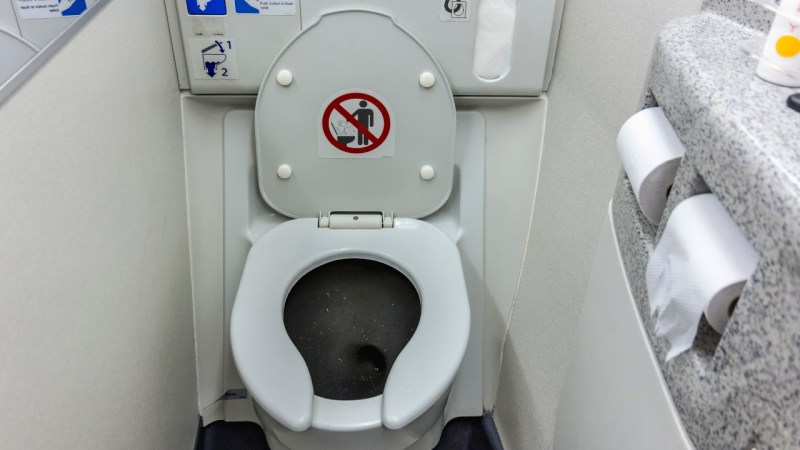











%20resized.jpg)


%20resized.jpg)


%20resized.jpg)
.jpg)
%20resized.jpg)


