
❌

Reading view

There are new articles available, click to refresh the page.

PTSD and the News

Usually my parent/pal/people tech support duty (PTSD) blogs are about friends asking me for help. But sometimes I come across people who don't know enough to ask, or don't know who to ask. (Note: I'm not soliciting people to ask me for help.)

I watch the local news every evening. Most people watch it over cable TV, but I don't have cable. (I haven't subscribed to a cable TV service in over 25 years.) They do have broadcast news, but when everything moved from analog to digital in 2009, I stopped receiving that. So, I watch the news over their streaming service. They offer a live stream on their web site and through their Roku app.

I'm a huge fan of our local news service, 9News in Denver. They cover local things around the state, as well as the major national and international topics. Moreover, they report on positive, entertaining, and inspirational topics, not just the negative. (They are not like other news channels. I've seen some news stations that are nothing more than a list of deaths and body counts around the city, state, country, and world.) 9News is really good at sifting through everything and giving accurate fact-based reporting while not causing viewers to become steadily depressed.

9News has even made national news, such as when Kyle Clark moderated a 2024 political debate. The Columbia Journalism Review remarked, "That’s how you run a debate!", noting: "[Kyle Clark] refused to allow the candidates to evade his direct questions with waffling, rambly answers, instead repeatedly cutting them off: β€œYou didn’t make any attempt to answer the actual question,” he said at one point." (Kyle also became internet-famous in 2013 for ranting about snow-covered patio photos.)

Keep in mind, it's not just Kyle Clark. Kim Christiansen, Jennifer Meckles, Jeremy Jojola, and other staffers have each earned several awards for news reporting. I don't mean to slight the others through omission; it's a long list of reporters and investigators. There are no slackers on their staff, and they are all held to a very high standard. Just by being on 9News, I trust the quality of their reporting. (And for my regular blog followers, you know that I don't typically have blind trust.)
Technical Difficulties

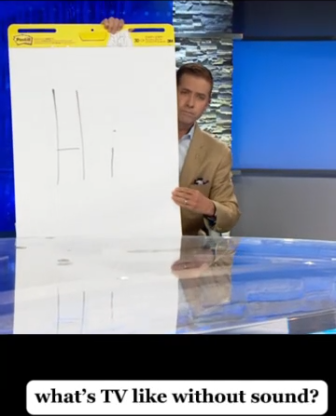
A few months ago, their newsroom was doing some upgrades that were causing technical problems. One day they had no video. Another day there was no audio. I mean, seriously, the news anchor used a paper flipboard to write out the news!


(Instead of calling it "9News", we jokingly called it "Mime News". Kyle Clark was the guy trapped in the TV box and couldn't make a sound.)

The Next! Problem

Fortunately, the audio problem only lasted for one broadcast. Unfortunately, it was followed by another problem: the live stream broke. For a few days, it wouldn't play at all. After a few days, it started up in 4x fast forward mode for a few seconds (without sound) before freezing completely. Meanwhile, I was writing in almost daily complaining that their Roku and live streaming services were not working. (I want to watch their news!)

After more than a week of this, the problem changed. I could see the video, but whenever it switched to or from a commercial break, the audio would drop. It wouldn't recover without restarting the stream. (You could either reload the web page or close and restart the Roku app. In either case, you'd miss the first 20-30 seconds of each news segment.)

My inquiries eventually got me in touch with their IT staff. Yes, they knew there was a problem. Unfortunately, it was inconsistent and not impacting everyone. Moreover, they were having trouble tracking down the cause. (As a techie, I can totally understand how hard it is to track down an inconsistent problem, especially when you cannot reproduce it locally.)

Well, this sounded like a job for "PTSD Man!" and his People Tech Support Duties!


Debugging a Stream

The first thing I did was check with a few friends who watch the same news using the same Roku app. One friend had the same "it's broken" problem. The other friend had no problem playing the newscast. (At least I could duplicate the "doesn't impact everyone" issue reported by the IT staff.)

Debugging the live stream wasn't easy. While some video streams are unencrypted, the news was being streamed over HTTPS. What this meant: I couldn't just use wireshark to sniff the stream and I couldn't directly detect the problem's cause.

I tried a different approach. If I couldn't see the streaming data directly, perhaps I could download fragments and identify any issues.

Chrome and Firefox have a developer panel that shows the web-based network requests. Unfortunately, it doesn't show the raw media streams. However, live streams typically have a series of web requests that contain URLs to the raw stream segments. I could see those requests in the developer panel and their the list of URLs. A typical sequence reply might look like:
#EXTM3U
#EXT-X-VERSION:6
#EXT-X-TARGETDURATION:6
#EXT-X-MEDIA-SEQUENCE:7800004
#EXT-X-DISCONTINUITY-SEQUENCE:0
#EXT-X-PROGRAM-DATE-TIME:2025-08-20T18:52:06.336Z
#EXTINF:6.006,
https://playback.tegnaone.com/kusa/live/index_3_7800004.ts?m=1716401672
#EXT-X-PROGRAM-DATE-TIME:2025-08-20T18:52:12.342Z
#EXTINF:6.006,
https://playback.tegnaone.com/kusa/live/index_3_7800005.ts?m=1716401672
#EXT-X-PROGRAM-DATE-TIME:2025-08-20T18:52:18.348Z
#EXTINF:6.006,
https://playback.tegnaone.com/kusa/live/index_3_7800006.ts?m=1716401672
#EXT-X-PROGRAM-DATE-TIME:2025-08-20T18:52:24.354Z
...

These URLs to the raw MPEG stream data can be easily requested with wget. I grabbed a few samples during the newscast and during commercials. Poof -- I found the problem.

There are many different ways to encode a video stream. There's not just one compression setting; there are lots of choices. A video may use a constant bitrate (CBR) or variable bitrate (VBR). The frame rate can also be constant or variable (CFR or VFR). At least, that's the theory.

In practice, there are some things that should never change and some things always change. For example:
  • With video (the visual portion), the aspect ratio should never change. (This doesn't mean it doesn't, but it shouldn't.)

  • VBR is very common with most audio codecs. Some, like the Advanced Audio Coding (AAC) method (which is extremely common), almost always uses VBR. MPEG supports VBR, but CBR is common.

  • VFR for video is often used if the video has long segments that don't change. ("Long" could be a fraction of a second or minutes.) This way, they only encode the one frame and leave it on the screen, rather than re-encoding and transmitting the same data over and over.

  • VFR for audio is very uncommon because it can cause synchronization errors. Moreover, audio VFR can result in audio misalignment if you try to fast-forward or rewind the audio stream. (If you've ever fast-forwarded or rewound a video and the audio was out of sync for a few seconds, that could be VFR or just bad alignment.)

  • While the bitrate and frame rate may change in the stream, the sample rate is usually constant. For audio, MPEG-1 uses a fixed sample rate and does not support changing the rate within a single stream. WAV and PCM only define the rate once, so it cannot change. AAC does support a variable rate, but it's uncommon; a fixed sample rate is typical. Moreover, some AAC profiles (like the kind typically used for streaming broadcasts) does not support a variable sample rate.
The FFMpeg media library doesn't always work well with a variable sample rate. Depending on the codec, the library might detect a change in the rate and decide the stream is corrupted. Worse: if the stream is associated with the video, then the corruption may cause unexpected results, like playing at the wrong speed or hanging. If the sample rate changes in the audio stream, then the player may just assume the audio is corrupted and stop playing sound.

That's what I was seeing with the live newsfeed. They were changing rates between the shows and the commercials. The change was detected as a corruption and the stream would drop sound.

Keep in mind, not all media players do this. It depends on the player and library version. (And as the user, you probably don't know what you're using.) Some libraries see the change, flush the buffer, and can safely recover from the corruption. However, other libraries see the corruption and give up. This makes the problem inconsistent between different people and different media players.

News to You

I reported my findings to the news channel's IT staff. They went running off and had the problem fixed in under 30 minutes. It's worked flawlessly since. (However, if you use Wireshark, you can see a ton of out-of-order TCP packets and retries, so I think they still have a networking problem. But that's probably due to the CDN and not the IT staff.) Today, I can watch the news again via Roku or in my web browser. (Huge thanks to the IT staff for listening to a rando spouting technical details over email, and for being incredibly responsive as soon as the problem was explained.)

On various online "can anyone help" forums, there are a lot of people reporting similar streaming problems with other online streaming services. I suspect they are all the same problem: the stream providers are changing the sample rate incorrectly, changing the aspect ratio (never change the aspect ratio in a video stream!), or otherwise failing to normalize the media between different segments. This is causing the media library to detect a corruption and the stream fails.

Now for the Bad News

I'm thrilled to be able to watch the news again via the streaming services. Unfortunately, earlier this week it was announced that the local Denver NBC affiliate's parent company, TEGNA, is being sold to Nexstar. Nexstar owns the local FOX station.

Personally, I equate FOX with fiction, conspiracies, and propaganda. This goes along with FOX repeatedly being involved in defamation and false reporting lawsuits, such as paying $758M to settle with Dominion Voting over FOX's false reporting, being sued for $2.7 Billion by Smartmatic, and most recently (June 2025) being sued by California's Governor Newsom for alleged false reporting. (Friends don't let friends watch FOX.)

In contrast to FOX, I think our local NBC 9News provides fair and balanced reporting. To me, they epitomize journalistic integrity. I don't know if they will continue that way after the merger and restructuring, or if we will have one less reliable news source in the area and the world.

Even though I don't know them personally, their newscasts come into my home every evening. They're so regular, that they feel like part of my extended family. (And like my extended family, I'm glad they don't regularly visit in person.) I typically reserve tech support for family and friends, which is why the folks at 9News became my newest cause of PTSD. If the staff at 9News end up jumping ship to another station, I'm certain to follow them.

Six Million Pictures

Last Saturday we hit a milestone at FotoForensics: 6 million unique pictures! I was really hoping that this achievement wouldn't be marred by porn so I could do a deep dive into it. (SPOILER ALERT: Not porn! Woo hoo!)

Here's the picture! It arrived on 2023-01-14 at 11:50:55 GMT:


I'm not big on following sports, celebrities, or pop culture, so I approached this picture with zero knowledge. The picture shows two women and a guy at some kind of club or restaurant. However, I don't know the people or the situation. This sounds like a great opportunity to do some image sleuthing. (Click on the picture to view it at FotoForensics.)

Side note: I'm writing this as a streaming flow of consciousness. I didn't gather the pictures or complete this investigation before I started writing.

Where to start? Metadata!

When evaluating a picture, it's always good to check the metadata. A camera-original picture will often include date, time, camera settings, and other information that can help track down the source. For example, an embedded time zone or region-specific device can provide a good guess about where the photo was taken. Similarly, many photo editors leave details in the metadata.

On the downside, many applications re-encode the image and strip out the source metadata. If the metadata was stripped, then there may be no camera or location information.

Unfortunately with this picture, there is no informative metadata. At minimum, this means that the picture has been resaved from some other photo.

The only interesting thing in the metadata is the ICC Profile. This specific profile is from Google and indicates that the picture was processed by an app -- either through an Android application or a Google service.

Hidden Pixels and Quality

JPEG encodes pixels using an 8x8 grid. If the image doesn't align with the grid, then there are hidden pixel along the right and bottom edges that pad out the image. This image size is 940x788 -- neither dimension is divisible by 8, so there are 4x4 hidden pixels. (940+4 = 944, which is divisible by 8. Similarly, 788+4 = 792 which is also dibisible by 8.) The encoded image is 944x792 pixels, but automatically cropped to 940x788 before being displayed.

Different applications use different approaches for filling the JPEG padding. Adobe uses a mirrored pattern than often produces a butterfly-wing shape on high-contrast curves. In contrast, libjpeg just repeats the last pixel value, creating a stretched effect. However, a lossless crop often leaves the original uncropped pixels. With this picture, there is a stretched pattern used for the padding. That's consistent with libjpeg and not an Adobe product.


Similarly, different applications use different encoding tables. The 'JPEG %' analyzer shows that this image was encoded as a JPEG at 92% using the JPEG Standard.

While this doesn't tell us who these people are, the results from the metadata, hidden pixels, and JPEG % are consistent: this was re-encoded using a standard JPEG library. (Google uses standard libraries.) This was not last saved using an Adobe product.

The final quality test is the error level analysis (ELA). ELA evaluates the compression quality. Bright colors indicates the areas that will change more during a JPEG re-encoding. You should compare similar surfaces, similar textures, and similar edges. Any inconsistencies, such as a flat surface that is at a different intensity from other flat surfaces, denotes an alteration.


With this picture, there are a couple of things that stand out:
  • All of the flat, smooth surfaces are equally dark. The dark clothing, dark ceiling, and even the smooth skin. (No comment about any potential plastic surgery to remove wrinkles.) An image that is this dark -- and yet last encoded at a high quality like 92% -- means that it has been re-encoded multiple times.

  • The areas with fine details (high frequencies), such as the lace, hair, and jewerly, are very high quality. This could be due to someone dramatically scaling the picture smaller, but it also could be due to selectively editing. Someone likely touched up the faces and hair. In addition, Adobe products can boost high frequency regions. While this was not last processed by an Adobe product, the second-to-last processing could have been with an Adobe product.
If we can find the original picture, then I'd expect the people to not be as brightly lit or crisp; they appear to be selectively touched up. I also would expect to find an Adobe application, like Photoshop or Lightroom.

External Sources

Back in 2016, I wrote about different search-by-picture systems. FotoForensics includes quick links for sending the pictures to TinEye, Google Image Search, and Bing Image Search. These might find different web sites that host similar pictures. If they find any, then it can provide context.

Google's image search has undergone many changes. Prior to 2015, it was really good at finding variations of the same picture. Then they changed it to a system that uses AI to identify the content and shows you similar content. (In my 2016 example, I used a photo of Brad Pitt. Google's AI identified 'Brad Pitt' as the key term and returned lots of different photos of Brad Pitt, but none of the same photo.) Last year, Google replaced their system with Google Lens. According to Google Lens, this photo visually matches "Boys Tails Tuxedo with Cummerbund" from Walmart. (It's not even the same tux! And he doesn't have a cummerbund!)


At the top of the image in Google Lens is a button that says "Find image source". This does the type of "find similar picture" search that I want. Google associated the picture with the name "Lisa Marie Presley" and found news articles that included variations of the picture. For example, People Magazine has an article from last week titled, "Lisa Marie Presley, Daughter of Elvis and Priscilla, Dead at 54: 'The Most Strong and Loving Woman'". (Oddly, People put this in the "Entertainment" category. Do they think people's deaths are entertainment?) People's article included this picture:


The metadata includes a caption: "Priscilla Presley, Austin Butler and Lisa Marie Presley at the Golden Globes on Jan. 10, 2023. Shutterstock for HFPA". Now we know the who, where, and when. We can also see that this picture is vertically taller and contains more content. However, the image's URL shows that it was also post-processed by People's web site:
https://people.com/thmb/K08A8Ur6jWci4DJwdFzNT-vlzxg=/1500x0/filters:no_upscale():max_bytes(150000):strip_icc():focal(924x19:926x21):format(webp)/Lisa-Marie-Presley-Hospitalized-after-Cardiac-Arrest-011223-5512728ae3084977bd9eb9e0001c3411.jpg

In order to serve this picture, their web server:
  • Stripped out any ICC Profile information. (The "strip_icc()" parameter.)

  • Selected a focal point. ("focal(924x19:926x21)")

  • Converted the file format to webp (dropping all JPEG metadata; "format(webp)").

  • Used variable compression to ensure the file size is no longer than 150,000 bytes ("max_bytes(150000)"). The resulting webp is 136,214 bytes.
However, these alterations imply that there is another source image out there somewhere that isn't altered.

Bing Image Search worked similarly to Google Lens. However, instead of identifying clothing, it identified the people. Oddly, when I first ran this test last night, it only identified Austin Butler and Priscilla Presley. Today (as I proofread my writing), it also identifies Lisa Marie Presley.

TinEye was more interesting. It didn't just find the picture, it found an expanded version of the picture at The Daily Mail! If you scroll past all of the disturbing paparazzi photos, you'll eventually find this image:


The picture is annotated with credits at the bottom and scaled very small; there's no original metadata. The only informative metadata says "Copyright Shutterstock 2023;121266844;5372;4000;1673420322096;Wed, 11 Jan 2023 06:58:42 GMT;0". However, this version is wider, showing another man in the photo! Who's he? The movie Elvis won an award at the Golden Globes. Priscilla and Lisa Marie are the real Elvis's wife/widow and daughter. The tall man in the middle is Austin Butler, who won Best Actor for his role as Elvis in the movie. The man who was cropped out is the movie's director, Mark Anthony "Baz" Luhrmann, who didn't win his nomination. (They cropped him out! Oh, the burn!)

You might also notice that the faces and hair are not as bright as the 6 millionth image. This version of the picture is darker. (The photo was likely taken in a room with bad lighting.)

Bigger Version?

I found another version of the picture at US Magazine.


This is a large image distributed by Shutterstock. It's not original, but it's much closer than my starting point.
  • The metadata says it was processed by Adobe Photoshop 2022 on a Mac.

  • There are still hidden pixels (not the original dimensions) and they show padding that is consistent with Adobe's butterfly pattern.

  • The JPEG quantization tables (JPEG %) are consistent with Adobe Save-for-Web quality 100 (equivalent to 99%).

  • ELA shows that the faces and hair of Austin, Lisa Marie, and Baz were selectively touched up. Priscilla's eyes appear touched up, but not her face.
Interestingly, even though this picture was touched up, the faces are visually darker and not as digitally sharpened compared to the previous versions. This picture shows edits, while the previous versions are edits on top of edits.

The Shutterstock ID "13707319l" finds the source picture's sale page: https://www.shutterstock.com/editorial/image-editorial/13707319l. (They list it as "Editorial" and not "Entertainment".) According to them, the largest size should be 5372x4000 pixels.

Much Closer!

I ended up finding the 5372x4000 picture at Closure Weekly. The URL is https://www.closerweekly.com/wp-content/uploads/2023/01/Lisa-Marie-Presley-Then-and-Now-Elvis-Daughter-Over-the-Years-.jpg. However, depending on your web browser, their web server may return a JPEG or WebP file. My Firefox web browser could only download the WebP version, but FotoForensics was able to retrieve the JPEG. The WebP lacks any informative metadata, but the JPEG has everything that was provided by Shutterstock.


The metadata still doesn't identify the type of camera. The annotated metadata was added using ExifTool 10.80. (ExifTool 10.80 is a production release that came out on 2018-02-22. Shutterstock really should update to get the latest patches.) The embedded information still identifies the people, but also includes the location!
Mandatory Credit: Photo by Shutterstock for HFPA (13707319l)..Priscilla Presley, Austin Butler, Lisa Marie Presley and Baz Luhrmann..80th Annual Golden Globe Awards, Inside, Beverly Hilton, Los Angeles, USA - 10 Jan 2023

(I find it interesting that none of the other photos include this "mandatory" credit.)

The ELA is also interesting -- it's almost entirely dark. That indicates a resave but no significant alterations.


With this version, there is no indication of selective editing to the faces. Visually, the faces are even darker (bad lighting) than the previous version. If you look at the full size picture, you can see that everyone has acne, freckles, pores, and other human features that were removed by the selective edits.

Now we know the history of this 6 millionth image:
  1. The Golden Globe Awards were held on 10 Jan 2023 at the Beverly Hilton in Los Angeles. (Technically, it's in a suburb called Beverly Hills). Priscilla Presley, Austin Butler, Lisa Marie Presley, and Baz Luhrmann posed for a photo at around 8:24pm (local time, according to the metadata). That same evening, Austin Butler won Best Actor for his role in the movie Elvis.

  2. A photo was taken of the ensemble. The metadata does not identify the photographer or the type of camera.

  3. The photo was sent to Shutterstock, where it was re-encoded (resaved) and metadata was added using a five-year-old version of ExifTool.

  4. The Shutterstock image went to a media outlet (like US Magazine), where the faces were selectively touched up using an Adobe application.

  5. The touched up version was then cropped on the right to remove Baz (maybe because he didn't win). Their faces were further brightened up and digitally smoothed out.

  6. The cropped version was further cropped (bottom, left, right, and top) with some kind of Google application. The cropping focused the content on the three people.

  7. Then the picture was uploaded to FotoForensics.
I'm certain that the source image used by the media came from Shutterstock (or related company owned by Shutterstock). However, I don't know if the picture went from Shutterstock to Closure Weekly to US Magazine to The Daily Mail to People to somewhere else before ending up at FotoForensics, or whether it took some alternate path. In addition, different media outlets may have applied similar brightness and sharpening edits; these may be branches of variations and not a linear chain of edits. However, given the similarities in cropping, nested edits, and handling artifacts, I don't think the final version took a much shorter path.

The picture originally had limited circulation since it was only associated with the Golden Globes. However, two days later, Lisa Marie Presley was hospitalized and then died. This picture received a resurgence in reporting and viral dissemination because it was taken shortly before her death.

When I first started FotoForensics (back in 2012), I was thrilled to see it receiving a few hundred pictures per day. These days, it receives over a thousand a day (and some days with over 10,000). Excluding two network outages, the last time it received fewer than 1000 pictures in a single day was 2016-12-31. (Dec 31 is always a very slow day, weekends are usually slower, and Dec 31 on a weekend? Only 818 uploads.) Still, six million pictures is quite a milestone. And every one of those pictures has some kind of story behind it.

Niches Get Stitches

The demise of Twitter certainly happened faster than I imagined. My Twitter stream went from hundreds of new messages per hour to at-most a dozen a day. The topics changed from a wide range of discussions to nearly all being centered around some kind of conspiracy. And people who had been blocked or banned are suddenly back in my feed. (Long ago, I had muted and blocked Elon Musk. Yet now he's at the top of my feed.) In effect, the community has evaporated and the desirable functionality is gone.

I really don't want to focus on the new owner of Twitter, his far-right and fascist leanings, or even debates about when the servers will totally collapse due to insufficient in-house skills and staff to keep it running. Rather, I've been watching where people have been going (or trying to go).

Oh give me a home

One of the consistent complaints that I've been hearing (in person, in forums, on podcasts, etc.) is that "[insert service name] is not like Twitter." And it's true; there is no drop-in replacement. If you're looking for something that is "just like Twitter but not Twitter", then you'll be very disappointed. Then again, Twitter has a bunch of patents around their look and feel. Nobody can perfectly recreate Twitter without violating those patents.

If, on the other hand, you go looking for some kind of forum for social networking, then there are a huge number of alternatives. Some are very old, some are new, and some are "coming soon". A few examples include:
  • IRC, Slack, and Discord: Internet Relay Chat (IRC) is an ancient internet technology. (It was created in 1988 and has been around as long as I've had internet access.) There are hundreds of different IRC servers. It's a stream of small text messages with various chatrooms. (No audio, no pictures, just text.) And yet, lots of people still use IRC for day-to-day communications.

    Slack and Discord are effectively modern IRC systems. There's still the concept of chatrooms (channels) within a server and the streaming flow of text message. However, both also support pictures, videos, and even virtual meetings (with cameras and microphones). Finding the proper Slack, Discord, or IRC server can be difficult (many don't advertise), and some require an invitation to join.

  • Facebook: Nope, this social network isn't dead yet. On the plus side, it does help you find other people. It permits direct messaging (DM), group messaging, and public messaging as well as comments to messages. On the downside, it uses very biased algorithms to "help" you find people to follow. It can very quickly lead you toward propaganda, misinformation, and disinformation. On top of this, there are serious privacy issues and really slimy ad techniques. (I don't do Facebook because I've seen what they collect about users.)

  • Tumblr and Instagram: Both of these services are more about media (pictures and video) than text. With most users, the text is used to caption or augment the media. (These days, Meta seems to be trying to turn Instagram into a TikTok alternative. Whereas Tumbr seems to be more like Twitter with pictures.) On mobile devices, the text usually only shows a portion of the text; seeing more requires a click. Similarly, comments and discussions are usually more about fandom and less about interactive discussions.

  • Reddit: Reddit offers channels, topics, and various discussion threads. However, it doesn't have the real-time flow seen with other social networks. Personally, I like that there are service moderators and per-channel moderators. These days, I find /r/news to be the best way to get information and discussions about current events.
This is far from a complete list of social networks. Some forums are focused on short-lived technical conversations, where the discussion topic dies out rapidly (e.g., Y Hacker News or the discussion threads that some news outlets permit on their articles). Others forums have long conversation threads that span weeks, months, or longer (e.g., some anime forums).

Where the buffalo roam

For chatting with strangers, I've moved over to Mastodon. Although it started in 2016, it didn't gain popularity until Twitter changed ownership and people began looking for alternatives. It isn't that Mastodon is the perfect platform. Rather, I think the popularity was because it was available immediately.

Unlike Meta, Twitter, Reddit, etc., Mastodon does not have a single owner. Instead, it is a distributed (federated) service. Lots of people run their own Mastodon servers and all of the servers talk to each other. You can be on "mastodon.social" and your friend may be on "ioc.exchange" and you can still chat. The communication flow is similar to Twitter: microblogging (short paragraph messages), pictures, and the occasional video.

However, Mastodon's follower/following model is very different from Twitter. Nothing suggests who you should follow, and you control who can follow you. On Twitter, I followed 55 people and had over 4,000 followers. On Mastodon, I currently follow 33 people and have 250 followers. Yet, I have far more interactions with people (followers, following, and people on various topics that interest me) on Mastodon than I ever had on Twitter.

Because Mastodon is distributed, you can't do a basic text search to find discussions. However, you can search by hashtags. If I search for "#news", I see a great selection of the current news briefs.

Mastodon has one other really cool feature that I recently learned about from someone called Tinker. The underlying protocol used by Mastodon is called 'ActivityPub' and it's used by lots of other social networks, including GNU Social, PeerTube (an ad-free alternative to YouTube), and Pixelfed (an ad-free alternative to Instagram). All of these services can reference and link to each other because they all use the same protocol! You can use Mastodon to follow people on any of these other services. (It's like Lego, but for social networks!)

Where the deer and the antelope play

There are literally thousands of individual social networks -- some large and some small -- with new ones constantly coming online. However, many of these new services bother me.

For example, as people leave Twitter, I have seen some of them mention about possibly joining Hive. Hive is a social network app. The thing that bothers me is that it's only available as an app. Apps have direct access to your device and can collect a huge amount of personal information. These days, I try to stay away from any app-only solutions. For social networks, if it doesn't have an option to run in a regular web browser, then I avoid it.

Post is another new social network that reportedly has a very long sign-up waiting list. However, the lack of transparency seems problematic. While there are lots of third-party descriptions about Post (news coverage, hearsay from other people on other social networks, etc.), there's nothing about the service on the service's own site. No "about us", no "terms of service", no "privacy policy". Who runs it? What country are they based in? What data do they collect? Who do they share the data with? All of this should be easy to find on their web site, but it's not there.

While Post lacks details about the service, their very basic homepage includes a ton of javascript, ad trackers, ad links, and data collection code:


There is literally nothing about Post on the Post web site, but there is a ton of data collection. This lack of disclosure and no description makes it really look more like a scam site than a real social network.

Last year, I wrote about a new and upcoming social network called "Clubhouse" that had a lot of similar problems. Clubhouse had a large waiting list, app-only access, and no information about the company (other than a mention of a shell company holder called Alpha Exploration). Since then, they did update their web page, but it still contains no real information. The only pictures associated with their company appear to be stock images. For example, "Carl" from their screenshot of their sample chat app comes from iStockPhoto:


Oddly, during this mass-migration off of Twitter, I haven't heard anyone mention Clubhouse. I can't help but think that Hive and Post are just following the Clubhouse model: get lots of visibility from press releases and venture capital funding, collect lots of data, and then go silent as they fail to live up to the hype.

I've also seen a bunch of pop-up services that will help you migrate off of Twitter. For example, there are a handful of "find your Twitter followers on Mastodon" apps. I'm intentionally not naming or linking to them because they all seem really sketchy. Even if the developers mean well, I'd be cautious about installing any app where the first thing it wants is direct access to your Twitter (or other) social network accounts. Even if you're abandoning Twitter, you don't want someone else to take over your account, impersonate you, or collect a list of your friends, followers, and private chats.

Where seldom is heard

With all of these social media options, one thing that keeps coming through loud and clear to me: there is no single social network solution that will make everyone happy. Some people thrive on Telegram or Messenger, while others prefer Reddit or Instagram. There are also a ton of niche social networks. I attend regular social gatherings on Jitsi and Discord. For specific work projects, I use Google Chat, RocketChat, and Slack. For security-related topics, I follow special interest groups on various mailing lists and video chat rooms. I've joined application-specific forums (e.g., ExifTool has a forum), participated in site-specific forums (e.g., the Etsy forums), and I'm even a member of some maker-space social networks that run their own Discourse servers. (I also consider GitHub to be a social network since there can be lively discussions related to source code.) Some of the forums that I attend are public, some are by invitation only, and some don't want to be named (snitches get kicked out of the group).

Every now and then, I've considered starting a niche social network or forum for people interested in photo/video analysis or network security. However, I've repeatedly decided against it because I don't have time to be a full-time forum moderator.

For most technical fields and specific products, there are niche forums. However, I haven't seen general-purpose forums for non-technical folks, like artists and writers. I don't know if I'm just "not in the loop" or if this is a missing opportunity. Technical people often build for technical people, but what about the non-techies? This is what Twitter was good for: it provided a general purpose social network where people with vastly different interests could interact, and it didn't require much technical ability to participate.
❌