❌

Reading view

There are new articles available, click to refresh the page.

NASA’s Moon Rocket Celebrates 250 Years of American Innovation

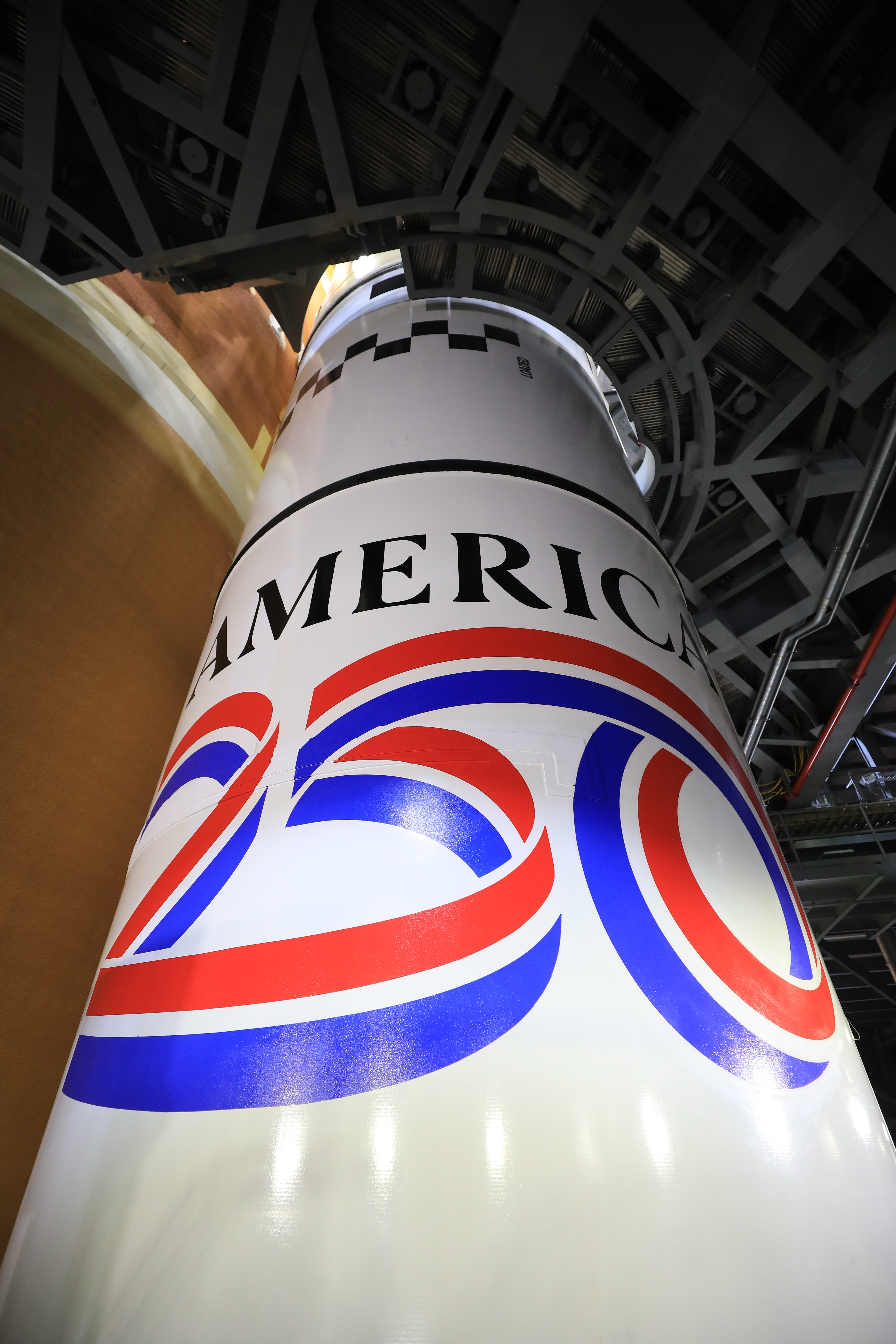
Image shows the America 250 logo in black, red, blue colors painted on the white solid rocket boosters of NASA's SLS (Space Launch System) rocket at NASA's Kennedy Space Center in Florida on Dec. 1, 2025.

NASA is marking America’s 250th year with a bold new symbol of the nation’s relentless drive to explore.

The America 250 emblem is now on the twin solid rocket boosters of the SLS (Space Launch System) rocket for Artemis II β€” the powerhouse that will launch a crew of four around the Moon next year. Unveiled Tuesday, the design echoes the America 250 Commission’s Spirit of Innovation theme, honoring a country that has never stopped pushing the horizon forward.

At NASA’s Kennedy Space Center in Florida, technicians spent recent weeks carefully applying the emblem on the rocket inside the Vehicle Assembly Building β€” the same place where rockets for Apollo once stood. Engineers are running final tests on SLS and the Orion spacecraft as preparations intensify for Artemis II.

The roughly 10-day Artemis II journey around the Moon will mark a defining moment in this new era of American exploration β€” paving the way for U.S. crews to land on the lunar surface and ultimately push onward to Mars.

America’s spirit of discovery is alive, and Artemis is carrying it to the Moon and beyond.

Image credit: NASA/Ben Smegelsky

NASA Aircraft Coordinate Science Flights to Measure Air Quality

4 min read

NASA Aircraft Coordinate Science Flights to Measure Air Quality

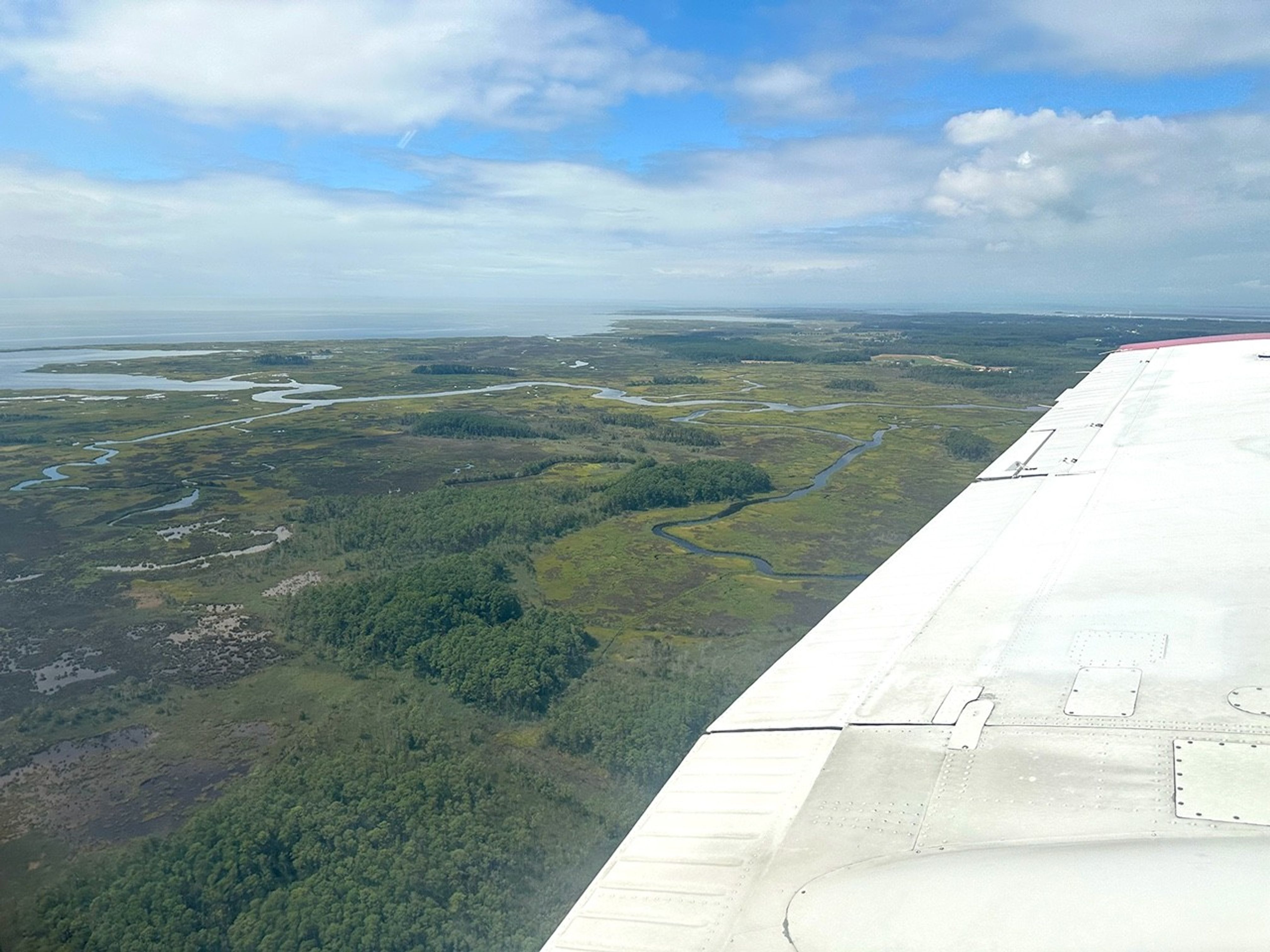
The image shows an aerial view of the Chesapeake Bay, with groves of trees, rivers, a body of water in the distance, and green land. The horizon, a third of the way down the image, separates the blue cloudy sky from the land. On the right of the image is a white wing of a plane.
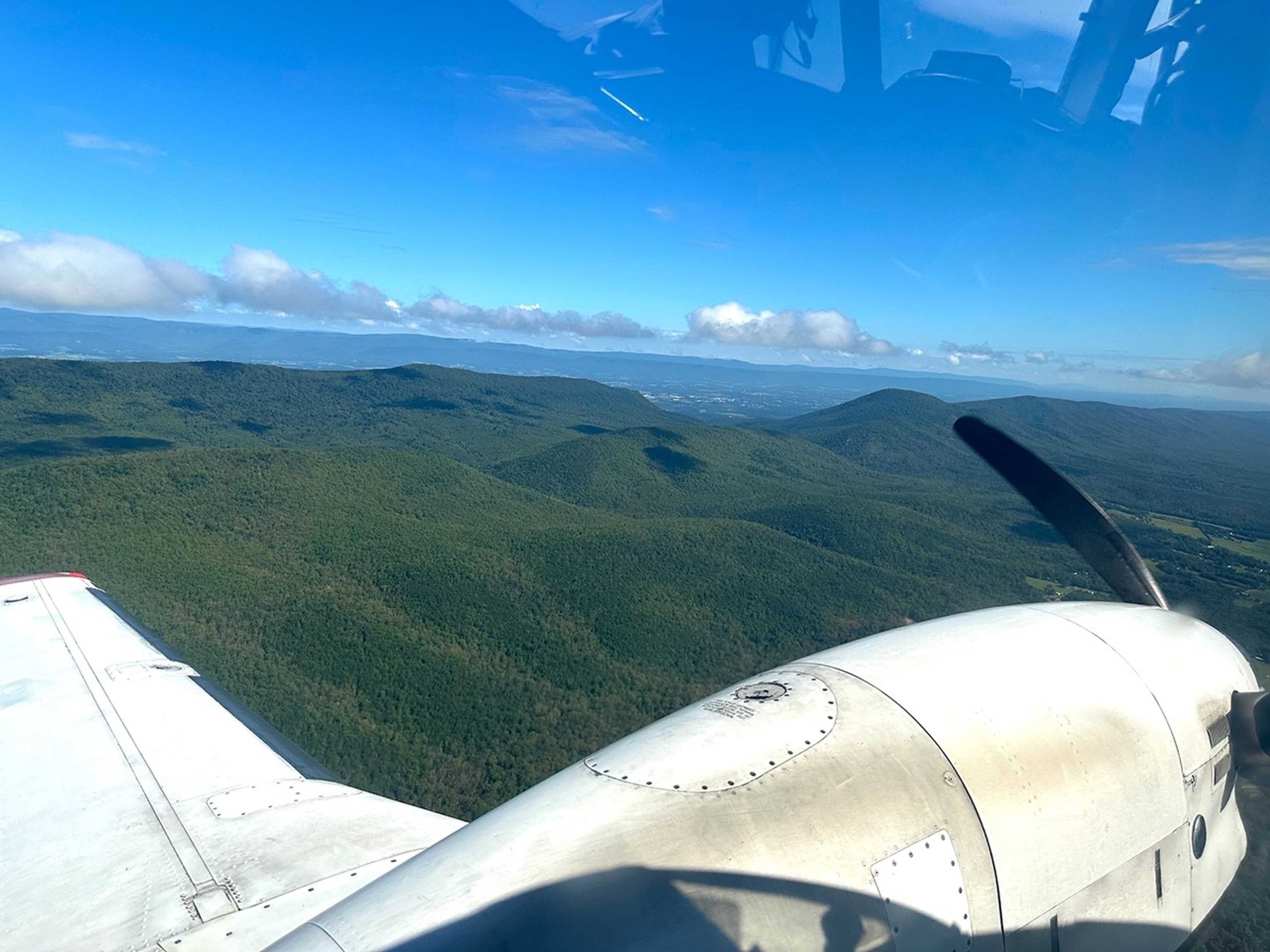
NASA Goddard’s G-LiHT flying on the A90 flies over Shenandoah Valley in the US East Coast during the week of August 11-15.
Credit: NASA/Shawn Serbin

Magic is in the air. No wait… MAGEQ is in the air, featuring scientists from NASA centers across the country who teamed up with the National Oceanic and Atmospheric Administration (NOAA), the University of Maryland Baltimore County, and several other university and government partners and collaborators.

This summer, six planes collectively flew more than 400 hours over the mid-Atlantic United States with a goal of gathering data on a range of objectives, including air quality, forestry, and fire management.

This was part of an effort called MAGEQ, short for Mid-Atlantic Gas Emissions Quantification. Rather than one mission, MAGEQ consists of several individual missions across more than a dozen organizations and agencies, along with university students. Over the course of around six weeks, aircraft flew over cities, wetlands, farms, and coal mining areas.

An aerial view of Shenandoah, showing green mountains and land. The horizon separates the bright blue sky from the land. At the top of the image is a reflection of inside the aircraft, showing this image was taken through a window. At the bottom of the image is a white wing of a plane and the engine and propellor of the same plane.
NASA Goddard’s G-LiHT flying on the A90 flies over the Chesapeake Bay near the Big Annemessex River.
Credit: NASA/Shawn Serbin

β€œEach aircraft team is comprised of highly skilled and motivated people who understand how to fly their particular plane to achieve the science they want,” said Glenn Wolfe, research scientist at NASA’s Goddard Space Flight Center in Greenbelt, Maryland, and project lead for MAGEQ. β€œThe complexity comes in identifying how each platform can complement or supplement the others.”

Coordinating flights required both advanced planning and flexibility to get the best outcome. Weather proved to be a primary challenge for the team, as members worked around cloudy days, wind, and storms to ensure safe flights.

The six aircraft had different objectives and requirements. For example, some carried instruments that needed to fly high to simulate a satellite’s view of the atmosphere and the Earth’s surface and could not measure through clouds. Others were equipped with instruments that directly measured the air particles and could work under the clouds, provided there was no rain.

Despite weather challenges, flight teams worked together to coordinate as many multi-aircraft flight days as possible, meeting the overall objective of the MAGEQ campaign.

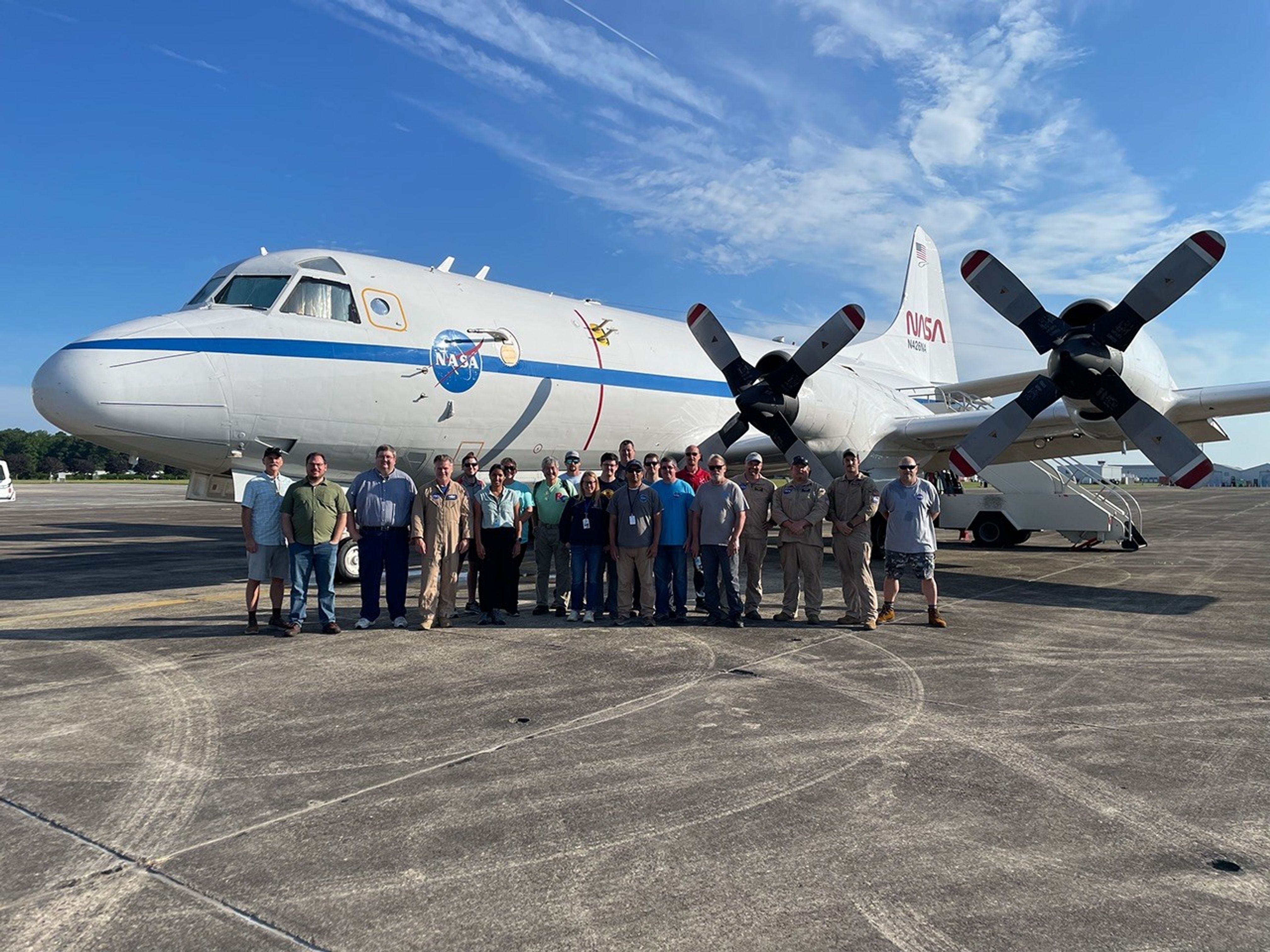
A group of twenty one people stand in front of a large, white aircraft with propellors. The NASA meatball logo is seen on the side of the aircraft. The people are all smiling and looking at the camera.
The MAGEQ team members pose in front of the P-3 aircraft at NASA’s Wallops Flight Facility in Virginia.
Credit: NASA/Roy Johnson

β€œIt’s been inspiring to see how everybody worked together,” said Lesley Ott, research meteorologist and lead carbon cycle modeler for NASA’s Global Modeling and Assimilation Office at NASA Goddard. β€œBy collecting data together, not only can we do a better job as scientists in having more complete understanding, we can also do a better job making usable data sets that meets the needs of different stakeholders.”

State resource managers in North Carolina and Virginia, for example, could benefit from this data as they monitor the health of wetlands, which provide resilience to storms, absorb carbon from the atmosphere and support local tourist industries. The data could also help operators at energy-producing facilities detect methane leaks or equipment failures quickly. Faster detection could speed up intervention and minimize waste, as well as lessen environmental impacts. Stakeholders were an integral part of the planning process, Ott said. They made suggestions about measurement sites and data needs that informed the flight planning.

Scientists will also use the measurements to verify satellite data from both public and commercial data providers. Satellites like the Tropospheric Emissions: Monitoring of Pollution (TEMPO) instrument collect similar data. Scientists can compare the airborne and satellite data to get a more complete picture of the atmosphere. They also will use MAGEQ data to evaluate atmospheric chemistry modeling from the Goddard Earth Observing System (GEOS) model, which connects atmospheric, oceanic, and land data to help create a more comprehensive picture of Earth science.

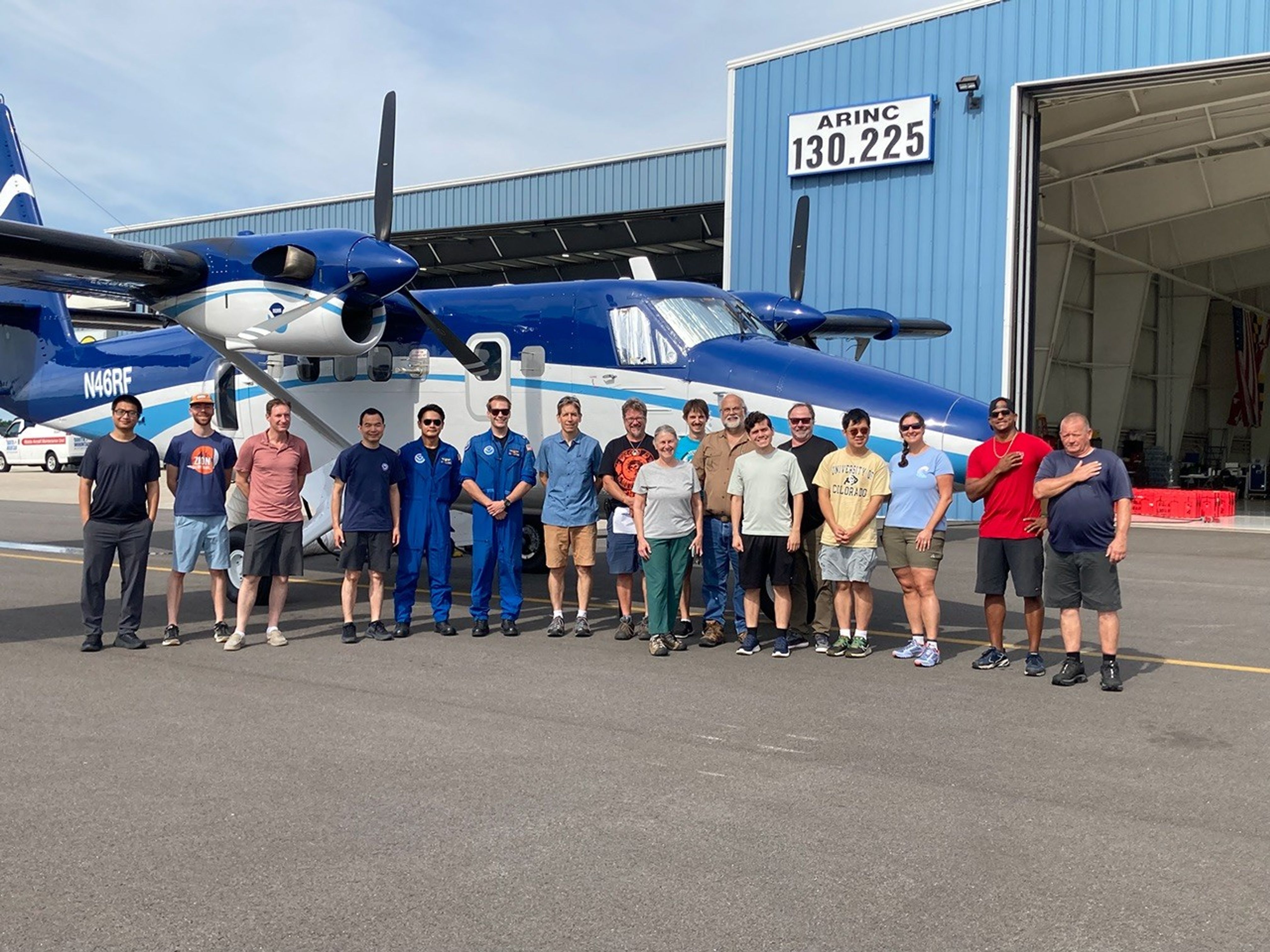
A group of seventeen people stand in a line in front of a blue aircraft with propellors. They all smile at the camera, which is taking a picture of them from a distance.
The MAGEQ team members from NOAA and NASA pose in front of the Twin Otter aircraft.
Credit: NOAA/Steve Brown

β€œEvery aircraft does something different and contributes a different type of data,” said Steve Brown, leader of the tropospheric chemistry and atmospheric remote sensing programs at the NOAA Chemical Sciences Laboratory in Boulder, Colorado. β€œWe’re going to have a lot of work to do at the end of this to put all these data sets together, but we will make the best use of all these measurements.”

By Erica McNamee

NASA’s Goddard Space Flight Center, Greenbelt, Md.

Share

Details

Last Updated
Sep 24, 2025
Editor
Jenny Marder
Contact
Location
Goddard Space Flight Center

Weed-Funded Rec Center Opens in Aurora, Colorado

The city of Aurora, Colorado hosted a grand opening on Tuesday for its brand new 77,000-square foot, nearly $42 million recreational facility that was funded entirely by tax revenue generated from legal marijuana sales.Β 

Known as the β€œSoutheast Recreation Center and Fieldhouse,” the facility boasts a slew of amenities, according to local news station KDVR: β€œA 23,000-square-foot fieldhouse with temperature controlled indoor environment; A full-sized field with professional-grade turf; An 8,000-square-foot multiuse gymnasium [that] will be able to accommodate one main basketball court, two cross basketball courts, two volleyball courts or three pickleball courts; A 1/9-mile long track elevated above the fitness area and gymnasium; A 7,600-square-foot fitness area with state-of-the-art equipment, including: A functional fitness area; An outdoor fitness space; A fitness studio; A large community room; [and a] natatorium, which in turn is comprised of: A 125,000-gallon swimming pool with a maximum depth of seven feet; A spa pool with water jets; A leisure pool that includes a 25-yard, four-lane lap pool, a lazy river, and a 20-foot-tall waterslide.” 

The city broke ground on the facility in early 2021, and it is the second new recreational facility to open in Aurora in the last four years.

The other rec center, which opened in 2019, was also funded by taxes from marijuana sales, according to KDVR. The news outlet Westworld reported that the Aurora City Council in 2020 β€œapproved increasing the city’s sales tax on recreational marijuana from 7.75 percent to 8.75 percent, with the additional revenues going to fund youth violence prevention projects.” 

β€œWe are excited to open our newest recreation center and fieldhouse,” Brooke Bell, the director of the Aurora Parks, Recreation and Open Space, said in a press release from the city earlier this month. β€œAfter an extensive community engagement process, the feedback received guided the creation of this exceptional facility; we look forward to the community enjoying the space they helped envision for years to come.”

In the press release, the city said that the Southeast Recreation Center is located β€œnear several neighborhoods and the Aurora Reservoir,” and that β€œthe center is a regional destination boasting the first indoor fieldhouse within the city in addition to a variety of other amenities and breathtaking views of the Colorado mountains.”

The construction of the two recreational facilities in Aurora serve as β€œproof of concept” for advocates who helped Colorado become one of the first two states to legalize recreational cannabis a little more than a decade ago when voters there approved Amendment 64.Β 

Supporters of marijuana legalization have long contended that a regulated cannabis retail market could be an economic boon for state and local governments.Β 

β€œColorado did what no one had done before,” Colorado Gov. Jared Polis said at an event in October commemorating the 10th anniversary of the state’s legalization measure, as quoted by the Denver Gazette. β€œWith voter [approval] of Amendment 64, we made history and therefore it is fitting that we are celebrating today 10 years here at History Colorado.”

Polis, a Democrat, has worked to strengthen the marijuana law. Last summer, he signed an executive order β€œto ensure that no Coloradan is subject to penalization for the possession, cultivation, or use of marijuana as this substance is legal in Colorado as a result of Amendment 64,” his office announced at the time.

β€œThe exclusion of people from the workforce because of marijuana-related activities that are lawful in Colorado, but still criminally penalized in other states, hinders our residents, economy and our State. No one who lawfully consumes, possesses, cultivates or processes marijuana pursuant to Colorado law should be subject to professional sanctions or denied a professional license in Colorado. This includes individuals who consume, possess, cultivate or process marijuana in another state in a manner that would be legal under Colorado law,” Polis said in a statement.

The post Weed-Funded Rec Center Opens in Aurora, Colorado appeared first on High Times.

❌