 Login
LoginWhat does it mean when Uncle Sam is one of your biggest shareholders? Chip startup xLight is about to find out
You can imagine how this is all going over in Silicon Valley, where the libertarian ethos runs deep.

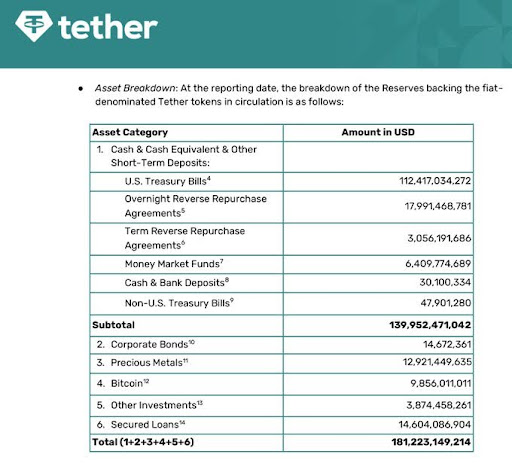
In a strategic move, Tether has shifted its reserve strategy, reducing its exposure to treasuries while increasing allocations to Bitcoin and gold. The USDT issuer has shown a notable reduction in government debt exposure, paired with an expanded position in hard assets known for durability and independence from traditional financial systems.
Stablecoin giant, Tether, has reduced its US Treasury holdings and increased its Gold and Bitcoin reserves. CryptosRus reported on X that Tether is quietly repositioning itself for what the company expects to be the Federal Reserve’s (FED) next round of rate cuts.
Related Reading: Rumble At The Core: How Tether Plans To Dominate The US Stablecoin Market
According to BitMex founder Arthur Hayes, Tether’s latest reserve update shows a clear shift away from the US treasuries and deeper into BTC and gold, a sign that the company is positioning for a changing macro environment. Furthermore, the Standard & Poor (S&P) Global noted that Tether is now leaning more heavily into assets with larger price swings in value, warning that this mix could expose USDT if markets turn volatile. Meanwhile, the current S&P Global rating on Tether remains weak.
Thus, Tether CEO Paolo Ardoino has pushed back, saying that the company holds no toxic assets. He claims that its rapid growth reflects a broader shift towards new financial systems that operate outside the traditional banking world.
Crypto analyst Ted Pillows has also offered insight into the Tether Fear Uncertainty and Doubt (FUD) as it is making its usual rounds again. The narrative is latching onto the company’s latest attestation, showing a notable shift into Gold and Bitcoin to offset declining interest income. Meanwhile, if these risk assets drop by 30%, Tether’s equity buffer could evaporate, creating an environment where Tether will be insolvent, and panic will kick in.
Related Reading: Tether Targets $500 Billion Valuation In New Equity Offering Amid US Expansion Plans
However, Ted is steadfast and believes that Tether has been through a decade of this same FUD, and USDT is still sitting at $1.00. They’re fully liquid, but they operate on a fractional-reserve model, much like traditional banks. As long as redemptions remain normal, everything will work smoothly. A problem will only arise if there’s an irrational panic, and then liquidity stress could hit quickly.
According to Ted, the USDT isn’t fully backed by cash, but it’s backed by a diverse portfolio that includes the US treasuries, yield-generating assets, and some risk assets. This is all scaled to a massive $174 billion stablecoin. “If someone wants to kill USDT, it’s possible, but I highly doubt it,” Ted noted.

Argentina officially launched a new government agency on Wednesday as part of an effort to bolster the country’s medical marijuana and hemp industry.
Reuters reports that the agency, known as the Regulatory Agency for the Hemp and Medicinal Cannabis Industry, or ARICCAME, represents “the first working group of a new national agency to regularize and promote the country’s nascent cannabis industry, which ministers hope will create new jobs and exports generating fresh income for the South American nation.”
“This opens the door for Argentina to start a new path in terms of industrial exports, on the basis of huge global demand,” said Argentina’s economy minister Sergio Massa at an event marking the launch of the new agency.
According to Reuters, “Massa said that the agency would from Thursday begin regularizing programs and coordinating with various provinces and [the] industrial sector, adding Argentina already counted on demand for projects linked to the agro-industrial sector.”
On the official website for ARICCAME, the agency outlines its mission and objectives.
“We are the Agency that regulates the import, export, cultivation, industrial production, manufacture, commercialization and acquisition, by any title, of seeds of the cannabis plant, cannabis and its derivative products for medicinal or industrial purposes,” the website reads, via an English translation.
The website lists the following “general objectives” for the agency: “Establish through the respective regulations, the regulatory framework for the entire production chain and national marketing and/or export of the Cannabis Sativa L. plant, seeds and derivatives for use in favor of health and industrial hemp; Promote a new agro-industrial productive sector for the commercial manufacture of medicines, phytotherapeutics, food and cosmetics for human use, medicines and food for veterinary use, as well as the different products made possible by industrial hemp; Generate the framework for the adaptation to the regulatory regime, of the cultivation and production of cannabis derivatives for use in existing health, guaranteeing the traceability and quality of the products in order to safeguard the right to health of the users of medical cannabis; Reintroduce hemp in Argentina and all its derivatives: food, construction materials, textile fiber, cellulose and bioplastics with low environmental impact; [and] Promote scientific research and sectoral technological progress, promoting favorable conditions for these existing industries in our country.”
ARICCAME’s specific objectives include: “Establish clear rules that provide legal certainty to the sector and encourage federal participation; Articulate through agreements and conventions with other State entities with intervention in the matter: INASE, SENASA, INTA, INTI, AFIP, INAES, BCRA, UIF, National Universities, etc; Determine the system of licenses and administrative authorizations for the productive chain; Generate quality standards that safeguard the right to health of users and consumers of cannabis/hemp products; [and] Control non-compliance with the regulatory regime.”
Argentine policymakers legalized cannabis oil for medical use in 2017. Three years later, the country legalized home cannabis cultivation for medical marijuana patients.
The launch of the new agency is part of a border effort by the Argentine government to continue to reform the medical cannabis program, something that the South American country identified as a priority last year.
According to Reuters, the newly launched agency will be helmed by Francisco Echarren, who “said the industry could generate thousands of new jobs, as well as create technological developments and new products for export.”
“We have a huge challenge ahead of us,” Echarren said, as quoted by Reuters, “not only getting a new industry on its feet, but giving millions of Argentines access to products that improve quality of life.”
The post Argentina Launches New Agency To Boost Cannabis Industry appeared first on High Times.
