Reading view

There are new articles available, click to refresh the page.

Cardano Price Prediction: Crypto Researcher Says New Hydra Upgrade Not 100% Secure – Could All Wallets Get Drained?

A prominent Cardano supporter just warned the community that the layer-2 scaling solution Hydra may not be as safe as they think. Are investors’ funds at risk, and does this justify a bearish Cardano price prediction?

If you want to use Hydra, you trust the operators of Hydra Head.

You are only in control of your funds if you are one of the Hydra Head operators.

When you lock ADA into a Hydra Head, you sign a transaction with your private key. The transaction sends ADA into an on-chain… pic.twitter.com/hbh78guPLY

— Cardano YOD₳ (@JaromirTesar) December 4, 2025

In a lengthy X post, a pseudonymous user named YODA, known for his support of the Cardano network for years, highlighted a potential flaw in the design of Hydra. This technical weakness would supposedly allow node operators to have a say on what happens with users’ tokens.

He clarified that the funds locked up in the L2 and delegated to third-party Hydra Heads (validators) are fully in control of the latter, not the owner.

In theory, if Hydra Heads collude and introduce false transactions, they would be able to sign them without necessarily having access to the private keys of the original owner of the ADA tokens.

“Every update requires signatures from all Hydra Head operators. Those signatures are made using the private keys of the operators, not the users,” YODA emphasized.

He added: “If they collude, they can ALL sign a malicious snapshot that splits all the funds between them.”

Cardano Price Prediction: ADA Finds Support at $0.40 But Bearish Trend Persists

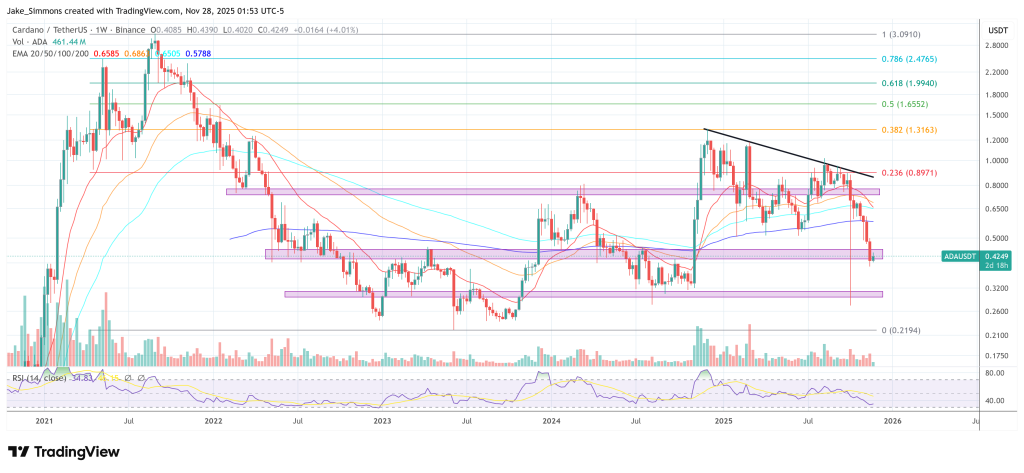
Aside from Dogecoin (DOGE), Cardano (ADA) has been one of the worst-performing top 10 tokens this year, with total losses now reaching 49%.
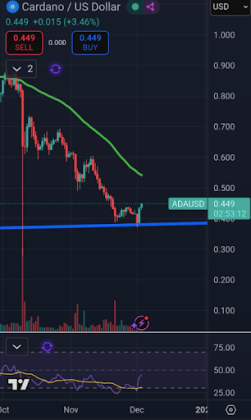
Source: TradingView

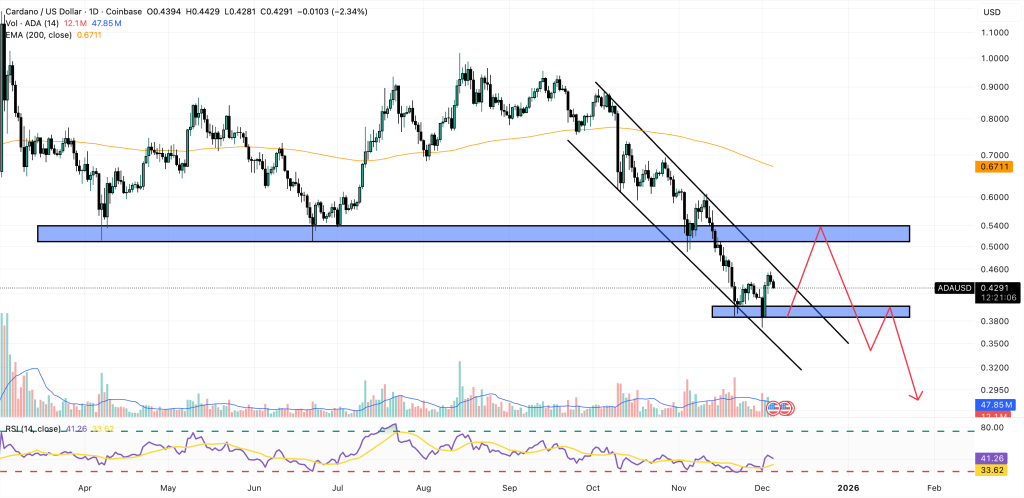
The daily chart shows that the token has found support temporarily at $0.40.

However, ADA has been on a strong downtrend and is not yet showing signs of a trend reversal. The price needs to climb above $0.52 to reverse this downtrend.

Otherwise, ADA may face a much more dramatic correction to $0.32, meaning a total downside risk of 25%.

Well-established tokens like ADA have struggled to reach higher highs during this cycle. However, a new crypto presale called Maxi Doge ($MAXI) has managed to raise over $4 million in just a few weeks to launch its community-centered meme coin.

Maxi Doge ($MAXI) is The New Dogecoin-Themed Meme Coin

Maxi Doge ($MAXI) is an Ethereum meme coin that aims to bring together an army of like-minded ‘degens’ who are not afraid to make YOLO trades to get out of mom’s basement.
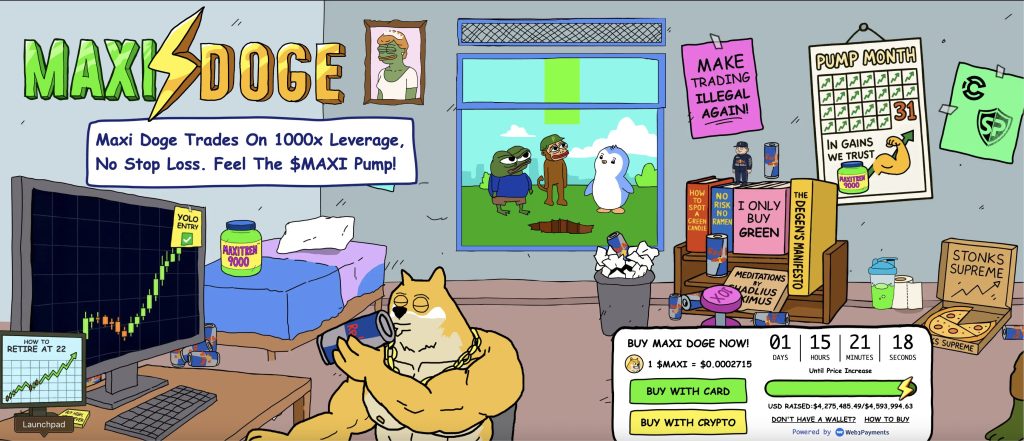
Through fun competitions like Maxi Gains and Maxi Ripped, token holders will compete by showcasing their highest-yielding traders to earn rewards and bragging rights.

They also get exclusive access to a hub through which they can share ideas, insights, setups, and more.

This is a vibrant community that fully embraces the energy that comes with bull markets.

Finally, up to 25% of the presale’s proceeds will be used to invest in high-potential projects.

The gains will be used to fund the project’s marketing efforts to make $MAXI known.

To buy $MAXI before the presale ends, simply head to the official Maxi Doge website and link up a compatible wallet like Best Wallet.

Either swap USDT or ETH to get this token or use a bank card instead.

Visit the Official Maxi Doge Website Here

The post Cardano Price Prediction: Crypto Researcher Says New Hydra Upgrade Not 100% Secure – Could All Wallets Get Drained? appeared first on Cryptonews.
U.S. clears $2.7B bomb sale to Canada

The State Department has approved a possible Foreign Military Sale (FMS) to Canada involving air strike weapons and related equipment with an estimated total cost of $2.68 billion. The Defense Security Cooperation Agency (DSCA) has notified Congress of the required certification. According to the DSCA release, the Government of Canada requested a broad package of […]
Cardano Founder Reveals “Game Plan” For 2026, But Can ADA Price Still Recover?

With 2025 almost over, the Cardano founder, Charles Hoskinson, and the broader crypto market are looking ahead to 2026 with renewed optimism for the ecosystem and the ADA price. Hoskinson has shared a strategic game plan for 2026 that could significantly transform the Cardano ecosystem and potentially even influence the value of its native token. Although ADA’s price has underperformed other top altcoins so far this year, upcoming developments and shifts in 2026 could create a better environment for a potential recovery. 

Cardano 2026 Game Plan Offers Hope For ADA Price Recovery

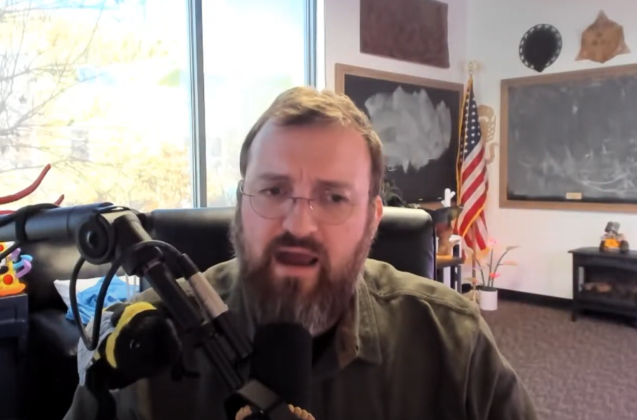
In a recent video posted on X, Hoskinson shared his thoughts on Cardano, offering a glimpse into the blockchain’s vision for 2026. According to the crypto founder, Cardano is preparing to enter the new year with a plan to become a powerful and exceptional blockchain network and the most relatable distribution system humanity has ever created. 

Hoskinson emphasized that achieving this vision will require significant time and effort, acknowledging that setbacks are part of building a complex system. He noted that bugs and mistakes are inevitable, but what distinguishes a successful project is how well and fast it responds and recovers. 

The Cardano founder also highlighted the importance of learning from errors and improving processes, suggesting that future obstacles will be overcome more quickly and effectively. While perfection is unattainable, Hoskinson’s statements reflect confidence in Cardano’s approach to problem-solving, adaptability, and its ongoing progress toward becoming a leading blockchain network.

While the blockchain prepares to advance, it remains uncertain if an ADA price recovery will follow. Currently, the cryptocurrency is trading at $0.449, reflecting a 63% decline this year and a 16.6% drop over the past month. Compared to other altcoins like Ethereum and Solana, which reached new all-time highs earlier this year, ADA’s underperformance has been somewhat of a puzzle, especially given its previous ecosystem developments and strong community

Analyst Says ADA Price Will Be Mega Bullish If It Breaks This Level

 The Cardano price has been trending downward for months; however, analysts remain bullish on the cryptocurrency. According to crypto analyst ‘Sssebi’, ADA’s next key milestone is the $0.50 resistance level. If the altcoin can successfully breach this threshold, he predicts that Cardano could enter a “mega bullish phase.”

Sssebi’s analysis highlights that despite Cardano’s price being significantly undervalued, its underlying structure still shows hints of bullishness. Breaking $0.50, therefore, could act as a psychological trigger that helps the altcoin overcome current bearishness and signal a much-anticipated recovery.

Cardano

The analyst suggested that ADA’s current price of $0.44 may represent a bottom level. As a result, he recommends that traders view this low level as a potential opportunity to enter the market ahead of a potential upward surge.

Cardano

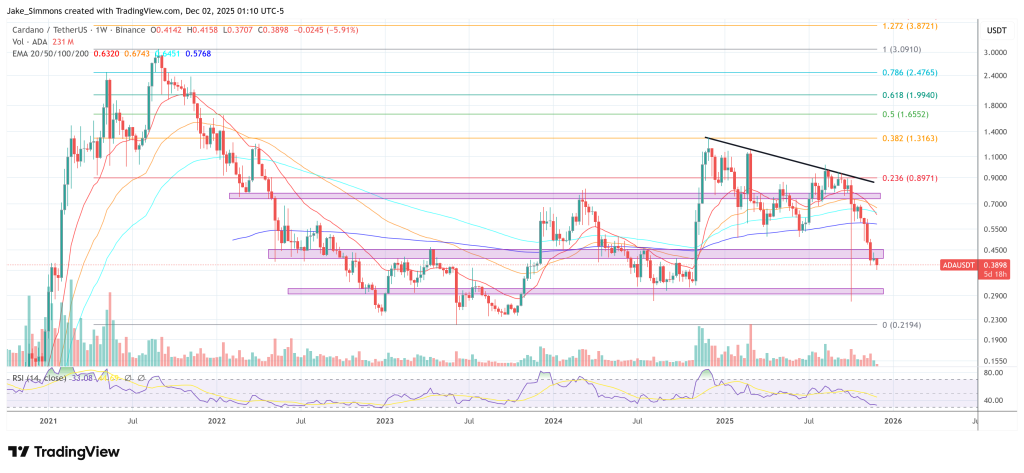
Cardano’s December Slide Intensifies: What’s Driving the Decline and What Comes Next?

Cardano (ADA) has opened December under pressure, dropping more than 7% in the past week as broader market sentiment weakens and macroeconomic uncertainty rises.

ADA is now trading near $0.38–$0.4, testing key support levels and extending a month-long downtrend that has erased recent gains.

Cardano ADA ADAUSD ADAUSD_2025-12-02_23-18-41

Macroeconomic Pressure and Market Sentiment Weigh on ADA

The latest decline comes amid renewed concerns over global interest rate policy. Comments from Bank of Japan Governor Kazuo Ueda signaled the possibility of a rate hike, a shift that could unwind leveraged positions funded through low-interest yen borrowing.

Cardano’s drop aligns with losses seen across the crypto market, with Bitcoin, Ethereum, and other major altcoins also trading lower. High trading volumes, over $1 billion in the past 24 hours, reflect elevated volatility and growing caution among investors.

On-chain indicators show dormant ADA wallets from as far back as 2017 moving coins to exchanges, a sign that long-term holders may be preparing to exit positions.

Short interest in ADA futures has also increased, with open interest rising 12% over the past week. Traders are betting on a further slide below $0.35 unless ADA can reclaim the $0.40 resistance level.

Ecosystem Developments Offer Some Long-Term Support

Despite the market downturn, several developments within the Cardano ecosystem continue to generate attention. A $30 million liquidity initiative designed to strengthen Cardano’s DeFi sector is scheduled for rollout in early 2026.

The fund aims to boost total value locked by supporting lending, staking, and decentralized exchange activity, areas where Cardano has historically lagged behind competitors.

Another upcoming milestone is the launch of the Midnight sidechain on December 8. The privacy-focused network introduces new capabilities around data protection and secure enterprise applications.

Some analysts believe the launch could increase Cardano’s adoption and improve sentiment, particularly if it leads to more activity in decentralized finance.

Cardano’s long-term technical outlook also remains a topic of debate. Analysts note that ADA is once again touching the support line of a multi-year uptrend. Historically, similar tests have preceded recoveries, with some projecting a possible rebound toward the $0.50–$0.75 range if the market stabilizes.

What Comes Next for Cardano (ADA)?

The near-term outlook for Cardano remains uncertain. A break below $0.38 could expose the token to further declines toward the $0.30 area, especially if broader market weakness continues. However, strong staking participation, around 70% of circulating supply, may help cushion deeper drawdowns.

Longer-term forecasts vary widely, ranging from modest recoveries to highly optimistic projections tied to expected ecosystem upgrades in 2026.

For now, ADA’s trajectory will depend on whether macroeconomic pressures ease and whether Cardano can translate its upcoming developments into sustained network growth and investor confidence.

Cover image from ChatGPT, ADAUSD chart on Tradingview

Canadian Victoria-class subs to get new U.S.-built bow array

Delphinus Engineering Inc., based in Newtown, Pennsylvania, has been awarded a $14.5 million contract to develop, fabricate, produce, integrate, and test a new sonar array and lift system for Canada’s Victoria-class submarines. According to a Department of War contract announcement, the award includes Foreign Military Sales (FMS) funds fully allocated to Canada and may grow […]

Cardano risks dropping to $0.32 as bearish trend thickens

Key takeaways

  • ADA has lost 7% of its value in the last seven days.
  • The coin could record further losses as the market remains bearish.

ADA sheds 35% in November

ADA, the native coin of the Cardano blockchain, is up by less than 1% on Tuesday after recovering from the 6% dip on Monday. The bearish performance occurred as the  Cardano derivatives market saw a decline in traders’ interest.

According to CoinGlass, ADA futures Open Interest (OI) dropped 6.82% over the last 24 hours to $693 million. This decline suggests that investors are adopting a risk-off approach to the market.

Furthermore, the OI-weighted funding rate stands at -0.0057% suggesting increased confidence among bearish-aligned traders. Due to the current market conditions, the long-to-short ratio stands at 0.8765, with short positions building to 53.29% of all derivatives contracts over the last 24 hours.

This data suggests that there is a sell-side dominance in Cardano derivatives, with traders anticipating a decline in ADA’s price in the near term.

Will ADA close below the 2025 low?

The ADA/USD daily chart is bearish and inefficient as Cardano has underperformed in recent weeks. The coin dropped below $0.40 after losing 35% of its value in November and could dip lower over the coming days and weeks. 

ADA/USD Daily Chart

The technical indicators are also bearish, with the daily RSI now at 28, indicating an oversold condition. The MACD lines are also within the negative territory, suggesting heavy selling pressure. If the RSI remains below 30, Cardano remains at risk of steeper corrections. 

If the daily candle closes below the November 21 low of $0.3876, ADA could suffer heavy losses and retest the September 16, 2024, low of $0.3264. On the upside, if the buyers regain control and ADA stays bullish above $0.3876, it could reclaim the $0.40 resistance level in the near term. 

The post Cardano risks dropping to $0.32 as bearish trend thickens appeared first on CoinJournal.

Cardano Founder Unveils Pentad Blueprint To Drive 2026 Growth

Cardano founder Charles Hoskinson has outlined an ambitious blueprint to turn the newly formed “Pentad” into a de facto executive engine for ecosystem growth in 2026, linking critical infrastructure deals, DeFi expansion, RealFi, Midnight’s privacy stack and a more aggressive developer and institutional outreach strategy.

Cardano Sets 2026 Ambitions With Pentad Governance

In a new livestream titled “Thoughts on Growth for Cardano in 2026 (Pentad Series),” Hoskinson framed Pentad as the missing executive layer in Cardano’s Voltaire-era governance design. CIP-1694 and the Cardano Constitution, he argued, have already established a “very strong legislative branch” and a “very strong judicial function,” with DReps providing checks and balances. What has been absent, he said, is an entity that can actually execute.

“We always had this idea that a government needs a judicial, a legislative, and an executive function,” he said. “But the executive function was always a little milky.”

The Pentad consists of the Cardano Foundation, Emurgo, Input Output, the Midnight Foundation and Intersect. Its first mandate is the “Cardano Critical Infrastructure” program, a coordinated negotiation effort to secure commercially essential integrations such as bridges, stablecoins, oracles and analytics. Hoskinson described this as a “try before you buy” test of whether the five entities can function as a single executive voice.

“All these guys together they’re super expensive and also they’re run by very competent business people,” he said of potential integration partners. “If we’re divided they’re going to divide and conquer and we’re going to end up with a damn mess and it’s going to be very expensive. So why don’t we put a Pentad together […] and let’s collectively negotiate kind of like collective bargaining.”

The success criteria are intentionally binary: either integrations are live, or they are not. Hoskinson called it “a really good test function for an emerging executive function.”

If that phase proves the concept, he wants the Pentad to pivot to explicit growth targeting in 2026. For now, he is anchoring that discussion in three headline indicators—monthly active users, transactions per day and TVL—while a broader KPI set is being drafted with community members. “Once we have a final set of candidate KPIs, we’re going to submit an info action to make them the official ecosystem KPIs,” he said, adding that “every budget moving forward has to be in some way connected to growth in those metrics.”

A central pillar of the 2026 plan is a curated showcase of roughly 10–15 Cardano DApps that exemplify the network’s capabilities. Hoskinson said these projects are typically “underfunded,” “understaffed,” and lack users, volume and TVL, which directly affects their profitability and Tier-1 exchange prospects. Midnight’s own listing push, he argued, has already “opened the door for Cardano native assets and all the big guys,” creating a window that showcase protocols could exploit if they reach sufficient scale.

The growth blueprint relies heavily on “aggregators of capital and people.” Hoskinson highlighted Bitcoin DeFi as a core channel to route external liquidity and users into Cardano, and pointed to XRP and other UTXO-based assets without native smart contracts as further sources of yield-seeking capital. Hybrid DApps that combine Cardano with Midnight’s privacy features are meant to provide differentiated USPs relative to Ethereum-based DeFi.

What Cardano Will Focus On

Developer and community strategy is set to become more aggressive. Hoskinson wants bi-weekly hackathons for Cardano, citing “awesome” growth results from Midnight’s cadence and existing events such as a large hackathon in Berlin. He argued that such frequency showcases that “Cardano can roll with the best of them” while tightening the feedback loop on Plutus and Aiken DevX.

At the same time, he called X “the worst of all mediums for a community to aggregate,” citing bots, noise and lack of curation, and pushed for controlled aggregation channels such as Discord, both for Cardano and for Midnight. Parallel to that, he described building a dedicated comms channel for analytics firms, institutions and VCs to run seminars on Midnight and Cardano, responding to persistent perceptions of Cardano as a “ghost chain” driven by incomplete third-party data.

On Input Output’s side, Hoskinson said the company is preparing a Cardano business unit to interface directly with the Pentad, consolidating ecosystem, engineering and governance work under leadership “custom-trained and tuned to think in this growth mindset.” He also emphasized a push into “horizontal” technology improvements, including AI-assisted “Vibe engineering” to compress research-to-production cycles from “five or 10 years” to “a 1 to two year cycle,” tested first in Lace and now in Acropolis.

He highlighted two flagship technology and product directions for 2026: the RealFi DApp emerging from more than a million loans in Kenya and Uganda—designed as “the ultimate bear market DApp” with off-chain, uncorrelated yields—and Hydra, which he said “truly can go a million transactions per second” on a per-DApp basis. The target is for the showcase protocols to become Hydra-enabled, achieving “Solana level speed” with minimal on-chain footprint.

Ultimately, Hoskinson presented the Pentad as a revocable, delegated executive layer rather than a centralized leadership structure, and put the onus on DReps to choose action over paralysis.

“Are you looking for perfection or are you looking to get things done?” he asked. “You’ve asked for unity. You’ve asked for growth. You’ve asked for leadership. This proposal is the beginning of answering those questions.”

At press time, ADA traded at $0.38.

Cardano price

Cardano Founder Says Genesis ADA Was Profit, Not Community Funds

Charles Hoskinson has drawn a firm line under one of Cardano’s longest-running controversies, declaring that the allocation of Genesis ADA to Input Output (IO) and EMURGO was private profit for early risk, not a community-controlled pool to be repurposed for new initiatives.

Cardano Founder Closes Door On Genesis ADA Criticism

In a November 30 livestream titled “Genesis ADA,” the Cardano founder called the topic “a closed matter” and rejected renewed calls to use Genesis ADA for current integrations such as oracles and stablecoin issuers.

“The Genesis ADA is profit for services rendered taking a risk, doing an activity and building an ecosystem,” he said. “It was a deal between us and the primary buyers of ADA, the Japanese who put up the initial wave of capital to get it done […] Those are the people that mattered in that transaction and every single one of them has been made whole.”

Hoskinson walked through the original funding structure: a Japanese crowd sale that raised about $72 million, converted into bitcoin, and a “tripartid” model comprising the Cardano Foundation (governance), EMURGO (commercialization) and IO (protocol development). Based on the crowd sale pricing, IO’s Genesis ADA allocation was worth around $8 million at the time.

“For the vast majority of the early days of Cardano, the Genesis ADA sat around 4 to 8 cents in value,” he said, arguing that the founding entities accepted extreme risk — regulatory, technical and reputational — in exchange for that upside. “To say that somehow we don’t deserve what we’ve gotten when what we got was about $8 million for delivering a $15 billion ecosystem, it’s a statement made of a Twitter mob with no basis in reality.”

He framed the core objection as a misunderstanding of the original terms. If the community now insists that 100% of Genesis ADA must be spent, he argued, “then where was the profit for taking the risk?” He listed Japan and US regulatory exposure, the possibility of protocol failure, insider and outsider security threats, and potential civil or even criminal liability in the early days.

“Let’s be very clear here,” he added. “99.9% of cryptocurrency ventures fail. Cardano is one of only a handful like XRP and Ethereum that have survived over the last 10 years and has value greater than $10 billion […] For a little over $40 million, a 10 plus billion dollar ecosystem has been created that at one point reached over a hundred billion dollars of value […] By any measurement, this has been an overwhelming success.”

Hoskinson also pushed back hard against the idea that IO and EMURGO should function as de facto public utilities whose entire balance sheets exist for Cardano’s “common good.”

“The books of my company and the books of EMURGO as private companies are none of the concern or business of the community as a whole,” he said. “We owe you nothing but the work we promise to do and will continue to do if you so choose. Those are the terms and conditions.”

He contrasted demands to forfeit profits with the existence of an already sizable on-chain treasury. “Demanding that whatever profit or revenue that we’ve made over the last 10 years be forfeited for a greater good while the community sits on a more than billion ADA treasury […] is a pretty absurd thing,” he said, noting that the treasury mechanism itself was part of the original design he proposed.

Why The Debate Now?

The immediate flashpoint is a joint request for 70 million ADA from the treasury to fund a package of integrations, including providers such as Pyth, RedStone and Circle. Some critics have argued that such work should be paid from Genesis holdings instead. Hoskinson called that retroactive expectation “pretty absurd” given that those companies “didn’t even exist at the time.”

He stressed that the 70 million ADA “will not cover the total fee of all the integrations” and that IO, the Midnight Foundation and others will “have to put skin in the game” because they are large ADA and KNIGHT holders who want to see yield on those assets.

Framing the broader governance vote, Hoskinson presented the current moment as a 2026 “reset” from the original tripartite structure to a new “pentad” executive layer involving EMURGO, the Midnight Foundation, the Cardano Foundation, IO and Intersect. The goal, he said, is to coordinate strategy and negotiations with “some of the largest most predatory and aggressive companies in this industry,” where Cardano must “speak with one voice” to secure key deals.

“The Genesis ADA is a closed issue. You have seen the end results of it and we have all moved on as founding entities,” he concluded. “We now have to decide, do we want to do something new and different […] and put a new structure for 2026 so that we can build the necessary infrastructure for the DeFi ecosystem? Or don’t we? It’s just that simple.”

At press time, ADA traded at $0.38.

Cardano price

What The Latest Cardano Treasury Move Means For Investors

Cardano’s core ecosystem organizations have submitted a new proposal requesting 70 million ADA from the Treasury to fund a coordinated set of infrastructure upgrades. The proposal, which was made by the founding entities, the Midnight Foundation, and Intersect, targets important components that Cardano still lacks, and its approval could shape how the network grows heading into 2026. 

Why Cardano Is Making This Move Now

Despite Cardano’s reputation as a well-established Layer-1 blockchain, its ecosystem still lacks several must-have infrastructure pieces that underpin vibrant decentralized finance (DeFi), real-world asset (RWA) tokenization and institutional participation. However, the situation might improve soon with a collaborative effort, as revealed in the Cardano’s Critical Integrations Budget proposal for 2026.

The Critical Integrations Budget proposal brings together Input Output, Emurgo, the Cardano Foundation, Intersect, and the Midnight Foundation under a single plan. The coalition asserts that despite Cardano’s strong foundations, several essential ecosystem layers are either incomplete or absent. 

These include tier-one stablecoin infrastructure, institutional-grade custody solutions, cross-chain bridges, deeper analytics capabilities, and globally recognized oracles. These components are necessary for Cardano to support stable liquidity, attract DeFi builders, enable RWA tokenization, and allow institutions to participate securely. 

The proposal frames 2026 as the year Cardano should enter a more mature phase, and these upgrades form the groundwork for that transition. As such, the coalition is asking for 70 million ADA for its 2026 budget. Interestingly, Cardano founder Charles Hoskinson also noted the proposal in a post shared on the social media platform X.

Negotiations with major integration partners are already in place. The discussions have matured enough that the coalition believes it is time for the community to finance the final steps needed to onboard them. 

What This Means For ADA Holders

According to the announcement, the budget request is designed to guarantee that these integrations arrive in a coordinated, timely manner instead of being scattered across years. 

Stablecoin infrastructure and cross-chain connectivity have long been cited as the missing ingredients holding back liquidity and activity on Cardano. If these integrations go live, liquidity pathways widen, capital can move more easily onto the network, and developers gain the confidence to deploy advanced DeFi, RWA, and DePIN applications.

The Cardano Treasury is one of the healthiest community treasuries in the crypto industry. Public records indicate that the treasury currently holds about 1.7 billion ADA. This figure continues to grow through transaction fee allocations and a percentage of the ADA rewards distributed through the protocol’s inflation mechanism that are not allocated to staking pools.  

In that context, the 70 million ADA request is a limited fraction of available reserves. Voting for the proposal is expected to expire on December 30. Voting is carried out by Delegated Representatives (DReps) and final approval will be done by the network’s Constitutional Committee.

Featured image from Unsplash, chart from TradingView

Cardano Price Prediction: Analyst Says ADA Could Double Your Money Soon – What’s Going On?

After the network split incident and that sudden drop to 0.38, ADA has climbed back above 0.42 and is trying to catch momentum again as the broader market recovers.

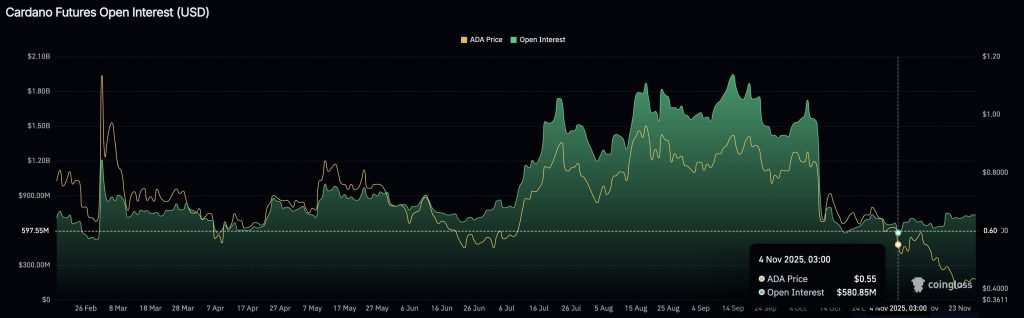
November was rough for Cardano’s open interest. It hit around 580 million dollars on November 5, marking its worst period since 2024 when ADA was trading under 0.33. Even with prices drifting downward, open interest has been rising, which typically indicates that traders are positioning aggressively despite the decline.

Source: Cardano Futures Open Interest / Coinglass

The steady decline over the past few weeks has triggered constant liquidations, forcing traders to either double down or reset their strategies. Still, several analysts point out that ADA has been holding the 0.40 support extremely well. They see that zone as a strong base that could fuel a sharp move upward if sentiment flips.

Cardano Price Prediction: Holding $0.40 Could Be The Key For Doubling Your Money

Source: ADAUSD / TradingView

Market watcher MMB Trader pointed out that Cardano is finally showing some real strength around the 0.40 support. Despite trading under a multi-year descending trendline and getting rejected near the 1.02 level back in August, ADA has managed to hold that 0.40 zone, which he sees as a solid accumulation area if the market flips bullish.

He expects that if momentum picks up from here, the first major target would be a move back toward the descending trendline around 0.819. Earlier, that target meant a full 100% rally, but with the recent bounce, it now sits closer to an 88% upside.

Crypto analyst Eilert is backing the bullish case too. He pointed out that Cardano just printed its second monthly Wyckoff Spring ever, which is a big accumulation signal. The last time this pattern appeared, ADA faked a breakdown and then exploded from $0.0177 to $3.10, a wild 175x move.

Obviously, it will not repeat that kind of run now, but the setup looks very similar.

On top of that, Charles Hoskinson seems more energized than ever. He said, “Cardano is going to enter 2026 with a game plan to not only be a great chain, an exceptional chain, but the most reliable distributed system humanity has ever built.”

He has also said before that 2026 will be a big year for crypto and even predicted that Bitcoin could hit $250,000. If he ends up being right about the market, there is a chance he can deliver something strong for Cardano, too.

If Cardano Might 2x, Bitcoin Hyper Might Have Room for a 10x

With Cardano fighting to hold the 0.40 support and the entire market chopping traders to pieces, investors are starting to rotate into projects that can still grow while major layer 1s struggle. Bitcoin Hyper is quickly becoming one of the clearest standouts in that category.

Bitcoin Hyper is building a fast Bitcoin Layer 2 powered by the Solana Virtual Machine, giving it Solana-level speed and near-zero fees while still settling back to Bitcoin for real security. ‘

It is the exact hybrid setup people want right now as the market shifts toward efficiency and safer long-term ecosystems.

And the numbers make the story even stronger. The presale has already raised more than $28.6 million, which is impressive during a volatile market where most projects struggle to attract investments.

Early whales keep stacking positions, and staking rewards sit at a stable 40% APY, making it one of the strongest yield opportunities in the Bitcoin ecosystem right now.

Visit the Official Website Here

The post Cardano Price Prediction: Analyst Says ADA Could Double Your Money Soon – What’s Going On? appeared first on Cryptonews.

Volatus offers Canary drone for military last-mile resupply

A Canadian-made unmanned aircraft originally developed for civilian medical logistics is being positioned for potential military use as modern conflict zones demand faster, quieter and more survivable small-scale resupply capabilities. Volatus Aerospace says its Canary unmanned aircraft system (UAS), now used for hospital-to-hospital medical transport, can be adapted for frontline logistics where traditional supply routes […]

ADA price forecast: Cardano proposes a 70 million budget for key upgrades

  • Core organizations have submitted a 70 million ADA tokens budget proposal.
  • The goal is to fund key ecosystem integrations ahead of 2026
  • ADA remains poised for remarkable breakouts despite short-term bearishness.

Cardano’s major organization has proposed a new budget, calling for 70 million ADA tokens in Treasury funding to supercharge delayed ecosystem upgrades and integration.

Announced yesterday, November 27, the proposal outlines a strategic plan to introduce innovative infrastructure needed for institutional access, cross-chain connectivity, and stablecoins.

BREAKING NEWS:

CARDANO SEEKS ₳70,000,000 FOR CRITICAL ECOSYSTEM UPGRADES 😱😱😱

A new Cardano Critical Integrations Budget has just been submitted requesting a massive ₳70 MILLION from the Treasury to supercharge the ecosystem with vital infrastructure.

According to the… pic.twitter.com/SDtzVXIWu0

— Mintern (@MinswapIntern) November 28, 2025

Named the Cardano Critical Integrations Budget, the plan received endorsement from key ecosystem organizations, including the Cardano Foundations, EMURGO, Input Output, the Midnight Foundation, and Intersect.

That reflects a unified approach to equip the ADA network with what it needs to thrive in the coming times.

The official blog highlighted:

Cardano needs a set of core infrastructure layers to unlock stablecoins, attract deeper liquidity, support institutional participation, and expand the possibilities for DeFi, RWAs, and DePIN. These integrations cannot be delivered in isolation. They require a shared, ecosystem-wide commitment that brings the right partners to Cardano in a structured and accountable way.

Trader attention remains on the ADA price amidst these developments. Are the coordinated efforts the catalyst that propels this altcoin to its predicted peaks?

Why is this budget crucial?

Cardano’s team is among the most active in the blockchain sector. Meanwhile, the project’s next growth phase now relies on mission or partially developed components.

They include functionalities like enterprise-level custody and wallets, pricing oracles, advanced stablecoin infrastructure, and cross-chain bridges.

The Cardano blockchain has struggled to unlock crucial utility without these elements.

For instance, stablecoins are essential for DeFi liquidity and day-to-day on-chain transactions.

Cross-chain support allows users to move tokens across the platform easily.

Moreover, institutional-grade analytics and custody are crucial for risk management and compliant offerings.

Indeed, Cardano’s long-term potential requires coordinated efforts to unleash.

Therefore, core organizations have been negotiating with top-notch integration partners recently, and their conversations have reached a mature phase, inviting the community to participate in the next steps.

ADA price outlook

Cardano is trading at $0.4311 after gaining more than 6% the last seven days.

The token remained relatively muted the past day, losing a mere 0.08% of its value.

Meanwhile, the 20% slump in 24-hour trading volume signals prevailing selling pressure.

Robust developer activity, especially with the 70 million ADA budget approved, and broad-based recoveries could trigger massive breakouts for ADA.

However, buyers should overcome key resistance at $0.45 and $0.70 and reclaim the psychological level at $1 to shift Cardano’s short-term outlook to bullish.

Surpassing $1.50 would confirm solid reversals and clear the path for higher targets.

ADA can skyrocket to $2 and extend toward $2.20. That would mean a more than 400% rally from the current market price.

On the other hand, continued selling pressure could trigger a roughly 40% decline to the support barrier at $0.25.

A breakdown here would erase all bullish momentum and drag ADA prices to the historical foothold at around $0.18.

The post ADA price forecast: Cardano proposes a 70 million budget for key upgrades appeared first on CoinJournal.

Hoskinson Urges Cardano Unity Ahead Of Pivotal 2026 Roadmap

Cardano founder Charles Hoskinson used a Thanksgiving livestream on November 27 to call for a reset of relations between the network’s core institutions and to frame 2026 as a decisive year for the ecosystem.

He acknowledged a bruising year marked by a contentious “social fork” and, more recently, a soft fork and long-chain reorganization. “Everyone has grievances and we all have sins as well, myself included,” he said. “For my part in all these things, I am sorry.”

Cardano Eyes 2026 Reset With Hoskinson’s Call For Cohesion

Hoskinson admitted that his own “rigid and principled” style and public anger over disagreements have sometimes made things worse, and warned that “in disunity and division this ecosystem cannot succeed regardless of philosophical differences.” He pledged to stop relitigating past disputes with the Cardano Foundation and focus instead on “the new governance structure moving forward.”

He tied that reset to a joint governance push by five institutions: IOG, the Cardano Foundation, EMURGO, Intersect and the Midnight Foundation. He credited “Philip [Pon] from EMURGO and Fahmi [Syed] from the Midnight Foundation and Jack [Briggs] from Intersect” for convening talks on “how all five entities […] can work better together for the greater good of the Cardano ecosystem,” and said the community should expect coordinated proposals, including a “critical integrations” budget for missing core infrastructure ahead of 2026.

Hoskinson also rejected characterizations of this week’s soft fork as a systemic failure, calling it “a demonstration of the strengths of Cardano as a whole.” Its Nakamoto-style proof-of-stake and “remarkable protocol engineering,” he argued, allowed the network to “organically recover without significant disruption or loss,” with genesis and infrastructure preserved.

Drawing an analogy to Bitcoin’s history of orphaned blocks, he argued that temporary chain splits are “a feature, not a bug,” because they create “internal resilience” that lets the network “recover to the longest chain over time.” The incident, he said, reminded him that “no matter how big the fork, there is a way for two chains to become one.”

Looking forward, Hoskinson cast 2026 as the key execution window for Cardano’s roadmap. He highlighted Hydra’s emerging DeFi use cases, “amazing innovations like Starstream,” the commercialization of the Midnight ecosystem and the opening of “completely new markets” through Bitcoin DeFi.

Realizing that vision, he said, requires a coordinated effort from “the young new ones like the Midnight Foundation,” groups “with a lot of collaboration but dissonance like Intersect,” infrastructure players such as Pragma and “the old guard” at IOG and the Cardano Foundation, alongside the wider community.

The speech also drew a sharper ideological line between what he described as two philosophies that will shape crypto over the next five years. One, in his telling, seeks to “rebuild Wall Street, make it a little faster, better, and cheaper” while preserving the same control structures and middlemen. The other, rooted in the cypherpunk tradition and Satoshi Nakamoto’s design, insists that “no entity should be so powerful that they get to decide your freedom of association, commerce and expression.”

Hoskinson positioned Cardano, Midnight and Bitcoin within the latter camp. “We’re the good guys,” he said. “Every day we wake up and we fight for every person to have a seat at the table […] they have a right to be there by the fact that they are human.” If the ecosystem can translate that ethos into unified governance and shared infrastructure, he argued, “this time next year, we will be 10 times stronger than we are today.”

Notably, the livestream came after the first joint governance proposal from Intersect, IOG, Emurgo, Cardano Foundation and the Midnight Foundation. Intersect wrote via X: “The Critical Integrations Budget – now on-chain – reflects several weeks of collaboration among the core entities, with last week’s mainnet incident highlighting the strength of that coordination. The Budget Info Action is now available for DReps and the six Constitutional Committee members to consider and vote on.”

At press time, ADA traded at $0.42.

Cardano price

Canada Rolls Back Climate Rules To Boost Investments

By: msmash
Canada's Prime Minister Mark Carney has signed an agreement with Alberta's premier that will roll back certain climate rules to spur investment in energy production, while encouraging construction of a new oil pipeline to the West Coast. From a report: Under the agreement, which was signed on Thursday, the federal government will scrap a planned emissions cap on the oil and gas sector and drop rules on clean electricity in exchange for a commitment by Canada's top oil-producing province to strengthen industrial carbon pricing and support a carbon capture-and-storage project. The deal, which was hailed by the country's oil industry but panned by environmentalists, signaled a shift in Canada's energy policy in favour of fossil fuel development and is already creating tensions within Carney's minority government. Steven Guilbeault, who served as environment minister under Carney's predecessor Justin Trudeau, said he was quitting the cabinet over concerns that Canada's climate plan was being dismantled.

Read more of this story at Slashdot.

INKAS debuts new M1 MRAP vehicle at Milipol Paris

INKAS has officially presented its new M1 Mine-Resistant Ambush-Protected (MRAP) vehicle at Milipol Paris 2025, marking what the company described as a major step in its evolution as a defense manufacturer. The unveiling showcased a platform developed over years of research, engineering, and testing, created in collaboration with the French firm Texelis. According to the […]

Roshel delivers Senator ERV to U.S. Law Enforcement in Guam

Roshel, one of North America’s leading armored vehicle manufacturers, has confirmed the delivery of its Senator Emergency Response Vehicle (ERV) to a U.S. law enforcement agency in Guam — expanding the company’s footprint to one of the most remote U.S. territories and a key strategic location in the Indo-Pacific. “Our next delivery is of the […]

Crypto loopholes across Canada enable silent cash transfers

  • A Toronto outlet handed over $1,900.00 in cash using only a $5 bill for verification.
  • Ukraine-based exchange 001k offered to deliver $1,000,000.00 in cash in Montreal.
  • Over 20 crypto-to-cash services were found operating unregistered across Canada.

A report by CBC has revealed how Canada is witnessing the rise of unregulated crypto-to-cash services that enable large-scale anonymous financial transfers.

These operations not only bypass anti-money laundering laws but also establish an untraceable money trail that financial intelligence agencies are unable to track.

Across cities from Toronto to Montreal, crypto platforms are facilitating discreet cash handovers worth thousands and even millions, without requiring any identification from users.

Despite rules that demand full verification for transactions over $1,000.00, services continue to hand over cash using only minimal confirmation.

Experts have raised alarm over the role of these services in enabling potential money laundering, illicit trade, and financial crime.

Investigative efforts have now revealed how this silent financial movement is escaping oversight in plain sight.

Crypto-for-cash deals avoid ID checks

In one midtown Toronto branch of a registered money transfer business, a $1,900.00 cash pickup was arranged through encrypted messages using the Telegram app.

The only verification required was a photo of a Canadian $5 bill.

The customer, who had earlier transferred 2,000 tether tokens to Ukraine-based crypto exchange 001k, showed the physical bill and received $100 notes from the teller with no further questions.

Such transactions breach Canada’s anti-money laundering regulations, which require personal identification and transaction documentation for any transfer exceeding $1,000.

The company later claimed that the arrangement had been made by a rogue manager using personal funds off the official books.

The teller involved, they said, acted without knowledge of the transaction’s real nature.

001k is not registered with FINTRAC, the Canadian financial intelligence agency, and therefore is not legally permitted to conduct business with Canadians.

Yet the transaction went ahead and passed under the regulatory radar.

Platforms offer million-dollar handovers

The same pattern was uncovered in Montreal.

Journalists engaged in anonymous conversations with crypto services, including 001k and another unnamed provider.

Both offered to deliver $1,000,000.00 and $890,000.00 in cash, respectively, in exchange for tether sent to designated wallets.

No identification was asked for at any stage.

These platforms operate online, contactable via web directories and Telegram channels.

Many advertise in plain sight and offer face-to-face cash deals in locations ranging from Halifax to Vancouver.

According to experts, more than 20 such services were found in Canada, most operating without proper registration or regulatory checks.

Despite Canada’s attempt to regulate the sector through FINTRAC, enforcement remains limited.

The agency oversees over 2,600 registered money service businesses, but lacks the resources to track unregistered and underground operators.

A growing global laundering channel

Crypto analysis firm Crystal revealed to CBC that crypto-to-cash services in Hong Kong alone processed $2.5 billion in 2024.

Canada’s rapidly growing market could mirror that figure if enforcement continues to lag.

With the rise of digital tokens like Bitcoin, Ethereum, and Tether, it has become easier for money to move across borders and be converted into untraceable cash.

Law enforcement depends on access to user identity at the point where crypto enters or exits the system.

When transactions are carried out without registration, those points vanish, and the blockchain’s transparency becomes meaningless.

Investigators lose visibility once digital assets are converted into physical currency anonymously.

The flexibility of these services creates risk.

Anyone can now move large sums in or out of Canada without detection, including organised crime networks and individuals involved in illegal activity.

Without active compliance monitoring, these transactions take place without leaving any traceable connection.

Canada struggles to enforce crypto regulations

Canadian regulators are under-equipped to deal with the scale of the problem.

Crypto platforms can connect users in seconds, bypassing traditional financial systems and enabling instant access to large volumes of cash.

FINTRAC’s oversight is stretched, and its inability to track foreign operators or monitor encrypted platforms like Telegram leaves a major gap in financial security.

The use of small signals, like a $5 bill serial number, to validate multi-thousand-dollar exchanges highlights just how far removed these services are from compliance.

Unless significant regulatory action is taken, Canada could continue to serve as a silent hub for crypto cash transfers that avoid scrutiny, recordkeeping, and legal obligations.

The post Crypto loopholes across Canada enable silent cash transfers appeared first on CoinJournal.

Cardano price dips 9% as bulls face market turmoil

  • Cardano price dips 9% as bulls face mounting pressure amid market turmoil.
  • ADA’s plunge saw bulls risk crashing below the $0.50 mark.
  • Despite the bearish outlook, analysts are upbeat on the longer-term performance for Bitcoin and top altcoins.

Cardano (ADA) has plummeted nearly 9% in the past 24 hours, trading as low as $0.51 on November 14, 2025.

The sharp decline has added significant pressure on bulls, with ADA dropping to near the psychologically vital $0.50 support level.

Losses in close to double-digit figures now see this mark in jeopardy, threatening a dump to lows witnessed in October.

Cardano price falls 9% to near $0.50

As one of the top 10 cryptocurrencies by market capitalisation, Cardano’s native token has mirrored the sector-wide downturn.

In the past 24 hours, this dip has gathered pace amid Bitcoin’s breach below $100,000, with BTC touching $97,000.

For Cardano, the drop from intraday highs of $0.57 to current levels around $0.51 highlights the fragility of recent demand zones at $0.56 and $0.54.

Notably, bears have capitalised on the momentum, extending losses from earlier peaks near $0.60.

Cardano Chart
Cardano chart by CoinMarketCap

Another leg down if bulls fail to hold $0.50 could accelerate selling, potentially seeing ADA revisit year-to-date lows of $0.27.

The altcoin touched the mark on October 10, 2025.

However, the level did serve as a rebound buffer in recent months.

Why did Cardano price fall sharply?

As noted, Cardano’s plunge in the past 24 hours is emblematic of a cascading altcoin rout.

Bitcoin’s dramatic fall below $100,000 for the first time since May had top altcoins shedding gains.

Ethereum dropped 8% to near $3,160, Solana declined nearly 10% to below $143, and XRP shed 8% to under $2.30.

Overall, the market convulsion appears pegged on macroeconomic headwinds, this week getting downside momentum despite the US government shutdown, the longest in history at over 40 days, ending on November 13.

President Donald Trump signed a short-term funding bill to end the impasse, a move that sparked brief optimism.

However, investor jitters quickly resurfaced, with US stocks cratering amid fears over the shutdown’s economic scars.

Mostly, the market is pricing in a collapse in the odds of a Federal Reserve rate cut in December.

Analyst on market outlook

Also, risk-off sentiment saw Bitcoin ETF flows flip negative with $870 million in outflows on Nov. 13, the second-largest so far.

Spot Ethereum ETFs also saw exits, with a total of $260 million net outflows that marked the third consecutive day of outflows for the top altcoin.

While the overall sell-off pressure could see ADA price fall and extend the rot below $0.50, analysts are suggesting a short-term dump followed by sustained gains.

Dragonfly managing partner Haseeb Qureshi contextualised the market outlook. In a post on X, he noted:

“Today’s market is much easier,” citing solid fundamentals and a resilient crypto infrastructure.

TBH this is the easiest bear market I've ever seen.

Seems like most of you have forgotten what 2022 was like. Luna collapsing, then 3AC, then FTX, then Genesis, BlockFi, Axie, NFTs–pretty much everything felt like a house of cards.

And then after all that stuff collapsed, the… https://t.co/DUwOZCBG3K

— Haseeb >|< (@hosseeb) November 14, 2025

Still, short-term consolidation or weakness looms for BTC and altcoins.

If Cardano gets into the mix as has happened so far, a dip below the $0.50 threshold might allow bears to chase $0.27.

Longer-term, though, Cardano’s fundamentals suggest bulls have a shot at regaining the upper hand.

This scenario puts a rebound toward $1 as a base case, with the all-time peak of $3.10 a key target.

The post Cardano price dips 9% as bulls face market turmoil appeared first on CoinJournal.

❌