Reading view

There are new articles available, click to refresh the page.

Cardano Founder Reveals “Game Plan” For 2026, But Can ADA Price Still Recover?

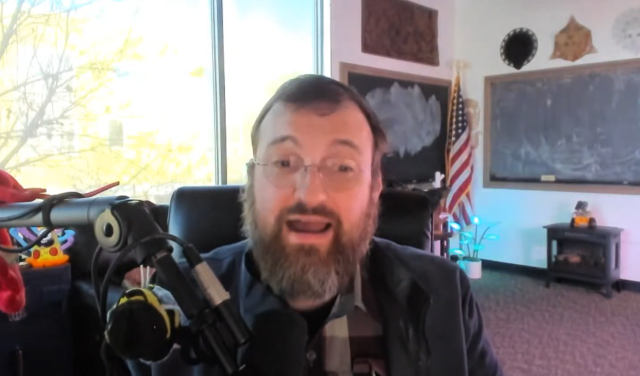
With 2025 almost over, the Cardano founder, Charles Hoskinson, and the broader crypto market are looking ahead to 2026 with renewed optimism for the ecosystem and the ADA price. Hoskinson has shared a strategic game plan for 2026 that could significantly transform the Cardano ecosystem and potentially even influence the value of its native token. Although ADA’s price has underperformed other top altcoins so far this year, upcoming developments and shifts in 2026 could create a better environment for a potential recovery. 

Cardano 2026 Game Plan Offers Hope For ADA Price Recovery

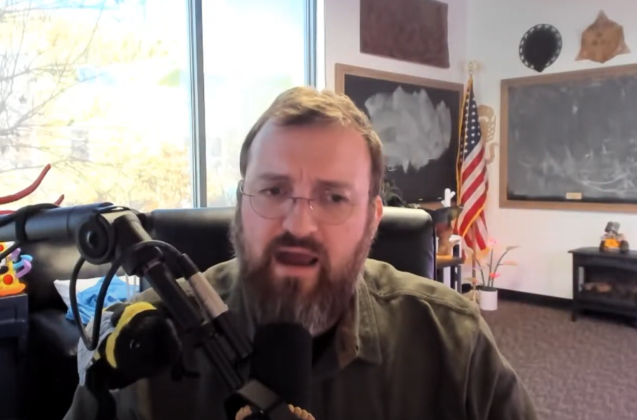
In a recent video posted on X, Hoskinson shared his thoughts on Cardano, offering a glimpse into the blockchain’s vision for 2026. According to the crypto founder, Cardano is preparing to enter the new year with a plan to become a powerful and exceptional blockchain network and the most relatable distribution system humanity has ever created. 

Hoskinson emphasized that achieving this vision will require significant time and effort, acknowledging that setbacks are part of building a complex system. He noted that bugs and mistakes are inevitable, but what distinguishes a successful project is how well and fast it responds and recovers. 

The Cardano founder also highlighted the importance of learning from errors and improving processes, suggesting that future obstacles will be overcome more quickly and effectively. While perfection is unattainable, Hoskinson’s statements reflect confidence in Cardano’s approach to problem-solving, adaptability, and its ongoing progress toward becoming a leading blockchain network.

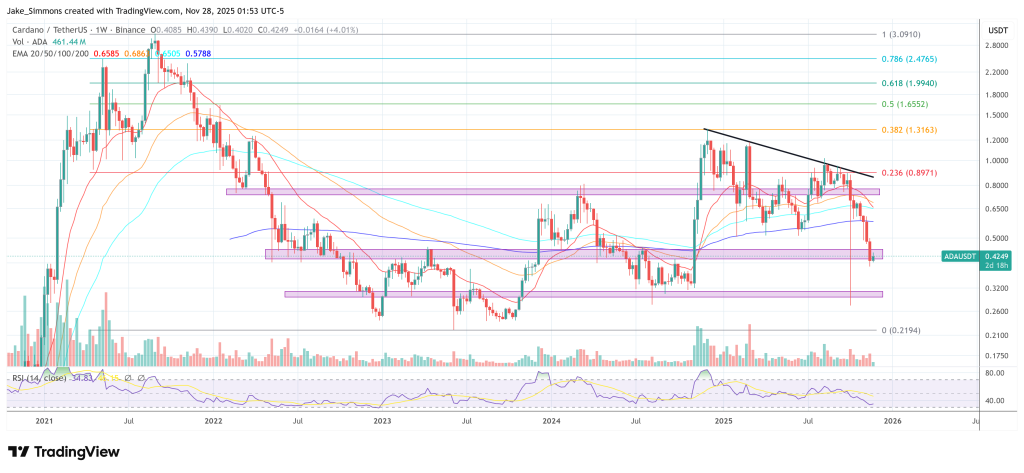
While the blockchain prepares to advance, it remains uncertain if an ADA price recovery will follow. Currently, the cryptocurrency is trading at $0.449, reflecting a 63% decline this year and a 16.6% drop over the past month. Compared to other altcoins like Ethereum and Solana, which reached new all-time highs earlier this year, ADA’s underperformance has been somewhat of a puzzle, especially given its previous ecosystem developments and strong community

Analyst Says ADA Price Will Be Mega Bullish If It Breaks This Level

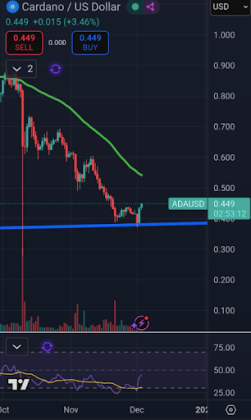
 The Cardano price has been trending downward for months; however, analysts remain bullish on the cryptocurrency. According to crypto analyst ‘Sssebi’, ADA’s next key milestone is the $0.50 resistance level. If the altcoin can successfully breach this threshold, he predicts that Cardano could enter a “mega bullish phase.”

Sssebi’s analysis highlights that despite Cardano’s price being significantly undervalued, its underlying structure still shows hints of bullishness. Breaking $0.50, therefore, could act as a psychological trigger that helps the altcoin overcome current bearishness and signal a much-anticipated recovery.
Cardano

The analyst suggested that ADA’s current price of $0.44 may represent a bottom level. As a result, he recommends that traders view this low level as a potential opportunity to enter the market ahead of a potential upward surge.

Cardano

Cardano Founder Unveils Pentad Blueprint To Drive 2026 Growth

Cardano founder Charles Hoskinson has outlined an ambitious blueprint to turn the newly formed “Pentad” into a de facto executive engine for ecosystem growth in 2026, linking critical infrastructure deals, DeFi expansion, RealFi, Midnight’s privacy stack and a more aggressive developer and institutional outreach strategy.

Cardano Sets 2026 Ambitions With Pentad Governance

In a new livestream titled “Thoughts on Growth for Cardano in 2026 (Pentad Series),” Hoskinson framed Pentad as the missing executive layer in Cardano’s Voltaire-era governance design. CIP-1694 and the Cardano Constitution, he argued, have already established a “very strong legislative branch” and a “very strong judicial function,” with DReps providing checks and balances. What has been absent, he said, is an entity that can actually execute.

“We always had this idea that a government needs a judicial, a legislative, and an executive function,” he said. “But the executive function was always a little milky.”

The Pentad consists of the Cardano Foundation, Emurgo, Input Output, the Midnight Foundation and Intersect. Its first mandate is the “Cardano Critical Infrastructure” program, a coordinated negotiation effort to secure commercially essential integrations such as bridges, stablecoins, oracles and analytics. Hoskinson described this as a “try before you buy” test of whether the five entities can function as a single executive voice.

“All these guys together they’re super expensive and also they’re run by very competent business people,” he said of potential integration partners. “If we’re divided they’re going to divide and conquer and we’re going to end up with a damn mess and it’s going to be very expensive. So why don’t we put a Pentad together […] and let’s collectively negotiate kind of like collective bargaining.”

The success criteria are intentionally binary: either integrations are live, or they are not. Hoskinson called it “a really good test function for an emerging executive function.”

If that phase proves the concept, he wants the Pentad to pivot to explicit growth targeting in 2026. For now, he is anchoring that discussion in three headline indicators—monthly active users, transactions per day and TVL—while a broader KPI set is being drafted with community members. “Once we have a final set of candidate KPIs, we’re going to submit an info action to make them the official ecosystem KPIs,” he said, adding that “every budget moving forward has to be in some way connected to growth in those metrics.”

A central pillar of the 2026 plan is a curated showcase of roughly 10–15 Cardano DApps that exemplify the network’s capabilities. Hoskinson said these projects are typically “underfunded,” “understaffed,” and lack users, volume and TVL, which directly affects their profitability and Tier-1 exchange prospects. Midnight’s own listing push, he argued, has already “opened the door for Cardano native assets and all the big guys,” creating a window that showcase protocols could exploit if they reach sufficient scale.

The growth blueprint relies heavily on “aggregators of capital and people.” Hoskinson highlighted Bitcoin DeFi as a core channel to route external liquidity and users into Cardano, and pointed to XRP and other UTXO-based assets without native smart contracts as further sources of yield-seeking capital. Hybrid DApps that combine Cardano with Midnight’s privacy features are meant to provide differentiated USPs relative to Ethereum-based DeFi.

What Cardano Will Focus On

Developer and community strategy is set to become more aggressive. Hoskinson wants bi-weekly hackathons for Cardano, citing “awesome” growth results from Midnight’s cadence and existing events such as a large hackathon in Berlin. He argued that such frequency showcases that “Cardano can roll with the best of them” while tightening the feedback loop on Plutus and Aiken DevX.

At the same time, he called X “the worst of all mediums for a community to aggregate,” citing bots, noise and lack of curation, and pushed for controlled aggregation channels such as Discord, both for Cardano and for Midnight. Parallel to that, he described building a dedicated comms channel for analytics firms, institutions and VCs to run seminars on Midnight and Cardano, responding to persistent perceptions of Cardano as a “ghost chain” driven by incomplete third-party data.

On Input Output’s side, Hoskinson said the company is preparing a Cardano business unit to interface directly with the Pentad, consolidating ecosystem, engineering and governance work under leadership “custom-trained and tuned to think in this growth mindset.” He also emphasized a push into “horizontal” technology improvements, including AI-assisted “Vibe engineering” to compress research-to-production cycles from “five or 10 years” to “a 1 to two year cycle,” tested first in Lace and now in Acropolis.

He highlighted two flagship technology and product directions for 2026: the RealFi DApp emerging from more than a million loans in Kenya and Uganda—designed as “the ultimate bear market DApp” with off-chain, uncorrelated yields—and Hydra, which he said “truly can go a million transactions per second” on a per-DApp basis. The target is for the showcase protocols to become Hydra-enabled, achieving “Solana level speed” with minimal on-chain footprint.

Ultimately, Hoskinson presented the Pentad as a revocable, delegated executive layer rather than a centralized leadership structure, and put the onus on DReps to choose action over paralysis.

“Are you looking for perfection or are you looking to get things done?” he asked. “You’ve asked for unity. You’ve asked for growth. You’ve asked for leadership. This proposal is the beginning of answering those questions.”

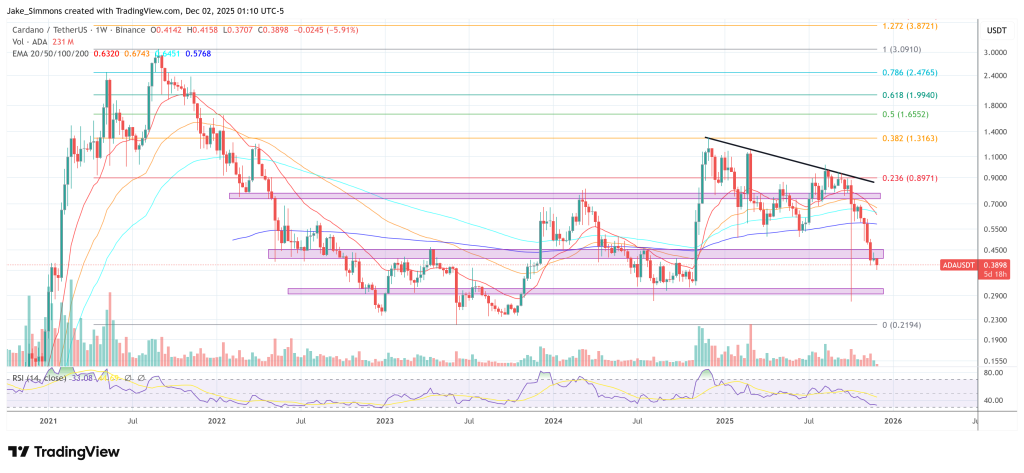
At press time, ADA traded at $0.38.

Cardano price

Cardano Founder Says Genesis ADA Was Profit, Not Community Funds

Charles Hoskinson has drawn a firm line under one of Cardano’s longest-running controversies, declaring that the allocation of Genesis ADA to Input Output (IO) and EMURGO was private profit for early risk, not a community-controlled pool to be repurposed for new initiatives.

Cardano Founder Closes Door On Genesis ADA Criticism

In a November 30 livestream titled “Genesis ADA,” the Cardano founder called the topic “a closed matter” and rejected renewed calls to use Genesis ADA for current integrations such as oracles and stablecoin issuers.

“The Genesis ADA is profit for services rendered taking a risk, doing an activity and building an ecosystem,” he said. “It was a deal between us and the primary buyers of ADA, the Japanese who put up the initial wave of capital to get it done […] Those are the people that mattered in that transaction and every single one of them has been made whole.”

Hoskinson walked through the original funding structure: a Japanese crowd sale that raised about $72 million, converted into bitcoin, and a “tripartid” model comprising the Cardano Foundation (governance), EMURGO (commercialization) and IO (protocol development). Based on the crowd sale pricing, IO’s Genesis ADA allocation was worth around $8 million at the time.

“For the vast majority of the early days of Cardano, the Genesis ADA sat around 4 to 8 cents in value,” he said, arguing that the founding entities accepted extreme risk — regulatory, technical and reputational — in exchange for that upside. “To say that somehow we don’t deserve what we’ve gotten when what we got was about $8 million for delivering a $15 billion ecosystem, it’s a statement made of a Twitter mob with no basis in reality.”

He framed the core objection as a misunderstanding of the original terms. If the community now insists that 100% of Genesis ADA must be spent, he argued, “then where was the profit for taking the risk?” He listed Japan and US regulatory exposure, the possibility of protocol failure, insider and outsider security threats, and potential civil or even criminal liability in the early days.

“Let’s be very clear here,” he added. “99.9% of cryptocurrency ventures fail. Cardano is one of only a handful like XRP and Ethereum that have survived over the last 10 years and has value greater than $10 billion […] For a little over $40 million, a 10 plus billion dollar ecosystem has been created that at one point reached over a hundred billion dollars of value […] By any measurement, this has been an overwhelming success.”

Hoskinson also pushed back hard against the idea that IO and EMURGO should function as de facto public utilities whose entire balance sheets exist for Cardano’s “common good.”

“The books of my company and the books of EMURGO as private companies are none of the concern or business of the community as a whole,” he said. “We owe you nothing but the work we promise to do and will continue to do if you so choose. Those are the terms and conditions.”

He contrasted demands to forfeit profits with the existence of an already sizable on-chain treasury. “Demanding that whatever profit or revenue that we’ve made over the last 10 years be forfeited for a greater good while the community sits on a more than billion ADA treasury […] is a pretty absurd thing,” he said, noting that the treasury mechanism itself was part of the original design he proposed.

Why The Debate Now?

The immediate flashpoint is a joint request for 70 million ADA from the treasury to fund a package of integrations, including providers such as Pyth, RedStone and Circle. Some critics have argued that such work should be paid from Genesis holdings instead. Hoskinson called that retroactive expectation “pretty absurd” given that those companies “didn’t even exist at the time.”

He stressed that the 70 million ADA “will not cover the total fee of all the integrations” and that IO, the Midnight Foundation and others will “have to put skin in the game” because they are large ADA and KNIGHT holders who want to see yield on those assets.

Framing the broader governance vote, Hoskinson presented the current moment as a 2026 “reset” from the original tripartite structure to a new “pentad” executive layer involving EMURGO, the Midnight Foundation, the Cardano Foundation, IO and Intersect. The goal, he said, is to coordinate strategy and negotiations with “some of the largest most predatory and aggressive companies in this industry,” where Cardano must “speak with one voice” to secure key deals.

“The Genesis ADA is a closed issue. You have seen the end results of it and we have all moved on as founding entities,” he concluded. “We now have to decide, do we want to do something new and different […] and put a new structure for 2026 so that we can build the necessary infrastructure for the DeFi ecosystem? Or don’t we? It’s just that simple.”

At press time, ADA traded at $0.38.

Cardano price

Hoskinson Urges Cardano Unity Ahead Of Pivotal 2026 Roadmap

Cardano founder Charles Hoskinson used a Thanksgiving livestream on November 27 to call for a reset of relations between the network’s core institutions and to frame 2026 as a decisive year for the ecosystem.

He acknowledged a bruising year marked by a contentious “social fork” and, more recently, a soft fork and long-chain reorganization. “Everyone has grievances and we all have sins as well, myself included,” he said. “For my part in all these things, I am sorry.”

Cardano Eyes 2026 Reset With Hoskinson’s Call For Cohesion

Hoskinson admitted that his own “rigid and principled” style and public anger over disagreements have sometimes made things worse, and warned that “in disunity and division this ecosystem cannot succeed regardless of philosophical differences.” He pledged to stop relitigating past disputes with the Cardano Foundation and focus instead on “the new governance structure moving forward.”

He tied that reset to a joint governance push by five institutions: IOG, the Cardano Foundation, EMURGO, Intersect and the Midnight Foundation. He credited “Philip [Pon] from EMURGO and Fahmi [Syed] from the Midnight Foundation and Jack [Briggs] from Intersect” for convening talks on “how all five entities […] can work better together for the greater good of the Cardano ecosystem,” and said the community should expect coordinated proposals, including a “critical integrations” budget for missing core infrastructure ahead of 2026.

Hoskinson also rejected characterizations of this week’s soft fork as a systemic failure, calling it “a demonstration of the strengths of Cardano as a whole.” Its Nakamoto-style proof-of-stake and “remarkable protocol engineering,” he argued, allowed the network to “organically recover without significant disruption or loss,” with genesis and infrastructure preserved.

Drawing an analogy to Bitcoin’s history of orphaned blocks, he argued that temporary chain splits are “a feature, not a bug,” because they create “internal resilience” that lets the network “recover to the longest chain over time.” The incident, he said, reminded him that “no matter how big the fork, there is a way for two chains to become one.”

Looking forward, Hoskinson cast 2026 as the key execution window for Cardano’s roadmap. He highlighted Hydra’s emerging DeFi use cases, “amazing innovations like Starstream,” the commercialization of the Midnight ecosystem and the opening of “completely new markets” through Bitcoin DeFi.

Realizing that vision, he said, requires a coordinated effort from “the young new ones like the Midnight Foundation,” groups “with a lot of collaboration but dissonance like Intersect,” infrastructure players such as Pragma and “the old guard” at IOG and the Cardano Foundation, alongside the wider community.

The speech also drew a sharper ideological line between what he described as two philosophies that will shape crypto over the next five years. One, in his telling, seeks to “rebuild Wall Street, make it a little faster, better, and cheaper” while preserving the same control structures and middlemen. The other, rooted in the cypherpunk tradition and Satoshi Nakamoto’s design, insists that “no entity should be so powerful that they get to decide your freedom of association, commerce and expression.”

Hoskinson positioned Cardano, Midnight and Bitcoin within the latter camp. “We’re the good guys,” he said. “Every day we wake up and we fight for every person to have a seat at the table […] they have a right to be there by the fact that they are human.” If the ecosystem can translate that ethos into unified governance and shared infrastructure, he argued, “this time next year, we will be 10 times stronger than we are today.”

Notably, the livestream came after the first joint governance proposal from Intersect, IOG, Emurgo, Cardano Foundation and the Midnight Foundation. Intersect wrote via X: “The Critical Integrations Budget – now on-chain – reflects several weeks of collaboration among the core entities, with last week’s mainnet incident highlighting the strength of that coordination. The Budget Info Action is now available for DReps and the six Constitutional Committee members to consider and vote on.”

At press time, ADA traded at $0.42.

Cardano price

❌