Reading view

There are new articles available, click to refresh the page.

New Legislation Bans Hemp-Derived THC

President Donald Trump signed a spending measure Nov. 12, funding federal operations through January and ending the longest government shutdown in US history after 43 days. The Senate had approved the measure the previous day, with seven Democrats crossing party lines to reach the needed 60-vote majority. They were won over by a Republican pledge to revisit the question of subsidies for Obamacare in December.

However, a sideshow to the fight over the Affordable Care Act is causing outrage in the hemp industry—and among farmers in hemp-producing states like Kentucky. A last-minute provision added to the spending bill will effectively ban all hemp-derived THC products.  


The Dreaded ‘Loophole’

This concerns what has been derided as a “loophole” in the 2018 Farm Bill that legalized the production of industrial hemp in the United States. The Farm Bill kept the federal ban on cannabis and cannabis products with more than 0.3% Delta-9 THC—and on Delta-9 THC itself, whether derived from hemp or “marijuana.” However, in a measure intended to legalize the CBD market, it allowed extraction and sale of cannabinoids other than Delta-9 THC, if derived from hemp. 

This had an unanticipated effect. In the wake of the 2018 law, an industry suddenly boomed around hemp-derived cannabinoid products—and not just CBD but psychoactive THC. Particularly at issue was Delta-8 THC, an isomer of Delta-9, which behaves much the same way in the human organism. Products containing Delta-8 were suddenly available in convenience stores, gas stations and truck stops coast to coast.  

A backlash also quickly emerged. Critics argued that because the industry was essentially using a subterfuge to skirt the law, these new products were basically unregulated

The new law contains a provision added to Agriculture Department funding that restricts hemp and hemp-derived products to those containing low concentrations of all THC—not just Delta-9 THC. It is to take effect on Nov. 12, 2026, one year from the date of signing. 

The new provision “prevents the unregulated sale of intoxicating hemp-based or hemp-derived products, including Delta-8, from being sold online, in gas stations, and corner stores, while preserving non-intoxicating CBD and industrial hemp products,” reads a Senate Appropriations Committee summary.  

Media reports warn of an “extinction-level event” for the hemp industry when the provision kicks in. 


Bluegrass Senators at Odds

Kentucky’s Republican Sen. Rand Paul pushed an amendment to strip the provision from the bill, but this failed in a 76-24 vote. And his principal opponent was fellow Bluegrass State GOP senator, Mitch McConnell—who had championed the 2018 Farm Bill as then-majority leader of the Senate. 

The Louisville Courier-Journal quoted Kentucky farmers fearing that the new law could be a “death sentence.” 

The move is also meeting with pushback in Texas, where the GOP-dominated political establishment is divided over an effort to ban Delta-8 at the state level. Officials with the Texas chapter of the Veterans of Foreign Wars told Waco’s KWTX that many vets use hemp-derived THC products to treat PTSD and other ailments related to their service. 

“What in the world just happened last night?” Thus responded Mitch Fuller, legislative chair for Texas VFW, after the Congressional logjam broke. Fuller had successfully lobbied Gov. Greg Abbott to veto the Delta-8 ban in the statehouse earlier this year.  

Abbott’s big rival on the question in his own administration was Lt. Gov. Dan Patrick, who had pushed for the state ban and enthused in a tweet about the federal one after it passed: “As part of the resolution, consumable, highly intoxicating hemp-derived THC is essentially banned in America. Farmers are protected to produce industrial products. CBD and CBG are still legal. However, Delta-8, Delta-10, and candies, snacks, and gummies with high dosages of intoxicating THC are all banned. Hemp-derived Delta-9 will only be allowed to be sold in very low, non-intoxicating dosages.” (This is a reference to the 0.3% cap, well below the threshold for any psychoactive effect.)

Mitch Fuller retorted: “Of course, safety is important, of course children not having access to this is important. But let’s not use a chain-saw approach to this, let’s use a scalpel approach to it, and regulate it.”

The VFW chapter said they will use the year before the ban takes effect to organize pressure to have it reversed.

Industry Voices Sound Alarm 

The hemp and cannabis industries are, predictably, distressed over the new measure. Adam Stettner, CEO of financial lender FundCanna, said in a statement: “Banning intoxicating hemp through a government funding bill isn’t policymaking; it’s panic disguised as progress. You can’t erase a $28 billion market or the millions of consumers who already exist. You can only decide whether those dollars flow through legal, regulated channels or into the shadows. You’re kidding yourself if you think consumers will stop buying hemp beverages, gummies or wellness products because Congress flipped a switch.” 


Stettner raised the specter of backsliding toward prohibition: “Dismantling compliant supply chains won’t make these products disappear; it will make them untraceable, untaxed and unsafe. What we need isn’t a ban, it’s balance and logic. If lawmakers want safer products and clearer rules, they need to regulate, not eradicate. The responsible path forward is to regulate hemp like we do alcohol or caffeine at the federal level, with age limits, testing and labeling. Inserting a blanket prohibition by sneaking it into a budget deal won’t work; prohibition never works.”

Thomas Winstanley, executive vice president of infused products purveyor Edibles.com, emphasized the ironic role of the former Senate majority leader, who has announced that he will retire next year.

“Mitch McConnell has once again proven himself the architect of the law of unintended consequences,” Winstanley said. “When he introduced the 2018 Farm Bill, it was celebrated as a lifeline for America’s farmers—a rare bipartisan achievement that gave rural communities a new cash crop and built a thriving, homegrown industry. What no one expected was that it would also ignite a $28 billion consumer market, create over 300,000 American jobs, and form a domestic supply chain rooted in U.S. agriculture and innovation. That was the first unintended consequence, a positive one. Today, history repeats itself, but this time, the fallout will be devastating. By attaching a sweeping hemp restriction to the government spending bill, McConnell has chosen to end his career by crippling the very industry he created.”

He too pledged to use the one-year grace period to organize resistance: “Farmers, brands, and consumers, once fragmented, are now mobilizing together to defend what they’ve built and to finally push for the federal framework the hemp industry has long demanded.”

The post New Legislation Bans Hemp-Derived THC appeared first on Cannabis Now.

How to Blind Test Cannabis for an Elevated Experience

Cannabis can be tasted and appreciated like fine wine and the idea is gaining momentum nationwide. Over in the global ganja epicenter of California, encouraging people to blind test cannabis is nearly standardized. 

Local chef, entrepreneur and industry veteran Chip Moore, 36, is the founder of the 4 and 20 Blackbirds collective and has been treating its members to the blind tasting concept — wherein participants don’t learn strain names before sampling, followed by discussion about the key characteristics of tastes, smells and effects.

In the hippy hamlet of Fairfax north of San Francisco, the newly formed Herba Buena collective, whose co-founder Alicia Rose comes from the wine industry, incorporated blind wine-style tastings as well. 

Alicia said the “effusiveness of the aromas” should guide aficionados through the tasting process. She’ll often make collective members smell a jar of Herba Buena’s ultra-organic cannabis before revealing the strain. “I like them to smell and experience the flower before identifying it,” she says.

It’s not a totally surprising development. The San Francisco Chronicle mentioned treating cannabis like wine as far back as 2007 and magazine The Clever Root — a farm-to-table foodie publication backed by the wine industry — has included an entire column devoted to cannabis. The magazine Marijuana Business Daily now publishes the results of blind taste tests in each issue.

As cannabis continues to be normalized and elevated through taste-testing events like these, industry leaders are wise to borrow from the wine and food culture, further illustrating how cannabis can offer as much of a connoisseur experience as wine or fine chocolate.

How to Conduct Your Own Blind Smell & Taste Test

1. When you blind test weed, make it blind. “The main difference is that when someone knows the strain they are tasting they have already categorized how it’s supposed to smell and taste based on their previous experience with that strain,” said Moore.

2. Pick rare strains. Don’t choose popular favorites like Sour Diesel or OG Kush — aficionados can identify their signature lemonhead or pine-sol funk aromas in one whiff, and the results lead to sample bias.

3. Pre-roll some joints. Unlike wine, cannabis strains can be identified visually from across a room, rendering moot the whole point of the blind taste. “I want to challenge the participants to use their senses,” says Moore, “particularly smell to reach past their preconceived notions and really get to know the bud they are smoking.”

4. Take a “dry hit.” Draw on an unlit joint to taste its terpenes at room temperature. A dry toke reveals a lot about the quality of the herb. It should have a clean herbal taste without any sharp salty notes which can indicate the presence of unflushed fertilizers.

5. Fire it up, but no bogarting. “I tell them to start off slow, not take one of those big, ‘I’m not going to get this joint back’ hits,” laughs Moore.

6. Write down your notes. Privately record initial impressions and share joints to taste how the joint changes as it smokes. As leading cannabis judge Swami of Swami Select says, “Each joint is a journey and each tells its own story, how well it was flushed, whether it’s indoor or sungrown, this kind of things.”

7. Use coffee beans as a palette cleanser. Coffee beans help refresh noses over-exposed to the onslaught of cannabis terpenes and smoke.

8. No spoilers. As the joint burns, Moore asks folks to continue to record their observations, but don’t shout out what they think the strain is. It creates expectation bias. 

9. Don’t overdo it. Wine tasters spit out the wine. Smokers just need to go slow. “The purpose is not to get so high they forgot what they’re doing,” says Moore with a chuckle.

10. Guess the strain. Write down your last impressions, along with any possible guesses as to what the strain is. Discuss.

11. Repeat. The best way to elevate your cannabis critiquing is to keep practicing.

TELL US, how do you choose your cannabis?

Originally published in Issue 21 of Cannabis Now. LEARN MORE

The post How to Blind Test Cannabis for an Elevated Experience appeared first on Cannabis Now.

Marijuana Might Be Beneficial in Combating Phobias

For some, it might mean feeling a little uneasy when matched with an unknown entity that catches them off guard when they least expect it, or a looming dread of a weekly editorial meeting that keeps them from wanting to get out of bed. Hey, we’ve been there. There are other people, however, who have an irrational, crippling fear (otherwise known as a phobia) of something that hinders their lives with such ferocity that they will do everything in their power to maintain a safe distance.

You won’t catch these folks in or even around an airport, near the snake pit at the local zoo, in confined spaces, or checking out the view from the top of the Empire State Building. Oh, hell no. People with phobias are perfectly content living their lives without any of these perceived frightening situations turning them into a frayed ball of nerves. Maybe even you have a phobia that you’ve lived with ever since you can remember that still, to this day, scares the holy bejeezus out of you. You’d do anything to avoid facing it. But don’t feel bad, you’re not alone. Around 19 million people all across the U.S. suffer from an irrational fear of something, which makes it the most common mental disorder in the country, according to the National Institute of Mental Health.

There is no need to fear, though, cannabis might be just what the doctor ordered. A body of evidence has emerged over the past six years or so suggesting that marijuana, or at least some of its essential compounds, might be able to help people with certain kinds of phobias be less afraid.

A study from the University of Michigan, which was published in the journal Neuropsychology in 2013, finds that tetrahydrocannabinol (THC) might provide phobia patients with a trapdoor out of the horrific anxiety that comes with these conditions. In some cases, researchers discovered that the stoner cannabinoid is so beneficial in this respect that it even allowed some patients to work through their fears and moved past them. But it’s not like researchers just got a bunch of people super stoned and then tossed them in a closed space and let them work out their anxieties.

The study, which involved around 30 people, used a Pavlovian fear extinction paradigm and simultaneous skin conductance response recording while dosing patients with a synthetic version of THC called dronabinol, according to Science Direct. Still, researchers say that people under the influence of THC showed less fear over time. “These results provide the first evidence that pharmacological enhancement of extinction learning is feasible in humans using cannabinoid system modulators, which may thus warrant further development and clinical testing,” the study authors wrote.

Another study, this one from the Frontiers of Pharmacology, shows that America’s favorite non-intoxicating cannabis compound cannabidiol (CBD) might actually have some therapeutic benefit when it comes to dealing with specific phobias. The study, which was led by Chenchen Song of the University of Birmingham in 2017, shows that 10 mg injections of CBD were able to reduce the fear memory in rats. Sure, it’s not likely that these animals were afraid of heights or flying, but Song says that the cannabis component did make them less fearful of being eaten alive by predators. It’s the same reason that the compound has been shown effective in treating people with post-traumatic stress disorder (PTSD). Essentially, some phobias, just like PTSD, manifest after a harrowing situation. The gist of the research is that CBD, which has gained some notoriety as an anxiety-squashing drug, was effective at preventing this fear from coming to the surface.

“In the more translationally-relevant stronger conditioning setting, CBD both acutely inhibited fear expression and enhanced extinction to produce longer-lasting reductions in fear,” the study reads. “These observations provide further support for the potential translational use of CBD in conditions such as post-traumatic stress disorder and specific phobias.”

It is possible, considering this body of evidence, that phobia patients might be able to contend with their fears with the use of medical marijuana. Traditionally, these conditions have been dealt with by prescribing beta-blockers, antidepressants and tranquilizers, but these drugs can be habit-forming and make a person feel less human than an irrational fear of anything. Still, it’s okay to be skeptical about the power of cannabis when it comes to treating phobia cases. I am. I mean, I’ve been pretty stoned in my day and never once was there a time when I felt any less freaked out by the thought of a snake slithering up next to me. And getting high and traveling to the top of the Empire State Building last year, well, that just gave me vertigo and made the experience even more frightening than it would have been under normal circumstances. However, at its most basic level, some strains of marijuana (Somari, Super Skunk Auto and Bigfoot) have been known to calm the anxiety that one experiences when those phobias kick in. Our best advice is to check with your budtender to find out what other fraidy cats are using to get through the terror.

TELL US, have you ever used cannabis to deal with a terrifying fear?

The post Marijuana Might Be Beneficial in Combating Phobias appeared first on Cannabis Now.

Smoking A Bowl of High-THC Flower Might Be Best For Combatting Pain

The average cannabis user living in states where marijuana is legal has the luxury of stepping inside his or her friendly neighborhood dispensary for access to a variety of pot products, like edible candies, pills, topicals, concentrates and even beverages. These processed variations of the cannabis plant are designed for those consumers who don’t necessarily want to smoke to achieve the desired effect. But when it comes to which method of consumption is best for patients suffering from chronic pain, a new study suggests that loading a bowl full of flower is still the most effective path to getting back to good.

Researchers at the University of New Mexico determined that people trying to manage pain through the use of cannabis are simply better off smoking bud than relying on other forms of the herb. The findings, which were published in the journal Complementary Therapies in Medicine, indicate that “whole cannabis flower was associated with greater pain relief than were other types of products.” The researchers go on to say that “higher tetrahydrocannabinol (THC) levels were the strongest predictors of analgesia and side effects prevalence across the five pain categories.”

These results are especially interesting considering that cannabidiol (CBD), the non-intoxicating compound of the cannabis plant, is now being praised as a rockstar at taming pain. Even the folks pushing the hemp-derived version of this medicine, which is much weaker than the oils made from marijuana, swear that this sometimes truck stop novelty is the key to living pain-free. However, researchers beg to differ. They have concluded that the presence of THC, which produces the stoned effects we all know and love, is also essential if the user expects any discernible pain-relief results.

“Cannabis flower with moderate to high levels of (THC) is an effective mid-level analgesic,” the study reads.

But it just isn’t the existence of THC that makes smoking marijuana the best approach to pain management.

We have swelled into a society convinced that dissecting cannabis and separating its components into good and evil is the right approach to the plant. This is perhaps the reason that CBD has risen to such stardom in the past five years. The problem with this attitude is that it completely disregards the 100 or so other cannabinoids that the cannabis plant has to offer. It also discounts essential terpenes and flavonoids and thereby eliminates any possibility that the patient will benefit from the plant’s synergistic properties. Science established long ago that the entourage effect associated with whole-plant cannabis is what truly provides the therapeutic effects. So, all of you military service members prohibited from using CBD products, don’t worry, you’re definitely not missing much.

But what about kids suffering from epilepsy? Dr. Sanjay Gupta told us years ago that they needed the CBD compound to stop seizures. Sure, while some sick children might have had some luck controlling this affliction through the use of CBD alone, a study published found the compound was more effective at helping them stay seizure-free if it was complemented with just a hint of THC. Researchers found that the closer they got to allowing the two cannabinoids to work together, the better the results. “We saw a statistically significant reduction in motor seizures, and an increase in seizure-free days,” the study authors said.

Although the U.S. Food and Drug Administration (FDA) approved a CBD-based drug called Epidiolex to be prescribed to young patients suffering from two rare forms of epilepsy, not even it is expected to be a miracle cure. The drug, which contains absolutely no THC, is only effective in around 32% of patients, according to the FDA. Parents with epileptic kids have long complained that CBD alone just doesn’t do the trick and that the efficacy of this compound has been hyped beyond belief.

The study out of New Mexico, however, provides some guidance for an America looking for answers as to whether marijuana can relieve pain or not.

A separate study published from the American Society of Anesthesiologists (ASA) shows that 75% of the U.S. population, most of them millennials, has a genuine interest in learning more about how pot can combat pain conditions. These folks, presumably those fed up with all of the anecdotal reports and the conflicting studies that emerge every other week, want to see the federal government finally roll up their sleeves on the cannabis issue and deliver real results.

Unfortunately, it seems that medical marijuana users are going to have to get high before they experience any noticeable pain relief. And that complicates things for a vast majority of the U.S. population — especially those in the workforce. Unlike over-the-counter pain remedies like acetaminophen and ibuprofen, which eliminate some of the hurt without a buzz, smoking marijuana to combat minor aches could lead to impairment issues on the job. Just like most companies don’t allow workers to drink booze on the clock, medical marijuana is not likely to be any different, even after federal legalization finally takes hold. So, don’t sell your stock in Tylenol just yet.

The post Smoking A Bowl of High-THC Flower Might Be Best For Combatting Pain appeared first on Cannabis Now.

The Urb Guide to Hemp-Derived Cannabis

Having a hard time getting your head around hemp-derived cannabis? With concepts like Delta-8, minor cannabinoids, and non-psychoactive CBD flying around, the modern legal cannabis landscape can often feel overwhelming and confusing.

Fortunately, Urb’s on a mission to connect customers with hemp-derived cannabinoid products they can trust. To date, the brand’s accomplishments in the field include being the first to bring Delta-8 THC to market, the first to bring Delta-9 THC edibles to market, and their award-winning Pegasus D8 oil, which boasts the highest standard for purity, safety and compliance in the hemp space.

Forged through a curated combination of quality, education and a diverse array of premium goods, Urb has something for everyone: From canna-curious newbies residing in hemp-only legal states to the old guard and their penchant for ripe flavors and high potency.

Want to learn more about which Urb lines can brighten your day? We’ve put together a clear and concise breakdown of the science behind their award-winning releases to help you find the perfect match for soothing what ails you. Read on for tables and explainers—complete with paired product suggestions—covering the full breadth of Urb’s pioneering work to provide hemp-derived cannabis far and wide across the legal landscape.

To get you started, we’re offering 25% to all Cannabis Now readers with code URBCN25.

De-Mystify Hemp-Derived Cannabinoids

Let’s start with the basics: What is hemp-derived cannabis? In short, hemp is a variety of cannabis plant that tests at 0.3% THC or less. In the wake of the passage of the 2018 U.S. Farm Bill, products featuring hemp-derived cannabinoids have surged in popularity. They include the non-psychoactive cannabinoid CBD, trace amounts of Delta-9 (the same THC found in non-hemp cannabis), Delta-8 (a weaker form of its more popular THC sibling), and new wonders like Delta 10. If you think of the cannabis plant as a box of crayons, hemp-derived cannabinoids are like a handful of fascinating new colors you’ve yet to color with. Completely safe and available in a myriad of enticing forms and formulas, let’s look under the hood at what each cannabinoid offers.

Non-Psychoactive

CBC

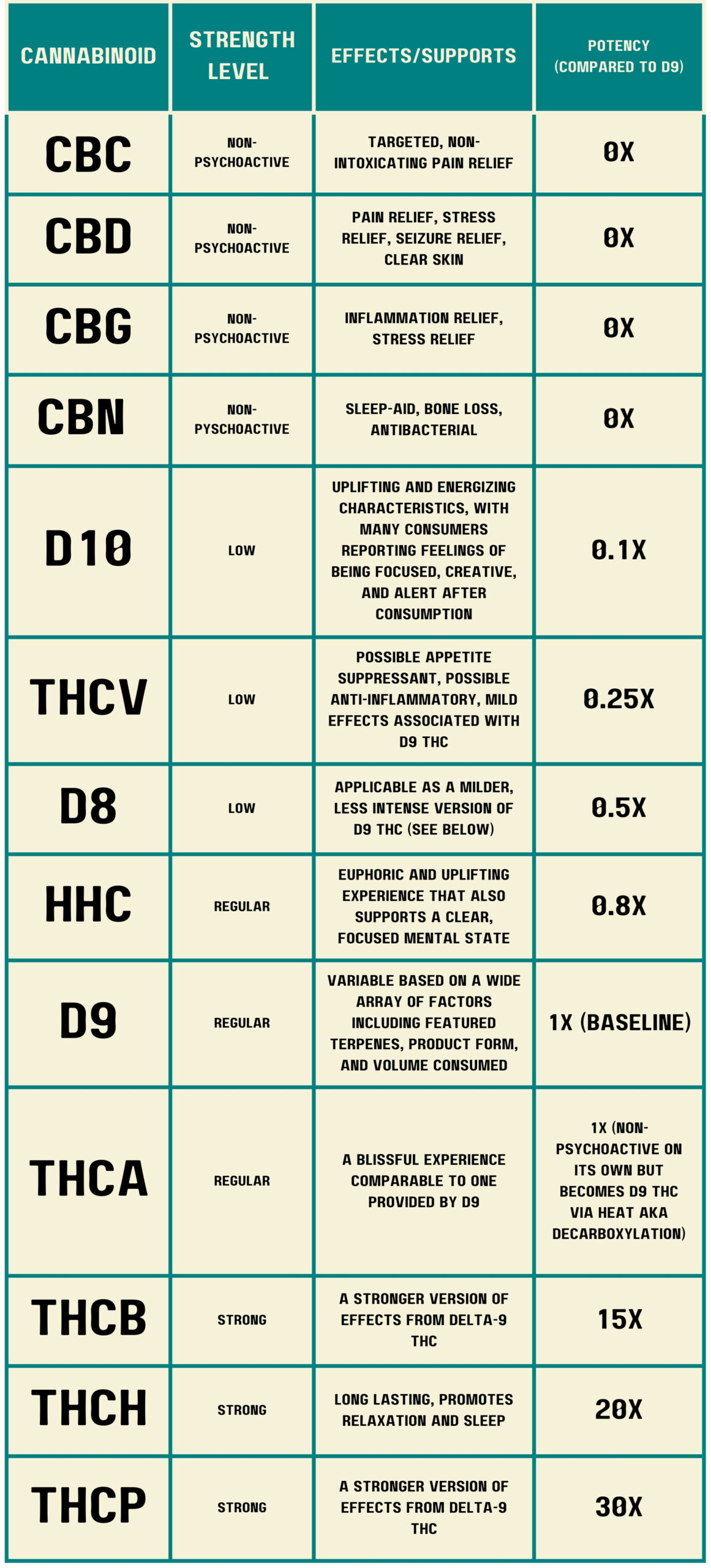
CBC—short for cannabichromene—doesn’t bind strongly to our natural endocannabinoid system’s CB1 receptors, but it does interact with some lesser-known receptors (TRPV1 and TRPA1), which can help to modulate inflammation and pain perception. Offering appealing potential as a targeted, non-intoxicating pain relief option, Urb is proud to offer CBC-powered products as part of our Boarding Skybites gummies line.

CBN

First identified in 1896, research suggests CBN can play a role as a sleep aid and that it may help support the reverse of bone loss associated with osteoporosis. Additionally, CBN may also have antibacterial properties against bacteria such as Staphylococcus aureus. Grab your ticket to the CBN revolution with Urb’s Landing Skybites: offering a soft landing when and where you need it, complete with delicious berry flavors.

CBD

Long considered a great cannabinoid for multitasking, CBD is associated with a wide range of reported benefits covering everything from relieving pain and reducing stress to taming seizures and even contributing to clearer skin. And it does it all without the psychoactivity of THC, leading to its recent popularity as a non-intoxicating, safe option for canna-curious consumers to try. If you’re looking for a potent yet gentle CBD experience, check out our Boarding Skybites.

CBG

CBG is short for cannabigerol: a comparatively rare cannabinoid that typically comprises less than 1% of most cannabis strains. While there are studies that show CBG may help with inflammation and reducing stress, there are indications that the cannabinoid may also help address some other, more challenging conditions. Check out Urb’s Lychee Dream Jointcase to enjoy flower dripping with juicy sweetness and fuled by the twin power of THCA and CBG.

Low Strength

D8

Yes, Delta-9 THC is the compound most people think of when they hear “THC,” but there’s a lot to like about Delta-8 THC, too. Known to typically deliver a subtler, less intense experience, D8 products are a great option for those desiring a lower altitude flight. Many describe the experience of Delta 8 as more subtle, and this reduced intensity can make it a popular choice for individuals seeking a mellower and balanced experience. Urb is proud to be the first company to bring D8 to the legal market. Try their award-winning Pegasus D8 oil via a variety of tailored vape products, including Urb’s ultra-convenient Mile High Aerovape 420 Max.

D10

Like its siblings, Delta-10 THC is mostly hemp-derived and produces psychoactive effects often described as being distinctly uplifting and inspiring productivity and mental clarity in some consumers. Get a taste of Delta-10 bolstered with bold, tropical flavors by trying Urb’s Gummy Getaway Bahamas. Featuring 50mg of cannabinoids per gummy, these flavorful companions for an island-inspired escape are available in both Delta-8 and Delta-10 formulas.

THCV

Recognized as an outlier in the THC family, THCV is a naturally occurring cannabinoid in hemp and cannabis plants, but one that’s markedly different from its siblings. Unlike the classic high associated with THC, THCV—or tetrahydrocannabivarin—THCV is only very mildly intoxicating. It’s said to provide a more clear-headed and less foggy experience, which has made THCV popular among those with a “get stuff done” mindset looking for a touch of THC. According to early research, THCV may act as an appetite suppressant, which earned it the somewhat infamous nickname “diet weed.” Take THCV for a test drive with Urb’s 710 Clarity Collection, which includes the convenience of our Aerovape 710 Clarity and the notes of juicy blueberries found in our Flight Fuel 710 Clarity.

Regular Strength

D9

Is there a difference between THC and Delta 9? Nope! Delta-9 THC is fully the same as THC. The main reason to call it “Delta 9” is to distinguish it from the other types of THC in the delta family, such as Delta 8 and Delta 10. Want to try Delta 9? Check out Urb’s delicious Take Off Skybites, available in three different formulations: Create, Rest and Energy. They’re the perfect blend of sweetness and euphoria.

HHC

HHC is short for hexahydrocannabinol, a cannabinoid that’s only recently emerged in the cannabis industry to capture the curiosity of enthusiasts and researchers alike. While it’s structurally related to THC—the primary psychoactive compound in cannabis—it possesses its own unique properties and effects. At present, it’s estimated that HHC is roughly 80% as potent as THC, and according to anecdotal reports, it can provide a euphoric and uplifting experience while supporting a clear, focused mental state. You’ll find a proprietary blend of HHC and HHCP designed to elevate you to new levels with Urb’s Aerovape 710 Euphoria disposable vapes and Flight Fuel 710 Euphoria 510 threaded carts.

THCA

THCA, or tetrahydrocannabinolic acid, is the acidic precursor to THC—the “A” signifies that it’s “acidic.” Though their names and chemical structures are very similar, it’s important to be clear on these two important cannabis compounds. THCA is formed within the trichomes, the tiny mushroom-shaped glands that appear as the silvery dust you see on cannabis flower. While not psychoactive, when exposed to heat, THCA turns into THC through a process called decarboxylation, leading to some legit benefits. Intrigued? You’re in luck— Urb invites you to try their premium high-THCA flower in multiple strains cultivated in the US under ideal growing conditions.

High Strength

If you’re looking to put the pedal to the floor, give Urb’s high-potency line of products a whirl!

THCP

Only just isolated by Italian scientists in 2019, THCP is a relatively new and highly sought-after cannabinoid. Notably, it’s been found to have a structure and properties that make it much more potent than THC when it’s introduced to the endocannabinoid system. It is a naturally occurring compound in cannabis, though only in trace amounts. By some estimates THCP may be 30 times more potent than Delta 9 THC. Because THCP is so new, research is still ongoing to explore other THCP effects and benefits. Soar to new heights with the potent power of THCP. You’ll find it in our Mile High Aerovape 420 Max disposables, our Mile High Flight Fuel cartridges, and in our Mile High Skybite and Red Eye Skybite gummies.

THCH

Another 2019 discovery, THCH also occurs in very trace amounts and is typically synthesized from other more abundant cannabinoids for use in cannabis products. THCH interacts with the endocannabinoid system and strongly binds to the CB1 receptors. THCH, like THCB and THCP, is believed to be much more potent than THC due to its impactful relationship with our CB1 receptors. Ready to wind down? Try THCH with the Aerovape 710 Relax disposable vape or the Flight Fuel Relax 510 vape cartridges.

THCB

This high-potency variant of THC was also first isolated in 2019 by the same team who discovered THCP. THCB is a new and exciting addition that’s similar to THCP in that it binds more strongly to your CB1 and CB2 receptors than THC, though it’s not as potent as THCP. For a potent lift, reach for the Liquid Badder Disposable. This handy all-in-one vape device combines hemp-derived THCP and THCB with flash frozen live resin and Pegasus-certified Delta 8 THC.

What to Look for in a Hemp-Derived Cannabis Brand

Having the facts makes all the difference when it comes to finding a hemp-derived cannabis brand you can trust. That’s why Urb is proud to feature transparent potency levels and full panel certificates of authentication, including GMP and Pegasus certifications, as part of their commitment to quality, safety and customer satisfaction.

Urb’s accolades in the industry include a High Times 2023 Hemp Cup award for Vape and Flower. The company also proudly manufactures everything in-house in contrast to most of its peers outsourcing such tasks. It all leads to the best possible experience for consumers like you, so come take flight with Urb today!

The post The Urb Guide to Hemp-Derived Cannabis appeared first on Cannabis Now.

Can you be Allergic to Weed? Marijuana Allergy Symptoms

can you be allergic to weed

Image credit: Kyle Glenn via Unsplash

Marijuana is one of the most common drugs used for both medicinal and recreational purposes. After the federal government passed the Farm Bill 2018, the usage of Marijuana has skyrocketed in different parts of the US.

Using Marijuana within the legally prescribed limits is not harmful unless you are allergic to it. So can you be allergic to weed? The answer is yes, you can be allergic to marijuana.

Unfortunately, as devastating as it may sound, this is a reality, and approximately 10% of weed users may be suffering from this condition.

If you want to know more about weed allergy, its symptoms, and its causes, keep reading!


Can you be Allergic to Weed

Cannabis sativa has more than 100 cannabinoids, and you can be allergic to them. You can consume Marijuana in various ways, such as oral, inhaled, and topical. However, if your body does not accept these components, it can display a negative reaction.

Non-marijuana users exposed to cannabis daily, like workers harvesting cannabis or manufacturing weed products, can also fall victim to these allergies. Weed pollen is the biggest allergen in such products that can cause severe sensitivity in some people.

In the current years, marijuana allergy has become more common among users. So many people are becoming allergic to marijuana.

It could be due to the rise in weed popularity or weakened immune systems. However, more studies are yet to be done on this matter to fully understand why some people are allergic to marijuana.


Marijuana Allergy Symptoms

Weed allergy has similar symptoms to allergic reactions to other things. These symptoms are closer to pollen allergy reaction since weed pollen is the biggest allergen in these products. Some of the most common marijuana allergy symptoms include:

  • Watery eyes
  • Red eyes
  • Sneezing
  • Coughing
  • Itchiness
  • Shortness of breath
  • High fever
  • Nausea
  • Congestion
  • Vomiting
  • Inflammation


According to some doctors, people who handle marijuana products daily can develop symptoms of contact dermatitis. It happens if they are allergic to marijuana. More severe symptoms of cannabis allergy include:

  • Blisters
  • Hives
  • Burning/redness
  • Dry skin
  • Anaphylaxis


These symptoms can commonly be cured with over-the-counter allergy medication. However, this is something you should not take lightly.

Since Marijuana is a drug that interacts with your body’s endocannabinoid system, it can cause damage to different organs if not treated. Therefore, make sure to visit a doctor if you notice any allergy symptoms after consuming or coming in contact with Marijuana.

In case of an Anaphylactic shock, your body can undergo severe trauma as your airways start shutting down. This condition can even cause death. So, take the symptoms seriously and get a test done to discover your allergies.


allergic to marijuana

Image credit: Matteo Vistocco via Unsplash


Causes of Weed Allergy

The most common cause of cannabis allergy is pollen. Most people are allergic to marijuana pollen and have severe reactions if they get in contact with it. It is because the weed plant releases a large number of anemophilous pollen, which can interact with human airways.

Since this pollen is transferred by wind, it can easily enter our nose or mouth. Doctors advise marijuana workers to wear a mask and gloves during work hours. You can also wear a full protective suit to avoid your skin getting in contact with the allergen.

Another reason could be that you are allergic to THC. It is the only psychoactive component in Marijuana and you can have a certain allergy to cannabinoids separately. Some people can also have a high sensitivity to this cannabinoid.

If a product has a high amount of THC or a user consumes more than the recommended amount of THC, it can cause hypersensitivity. Moreover, cannabis plants also contain the Cas s 3 protein, which can cause allergic reactions in some people.


Weed Allergy Diagnosis

Cannabis allergy is still a debated topic that is under research. However, a prick test is the most common way to test for allergies. During a prick test, a doctor will inject a small amount of allergen into your skin using a needle.

They will keep you under supervision to check for any reactions. If they notice physical or internal changes, they will put you on medication immediately. However, there is no standard test in the medical industry to identify surely if you have a weed allergy.

Doctors check your consumption history and how your body reacts after consuming minor doses. Skin testing is also a great way to find out contact allergies caused by weed exposure. This test provides better results than any other test.

Even though these tests are not standardized, they can inform you about the sensitivity in your body. You need to be careful while consuming any drug. So, make sure to start it in a small dose to see how your body reacts to it.


Weed Interactions

If you are on medication or have any other food allergies, you must consult your doctor before consuming weed. Marijuana can have a negative reaction when in contacts with drugs like sympathomimetics, anticholinergics, alcohol, and opioids.

Weed allergy can become more prominent if it interacts with other food allergens. Some common food allergens include nuts, tomatoes, grapefruit, peaches, bananas, apples, and eggplants. These foods have similar allergen properties as weed allergens, which can worsen the side effects.

Consuming these foods together with marihuana can also make you more sensitive to weed products, even if you don’t have an allergy. If you are physically exposed to these fruits due to your work, then the chances of nasal allergy are also high.

Go through the ingredient list at the back of your weed products to see if anything does not suit your diet restrictions. Moreover, if you have dust and pet dander allergies, the use of Marijuana can worsen the sensitivity.


What to Do if You are Allergic to Weed

The first thing to do if you get a reaction from marijuana consumption is to consult with a doctor. It can turn into a life-threatening problem if not taken care of properly. It is important to get an allergy test done to understand what is causing sensitivity.

Start with a minor dose and track your reaction to Marijuana. Once your doctor confirms the allergy, take allergy medication to wear down the reaction. You should avoid using marijuana-based products completely if you are allergic to their components.

However, you are medically advised to take Marijuana for a certain illness, consult with your doctor and take medication to minimize the reaction. Since there is no treatment for this allergy, the only way you can control it is by not exposing your system to marijuana allergens.

If you are an avid user of cannabis products and wondering how you can be allergic to marijuana all of a sudden, it means you are consuming low-quality products.

People also develop weed allergies after using it for several years. Therefore, make sure to use the highest quality product to ensure safety.


cannabis allergy

Image credit: Towfiqu barbhuiya via Unsplash


Wrapping up with Cannabis Allergy

If you are wondering, can you be allergic to weed? So, yes you can develop allergies to marijuana components. It can cause symptoms like itchiness, shortness of breath, inflammation, or nausea if you are allergic to the ingredients in your weed products.

Therefore, it is essential to start with a minor dose and consult your doctor immediately if you notice signs of an allergy. Moreover, if you work in a marijuana field and have constant exposure to its components daily, then cover your body, and face and take allergy medication to prevent damage.

Tennessee Bill Would Regulate the Sale of Delta-8 THC

Tennessee leaders are again putting forth a bill that would regulate hemp-derived cannabinoids like delta-8 and delta-10 THC, after a previous attempt failed last year. Some hemp advocates applauded the bill, while others would rather simply legalize cannabis, naturally rich in delta-9 THC.

State House Majority Leader William Lamberth (R-Portland) and Sen. Richard Briggs, (R-Knoxville) introduced a bill on Tuesday to regulate products containing hemp-derived cannabinoids, such as delta-8 and delta-10 THC—his second attempt to do so.

House Bill 403 would tax and regulate cannabinoids derived from hemp via what some describe as synthetic processes. Typically products with delta-8 THC are marketed as being somewhat psychoactive, with effects weaker but similar to delta-9 THC.

“Delta-8 is a legal substance that can be sold and packaged in the form of candy or gummies; it often has a very high concentration of THC,” Rep. Lamberth stated. “There are no regulations and no legitimate way for anyone to know exactly what they are buying. Nothing in our current law prohibits a child from purchasing delta-8.”

The bill would ban the sale of hemp-derived cannabinoid products to people under the age of 21; adds a 5% additional sales tax to any product sold at a store; and create a licensing, quality testing, regulatory and enforcement process through the Tennessee Department of Agriculture.

“We need to regulate this because the horse is out of the barn,” Sen. Briggs said. “This stuff is everywhere, and we can’t put that genie back in the bottle.”

What is Delta-8 THC?

The idea is that hemp-derived CBD can be converted to other compounds, frequently being marketed as psychoactive. This doesn’t mesh with the general U.S. definition of hemp, bred specifically to not be psychoactive.

Delta-8 THC occurs naturally, but only in trace amounts: According to Chemical & Engineering News, cannabis plants naturally contain just 0.1% delta-8 THC or less—though some plants contain as much as 1%. Jeffrey Raber, cofounder and CEO of the Werc Shop told C&E News that there isn’t enough delta-8 THC found naturally in hemp to be economical for extraction.

But hemp growers in the state are supportive of the bill despite some suspicion about emerging hemp-derived cannabinoids. “We support anything that doesn’t put burdensome regulations on the industry,” Kelley Hess, executive director of the Tennessee Growers Coalition, said.

While hemp growers may support delta-8 products, others do not.

Artists such as Margo Price support legalization, but don’t support hemp-derived cannabinoid products in Tennessee. Opponents don’t like the way certain cannabinoids are extracted from hemp, which usually means altering the CBD molecule, which is found in hemp in larger amounts, using natural solvents and acids.

Tennessee! Legalize cannabis, grow it, eat it, smoke it and TAX IT! People are just gonna cross state lines and do it anyway. This Delta 8 shit had got to go! https://t.co/8CJKwDRk5x

— Margo Price (@MissMargoPrice) December 17, 2022

Attempt to Regulate Delta-8 Last Year

While some states moved to restrict hemp-derived cannabinoids, such as Utah, Tennessee would be taking a much different approach by regulating it instead.

Rep. Lamberth sponsored an earlier attempt to regulate delta-8 THC and similar compounds. Some Tennessee lawmakers and the Tennessee Bureau of Investigation said that by regulating delta-8, the state would be legitimizing the industry. 

House Bill 1927, which was introduced previously, would regulate delta-8 by making it illegal in most cases outside trace-level concentrations. The bill was amended in April 2022 to be more specific to include other hemp-derived THCs such as delta-9 and 10 and the derivative hexahydrocannabinol (HHC), but exclude non-THC hemp cannabinoids such as CBD.

Tennessee is one of 11 non-green states that hasn’t legalized, regulated, or decriminalized cannabis in some form. 

The post Tennessee Bill Would Regulate the Sale of Delta-8 THC appeared first on High Times.

❌