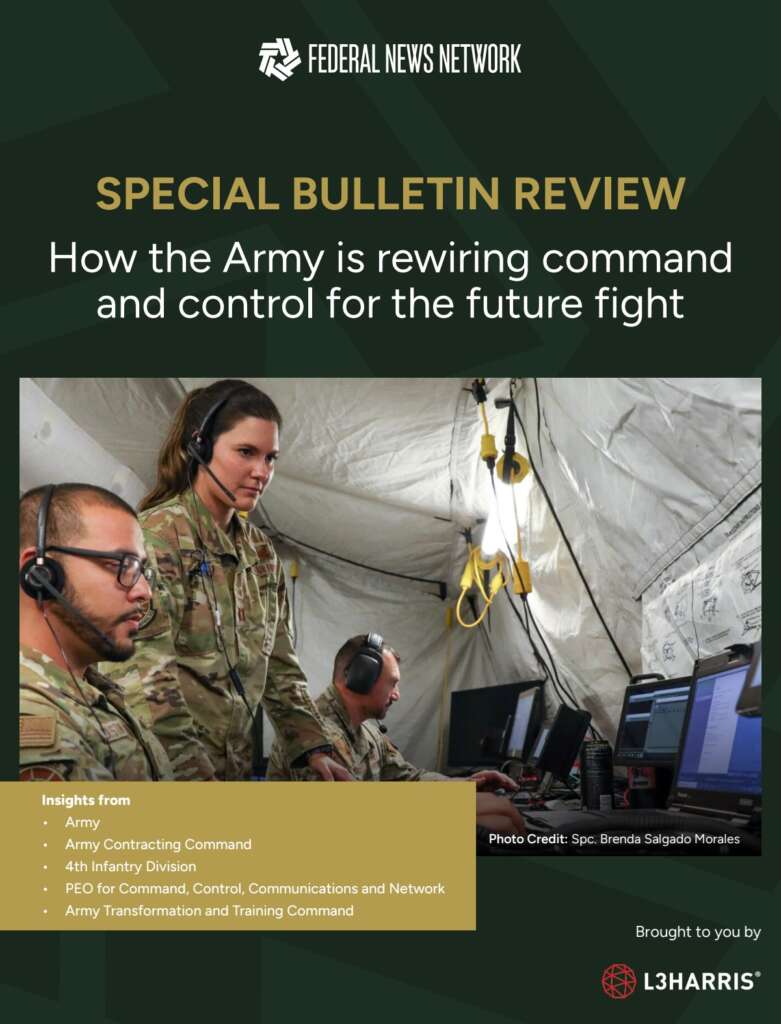
The Army’s Next Generation Command and Control (NGC2) initiative isn’t just a tech upgrade — it’s a full-stack transformation of how the force fights, communicates and makes decisions.
Our new Special Bulletin Review dives into how the Army Futures Command, PEO C3N and the 4th Infantry Division are collaborating with industry to build a scalable, data-centric ecosystem. It must support artificial intelligence, enable rapid decision-making and withstand contested environments.
What Army leaders told us:
“The first time soldiers are seeing it is immediately upon contract award.” — Col. Chris Anderson, NGC2 program manager, Program Executive Office for Command, Control, Communications and Network
“We’re doing this every day. … You have to fail a little bit.” — Lt. Col. Nate Platz, deputy chief of staff for NGC2 for the 4th Infantry Division
“Success looks like data free flowing across the battlefield.” — Anthony Nigara, vice president of business development, sales and strategy, L3Harris Technologies
“This is the most significant transformation of command and control in the service’s history.” — Brig. Gen. Mike Kaloostian, director of the C2 Cross-Functional Team, Transformation and Training Command
Get insights into Ivy Sting exercises, multivendor contracting strategies, how the Army is preparing for AI-enabled warfare and more.
The Blue Cross and Blue Shield Federal Employee Program (FEP) offers several great coverage plans for federal employees, retirees, and their families.
FEP Blue Focus® is an ideal choice for individuals and families who mainly use their benefits for free preventive care and have minimal prescription needs.
What you’ll love about Focus:
Lowest premium to keep your costs down
$10 per visit for the first 10 primary and specialist visits for each person on your plan
Lowest copay for urgent care centers
Open Season starts November 10, 2025, and ends December 8. Explore how FEP Blue Focus® fits your needs.
Federal tech leaders are turning data into mission power.
Deliver faster. Operate smarter. Spend less. That’s the challenge echoing across federal C suites, and data modernization is central to the answer.
In our latest Federal News Network Expert Edition, leaders from across government and industry share how agencies are transforming legacy systems into mission-ready data engines:
Alyssa Hundrup, health care director at the Government Accountability Office, urges DoD and VA to go beyond “just having agreements” to share health care services and start measuring the impact of these more than 180 agreements: “There’s more … that could really take a data-informed approach.”
Duncan McCaskill, vice president of data at Maximus, reminds us that governance is everything: “Governance is your policy wrapper. … Data management is the execution of those rules every day. If you give AI terrible data, you’re going to get terrible results.”
Stuart Wagner, chief data and AI officer at the Navy, calls out the risks of inconsistent classification: “If the line is unclear, they just go, ‘Well, we can’t share.’ ”
Vice Adm. Karl Thomas, deputy chief of Naval operations for information warfare, highlights the power of AI and open architectures: “Let machines do what machines do best … so humans can make the decisions they need.”
And from the Office of Personnel Management, a full overhaul of FedScope is underway to make federal workforce data more transparent and actionable.
In every case: Data is the mission driver.
Download the full ebook to explore how these agencies are addressing modernizing their data strategy!
Life is busy. Which is why the Blue Cross and Blue Shield Federal Employee Program (FEP) offers benefits designed for your convenience.
Our Nurse Line is on call 24/7
Get expert health advice from qualified registered nurses anytime, at no cost.
Telehealth visits at no cost to you
Connect with a doctor anytime by phone, video chat, or the Teladoc Health® app—for free.
Programs designed to help you feel your best
Take control of your health through any of FEP’s condition management programs. We offer personalized wellness support and resources to help you manage your weight, diabetes, or hypertension.
Open Season starts November 10, 2025, and ends December 8. Learn more about FEP’s convenient, anytime-anywhere benefits.
There’s a lot to consider when choosing your next health plan this Open Season. The Blue Cross and Blue Shield Federal Employee Program (FEP) offers benefits that reward you for completing activities that support your health.
Get $150 for completing your annual physical
Use it to pay for qualified and specific non-qualified medical expenses, eyewear, medications and more.
Earn $120 for completing Daily Habits
From eating better to managing stress, FEP Blue Basic® and FEP Blue Standard® members can get rewarded for completing three eligible goals in 2026.
Enjoy access to Blue365®
Treat yourself and your health through our exclusive discount program with hundreds of ways to save on everything from gym memberships and fresh meal kits to travel.
Open Season starts November 10, 2025, and ends December 8. Learn more about FEP plans and how these wellness rewards can support your health this Open Season.
The Office of Personnel Management is anticipating a wave of retirement applications, stemming from the increasing number of federal employees who have opted into the Voluntary Early Retirement Authority (VERA) and the deferred resignation program (DRP). In a justification statement for a recent contract award to modernize its human resources systems, OPM referred to an “expected doubling of the retirement application backlog.”
With so many currently heading for the exit, it’s a good time for federal employees to improve their understanding of the retirement process, including separating facts from common misconceptions.
Misconception: Retirement pay begins right away
Fact: A retiree’s agency doesn’t send their retirement packet to OPM until the date of their retirement. At that point, OPM begins processing the retirement packet. OPM does have a processing backlog; it can take up to 90 days for them to begin.
Retirees can expect their first, estimated annuity payment within two to three months. OPM refers to this as “interim” pay: Usually, it’s about 60-80% of what your actual annuity will be.
Misconception: TSP is all you need after retirement
Fact: Federal employees will have three main sources of income in retirement: their pension, Social Security and their Thrift Savings Plan account.
When planning their budget for retirement, they can easily calculate how much the first two will provide each month. Their TSP will need to bridge the gap between that amount and the monthly cost of the lifestyle they intend to live during retirement. That’s why there’s no easy answer to how much feds should have in their TSP accounts when they retire. It differs for every person.
In addition, the TSP offers different ways to withdraw: partial, full, installment or annuity. It’s recommended that any federal employee within the retirement horizon transfer some or all of their TSP balance into an IRA or Roth IRA in the private sector. As long as they transfer the funds an IRA or Roth IRA, there are no taxes, penalties or fees.
Misconception: Federal Employee Health Benefits (FEHB) go away at retirement, or become more expensive.
Fact: Under certain eligibility requirements, federal employees can continue their FEHB coverage into retirement. These requirements include enrollment in FEHB for at least five consecutive years leading up to, and having coverage on, the retirement date. It is important to note that qualified spouses, dependent children, and children with disabilities can be covered without meeting this five-year rule. Employees become classified as annuitants upon retiring, at which point the government will continue to cover about 72% of the FEHB premium.
In addition, retirees can also enroll in Medicare parts A and B, offering nearly comprehensive coverage, with Medicare as the primary payer and FEHB as secondary. To reduce costs, some retirees opt for a basic FEHB plan.
Misconception: Federal Employee Group Life Insurance (FEGLI) will remain the same price after retirement
Fact: Basic FEGLI insurance costs between $10-$30 per pay period. It’s very inexpensive while employed, but the price increases dramatically in retirement. How much it increases in price depends on the plan; there are four FEGLI options, including Basic, Option A, Option B and Option C. Federal employees often don’t know what plan they have, or how much they’re paying for it. Understanding their plan can help prospective retirees maximize their FEGLI benefits in retirement.
Misconception: Survivor’s benefits are automatic and free
Fact: Federal employees will need to make some decisions about survivor’s benefits on their retirement application. The pension is the main place where retirees need to consider their options along with their potential beneficiaries — these will primarily be spouses, except in a few special circumstances. Each of these options comes with a cost, in the form of a monthly percentage deducted from the overall pension. The options and percentages vary between the Federal Employees Retirement System and the Civil Service Retirement System.
Misconception: Spouses will automatically continue to be covered by FEHB into retirement
Fact: This is the biggest caveat about survivor’s benefits: If survivors were on the federal retiree’s health insurance plan, that health insurance will cease if there is no survivor’s benefit. Any amount of survivor’s benefit will continue the health insurance plan, so prospective retirees and their spouses should speak with a federal retirement consultant, and consider the holistic picture of their assets, the spouse’s income, their needs and budget, life insurance, and whether they have any additional financial obligations, like debt or a child in college.
Artificial intelligence is no longer a future goal. It’s a present-day mission driver for government agencies. Our latest e-book brings together insights from top technologists who are partnering to help agencies scale AI from pilot to production.
Our Federal Drive Host Terry Gerton talks with:
Sanjeev Pulapaka, principal solutions architect at AWS
JP Marcelino, federal joint solutions manager at Dell Technologies
Kush Gupta, Solution Architect at Red Hat
Kurt Steege, Chief Technology Officer at ThunderCat Technology
These leaders explore:
Infrastructure readiness for AI workloads
Data governance in federated environments
Workforce training and talent gaps
Ecosystem collaboration across OEMs and integrators
Real-world mission impact — from border security to health care
While the understanding is there that AI is a must-do, getting from concept to a viable — and valuable — implementation remains a challenge because, as Dell’s Marcelino points out: “There’s a real shortage of people who know how to build and use AI.”
Download the full ebook to explore how to build out AI that works!
Whenever there is the possibility of a government shutdown, FedChoice Federal Credit Union immediately jumps into action and starts planning direct support for federal employees.
The Lanham, Maryland–based financial institution, which serves more than 25,000 members and manages $447 million in assets, processed assistance for hundreds of federal workers after the shutdown began. The FedChoice strategy focused on addressing the full impact of the crisis: the mind, body, wallet and health of their members.
Between Oct. 1 and Nov. 5, FedChoice welcomed over 400 new members seeking financial support and allowed nearly 350 members to skip consumer loan payments, preserving nearly $150,000 in immediate cash flow for affected households. This $2.4 million in direct financial aid was critical when at least 670,000 federal employees were furloughed, while roughly 2 million continued working without pay, FedChoice President and CEO Brett Noll said.
Addressing the shutdown’s full economic impact
FedChoice wants consumers to know the shutdown affects everyone. Experts estimate the economic impact of this shutdown ranged from $7 billion to $16 billion per week of lost U.S. revenue. The drastic slowdown affects every American because there is less money fueling the economy, creating an anchor on access to lending and competitive rates.
“We know that our federal workers aren’t back on their feet and doing fine just because congress voted to end the shutdown,” Noll said. “We remain committed to helping federal employees return to financial normalcy as quickly as possible. Regardless of there being a shutdown or not, we exist to improve the financial well-being of our members, most of whom are federal employees.”
FedChoice has designed products and services to directly address these issues head on and advance its mission to serve. FedChoice’s FedAssist Program is tailored to put money into federal workers’ pockets at competitive market rates to help them move into their first or next home, purchase or refinance cars and trucks, and more, said Christine Wright, vice president of marketing at FedChoice. The program even offers support like skip-a-pay loan options.
“What is a travel inconvenience for Americans across the country is devastating to our family of federal workers,” Wright pointed out. “The people who are impacted aren’t just a headline on the news. One of our members visiting a branch said, ‘Look, I’m trying to figure out if I need to go to food banks? I’m worried about the gas in my car.’ And he just started hugging people and thanking us. These are the times we see how impactful credit unions can be.”
Providing for needs beyond financial well-being
Since the shutdown started, FedChoice’s efforts have gone far beyond offering traditional financial services, recognizing that health encompasses more than just insurance coverage. It also includes food security, mental well-being and physical resilience, said Alexis Jones, founder and CEO of Transcend Clinical Services.
In early November, the credit union organized a food truck event at its headquarters, serving free meals to federal employees while also connecting them with mental health professionals from Transcend Clinical Services and certified financial planners.
The emotional and financial toll of a shutdown is significant. It’s critical for anyone affected to protect their well-being through resilience.
FedChoice offered three suggestions:
Control the controllables: Focus on your routines, mindset and responses — what you can control, not what you can’t.
Get outside and move your body: Stepping outside and moving can reset your nervous system and reduce anxiety.
Be intentional about what you allow in: Protect your peace by choosing inputs that nourish your spirit over noise.
“You may not be able to control the storm, but you can always control how you care for yourself in it,” Jones said.
From border security to veteran care, federal agencies are transforming how they serve the public — with AI, cloud platforms and human-centered design leading the way.
Explore how leaders from CBP, DoD, USPS and VA are driving innovation, improving trust and putting people at the center of every mission.
You’ll hear from:
Barbara Morton, VA
Janet Pence, CBP
Bill Tinston, FEHRM Office
Ken Gonzalez, Verizon
Read the full Federal News Network Executive Briefing and see how tech is powering better experiences for employees and citizens alike.
The International Trade Administration has a complex mission of supporting U.S. companies in exporting, enforcing trade laws. and increasing foreign direct investment.
In this conversation, Stan Kowalski, ITA’s director of organizational excellence and strategic delivery will share how ITA is modernizing digital services, expanding self-service options and using AI tools to help customers find what they need faster. In addition, Sean Hetherington the director of federal civilian at Adobe will provide the industry perspective of supporting federal agencies.
Featured topics:
Harnessing AI tools to help automate tasks and enhance efficiency
Using customer and employee feedback loops to redesign services and boost satisfaction
Aligning CX, EX and emerging technologies to drive continuous improvement across mission operations
Resumption of Contributions: The most significant change is that for active federal employees, Thrift Savings Plan (TSP) contributions, including the agency matching contributions (for FERS employees), resume with the return of paychecks. During a shutdown, these contributions are typically paused, which can affect long-term growth.
Back Pay and Benefits: Furloughed employees receive retroactive pay for the missed period. This resolves immediate financial hardship and ensures that the “high-3 average pay” used to calculate future annuities is unaffected.
Processing of Paperwork: Delays in processing retirement applications at the Office of Personnel Management (OPM) and individual agency HR departments should end. This is good news for those who retired or were planning to retire around the time of the shutdown, as it means their full annuity payments will be finalized sooner, and they will move from interim payments to full payments.
Access to Services: Normal access to HR support, retirement counseling sessions, and other planning resources is restored.
For current federal retirees and the general public it means-
Annuity and Social Security Payments: For individuals already retired and receiving a federal pension (Civil Service Retirement System or Federal Employees Retirement System) or Social Security benefits, payments generally continue uninterrupted even during a shutdown because they are funded differently. The government being back in action ensures these operations continue normally without any threat of future disruption.
Market Stability: A resolved shutdown can reduce the political uncertainty that sometimes causes short-term volatility in the stock market, which can indirectly affect the balance of market-based retirement savings plans like the TSP’s C, S, and I funds.
A federal civil service career may not be a way to get rich. Yet after decades of performing meaningful and satisfying work, you can look forward to a financially secure and dignified retirement.
Since the late 1980s, federal retirement has consisted of three basic components. Feds who qualify for full retirement can expect their pension, known as their annuity or Basic Benefit, calculated by the Office of Personnel Management at the time of retirement. Civil service reform of that era added a Social Security benefit to compensate for the larger annuities of the earlier Civil Service Retirement System. You don’t have much control over the specific eventual payouts of these two components; they derive from standard calculations based on salary and time.
When it comes to the third component of retirement – your Thrift Savings Plan – actions throughout your career can greatly influence the account you retire with. Small adjustments in strategy early in a career can magnify to significant gains later on, thanks to the historically long-term gains of the stock market.
But it doesn’t happen automatically. In this article, I’ll outline important steps you can take to help ensure you’ll be able to afford those European river cruises after you’ve left your full-time career.
Put enough in
It sounds obvious: The more you contribute to the TSP, the more you’ll have later. Yet too many federal employees fail to take a basic step; namely, contributing enough to earn the maximum match the government makes to your TSP.
The government contributes 1% automatically to your TSP account each year. It will increase that contribution by 1% increments for each additional 1% you contribute, up to an additional 4%. That is, if you contribute 5% of your salary each pay period, the government will keep matching.
A couple of important details about matching contributions:
For the first 3% of your salary you contribute, the government will match it 100%.
If you contribute another 2% (for a total of 5%), the government will match half of that. In other words, if you contribute the full 5%, the government will add another 4%.
You may contribute more than 5% (up to the maximum allowed), but government matching ceases beyond that.
Also keep in mind that your contribution to the TSP is vested the moment you make it. So is the government’s match – with the important exception of the automatic 1%. That’s subject to a 2-year or 3-year vesting period depending on your position. That means you’d have to forfeit the 1% should you leave government service before the vesting period.
Note that tax law puts a limit on yearly contributions to tax-deferred individual retirement accounts. This year it’s $23,500. To max out your TSP, simply divide that number by the number of pay periods to determine the per-period contribution.
It’s wise to spread out your contributions evenly over the year. That way, you’ll max out the government matching contribution.
And keep this in mind: If you are 50 or older, you can take advantage of a provision known as catch-up contributions. Check with TSP for your own eligibility and catch-up max, but this year FEBA estimates you’ll be able to catch up by as much as $7,500. Those between the ages of 60 and 63 can likely contribute up to $11,250 in catch-up savings.
Pay taxes now?
Most federal employees stick with traditional TSP contributions; those made with pre-tax dollars. This presumes that, once you retire, you’ll fall into a lower tax bracket and thus pay less taxes on withdrawals than you would have on the same income dollars when you were working.
For a myriad of reasons, that’s not always the case. For example, retired senior executives or those with highly technical jobs often find themselves working in industry at or past the age at which they must make required minimum distributions from their TSP accounts. That typically puts them in a higher tax bracket.
This is where the Roth option comes in. A Roth account consists of TSP contributions using after-tax dollars. You therefore don’t pay taxes on eventual withdrawals. (Roth IRAs get their name from former Sen. William
Roth, sponsor of the legislation that enabled this form of retirement savings account.)
TSP statistics show that of the more than 7 million accounts, only about a third are Roth. If you have only a traditional TSP, consider adding a Roth option as a strategy to give you more flexible tax approaches in the future. The TSP offers a way to convert some or all of your TSP to a Roth. Because such a transfer entails taxes now, only do this after consulting with a qualified tax expert who can work through your individual situation.
Timidity = loss
Many TSP participants feel safe by investing most of their dollars in the TSP’s G-Fund. Because it consists of government bonds, the G-Fund never shrinks, meaning you get a basically guaranteed positive return on your investments. But that growth is almost always below the rate of inflation.
The result? Over time your savings have ever less real buying power.
A related mistake is retreating to the G-Fund when the stock market goes through a period of gyration with big swings down and up. No one can time the market, so nervous investors often end up selling low, then buying high as they chase the inevitable upswings.
Over the course of a 25- or 30-year career, the difference between a pure G-Fund investment and a diversified one that includes stock funds can add up to hundreds of thousands of dollars. It can determine whether you join the ranks of those with at least $1 million in their TSP.
Alternative strategies include contributions aggressively to the C fund. True, the C, S, and I correlate, meaning they move in the same direction at the same time and carry relatively the same risk. But the C fund has a much larger long-term rate of return.
Keep in mind, TSP now automatically puts new hires into the appropriate L fund based on their date of birth. A L-Fund customized such that the “conservative” portion is all G fund and the “aggressive” portion all C-Fund has historically produced a higher return and with lower fees than the standard-issue L-Fund.
Other ways to enhance
Several other practices can help your TSP investment help you. These include:
Staying on top of your intended beneficiaries, such as after divorce and you don’t want your ex to remain the beneficiary. The TSP lets you manage beneficiaries online.
Letting the funds stay put unless you have a dire, potentially life-changing need to take a loan against your TSP investment. TSP loans can go as long as 5 years (15 years for real estate). They are not considered withdrawals if they are in good repayment standing. However if you default on the loan you will get a taxable disbursement and the 10% penalty if under 59 ½.
Making careless withdrawals, such as a large lump sum the minute you hit 73. You’ll end up overpaying taxes.
Finally, consider whether to leave you funds in the TSP after you retire, versus rolling them over into a standard IRA. True the TSP has low fees and a good record of funds management. On the other hand, an IRA gives you access to a vastly larger universe of investment options. You also get more withdrawal flexibility with an IRA. The TSP only lets you make withdrawals proportionately over the funds you’re in. And, unlike the TSP, an IRA lets you make a tax-free qualified charitable donation, or OCD, once you reach the age of 70½.
Regardless of the many possible strategies you choose, contributing to your TSP to the maximum and managing it carefully will go a long way to ensuring you’ll achieve the retirement you hope for.
Learning about contribution limits and strategies. Roth vs. Traditional. When/how to withdraw. Plus more!
How to maximize TSP utilizing the Age-Based In-Service withdrawal.
Forms needed for retirement: The forms you need for retirement vary depending on your specific situation and the retirement system you’re a part of within the federal government.
The Department of Veterans Affairs’ top technology priorities encompass cybersecurity, modernization and veteran experience, emphasizing a shift from compliance-driven cybersecurity to a risk-based, assume-breach model anchored in zero trust and operational resilience.
Join Federal News Network Executive Editor Jason Miller for an exclusive conversation with the Eddie Pool, the acting assistant secretary for information and technology and chief information officer and Travis Rosiek, Rubrik’s public sector chief technology officer as they discuss VA’s evolving modernization strategies and what it means for industry partners.
Learning objectives:
Cybersecurity and zero trust: Explain VA’s shift to a risk-based, assume-breach model and the role of zero trust in achieving cyber resilience
Business process modernization: Describe how streamlined workflows and standardized systems improve veteran services
Data governance and interoperability: Understand the use of authoritative data and enterprise standards to enable better decision-making
AI and analytics in service delivery: Explore how AI and predictive analytics support proactive, data-driven outcomes
Workforce and technology strategy: Assess strategies for upskilling staff, centralizing shared services, and maintaining resilient IT infrastructure
Research shows that a strong internal culture focused on high performance is critical to the effective delivery of essential public services. In times of stress or transition, that healthy culture works to keep the mission on track and employees engaged. Leaders at every level can follow practical strategies and evidence-based practices to improve the organizational health of their teams and support their employees at the same time.
Federal News Network and WAEPA will convene a panel of federal officials and expert researchers to discuss strategies for building and maintaining healthy organizations in every situation. The video presentation will become the basis for a webinar your federal colleagues can view at no charge.
As a federal retiree, you finally have plenty of time to do the things you love—spend days with family and friends, travel, enjoy various activities. But if you’re living with or trying to manage a chronic condition, it may be harder to do the things you’d like that will help you to make the most of your retirement.
With a Kaiser Permanente Medicare Advantage Federal Employees Health Benefits (FEHB) health plan, you’ll have all the tools and support you need not only to manage your condition, but also to enjoy your well-deserved retirement.
A commitment to care excellence
Our doctors practice across 60+ specialties, so you’ll always get the specific support you need, whatever your condition. You’ll partner with your primary physician, specialists and care team to make the right decisions for your health—because who knows better than you what it’s like to live with a chronic illness or disease? Whatever your condition, your care team will decide how to best manage it—whether that’s through medication, lifestyle changes or another course of action.
Chronic care
If you have a chronic illness like diabetes or high blood pressure, your care team will work with you to manage your condition with frequent screening measures and advanced treatments. Remote monitoring, 24/7 phone advice, and routine video checkups1 make it easy for you and your doctor to stay on top of your health. Pair those with disease management programs, wellness classes, and other measures, and you’ll be managing your condition in no time.
Cancer care
We customize cancer care for each patient, and you and your family will be active participants in all decisions about treatments, surgeries, and emotional support. After a diagnosis, your Kaiser Permanente cancer care team will evaluate your case and explore any new breakthrough treatments, clinical trials, or procedures for your specific type of cancer. Your physician will recommend options that best suit your needs.
Cardiac care
Our cardiac specialists use treatment methods and medications that are customized specifically for each individual’s heart condition and lifestyle. Our clinical trials and culture of innovation will give you access to cutting-edge treatments, like less invasive surgery, so you can get the care you need to stay healthy and active. Kaiser Permanente offers healthy lifestyle classes, such as nutrition, to help you better manage your condition and improve your heart health. We even offer same-day diagnosis and treatment with rapid access cardiac testing.
Mental health care
Even without the stress of a daily workday, you may need support for your mental wellness. At Kaiser Permanente, we’ll have you covered. We offer several options to get care for your mental health in a way that’s most comfortable and convenient for you. And no referral is necessary. You’ll also have access to a variety of mental wellness resources, including classes, support groups, and self-care apps Calm and Headspace, which are available to members at no additional cost.2
Now that you’ve got the time to live life to the fullest, you shouldn’t let a chronic condition slow you down. With a Kaiser Permanente Medicare Advantage FEHB health plan, you’ll have access to coordinated care, where your doctors work together to provide you with all you need to keep your condition in check. This means you can embrace your well-earned retirement—and thrive in your next chapter.
1 When appropriate and available. If you travel out of state, phone appointments and video visits may not be available in select states due to licensing laws. Laws differ by state.
2 App services may not be covered under your health plan benefits and may not be subject to the terms set forth in your Evidence of Coverage or other plan documents. These services may be discontinued at any time without notice.
Federal retirees—you have more than earned your benefits for the many years that you’ve dedicated to service. So why not make the most of them in retirement? Kaiser Permanente’s Medicare Advantage health plans, combined with your Federal Employees Health Benefits (FEHB), deliver the convenient, high-quality, affordable care that you need to keep you at your healthiest—and to stick to your budget.
Whichever Medicare health plan you choose, here are five ways that Kaiser Permanente can support your health and your life in retirement:
A coordinated system of care
Our doctors, pharmacists, diagnostics, medical facilities and health plan all work together to deliver convenient care that’s personalized for each member. And, as a member, your care team will help you manage your care by making appointments, finding specialists and more, so you’re never left on your own. This lets you spend your time on other things—like enjoying your retirement.
Top-rated care from highly skilled doctors
In the survey Best Health Insurance Companies of 2025 by Insure.com, Kaiser Permanente as a national enterprise is tied for #1 overall among 65 competitors.
Our region-wide pool of 1,800+ physicians is recruited from the top medical schools in the country, and many are recognized as Top Doctors1 annually in local publications. They practice in 60+ specialties, including:
Endocrinology
Gastroenterology
Ophthalmology and many more
A focus on preventive care
There’s no better time to focus on your overall well-being than in retirement. You deserve to live your golden years to the fullest, as healthy as you can be. Because frequent monitoring and early detection are key to better outcomes, as a Kaiser Permanente member you’ll get your blood pressure checked at every visit. Our members also get same-day results for mammograms, so they get to diagnosis and treatment faster. This commitment to prevention is the reason why:
We lead the region in controlling 81% of members’ blood pressure.
We lead the nation for members who get screened for colon cancer (80%), cervical cancer (91%), and breast cancer (85%).2
Easy access to care
Our members can see a doctor face-to-face at any of our 35+ medical facilities throughout the Mid-Atlantic region. Most offer primary and specialty care, lab, X-ray, and pharmacy together under one roof. We also offer access to hospitals, After Hours Care, and Urgent Care centers, including several Advanced Urgent Care centers open 24/7.
Our $0 virtual care options help members conveniently get medical attention 24/7. These include:
Phone appointments
Video visits
E-visits3
Same day, on-demand visits to see a doctor by phone or video for a minor health concern are also available—no appointment needed. And any doctor our members see will have access to their digital health record to personalize their care.
Extra convenience and wellness benefits
One no-cost hearing aid per ear every 36 months
Nonemergency transportation to medical providers (up to 24 one-way rides per year)
Membership in the One Pass® fitness program,4 where members can choose from a nationwide network of gyms and fitness centers or enjoy digital fitness classes from the comfort of home
What Kaiser Permanente Medicare Advantage plans are available to FEHB members?
Members can choose either a High Option or Standard Option plan, both with great benefits.
For Medicare Advantage 1, High and Standard Option plans offer:
No copays for primary care, specialty care and Urgent Care visits (High Option), plus lower copays for outpatient surgery, inpatient hospital and most prescription drugs
$50 over the counter (OTC) quarterly wellness benefit to order items such as cold remedies and pain relievers (High Option)
For Medicare Advantage 2, High and Standard Option plans deliver:
Up to $2,400 reimbursement per year ($200 per month) for the Medicare Part B premium you pay
Lower copays for primary and specialty care office visits, outpatient surgery, Urgent Care and most prescription drugs
Prosper members also get money-saving benefits:
Lower copays for primary and specialty care office visits, outpatient surgery, inpatient hospital, Urgent Care and most prescription drugs
No annual deductible
As a retiree, you deserve to live a hassle-free, healthy life. When you combine your FEHB coverage with a Kaiser Permanente Medicare Advantage plan, you’ll get seamless care, save money, and enjoy extra benefits that help keep you at your healthiest—and make your life easier.
This article is sponsored by Kaiser Permanente. Discover how our Medicare Advantage plans work seamlessly with FEHB to support your health and budget. Visit kp.org/fedsmedicare or call 1-877-547-4909 to learn more.
1 The physicians who practice at Kaiser Permanente are recognized as Top Doctors in Arlington Magazine (2025), Bethesda magazine (2025), Northern Virginia Magazine (2025), Washingtonian magazine (2024), and Baltimore magazine (2024).
3 When appropriate and available. If you travel out of state, phone appointments and video visits may not be available in select states due to licensing laws. Laws differ by state.
4 One Pass® is a registered trademark of One Pass Solutions, Inc. in the U.S. and other jurisdictions and is a voluntary program. The One Pass program and amenities vary by plan, area, and location. The information provided under this program is for general informational purposes only and is not intended to be nor should be construed as medical advice. One Pass is not responsible for the services or information provided by third parties. Individuals should consult an appropriate health care professional before beginning any exercise program to determine what may be right for them. One Pass is not available with Kaiser Permanente Medicare Advantage DC (HMO-POS) or Kaiser Permanente Medicare Advantage Value 1 and Value 2 MD (HMO) plans. One Pass® is a registered trademark of Optum, Inc. in the U.S. and other jurisdictions and is a voluntary program.
Artificial Intelligence has burst onto the scene as a technology with the possibility of enormous benefits and just as many risks. But successful implementation of AI in government requires many different elements to work together. Learn what puzzle pieces can make or break successful AI implementation in your agency in this exclusive ebook.

 Login
Login