Reading view

There are new articles available, click to refresh the page.

BlackRock’s Bitcoin ETF Bleeds $2.7B in Longest Outflow Streak Since Launch

By: Amin Ayan

BlackRock’s iShares Bitcoin Trust has logged its longest stretch of weekly withdrawals since the fund launched in January 2024, marking a sharp turn in institutional sentiment toward Bitcoin even as prices steady.

Key Takeaways:

  • BlackRock’s iShares Bitcoin Trust has entered its longest outflow streak to date, with over $2.7 billion withdrawn in five weeks.
  • The reversal follows October’s sharp crypto-market liquidation, which erased more than $1 trillion in value and halted IBIT’s months of steady inflows.
  • Analysts warn the trend signals weakening institutional appetite.

Investors pulled more than $2.7 billion from the fund over the five weeks ending Nov. 28, according to data from SoSoValue.

Redemptions continued on Thursday with an additional $113 million, putting the ETF on track for a sixth consecutive week of outflows.

IBIT Faces Reversal as Crypto Wipeout Ends Months of Steady Inflows

IBIT, which manages more than $71 billion in assets, has been the flagship vehicle for traditional investors seeking regulated exposure to Bitcoin.

However, flows have reversed direction since early October, when a violent liquidation across crypto markets triggered a sell-off that erased more than $1 trillion in digital-asset value.

The shift stands in contrast to the steady inflows that helped propel Bitcoin higher earlier in the year.

Last week, speaking in São Paulo, BlackRock business development director Cristiano Castro said the company’s Bitcoin ETFs had become one of its strongest revenue engines, calling their rapid ascent “a big surprise” as investor allocations surged throughout the year.

Castro also downplayed outflow concerns, noting that “ETFs are very liquid and powerful instruments.”

“What we’ve been seeing is perfectly normal; any asset that starts to experience compression usually has this effect, especially in an instrument that is heavily controlled by retail investors,” he added.

$ETH ETF outflow of $41,500,000 🔴 yesterday.

BlackRock bought $28,400,000 in Ethereum. pic.twitter.com/LudLAdu0rg

— Ted (@TedPillows) December 5, 2025

Bitcoin has clawed back some losses this week, but analysts say ETF flows paint a clearer picture of institutional caution.

In a recent report, Glassnode wrote that the outflow streak “marks a clear reversal from the persistent inflow regime that supported price earlier in the year, and reflects a cooling of new capital allocation into the asset.”

The firm noted that investor positioning has become more defensive as volatility and funding pressure remain elevated.

Despite the turbulence, Bitcoin traded around $92,000 in London on Friday morning, still down 27% from its October peak.

Spot Chainlink ETF Pulls $41M on First Day

As reported, Grayscale’s first US spot exchange-traded fund tied to Chainlink opened with solid demand, adding another data point to the debate over whether appetite for altcoins can survive a cooling crypto market.

The product ended its debut session with $41 million in net inflows and about $13 million in trading volume.

The figures placed Chainlink among the stronger ETF launches this year and suggested that, at least for some investors, regulated vehicles remain the preferred route into higher-risk digital assets.

The new Chainlink ETF comes amid the rollout of a wave of new altcoin ETFs.

Over the past month, issuers have launched products tied to Solana, XRP, and Dogecoin, with more XRP and Dogecoin funds set to list next week.

The Canary Capital XRP ETF (XRPC) debuted with $58 million in net inflows, the highest opening-day haul for any ETF this year, edging out the Bitwise Solana Staking ETF (BSOL), which launched with $57 million.

The post BlackRock’s Bitcoin ETF Bleeds $2.7B in Longest Outflow Streak Since Launch appeared first on Cryptonews.


Bitcoin Dip Attracts Gradual Buying From Sovereign Funds—CEO

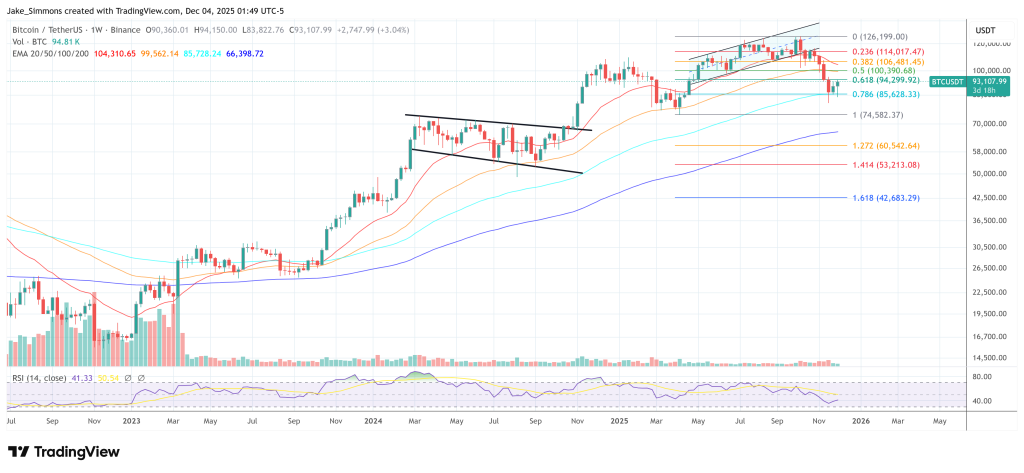
Reports have disclosed a sharp rebound in crypto markets this week, with Bitcoin jumping 8% to trade above $93,000 after sliding from lows under $85,000 earlier in the week.

Traders are watching the Federal Reserve’s December actions closely as they try to gauge how much liquidity will return to markets. The move pushed bitcoin back within reach of a roughly $2 trillion market cap.

Sovereign Funds Building Longer Positions

According to BlackRock chief executive Larry Fink, several sovereign wealth funds have been quietly adding to positions as prices fell from a peak near $126,000.

“There are a number of sovereign funds that are standing by…. and they’re buying ‘incrementally’ as the Bitcoin price has retreated from its $126,000 peak,” Fink said.

He said these buyers are taking a gradual approach — adding over time rather than making quick bets — and treating holdings as multi-year positions.

Reports have disclosed that public funds in Abu Dhabi and Luxembourg have bought into BlackRock’s IBIT bitcoin fund in recent months.

Fink warned that markets remain skewed and that volatility will persist while many players remain highly leveraged.

Tokenization Seen As A Long-Term Story

Fink has been vocal about tokenization as a major theme for the coming years. Based on reports, he wrote in The Economist that tokenization could grow as quickly as the internet did in its early days, noting that Amazon had only $16 million in sales in 1996.

BlackRock, the $10 trillion asset manager he runs, has pushed the idea that a digital wallet could one day hold stocks, bonds and tokenized assets together.

Coinbase chief executive Brian Armstrong said some of the largest banks are already working with Coinbase on stablecoins, custody and trading services, though he did not name the banks.

On Ownership & Worry

According to remarks made at a DealBook event alongside Andrew Ross Sorkin and Brian Armstrong, Fink described bitcoin in emotional terms: ownership often reflects worries about physical safety or financial security.

He tied demand to concerns over the debasement of financial assets and rising deficits. Reports have also quoted him warning that the US risks falling behind other governments if it does not speed up adoption of tokenization and other digital tools.

US President Donald Trump has similarly warned about competition from China in crypto innovation.

Market Reaction And Risks Ahead

Traders are already pricing in a variety of scenarios. Some are betting on a major development in 2026 that could reshape demand; others remain focused on short-term policy moves from the Fed.

Bitcoin’s recent 8% gain was the largest daily jump since May, but it came after sharp swings that highlighted how quickly positions can reverse.

With significant capital now involved — and big names publicly backing tokenization — the market is likely to see more headline-driven moves.

Featured image from Pexels, chart from TradingView

Bitcoin Is ‘An Asset Of Fear,’ Says BlackRock CEO Larry Fink

BlackRock chairman and CEO Larry Fink has framed Bitcoin’s latest boom-and-bust swing as the clearest expression yet of its core narrative: not a growth asset, but “an asset of fear.”

Speaking at the New York Times’ DealBook “Crypto and Capital” event alongside Coinbase CEO Brian Armstrong, Fink contrasted the $13.5 trillion BlackRock manages with the motivations behind Bitcoin demand. BlackRock’s portfolios, he said, are essentially “managing hope” over decades: “The $13.5 trillion that BlackRock managed on behalf of our clients, it’s basically managing hope. That’s all it is. I mean, why would anybody invest in a 30-year outcome unless you’re hopeful that in 30 years you’re going to have the compounding effect.”

Why Bitcoin Is ‘An Asset Of Fear’

Bitcoin, by contrast, he placed on the opposite side of the psychological ledger. “Bitcoin is an asset of fear,” Fink said. “You own Bitcoin because you’re frightened of your physical security. You own it because you’re frightened of your financial security. The long-term fundamental reason you own it [is] because of debasement of financial assets because of deficits.”

His comments came against the backdrop of a sharp reversal in the Bitcoin market. The asset hit an all-time high above $125,000 in early October 2025 before sliding nearly 30% and briefly dropping below $90,000 in mid-November. Fink explicitly referenced that move to illustrate just how violent the swings can be. “If you had bought it at $125,000 and it’s now sitting at $90,000,” he said, anyone treating it as a trade is dealing with “a very volatile asset” and “you’re going to have to be really good at market timing, which most people aren’t.”

For investors using Bitcoin as a macro hedge, he argued, the volatility looks different. “If you’re buying it as a hedge against all your hope, you know, then it has a meaningful impact on a portfolio.” In his telling, Bitcoin rallies when fear rises and retreats when fear subsides, citing episodes such as a US–China trade agreement or talk of a possible Ukraine settlement, after which Bitcoin “fell a little bit.” The pattern, he suggested, is consistent with a fear-driven hedge against geopolitical risk and fiscal slippage.

Fink also underscored that structurally, the market remains fragile. “The other big problem of Bitcoin is it is still heavily influenced by leveraged players,” he said, linking the asset’s outsized volatility to leverage even as flows through his firm’s spot ETF channel normalize.

Since launching IBIT, BlackRock has already lived through several drawdowns on the order of 20–25%, he noted, yet the holder base is shifting. “We’re seeing more and more legitimate long-only investors investing in it,” he said, citing a large foundation endowment and adding that “a number of sovereign funds” are “adding incrementally at $120k, at $100k,” and “bought more in the $80k’s.” For those allocators, he stressed, “this is not a trade. You own it over years. This is not a trade. You own it for a purpose.”

The stance marks a striking reversal from Fink’s 2017 description of Bitcoin as an “index for money laundering… and thieves.” He told the audience that during the pandemic he “took it upon myself to visit and talk to a lot of people who were advocates of it,” asking, “What am I missing?” and that “around 2021–22” he began to “evolve those views.” It is, he conceded, “a very glaring public example of a big shift in my opinion,” adding, “I have very strong views but that doesn’t mean I’m not wrong.”

At press time, Bitcoin traded at $93,107.

Bitcoin price

BlackRock CEO Larry Fink Says He Was Wrong About Bitcoin, Reveals a ‘Big Shift’ in His View

Bitcoin Magazine

BlackRock CEO Larry Fink Says He Was Wrong About Bitcoin, Reveals a ‘Big Shift’ in His View

BlackRock CEO Larry Fink has shifted his perspective on Bitcoin — and he openly acknowledged the change.

Speaking at the NYT DealBook Summit on Wednesday, Fink stated that he now sees potential in Bitcoin. Fink was once a vocal critic who famously labeled Bitcoin “an index for money laundering,” 

Today, Fink described Bitcoin as “an asset of fear,” elaborating that investors frequently purchase it in response to concerns about financial security, geopolitical instability, or the ongoing debasement of traditional assets caused by growing deficits.

“If you bought it for a trade, it’s a very volatile asset, you’re going to have to be really good at market timing, which most people aren’t,” Fink said. “If you’re buying it as a hedge against all your hope, then it has a meaningful impact on a portfolio… the other big problem of Bitcoin is it is still heavily influenced by leveraged players.”

Fink, speaking alongside Coinbase CEO Brian Armstrong, noted that market movements — like a recent 20–25% drawdown in Bitcoin — often reflect broader events, such as trade agreements with China or potential settlements in Ukraine. 

Despite all this, Fink still suggested it can serve as meaningful portfolio insurance for those holding it as a hedge rather than for short-term trading.

Fink emphasized that his perspective has evolved through years of client interactions and discussions with policymakers, calling his change of heart a “very glaring public example” of the need to reassess strong opinions. 

Meanwhile, BlackRock, the $13.5 trillion asset manager Fink helped build, now offers several crypto products, including a major Bitcoin ETF, marking a stark contrast to his earlier skepticism.

“There is no chance” that Bitcoin goes to zero, said Mr. Armstrong, who sat beside Fink. Fink also shared an optimistic view for the asset: “I see a big, large use case for Bitcoin,” he said.

JUST IN: BlackRock CEO Larry Fink says he was wrong to be a Bitcoin critic and changed his views 👀

"My thought process always evolves. This is a big shift in my opinion." 👏 pic.twitter.com/4PhDuoy5Le

— Bitcoin Magazine (@BitcoinMagazine) December 3, 2025

BlackRock’s bold embrace of bitcoin and crypto

Back in October, BlackRock said they were developing technology to tokenize a wide range of assets, including real estate, equities, and bonds.

Fink said at the time that global digital wallets held over $4.5 trillion across crypto, stablecoins, and tokenized assets. He noted much of this capital was outside the U.S., presenting opportunities to reach new investors. 

Fink said tokenization could allow crypto entrants to access traditional long-term products, like retirement funds. He described Bitcoin and crypto as serving a similar purpose to gold. 

This post BlackRock CEO Larry Fink Says He Was Wrong About Bitcoin, Reveals a ‘Big Shift’ in His View first appeared on Bitcoin Magazine and is written by Micah Zimmerman.

BlackRock CEO: Tokenization to Trigger Finance’s Biggest Overhaul Since the 1970s — How?

BlackRock executives are warning that the global financial system could be facing its most profound transformation since the introduction of electronic messaging in the 1970s, driven by blockchain-based tokenization.

In a recent column for The Economist, CEO Larry Fink and COO Rob Goldstein called tokenization the “next major evolution in market infrastructure.”

They emphasized its potential to move assets more quickly and securely than legacy financial systems, showing a shift that could reshape how markets operate worldwide.

Tokenization Offers Efficiency, But Experts Warn of Market Fragility

Tokenization, which records ownership of assets on digital ledgers, allows stocks, bonds, real estate, and other holdings to exist as verifiable digital records that can be traded and settled without traditional intermediaries.

The approach aligns with BlackRock’s long-standing commitment to digital markets, dating back to Fink’s 2022 remarks that the next generation of securities will be tokenized.

Fink and Goldstein acknowledged that tokenization was initially overshadowed by the speculative crypto boom.

Yet, beneath the noise, the technology has the potential to expand investable assets and enable near-instant settlement, reducing reliance on manual processes and bespoke recordkeeping that have persisted for decades.

The executives cautioned, however, that adoption will be gradual, likening the process to a “bridge being built from both sides of a river,” connecting traditional financial institutions with digital-first innovators.

While tokenization promises efficiency and broader market access, it also carries risks that could mirror historical financial shocks.

Analysts point to several mechanisms that could amplify losses.

Increased systemic interconnectedness could make widely shared ledgers a single point of failure, while automated trading on programmable ledgers could accelerate market shocks, potentially triggering rapid “flash crashes.”

Legal ambiguities surrounding ownership rights and settlement finality, coupled with cybersecurity vulnerabilities, could exacerbate operational risks.

Additionally, fragmented markets, high leverage, and concentration of infrastructure among a few dominant players may increase systemic fragility.

Experts warn that a large-scale operational failure or confidence crisis could produce losses reminiscent of the post-Bretton Woods era in the early 1970s.

Tokenized Markets Grow Fast; EU Warns Oversight Crucial for Stability

European regulators are increasingly focused on the growth of tokenized financial assets, balancing innovation with oversight.

Natasha Cazenave, Executive Director of ESMA, outlined the potential and risks of wrapping conventional instruments in digital layers.

🇪🇺 ESMA’s Natasha Cazenave has outlined how tokenization has reshaped EU markets and raised legal and investor protection questions.#RWA #Tokenization https://t.co/aqNvntO52N

— Cryptonews.com (@cryptonews) September 2, 2025

Once a niche area, tokenized assets now represent a global market of roughly $600 billion, with the issuance of tokenized fixed-income instruments exceeding €3 billion in 2024.

The Skynet RWA Security Report projects that tokenized real-world assets could reach $16 trillion by 2030, with Europe positioned to lead.

📈 Skynet projects RWA tokenization to hit $16T by 2030, with institutions driving growth amid ongoing security and access challenges.#rwa #tokenizationhttps://t.co/1wYJ0aw4fl

— Cryptonews.com (@cryptonews) August 25, 2025

Pilot projects by Société Générale, Santander, the European Investment Bank, and Germany’s Ministry of Finance demonstrate growing interest, though the market remains fragmented.

Cazenave emphasized that regulatory alignment is critical to ensure investor protections and prevent instability.

Globally, tokenization is reshaping access to private markets. Institutional investors expect tokenized instruments to make up 10–24% of portfolios by 2030.

🏦 @StateStreet says tokenized assets could account for 10%–24% of institutional portfolios by 2030, with private equity leading adoption.#StateStreet #Tokenization https://t.co/M1SisAWT3s

— Cryptonews.com (@cryptonews) October 10, 2025

Currently, digital assets average 7% of institutional holdings, expected to rise to 16% within three years, driven by tokenized equities, fixed income, and digital cash, according to State Street research.

Challenges remain on the issuer side. Infrastructure for identity verification, compliance, and cap-table management lags behind front-end trading platforms, slowing onboarding, complicating reconciliation, and limiting secondary market liquidity.

Authorities worldwide are taking note. In November, the IMF highlighted tokenization’s potential to accelerate transactions and reduce costs, while cautioning that automated markets could amplify volatility and systemic risks.

🇬🇧 UK appoints digital lead to coordinate financial market tokenization, signaling institutional interest in blockchain-based infrastructure.#uk #tokenizationhttps://t.co/SAU9U8go3N

— Cryptonews.com (@cryptonews) October 8, 2025

Notably, in the UK, a “digital markets champion” and the Dematerialisation Market Action Taskforce are overseeing the issuance of digital gilts on distributed ledgers.

Data from RWA(.)xyz shows the distributed asset market currently represents $18.41 billion, with $391.55 billion in represented asset value across more than 555,000 asset holders.

The post BlackRock CEO: Tokenization to Trigger Finance’s Biggest Overhaul Since the 1970s — How? appeared first on Cryptonews.

BlackRock Exec Says Bitcoin ETFs Becoming A Major Revenue Source Was A ‘Big Surprise’

Spot Bitcoin ETFs (exchange-traded funds) are one of the biggest narratives and have been a game-changer in the cryptocurrency space in the past two years. With these investment products, people get to participate in the cryptocurrency market without having to directly own the digital assets.

Interestingly, one of the biggest winners—that often gets overlooked—has been the issuers, especially as the crypto industry has seen increased institutional adoption since the Bitcoin ETFs launched. According to the firm’s executive, the BTC exchange-traded funds becoming the major source of revenue for BlackRock, the world’s largest asset manager, was not envisioned.

BlackRock’s Bitcoin Funds Outweighing Expectations 

At the Blockchain Conference 2025 in São Paulo on Friday, November 28, BlackRock’s business development director in Brazil, Cristiano Castro, told reporters that the Bitcoin ETFs are the largest revenue source for their company. According to the executive, this development came as a “big surprise” to the asset management firm.

Castro said in a statement:

We were very optimistic when we launched, but we didn’t believe it would reach such proportions. Just to give you an idea, it [IBIT in the US and IBIT39 in Brazil – the asset’s reference names] came very close to US$100 billion [in allocation].

This feat is notable for the Bitcoin ETFs, especially considering that BlackRock offers more than 1,400 exchange-traded products globally and has a whopping $13.4 trillion in assets under management. The US-based Bitcoin fund (with the IBIT ticker) has over $70.7 billion in net assets, becoming the first ETF to reach the $70-billion mark (doing so in June 2025).

While the US Bitcoin ETF market has somewhat slowed down, BlackRock’s IBIT still continues to outpace other ETFs launched in recent years. As earlier reports suggested, IBIT had managed to generate roughly $245 million in annual fees as of October 2025.

Bitcoin ETF Outflows ‘Perfectly Normal’ – Castro

When asked about the recent outflows from BlackRock’s Bitcoin ETF as the market leader’s value fell, the director stated that there are zero surprises in that trend. “ETFs are very liquid and powerful instruments, and they serve precisely to allow people to allocate their capital and manage their cash flow,” Castro noted.

The BlackRock director said that the withdrawals are expected, considering that the product is heavily owned by retail investors, who are reactionary in nature to price corrections. On Friday, the iShares Bitcoin Trust saw a net outflow of $113.72 million, bringing the weekly record to a negative $137.01 million and the fund to its fifth-consecutive week of withdrawals.

Bitcoin ETFs

Featured image from Getty Images, chart from TradingView

XRP Price Suppression? Analyst Points To Big Banks And Private Equity Players

Reports are circulating that big financial players may be quietly buying XRP while the price sits near $2.18. If true, that could help explain why XRP hasn’t pushed past $3 even as trader interest grows. Some observers point to shrinking exchange wallets and limited disclosures as hints that accumulation is happening off-exchange.

Are Institutions Buying?

On-chain data shows Coinbase’s XRP stash fell sharply — from almost 1 billion tokens to about 32 million in September. Some analysts read that as coins being moved into private custody, possibly under NDAs.

Market commentator Dr. Jim Willie has suggested banks like Bank of America and BNY Mellon could be building positions quietly. He’s also picked up on recent remarks from BlackRock’s Larry Fink about an XRP ETF and taken them as another sign of institutional involvement. That’s a possible explanation, not proof.

Hydraulic Shift And ETF Bets

Willie uses a “hydraulic” metaphor: money leaving Bitcoin and Ethereum could push large gains into XRP if flows shift that way. ETFs, he argues, could speed this process by giving institutions easier access — especially if over-the-counter supply tightens.

But analysts warn against assuming ETFs will automatically spark a rapid price surge. Liquidity, market sentiment and broader macro conditions still matter a lot.

Targets, Math And Past Rallies

XRP recently traded under $2.20, roughly $2.18 as November closed. Commentator Meme Whale floated targets of $5 (near-term) and $10 (longer-term) — rises of close to 130% and 358% from current levels by April 2026.

For perspective, XRP once jumped 340% in five weeks back in 2021, rising from $0.43 to $1.96. Past spikes show how volatile the crypto market can be, but they don’t guarantee a repeat.

My Prediction For Next 5 Months:$BTC: $140K-$200K+$ETH: $5K-$10K$BNB: $1500-$3000$SOL: $300-$600$XRP: $5-$10$WKC: $0.00001-$0.0001$FLOKI: $0.01-$0.1$SHIB: $0.001-$0.01$MANYU: $0.00001-$0.0001$CREPE: $0.001-$0.01$LUNC: $0.001-$0.01$SUI: $6-$10$PI: $5-$15$DTG:…

🐳𝓜𝓮𝓶𝓮 𝓦𝓱𝓪𝓵𝓮 🐳 🌟 (@MeMeWhAle0) November 28, 2025

Big Claims Vs. Reality

Willie has even suggested XRP could one day rival the US dollar in global trade, implying market caps as high as $100 trillion. Most experts call that extremely unlikely.

Skeptics say those projections far outstrip reality and demand hard evidence before accepting ideas about coordinated price suppression or ultra-high future valuations.

Institutional accumulation could be happening — it’s plausible — but there’s no airtight proof yet. Investors should weigh on-chain data and credible analysis against hype and bold forecasts. In short: interesting signs, but tread carefully.

Featured image from Unsplash, chart from TradingView

💾

In this episode, I sit down with Dr. Jim Willie, legendary macroeconomics and precious metals expert, to break down how Wall Street giants like BlackRock and...

IMF flags rising risks as tokenized markets look to reshape global finance

  • Researchers have identified cost savings in early tokenized systems.
  • Smart contract chains can escalate local issues into wider shocks.
  • Tokenized assets now form a multibillion-dollar global market.

The IMF released a new video on its X account today, placing tokenized markets at the centre of a major shift in how global finance operates.

Instead of treating tokenization as a niche experiment, the fund presents it as a structural development that is already influencing policy discussions, investor behaviour and the future shape of cross-border markets.

The video also stresses that new digital frameworks can create fragility, accelerate market shocks and draw governments back into a more active role in managing monetary transitions.

How tokenization changes market plumbing

The IMF video describes tokenization as the next step in money’s long transformation.

It highlights how digital tokens can replace long chains of intermediaries that currently handle verification, settlement and record-keeping.

Clearinghouses and registrars are replaced by functions written directly into code, allowing assets to move more quickly between holders.

Early studies cited in the video show meaningful cost reductions in tokenized environments.

These savings stem from programmability, near-instant settlement and more efficient use of collateral.

The IMF frames these features as changes to the core plumbing of financial markets, altering how value circulates through the system.

Why the IMF says risks are growing

Alongside these benefits, the IMF signals rising exposure to volatility.

Automated trading has already caused sudden drops known as flash crashes, and the video warns that these events can intensify when markets settle instantly.

Faster execution leaves less time for human intervention, increasing the likelihood that sharp swings spread across platforms.

The video also focuses on the risks built into complex smart contract chains.

When multiple layers of code interact during periods of stress, small disruptions can escalate into wider problems.

The IMF compares this behaviour to falling dominoes, where one malfunction triggers a broader shock.

A separate issue is market fragmentation. If competing tokenised platforms develop without shared standards, they may not interact smoothly.

The IMF warns that this could limit liquidity and reduce the efficiency that tokenisation aims to deliver.

Governments and the history of monetary change

The IMF places today’s tokenization wave within the long arc of government involvement in financial transitions.

It highlights the 1944 Bretton Woods agreement, when global powers redesigned the monetary order by linking exchange rates to the United States dollar and tying the dollar to gold.

This top-down structure defined international finance for a generation.

That system collapsed in the early 1970s when growing fiscal pressures made the gold peg impossible to maintain.

The move to fiat currencies and floating exchange rates changed how economies managed deficits and cross-border flows.

By referencing these episodes, the IMF emphasises that governments rarely remain passive when new forms of money emerge.

The post IMF flags rising risks as tokenized markets look to reshape global finance appeared first on CoinJournal.

Bitcoin Price Skyrockets Past $90,000 as BlackRock and JPMorgan Deepen Bitcoin Bets

Bitcoin Magazine

Bitcoin Price Skyrockets Past $90,000 as BlackRock and JPMorgan Deepen Bitcoin Bets

Bitcoin price ripped higher above $90,000 on Wednesday, extending a sharp rally fueled by accelerating institutional demand and a new wave of Wall Street–engineered crypto products. 

The surge followed fresh disclosures showing BlackRock increasing its exposure to its own spot Bitcoin ETF, and JPMorgan pitching a complex, high-stakes structured note tied directly to BlackRock’s IBIT fund.

Bitcoin price touched 24-hour lows of $86,129 before rebounding above $90,300, continuing a volatile upswing that has defined the fourth quarter.

BlackRock’s latest regulatory filing shows the Strategic Income Opportunities Portfolio now holds 2,397,423 shares of IBIT, valued at $155.8 million as of September 30. That’s up 14% from June, when the fund reported 2,096,447 shares. 

The steady buildup underscores how the world’s largest asset manager is using its internal portfolios to deepen its Bitcoin-linked positions.

The moves arrive as demand for structured crypto-linked investments heats up among major banks. JPMorgan’s newly proposed derivative-style note gives institutional clients a way to bet on the future price of Bitcoin through IBIT, currently the largest Bitcoin ETF with nearly $70 billion in assets.

The product is unusual — and aggressive. The note sets a price for IBIT next month. If, one year from now, IBIT trades at or above that price, the note is automatically called and investors collect a fixed 16% return.

If IBIT trades below the set level in a year, investors stay in the product until 2028. Should IBIT exceed JPMorgan’s next target price by then, investors earn 1.5x their investment with no upside cap. If the Bitcoin price skyrockets, the payouts follow.

There’s downside protection, too. If IBIT finishes 2028 down no more than 30%, investors receive their full principal back. But if the ETF falls more than 30%, losses match IBIT’s decline.

The structure combines a bond-like wrapper with derivatives exposure, a formula FINRA classifies broadly under its “structured note” category. These notes blend a traditional security with options-based payouts tied to a reference asset — in this case BlackRock’s Bitcoin ETF.

The pitch to institutions is simple: predictable returns if Bitcoin price stalls next year, leveraged upside through 2028, and limited long-term downside. The tradeoff is equally clear: no interest payments, no FDIC insurance, and the risk of losing most or all principal.

Reporting from The Block helped with this article. 

Bitcoin price volatility

JPMorgan is explicit about the stakes. Its prospectus warns that investors “should be willing to lose a significant portion or all of their principal amount at maturity.” Volatility in Bitcoin, it adds, may be extreme, and the notes remain unsecured obligations of the bank.

The bank’s latest move also highlights an ongoing shift in Wall Street’s tone toward Bitcoin. CEO Jamie Dimon once mocked Bitcoin as “worse than tulip bulbs.” Yet JPMorgan is now engineering products that depend on the digital asset’s long-term trajectory.

Morgan Stanley has been exploring similar territory. Its own IBIT-linked structured note drew $104 million last month. The bank’s two-year “dual directional autocallable” product offers enhanced payouts if IBIT rises or stays flat, and modest gains if it falls up to 25%. But once losses exceed that level, investors take the hit with no cushion.

Analysts say these products reflect a revival in the structured-notes market. Bloomberg reported the sector is recovering from a decade-long slump after the collapse of Lehman Brothers wiped out billions tied to similar instruments.

The bitcoin price has fallen more than 30% from its October all-time high, slipping to around $87,000 as a nearly two-month drawdown keeps markets on edge. Mid-tier whale wallets holding 100+ BTC are ticking higher — a potential sign of bargain hunting — but larger whale cohorts continue to offload, contributing to weakened spot demand. 

Analysts warn that the key $80,000–$83,000 support zone is being tested repeatedly, while Citi says the market lacks the inflows needed to stabilize prices. 

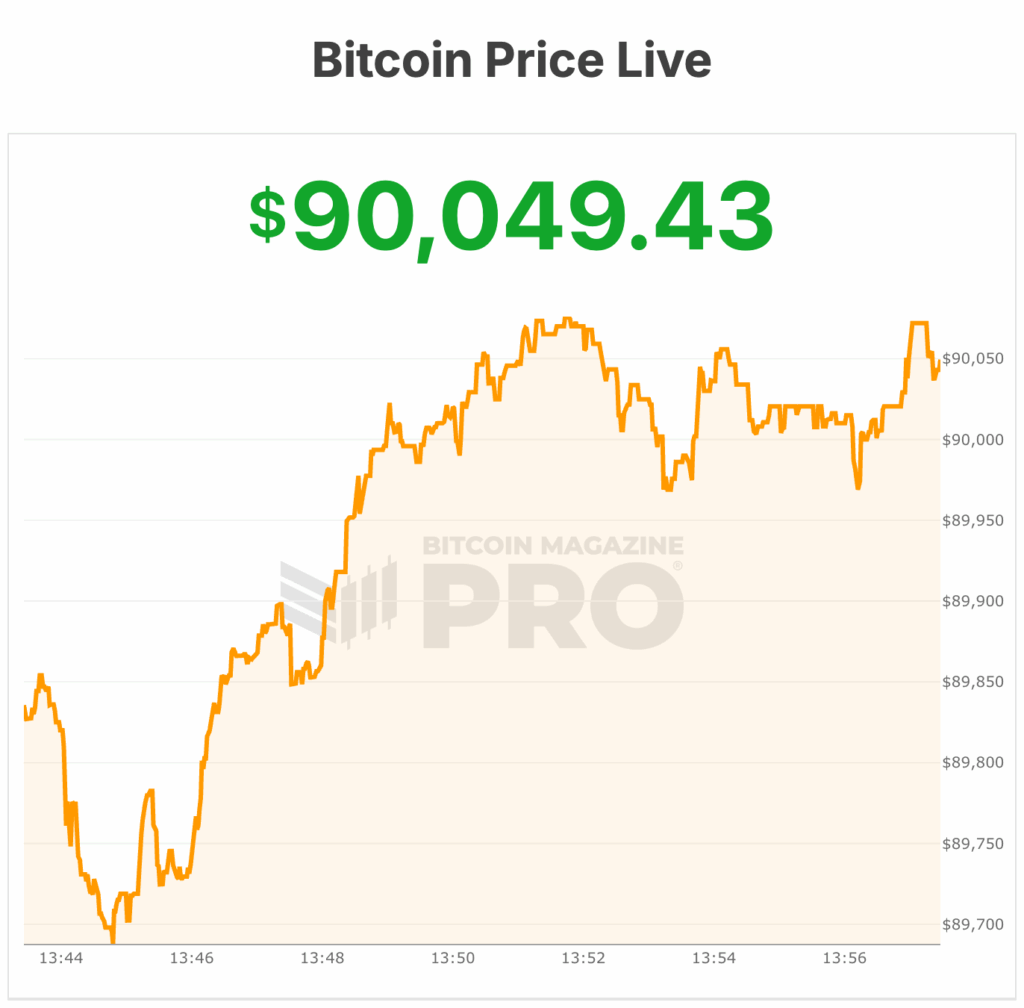
At the time of writing, the bitcoin price is $90,049.

Bitcoin Price

This post Bitcoin Price Skyrockets Past $90,000 as BlackRock and JPMorgan Deepen Bitcoin Bets first appeared on Bitcoin Magazine and is written by Micah Zimmerman.

Texas buys $5mn BTC ETF, pushes for Bitcoin reserve plan

  • The state legislation sets aside $10 million for Bitcoin accumulation.
  • Texas is preparing a formal tender to choose a custodian for the reserve.
  • New Hampshire authorised a Bitcoin reserve and approved a $100 million Bitcoin bond.

Texas is moving ahead with one of the most ambitious state-level crypto strategies in the country as it begins shaping the framework for a government Bitcoin reserve.

The state has now taken its first formal step by acquiring $5 million in shares of BlackRock’s iShares Bitcoin Trust.

The purchase is part of a wider plan triggered by legislation passed earlier this year, which allocated $10 million for future Bitcoin accumulation.

The early activity positions Texas to become the first US state to hold a dedicated cryptocurrency reserve, giving it a lead in a growing competition among states exploring digital asset policies.

Texas builds foundation for Bitcoin reserve

The state has been gathering information from the cryptocurrency industry to help design how its reserve will operate.

The review began after Texas issued a request for information in September seeking guidance on best practices for storage, security, and management.

Industry groups sent detailed submissions covering custody models, investment structures, governance frameworks, and security systems.

The process is part of a wider effort to ensure the reserve can be managed with clear procedures once it transitions from planning to execution.

Texas officials are expected to follow this phase with a formal request for proposal.

The tender will be used to select a custodian and determine the final operational rules for the programme.

The recent $5 million allocation acts as a temporary measure rather than direct Bitcoin ownership while the state completes its selection process, according to a CoinDesk report.

States explore government crypto strategies

Other states have also gained exposure to Bitcoin, though through different channels.

Michigan and Wisconsin accessed cryptocurrency markets through public-employee retirement funds.

Wisconsin sold a $350 million allocation in May, according to public records.

These moves reflect growing institutional interest at the state level, even in cases where governments have not yet adopted dedicated reserves.

Several states are actively studying the idea of holding Bitcoin for strategic purposes.

New Hampshire has authorised the creation of a government Bitcoin reserve, although it has not yet made any purchases.

Last week, the New Hampshire Business Finance Authority approved a $100 million Bitcoin bond designed to support an economic development fund backed by cryptocurrency.

The structure relies on private sector activity rather than direct state accumulation.

Early development continues nationwide

Arizona is also taking steps toward a government-level reserve.

Its legislation directs unclaimed cryptocurrency assets held by the state into a dedicated reserve.

The plan creates an initial legal foundation that could support future accumulation, although the full reserve framework is still in development.

These early efforts reflect a rising interest among states in integrating digital assets into long-term financial planning.

The state-level activity is unfolding alongside federal discussions.

President Donald Trump has publicly supported the idea of a national Bitcoin investment strategy.

The administration has issued an executive order directing officials to begin planning for a federal reserve structure.

Government teams working on the project are now waiting for congressional approval before advancing to the next stage.

Texas sets the pace in state crypto adoption

Texas remains the most advanced of the state-level initiatives due to its legislative backing and its first confirmed investment.

The move signals a shift from exploratory interest to practical implementation, with a structured plan for selecting custodians and defining reserve operations.

The next steps will determine how the state transitions from temporary allocations to direct Bitcoin ownership once contracts and governance systems are finalised.

The post Texas buys $5mn BTC ETF, pushes for Bitcoin reserve plan appeared first on CoinJournal.

BlackRock expands Ethereum staking plans with new Delaware trust

  • The trust was formed on Nov. 19 under the Securities Act of 1933.
  • A Form S-1 filing with the SEC would be required before the product launches.
  • ETHA, BlackRock’s spot Ethereum ETF, has more than $13 billion in inflows.

BlackRock has taken another step toward a staking-focused Ethereum ETF by setting up a new statutory trust in Delaware, signalling fresh movement in the fast-growing market for yield-generating crypto products.

The trust, called the iShares Staked Ethereum Trust ETF, was officially formed on Nov. 19, according to state records.

While the filing does not include product documents, it adds to a broader industry shift toward staking features within regulated ETFs.

The move positions BlackRock to explore yield-bearing structures as competitors such as Grayscale, Fidelity, 21Shares, Franklin Templeton, and REX-Osprey advance their own staking plans across major digital asset funds.

Delaware trust expands BlackRock’s Ethereum plans

The new trust was registered under the Securities Act of 1933, which requires full disclosures before any product reaches investors.

This registration serves as a preliminary step rather than a full submission to the US Securities and Exchange Commission.

To move forward, BlackRock would still need to file a Form S-1, but the firm has not provided a timeline.

Delaware continues to be a popular state for early-stage ETF setup because of its regulatory structure, and BlackRock has often used the same route when preparing digital asset products.

Link to BlackRock’s Ethereum ETF strategy

The trust now sits alongside ETHA, the firm’s spot Ethereum ETF that launched in July 2024.

ETHA has attracted more than $13 billion in inflows and currently does not stake its holdings.

Nasdaq filed a Form 19b-4 in July 2025 to allow ETHA to stake ETH with approved validators.

If approved, that update would introduce staking rewards while also requiring detailed disclosures about custody arrangements, slashing risks, validator selection, and the handling of locked ETH.

Staking rewards on Ethereum generally range between 3% and 5% each year, and issuers must explain how they will track, calculate, and distribute those rewards.

Growth in staking-focused ETFs

BlackRock’s move comes as the broader ETF market accelerates toward staking-enabled products.

Grayscale received approval in October 2025 to introduce staking within ETHE and its Mini Trust ETF, making them the first Ethereum funds under the 1933 Act permitted to earn staking rewards.

Other issuers, including Fidelity, 21Shares, Franklin Templeton, and REX-Osprey, have also submitted similar filings.

REX-Osprey already operates a staked Solana ETF and launched a staked Ethereum version in September.

BlackRock’s digital assets head Robert Mitchnick said staking features across ETFs could attract between $10 and $20 billion by mid-2026.

Experts now expect the next catalyst to be BlackRock’s potential S-1 submission, which would move the new trust closer to becoming a yield-bearing Ethereum ETF.

Rising market interest in Ethereum staking

ETF analysts say expanding staking options could lock a significant amount of ETH within regulated products, influencing liquidity and long-term supply.

The combination of new filings, updated fund structures, and rising capital inflows has set up a competitive race among issuers.

BlackRock’s new trust adds another step in that process, signalling how institutional demand for Ethereum staking continues to reshape the ETF landscape.

The post BlackRock expands Ethereum staking plans with new Delaware trust appeared first on CoinJournal.

BlackRock’s BUILD launches on BNB Chain as RWA momentum accelerates

  • The largest tokenized RWA has debuted on BNB Chain.
  • Investors can now access tokenized US dollar yields on a user-friendly platform.
  • Real-world assets top $36 billion after a 6% increase in the previous month.

BNB Chain has welcomed a new resident today as BlackRock’s USD Institutional Digital Liquidity Fund (BUILD) went live on the platform.

The strategic launch, powered by Securitize’s compliant tokenization platform and Wormhole, adds one of the most regulated digital assets to Binance’s thriving financial ecosystem.

The strategic move comes as real-world assets see massive traction, with their value up 6% the past month to surpass $36 billion.

BUILD’s debut reflects the convergence between blockchain and traditional finance.

BlackRock is a leading asset manager and is now bringing its trust, base, and compliance to BNB Chain, a platform known for accessibility, low fees, and high speed.

Commenting on today’s arrival, BNB Chain Head of Business Development Sarah Song said:

BNB Chain is designed for scalable, low-cost, and secure financial applications, and we’re excited to welcome BUILD to our ecosystem. BUILD is turning real-world assets into programmable financial instruments, enabling entirely new types of investment strategies on-chain.

Meanwhile, the development introduces a new share class on Binance’s ecosystem, offering eligible investors access to a tokenized US dollar yield in a blockchain setup.

BlackRock’s tokenized asset also secures new utility. Binance will now accept BUILD as collateral.

That allows professional traders and institutions to deploy cash smoothly without surrendering exposure to Treasuries-linked RWAs.

That use case underscores the broader shift in how on-chain systems integrate real-world assets.

These products are maturing from static representations to practical instruments that can function across DeFi and TradFi environments.

Leveraging Securitize’s compliant infrastructure

Securitize, a regulated tokenization firm boasting more than $4 billion in tokenized AUM (assets under management), is powering BlackRock’s expansion into BNB Chain.

Securitize handles everything from fund administration to digital transaction agency services.

That ensures that clients access enterprise-level RWAs within regulated frameworks.

At the same time, BUILD unlocks new use cases that were previously absent for real-world tokenized assets.

According to Securitize CEO Carlos Domingo:

Expanding BUILD to the BNB Chain and making it available as collateral on the Binance exchange further extends its accessibility and reinforces our mission to bring regulated real-world assets on-chain while unlocking new forms of utility that were previously out of reach.

RWA and stablecoin market thrive

BUILD’s launch on BNB Chain comes as on-chain real-world assets see impressive growth.

RWAxyz data shows the value of RWAs on public blockchains increased by 5.91% the past 30 days to $36.06 billion.

Furthermore, the number of holders surged 10.78% to 537,549, with asset issuers hitting 249.

Such figures reflect a flourishing ecosystem of enterprises tokenizing regulated real-world assets.

Stablecoins also steadied despite crypto market turmoil, with their value up 0.79% in a month to $299.76 billion.

Moreover, stablecoin holders increased by 3.39% in that timeframe to $202.89 million, indicating unwavering demand for digitized financial instruments that guarantee liquidity, compliance, and stability.

The post BlackRock’s BUILD launches on BNB Chain as RWA momentum accelerates appeared first on CoinJournal.

BlackRock Expands Global Bitcoin Strategy with Australian ETF Launch

Bitcoin Magazine

BlackRock Expands Global Bitcoin Strategy with Australian ETF Launch

BlackRock, the world’s largest asset manager, is reportedly planning to launch the iShares Bitcoin ETF (ASX: IBIT) on the Australian Securities Exchange, extending its global Bitcoin investment strategy to the Asia-Pacific region.

Expected to debut in mid-November 2025, IBIT will give Australian investors regulated exposure to Bitcoin through a traditional stock exchange structure, removing the need for offshore accounts or direct crypto custody. 

The ETF will carry a management fee of 0.39% and will wrap the U.S.-listed iShares Bitcoin Trust (NASDAQ: IBIT), which has become one of the most successful ETF launches in history since its January 2024 debut.

The Australian listing places the country alongside major jurisdictions such as the United States, Germany, and Switzerland where Bitcoin ETFs are already active. 

The move also reflects growing institutional demand for Bitcoin across the Asia-Pacific region as more investors seek regulated access to the asset. 

Australia’s embrace of crypto

The announcement follows the Australian Securities and Investments Commission’s updated guidance reclassifying most digital assets as financial products, requiring service providers to obtain an Australian Financial Services Licence by June 2026. 

While Bitcoin itself is not a financial product, funds and platforms offering Bitcoin exposure will operate under this regulatory framework, providing additional investor protection and market transparency.

In other words, a Bitcoin ETP or ETF lets investors gain exposure to Bitcoin without actually buying or storing the cryptocurrency themselves. 

Instead, the fund holds Bitcoin (or Bitcoin-related contracts) while investors simply buy shares on a stock exchange, with the share price moving alongside Bitcoin’s market value. It’s a convenient and easy way to get invested in Bitcoin. 

The announcement comes as Bitcoin trades down from record highs around $104,000, supported by rising inflows into global ETFs and accelerating institutional adoption. 

Earlier last month, BlackRock officially listed its iShares Bitcoin ETP (IB1T) on the London Stock Exchange following the FCA’s decision to relax rules on crypto investment products. 

The physically backed fund allowed retail investors to gain Bitcoin exposure without directly holding the asset, with custody managed by Coinbase. 

Just like with this launch in Australia, the launch was viewed as timely amid rising UK crypto adoption, offering a regulated and accessible entry point for investors.

Last June, Monochrome Asset Management announced their Bitcoin ETF (IBTC) in Australia. The ETF traded under the ticker IBTC and carried a management fee of 0.98%.

This post BlackRock Expands Global Bitcoin Strategy with Australian ETF Launch first appeared on Bitcoin Magazine and is written by Micah Zimmerman.

BlackRock Launches Bitcoin ETP on London Stock Exchange as UK Lifts Crypto Ban

Bitcoin Magazine

BlackRock Launches Bitcoin ETP on London Stock Exchange as UK Lifts Crypto Ban

BlackRock has officially listed its iShares Bitcoin Exchange-Traded Product (ETP) on the London Stock Exchange (LSE).

This comes after the Financial Conduct Authority’s (FCA) decision to ease restrictions on crypto-linked investment products. 

The ETP, ticker IB1T, allows retail investors to gain exposure to Bitcoin without directly trading or storing the cryptocurrency, offering a simplified entry point into the digital asset market.

The product is fully physically backed, with all Bitcoin held in secure custody through Coinbase

BlackRock emphasized that the ETP removes the technical challenges of holding cryptocurrency, transferring responsibility for secure storage to the issuer.

According to the firm, Coinbase employs a combination of physical security, multiparty computation, and daily transfers to segregated cold storage wallets, ensuring institutional-grade protection for investors.

“The iShares Bitcoin ETP leverages years of integration between Coinbase and BlackRock, providing UK investors with a secure gateway to digital assets through traditional trading platforms,” said Jane Sloan, EMEA Head of Global Product Solutions at BlackRock. 

With UK crypto ownership projected to grow to nearly four million adults over the next year, the launch is seen as timely, providing access to a regulated, familiar investment vehicle.

NEW: BlackRock's #Bitcoin exchange traded product is now officially trading on the London Stock Exchange 🇬🇧 pic.twitter.com/5HjgHvW1tX

— Bitcoin Magazine (@BitcoinMagazine) October 21, 2025

The ETP has a total expense ratio (TER) of 15 basis points per annum, including a temporary fee waiver until the end of 2025. 

From January 1, 2026, the TER will increase to 25 bps. The BlackRock Investment Institute advises that for investors with suitable governance and risk tolerance, a 1–2% allocation to Bitcoin within multi-asset portfolios is reasonable, reflecting both potential upside and the asset’s high volatility.

UK retail ban lift on ETNs and ETPs

The debut follows a regulatory shift in the UK after the FCA lifted its four-year ban on retail access to crypto-linked exchange-traded notes (ETNs) and ETPs. Previously, retail investors were barred from such products due to high volatility and consumer risk concerns. 

The FCA noted that the market has matured, with institutional-grade custodians and improved liquidity making such investments more suitable for regulated markets. 

While the retail ban on crypto derivatives remains, the FCA has indicated ongoing monitoring of high-risk investments and opened the door for fund tokenization initiatives in the asset management sector.

The UK launch mirrors the success of BlackRock’s U.S. Bitcoin offerings. Its flagship iShares Bitcoin Trust ETF (IBIT) now manages over $100 billion, attracting both retail and institutional investors through traditional brokerage accounts.

In the third quarter of 2025, BlackRock reported $17 billion in net inflows into digital asset products, underlining strong demand for regulated crypto exposure.

This post BlackRock Launches Bitcoin ETP on London Stock Exchange as UK Lifts Crypto Ban first appeared on Bitcoin Magazine and is written by Micah Zimmerman.

Bitcoin Whales Are Moving On-Chain Wealth Onto Wall Street Via BlackRock’s IBIT

Bitcoin Magazine

Bitcoin Whales Are Moving On-Chain Wealth Onto Wall Street Via BlackRock’s IBIT

A quiet migration is underway among Bitcoin’s wealthiest holders — from cold storage to custodians.

A new wave of U.S. exchange-traded funds (ETFs) is allowing longtime Bitcoiners to fold their holdings into the traditional financial system without selling a single sat. 

The change comes after regulators approved “in-kind” transactions for spot Bitcoin ETFs this summer, a mechanism that lets investors deposit Bitcoin directly into a fund in exchange for shares, according to Bloomberg reporting.

This mechanism is a tax-neutral move standard across equities and commodities ETFs.

The result: volatile digital assets become regulated, reportable holdings on brokerage statements, instantly easier to borrow against, pledge as collateral, or include in estate plans.

BlackRock, the world’s largest asset manager, has already processed over $3 billion worth of these conversions, according to Robbie Mitchnick, head of digital assets at the firm. Bitwise Asset Management says it now fields daily inquiries from investors looking to bring private Bitcoin holdings into managed portfolios. Liquidity provider Galaxy has also facilitated several such transfers, per Bloomberg.

The shift marks another ironic evolution for Bitcoin — the asset designed to exist outside the banking system is now being absorbed by it. 

As ETFs integrate Bitcoin into brokerage infrastructure, even many anti-establishment investors are realizing that some of TradFi’s tools — custody, leverage, and estate planning — can’t easily be replicated on-chain.

Some holders are transferring only part of their Bitcoin, while others are consolidating everything into ETFs for simplicity. This trend could expand Wall Street’s involvement with Bitcoin, bridging the gap between the crypto world and established finance.

BlackRock’s ETF and tokenization push

BlackRock’s iShares Bitcoin Trust ETF (IBIT), launched just 22 months ago, recently reached over $100 billion in assets under management, making it the firm’s most profitable fund.

Generating approximately $244.5 million in annual revenue, IBIT has surpassed long-standing BlackRock ETFs, including the 25-year-old iShares Russell 1000 Growth ETF, in both growth speed and profitability. 

Last quarter, the fund also overtook Coinbase Global’s Deribit platform to become the world’s largest venue for Bitcoin options.

On top of this, BlackRock is simultaneously developing technology to tokenize a wide array of assets, from equities and bonds to real estate, aiming to connect the $4.5 trillion global digital wallet market to the U.S.-based investment products.

This post Bitcoin Whales Are Moving On-Chain Wealth Onto Wall Street Via BlackRock’s IBIT first appeared on Bitcoin Magazine and is written by Micah Zimmerman.

❌