Reading view

There are new articles available, click to refresh the page.

Gold Buys Hit New Highs — Is Bitcoin About To Join The Party?

Reports have disclosed that central banks around the globe have stepped up purchases of gold this year, with one month standing out. In October 2025, officials bought 53 tons of gold, a level that analysts say is the highest monthly demand seen this year. These moves reflect growing concern about inflation, weaker currencies and rising geopolitical risk.

Central Bank Buying Surges

According to data cited by financial outlets, 2025 is on track to be the fourth-highest year this century for institutional gold accumulation when measured net year-to-date through October. Analysts at Deutsche Bank put gold’s share of central-bank reserves at about 24%, a level not seen since the 1990s. Those figures help explain why governments that once moved away from bullion are returning to it now.

Bitcoin Enters The Conversation

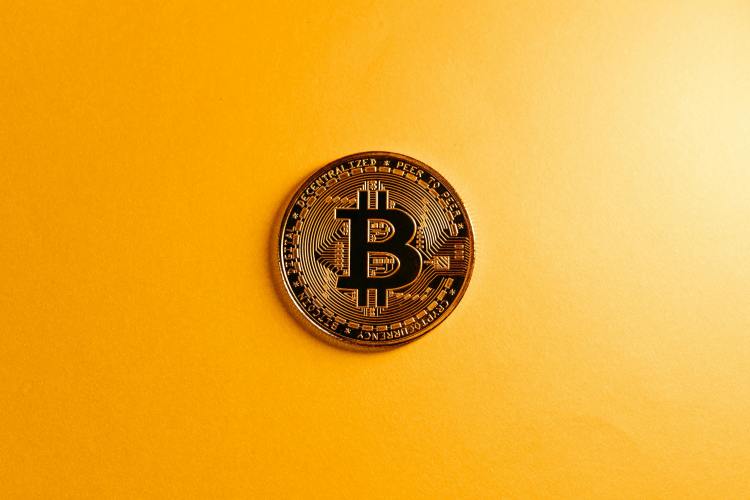
Some banks and market researchers are now asking whether Bitcoin could play a similar role for national treasuries. Based on reports from major financial firms, Deutsche Bank projects that Bitcoin could appear on central-bank balance sheets by 2030 as a complementary reserve asset.

Central banks are ramping up gold purchases:

Global central banks purchased +53 tonnes of gold in October, the most since November 2024.

This marks a +194% jump compared to July, and the 3rd-straight monthly acceleration.

In the first 10 months of the year, central banks have… pic.twitter.com/7pZWyEjjvf

— The Kobeissi Letter (@KobeissiLetter) December 4, 2025

Bitcoin’s market profile has changed: liquidity has risen, and price swings have been less extreme during recent months even though volatility remains higher than older reserve assets. Bitcoin also reached a record above $123,500 in recent trading, a price point that has captured wide attention.

A Few Banks Are Testing The Idea

A small number of central banks are now at least studying the idea more seriously. The Czech National Bank, for example, has discussed the possibility of a “test allocation” to learn how crypto might behave inside a reserve mix. Those conversations tend to focus on custody, accounting rules and how to report gains or losses, rather than immediate buying.

On Gold & Bitcoin: Why Officials Are Cautious

Risk is the main reason most central banks have not moved faster. Bitcoin still shows larger price swings than standard reserve assets, and global rules for how to hold and audit crypto are not uniform. Based on expert commentary, regulators and auditors would need clear guidance before many central banks felt comfortable adding crypto to official reserves.

What This Could Mean For Markets

If even a handful of national banks were to allocate a small share of reserves to Bitcoin, demand could rise sharply and change how markets view the asset. A modest sovereign allocation would not replace gold or the US dollar, but it could give Bitcoin a stronger role as a hedge for countries facing currency weakness or rising inflation. At the same time, such a move would push more work into custody and compliance services, which would have to scale up quickly.

Gold buying by central banks is already significant — 53 tons in one month and about 24% of reserves in gold for some — and that Bitcoin is being discussed as a possible next step for some policymakers. The path from discussion to adoption is uncertain, and many technical and legal questions remain. Still, the debate has moved from theory to test runs and official reports, making this one of the more closely watched trends in global finance this year.

Featured image from Unsplash, chart from TradingView

Bitcoin Adoption Is Just Getting Started — 200x Growth Possible, Tom Lee Says

Fundstrat’s Tom Lee told attendees at Binance Blockchain Week that he believes the worst leg of the recent crypto slump is likely over and that markets may be ready for a gradual recovery. He pointed to weakening selling pressure and growing underlying activity as reasons for cautious optimism.

Market Sentiment May Be Near A Turning Point

According to Lee, mood on the street turned darker after October, with many investors showing fatigue after steady losses. He said the current selling looks closer to exhaustion than to the start of another major decline. Trading desks have cut back. Volume has thinned. Sentiment is low. Lee argued that often, when pessimism peaks, conditions for a reversal begin to form.

Bitcoin Drawdowns Are Not Uncommon

Based on reports, Bitcoin has fallen about 36% from its all-time high in the recent retreat. That size of drop has happened in prior cycles, including 2017 and 2021, and has been followed by rallies that reached new records.

“Crypto prices likely bottomed. The best years of growth are still ahead: there is 200x adoption to come.” – Tom Lee, Chairman of Bitmine pic.twitter.com/fPWbWdaosO

— Binance (@binance) December 4, 2025

Lee pointed to long-term returns for bitcoin and ether compared with some traditional assets over the last decade, saying crypto’s gains were larger. He used that history to support the idea that patient holders have been rewarded after past stress.

Tokenization Could Be A Major Story In 2026

Lee also presented tokenization as a key theme for the future. He said large institutions are preparing to move more financial products on-chain and that, if real estate joins the shift, close to a quadrillion dollars in assets could eventually be tokenized.

Stablecoins were cited as an early example of why tokenized instruments can attract demand. He suggested that a broader institutional push could add steady interest to the market over time.

BlackRock’s Bitcoin ETF Was Highlighted As A Signal

Reports have disclosed that BlackRock’s bitcoin ETF has become one of the firm’s top fee-earning products, a fact Lee used to show growing involvement from legacy finance. That kind of institutional participation, he argued, points to deeper engagement from big players who were previously on the sidelines.

Adoption Gap Suggests Large Upside

According to Lee, only 4.4 million bitcoin wallets hold more than $10,000 in BTC, while nearly 900 million people globally have more than $10,000 in retirement savings.

He said that gap shows how early the market still is and argued that if just a fraction of those savers put money into bitcoin, adoption could expand by as much as 200 times. The figure is speculative, he acknowledged, but he used it to show the potential scale for future demand.

What This Means For Investors Now

Lee questioned whether the old four-year cycle should be used as a strict guide. He suggested recent moves were driven more by de-leveraging and structural shifts than by the halving rhythm that shaped earlier cycles.

Featured image from Unsplash, chart from TradingView

Russia Steps Deeper Into Crypto As State Bank Prepares Direct Trading

VTB, Russia’s second-largest bank, has told clients it plans to let them buy and sell real cryptocurrencies through its brokerage service, with a target rollout in 2026 pending regulator approval.

According to the bank, the move would go beyond the derivative products that most Russian banks have offered so far. It is a clear shift toward opening traditional finance to digital assets, at least for now among wealthy clients.

Client Eligibility And Timetable

Reports have disclosed that VTB intends to begin with high-net-worth customers only. The bank set thresholds for its initial offering: clients with assets above $1.3 million or annual income over $649,000 would be eligible at first.

Andrey Yatskov, who heads VTB’s brokerage arm, said there is “sharp demand” from clients for access to actual crypto, not just paper products tied to token prices. The bank has picked 2026 as the planned start year, but it made that clear the launch depends on regulators signing off.

Real Crypto, Not Just Contracts

Based on reports, the service would allow ownership of the underlying coins — not merely derivative contracts or token-linked notes. That is a significant distinction in Russia, where until recently banks were limited to offering exposure through derivative instruments.

Allowing customers to hold coins directly would require legal and compliance work, from custody arrangements to anti-money-laundering controls. Those steps are on the critical path before any retail expansion can happen.

Potential Market Signals

VTB has also given investors a sense of how it views crypto as an asset class. The bank recommended a 7% allocation to crypto for some investor profiles, and its internal forecasts have mentioned medium-term Bitcoin price targets in the $200,000–$250,000 range under favorable conditions.

If VTB moves forward, it could be the first major Russian bank to operate in this way — a signal that some parts of the financial sector see token ownership as something to be offered through mainstream channels.

Regulatory Hurdles And Geopolitics

The plan is not risk free. Russian regulation of crypto is still evolving, and any permit to offer direct trading will require approval from the relevant authorities. Sanctions and other geopolitical pressures could alter timelines or force changes to how the service is structured. Compliance teams will need to reconcile domestic rules with international restrictions that affect many big banks operating in or dealing with Russia.

For now, the rollout remains conditional. VTB’s timeline, client criteria, and product design all hinge on legal clarifications and regulator consent. Market participants and clients will likely follow announcements from the Bank of Russia and other agencies to judge how soon broader access might come.

Featured image from Pexels, chart from TradingView

Layoff Rumors And Metaverse Cuts Push Meta Shares Higher—Details

Meta Platforms Inc. shares climbed after reports that the company is weighing deep reductions to the budget behind its metaverse projects. Investors pushed the stock higher as traders reacted to the possibility that one of the company’s most costly bets could be scaled back.

Metaverse Budget Faces A Major Trim

Based on reports from Bloomberg and Reuters, Meta is considering cuts of up to 30% to the unit that builds its virtual reality and metaverse products, a move tied to planning for the company’s 2026 budget. The change would mainly affect Reality Labs, the division that makes Quest headsets and Horizon virtual spaces.

Reality Labs Has Been Losing Billions

Reality Labs has posted heavy losses since 2020. Reports put the total at more than $60 billion and, by some counts, closer to $70 billion in cumulative losses over recent years. Those sums have kept pressure on management to rethink where the company puts its money.

Investors Reward A Smaller Bet

The market response was swift. Meta’s share price jumped roughly 4%, and some outlets calculated that the move added about $69 billion to the company’s market value as traders reacted positively to a pullback from costly metaverse spending. That reaction signals investors prefer money steered toward projects with clearer near-term returns.

Layoffs Could Follow Early Next Year

Reports have warned that the cuts could bring staff reductions inside Reality Labs, with layoffs possibly starting as early as January 2026. Company leaders reportedly discussed budget scenarios during recent planning meetings. Any job cuts would mark a sharp change after years of heavy investment in virtual reality and related software.

A Bigger Push Toward AI And Wearables

At the same time, Meta has been moving money into artificial intelligence and related hardware. The company finalized a multibillion-dollar deal this year to take a large stake in Scale AI — a pact reported at roughly $14 billion for a near-half ownership — and then hired talent from that startup to help run a new AI effort. That tradeoff shows where Meta’s priorities now lie.

What This Means For Users And Competitors

For people who own or use Meta’s VR gear, this does not mean every project will end. But several initiatives could see slower progress and smaller teams. For rivals and suppliers in the AR/VR space, the cut may reshape who wins short-term device and platform business.

Analysts say the move narrows one major uncertainty for Meta while opening another: how well the company can compete in AI after so many dollars flowed into virtual worlds.

Featured image from Unsplash, chart from TradingView

FUD Frenzy: XRP Battles Its Biggest Sentiment Drop In Months—Data

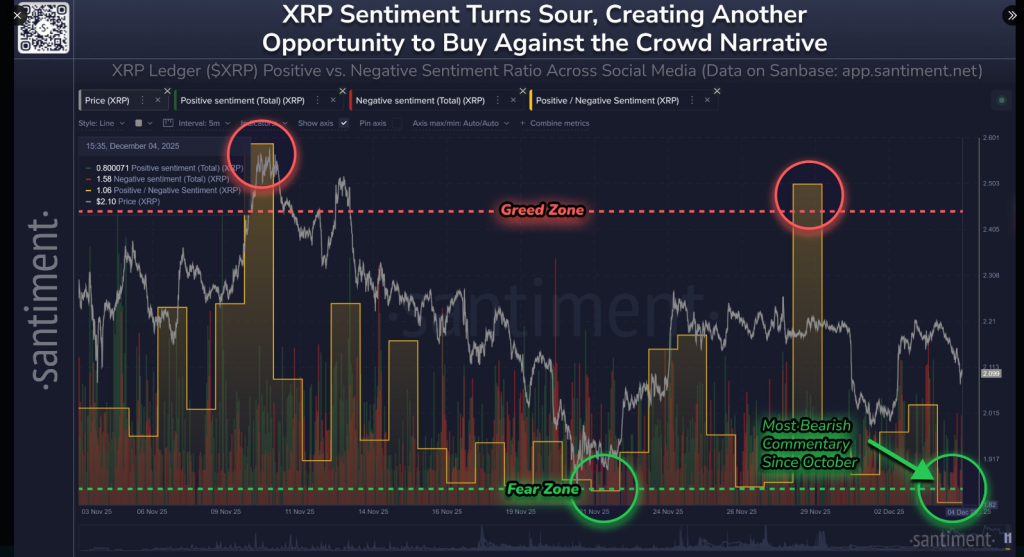
According to an analytics report, XRP traded near $2.06 on Friday as social chatter around the token turned sharply negative after a two-month slide of about 30%.

Traders and data firms flagged a sudden rise in bearish messages, a shift from the more mixed views seen earlier this year. The mood has tightened around crypto, and XRP is not immune.

Crowd Mood Shifts To Fear

Based on reports from Santiment, its chart tracks XRP’s price against positive and negative comments and a combined sentiment line that aims to measure crowd feeling.

Recent readings pushed the balance into what Santiment calls the fear zone, where negative talk outweighs optimism. On this same model, Santiment pointed to Nov. 21 as a comparable moment.

Back then, XRP rallied more than 20% over the next three days before gains cooled. That past move is being used as a reference point by traders who watch social signals closely.

😨 XRP (-31% in the past 2 months), unlike Bitcoin, is seeing the most fear, uncertainty, & doubt (FUD) since October, according to our social data.

🔴 Circles indicate days where there are abnormally higher BULLISH comments compared to BEARISH comments, about XRP (Greed Zone)… https://t.co/lJNW8zlRwK pic.twitter.com/ZoFmwrtw3h

— Santiment (@santimentfeed) December 4, 2025

Short Squeezes And Reflexive Moves

Extreme pessimism can become a catalyst. When weaker holders sell and shorts pile in, a quick reversal can squeeze sellers and lift price sharply. This is the scenario many are watching: heavy bearish chatter could clear the way for a reflexive rebound if buying pressure appears.

Santiment urged followers to keep an eye on the same dashboard to spot rapid shifts in sentiment, and some traders say the crowd’s mood often leads price in the very short term.

Price Moves And Market Backdrop

XRP was last reported down about 4% at $2.04, extending a loss of roughly 6% over the past month. The total crypto market value slipped about 1% to $3.22 trillion on the same day, a pullback that has dragged on many altcoins even as liquidity stays concentrated in the largest tokens.

Order books on smaller pairs have thinned and leveraged positions were trimmed, leaving less depth to absorb big moves. Traders also cited uncertainty around upcoming US policy decisions as a factor behind cautious positioning.

Institutional Push And On-Ledger Activity

Analysts watching the token say it still has room to run toward $2.50 to $2.75 if cross-border liquidity flows pick up and stablecoin projects on the XRP Ledger gain momentum. Reports have disclosed that Ripple has been moving to broaden its institutional reach.

Buy XRP. Stop focusing on any other Crypto Coins

They don’t matter

— Cameron Scrubs (@imcameronscrubs) December 2, 2025

Last month, the firm launched digital asset spot prime brokerage services in the US after acquiring Hidden Road and folding it into Ripple Prime, a combined trading and custody setup for professional clients. That push is being watched as a potential longer-term support for demand.

Vocal Bulls And Market Signals

Despite the FUD surrounding XRP, Cameron Scrubs, founder of Tradeship University, has again urged followers to “buy XRP,” stating that other crypto assets “don’t matter.” In previous posts, he also called to “sell everything and buy XRP.”

Traders are watching these statements closely as sentiment shifts, while on-chain data and social signals are being monitored for indications that the current negative chatter may be starting to ease.

Featured image from Gemini, chart from TradingView

Strategy’s Bitcoin Appetite Dries Up In 2025 — What Happened?

Strategy, the Michael Saylor-led corporate Bitcoin buyer long watched by investors, has sharply cut back purchases this year, according to CryptoQuant. Once a steady force of demand, its monthly buys have fallen dramatically, changing the way market watchers view institutional support for Bitcoin.

Sharp Drop In Monthly Purchases

Based on reports, Strategy’s monthly accumulation peaked around 134,000 BTC in late 2024. By November 2025 that figure had dropped to roughly 9,100 BTC. That move amounts to about a 93% decline from the high-water mark. Buying this month was almost nil, with only 135 BTC recorded early in December. Those numbers show how quickly a major buyer can thin out.

Strategy’s Bitcoin buying has collapsed through 2025.

Monthly purchases fell from 134K BTC at the 2024 peak to just 9.1K BTC in November 2025, only 135 BTC so far this month.

A 24-month buffer makes one thing clear: they’re bracing for the bear market. pic.twitter.com/qEwXR3JQ82

— CryptoQuant.com (@cryptoquant_com) December 3, 2025

A Big Buy Amid The Pullback

Reports have disclosed that on November 17, 2025, Strategy made a sizeable purchase of roughly 8,178 BTC, a buy worth near $835 million at the time. The purchase was the largest for the firm since July and pushed its total holdings to about 649,870 BTC. But while that single entry was large, it did not reverse the broader trend: overall monthly activity is far lower than it was a year earlier.

Big Holdings But More Cash On Hand?

According to CryptoQuant, Strategy has also piled up cash — about $1.4 billion has been set aside. That reserve is being held to cover dividend payments, debt servicing and other company needs. Observers say this signals a shift toward preserving liquidity rather than steady accumulation of Bitcoin. In other words, the company appears to be prioritizing cash stability over more buys for now.

What CryptoQuant And Others Are Watching

Market analysts are taking the slowdown as a warning sign that corporate appetite for Bitcoin treasuries may be cooling. If other big holders act the same, the structural demand that helped support prices could weaken.

Some traders will read the figures as a move to brace for a possible bear market. Others point out that Strategy’s enormous stash — nearly 650,000 BTC — still gives it room to ride out a downturn without having to sell immediately.

Key signals to monitor include the monthly purchase totals going forward and any change in Strategy’s cash holdings. Observers will be watching to see if the company returns to regular Bitcoin purchases or if the reduced buying becomes the standard.

It’s also important to monitor other corporate treasuries, because if several slowdowns occur together, the market for newly issued and available Bitcoin could tighten significantly.

Featured image from JRU, chart from TradingView

Bitcoin’s Dark Energy: Malaysia Cracks Down, Seizing 14,000 Rigs Over $1B Power Theft

According to utility records and media reports, Malaysian authorities have begun a nationwide crackdown on illegal Bitcoin mining after state power losses linked to miners topped roughly $1.1 billion between 2020 and August 2025.

The push targets nearly 13,800–14,000 sites suspected of tapping power without paying. Actions have included drone sweeps, meter inspections and on-the-ground raids.

Task Force Launches Drone And Ground Sweeps

Based on reports, a multi-agency task force was formed that includes the national utility Tenaga Nasional Berhad (TNB), police and other regulators. Drones fitted with thermal cameras and teams with special meters have been used to spot heat signatures and odd power draws in warehouses, shuttered shops and even residential blocks.

Bitcoin mining hardware were seized in several operations and arrests were reported in at least a few cases where evidence of meter tampering was found.

Illegal Bitcoin Mining: Estimated Losses And Numbers

The scale is large. Reports have disclosed losses of about $1.1 billion, which is roughly RM 4.57 billion, and investigators say the number of illicit premises discovered since 2020 is close to 14,000.

Authorities warned that power theft linked to mining has climbed sharply in recent years, with some sources pointing to an increase of about 300% since 2018. Many operators pick low-cost hiding spots and keep moving to avoid detection.

Legal And Policy Questions Loom

While Bitcoin mining itself is not outright banned in Malaysia, stealing power and bypassing meters is illegal under the Electricity Supply Act 1990. Officials are weighing tougher steps. Some lawmakers and energy officials have raised the option of stricter licensing, smarter metering or even temporary bans on certain operations if theft continues.

Based on reports, the effort is meant to protect grid stability and stop long running losses that hit the utility’s bottom line.

Safety Risks And Grid Strain

Beyond the money, authorities say there are safety concerns. Tampered connections and overloaded lines raise the risk of short circuits and fires, and they can damage transformers and other costly equipment.

In some areas, local residents reported flickering lights and unstable supply, which investigators link to abnormal draws found at nearby illegal mining sites. Those technical strains add urgency to enforcement.

What Comes Next

Reports suggest enforcement will rely on a mix of tech—drones, thermal scans, smart meters—and traditional policing. For now, the immediate goal is to shut down rigs, seize equipment and bring legal action against operators who took power without paying. The long term path may include clearer rules for legal miners and tighter monitoring across the grid.

Featured image from Pexels, chart from TradingView

A New Era Begins: CFTC Approves Spot Bitcoin On Regulated US Markets

Regulators in Washington on Thursday cleared a major step that lets Americans trade spot Bitcoin and other cryptocurrencies on federally registered exchanges for the first time.

According to the Commodity Futures Trading Commission, listed spot crypto products may now be offered on exchanges registered with the agency, a move announced on December 4, 2025.

Regulated Spot Trading Begins

The action comes from a CFTC press release labeled Release No. 9145-25 and that the change allows spot crypto contracts to be listed on futures exchanges that are registered with the CFTC.

The regulator said its rules now permit such listings to trade under the oversight and surveillance standards those exchanges already follow.

.@CFTCpham Announces First-Ever Listed Spot Crypto Trading on U.S. Regulated Exchanges: https://t.co/89Mx6f0ss4

— CFTC (@CFTC) December 4, 2025

Bitnomial Leads The Way

Bitnomial, a Chicago-based derivatives exchange, is set to be the first exchange to list such products, with plans to offer both leveraged and non-leveraged spot trading on its platform.

Market notices and statements show Bitnomial moved quickly to use the new framework, announcing a launch and filings that position it as the first US venue to trade listed spot crypto under CFTC rules.

What This Means For Investors

According to market commentators and reporting, the shift brings spot trades under long-standing market protections like clearing, surveillance and execution rules that apply to other listed products.

That can make some institutional players and big funds more willing to trade onshore. At the same time, regulators say this is meant to pull activity away from unregulated offshore venues and improve market oversight.

Acting Chairman Caroline Pham said the move is meant to strengthen the US position in the crypto market while giving traders access to safer and more transparent trading venues.

Risks Remain

Reports have disclosed that the change does not remove the underlying risks of crypto: prices can swing widely, and no regulatory move can stop market volatility.

Also, only exchanges that seek and obtain the proper CFTC registration will be able to use this route, so most offshore platforms remain outside US oversight for now.

Next Steps

Observers will be watching whether other US exchanges follow Bitnomial, how many retail investors gain access, and how the SEC responds on parallel issues such as token classification and custody rules.

The CFTC had flagged this pathway in August as part of a broader initiative to allow listed spot crypto trading, and agencies have since coordinated on guidance and public engagement.

The CFTC’s Acting Chairman said this brings spot crypto trading into a regulated setting Americans can trust, and that exchanges with the right protections can now list these products.

This development is part of a months-long policy push by the administration to create clearer rules for digital assets.

Featured image from Barron’s, chart from TradingView

Bitcoin Dip Attracts Gradual Buying From Sovereign Funds—CEO

Reports have disclosed a sharp rebound in crypto markets this week, with Bitcoin jumping 8% to trade above $93,000 after sliding from lows under $85,000 earlier in the week.

Traders are watching the Federal Reserve’s December actions closely as they try to gauge how much liquidity will return to markets. The move pushed bitcoin back within reach of a roughly $2 trillion market cap.

Sovereign Funds Building Longer Positions

According to BlackRock chief executive Larry Fink, several sovereign wealth funds have been quietly adding to positions as prices fell from a peak near $126,000.

“There are a number of sovereign funds that are standing by…. and they’re buying ‘incrementally’ as the Bitcoin price has retreated from its $126,000 peak,” Fink said.

He said these buyers are taking a gradual approach — adding over time rather than making quick bets — and treating holdings as multi-year positions.

Reports have disclosed that public funds in Abu Dhabi and Luxembourg have bought into BlackRock’s IBIT bitcoin fund in recent months.

Fink warned that markets remain skewed and that volatility will persist while many players remain highly leveraged.

Tokenization Seen As A Long-Term Story

Fink has been vocal about tokenization as a major theme for the coming years. Based on reports, he wrote in The Economist that tokenization could grow as quickly as the internet did in its early days, noting that Amazon had only $16 million in sales in 1996.

BlackRock, the $10 trillion asset manager he runs, has pushed the idea that a digital wallet could one day hold stocks, bonds and tokenized assets together.

Coinbase chief executive Brian Armstrong said some of the largest banks are already working with Coinbase on stablecoins, custody and trading services, though he did not name the banks.

On Ownership & Worry

According to remarks made at a DealBook event alongside Andrew Ross Sorkin and Brian Armstrong, Fink described bitcoin in emotional terms: ownership often reflects worries about physical safety or financial security.

He tied demand to concerns over the debasement of financial assets and rising deficits. Reports have also quoted him warning that the US risks falling behind other governments if it does not speed up adoption of tokenization and other digital tools.

US President Donald Trump has similarly warned about competition from China in crypto innovation.

Market Reaction And Risks Ahead

Traders are already pricing in a variety of scenarios. Some are betting on a major development in 2026 that could reshape demand; others remain focused on short-term policy moves from the Fed.

Bitcoin’s recent 8% gain was the largest daily jump since May, but it came after sharp swings that highlighted how quickly positions can reverse.

With significant capital now involved — and big names publicly backing tokenization — the market is likely to see more headline-driven moves.

Featured image from Pexels, chart from TradingView

100 Million TRX Leaves Binance — Justin Sun Behind The Move

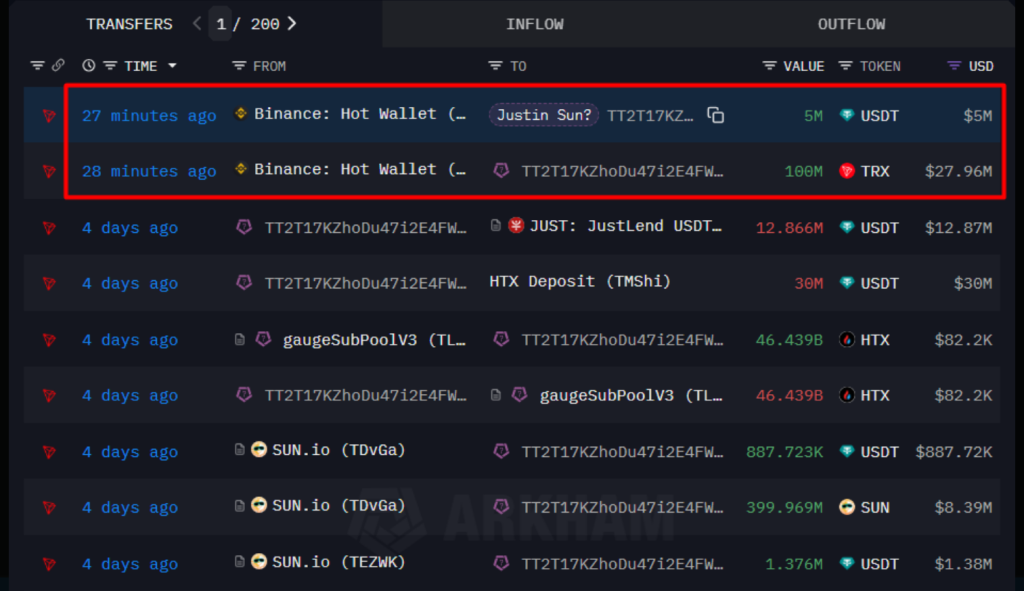
According to on-chain monitors, a wallet linked to TRON founder Justin Sun pulled 100 million TRX from Binance on December 3, 2025. Reports say the same address also moved $5 million USDT around the same time. These large transfers were flagged publicly by Onchain Lens and picked up by multiple crypto news outlets.

Transaction Values And Timing

Onchain tracking shows the 100 million TRX was worth close to $28 million at the time of the move. The USDT transfer of $5 million happened within a minute of the TRX withdrawal, which has led observers to call the action coordinated rather than routine.

Based on reports, the close timing and mixed asset types — token plus stablecoin — drew extra attention from traders and on-chain sleuths.

Data also shows the Justin Sun-linked wallet now holds a much larger TRX balance than just this single transfer. Tracking services report the address sits at about 492 million TRX, a holding with a notional value near $138 million based on market rates at the time. That swelling balance has prompted talk that accumulation of TRX has been steady in recent days.

A wallet linked to Justin Sun (@justinsuntron) withdrew 100M $TRX worth $27.96M from #Binance and also withdrew $5M $USDT.https://t.co/4d2utqwsv0 pic.twitter.com/k40pMUj15d

— Onchain Lens (@OnchainLens) December 3, 2025

Market Reaction And Liquidity

Initial market moves were muted. Some exchange data and commentaries noted a mild uptick in TRX price after the news, suggesting traders saw the outflow as removing sell pressure from exchange order books.

Analysts who track exchange liquidity say large withdrawals like this can shrink available sell-side supply and can support price stability if demand holds. Still, any clear price trend will depend on what happens next with the withdrawn tokens.

No Official Word Yet

There has been no public statement from Justin Sun or TRON explaining the transfers. Without confirmation, motives remain speculative. Observers are weighing a few common possibilities: long-term cold storage, staking or protocol use, or internal treasury moves. All of those ideas are possible, but none are confirmed by the team.

What Could Happen Next

If the tokens stay offline, some traders may view the move as bullish since it cuts the floating supply held on big exchanges. If the funds are later sold or used to provide liquidity, the effect could swing the other way.

Reports point out that similar moves by major holders have sometimes been followed by quiet accumulation and other times by large transfers into trading venues — timing and intent matter.

Featured image from Unsplash, chart from TradingView

Bitcoin Crash Fails To Shake Ripple CEO — He Still Calls For $180K

Reports have disclosed that Ripple CEO Brad Garlinghouse told a Binance-hosted panel he expects Bitcoin to reach $180,000 by December 31, 2026.

Bank Moves Could Be The Spark

According to market coverage, Bitcoin tumbled about $5,000 in roughly three hours during early December, wiping more than $200 billion from the broader crypto market and triggering nearly $700 million in liquidations. That sudden drop has been linked to moves in traditional markets, not a single crypto event.

Some analysts point to a change in Japan’s bond market that is pressuring the long-running yen carry trade. Reports say the Bank of Japan’s policy path is now in focus, with a key decision due in mid-December that could move global risk appetite and the yen.

Whales Bought While Prices Fell

On-chain trackers show large investors added to holdings during the drop. According to on-chain data aggregators, accumulator addresses picked up about 375,000 BTC over recent weeks. That figure, if measured the way those firms define “whales,” suggests big players were buying into weakness.

Miners Also Cut Back Sales

Based on market commentary, miner selling has slowed sharply. One widely cited dataset shows miner outflows fell from roughly 23,000 BTC per month to about 3,672 BTC in the most recent window. That drop in miner supply was flagged as a possible tailwind for price if it persists.

ETF Money Flows And Model Targets

Reports have also tracked ETF movements, noting several billion dollars left Bitcoin ETFs in November, and that flows remain a key short-term force for price direction. Meanwhile, major banks have published valuation work that places fair-value scenarios well above current levels — for example, JPMorgan analysts have argued a model-based target near $170,000 under certain assumptions.

How Realistic Is A $180,000 Outcome?

Putting these pieces together, hitting $180,000 by the end of 2026 is possible in a bullish scenario where institutional demand resumes, whale buying continues, miner selling stays low, and central-bank moves help risk appetite.

But it would require sizeable, sustained inflows and a benign macro backdrop across many months — not just a one-off rally. Garlinghouse remains optimistic about his forecast.

Signals To Watch Next

Bank of Japan guidance in mid-December could influence Bitcoin’s next move. Daily ETF flows and open interest have shown significant shifts recently. On-chain data indicates that accumulators added around 375,000 BTC while miner selling dropped sharply. These figures, if confirmed by the original data sources, may play a major role in shaping near-term price action.

Garlinghouse’s $180,000 call is a high-profile, optimistic view that matches other bullish models on the market. Reports show real volatility and major flows are already shaping price. For now, the forecast is an opinion rooted in plausible scenarios — one to watch, not a certainty.

Featured image from Pexels, chart from TradingView

Fed Turns On The Liquidity Hose, XRP Ready To Ignite, Investor Claims

Reports have disclosed that the US Federal Reserve has ended its Quantitative Tightening program and has put cash back into markets. According to sources, the Fed injected more than $13 billion through overnight repo operations, the largest such move in years.

Crypto investor and author Paul Barron said that coins like XRP could “bring the fire” now that more liquidity is flowing back into the system. He believes that when the Fed starts easing up, assets with clear utility often react faster than the rest of the market.

Barron added that stronger liquidity usually pulls traders toward tokens that can move money quickly and cheaply, which is why he thinks XRP may see more attention if this trend continues.

Markets reacted quickly. Bitcoin rose about 4% in a 24-hour span to reach $93,800. XRP climbed more than 8%, touching $2.18 as demand picked up.

🔥 THE FED JUST DOUSED THE FLAMES: $13.5B repo injection, 2nd-largest since C@#$D After months of burning through liquidity (QT), they’re flooding the system again. Here’s the pattern: When the Fed brings water, $BTC, $ETH, $XRP brings the FIRE. Risk assets don’t cool down when…

— PaulBarron (@paulbarron) December 2, 2025

Liquidity Push Fuels Market Moves

According to analysts, this type of liquidity shift often lifts risk assets, including crypto. Tom Lee of BitMine said on TV that Bitcoin gained nearly 20% in the weeks following the last time the Fed shifted away from QT.

He noted that the same setup might lead to more upside before the year ends. Many traders are watching how much money returns to markets because it can shape short-term sentiment.

ETF Flows And Long-Term Views

According to reports, new XRP ETFs have already attracted more than $800 million in inflows. Supporters say these inflows can change how investors view XRP, although they don’t remove all uncertainty.

Some hedge fund managers also weighed in, pointing out that over the past 16 years the Fed added close to $9 trillion in liquidity while only removing $3.2 trillion before reversing course.

Utility Tokens May Get More Attention

Some community voices argue that tokens built for payments or settlement may see stronger demand if liquidity continues to rise. One XRP supporter said XRP was made to move money at scale and claimed the market will focus more on assets with real use cases.

Adoption remains mixed. Some companies that previously used Ripple’s tools have stepped back, while others still rely on parts of its payment network. The XRP Ledger is being used, but not always in the same way it was during earlier partnerships.

Outlook For The Market

With Bitcoin holding steady at the $93,000 level, and XRP at $2.22, the market is clearly reacting to the Fed’s change of direction. Liquidity helps drive rallies, but it also creates quick pullbacks and shaky moments.

Barron’s line — that coins like XRP could “bring the fire” — hangs over the market: renewed liquidity may be the spark that helps XRP ignite fresh momentum. But fire can spread fast or fizzle out; traders should stay alert, manage risk, and not get burned if the rally cools as quickly as it heats up.

Featured image from Unsplash, chart from TradingView

It’s Official: UK Grants Bitcoin And Crypto Full Legal Asset Status

According to reports, the UK has put new law on the books that names cryptocurrencies as property under English law. The measure was approved and was given Royal Assent on December 2, 2025.

That move turns a long stretch of legal uncertainty into a clear rule about who owns what when it comes to Bitcoin, stablecoins and other tokenized assets.

UK Grants Property Status To Crypto

Based on reports, the bill — called the Property (Digital Assets etc.) Act 2025 — creates a new, third category of personal property for digital assets. The law covers England, Wales, and Northern Ireland.

It does not make crypto money that must be accepted in shops, and it does not itself set new rules for exchanges or taxes. What it does do is give owners a firmer legal claim they can use in court.

Courts Had Set The Stage Years Earlier

Even before the law, judges were already treating crypto as property in some cases. For example, a High Court action in 2019 allowed a proprietary remedy over Bitcoin used in a ransom claim.

Reports show another key ruling came in 2023 when a judge found that the stablecoin USDT could attract property rights under English law.

Legal groups such as the UK Jurisdiction Taskforce had argued for years that crypto meets basic tests for property: it can be defined, found, transferred and held for a period of time. The new act simply puts that view into statute.

Both takes miss it a bit. UK courts have already treated crypto as property for years; this just codifies and tightens the framework, especially for insolvency/estate stuff. It is “true” in the sense that the statute now spells it out, but it is not the revolution CryptoUK is…

— Crypto Reply Guy (@CryptoReplyGuy1) December 2, 2025

Stronger Rights For Holders And Courts

With property status written into law, people who hold crypto should find it easier to bring claims to recover stolen or lost assets. Creditors and insolvency practitioners will have clearer grounds to list digital assets in estates and bankruptcies.

Reports suggest the change will make freezing orders, seizure and restitution easier to obtain through UK courts than before. That matters for victims of hacks, customers of failed platforms, and anyone trying to settle an estate that includes crypto.

A Law, Not A Full Rulebook

The act is a legal recognition, not a full set of rules for how crypto is bought, sold or taxed. Regulators still control licensing, anti-money-laundering checks, and market conduct.

Tax authorities will keep defining how gains are assessed. Based on reports from legal commentators, the act acts as a foundation — it clarifies ownership first, and lawmakers or regulators can build more detailed rules on top of that later.

Featured image from Unsplash, chart from TradingView

A Big January For Solana: Mobile Unit Prepares To Drop Native Token

Solana Mobile will roll out a native token called SKR at the start of next year, a move that ties a new crypto asset directly to the company’s Seeker smartphone and its growing app network.

According to the company’s own blog and subsequent reports, SKR is being positioned as a governance and incentive token for people who use, build for, or operate parts of the platform.

Solana Mobile Confirms SKR Launch

Solana Mobile confirmed that SKR will launch in January 2026 and that the total supply will be 10 billion SKR. The announcement appeared on the company’s official channels and was widely picked up by crypto news outlets.

SKR Tokenomics

The total SKR supply is 10 billion SKR.

SKR distribution: – 30% Airdrops – 25% Growth + Partnerships – 10% Liquidity + Launch – 10% Community Treasury – 15% Solana Mobile – 10% Solana Labs pic.twitter.com/pluKRzTDVZ

— Seeker | Solana Mobile (@solanamobile) December 3, 2025

Token Distribution And Staking

Reports have disclosed a detailed split of that 10 billion. Some 30% is reserved for airdrops. 25% goes to growth and partnerships. 10% is set aside for liquidity and launch, another 10% for a community treasury, and 15% for Solana Mobile itself, etc.

This arrangement puts a large chunk of supply into the hands of users and partners from day one, with a sizeable allocation kept for the company and its parent.

How SKR Will Be Used

According to the Solana Mobile post, SKR will be used to reward builders and reinforce device security, and it will help coordinate how the dApp Store and related services work on Seeker devices.

The company also described a “Guardian” model meant to involve trusted actors in tasks like app review and device verification.

Who Might Benefit First

Seeker owners and early dApp developers are the most likely to see immediate benefits. Airdrops are intended for users and builders, so people who actively use Seeker apps or who run services for that ecosystem could receive SKR at launch.

Based on reports, the token’s real value will hang on how many people buy Seeker phones, how many apps appear, and how active the community becomes.

A big airdrop number does not guarantee broad usage, and governance systems often face challenges if participation is low or power concentrates with a few parties.

Featured image from Gemini, chart from TradingView

❌