Remember the Key Bridge collapse? With as eventful a year as 2025 has been, we wouldn’t blame anyone for forgetting that in March of 2024, container ship MV Dali plowed into the bridge across Baltimore Harbor, turning it into 18,000 tons of scrap metal in about four seconds, while taking the lives of six very unlucky Maryland transportation workers in the process. Now, more than a year and a half after the disaster, we finally have an idea of what caused the accident. According to the National Transportation Safety Board’s report, a loss of electrical power at just the wrong moment resulted in a cascade of failures, leaving the huge vessel without steerage. However, it was the root cause of the power outage that really got us: a wire with an incorrectly applied label.
Sal Mercogliano, our go-to guy for anything to do with shipping, has a great rundown of the entire cascade of failures, with the electrically interesting part starting around the 8:30 mark. The NTSB apparently examined a control cabinet on the Dali and found one wire with a heat-shrink label overlapping the plastic body of its terminating ferrule. This prevented the wire from being properly inserted into a terminal block, leading to poor electrical contact. Over time, the connection got worse, eventually leading to an undervoltage condition that tripped a circuit breaker and kicked off everything else that led to the collision. It’s a sobering thought that something so mundane and easily overlooked could result in such a tragedy, but there it is.
We’ve been harping a bit on the Flock situation in this space over the last month or so, but for good reason, or at least it seems to us. Flock’s 80,000-strong network of automated license plate readers (ALPRs), while understandably attractive from a law-and-order perspective, is a little hard to swallow for anyone interested in privacy and against pervasive surveillance. And maybe all of that wouldn’t be so bad if we had an inkling that the security start-up had at least paid passing attention to cybersecurity basics.
But alas, Benn Jordan and a few of his cybersecurity pals have taken a look inside a Flock camera, and the news isn’t good. Granted, this appears to be a first-pass effort, but given that the “hack” is a simple as pressing the button on the back of the camera a few times. Doing so creates a WiFi hotspot on the camera, and from there it’s off to the races. There are plenty of other disturbing findings in the video, so check it out.
Sufficiently annuated readers will no doubt recall classic toys of the ’60s and ’70s, such as Lite-Brite and Rock ‘Em Sock ‘Em Robots, and games like Mouse Trap and Toss Across. We recall owning all of those at one time or another, and surprisingly, they all sprang from the inventive mind of the same man: Burt Meyer, who died on October 30 at the age of 99. We have many fond memories of his inventions, but truth be told, we never much cared for Mouse Trap as a game; we just set up the Rube Goldberg-esque trap and played with that. The rest, though? Quality fun. RIP, Burt.
Last week, we featured the unfortunate story about a Russian humanoid robot that drunk-walked its way into “demo hell” history. And while it’s perhaps a bit too easy to poke fun at something like this, it’s a simple fact of life that the upright human form is inherently unstable, and that any mechanism designed to mimic that form is bound to fall once in a while. With that in mind, Disney Research engineers are teaching their humanoid bots to fall with style. The idea is for the robots to protect their vital parts in the event of a fall, which is something humans (usually) do instinctively. They first did hundreds of falls with virtual robots, rewarding them for correctly ending up in the target pose, and eventually worked the algorithms into real, albeit diminutive, robots. The video in the article shows them all sticking the landing, and even if some of the end poses don’t seem entirely practical, it’s pretty cool tech.
And finally, this week on the Hackaday Podcast was discussed the infuriating story of an EV-enthusiast who had trouble servicing the brakes on his Hyundai Ioniq. Check out the podcast if you want the full rant and the color commentary, but the TL;DL version is that Hyundai has the functions needed to unlock the parking brakes stuck behind a very expensive paywall. Luckily for our hacker hero, a $399 Harbor Freight bidirectional scan tool was up to the task, and the job was completed for far less than what the officially sanctioned tools would have cost. But it turns out there may have been a cheaper and more delightfully hackish way to do the job, with nothing but a 12-volt battery pack and a couple of jumper wires. Lots of vehicles with electric parking brakes use two-wire systems, so i’s a good tip for the shade tree mechanic to keep in mind.
Wait, what? Is it time for the podcast again? Seems like only yesterday that Dan joined Elliot for the weekly rundown of the choicest hacks for the last 1/52 of a year. but here we are. We had quite a bit of news to talk about, including the winners of the Component Abuse Challenge — warning, some components were actually abused for this challenge. They’re also a trillion pages deep over at the Internet Archive, a milestone that seems worth celebrating.
As for projects, both of us kicked things off with “Right to repair”-adjacent topics, first with a washing machine that gave up its secrets with IR and then with a car that refused to let its owner fix the brakes. We heated things up with a microwave foundry capable of melting cast iron — watch your toes! — and looked at a tiny ESP32 dev board with ludicrously small components. We saw surveyors go to war, watched a Lego sorting machine go through its paces, and learned about radar by spinning up a sonar set from first principles.
Finally, we wrapped things up with another Al Williams signature “Can’t Miss Articles” section, with his deep dive into the fun hackers can have with the now-deprecated US penny, and his nostalgic look at pneumatic tube systems.
If you take a look around you, chances are pretty good that within a few seconds, your eyes will fall on some kind of electrical connector. In this day and age, it’s as likely as not to be a USB connector, given their ubiquity as the charger of choice for everything from phones to flashlights. But there are plenty of other connectors, from mains outlets in the wall to Ethernet connectors, and if you’re anything like us, you’ve got a bench full of DuPonts, banana plugs, BNCs, SMAs, and all the rest of the alphabet soup of connectors.
Given their propensity for failure and their general reputation as a necessary evil in electrical designs, it may seem controversial to say that all connectors are engineered to last. But it’s true; they’re engineered to last, but only for as long as necessary. Some are built for only a few cycles of mating, while others are built for the long haul. Either way, connectors are a great case study in engineering compromise, one that loops physics, chemistry, and materials science into the process.
A Tale of Two Connectors
While there’s a bewildering number of connectors available today, most have at least a few things in common. Generally, connectors consist of one or more electrically conductive elements held in position by an insulating body of some sort, one that can mechanically attach to another body containing more conductive elements. When the two connectors are attached, the conductive elements come into physical contact with each other, completing the circuit and providing a low-resistance path for current to flow. The bodies also have to be able to separate from each other when the connections need to be broken.
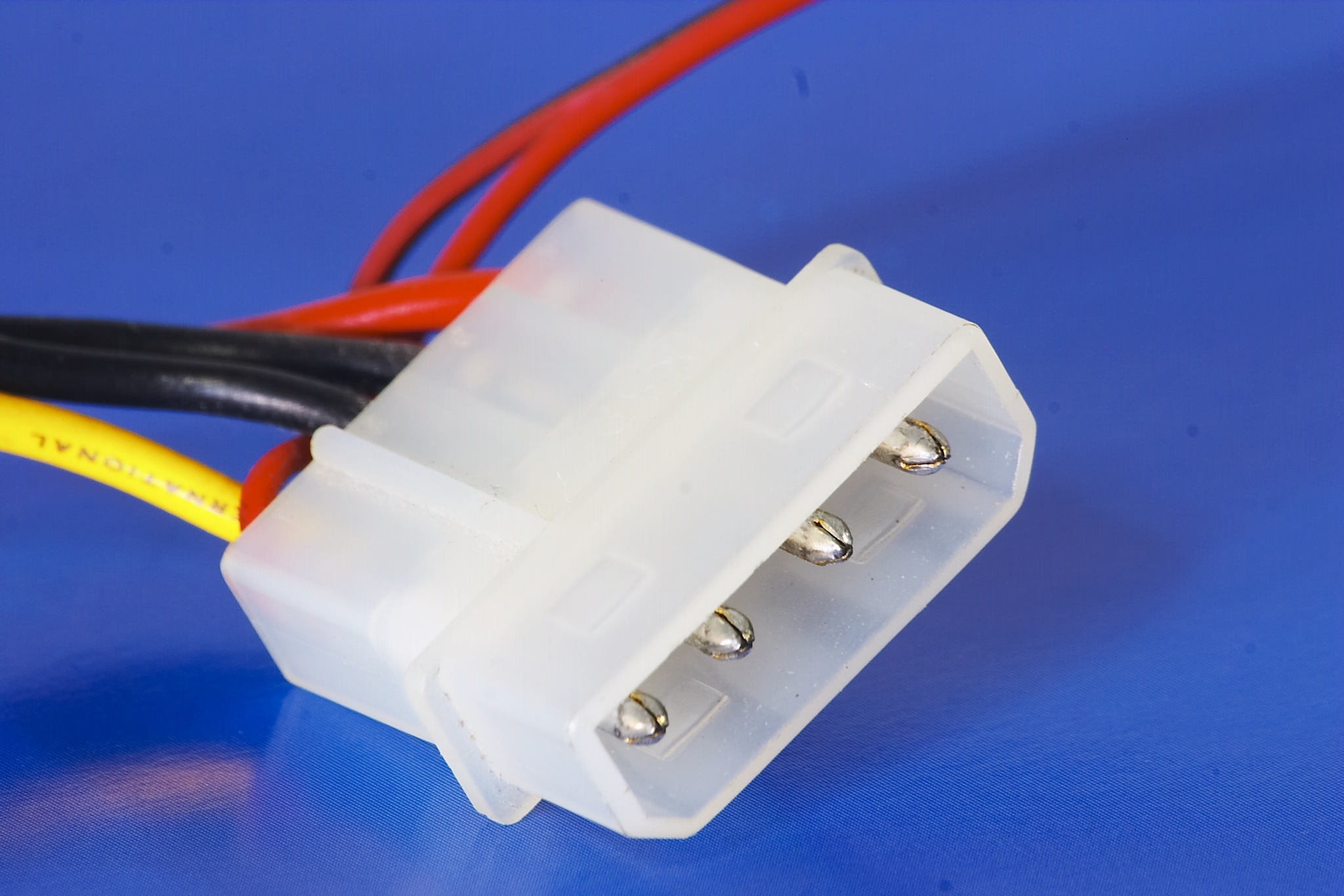
This Molex connector is only engineered for a few mating cycles over its useful life. By Barcex – Self-published work, CC BY-SA 2.5.
For as simple as that sounds, a lot of engineering goes into making connectors that are suitable for the job at hand. The intended use of a connector dictates a lot about how it’s designed, and in terms of connector durability, looking at the extremes can be instructive. On one end of the scale, we might have something like a Molex connector on a wiring harness in a dishwasher. Under ideal circumstances, a connector like that only needs to be used once, in the factory during assembly. If the future owner of the appliance is unlucky, that connector might go through one or two more mating cycles if the machine needs to be serviced at some point. Either way, the connector is only going to be subjected to low single-digit mating cycles, and should be designed accordingly
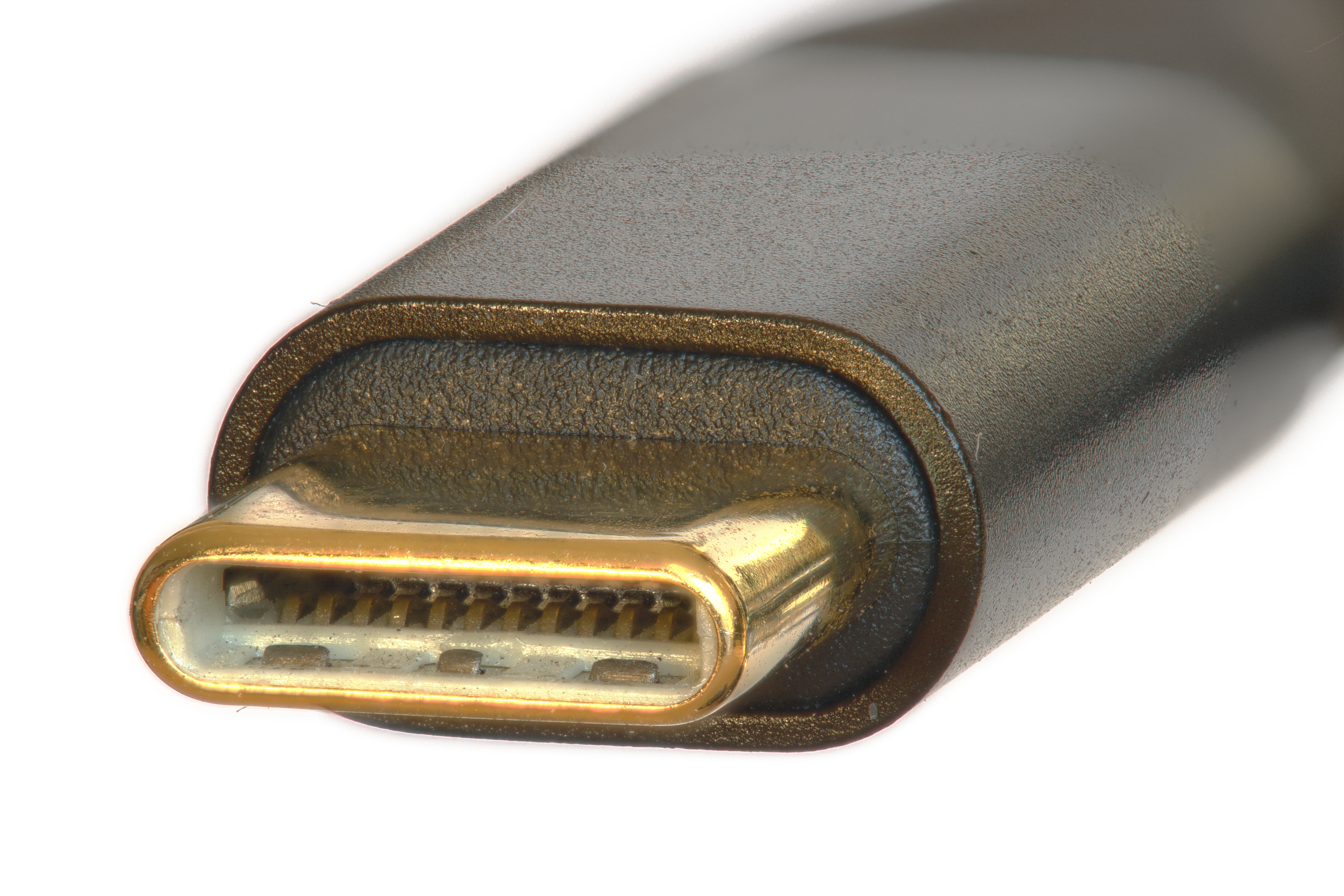
A USB-C connector, on the other hand, is designed for 10,000 mating cycles. By Tomato86 – Own work, CC BY-SA 4.0.
On the other end of the mating-cycle spectrum would be something like the USB-C connector on a cell phone. Assuming the user will charge the phone once a day, the connector might have to endure many thousands of mating cycles over the useful life of the phone. Such a connector has a completely different use case from a connector like that Molex, and very different design constraints. But the basic job — bringing two conductors into close contact to complete a low-resistance circuit, and allow the circuits to be broken only under the right circumstances — is the same for both.
But what exactly do we mean by “close contact”? It might seem obvious — conductors in each half of the connector have to touch each other. But keeping those conductors in contact is the real trick, especially in challenging environments such as under the hood of a car or inside a CNC machine, where vibration, dust, and liquid intrusion can all come together to force those contacts apart and break the circuit while it’s still in use.
Why Be Normal?
To keep contacts together, engineers rely on one of the simplest mechanisms of all: springs. In most connectors, the contacts themselves are the sprung elements, although there are connectors where force is applied to the contacts with separate springs. In either case, the force generated by the spring pushes the contacts together firmly enough to ensure that they stay connected. This is the normal force, called so because the force is exerted perpendicular to the plane of contact when the connector is mated.
Traditionally, normal force in connector engineering is expressed in grams, which seems like an affront to the SI system, where force is expressed in Newtons. But fear not — “grams” does not refer to the mass of a contact, but rather is shorthand for “gram-force,” the force applied by one gram of mass in a one g gravitational field. So, an “80 gram” contact is really exerting 0.784 N of normal force. But that’s a bit clunky, especially when most connectors have normal forces that are a fraction of a Newton. So it ends up being easier to refer to the grams part of the equation and just assume the acceleration component.
The amount of normal force exerted by the contacts is a critical factor in connector design, and has to be properly scaled for the job. If the force is too low, it may increase the resistance of the circuit or even result in intermittent open circuits. If the force is too high, the connector could be difficult to mate and unmate, or the contacts could wear out from excess friction.
Since the contacts themselves are usually the springs as well as the conductors, getting the normal force right, as well as ensuring the contacts are highly conductive, is largely an exercise in materials science. While pure copper is an excellent conductor, it is not elastic enough to provide the proper normal force. So, most connectors use one of two related copper alloys for their contacts: phosphor bronze, or beryllium copper. Both are excellent electrical and thermal conductors, and both are strong and springy, but there are significant differences between the two that make them suitable for different types of connectors.
As the name implies, phosphor bronze is an alloy of phosphorus and bronze, which itself is an alloy of copper and tin. To make phosphor bronze, about 0.03% phosphorus is added to pure molten copper. Any oxygen dissolved in the copper reacts with the phosphorus, making phosphorus pentoxide (P2O5), which can be easily removed during refining. About 2% tin is added along with about 10% zinc and 2% iron to make the final alloy, which is easily cast into sheets or coil stock.
While far superior to pure copper or non-phosphor bronze for use in contacts, phosphor bronze is, at best, a compromise material. It’s good enough in almost all categories — strength, elasticity, conductivity, wear resistance — but not really great in any of them. It’s the “Jack of all trades, master of none” of the electrical contact world, which, coupled with its easy workability and low cost, makes it the metal of choice for the contacts in commodity connectors. If a manufacturer is making a million copies of a connector, especially ones that are cheap enough that nobody will cry too much if they have to be replaced, chances are good that they’ll choose phosphor bronze. It’s also the alloy most likely to be used for connectors intended for low mating-cycle applications, like the aforementioned dishwasher Molex.
For more mission-critical contacts, a different alloy is generally called for: beryllium copper. Also known as spring copper, beryllium copper contains up to about 3% beryllium, but for electrical uses, it’s usually around 0.7% with a little cobalt and nickel added in. Beryllium copper is everything that phosphor bronze is, and more. It’s stronger and springier, it’s a far better electrical conductor, and it also has a better ability to withstand creep under load. Also known as stress relaxation, creep under load is the tendency for a spring to lose its strength over time, which reduces its normal force. Phosphor bronze has pretty good stress relaxation resistance, but when it heats up past around 125°C, it starts to lose spring force — not ideal for high-power applications. Beryllium copper is easily able to withstand 150°C or more, making it a better choice for power connectors.
Beryllium copper also has a higher elastic modulus than phosphor bronze, which makes it easier to create small contacts that still have enough normal force to maintain good contact. Smaller is better when it comes to modern high-density connectors, so you’ll often see beryllium copper used in fine-pitch connectors. It also has better fatigue life and tends to maintain normal force over repeated mating cycles, making it desirable for connectors that specify cycle lives in the thousands. But just because it’s desirable doesn’t make it a shoo-in — beryllium copper is at least three times more expensive than phosphor bronze. That means it’s usually reserved for connectors that can justify the added expense.
Noble Is Only Skin Deep
No matter what the base metal is for connector contacts, chances are good that the finished contact will have some sort of plated finish. Plating is important because it protects the base metal from oxidation, as well as increasing the wear resistance of contacts and improving their electrical conductivity. Plating metals fall into two broad categories: noble (principally gold, with silver used sometimes for high-power connectors, as well as palladium, but only very rarely) and non-noble platings.
Noble metal finishes are quite common in high-density connectors, RF applications, and high-speed digital circuits, as well as high-reliability applications and connectors that are expected to have high mating cycles. But at the risk of stating the obvious, gold is expensive, so it’s used only on connectors that really need it. And even then, it’s very rare that the entire contact is plated. While that would be incredibly expensive — gold is currently pushing $4,000 an ounce — the real reason is that gold isn’t particularly solderable. So generally, selective plating is used to deposit gold only on the mating surfaces of contacts, with the tail of the contact plated in a non-noble metal to improve solderability.
Among the non-noble finishes, tin and tin alloys are the first choice. Aside from its excellent solderability, tin alloys do a great job at protecting the base metal from corrosion. However, the tin plating itself begins to oxidize almost immediately after it’s applied. This would seem to be a problem, but it’s easily addressed by using more spring force in the contacts to break through the oxide layer to fresh tin. Tin-plated contacts typically specify normal forces of 100 grams or more, while noble metal contacts can get by with 30 grams or less. Also, tin contacts require much thicker plating than noble metal finishes. Tin is generally specified for commodity connectors and anywhere the number of mating cycles is likely to be low.
Don’t You Fret
Although corrosion is obviously something to be avoided, the real enemy when it comes to connector durability is metal-on-metal contact. The spring pressure between contacts unavoidably digs into the plating, and while that’s actually desirable in tin-plated contacts, too much of a good thing is bad. Digging past the plating into the base metal marks the end of the road for many connectors, as the base metal’s relatively lower conductivity increases the resistance of the connection, potentially leading to intermittent connections and even overheating. Again, noble metals perform better in this regard, at least in the long run, as their lower normal force reduces friction and results in a longer-lived contact.
There’s another metallurgical phenomenon that can wreak havoc on connectors: fretting. Fretting is caused by tiny movements of the contacts against each other, on the order of 10-7 meters, generally in response to low-g vibrations but also as a result of thermal expansion and contraction. Fretting damage occurs when the force of micromotions between contacts exceeds the normal force exerted between them. This leads to one contact sliding over the other by a tiny amount, digging a trench through the plating metal. In tin-plated contacts, this exposes fresh tin, which oxidizes instantly, forming an insulating surface. Further micromotions expose more fresh tin, which leads to more oxides. Eventually the connection fails due to high resistance. Fretting is insidious because it happens even without a lot of mating cycles; all it takes is a little vibration and some time. And those are the enemies of all connectors.
We make no claims to be an expert on anything, but we do know that rule number one of working with big, expensive, mission-critical equipment is: Don’t break the big, expensive, mission-critical equipment. Unfortunately, though, that’s just what happened to the Deep Space Network’s 70-meter dish antenna at Goldstone, California. NASA announced the outage this week, but the accident that damaged the dish occurred much earlier, in mid-September. DSS-14, as the antenna is known, is a vital part of the Deep Space Network, which uses huge antennas at three sites (Goldstone, Madrid, and Canberra) to stay in touch with satellites and probes from the Moon to the edge of the solar system. The three sites are located roughly 120 degrees apart on the globe, which gives the network full coverage of the sky regardless of the local time.
Losing the “Mars Antenna,” as DSS-14 is informally known, is a blow to the DSN, a network that was already stretched to the limit of its capabilities, and is likely to be further challenged as the race back to the Moon heats up. As for the cause of the accident, NASA explains that the antenna was “over-rotated, causing stress on the cabling and piping in the center of the structure.” It’s not clear which axis was over-rotated, but based on some specs we found that say the azimuth travel range is ±265 degrees “from wrap center,” we suspect it was the vertical axis in the base. It sounds like the azimuth went past that limit, which wrapped the swags of cables and hoses that run the antenna tightly, causing the damage. We’d have thought there would be a physical stop of some sort to prevent over-rotation, but then again, running a structure that big up against a stop would be very much an “irresistible force, immovable object” scenario. Here’s hoping they can get DSS-14 patched up quickly and back in service.
Speaking of having a bad day on the job, we have to take pity on these Russian engineers for the “demo hell” they went through while revealing the country’s first AI-powered humanoid robot. AIdol, as the bot is known, seemed to struggle from the start, doddering from behind some curtains like a nursing home patient with a couple of nervous-looking fellows flanking it. The bot paused briefly before continuing its drunk-walk, pausing again to deliver a somewhat feeble wave to the crowd before entering the terminal stumble and face-plant part of the demo. The bot’s attendants quickly dragged it away, leaving a pile of parts on the stage while more helpers tried — and failed — to deploy a curtain to hide the scene. It was a pretty sad scene to behold, made worse by the choice of walk-out music (Bill Conti’s iconic “Gonna Fly Now,” better known as the theme from Rocky).
We just noticed that pretty much everything we have to write about this week has a “bad day at work” vibe to it, so to continue on with that theme, witness this absolutely disgusting restoration of a GPU that spent way too many years in a smoker’s house. The card, an Asus 9800GT Matrix, is from 2008, so it may have spent the last 17 years getting caked with tar and nicotine, along with a fair amount of dust and perhaps cat hair, from the look of it. Having spent way too much time cleaning TVs similarly caked with grossness most foul, we couldn’t stomach watching the video of the restoration process, but it’s available in the article if you dare.
And the final entry in our “So you think your job sucks?” roundup, behold the poor saps who have to generate training data for AI-powered domestic robots. The story details the travails of Naveen Kumar, who spends his workday on simple chores such as folding towels, with the twist of doing it with a GoPro strapped to his forehead to capture all the action. The videos are then sent to a U.S. client, who uses them to develop a training model so that humanoid robots can eventually copy the surprisingly complex physical movements needed to perform such a mundane task. Training a robot is all well and good, but how about training them how to move around inside a house made for humans? That’s where it gets really creepy, as an AI startup has partnered with a big real estate company to share video footage captured from those “walk-through” videos real estate agents are so fond of. So if your house has recently been on the market, there’s a non-zero chance that it’s being used to train an army of domestic robots.
And finally, we guess this one fits the rough-day-at-work theme, but only if your job is being a European astronaut, who may someday be chowing down on protein powder made from their own urine. The product is known as Solein — sorry, but have they never seen the movie Soylent Green? — and is made via a gas fermentation process using microbes, electricity, and air. The Earth-based process uses ammonia as a nitrogen source, but in orbit or on long-duration deep-space missions, urea harvested from astronaut pee would be used instead. There’s no word on what Solein tastes like, but from the look of it, and considering the source, we’d be a bit reluctant to dig in.

 Login
Login