Reading view

There are new articles available, click to refresh the page.

Bitcoin Price Slides Below $90,000 – Is A Retest Of The November Lows Near?

Bitcoin (BTC) is retesting a crucial support area after its price slid 5% from the recent highs and fell below the $90,000 barrier. Some analysts have suggested that the cryptocurrency’s structure remains intact, but warned that it must bounce quickly or risk retesting the November lows.

Bitcoin Retests $88,000 After Rejection

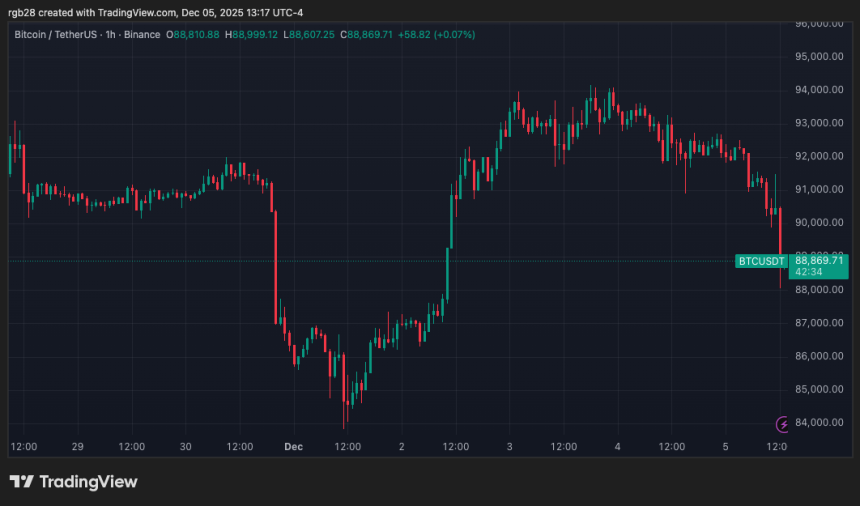
On Friday, Bitcoin lost the recently reclaimed $90,000 level, falling to a key support area before stabilizing. The flagship crypto has been attempting to recover from the November market correction, which sent its price to a seven-month low of $80,600.

Since reaching its local lows two weeks ago, the cryptocurrency has traded within a macro re-accumulation range, between $82,000 and $93,500, attempting to break out of this zone on Wednesday, when it reached a multi-week high of $94,150.

However, as the first week of December approaches its end, BTC has lost the upper area of its local range again, falling below its monthly open and tapping the $88,000 support.

Amid the drop, Analyst Ted Pillows noted that BTC has been struggling to reclaim the $94,000 resistance, adding that price “wants to go lower here before another breakout attempt.”  Therefore, he suggested that a bounce back from the $88,000-$89,000 support zone is likely.

Altcoin Sherpa affirmed that the ongoing retest would confirm whether the recent bounce was “just lower highs and price is going lower or if we actually have any juice to bounce to like 100k or something.”

The analyst outlined two potential outcomes. In the first scenario, the flagship crypto would retrace to the $87,000-$89,000 area and bounce above the $93,000-$94,000 resistance levels.

In the second scenario, Bitcoin would continue to move sideways below the local resistance before eventually sliding to the November lows and potentially lower levels. Per the analysis, the leading cryptocurrency must bottom quickly, or it will risk the second outcome.

BTC Shows Shallowing Pullback Tendency

Analyst Rekt Capital also pointed out that Bitcoin continues to face rejection from the range high resistance. However, he considers that investors should not worry as long as the pullback isn’t as big as the previous ones.

If “the rejection is shallower than the previous two, then this resistance will continue to weaken until eventually breached,” he explained, adding that “as long as this weakening continues, BTC should be able to finally breach this resistance over time & try to challenge the multi-week Downtrend above.”

Earlier this week, the analyst affirmed that BTC’s consolidation structure will remain intact as long as Bitcoin closes the week above the range lows. He also noted that its Macro Downtrend, which “has been dictating resistance throughout this phase of the cycle,” remains the dominant structural barrier and the level to break.

As the price stabilized between the $88,500-$89,350 area, the analyst added that today’s retracement “continues to be a shallower pullback than the previous two,” which keeps the range “‘retrace shallowing’ tendency” intact.

He noted that Bitcoin could technically drop into the ascending two-week support trendline, or tap the $86,000 level and still perform a shallower correction than the recent 10% drop.

As of this writing, Bitcoin is trading at $89,400, a 2.9% decline in the daily timeframe.
Bitcoin, btc, btcusdt

Stay warm with hot holiday deals at AmeriCannaRx

This holiday season will be a cold one, but AmeriCannaRx is helping you and yours stay warm with hot deals all December long. They are offering a gigantic 60% off discount on select products throughout the end of the year, so you’ll have more than enough to stuff your stocking. They’ll even price match any […]

The post Stay warm with hot holiday deals at AmeriCannaRx appeared first on Leafly.

AWS needs you to believe in AI agents

AWS announced a wave of new AI agent tools at re:Invent 2025, but can Amazon actually catch up to the AI leaders? While the cloud giant is betting big on enterprise AI with its third-gen chip and database discounts that got developers cheering, it’s still fighting to prove it can compete beyond infrastructure.  This week […]

This startup built a Fitbit for your brain to combat chronic stress

Forenza collaborated with data scientists and biomedical engineers to develop Awear, a small device worn behind the ear for continuous brainwave monitoring. The device transmits results to an app, which provides information about the wearer’s mood and offers AI-powered coaching advice for managing stress and improving emotional resilience.   

West Virginia medical cannabis is available at Greenlight

Medical cannabis is available from Greenlight at locations all across West Virginia. Their locations all feature a wide selection of brands and knowledgeable staff. Patients with a medical card are welcome between 10:00 a.m. and 8:00 p.m. every day of the week. Do not operate a vehicle or machinery under the influence of this drug. […]

The post West Virginia medical cannabis is available at Greenlight appeared first on Leafly.

Risk and Compliance 2025 Exchange: Diligent’s Jason Venner on moving beyond manual cyber compliance

The Pentagon is taking a major step forward in modernizing how it addresses cybersecurity risks.

Defense Department officials have emphasized the need to move beyond “legacy shortcomings” to deliver technology to warfighters more rapidly. In September, DoD announced a new cybersecurity risk management construct to address those challenges.

“The previous Risk Management Framework was overly reliant on static checklists and manual processes that failed to account for operational needs and cyber survivability requirements,” DoD wrote at the time. “These limitations left defense systems vulnerable to sophisticated adversaries and slowed the delivery of secure capabilities to the field.”

Weeding through legacy manual processes

The legacy of manual processes has built up over decades. Jason Venner, a solutions sales director at Diligent, said agencies have traditionally relied on people and paperwork to ensure compliance.

“It’s no one’s fault,” Venner said during Federal News Network’s Risk & Compliance Exchange 2025. “It just sort of evolved that way, and now it’s time to stop and reassess where we’re at. I think the administration is doing a pretty good job in looking at all the different regs that they’re promulgating and revising them.”

Venner said IT leaders are interested in ways to help streamline the governance, risk and compliance process while ensuring security.

“Software should help make my life easier,” he said. “If I’m a CIO or a CISO, it should help my make my life easier, and not just for doing security scans or vulnerability scans, but actually doing IT governance, risk and compliance.”

Katie Arrington, who is performing the duties of the DoD chief information officer, has talked about the need to “blow up” the current RMF. The department moved to the framework in 2018 when it transitioned away from the DoD Information Assurance Certification and Accreditation Process (DIACAP).

“I remember when we were going from DIACAP to RMF, I wanted to pull my hair out,” Arrington said earlier this year. “It’s still paper. Who reads it? What we do is a program protection plan. We write it, we put it inside the program. We say, ‘This is what we’ll be looking to protect the program.’ We put it in a file, and we don’t look at it for three years. We have to get away from paperwork. We have to get away from the way we’ve done business to the way we need to do business, and it’s going to be painful, and there are going to be a lot of things that we do, and mistakes will be made. I really hope that industry doesn’t do what industry tends to do, [which] is want to sue the federal government instead of working with us to fix the problems. I would really love that.”

Arrington launched the Software Fast Track initiative to once again tackle the challenge of quickly adopting secure software.

Evolving risk management through better automation, analytics

DoD’s new risk management construct includes a five-phase lifecycle and then core principles, including automation, continuous monitoring and DevSecOps.

Arrington talked about the future vision for cyber risk management within DoD earlier this year.

“I’m going to ask you, if you’re a software provider, to provide me your software bill of materials in both your sandbox and production, along with a third-party SBOM. You’re going to populate those artifacts into our Enterprise Mission Assurance Support Service,” she said. “I will have AI tools on the back end to review the data instead of waiting for a human and if all of it passes the right requirements, provisional authority to operate.”

Venner said the use of automation and AI rest on a foundation of data analytics. He argued the successful use of AI for risk management will require purpose-built models.

“Can you identify, suggest, benchmark things for me and then identify controls to mitigate these risks, and then let me know what data I need to monitor to ensure those controls are working. That’s where AI can really accelerate the conversation,” Venner said.

Discover more articles and videos now on our Risk & Compliance Exchange 2025 event page.

The post Risk and Compliance 2025 Exchange: Diligent’s Jason Venner on moving beyond manual cyber compliance first appeared on Federal News Network.

© Federal News Network

fnr-icon-full

Solana Eyes Major Resistance After $140 Reclaim, But Analyst Questions SOL’s Strength

As the market rebounds, Solana (SOL) is retesting a crucial area that has served as resistance since the November pullbacks. Some market watchers suggest that a short-term rally is likely, while others have highlighted potential signs of weakness.

Solana Eyes $144 Resistance

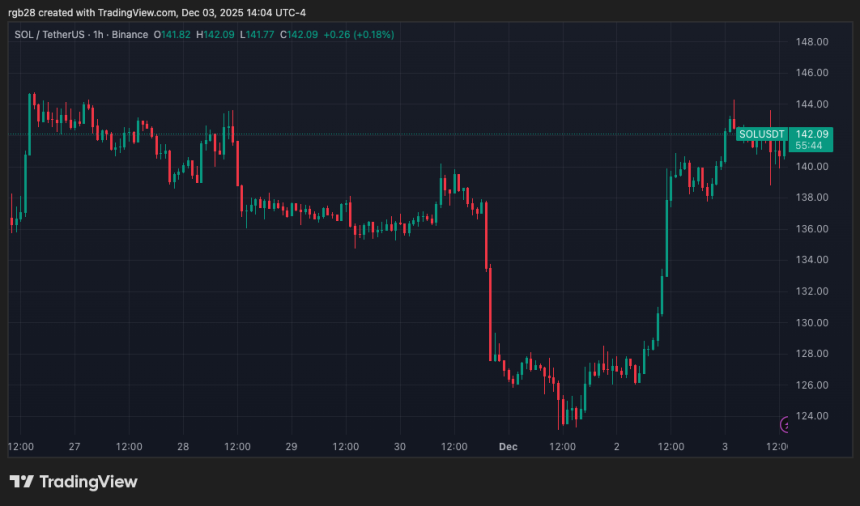
Solana is attempting to turn the $140 area into support while nearing a key local resistance for the third time in a month. The cryptocurrency has been trading between the $120-$144 levels since mid-November, struggling to hold the high zone of its local range amid the recent market volatility.

Last week, it bounced 10% toward the $140-$144 area but plunged to the range lows after Sunday’s correction, hitting a one-week low of $123 on Monday. As a result, it tested an ascending trendline that has served as support since 2023.

Ali Martinez explained that during the pullbacks, SOL has retested this key support trendline. Notably, each time the cryptocurrency has tapped this trendline, it has registered strong rebounds in the following months, suggesting that the price could rally more than 80% in the mid-term if this support holds.

Following Tuesday’s market rebound, SOL climbed back to the range’s highs, attempting to break above the local range once more. Market observer More Crypto Online affirmed that Wednesday’s rejection from $144 was expected, as it has been a strong resistance for weeks.

The trader considers that investors should not worry as long as the mid-zone of its range, between the $134-$139 levels, holds as support. “It’s not really a breakdown yet; we just have a first sharp pullback,” he affirmed, emphasizing that there’s no evidence that bears are taking the lead.

He noted that breaking below the mid-zone of its range would open the door to a retest of the recent lows and potentially risk a drop to the $117 area or lower. Nonetheless, if bulls take the lead and reclaim the $144 level as support, it will open the door to a retest of higher levels, including the $163 level, where the major next sell wall for SOL is situated.

Is SOL’s Crucial Support Weakening?

Meanwhile, Rekt Capital shared an analysis on longer timeframes, pointing out that Solana has been moving within a clear macro range, situated between the $123 and $296 levels, in the monthly timeframe, clustering in this area since early 2024.

Per the analyst, the cluster has been developing for an extended period, and the potential for distribution and its function as a re-accumulation structure decreases the longer it continues.

Despite this, he emphasized that the focus is on the 21-month horizontal support level. As the analysis noted, Solana recorded a 140% rally during the first major rebound from the region in Q3 and Q4, 2024.

In the second rebound from this support, which started in Q3 2025, SOL saw a significantly smaller rally, surging around 100% to its September local high. Now, the cryptocurrency is rebounding from this level, which could confirm a decreasing trend for the altcoin and raise the alarm about its strength.

“While it is positive to see this rebound, if the move turns into a weaker rebound than the previous ones, then questions will arise regarding the strength of this support,” Rekt Capital asserted.

To prevent this, Solana must breach the one-year downtrend or the multi-week downtrend on the weekly timeframe. “Failing to break either of these trendlines would produce a smaller rally because the prior rebound — the one that rallied around 100% — would fall short and reject from these downtrends instead.”

The analyst concluded that a sequence of progressively smaller bounces “would imply increasing weakness into that support, which in turn would favour the potential for distribution in Solana over time.”

Solana, SOL, SOLUSDT

AWS Adds Bevy of Tools and Capilities to Improve Cloud Security

maginot, defense,

Amazon Web Services (AWS) this week made an AWS Security Hub for analyzing cybersecurity data in near real time generally available, while at the same time extending the GuardDuty threat detection capabilities it provides to the Amazon Elastic Compute Cloud (Amazon EC2) and Amazon Elastic Container Service (Amazon ECS). Announced at the AWS re:Invent 2025..

The post AWS Adds Bevy of Tools and Capilities to Improve Cloud Security appeared first on Security Boulevard.

❌