Reading view

There are new articles available, click to refresh the page.

What can individuals and businesses expect when the tax filing window opens in just a few weeks?

Interview transcript

Terry Gerton We’re a few weeks past the longest lapse in federal appropriations and maybe looking at another one in the end of January. So I want to work with you to put October and November into context. You’ve seen many shutdowns in your time on the Hill and now at Deloitte. How would you say this one differs from previous episodes, especially when it comes to your area of expertise, tax policy?

Anna Taylor Well, I do think it was different than what we’ve seen in years past. And part of that starts with just the way folks on the hill operated in it. I was really shocked that — my first sign that something was different was — I was shocked when I heard reporting that … the members and the staff that work in the Capitol building had left before we even hit midnight the night that we entered the shutdown. That’s not normal. In years past in shutdowns, you have frantic work happening behind the scenes where they’re trying to see if there’s any way to find a deal. And it was just obviously clear to all of them that they were so far away from a deal at that point that there was nothing to do. And so they left the building. And that was my first sign that this one was not normal and we were in for a longer shutdown. You know, in terms of the impact it has on tax administration and tax policy, it’s significant. You know, the fact that you had so many furloughed workers in the federal workforce and specifically at IRS and in Treasury, during that extended period definitely has an effect on customer service. It has an effect on their ability to move forward with their reg writing and guidance plans, which is in this moment, you know, where we’re just getting through a big piece of legislation, the One Big Beautiful Bill Act that was signed into law back in the summer, and they’re in a very significant guidance process to go along with that bill right now. There’s a lot of work that needs to get done … I know that you know, the treasury and the IRS said much of that work went on during the shutdown. So I do think that there was some of that that didn’t stop, which is a good thing for taxpayers, but had to slow it down in some capacity. And when you think about just customer service for taxpayers and not being able to call and find somebody on the phone to talk to, certainly there were challenges there as well. So I do think there was that, you know, kind of tangible direct effect. Now, in terms of effect on tax policy, I think it’s jury still out. Obviously there wasn’t any sort of deal that ended the shutdown with additional legislation. So we didn’t have some big tax package coming out of the — sometimes you do see some sort of legislative deal come out of a — well, not often with a shutdown. Normally nobody wins in a shutdown. But when you’re reaching appropriations deals that don’t end in shutdown, sometimes you’ll see tax legislation attached to those kinds of deals. And, you know, we didn’t have that … There were not regular hearings and regular markups happening in the tax writing committees while we were in shutdown. And so there was probably a slowdown in some bills that are maybe under consideration because they weren’t being considered during the shutdown. And so I do think that probably it definitely had a direct effect on taxpayers who may have had an impact on customer service, but there’s also that effect of maybe slowing down policymaking as well.

Terry Gerton I’m speaking with Anna Taylor. She’s managing principal of the Tax Policy Group at Deloitte. Well, let’s talk about the specific impact on taxpayers. I mean, filing season is going to open in just a few weeks. Is there a reasonable expectation that the IRS and all of the companies that support tax filing will have written in the rules for the One Big Beautiful Bill Act provisions and anything else that might come up before the year end? Are tax filers going to have the systems ready to go?

Anna Taylor Well, I think that the Treasury and IRS have done a — they’ve made a real effort to try to get to the things from that bill first that were going to need to be implemented for taxpayers at the beginning of 2026. So I think in most cases, you have … already seen guidance come out on those things that are affecting individual taxpayers, like … the tipped income deduction and overtime pay, things like that. So they have already put out quite a bit of guidance in those spaces that will have a direct effect on individual taxpayers. There’s still a lot to go though. And, you know, you have business taxpayers who maybe aren’t filing on the same timeline as individuals. Some of that important guidance is still yet to come. But I do think that because of the thinking about the kind of end year for individuals, the administration has tried to prioritize those things that are going to need to be known on day one of the new year.

Terry Gerton That’s good to hear. You also mentioned the congressional tax writing committees and certainly as Congress has come back, the committees have quite a backlog. Can you give us any insight as to what they may be talking about in those committees?

Anna Taylor Well, they do have a full agenda. I mean, I think the first thing that you’re hearing a lot about if you turn on any news outlet right now is of course the thing that landed them in the shutdown to begin with, finding some sort of path forward on those Affordable Care Act premium tax credit — the enhancements for those credits. They didn’t reach any deal before they came out of the shutdown, but they did agree to keep working on it. So there was an agreement as part of coming out of that shutdown where Majority Leader Thune in the Senate said he will hold another round of votes on those credit extensions by the middle of December. So I do think that there’s conversations happening, both bipartisan and partisan, to see if there’s a path forward on figuring out a way to deal with health care costs and insurance premium costs. So that’s taking up a lot of time right now. In addition to that, there is interest from the committees to try to move some things that they’ve been working on for a while on a bipartisan basis. These are things that have been in works for years, honestly, and have pretty broad consensus support. Things like, you know, there’s a tax treaty with Taiwan that has moved through regular order in both the House and the Senate that I think people would like to see get over the finish line. There is, the chairman and ranking member of the Senate Finance Committee have worked on — they haven’t actually processed legislation, but they’ve put out a joint white paper on tax administration. So just some changes to make the system work better for taxpayers. I think that’s something they’re interested in trying to see if there’s opportunities to move together. And then there are a few expiring tax provisions on the business side of the ledger that haven’t been dealt with this year. You know, a lot of the expiring provisions on the individual side were included in that one big beautiful bill act back in the summer. But there are a couple of provisions like the Work Opportunity Tax Credit. That’s an important one that does have an effect on people’s ability to get a job and on business’s ability to hire. And so that’s one that is set to expire at the end of this year that I do think there’s probably bipartisan interest in extending. So those are all things I think on the near-term agenda, if they’re in an environment to be able to move some bipartisan legislation. And we all know right now that’s a big no.

Terry Gerton Well, speaking of that environment, 2026 is an election year for many members of Congress. Do you think in that environment they really will be able to move some of these big pieces of tax legislation or will they maybe just nibble around the edges?

Anna Taylor It’s a really good question. And … when I look in my crystal ball, it’s cloudy, you know. I think that, even in the most political of times, you can sometimes get smaller packages of bipartisan consensus product through. So, you know, I’m still hopeful that they can — they’re going to have to do something on appropriations again when they get to the end of January. That’s when that next government funding deadline will be reached. And so there is potentially a bipartisan vehicle that will be heading our way come late January, assuming we’re not headed towards another shutdown at that point. And so I really do think there’s a possibility that if they reach some sort of funding deal, you know, as they’re working through it in December and into January, that there’s the potential that you could see some tax legislation move along with it, possibly. The later — and I think this goes without saying — the later you get into an election year, the harder it is to do bipartisan things. So when we get into, you know, maybe late summer, early fall, I’ll stop being as optimistic. But until then, I think that there’s still a chance they could move some of the smaller consensus items.

The post What can individuals and businesses expect when the tax filing window opens in just a few weeks? first appeared on Federal News Network.

© AP Photo/J. Scott Applewhite

Early morning light filters through the fluted columns of the House of Representatives as lawmakers await final passage of President Donald Trump's signature bill of tax breaks and spending cuts, at the Capitol in Washington, Thursday, July 3, 2025. (AP Photo/J. Scott Applewhite)

Popular Swiss Crypto Law Just Got A Massive Delay, Here’s The New Timeline

The Swiss government has announced a delay in its plans to implement a major crypto law. This comes as governments worldwide face difficulty in achieving uniform crypto tax regulations, even as the crypto industry heats up with wider adoption. 

Swiss Government Delays Implementation Of Popular Crypto Law

In a press release, the Swiss Federal Council announced that the new Crypto-Asset Reporting Framework (CARF) will be enshrined into law from January 2026, but will not be implemented until 2027 at the earliest. The National Council’s Economic Affairs and Taxation Committee (ETAC) earlier this month suspended deliberations on the partner states with which Switzerland intends to exchange data under the crypto law, which prompted this decision.

The Federal Council also determined that the provisions on crypto assets contained in the Federal Act on the Automatic Exchange of Information in Tax Matters (AEOIA) and AEOI Ordinance shall not apply next year. Meanwhile, the government approved amendments to the Automatic Exchange of Information in Tax Matters (AEOI Ordinance). 

The release noted that the crypto law contains implementing provisions on amending the Federal Act on the AEOIA. As part of the amendments, the AEOI Ordinance now includes the crypto service providers’ duty to report, duty to conduct due diligence, and duty to register. It also specifies their nexus to Switzerland. 

Furthermore, under the crypto law, crypto service providers such as exchanges will now directly apply to associations and foundations, and their accounts will be subject to the law. However, they are excluded from the AEOI if they meet certain conditions under the revised ordinance. Lastly, the law also contains transitional provisions that make it easier for the affected parties to implement the amended CRS and the CARF. 

The Crypto-Asset Reporting Framework (CARF) will enable the automatic exchange of tax information on crypto transactions between countries. Other countries, including the U.S. and the U.K., are working to implement this global standard of crypto tax reporting into their legal frameworks. 

U.K. Also Moves To Implement CARF

In a release, the U.K. government announced that it is implementing the CARF for the first international data exchanges in 2027. The government noted that the CARF requires U.K. reporting crypto asset service providers (RCASPs) to collect relevant tax information and undertake due diligence in relation to their users on an annual basis. 

These U.K. RCASPs will also be required to collect information concerning U.K. resident customers. This means that the country’s tax authority, HMRC, will have CARF data on all taxpayers using a U.K.-based RCASP. Meanwhile, it is worth noting that the U.S. is also planning to implement the crypto law. Bitcoinist recently reported that the Treasury Department has dispatched the CARF regulations to the White House for review.

Crypto

IRS tech chief directs staff to take ‘skills assessment’ ahead of IT reorganization

The IRS, ahead of an upcoming reorganization of its tech office, is putting its IT staff to the test.

The agency, in an email sent Monday, directed its IT workforce to complete a “technical skills assessment.”

IRS Chief Information Officer Kaschit Pandya told employees that the assessment is part of a broader effort to gauge the team’s technical proficiency, ahead of an “IRS IT organizational realignment.”

“Over time, hiring practices and role assignments have evolved, and we want to ensure our technical workforce is accurately aligned with the work ahead. The assessment will help establish a baseline understanding of our collective strengths and areas for development,” Pandya told staff in an email sent Monday.

Pandya’s office is leading the technical skills assessment, in coordination with the Treasury Department, the IRS human capital office and the Office of Personnel Management.

“I want to emphasize that this is a baseline assessment, not a performance rating. Your individual-level results will not affect your pay or grade,” he told staff. “I know this comes during a very busy and uncertain time, and I deeply appreciate your partnership.”

Pandya told staff that a “limited group” of IRS IT employees in technical roles — including developers, testers and artificial intelligence/machine learning engineers have been invited to complete the test. He told staff that, as of Monday, about 100 employees were directed to complete the assessment.

On Friday, an IRS IT employee told Federal News Network that several hundred employees have now completed the assessment, and that it took employees about 90 minutes to complete it.

According to the employee, Pandya told staff in an all-hands meeting on Friday that one of the agency’s goals is to rely more on full-time IT employees, and less on outside contractors. He said during that meeting that IRS IT currently has about 6,000 IT employees and about 4,500 contractors.

“It doesn’t make sense, considering all the RIFs, firings and decisions that ignored expertise,” the IRS IT employee said.

The IRS has lost more than 25% of its workforce so far this year, largely through voluntary separation incentives. Pandya told staff in an email this summer that the agency needs to “reset and reassess,” in part because more than 2,000 IT employees have separated from the IRS since January. The IRS had about 8,500 IT employees at the start of fiscal 2025.

The agency also sent mass layoff notices to its employees during the government shutdown, but has rescinded those notices as required by Congress in its spending deal that ended the shutdown.

The Treasury Department sent reduction-in-force notices to 1,377 employees during the recent government shutdown — as part of a broader RIF that targeted about 4,000 federal workers. Court documents show the IRS employees received the vast majority of those RIF notices, and that they disproportionately impacted human resources and IT personnel at the IRS.

The technical assessment is also in line with goals set by Treasury CIO and Department of Government Efficiency representative Sam Corcos, who recently said IRS IT layoffs were “painful,” but necessary for the agency’s upcoming tech reorganization.

In a recent podcast interview, Corcos said much of his time as Treasury CIO has been focused on projects at the IRS, and that the agency’s IT workforce doesn’t have the necessary skills to deliver on its long-term modernization goals.

“We’re in the process of recomposing the engineering org in the IRS, which is we have too many people within the engineering function who are not engineers,” he said. “The goal is, let’s find who our engineers are. Let’s move the people who are not into some other function, and then we’re going to bring in more engineers.”

Corcos estimated that there are about 100 to 200 IRS IT employees currently at the organization that he trusts to carry out his reorganization plans.

“When you go in and you talk to people, a lot of the people, especially an engineer, the engineers on the team, they want to solve this problem. They don’t feel good about the fact that this thing has been ongoing for 35 years and will probably never get done. They actually want to solve these problems.”

IT employees at several agencies have gone through evaluations and assessments during the Trump administration. Tech employees at the General Services Administration were also interviewed and questioned about their skills and expertise by GSA and DOGE leadership. GSA later downsized its Technology Transformation Services office and shuttered its 18F tech shop.

In March, the IRS removed 50 of its IT leaders from their jobs and put them on paid administrative leave. Corcos defended that decision, saying the IRS “has had poor technical leadership for roughly 40 years.”

Corcos said those former IRS IT leaders pushed back on DOGE’s audit of government contracts. The agency, he added, spent an “astounding” amount on cybersecurity contracts, but former leaders resisted cutting and scaling back any of those contracts.

“The initial leadership team just said, ‘Everything is critical, you can’t cut anything. In fact, we need more,’” Corcos said. “And when we swapped them out for people who were more in the weeds, who knew what these things were, we found actually quite a lot that we could cut.”

The post IRS tech chief directs staff to take ‘skills assessment’ ahead of IT reorganization first appeared on Federal News Network.

© AP Photo/Patrick Semansky

After mixed messages on back pay, IRS says staff will get ‘majority’ by Nov. 19

IRS employees are getting mixed signals on when they should expect to receive their back pay, now that the longest government shutdown is over.

About 34,000 previously furloughed IRS employees were told earlier Friday that they would have to wait until early December to receive all of the back pay they are owed. But they’re now being told that they will receive the “majority of their back pay” by Nov. 19, which is the latest that federal employees will receive back pay.

“After ongoing conversations with the National Finance Center, the IRS now anticipates the majority of back pay will be paid on 11/19/2025,” the IRS told employees in an email obtained by Federal News Network.

In an earlier memo, IRS employees were told they would receive back pay covering two full pay periods on Nov. 24, and would receive back pay for a partial pay period on Dec. 8. That’s a later timeline than what the Trump administration provided earlier this week. The IRS, however, says these internal communications are no longer accurate.

Nearly all other federal employees will receive their back pay no later than Nov. 19. A senior administration official told Federal News Network on Thursday that all employees at the Treasury Department, as well as several other agencies, would receive their back pay on Nov. 19.

Employees at some agencies will receive their back pay as soon as this weekend, while others will get their back pay next week.

Doreen Greenwald, president of the National Treasury Employees Union, told reporters in a call Friday that the IRS “was able to get people paid much faster” after the January 2019 shutdown, which lasted for 35 days, and called the delayed timeline “entirely unacceptable.”

“To find out that there isn’t an urgency to get these employees paid is really just outrageous,” Greenwald said.

“They’re showing up to work, but they’re still not getting paid. And they are still waiting a long time to see when they’re going to get paid,” she added.

The IRS told Federal News Network, following NTEU’s call with reporters, that it had tested its systems, and expects that all employees will receive their full back pay by Nov. 24.

The IRS isn’t the only agency updating its back pay schedule. According to Greenwald, the Interior Department told its employees that they will receive 50% of their back pay on Nov. 17 and the rest on Nov. 25.

A senior administration official previously told Federal News Network that Interior Department employees would receive a “supercheck” on Nov. 17 that would cover all days between Oct. 1 and Nov. 1. Federal News Network has reached out to the Interior Department for comment.

“We’re really asking the federal government to live up to the November 19th deadline and really respect employees and the urgency of their needs and to get this pay issued as soon as possible, but no later than Nov. 19,” Greenwald said.

The Office of Personnel Management, in its latest guidance, said it “is committed to ensuring that retroactive pay is provided as soon as possible.”

The spending deal passed by Congress on Wednesday evening ensures back pay for furloughed and excepted federal employees.

A 2019 law previously called for retroactive compensation for all federal employees impacted by a shutdown. But during the shutdown, White House’s Office of Management and Budget floated the idea that back pay wasn’t guaranteed for furloughed employees.

Mike Radock, the acting director of the IRS Office of Human Resources Operations, told staff in an email obtained by Federal News Network that the agency’s payroll and employee services divisions “are working collaboratively to ensure employees receive pay and backpay.”

“Periods like this can bring challenges and uncertainty, and I want to thank you for staying connected and supporting one another. The work you do is essential, and I’m eager to move forward together as we resume normal operations,” Radock wrote.

Greenwald said the back pay schedule puts a strain on furloughed IRS employees, who missed two full paychecks and received one partial paycheck. Meanwhile, IRS staff are dealing with a significant backlog of work that has piled up during the 43-day shutdown.

“They’re coming back to their workplaces with inventory that has backed up, with messages on their phones, with emails they couldn’t answer, all the things that they weren’t allowed to do during a furlough. So they’re already set behind because the work has piled up during this time,” she said. “Let’s respect them enough to get them their back pay, so they can start to get their lives back on track and get moving forward.”

The post After mixed messages on back pay, IRS says staff will get ‘majority’ by Nov. 19 first appeared on Federal News Network.

© Getty Images/iStockphoto/marcnorman

Post-shutdown, here’s how soon federal employees can expect back pay

Following the longest shutdown in U.S. history, the federal workforce is now trying to get back to at least some sense of normalcy.

While federal employees who have been furloughed for the last 43 days return to work Thursday, the Office of Personnel Management is setting expectations for agencies as they begin to update pay, leave and benefits for those impacted by the lapse in appropriations.

In new guidance, OPM said it is “is committed to ensuring that retroactive pay is provided as soon as possible.” Compensation will be provided for both furloughed and excepted federal employees, as the spending agreement that was enacted Wednesday evening reaffirmed. A 2019 law previously called for retroactive compensation for all federal employees impacted by a shutdown.

A senior Trump administration official said the White House “has urged agencies to get employee paychecks out expeditiously and accurately to not leave anyone waiting longer than necessary.”

But the timing of employees receiving their back pay varies, depending on what payroll provider an agency uses, and the different pay schedules across the federal workforce.

Sending out retroactive payments to employees involves working across agency HR offices, federal payroll providers and shared service centers. Agency HR offices, for instance, have to submit timecards for federal employees, which are then processed by the government’s various payroll providers.

According to the senior administration official, employees from the General Services Administration and OPM will be among the first to receive their retroactive paychecks, with an expected deposit date set for Saturday.

Employees at the departments of Veterans Affairs, Energy, and Health and Human Services, as well as civilian employees from the Defense Department, will receive their deposits shortly after that — this Sunday.

On Monday, affected employees from the departments of Education, State, Interior and Transportation, as well as the Environmental Protection Agency, National Science Foundation, Nuclear Regulatory Commission, Social Security Administration and NASA, are all expected to receive their back pay.

Then on Wednesday, employees from the departments of Agriculture, Commerce, Treasury, Labor and Justice, along with the Department of Homeland Security, the Department of Housing and Urban Development and the Small Business Administration, are projected to get their paychecks. The timing of the retroactive payments for feds was first reported by Semafor.

The National Finance Center, a payroll provider housed under the Agriculture Department, confirmed that employees at agencies using NFC’s services should expect a payroll deposit by the middle of next week.

“In order to provide backpay for employees as quickly as possible, the National Finance Center will be expediting pay processing for pay period 22 and backpay for pay periods 19 (October 1-4), 20 (October 5-18), and 21 (October 19-November 1),” USDA wrote in an all-staff email Wednesday evening, obtained by Federal News Network.

Federal News Network has reached out to several other federal payroll providers requesting details on the timeline for processing retroactive payments.

The National Treasury Employees Union urged immediate back pay for all federal employees who have been going without compensation for the last six weeks.

“This is an emergency for federal employees across the country, and they should not have to wait another minute longer for the paychecks they lost during the longest government shutdown in history,” NTEU National President Doreen Greenwald said. “We call on all federal agencies to process the back pay immediately.”

In its new guidance, OPM also noted that to make payments as quickly as possible, payroll providers may need to “make some adjustments.” That could mean, for instance, that the initial retroactive payments employees receive might not reflect the exact calculations of their pay and leave hours.

“Payroll providers will work with agencies to make any necessary adjustments as soon as practicable,” OPM said.

Who receives back pay, and how much?

Furloughed employees will receive their “standard rate of pay” for the hours they would have worked if the government shutdown hadn’t occurred, OPM said in its guidance Wednesday evening.

But there are some exceptions to that. If a furloughed employee, for example, had been scheduled for overtime hours that would have occurred during the shutdown, OPM said they should be paid their premium rate for those hours.

Additionally, OPM said that allowances, differentials and other types of payments, like administratively uncontrollable overtime pay or law enforcement availability pay, should be paid as if the furloughed employee continued to work.

Although most employees impacted by the shutdown are ensured back pay, there are some smaller exceptions carved out where employees may not receive retroactive pay, OPM added.

If a furloughed employee was in a non-pay status before the shutdown began, for instance, then they are not entitled to receive back pay.

Excepted employees who were considered “absent without leave” (AWOL) — or in other words, took unapproved time off — will also not receive back pay for that time.

Guidance on leave, post-shutdown

Although excepted employees are not required to use paid leave for taking time off during the shutdown — and can instead enter a “furlough” period — there may still have been some instances where excepted employees took leave during the funding lapse, OPM wrote in its guidance.

In those cases, excepted employees who were approved to take paid leave during the shutdown will be charged for the hours from their leave bank, OPM said.

Agencies are also expected to begin adjusting leave accrual for furloughed employees. Now that the shutdown is over, furloughed employees should be placed in a “pay status” for the time they would have otherwise spent working during the funding lapse. That means accrual of annual and sick leave will be retroactively adjusted as if the employees were in a pay status, OPM said.

Excepted employees continued to accrue leave during the shutdown, which should be reflected in their leave banks, OPM said.

What happens to RIFs of federal employees?

On top of reaffirming back pay, the spending bill that was enacted Wednesday evening also rescinds the roughly 4,000 reductions in force that have occurred since Oct. 1. Federal employees will be temporarily protected from additional RIFs, at least until the end of January.

Agencies have five days to inform federal employees who received RIF notices in October that those actions are rescinded.

“Agencies should issue those notices and confirm to OPM the rescissions have been issued,” OPM’s guidance states.

At least 670,000 federal employees have been furloughed, and 730,000 employees have been working without pay during the shutdown. Agencies have been putting plans in the works to return all furloughed federal employees to their duties as of Thursday.

OPM also said agencies “may consider” providing flexibility for employees who might not be able to return to work immediately, such as by approving personal leave or adjusting individual work schedules.

The post Post-shutdown, here’s how soon federal employees can expect back pay first appeared on Federal News Network.

© AP Photo/Mark Schiefelbein

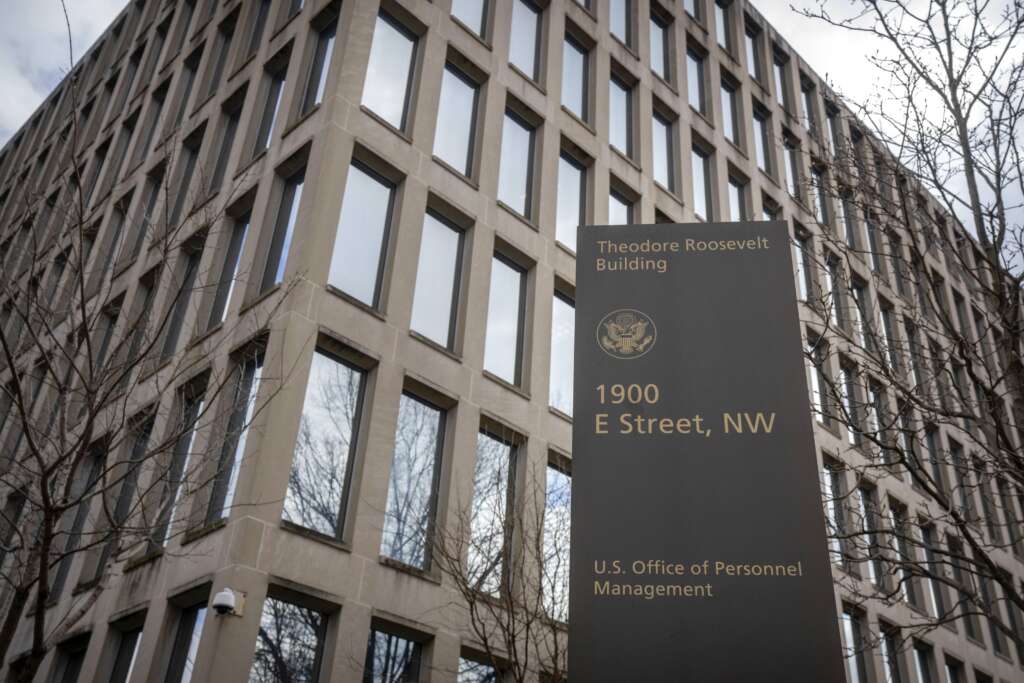
The Theodore Roosevelt Building, location of the U.S. Office of Personnel Management, on Tuesday, Feb. 13, 2024, in Washington. Former President Donald Trump has plans to radically reshape the federal government if he returns to the White House, from promising to deport millions of immigrants in the U.S. illegally to firing tens of thousands of government workers. (AP Photo/Mark Schiefelbein)
❌