
Reading view

There are new articles available, click to refresh the page.

Federal employees who left ‘DEI’ roles still fired under Trump administration purge, lawsuit claims

Mahri Stainnak got the call the day after President Donald Trump took office: the Office of Personnel Management’s human resources office was putting them on administrative leave “effective immediately,” while the agency “investigates your radical and wasteful DEI activity.”

Stainnak was surprised by the news. Before the Trump administration, they served as OPM’s deputy director of the governmentwide Office of Diversity, Equity, Inclusion and Accessibility. But now they worked as the director of OPM’s talent innovation group, a human resources job focused on recruiting and retaining talent across the federal government.

“I said, ‘Wait a minute, I’m not in diversity, equity and inclusion.’ I started a new role in a job that has nothing to do with diversity, equity and inclusion.’ So I felt incredibly shocked and confused,” Stainnak said.

The second call came 48 hours later: Stainnak, a nonbinary person who had worked in the federal government for more than 16 years, received a reduction in force notice, as part of the Trump administration’s plan to root out DEI programs across the federal government.

Stainnak is now part of a class-action lawsuit filed this week in the D.C. District Court for the District of Columbia.

The lawsuit, led by the American Civil Liberties Union of D.C., claims the Trump administration unlawfully targeted and fired federal employees perceived to be associated with DEI work — even if their current jobs had nothing to do with it.

Mary Kuntz, an attorney at the law firm Kalijarvi, Chuzi, Newman & Fitch, P.C. who is representing the former employees, said the administration’s actions “clearly” violate the Civil Service Reform Act, because employees like Stainnak were fired for previous work in DEI positions.

“You can’t RIF somebody from a position they’re not in,” Kuntz said. “They sought to punish Mahri [Stainnak] for previous DEI work. That’s a violation of the First Amendment.”

Kuntz said the lawsuit claims that the administration’s push to “eviscerate” DEI programs also had a disproportionate impact on people of color, women, non-binary individuals, and violates Title VII of the 1964 Civil Rights Act.

“The DEI folks were working on behalf of people with disabilities, people who are non-native speakers of English. They were advocating for protected groups,” she said.

On the campaign trail last year, President Donald Trump pledged to “eliminate all diversity, equity, and inclusion programs across the entire federal government,” and characterized these programs as promoting “un-American” ideology.

On his first days in office, Trump signed executive orders that directed agencies to create lists of employees associated with DEI going back to Nov. 5, 2024 — the date of the presidential election.  The complaint says agencies were directed to remove those employees, “regardless of their current roles or duties.”

“President Trump’s directives did not merely represent a change in presidential priorities — a normal occurrence when presidential administrations change. Rather, they were targeted actions intended to punish perceived political enemies, as well as to eliminate from the federal workforce women, people of color, and those, like plaintiffs, who advocated for or were perceived as advocating for protected racial or gender groups,” the complaint states.

The complaint says agencies set competitive levels for the RIFs so narrowly that federal employees were unable to compete for retention, and that those impacted by RIFs were not considered for reassignment to other jobs.

“I absolutely feel targeted on the basis of what the Trump administration believes my beliefs are, because I was not working in a diversity, equity and inclusion role in any way at the time when the new administration came in, or at the time I was placed on administrative leave,” Stainnak said.

For all the Trump administration’s actions to strip DEI out of the federal workforce, Kuntz said the president’s executive orders don’t go into any detail to define DEI.

“He characterizes them as illegal and discriminatory and various other things … but does doesn’t define them,” Kuntz said. “You can’t decide that somebody is a different party than the party in the White House and decide to fire them on that basis.”

The lawsuit states that the total number of federal employees impacted by the DEI rollback fis unknown, but says news reports suggest it could be “potentially in the thousands.”

The complaint states that at least 40 women or non-binary individuals, and more than 40 people of color received layoffs in connection with the Trump administration’s directives.

Stainnak and their colleagues filed an appeal to the Merit Systems Protection Board in March, but Kuntz said that appeal and similar cases brought before the Office of Special Counsel and agencies’ Equal Employment Opportunity (EEO) offices, have stalled.

In their last role, Stainnak helped agencies recruit top talent into the federal workforce. But they said the Trump administration’s purge of DEI workers has pushed out individuals who worked on bipartisan projects.

Former federal employees leading the lawsuit include a former operations manager at the Department of Veterans Affairs who “helped ensure that veterans were not inhibited from accessing earned benefits due to cultural or socioeconomic barriers,” a Department of Homeland Security Employee who led language competency efforts at the border to advance intelligence gathering and the safety of Immigration and Customs Enforcement officers.

“By illegally targeting people based on the Trump administration’s assumptions about our political beliefs, or by targeting us based on who we are, this administration actually is hurting the people who work and live in this country, because now these dedicated, hardworking federal servants are not in their jobs providing the critical services that they do, whether it’s responding to emergencies like hurricanes and making sure folks have drinking water and shelter, or making sure our transportation systems are safe and timely. This action is really hurting the people who live in this country,” Stainnak said.

The post Federal employees who left ‘DEI’ roles still fired under Trump administration purge, lawsuit claims first appeared on Federal News Network.
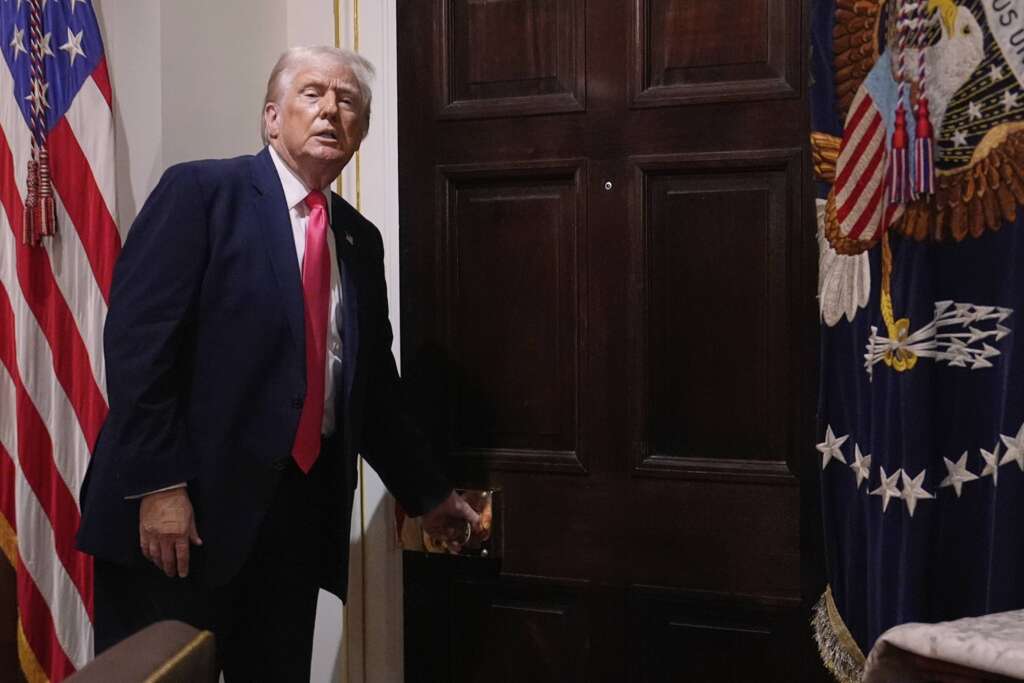
© The Associated Press
President Donald Trump walks out of the Cabinet Room following a Cabinet meeting at the White House, Tuesday, Dec. 2, 2025, in Washington. (AP Photo/Julia Demaree Nikhinson)

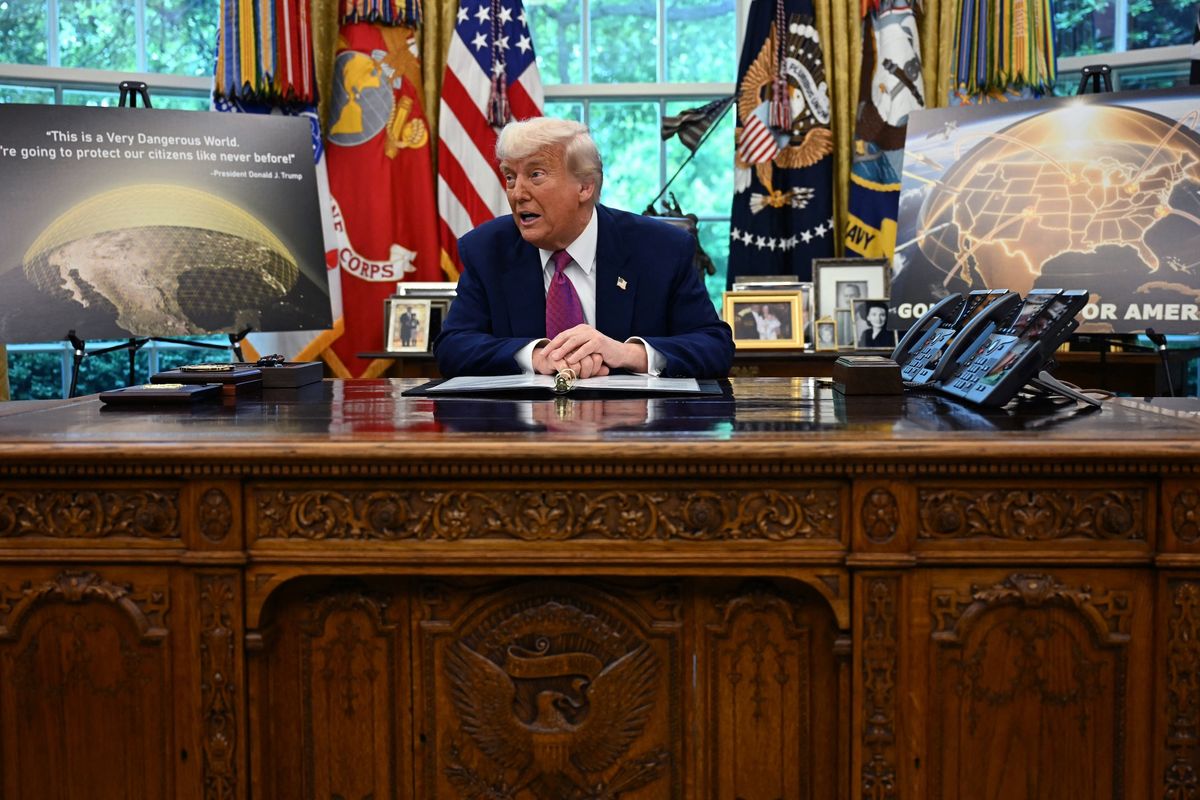
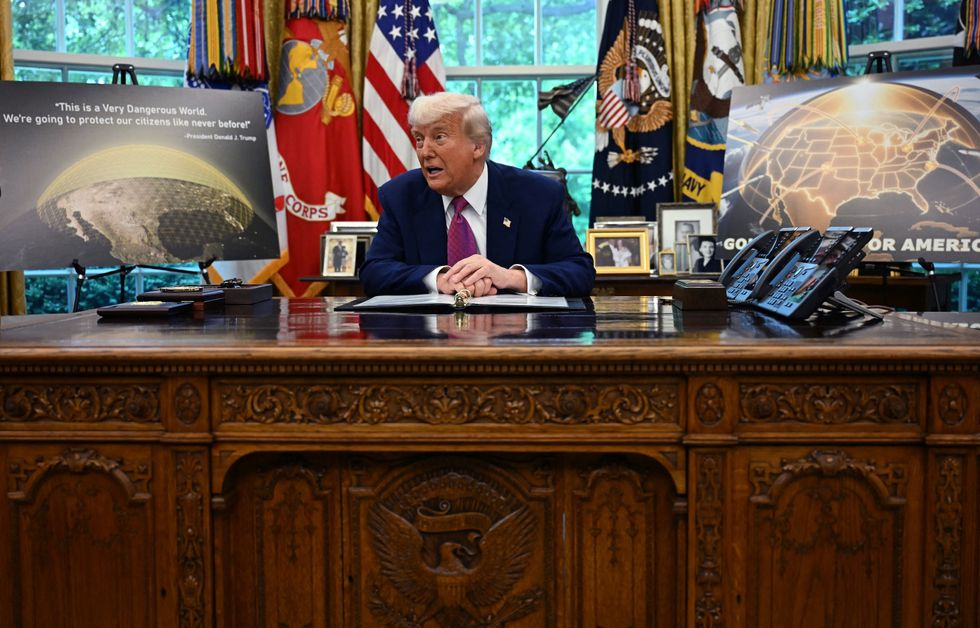
The Golden Dome Gamble: Space-Based Defense and the Future of Deterrence


CIPHER BRIEF REPORTING – The missile threat against the U.S. has quietly and significantly grown over the past four decades as U.S. adversaries have added more sophisticated missiles to their arsenals, investing in both the scope of their systems as well as their ability to reach the U.S. homeland, according to experts.

As one of his very first actions in office, President Trump issued an executive order to address it, calling it the Iron Dome for America. And while some experts believe the name itself is “unfortunate” because it creates unrealistic expectations of what the system can actually do, it also represents what many believe to be a “necessary and long overdue shift in thinking and policy to begin to better address” the vulnerability of the U.S. homeland.

The name itself, the Golden Dome, is meant to echo Israel’s battlefield-proven Iron Dome, the short-range rocket defense system that has proven incredibly effective at saving Israeli lives. Yet while Iron Dome protects a sliver of territory with ground-launched interceptors, Golden Dome is pitched as something far more audacious: a planetary shield in orbit, capable of destroying intercontinental ballistic missiles (ICBMs) from Russia or China, intercepting hypersonic glide vehicles, and blunting Iran’s growing arsenal.

The scale alone is staggering. Washington has signed off on $175 billion, most of which will flow to defense giants Lockheed Martin, RTX (formerly Raytheon), and L3Harris, to design the satellites, interceptors, and ground systems. Billions more are headed to the U.S. Space Force and the Missile Defense Agency (MDA), which will be tasked with weaving the pieces into a functioning shield. The effort is less like Iron Dome and more like the Apollo program—a bet that space-based interceptors can alter the nuclear balance of power.

Since July, when President Trump unveiled the plan and appointed U.S. Space Force Gen. Michael Guetlein to lead it, Golden Dome has begun to take shape. Early budget outlines, hints of which defense firms are poised to win contracts, and debates among scientists and strategists all point to the same conclusion: the United States is embarking on one of the most ambitious defense projects in modern history and as with ambitious endeavors, this one is not without risk.

What’s New: Price Tag, Commander, and a Sprint Schedule

At the May 20 White House launch, Trump vowed that Golden Dome would be operational before his term ends—a three-year sprint to bolt revolutionary technology onto legacy missile defenses. He also named states like Alaska, Florida, Georgia, and Indiana as benefitting from the program, indicating that the way it’s being implemented could be politically strategic as well.

These are not random mentions: Alaska hosts vital long-range radars, Florida provides launch ranges, Georgia is home to contractor and military facilities, and Indiana is a hub for advanced aerospace and defense manufacturing. In short, the rollout carries as much weight for domestic politics and jobs as it does for national defense.

The program itself relies on space-based interceptors (SBIs) and missile-tracking satellites linked to existing ground and sea defenses. An early sign of the complications associated with the program came from The Congressional Budget Office (CBO), which promptly warned that the actual cost could exceed $540 billion over the next two decades.

Over the summer, the outlines have grown sharper: $40 billion for the Space Force, including $24.4 billion specifically for Golden Dome. Nearly $9.2 billion is allocated for tracking satellites, $5.6 billion for orbiting interceptors, and approximately $1 billion for integration and testing. Congress added another $25 billion through the fast-track “One Big Beautiful Bill Act.” The shortcut could accelerate prototypes—but with less oversight, which is not an unfamiliar gamble for big-ticket defense programs.

How It Would Work

Despite its evocative name, the Golden Dome is not a physical shield arching over pockets of the United States. It is a layered missile-defense architecture stitched together by artificial intelligence and rooted in a mix of space and ground systems. Here’s how the architecture is designed to function:

Spot and track: Satellites equipped with infrared sensors detect missile launches the moment engines ignite and then track their trajectories.

Boost-phase intercept (BPI): New space-based interceptors (SBIs) would attempt to destroy missiles in the first minutes after launch, before they can release decoys or split into multiple warheads.

Midcourse and terminal defenses: If anything gets through, existing systems fire. The Navy’s Aegis system launches Standard Missile-3 (SM-3) and Standard Missile-6 (SM-6) interceptors from ships at sea, while the Army relies on Terminal High Altitude Area Defense (THAAD) batteries and Patriot missiles closer to the ground.

The brain: A central hub known as Command and Control, Battle Management and Communications (C2BMC) fuses satellite, radar, and electronic intelligence data, then assigns the best shooter to make a split-second kill decision.

In simpler terms, the system would begin by using satellites equipped with infrared sensors to detect launches and track missiles. Those satellites would feed data to interceptors in orbit, designed to strike in the “boost phase”— the brief moments right after a missile takes off, before it can release decoys or multiple warheads. If a missile makes it past that first layer, existing defenses would kick in: the Navy’s Aegis system with SM-3 and SM-6 interceptors, the Army’s THAAD batteries, and Patriots closer to the ground. A central command system would fuse data from satellites, radars, and electronic intelligence to make split-second engagement decisions.

"I think the real technical challenge will be building of the space-based interceptor,” said Space Force General Michael Guetlein shortly after being confirmed as head of the Golden Dome Program. “That technology exists, I believe. I believe we have proven every element of the physics [to the point] that we can make it work. What we have not proven is, first, can I do it economically, and then second, can I do it at scale? Can I build enough satellites to get after the threat? Can I expand the industrial base fast enough to build those satellites? Do I have enough raw materials, et cetera?"

Feasible but Costly

Experts agree that the most complex and most ambitious piece is the boost-phase intercept. Dr. Patrick Binning, a space-systems expert at Johns Hopkins, calls it the “holy grail” of missile defense. Taking out a missile right after launch gives the U.S. its best chance of success. But the hurdles are enormous: maintaining global satellite coverage, striking within seconds, and defending the system itself from cyberattacks, jamming, or anti-satellite weapons.

Binning calls the idea “quite feasible, but also likely quite costly.”

“Designing, developing, and deploying the space-based interceptors are the key technical risk,” he tells The Cipher Brief. In other words, the concept is sound, but building the hardware will be the real test.

Need a daily dose of reality on national and global security issues? Subscriber to The Cipher Brief’s Nightcap newsletter, delivering expert insights on today’s events – right to your inbox. Sign up for free today.

Peter Garretson, Senior Fellow in Defense Studies at the American Foreign Policy Council, argues that the technology is no longer science fiction.

“Completely feasible,” he tells The Cipher Brief, citing decades of progress: successful missile intercepts in space, proven battle-management systems like Aegis, miniaturized computing power, and advances in artificial intelligence. In his view, the building blocks for a space-heavy defense are finally in place.

The White House aims to have the Golden Dome operational within just three years. Binning, however, is blunt.

“Full operational capability in three years? Never going to happen,” he observes.

At best, he predicts, “the Golden Dome could conduct a sophisticated intercept test against an intercontinental ballistic missile test target using a newly orbiting space-based interceptor.”

Yet, turning a demonstration shot into a reliable shield will take far longer. But Garretson sees political risk in missing the target.

“Golden Dome must achieve both successful testing and initial deployments before the 2028 election,” he says. If that happens, “no political party will remove a missile shield from the U.S. public.”

But he warns that bureaucratic turf wars inside the Pentagon could be as dangerous as engineering setbacks.

Even if the politics align, the physics remain punishing. Building a shield in the sky is not just about winning budgets or inter-service battles—it’s about scale. Seeing everything—and firing first—requires massive constellations of satellites and interceptors. That scale creates two problems: launch bottlenecks and space debris.

Strategic Effects—And a Dual-Use Case

Golden Dome is meant to complicate the war plans of China and Russia while reducing leverage from Iran and North Korea. Garretson argues it could force adversaries to rethink their arsenals.

“It will cause their current force structure to be a wasting asset and cast doubt on their current investments,” he said. “They will be forced to massively overbuild to compensate and for their war plans to have similar confidence.” In time, he suggests, the pressure could open doors to new arms-control talks—just as President Reagan’s Strategic Defense Initiative (SDI) pushed the Soviet Union to the table.

Beyond deterrence and diplomacy, advocates see the Golden Dome serving another role: safeguarding the United States’ own presence in space. The conversation isn’t only about missile defense. Proponents argue that the Golden Dome could also guard the satellites that anchor U.S. power in space.

“The space-based interceptors will have a dual-use capability to also protect our critical space systems from anti-satellite interceptors being developed by our competitor nations,” Binning asserts.

In other words, Golden Dome might not only shield against nuclear attack—it could also defend the satellites that underpin U.S. communications, navigation, and intelligence.

Politics and Procurement

The administration has built political durability into the Golden Dome by spreading contracts across multiple states. Congress’s $25 billion “accelerator” allows the Pentagon to bypass some oversight in the name of speed. However, credibility will depend on rigorous testing—multiple simultaneous launches, decoys, and heavy jamming.

Garretson argues that management will matter as much as technology.

“Centralized leadership reporting directly to the President, with broad independence and exceptions from normal oversight,” will be needed, said Garretson. “Focus on sprints to incremental testing… Deploy in tranches and continuously upgrade… Focus on building and testing, not on studies and requirements documents.”

The core question isn’t whether Golden Dome can stop every missile. It is whether it can change how rivals think. A reliable boost-phase layer could force Beijing and Moscow to adjust their nuclear strategies. However, a fragile or easily compromised system could invite a preemptive attack.

For now, Washington hasn’t built a shield in space—it has placed a bet. The coming months will reveal whether defense contractors can turn promises into hardware, whether early tests prove the concept, and whether Congress will continue to write checks for a program on par with Apollo in terms of cost and ambition.

Are you Subscribed to The Cipher Brief’s Digital Channel on YouTube? There is no better place to get clear perspectives from deeply experienced national security experts.

Read more expert-driven national security insights, perspective and analysis in The Cipher Brief because National Security is Everyone’s Business.

❌