Reading view

There are new articles available, click to refresh the page.

NASA Selects 2 Instruments for Artemis IV Lunar Surface Science

4 min read

NASA Selects 2 Instruments for Artemis IV Lunar Surface Science

NASA has selected two science instruments designed for astronauts to deploy on the surface of the Moon during the Artemis IV mission to the lunar south polar region. The instruments will improve our knowledge of the lunar environment to support NASA’s further exploration of the Moon and beyond to Mars. 
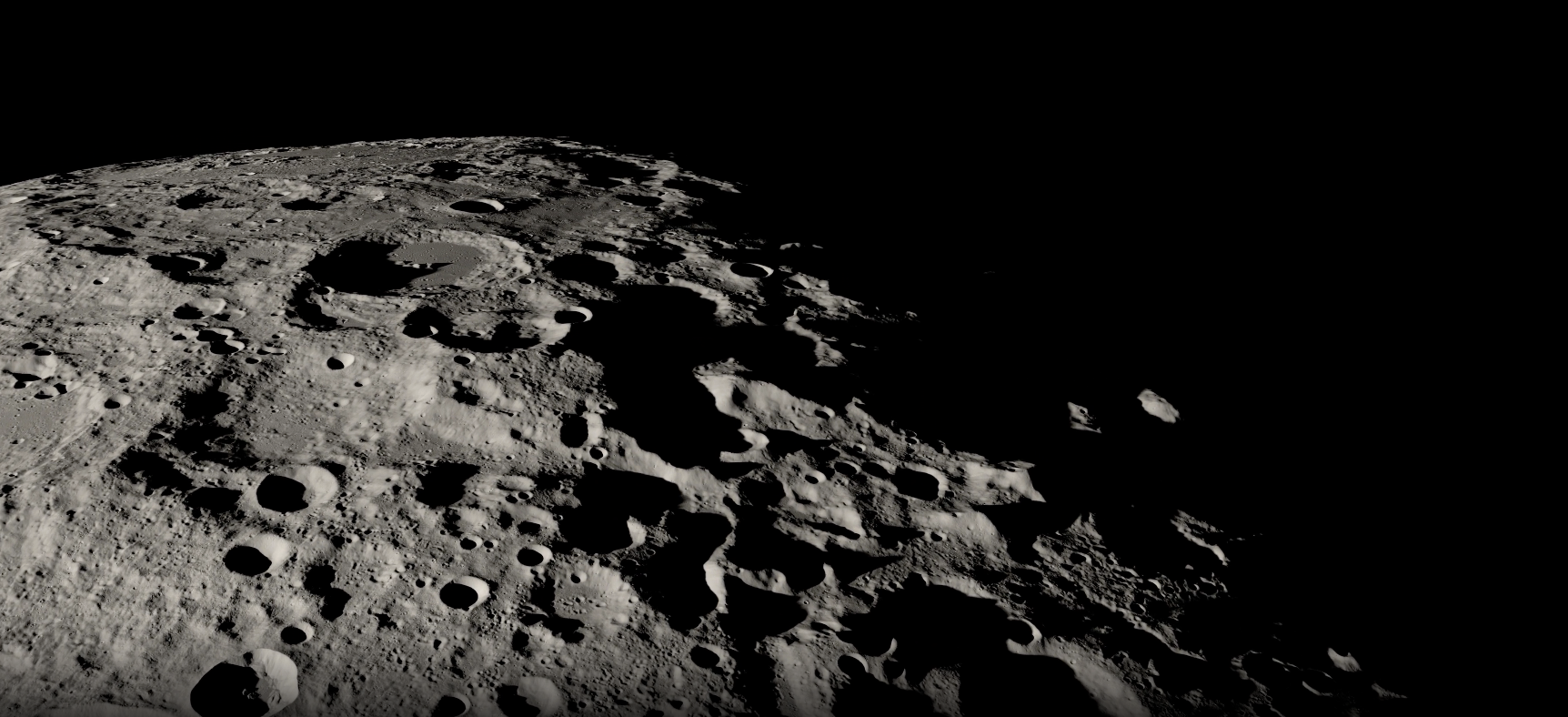
A visualization of the Moon’s South Pole region created with data from NASA’s Lunar Reconnaissance Orbiter, which has been surveying the Moon with seven instruments since 2009. 
NASA’s Scientific Visualization Studio/Ernie Wright

“The Apollo Era taught us that the further humanity is from Earth, the more dependent we are on science to protect and sustain human life on other planets,” said Nicky Fox, associate administrator, Science Mission Directorate at NASA Headquarters in Washington. “By deploying these two science instruments on the lunar surface, our proving ground, NASA is leading the world in the creation of humanity’s interplanetary survival guide to ensure the health and safety of our spacecraft and human explorers as we begin our epic journey back to the Moon and onward to Mars.”

After his voyage to the Moon’s surface during Apollo 17, astronaut Gene Cernan acknowledged the challenge that lunar dust presents to long-term lunar exploration. Moon dust sticks to everything it touches and is very abrasive. The knowledge gained from the DUSTER (DUst and plaSma environmenT survEyoR) investigation will help mitigate hazards to human health and exploration. Consisting of a set of instruments mounted on a small autonomous rover, DUSTER will characterize dust and plasma around the landing site. These measurements will advance understanding of the Moon’s natural dust and plasma environment and how that environment responds to the human presence, including any disturbance during crew exploration activities and lander liftoff. The DUSTER instrument suite is led by Xu Wang of the University of Colorado Boulder. The contract is for $24.8 million over a period of three years. 

A model of the DUSTER instrument suite
A model of the DUSTER instrument suite consisting of the Electrostatic Dust Analyzer (EDA)—which will measure the charge, velocity, size, and flux of dust particles lofted from the lunar surface—and Relaxation SOunder and differentiaL VoltagE (RESOLVE)—which will characterize the average electron density above the lunar surface using plasma sounding. Both instruments will be housed on a Mobile Autonomous Prospecting Platform (MAPP) rover, which will be supplied by Lunar Outpost, a company based in Golden, Colorado, that develops and operates robotic systems for space exploration.
LASP/CU Boulder/Lunar Outpost

Data from the SPSS (South Pole Seismic Station) will enable scientists to characterize the lunar interior structure to better understand the geologic processes that affect planetary bodies. The seismometer will help determine the current rate at which the Moon is struck by meteorite impacts, monitor the real-time seismic environment and how it can affect operations for astronauts, and determine properties of the Moon’s deep interior. The crew will additionally perform an active-source experiment using a “thumper” that creates seismic energy to survey the shallow structure around the landing site. The SPSS instrument is led by Mark Panning of NASA’s Jet Propulsion Laboratory in Southern California. The award is for $25 million over a period of three years. 
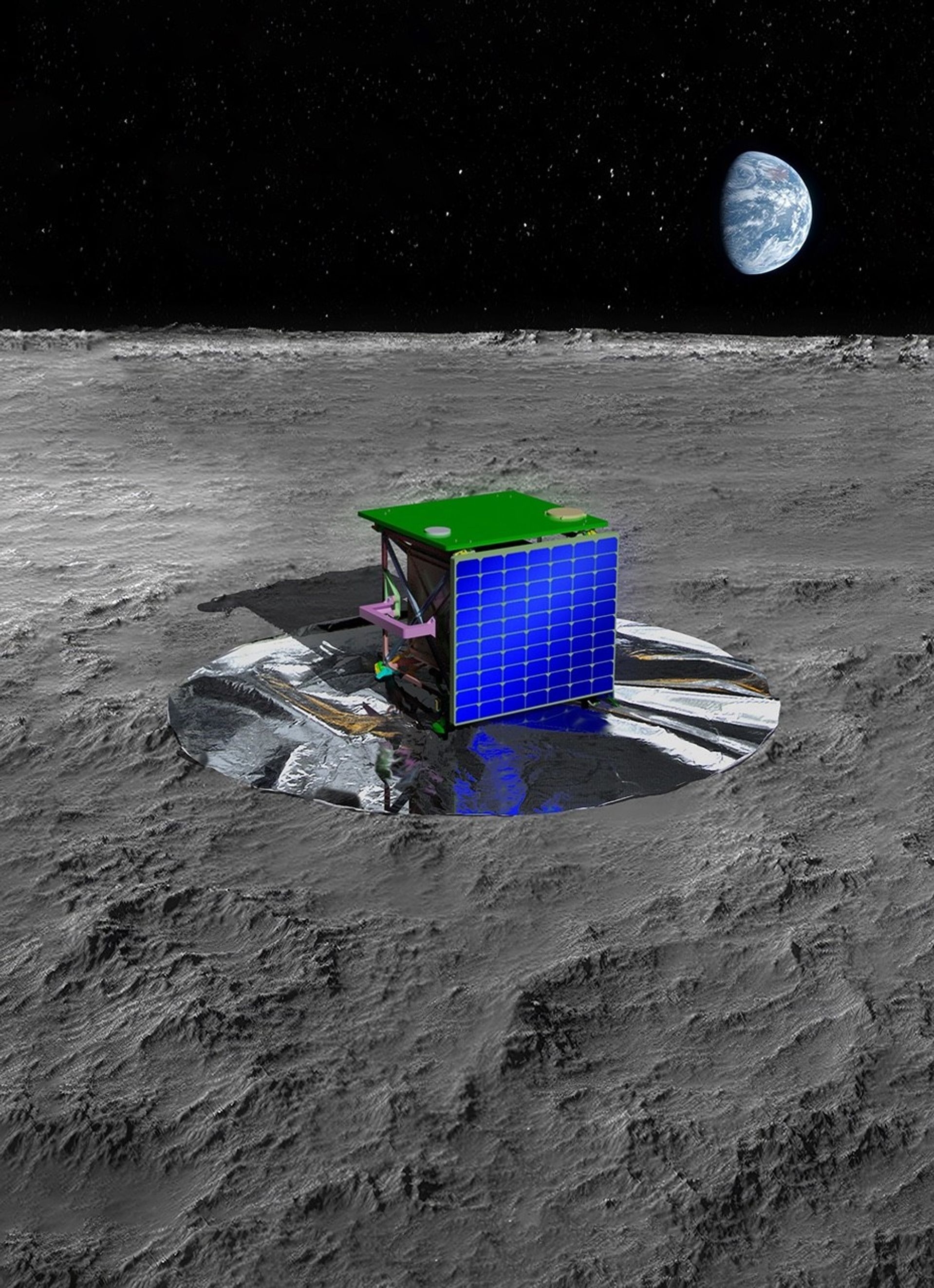
An artist’s concept of SPSS (South Pole Seismic Station)
An artist’s concept of SPSS (South Pole Seismic Station) to be deployed by astronauts on the lunar surface.
NASA/JPL-Caltech

“These two scientific investigations will be emplaced by human explorers on the Moon to achieve science goals that have been identified as strategically important by both NASA and the larger scientific community”, said Joel Kearns, deputy associate administrator for exploration, Science Mission Directorate at NASA Headquarters. “We are excited to integrate these instrument teams into the Artemis IV Science Team.”

The two payloads were selected for further development to fly on Artemis IV; however, final manifesting decisions about the mission will be determined at a later date. 

Through Artemis, NASA will address high priority science questions, focusing on those that are best accomplished by on-site human explorers on and around the Moon and by using the unique attributes of the lunar environment, aided by robotic surface and orbiting systems. The Artemis missions will send astronauts to explore the Moon for scientific discovery, economic benefits, and build the foundation for the first crewed missions to Mars.

For more information on Artemis, visit:

https://www.nasa.gov/humans-in-space/artemis

Karen Fox / Molly Wasser
Headquarters, Washington
202-358-1600 
karen.c.fox@nasa.gov / molly.l.wasser@nasa.gov
Facebook logo
Instagram logo
Linkedin logo

Regions on Asteroid Explored by NASA’s Lucy Mission Get Official Names

The IAU (International Astronomical Union), an international non-governmental research organization and global naming authority for celestial objects, has approved official names for features on Donaldjohanson, an asteroid NASA’s Lucy spacecraft visited on April 20. In a nod to the fossilized inspiration for the names of the asteroid and spacecraft, the IAU’s selections recognize significant sites and discoveries on Earth that further our understanding of humanity’s origins.

The asteroid was named in 2015 after paleoanthropologist Donald Johanson, discoverer of one of the most famous fossils ever found of a female hominin, or ancient human ancestor, nicknamed Lucy. Just as the Lucy fossil revolutionized our understanding of human evolution, NASA’s Lucy mission aims to revolutionize our understanding of solar system evolution by studying at least eight Trojan asteroids that share an orbit with Jupiter.

The Lucy spacecraft cartoon character peeking out from behind an artistic rendering of the two-lobed asteroid Donaldjohanson with the words “Greetings from Donaldjohanson.”
Postcard commemorating NASA’s Lucy spacecraft April 20, 2025, encounter with the asteroid Donaldjohanson.
NASA’s Goddard Space Flight Center

Donaldjohanson, located in the main asteroid belt between the orbits of Mars and Jupiter, was a target for Lucy because it offered an opportunity for a comprehensive “dress rehearsal” for Lucy’s main mission, with all three of its science instruments carrying out observation sequences very similar to the ones that will occur at the Trojans.

After exploring the asteroid and getting to see its features up close, the Lucy science and engineering team proposed to name the asteroid’s surface features in recognition of significant paleoanthropological sites and discoveries, which the IAU accepted.

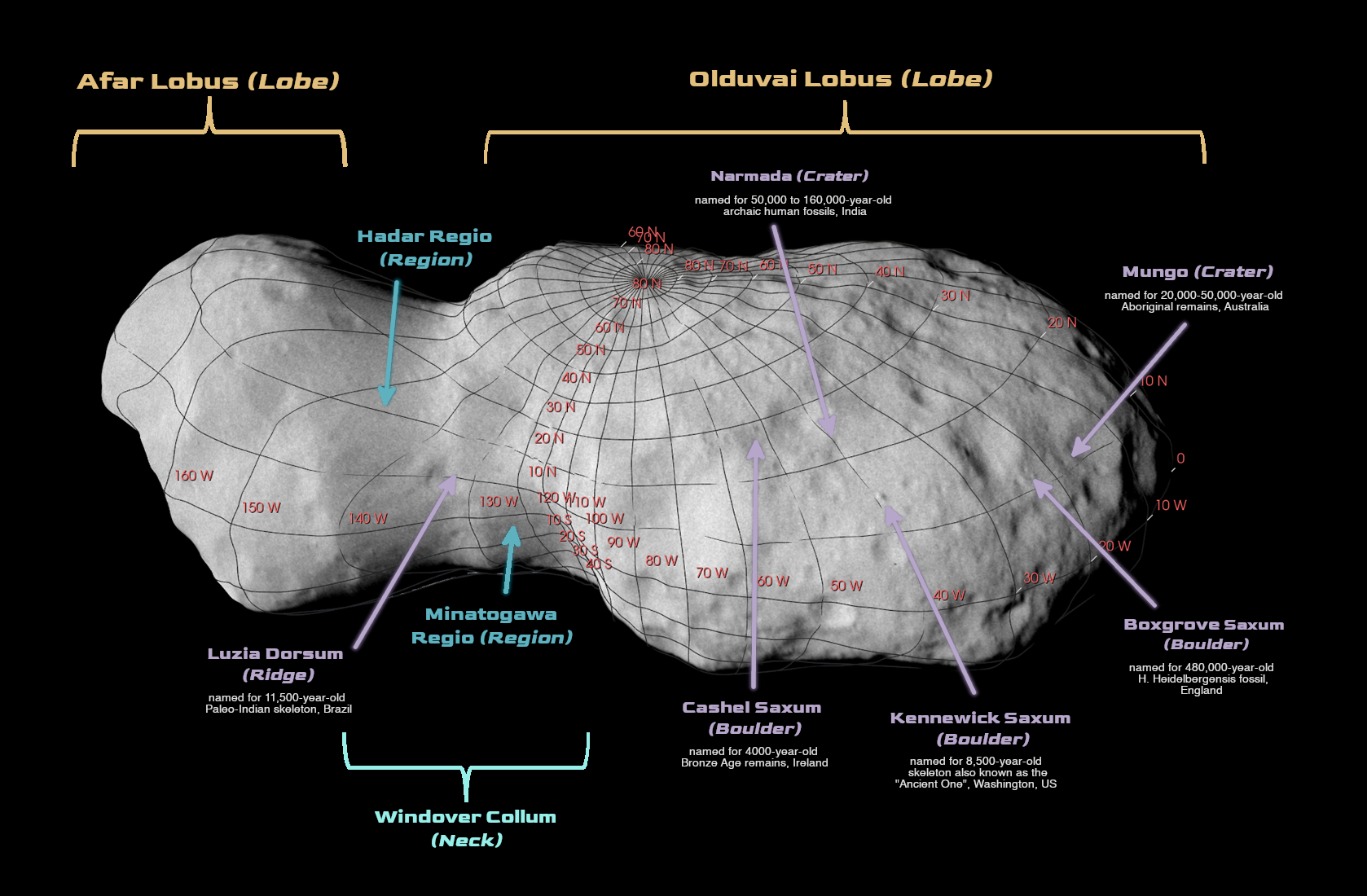
The smaller lobe is called Afar Lobus, after the Ethiopian region where Lucy and other hominin fossils were found. The larger lobe is named Olduvai Lobus, after the Tanzanian river gorge that has also yielded many important hominin discoveries.

The asteroid’s neck, Windover Collum, which joins those two lobes, is named after the Windover Archeological Site near Cape Canaveral Space Force Station in Florida — where NASA’s Lucy mission launched in 2021. Human remains and artifacts recovered from that site revolutionized our understanding of the people who lived in Florida around 7,300 years ago.

The asteroid Donaldjohanson with latitude and longitude lines and arrows indicating the names of various features on the surface.
Officially recognized names of geologic features on the asteroid Donaldjohanson.
NASA Goddard/SwRI/Johns Hopkins APL

Two smooth areas on the asteroid’s neck are named Hadar Regio, marking the specific site of Johanson’s discovery of the Lucy fossil, and Minatogawa Regio, after the location where the oldest known hominins in Japan were found. Select boulders and craters on Donaldjohanson are named after notable fossils ranging from pre-Homo sapiens hominins to ancient modern humans. The IAU also approved a coordinate system for mapping features on this uniquely shaped small world.

As of Sept. 9, the Lucy spacecraft was nearly 300 million miles (480 million km) from the Sun en route to its August 2027 encounter with its first Trojan asteroid called Eurybates. This places Lucy about three quarters of the way through the main asteroid belt. Since its encounter with Donaldjohanson, Lucy has been cruising without passing close to any other asteroids, and without requiring any trajectory correction maneuvers.

The team continues to carefully monitor the instruments and spacecraft as it travels farther from the Sun into a cooler environment.

Stay tuned at nasa.gov/lucy for more updates as Lucy continues its journey toward the never-before-explored Jupiter Trojan asteroids, and download a postcard commemorating the Donaldjohanson encounter.

By Katherine Kretke
Southwest Research Institute

Media Contact:

Lonnie Shekhtman

lonnie.shekhtman@nasa.gov

NASA’s Goddard Space Flight Center, Greenbelt, Md.

❌