Reading view

There are new articles available, click to refresh the page.

NASA Rover Detects Electric Sparks in Mars Dust Devils, Storms

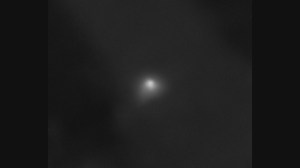
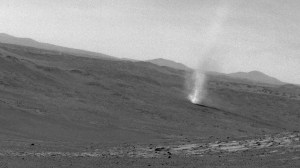
Three Martian dust devils can be seen near the rim of Jezero Crater in this short video made of images taken by a navigation camera aboard NASA’s Perseverance rover on Sept. 6, 2025. The microphone on the rover’s SuperCam previously captured audio when a dust devil passed over.
NASA/JPL-Caltech/SSI

Perseverance confirmed a long-suspected phenomenon in which electrical discharges and their associated shock waves can be born within Red Planet mini-twisters.

NASA’s Perseverance Mars rover has recorded the sounds of electrical discharges —sparks — and mini-sonic booms in dust devils on Mars. Long theorized, the phenomenon has now been confirmed through audio and electromagnetic recordings captured by the rover’s SuperCam microphone. The discovery, published Nov. 26 in the journal Nature, has implications for Martian atmospheric chemistry, climate, and habitability, and could help inform the design of future robotic and human missions to Mars.

A frequent occurrence on the Red Planet, dust devils form from rising and rotating columns of warm air. Air near the planet’s surface becomes heated by contact with the warmer ground and rises through the denser, cooler air above. As other air moves along the surface to take the place of the rising warmer air, it begins to rotate. When the incoming air rises into the column, it picks up speed like spinning ice skaters bringing their arms closer to their body. The air rushing in also picks up dust, and a dust devil is born.

SuperCam has recorded 55 distinct electrical events over the course of the mission, beginning on the mission’s 215thMartian day, or sol, in 2021. Sixteen have been recorded when dust devils passed directly over the rover.

Decades before Perseverance landed, scientists theorized that the friction generated by tiny dust grains swirling and rubbing against each other in Martian dust devils could generate enough of an electrical charge to eventually produce electrical arcs. Called the triboelectric effect, it’s the phenomenon at play when someone walks over a carpet in socks and then touches a metal doorknob, generating a spark. In fact, that is about the same level of discharge as what a Martian dust devil might produce.

“Triboelectric charging of sand and snow particles is well documented on Earth, particularly in desert regions, but it rarely results in actual electrical discharges,” said Baptiste Chide, a member of the Perseverance science team and a planetary scientist at L’Institut de Recherche en Astrophysique et Planétologie in France. “On Mars, the thin atmosphere makes the phenomenon far more likely, as the amount of charge required to generate sparks is much lower than what is required in Earth’s near-surface atmosphere.”

Perseverance’s SuperCam instrument carries a microphone to analyze the sounds of the instrument’s laser when it zaps rocks, but the team has also captured the sounds of wind and even the first audio recording of a Martian dust devil. Scientists knew it could pick up electromagnetic disturbance (static) and sounds of electrical discharges in the atmosphere. What they didn’t know was if such events happened frequently enough, or if the rover would ever be close enough, to record one. Then they began to assess data amassed over the mission, and it didn’t take long to find the telltale sounds of electrical activity.

The SuperCam microphone on NASA’s Perseverance captured this recording of the sounds of electrical discharge as a dust devil passed over the Mars rover on Oct. 12, 2024. The three crackles can be heard in between the sounds of the dust devil’s front and trailing walls.
Credit: NASA/JPL-Caltech/LANL/CNES/CNRS/ISAE-Supaero

Crackle, pop

“We got some good ones where you can clearly hear the ‘snap’ sound of the spark,” said coauthor Ralph Lorenz, a Perseverance scientist at the Johns Hopkins Applied Physics Lab in Laurel, Maryland. “In the Sol 215 dust devil recording, you can hear not only the electrical sound, but also the wall of the dust devil moving over the rover. And in the Sol 1,296 dust devil, you hear all that plus some of the particles impacting the microphone.”

Thirty-five other discharges were associated with the passage of convective fronts during regional dust storms. These fronts feature intense turbulence that favor triboelectric charging and charge separation, which occurs when two objects touch, transfer electrons, and separate — the part of the triboelectric effect that results in a spark of static electricity.

Researchers found electrical discharges did not seem to increase during the seasons when dust storms, which globally increase the presence of atmospheric dust, are more common on Mars. This result suggests that electrical buildup is more closely tied to the localized, turbulent lifting of sand and dust rather than high dust density alone.

While exploring the rim of Jezero Crater on Mars, NASA’s Perseverance rover captured new images of multiple dust devils in January 2025. These captivating phenomena have been documented for decades by the agency’s Red Planet robotic explorers.
Credit: NASA/JPL-Caltech/LANL/CNES/CNRS/INTA-CSIC/Space Science Institute/ISAE-Supaero/University of Arizona

Profound effects

The proof of these electrical discharges is a discovery that dramatically changes our understanding of Mars. Their presence means that the Martian atmosphere can become sufficiently charged to activate chemical reactions, leading to the creation of highly oxidizing compounds, such as chlorates and perchlorates. These strong substances can effectively destroy organic molecules (which constitute some of the components of life) on the surface and break down many atmospheric compounds, completely altering the overall chemical balance of the Martian atmosphere.

This discovery could also explain the puzzling ability of Martian methane to vanish rapidly, offering a crucial piece of the puzzle for understanding the constraints life may have faced and, therefore, the planet’s potential to be habitable.

Given the omnipresence of dust on Mars, the presence of electrical charges generated by particles rubbing together would seem likely to influence dust transport on Mars as well. How dust travels on Mars plays a central role in the planet’s climate but remains poorly understood.

Confirming the presence of electrostatic discharges will also help NASA understand potential risks to the electronic equipment of current robotic missions. That no adverse electrostatic discharge effects have been reported in several decades of Mars surface operations may attest to careful spacecraft grounding practices. The findings could also inform safety measures developed for future astronauts exploring the Red Planet.

More about Perseverance

Managed for NASA by Caltech, the Jet Propulsion Laboratory in Southern California built and manages operations of the Perseverance rover on behalf of the agency’s Science Mission Directorate as part of NASA’s Mars Exploration Program portfolio.

To learn more about Perseverance visit:
https://science.nasa.gov/mission/mars-2020-perseverance

News Media Contacts

DC Agle
Jet Propulsion Laboratory, Pasadena, Calif.
818-393-9011
agle@jpl.nasa.gov

Karen Fox / Molly Wasser
NASA Headquarters, Washington
202-358-1600 / 240-419-1732
karen.c.fox@nasa.gov / molly.l.wasser@nasa.gov

2025-132

Share

Details

Last Updated
Dec 03, 2025

NASA Tests Drones in Death Valley, Preps for Martian Sands and Skies

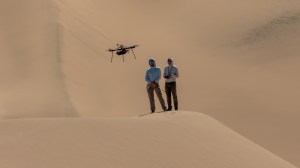
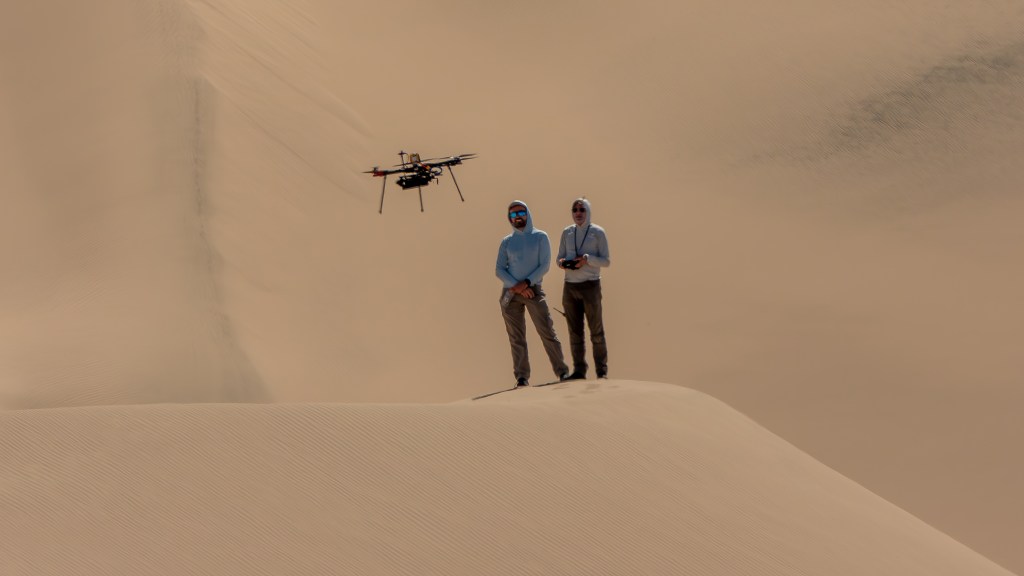
Two people stand side by side on a sandy hill, or dune. The person on the left is standing in a blue top, while the person on the right in a gray top is holding a controller. Above and to the left of their heads is a rotorcraft flying above the dune. The background of this image is more sandy dunes.
Researchers from NASA’s Jet Propulsion Laboratory in Southern California monitor a research drone in the Dumont Dunes area of the Mojave Desert in September as part of a test campaign to develop navigation software to guide future rotorcraft on Mars.
NASA/JPL-Caltech
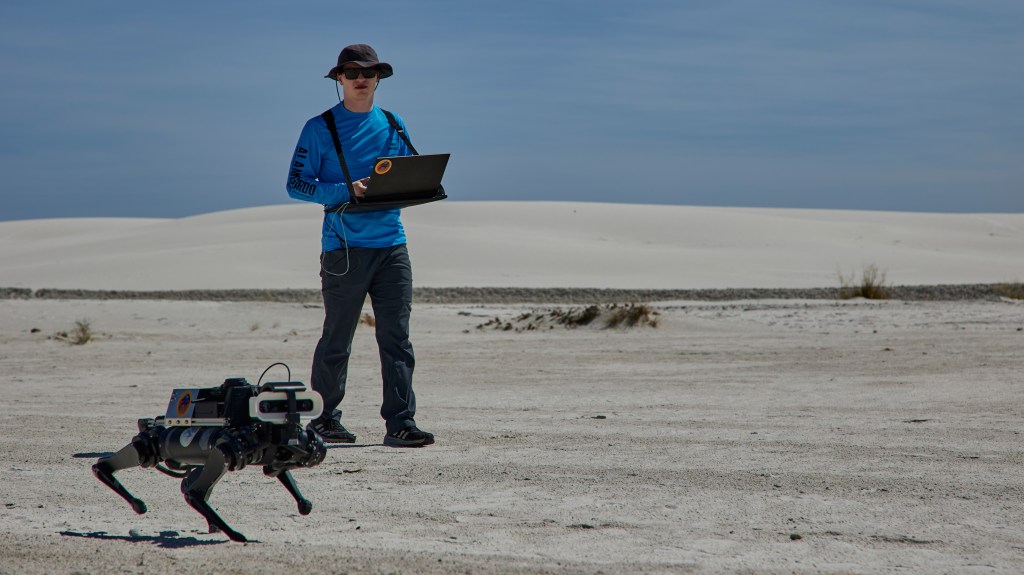
One person in a blue shirt and a bucket hat walks on a flat, white sandy ground and there is a blue sky behind them. They are holding a laptop on a harness around their neck while in the foreground, a small, dog-like robot walks.
A researcher monitors LASSIE-M (Legged Autonomous Surface Science In Analogue Environments for Mars), a robot being developed by NASA’s Johnson Space Center and other institutions, during testing this year at New Mexico’s White Sands National Park.
Justin Durner
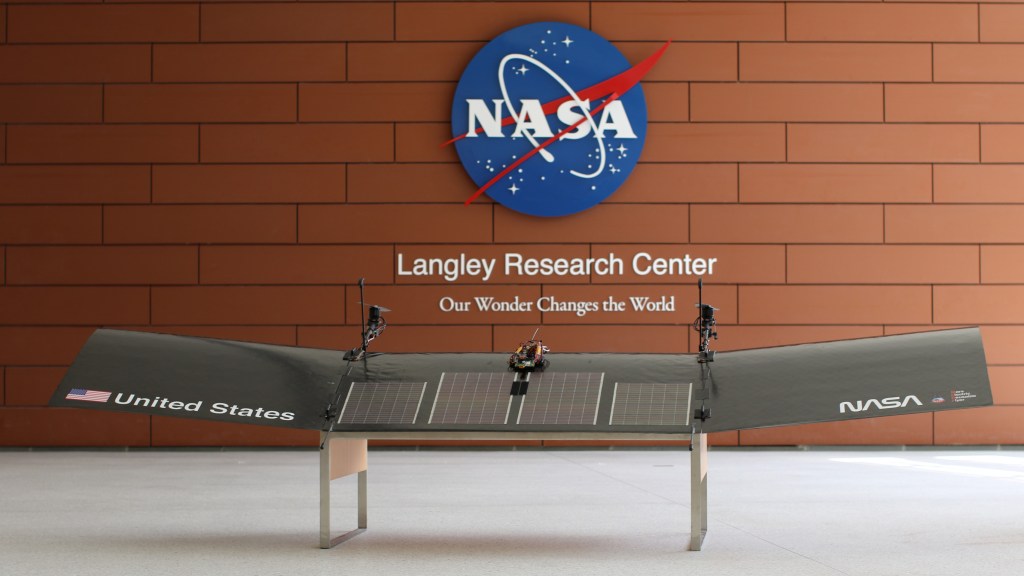
A NASA meatball is placed with "Langley Research Center: Our Wonder Changes the World" below it on a brick wall. In front of the wall is a silver scale model of MERF (Mars Electric Reusable Flyer).
This half-scale model of MERF (Mars Electric Reusable Flyer), a gliding robot being developed by NASA’s Langley Research Center, was flown this year to test new technologies for Mars exploration.
NASA

Next-generation drone flight software is just one of 25 technologies for the Red Planet that the space agency funded for development this year.

When NASA engineers want to test a concept for exploring the Red Planet, they have to find ways to create Mars-like conditions here on Earth. Then they test, tinker, and repeat. 

That’s why a team from NASA’s Jet Propulsion Laboratory in Southern California took three research drones to California’s Death Valley National Park and the Mojave Desert earlier this year. They needed barren, featureless desert dunes to hone navigation software. Called Extended Robust Aerial Autonomy, the work is just one of 25 projects funded by the agency’s Mars Exploration Program this past year to push the limits of future technologies. Similar dunes on Mars confused the navigation algorithm of NASA’s Ingenuity Mars Helicopter during several of its last flights, including its 72nd and final flight on the Red Planet.

“Ingenuity was designed to fly over well-textured terrain, estimating its motion by looking at visual features on the ground. But eventually it had to cross over blander areas where this became hard,” said Roland Brockers, a JPL researcher and drone pilot. “We want future vehicles to be more versatile and not have to worry about flying over challenging areas like these sand dunes.”

Whether it’s new navigation software, slope-scaling robotic scouts, or long-distance gliders, the technology being developed by the Mars Exploration Program envisions a future where robots can explore all on their own — or even help astronauts do their work.

Desert drones

NASA scientists and engineers have been going to Death Valley National Park since the 1970s, when the agency was preparing for the first Mars landings with the twin Viking spacecraft. Rubbly volcanic boulders on barren slopes earned one area the name Mars Hill, where much of this research has taken place. Almost half a century later, JPL engineers tested the Perseverance rover’s precision landing system by flying a component of it in a piloted helicopter over the park. 

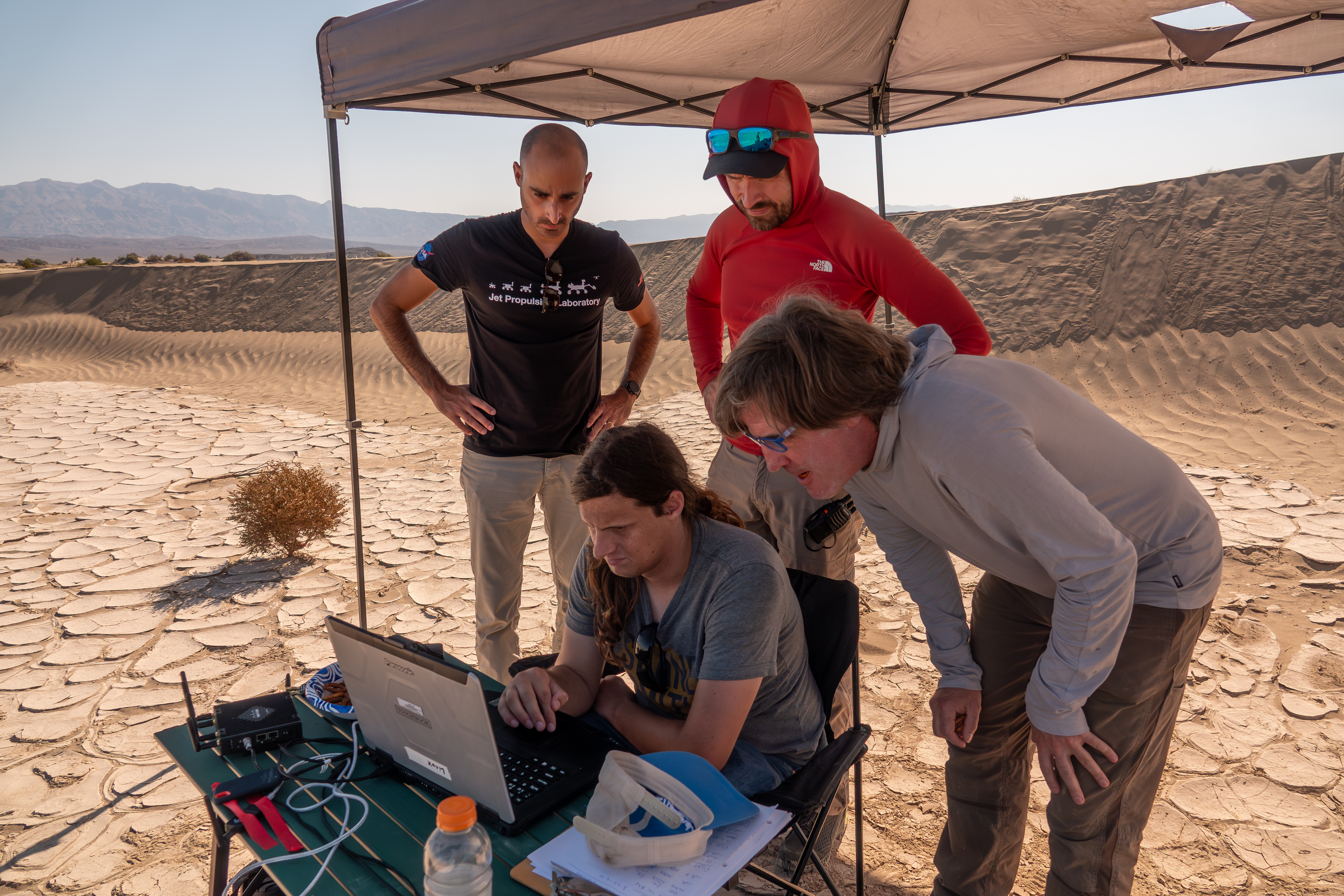
For the drone testing, engineers traveled to the park’s Mars Hill and Mesquite Flats Sand Dunes in late April and early September. The JPL team received only the third-ever license to fly research drones in Death Valley. Temperatures reached as high as 113 degrees Fahrenheit (45 degrees Celsius); gathered beneath a pop-up canopy, team members tracked the progress of their drones on a laptop. 

Four people gather around a laptop on a table underneath a tent in the middle of the desert.
JPL researchers gather under a pop-up tent in Death Valley National Park while monitoring the performance of a research drone equipped with navigation software for Mars.
NASA/JPL-Caltech

The test campaign has already resulted in useful findings, including how different camera filters help the drones track the ground and how new algorithms can guide them to safely land in cluttered terrain like Mars Hill’s. 

“It’s incredibly exciting to see scientists using Death Valley as a proving ground for space exploration,” said Death Valley National Park Superintendent Mike Reynolds. “It’s a powerful reminder that the park is protected not just for its scenic beauty or recreational opportunities, but as a living laboratory that actively helps us understand desert environments and worlds beyond our own.”

For additional testing during the three-day excursion, the team ventured to the Mojave Desert’s Dumont Dunes. The site of mobility system tests for NASA’s Curiosity rover in 2012, the rippled dunes there offered a variation of the featureless terrain used to test the flight software in Death Valley.

“Field tests give you a much more comprehensive perspective than solely looking at computer models and limited satellite images,” said JPL’s Nathan Williams, a geologist on the team who previously helped operate Ingenuity. “Scientifically interesting features aren’t always located in the most benign places, so we want to be prepared to explore even more challenging terrains than Ingenuity did.”

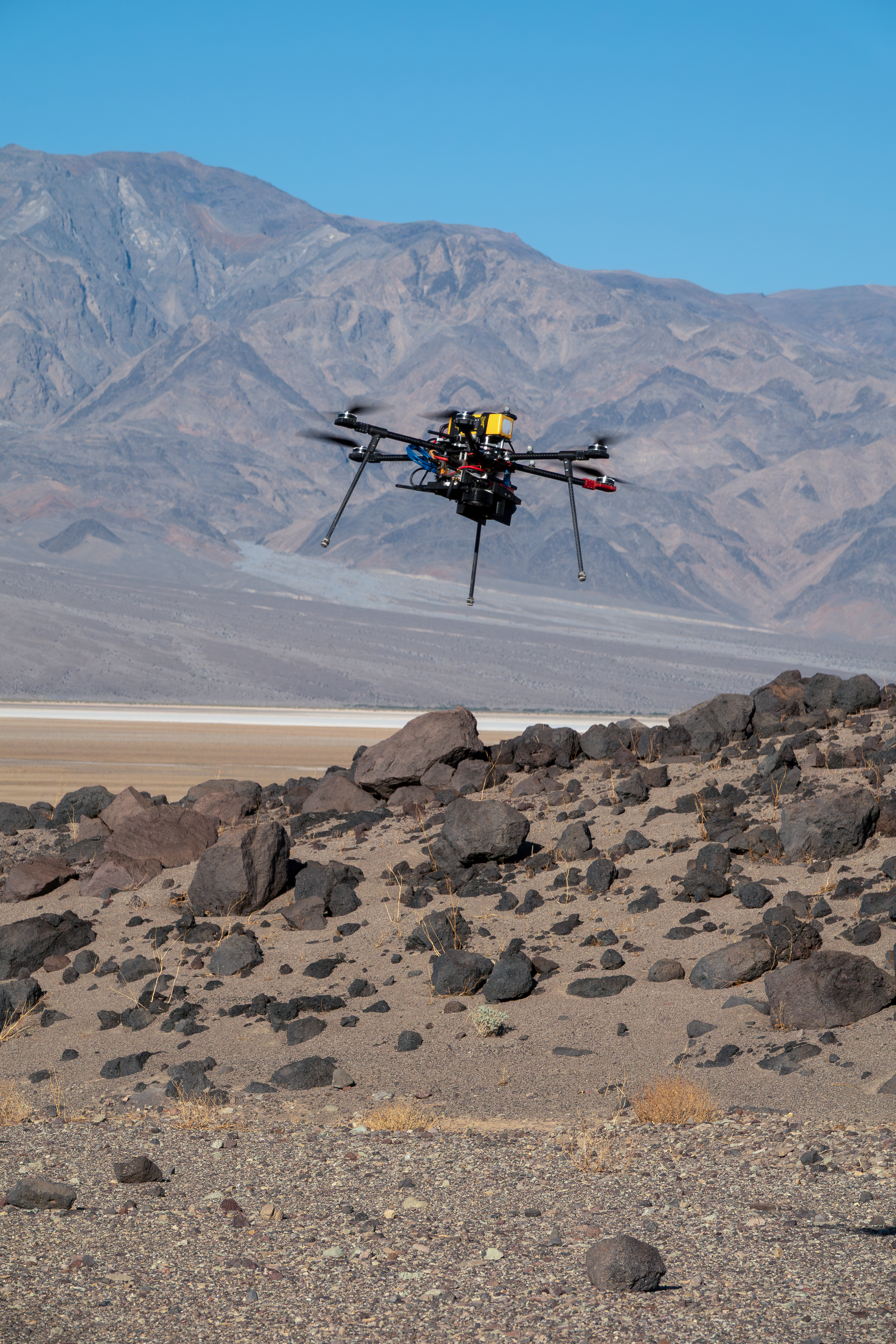
A drone flies over a rocky desert surface with a mountain and blue sky in the background.
One of three JPL drones used in recent tests flies over Mars Hill, a region of Death Valley National Park that has been visited by NASA Mars researchers since the 1970s, when the agency was preparing to land the twin Viking spacecraft on the Red Planet.
NASA/JPL-Caltech

Robot dogs

The California desert isn’t the only field site where Mars technology has been tested this year. In August, researchers from NASA’s Johnson Space Center in Houston ventured to New Mexico’s White Sands National Park, another desert location that has hosted NASA testing for decades. 

They were there with a doglike robot called LASSIE-M (Legged Autonomous Surface Science In Analogue Environments for Mars). Motors in the robot’s legs measure physical properties of the surface that, when combined with other data, lets LASSIE-M shift gait as it encounters terrain that is softer, looser, or crustier — variations often indicative of scientifically interesting changes. 

The team’s goal is to develop a robot that can scale rocky or sandy terrain — both of which can be hazardous to a rover — as it scouts ahead of humans and robots alike, using instruments to seek out new science.

Wings for Mars 

Another Mars Exploration Program concept funded this past year is an autonomous robot that trades the compactness of the Ingenuity helicopter for the range that comes with wings. NASA’s Langley Research Center in Hampton, Virginia, has been developing the Mars Electric Reusable Flyer (MERF), which looks like a single wing with twin propellers that allow it to lift off vertically and hover in the air. (A fuselage and tail would be too heavy for this design.) While the flyer skims the sky at high speeds, instruments on its belly can map the surface.

At its full size, the MERF unfolds to be about as long as a small school bus. Langley engineers have been testing a half-scale prototype, sending it soaring across a field on the Virgina campus to study the design’s aerodynamics and the robot’s lightweight materials, which are critical to flying in Mars’ thin atmosphere.

With other projects focused on new forms of power generation, drills and sampling equipment, and cutting-edge autonomous software, there are many new ways for NASA to explore Mars in the future.

News Media Contacts

Andrew Good
Jet Propulsion Laboratory, Pasadena, Calif.
818-393-2433
andrew.c.good@jpl.nasa.gov


Alise Fisher / Alana Johnson
NASA Headquarters, Washington
202-617-4977 / 202-672-4780
alise.m.fisher@nasa.gov / alana.r.johnson@nasa.gov

2025-131

Share

Details

Last Updated
Dec 02, 2025
❌