A three-judge panel ruled Friday that President Donald Trump’s firings without cause of Cathy Harris and Gwynne Wilcox, Democratic members on the Merit Systems Protection Board and the National Labor Relations Board, were lawful.
The split 2-to-1 panel decision of the D.C. Circuit Court of Appeals has no immediate effect, since both Harris and Wilcox’s firings were finalized in May. But Friday’s ruling comes as the Supreme Court is expected to soon hear arguments on whether to overturn a 90-year-old ruling known as Humphrey’s Executor — a decision that could expand Trump’s power to shape independent agencies.
In the 1935 Supreme Court ruling on Humprey’s Executor, the justices unanimously found that commissioners can be removed only for misconduct or neglect of duty, effectively limiting when presidents can fire board members.
But when Judges Gregory Katsas and Justin Walker ruled Friday in favor of Trump’s firings of Harris and Wilcox, they argued that MSPB and NLRB fall outside the limitations stemming from Humphrey’s Executor, and that the president can still “remove principal officers who wield substantial executive power.”
“The NLRB and MSPB wield substantial powers that are both executive in nature and different from the powers that Humphrey’s Executor deemed to be merely quasi-legislative or quasi-judicial,” the judges wrote. “So, Congress cannot restrict the President’s ability to remove NLRB or MSPB members.”
Judge Florence Pan, the dissenting panel member and a Biden appointee, argued that the two agencies do fall under the scope of Humphrey’s Executor, and that maintaining the independence of MSPB and NLRB is critical. She wrote that the Trump administration’s “extreme view of executive power sharply departs from precedent.”
“We may soon be living in a world in which every hiring decision and action by any government agency will be influenced by politics, with little regard for subject-matter expertise, the public good, and merit-based decision-making,” she wrote.
The MSPB is an independent agency responsible for adjudicating appeals from federal employees who allege prohibited personnel practices by their agencies. The NLRB investigates unfair labor practices in the private sector and oversees union elections. Both boards are typically composed of members of both political parties.
Trump fired both Wilcox and Harris within his first few weeks in office, but did not point to a specific reason for the terminations. Wilcox and Harris, both of whom were Democratic board members, sued the president over their removals, arguing that they are protected by a federal law meant to ensure MSPB and NLRB’s independence from political considerations — and that the president can only remove them “for inefficiency, neglect of duty, or malfeasance in office.”
Though a federal judge initially ruled the two terminations were unlawful, the Supreme Court reversed that decision in May, effectively green-lighting the finalization of the board members’ firings earlier this year.
In its May decision, the Supreme Court indicated that it was likely “that both the NLRB and MSPB exercise considerable executive power,” which it said would make restrictions on the president’s ability to fire them unconstitutional. Friday’s panel ruling aligns with the Supreme Court’s initial arguments.
The Supreme Court is expected to hear arguments Monday on Trump’s firing of Rebecca Slaughter, a Democratic member of the Federal Trade Commission — a case that may further influence the outcome of both Harris and Wilcox’s terminations.
Mahri Stainnak got the call the day after President Donald Trump took office: the Office of Personnel Management’s human resources office was putting them on administrative leave “effective immediately,” while the agency “investigates your radical and wasteful DEI activity.”
Stainnak was surprised by the news. Before the Trump administration, they served as OPM’s deputy director of the governmentwide Office of Diversity, Equity, Inclusion and Accessibility. But now they worked as the director of OPM’s talent innovation group, a human resources job focused on recruiting and retaining talent across the federal government.
“I said, ‘Wait a minute, I’m not in diversity, equity and inclusion.’ I started a new role in a job that has nothing to do with diversity, equity and inclusion.’ So I felt incredibly shocked and confused,” Stainnak said.
The second call came 48 hours later: Stainnak, a nonbinary person who had worked in the federal government for more than 16 years, received a reduction in force notice, as part of the Trump administration’s plan to root out DEI programs across the federal government.
Stainnak is now part of a class-action lawsuit filed this week in the D.C. District Court for the District of Columbia.
The lawsuit, led by the American Civil Liberties Union of D.C., claims the Trump administration unlawfully targeted and fired federal employees perceived to be associated with DEI work — even if their current jobs had nothing to do with it.
Mary Kuntz, an attorney at the law firm Kalijarvi, Chuzi, Newman & Fitch, P.C. who is representing the former employees, said the administration’s actions “clearly” violate the Civil Service Reform Act, because employees like Stainnak were fired for previous work in DEI positions.
“You can’t RIF somebody from a position they’re not in,” Kuntz said. “They sought to punish Mahri [Stainnak] for previous DEI work. That’s a violation of the First Amendment.”
Kuntz said the lawsuit claims that the administration’s push to “eviscerate” DEI programs also had a disproportionate impact on people of color, women, non-binary individuals, and violates Title VII of the 1964 Civil Rights Act.
“The DEI folks were working on behalf of people with disabilities, people who are non-native speakers of English. They were advocating for protected groups,” she said.
On the campaign trail last year, President Donald Trump pledged to “eliminate all diversity, equity, and inclusion programs across the entire federal government,” and characterized these programs as promoting “un-American” ideology.
On his first days in office, Trump signed executiveorders that directed agencies to create lists of employees associated with DEI going back to Nov. 5, 2024 — the date of the presidential election. The complaint says agencies were directed to remove those employees, “regardless of their current roles or duties.”
“President Trump’s directives did not merely represent a change in presidential priorities — a normal occurrence when presidential administrations change. Rather, they were targeted actions intended to punish perceived political enemies, as well as to eliminate from the federal workforce women, people of color, and those, like plaintiffs, who advocated for or were perceived as advocating for protected racial or gender groups,” the complaint states.
The complaint says agencies set competitive levels for the RIFs so narrowly that federal employees were unable to compete for retention, and that those impacted by RIFs were not considered for reassignment to other jobs.
“I absolutely feel targeted on the basis of what the Trump administration believes my beliefs are, because I was not working in a diversity, equity and inclusion role in any way at the time when the new administration came in, or at the time I was placed on administrative leave,” Stainnak said.
For all the Trump administration’s actions to strip DEI out of the federal workforce, Kuntz said the president’s executive orders don’t go into any detail to define DEI.
“He characterizes them as illegal and discriminatory and various other things … but does doesn’t define them,” Kuntz said. “You can’t decide that somebody is a different party than the party in the White House and decide to fire them on that basis.”
The lawsuit states that the total number of federal employees impacted by the DEI rollback fis unknown, but says news reports suggest it could be “potentially in the thousands.”
The complaint states that at least 40 women or non-binary individuals, and more than 40 people of color received layoffs in connection with the Trump administration’s directives.
Stainnak and their colleagues filed an appeal to the Merit Systems Protection Board in March, but Kuntz said that appeal and similar cases brought before the Office of Special Counsel and agencies’ Equal Employment Opportunity (EEO) offices, have stalled.
In their last role, Stainnak helped agencies recruit top talent into the federal workforce. But they said the Trump administration’s purge of DEI workers has pushed out individuals who worked on bipartisan projects.
Former federal employees leading the lawsuit include a former operations manager at the Department of Veterans Affairs who “helped ensure that veterans were not inhibited from accessing earned benefits due to cultural or socioeconomic barriers,” a Department of Homeland Security Employee who led language competency efforts at the border to advance intelligence gathering and the safety of Immigration and Customs Enforcement officers.
“By illegally targeting people based on the Trump administration’s assumptions about our political beliefs, or by targeting us based on who we are, this administration actually is hurting the people who work and live in this country, because now these dedicated, hardworking federal servants are not in their jobs providing the critical services that they do, whether it’s responding to emergencies like hurricanes and making sure folks have drinking water and shelter, or making sure our transportation systems are safe and timely. This action is really hurting the people who live in this country,” Stainnak said.
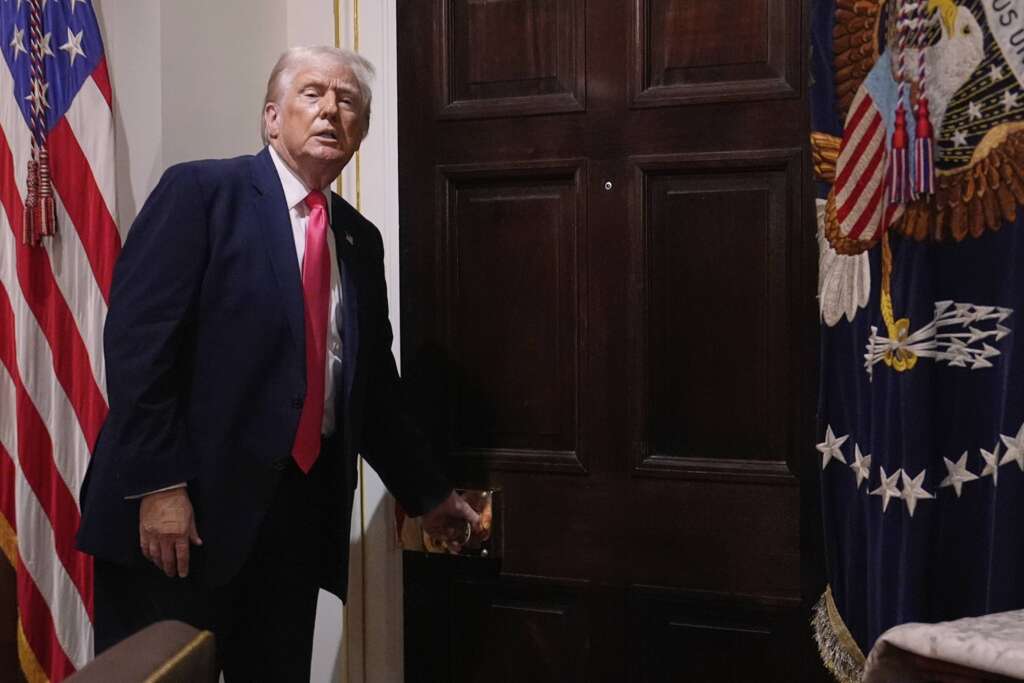
President Donald Trump walks out of the Cabinet Room following a Cabinet meeting at the White House, Tuesday, Dec. 2, 2025, in Washington. (AP Photo/Julia Demaree Nikhinson)
The Department of Health and Human Services is setting new restrictions on telework as a reasonable accommodation for employees with disabilities.
A new, departmentwide reasonable accommodation policy shared with employees this week states that all requests for telework, remote work, or reassignment must be reviewed and approved by an assistant secretary or a higher-level official — a decision that is likely to slow the approval process.
The new policy, as Federal News Network reported on Monday, generally restricts employees from using telework as an “interim accommodation,” while the agency processes their reasonable accommodation request.
“Telework is not appropriate for an interim accommodation, unless approved at the assistant secretary level or above,” the new policy states.
The updated reasonable accommodation policy, signed on Sept. 15 by HHS Chief Human Capital Officer and Deputy Assistant Secretary Thomas Nagy, Jr., replaces a more than decade-old policy, and applies to all HHS component agencies.
“This policy is effective immediately and must be followed by HHS component in accordance with applicable laws, regulations, and departmental policy,” the policy states.
It’s not clear how long it will take HHS to review each individual reasonable accommodation request. But HHS, which now handles all reasonable accommodation requests from its component agencies, faces a backlog of more than 3,000 cases — which it expects will take six to eight months to complete.
The new policy allows frontline supervisors to grant “simple, obvious requests” without consulting with an HHS reasonable accommodation coordinator, but prohibits them from granting telework or remote work.
“Telework and reassignment are not simple, obvious requests,” the policy states.
The policy also directs HHS to collect data on the “number of requests that involve telework or remote work, in whole or in part.”
A memo from the Centers for Disease Control and Prevention states that “all telework related to RAs will be repealed,” and that CDC leadership will no longer be allowed to approve telework as an interim accommodation.
“Staff currently on an agreement will need to report back to the worksite,” the memo states.
The CDC memo states employees can still request telework as a reasonable accommodation, but “until they are reviewed and approved by HHS they must report to the worksite.”
It also states that employees can request what was previously known as “medical telework,” which can be approved by the CDC chief operating officer for around six months in length.
According to the memo, CDC can temporarily grant medical telework to employees who are dealing with recovering from chemotherapy, hip replacement surgery or pregnancy complications.
If HHS rejects a reasonable accommodation, the CDC memo states an employee can challenge the decision before an appeal board. The CDC, however, expects that appeal will “also take months to process,” and that employees must continue to work from the office while the appeal is pending.
“We know this is going to be tough, especially on front-line supervisors,” the CDC memo states.
HHS Press Secretary Emily Hilliard said in a statement that the new reasonable accommodation policy “establishes department-wide procedures to ensure consistency with federal law.”
“Interim accommodations may be provided while cases move through the reasonable-accommodation process toward a final determination. The department remains committed to processing these requests as quickly as possible,” Hilliard said.
Jodi Hershey, a former FEMA reasonable accommodation specialist and the founder of EASE, LLC, a firm that helps employers and employees navigate workplace accessibility issues, said the new policy suggests HHS is “playing fast and loose with the Rehabilitation Act, and what’s required of them” under the legislation.
“This is the most inefficient way to handle reasonable accommodations possible. By centralizing reasonable accommodation-deciding officials, you’re removing the decision from the person who knows the most about the job. The immediate supervisor or manager knows what the job is, how the job is normally performed. They know the employee. When you remove that level of familiarity from the process, and you move it up the chain … that person has no idea what the job even is. They don’t know the person that they’re dealing with. They don’t know the office. They don’t know the particulars at all,” Hershey said.
In a message obtained by Federal News Network, Cheryl Prigodich, principal deputy director for the CDC’s Office of Safety, Security and Asset Management, told an HHS employee that because their one-year reasonable accommodation had expired, they needed to submit a new request for approval.
“The timeframe for approval on your request is not known at this time. In the interim, however, we are not allowed to approve telework as an interim accommodation for a reasonable accommodation,” Prigodich said.
Prigodich told the employee that, according to HHS, employees must either use annual leave, 80 hours of annual ad hoc telework available to each HHS employee, take leave under the Family and Medical Leave Act or report to the workplace “with the possibility of another acceptable accommodation (work tour, physical modifications to the workplace, etc).”
Prigodich directed the employee to submit their request to renew their reasonable accommodation request to the HHS assistant secretary for administration, but recommended that they “efficiently summarize your concern and request (with appropriate documentation) into no greater than a single-page memo.”
“The ASA will not want to comb through previous emails or too many attachments,” Prigodich said.
The one-page request, she added, should include “why no other alternative accommodation will work,” documentation of the disability, and records showing the previously approved reasonable accommodation.
“I know this is frustrating. We are certainly frustrated too — and this represents a significant policy change for a great number of people who rely on this type of accommodation for their personal health and needs,” Prigodich said.
The Office of Personnel Management is trying to address what it says are concerns from some managers and supervisors who worry they may be held personally liable for disciplining federal employees deemed poor performers.
In response to those concerns, a Nov. 21 memo from OPM clarified that managers and supervisors are generally acting on behalf of an agency when they “manage employees’ job performance and address unacceptable performance.” There is an “extremely limited scope” where managers or supervisors would be held individually responsible for those actions, OPM said.
When a manager puts an employee on a performance improvement plan, demotes an employee or removes an employee from their job for poor performance, that’s technically considered the action of the agency, OPM said, and not the individual manager’s responsibility. If an employee challenges one of those actions, OPM said that the agency, not the manager, would be responsible for responding.
“In the unusual event that a manager or supervisor is sued personally for actions within the scope of their employment, the Department of Justice (DOJ) typically provides representation,” the memo reads.
But if a supervisor or manager misuses their authority — for example through discrimination, harassment or whistleblower-related prohibited personnel practices — OPM said the individual can then be held personally accountable for their actions.
In its memo, OPM also reminded supervisors and managers of the availability of professional liability insurance, which may help protect them in the rare cases where they may be held liable. Supervisors and managers are usually eligible for a government reimbursement amounting to up to half the cost of the insurance.
“But even in these situations Congress did not give employees the right to hold their managers or supervisors personally liable for any performance or conduct-related adverse action,” OPM said.
OPM’s clarification comes after the Trump administration earlier this year set new expectations for measuring federal employees’ job performance. In June, OPM told agencies they don’t have to use “progressive discipline” and that they should not substitute a suspension when a full removal of an employee from their job “would be appropriate.”
The administration’s new performance management standards also attempt to more strictly delineate between different levels of employee performance and encourage agencies to rate fewer employees as high performers.
OPM Director Scott Kupor has repeatedly argued that the government has inflated performance ratings, and has targeted the rating system as a key area for OPM to update.
“In the real world we are not all equally successful and differences in performance from one person to the next are in fact real,” Kupor wrote in a Sept. 15 blog post. “We simply can’t all get A’s because not everyone’s contributions to the success of the organization are the same. Some people simply perform better than others — whether by luck or skill.”
More recently, OPM also announced a new mandatory training program for all federal supervisors, intended to educate supervisors on how to better manage performance of federal employees. The one-hour online course will cover topics including recognition, awards, hiring, firing and discipline of federal employees, according to a memo OPM sent to agencies Wednesday.
“At the end of the training, supervisors will be ready to set clear expectations, deliver quality feedback, document fairly, reward excellence, and take timely action when needed—all while building an engaged, high-performing team through transparency, accountability, and collaboration,” the memo stated.
Federal supervisors are required to complete the training by Feb. 9, 2026, OPM said.
The required supervisor training comes shortly after OPM also launched two optional training programs, designed to educate senior executives in the federal workforce, while incorporating common themes from the Trump administration on “accountability,” performance management and adherence to the president’s priorities.
Human resources, corporate hierarchy concept and multilevel marketing - recruiter complete team represented by wooden cube by one leader person (CEO) and icon.
A federal judge in San Francisco is temporarily blocking the State Department from finalizing hundreds of employee layoffs.
Judge Susan Illston approved a temporary restraining order on Thursday, preventing the department from officially terminating more than 200 employees, most of them Foreign Service officers.
Separately, federal employee unions are asking the U.S. District Court for the Northern District of California to reverse more layoffs than agencies have allowed under a spending deal that ended the recent government shutdown.
The American Federation of Government Employees and the American Foreign Service Association filed the emergency request for a temporary restraining order to bar the “imminent and unlawful execution” of reduction in force notices the State Department sent this summer.
“The severe threats to the public presented by the imminent State Department actions necessitate a temporary pause to protect the status quo for plaintiffs and the employees they represent who are adversely impacted by these imminent separations,” the emergency request states.
The emergency request is part of an ongoing lawsuit that unions filed on the eve of the government shutdown, which blocked the Trump administration from conducting widespread layoffs during a lapse in congressional funds.
The amended lawsuit states that several agencies, including the State Department, aren’t fully adhering to a provision in the shutdown-ending spending bill that temporarily blocked the Trump administration from carrying out layoffs.
The nonprofit Democracy Forward, which is also part of the lawsuit, said the amended lawsuit seeks to reverse “other unlawful RIF actions” at the Small Business Administration and the General Services Administration, as well as the departments of Education and Defense.
“Those RIFs would violate the federal legislation that ended the federal government shutdown, which prohibits implementation of any RIFs through January 30,” the amended complaint states.
The continuing resolution Congress passed on Nov. 12 states that “any reduction in force proposed, noticed, initiated, executed, implemented, or otherwise taken by an executive agency between October 1, 2025, and the date of enactment, shall have no force or effect.”
It also states that between Nov. 12, 2025 and Jan. 30, 2026, “no federal funds may be used to initiate, carry out, implement, or otherwise notice a reduction in force to reduce the number of employees within any department.”
Agencies, however, have followed a narrower interpretation of the stopgap spending bill, and have only reinstated federal employees who received RIF notices between Oct. 1 and Nov. 12. The amended lawsuit states that interpretation of the continuing resolution “is significantly under-inclusive.”
The State Department sent RIF notices to nearly 1,350 employees in July. Most of those employees were officially separated from the agency in September.
But this Friday, Dec. 5, the department plans to officially remove nearly 250 Foreign Service employees and several civil service employees whose separation dates were postponed, because they recently gave birth or faced medical issues.
The State Department claims that the continuing resolution’s layoff protections only apply to RIF notices that went out after Oct. 1.
“Defendants are wrong,” the amended complaint states. “The plain language of the continuing resolution prohibits any actions implementing any RIFs of any employees at any agency between November 12, 2025 and January 30, 2026, and requires recission of any previously issued RIF notices (regardless of when they were issued) if the RIFs were implemented during the shutdown.”
The amended lawsuit also takes issue with how the State Department modified the official separation date for impacted employees.
Foreign Service employees were originally told they would be separated from the agency on Nov. 10, when the agency was still affected by the government shutdown. But on that date, employees received a notice from the department’s human resources offices that said they would remain on administrative leave so the agency could correct “administrative errors.”
On Monday evening, employees received a notice that said they will be officially separated from the State Department this Friday.
“The RIF notices were not reissued, and employees received nothing further from the State Department regarding the now-expired RIF notices until December 1, 2025,” the amended lawsuit states.
The State Department’s notice to employees cites “formal written guidance” from the Office of Management and Budget and the Justice Department’s Office of Legal Counsel regarding RIFs that had been issued prior to the shutdown, but further implemented during or after the shutdown. The unions leading the lawsuit say that formal written guidance hasn’t been made publicly available.
“During the shutdown, the State Department continued to implement the stages of these RIFs in preparation for final separation of the employees, including by processing personnel paperwork in advance of the planned separations,” the amended complaint states.
The unions claim that without a temporary restraining order, State Department employees and their families will suffer “irreparable harm,” including a loss of income and health insurance benefits.
“For many of these employees, the imminent loss of employment means a sustained loss of income and benefits in a job market already flooded with unemployed former State Department and USAID employees,” the amended complaint states.
AFGE National President Everett Kelley said in a statement that “Congress clearly stated that no federal employees should lose their jobs due to a reduction-in-force for the duration of the continuing resolution.”
“This means that no RIF should be issued or acted upon, and any RIF terminations that occurred during the shutdown must be reversed,” Kelley said.
AFSA President John Dinkelman said in a statement that these “unlawful separations reveal a callous indifference to the rule of law and the people who carry out America’s diplomatic mission every day.”
The Office of Personnel Management is requiring all federal supervisors to enroll in a new training program on performance management. A new memo said the mandatory training will cover how to both reward and discipline employees, as well as how to create effective performance plans. All supervisors are required to complete OPM's new training by Feb. 9, 2026.
The Missile Defense Agency has tapped more than 1,000 companies to support the Golden Dome initiative. The first round of awards under the agency’s Scalable Homeland Innovative Enterprise Layered Defense, or SHIELD, contracting vehicle went to 1,014 “qualifying offerors.” Vendors that receive task orders will draw funds from a pool worth up to $151 billion. Officials say those order competitions won’t begin until all companies in the competitive range get the chance to "engage in meaningful discussions” with the agency.
The top Democrat on the Senate Subcommittee on Aviation, Space and Innovation is pressing Transportation Secretary Sean Duffy to give a majority of the FAA workers a bonus. Sen. Tammy Duckworth (D-Ill.) said it was unfair to limit who received the $10,000 bonus when all 20,000 air traffic controllers and technicians worked during the 43-day shutdown. The FAA is giving a $10,000 award to approximately 2.4% of the air traffic controller workforce and to roughly 6% of the technician workforce. Duckworth said this creates a "perverse and dangerous incentive" that threatens to weaken national airspace system safety during future shutdowns.
Senate Democrats are ringing the alarm bells about the new deputy general counsel at the General Services Administration. Sen. Gary Peters (D-Mich.) and five other members of the Homeland Security and Governmental Affairs Committee are calling for the White House to reverse its appointment of Paul Ingrassia to be the GSA deputy general counsel. The lawmakers say Ingrassia is unqualified for the position because of his very limited legal experience and because of his lengthy and public record of offensive statements. The Trump administration withdrew Ingrassia's nomination to lead the Office of Special Counsel after statements he made became public about him having a "Nazi streak from time to time" and on other questionable topics. The Senators want a briefing from GSA and the White House Office of Presidential Personnel by Dec. 9.
The Pentagon inspector general said Defense Secretary Pete Hegseth’s use of the messaging app Signal to discuss operational details of airstrikes in Yemen created a risk of exposing U.S. tactics and endangering service members. Pentagon spokesperson Sean Parnell pushed back on the finding, and pointed to the “flawless execution and success” of Operation Rough Rider. Parnell also noted that the inspector general determined that no classified information was shared. “Case closed,” he said on social media platform X. CNN first reported the watchdog’s findings.
Former EPA employees are challenging the Trump administration, saying they were fired illegally. After being fired for signing a letter criticizing the Trump administration, six former EPA employees argue the agency’s actions violated the First Amendment. The employees were some of the 140 workers who signed the “declaration of dissent,” which resulted in around 20 employees being fired, and dozens more facing two-week suspensions. The fired feds are appealing their case to the Merit Systems Protection Board.
A recent survey shows most Americans agree agencies should make secure data-handling a top priority for the services they provide. But only 41% of those surveyed say they trust the government’s handling of their personal data. In a survey of more than 1,500 people conducted by Gartner, more than half say more transparency in how their data is used would improve their level of trust with the federal government’s online services.
The State Department’s diplomatic workforce is feeling overburdened, under-resourced and more likely to leave in the next few years. In a survey of more than 2,100 active-duty Foreign Service employees, the American Foreign Service Association found 98% of respondents reported reduced morale this year. About 86% of respondents said workplace changes since January have affected their ability to advance U.S. diplomatic priorities. Before the Trump administration, about 17,000 active-duty Foreign Service officers worked for the State Department. AFSA estimates that nearly a quarter of them left this year when counting layoffs, retirements and those who accepted deferred resignation offers.
Tens of thousands of blue-collar Defense Department workers are slated to receive their long-delayed 2024 pay raises. The raises were stalled for nearly a year after Defense Secretary Pete Hegseth’s purge of advisory committees halted the DoD Wage Committee’s ability to authorize new wage schedules.
The DoD Wage Committee met last week for the first time this year to approve publication of 2024 updates to about 1,600 wage schedules covering 250 wage areas.
These raises will match the General Schedule locality increases, and they will be applied retroactively according to when they should have taken effect last year. DoD workers could see the pay bump reflected in their next paychecks.
“It will probably be in the next paycheck, or possibly a separate check. It will depend on which payroll processor is being used,” Jacqueline Simon, American Federation of Government Employees’ director of public policy, told Federal News Network.
“There might be some other agencies, like the Bureau of Prisons, Social Security, even the Department of Veterans Affairs that might be more delayed. But I’m told the Defense Finance and Accounting Service says it will be the next paycheck,” she said.
For blue-collar federal employees under the Federal Wage System, the process of getting a pay raise is more complex than for most General Schedule employees. While the GS base pay schedule is adjusted annually each January with an across-the-board pay increase set by the president or Congress, FWS adjustments are based partly on that overarching raise and partly on wage surveys conducted by the DoD Wage Committee, which then votes to implement new schedules region by region throughout the year.
But in March, Hegseth launched a review of all advisory committees, requiring them to justify their existence. He instructed the committees to explain how their advice “benefited the DoD, the federal government, and the United States,” and how it aligned with President Donald Trump’s goals and the department’s priority of “restoring the warrior ethos.” Hegseth dismissed all members of the advisory committees in April.
The DoD Wage Committee — made up of three agency officials and two union leaders, and whose sole function is to approve wage schedules for FWS employees — has been unable to meet since then.
“We don’t provide advice per se. We look through all the data, at the way the calculations were done, make sure everything was done right, and then you vote that yes, this is okay. And sometimes it’s not okay. Sometimes there are errors and they’re found. But that’s what the DoD wage committee is,” Simon said.
“The surveys happened, the calculation and the new wage scales and wage rates were determined, but none of them could be actually implemented or paid because of the pause on the advisory committees. Everything was ready to go. So people who were due their raise in March and April and May, in June, July, August, September, none of them got their raises when they were supposed to,” she added.
Simon said the Office of the Secretary of Defense never offered any explanation of why the committee could not be exempted. “They just wouldn’t do it. They were not permitted to meet with us,” she said.
It appears that pressure from lawmakers eventually pushed the department to reverse its course.
“We certainly talked to a lot of lawmakers, and we talked to as many people in the administration as we possibly could and tried to put some political pressure on the secretary, and I guess he finally relented,” Simon said.
The delay, Simon said, has been deeply frustrating for workers. “Across the board, people were absolutely furious. There’s no way to overstate how angry and resentful people were that this was happening. And, of course, there was a hardship, of course there was the shutdown, and then this on top of it, and it was a terrible outrage.”
AFGE estimates that more than 118,000 DoD employees are paid through the Federal Wage System.
If you would like to contact this reporter about recent changes in the federal government, please email anastasia.obis@federalnewsnetwork.com or reach out on Signal at (301) 830-2747.
Former Environmental Protection Agency employees who were fired after signing a letter criticizing the Trump administration are now appealing their dismissals before the Merit Systems Protection Board.
The six former EPA employees, who were among roughly 140 workers who signed a “declaration of dissent” in June, argued their firings were not only an illegal response to exercising their First Amendment rights, but also a form of retaliation for “perceived political affiliation,” and executed without cause.
The former employees are represented by attorneys at several law firms in the MSPB case, including the Public Employees for Environmental Responsibility (PEER).
“Federal employees have the right to speak out on matters of public concern in their personal capacities, even when they do so in dissent,” Joanna Citron Day, general counsel for PEER, said Wednesday. “EPA is not only undermining the First Amendment’s free speech protections by trying to silence its own workforce, it is also placing U.S. citizens in peril by removing experienced employees who are tasked with carrying out EPA’s critical mission.”
An EPA spokesperson declined to comment, stating that the agency has a longstanding practice of not commenting on pending litigation.
The June dissent letter from EPA employees warned that the Trump administration and EPA Administrator Lee Zeldin were “recklessly undermining” the agency’s mission, and criticized the administration’s policies on public health and the environment. The letter led EPA to launch an investigation into employees who signed the letter, resulting in at least eight probationary employees and nine tenured career employees receiving termination notices. Dozens more who signed the declaration were suspended without pay for two weeks, according to the American Federation of Government Employees.
Justin Chen, president of AFGE Council 238, which represents EPA employees, said the firings of these employees added to a “brain drain” at EPA, on top of other workforce losses stemming from the deferred resignation program (DRP) and other actions from the Trump administration this year.
“These were subject matter experts — extremely talented people who were working on behalf of the American public to protect them,” Chen said in an interview. “The loss of these people will be felt for quite some time. And honestly, the intent of this action is to put a chilling effect on the rest of the civil service.”
A termination notice delivered to one of the EPA employees shows that in response to concerns of free speech and whistleblower protection violations, the agency’s general counsel office stated that it believed the issues raised “do not outweigh the seriousness of your offense.”
“The Agency is not required to tolerate actions from its employees that undermine the Agency’s decisions, interfere with the Agency’s operations and mission, and the efficient fulfillment of the Agency’s responsibilities to the public,” the termination letter reads. “You hold a trust-sensitive position that requires sound judgement and alignment with the Agency’s communication strategies.”
Despite the employee having a high performance rating and a lack of disciplinary history, the termination letter stated that “the serious nature of your misconduct outweighs all mitigating factors.”
“I also considered that you took no responsibility for your conduct, which reflects a lack of acknowledgment of the seriousness of your actions and raises concerns about your ability to exercise sound judgment and undermines your potential for rehabilitation,” the letter reads.
In August, EPA leadership also canceled all its collective bargaining agreements and told its unions it would no longer recognize them. The decision came after an appeals court allowed agencies to move forward with implementing President Donald Trump’s March executive order to terminate union contracts at a majority of federal agencies.
“If we still had our collective bargaining rights, none of this would have happened in the first place. We would have immediately filed grievances,” Chen said. “[With the MSPB appeal] our hope is that these employees get everything back — that they will have full reinstatement and full back pay.”
Terry Gerton Virginia Tech has just launched a generative AI training program. Tell us about what the program is and why you decided to start it now.
Jamie Cogbill Okay, great. Well, this partnership between Virginia Tech and Amazon Web Services is really about preparing the next generation of national security leaders for an AI-driven world. As one of our nation’s six senior military colleges, Virginia Tech has had the chance to pilot AWS’s new generative AI training, which is the first of its kind, before it’s rolled out to nationwide, or at least to the other senior military colleges. It directly supports the recent White House call to make senior military colleges hubs of AI research and talent development. And our cadets are already finding it incredibly valuable training as they prepare to lead in a defense environment that’s rapidly being transformed by artificial intelligence.
Terry Gerton There’s a lot of AI courses out there. What sets this collaboration apart? What’s unique in terms of content or focus or tools?
Jamie Cogbill Okay. Well, this is the first generative AI training program of its kind offered specifically at senior military colleges. And it directly supports the recent White House AI Action Plan, which was released last July, which calls on senior military colleges to become hubs of AI talent and innovation. And our cadets are getting hands-on experience with the same AI tools and problem solving approaches that are being used in real defense and intelligence missions.
Terry Gerton You mentioned cadets a couple of times here. For folks who may not know that Virginia Tech has a Corps of Cadets, tell us a little bit about that and how many cadets are actually taking the course.
Jamie Cogbill Okay. So yes, Virginia Tech is, as I mentioned, is one of six senior military colleges, which means that they have a Corps of Cadets, just like Virginia Military Institute or the Citadel, or our closest comparison is Texas A&M. There’s currently close to 1,400 cadets in the Corps of Cadets at Virginia Tech. But for this first pilot, it was offered to a total of about 75 students, and the intent was that at least half of them be cadets. And in this case, it was. We had about 38 total cadets that participated in the program.
Terry Gerton And who filled the other seats?
Jamie Cogbill The other seats were mostly people who are affiliated with Virginia Tech’s National Security Institute, which is a hub for defense-related research, but also for preparing future national security leaders here at Virginia Tech. And so the advertisement went out to both cadets and to the students who are affiliated with the Virginia Tech’s National Security Institute.
Terry Gerton It sounds like you didn’t have any trouble filling the seats. What does that tell you about the interest in this topic from future military and civilian defense leaders?
Jamie Cogbill There’s definitely a huge interest and our cadets who I talked to after the training just found it to be very valuable for them with just learning about AI in general, because they know it’s going to be an important part of their future careers, but also learning how to use it more effectively through effective prompt engineering and other methods that they learned throughout the training.
Terry Gerton Talk to us about some of the specific defense AI applications that you’re covering in this course. We all think about Chat GPT and Copilot, but how are those topics specifically coming across in defense-related issues?
Jamie Cogbill That’s a great question. And I don’t know the exact answer to that, but I can say that it’s teaching the core Amazon Gen AI services, which is something they call Amazon Bedrock, which Department of Defense has partnered with Amazon Web Services in a lot of ways, so it’s likely already using some of these AWS services. And so some of the people who are participating in the training will likely go into defense- or national security-related careers and already be expected to use or quickly learn how to use AWS software and AI tools. But I think the big takeaway is just learning AI in general, which is clearly going to be part of their future in national security and defense.
Terry Gerton I’m speaking with Jamie Cogbill. He’s the deputy director of the Defense Civilian Training Corps at Virginia Tech’s National Security Institute. Well, we talk a lot about AI on this program and all of its different applications. One thing we do know about it is it’s powerful but it’s also risky. So in this kind of training, how are you preparing students not just to use the tools, but to really lead responsibly with AI when the risks could be pretty high?
Jamie Cogbill I don’t have specifics about how this training addressed those kind of risks. I haven’t taken the course myself. It was Amazon Web Services who provided it. Talking to my cadets, I think it was a pretty intense curriculum. They did have two different instructor-led sessions, both four hour sessions, and each session was about three hours of content and an hour lab. And then they had a final competitive kind of gamified lab at the end. It was another four hour session where they practiced with real world challenges and in using AI. So I would assume that some of the training in the instructor-led portions was related to the risks of using AI, how to avoid hallucinations that AI can provide. And but also, in the Department of Defense, a key thing is ensuring the use of responsible AI, or RAI as they call it. And so I imagine that was also covered in the curriculum.
Terry Gerton This is cohort one this fall, first time you’ve rolled out the course. What do you think happens next? Where does it go from here?
Jamie Cogbill So we’re hoping that, and this is partially up to Amazon Web Services, but AWS is actively exploring how to scale the program for our spring semester here at Virginia Tech, potentially bringing it back in the spring, but also for 2026 in general. AWS originally intended to expand this training to all six senior military colleges across the country. And I think the success here at Virginia Tech with the pilot proved that our cadets and probably other cadets across the nation are eager to learn and ready to lead in the AI space. And we’re hoping that it set the standard for what other programs could look like.
Terry Gerton Well, always in a pilot there are lots of lessons learned in the process. What do you at Virginia Tech and Amazon take away in terms of needing to improve or broaden the program as you tried it out?
Jamie Cogbill Well, I think as you mentioned earlier, I think the demand is there. So if we can scale it up even here at Virginia Tech and and offer it to more than just 75 cadets and students. But I think that the big takeaway is really that partnerships like this are essential. And AI is changing the nature of national security. And we need to ensure our future military and civilian leaders can lead confidently in that environment. And I think this program shows how academia, industry and government can come together to make that happen.
Terry Gerton AI is such a fast changing space. How do you imagine that the curriculum might have to adjust even from one semester to the next just to stay current?
Jamie Cogbill Absolutely. And I’m sure the folks at AWS are right there on the cusp of all that change. And so my guess is that they are constantly updating their curriculum to keep pace with that.
Terry Gerton Are you hearing from senior leaders in the Department of Defense about how they view the program and what their hopes for it are?
Jamie Cogbill So far, no, not directly. My guess is at the senior levels at AWS, they are talking to senior leaders in the Department of Defense and potentially at the most senior levels of our government, since it was a key goal of the White House AI Action Plan to offer this type of training.
Terry Gerton We’re sitting here after weeks of uncertainty and missed paychecks during the government shutdown and a lot of people are probably feeling kind of anxious about their finances. How does that stress from just day-to-day situations spill over into how people make decisions about investments?
Art Stein Well, stress and emotion make a big difference in how people make their investments. And with the TSP, it makes a big difference in how much people are putting in the stock funds, which are the C and the S and the I funds, and then how much they’re putting in, well, especially the G fund, which is a short-term bond fund, really, it’s more of a cash account. And you know, what I’ve seen time and again for 30 years is that when the stock market crashes, federal employees and retirees tend to get disgusted and move money into the G fund. And the problem with that is, there’s never a good time to take it out of the G fund and reinvest. Usually they’ve made that move after the market has declined and frequently don’t get back in until it’s gone back a lot. So really what we caution our clients to do is to set an investment plan. And part of the investment plan is to know what you’re going to do when the stock market does crash. Because inevitably it’s going to. We don’t know when. Stock market crashes average about one every four years or one every seven years, depending upon the time period, or somewhere in between. But they are a regular part of the market cycle. And what we mean by a stock market crash is that a particular stock market like the S&P 500, which is the basis for the C fund, goes down 20% or more from a previous high. And that’s also called a bear market. A bull market is when, let’s say, the S&P 500 increases more than 20% from a previous high. And people really avoid investing in stocks or putting too much money in stocks because they fear the bear markets, they fear the crashes, they don’t like the volatility. But we’re always having volatility in any market except a bank account or the G fund. Volatility is just a fluctuation in value. Now stocks are more volatile than bonds, that’s clear. But what investors should do is trying to determine appropriate allocation between stock investments and bond investments and bank accounts. And the TSP, that means what percentage of your investments do you want in the G and the F funds, which are bonds and cash accounts, and what percentage do you want in stocks, which are C, S and I? And once you choose that percent, stick with it unless there’s a good reason to change. And the stock market crash is not really a good reason to change. And if the stock market crashes, especially for employees, that’s an opportunity. They’re investing money every two weeks. And of course they’d rather buy shares in the C and the S and the I funds when those are down and cheap than when they’re high and expensive. So just being able to stick to it really makes a difference.
Terry Gerton It’s really hard to imagine that the market is going to crash anytime soon. It’s been on such a steady upward climb for so many months. And yet you talk about when that correction, which is impossible to predict exactly, but pretty possible to predict generally happens, people do the opposite of standard recommendation. They sell low and then try to buy again high instead of buying low and selling high. Talk to us again about what kind of planning can help people avoid the emotional response to that sort of occurrence.
Art Stein Well, I think it’s very important to one, know and admit to yourself and take into account that the market’s going to crash. I mean, it’s going to happen. And it’s not unusual. It’s typical. And two, especially for employees, don’t change your investment allocation if the stock markets crash, unless you’re increasing your percentage allocation of your biweekly investments into the TSP fund. If you’re increasing the percentage going into the stock funds, that would make sense. And, you know Terry, when we speak to TSP millionaires, one consistent theme is that they had most of their investments going to the stock funds. And they did not change that when the stock markets crashed. They just kept investing. They accepted that. It was a long-term investment. And they just stuck with it.
Terry Gerton I’m speaking with certified financial planner Art Stein of Arthur Stein Financial. Art, we’re talking about a disciplined, non-emotional approach to investment here, but we’ve just come out of the longest government shutdown in history. And the current continuing resolution only goes through the 30th of January, about two and a half months from now. So how should feds think not just about their investments, about building up or building back their emergency savings if they had to dip into it during the shutdown?
Art Stein Well, this shutdown was horrible, as we know. People were living on credit card debt in many cases. It shows how important it is to have an emergency fund, three to six months of expenses in a bank account, or maybe the G fund. And what we sometimes have to recommend to people, we don’t like doing it, is to reduce your contributions to the TSP to 5%. Because in many cases, Terry, we’re speaking to people who are maxing out their contributions. But no, if you don’t have an emergency fund, that’s a mistake. Reduce it to 5%. Don’t go below that because you want to get the full 5% match from the federal government. Take that extra money that you were investing and use it to build up a bank account, three to six months of expenses. And especially, you know, this is so crazy. We’ve gone through this long shutdown, and then they had this big victory. But when you look at the victory, it only funded the government for two and a half months. I mean, how short term is that? So now is a good time. Just get on the TSP website and reduce your contributions to 5% and build up some cash. I mean, I’m praying and hoping that they won’t do another shutdown on you know, January 30th, but as we all know, things are not good with these negotiations.
Manny Marotta points to his laptop while examining the stock chart for Trump Media and Technology Group, Wednesday, April 24, 2024, in Cleveland. Amateur traders, mostly risking no more than a few thousand dollars each, say the stock is too volatile to declare victory yet. (AP Photo/David Dermer)
Terry Gerton I know you have studied how workers of different skill levels choose to use generative AI and the concept of AI exposure. Can you talk to us a little bit about what you’re finding there? Are there certain roles more likely to embrace AI, or certain roles that are more likely to be replaced?
Ramayya Krishnan AI exposure, to understand that, I think we have to think about how occupations are structured. So the Bureau of Labor Statistics has something, a taxonomy called O*NET. And O*NET describes all the occupations in the U.S. economy, there are 873 or so. And each of those occupations is viewed as consisting of tasks and tasks requiring certain sets of skills. AI exposure is a measure of how many of those tasks are potentially doable by AI. And thereby that becomes, then, a measure of ways in which AI could have an impact on people who are in that particular occupation. So, however, AI exposure should not be assumed to mean that that’s tantamount to AI substitution, because I think we should be thinking about how AI is deployed. And so there are capabilities that AI has. For instance, this conversation that we’re having could be automatically transcribed by AI. This this conversation we are having could be automatically translated from English to Spanish by AI, for instance. Those are capabilities, right? So when you take capabilities and actually deploy them in organizational contexts, the question of how it’s deployed will determine whether AI is going to augment the human worker, or is it going to automate and replace a particular task that a human worker does? Remember, this happens at the task level, not at the occupation level. So some tasks within an occupation may get modified or adapted. So if you look at how software developers today use co-pilots to build software, that’s augmentation, where it’s been demonstrated that software developers with lower skills usually get between 20% to 25% productivity improvement. Call center employees, again, a similar type of augmentation is happening. In other cases, you could imagine, for instance, if you were my physician and I was speaking to you, today we have things called ambient AIs that will automatically transcribe the conversation that I’m having with you, the physician. That’s an example of an AI that could potentially substitute for a human transcriber. So I gave you two examples: software developer and customer service where you’re seeing augmentation; the transcription task, I’m giving you an example of substitution. So depending on how AI is deployed, you might have some tasks being augmented, some being substituted. When you take a step back, you have to take AI exposure as a measure of capability and then ask the question, how does that then get deployed? Which then has impact on how workers are going to actually have to think about, what does this then mean for them? And if it’s complementing, how do they become fluent in AI and be able to use AI well? And if there’s a particular task where it’s being used in a substitutive manner, what does that then mean longer term for them, in terms of having to acquire new skills to maybe transition to other occupations where there might be even more demand? So I think it’s we have to unpack what AI exposure then means for workers by thinking about augmentation versus automation.
Terry Gerton There’s a lot of nuance in that. And your writings also make the point that Gen AI adoption narrows when the cost of failure is high. So how do organizations think both about augmentation versus replacement and the risk of failure as they deploy AI?
Ramayya Krishnan If you take the example of using AI in an automated fashion, its error rate has to be so low because you don’t have human oversight. And therefore, if the error rates are not sufficiently appropriate, then you need to pair the human with the AI. In some cases you might say the AI is just not ready. So we’re not going to use the AI at all. We’ll just keep human as is. In other cases, if AI can be used with the human, where there is benefits to productivity but the error rates are such you still need the human to ensure and sign off, either because the error rates are high or from an ethical standpoint or from a governance standpoint, you need the human in the loop to sign off, you’re going to see complementing the human with the AI. And then there are going to be tasks for which the AI quality is so high, that its error rates are so low, that you could actually deploy it. So when we talk about the cost of failure, you want to think about consequential tasks where failure is not an option. And so either the error rates have to be really low, and therefore I can deploy the AI in an automated fashion, or you have to ensure there is a human in the loop. And this is why I think AI measurement and evaluation prior to deployment is so essential because things like error rates, costs, all of these have to be measured and inform the decisions to deploy AI and deploy AI in what fashion? Is it in augmentation fashion or not, or is it going to be used independently?
Terry Gerton I’m speaking with Dr. Ramayya Krishnan. He’s the director of the Center for AI Measurement Science and Engineering at Carnegie Mellon University. So we’re talking there about how AI gets deployed in different organizations. How do you see this applying in the public sector? Are there certain kinds of government work where AI is more suitable for augmentation versus automation and that error rate then becomes a really important consideration?
Ramayya Krishnan I think there are going to be a number of opportunities for AI to be deployed. So you remember we talked about call centers and customer service types of centers. I mean, public sector, one aspect of what they do is they engage with citizens in a variety of ways, where they have to deliver and provide good information. Some of those are time sensitive and very consequential, like 911 emergency calls. Now, there you absolutely want the human in the loop because we want to make sure that those are dealt with in a way that we believe we need humans in the loop, which could be augmented by AI, but you know, you want humans in the loop. On the other hand, you could imagine questions about, you know, what kind of permit or what kind of form, you know, administrative kinds of questions, where there’s triage, if you will, of having better response time to those kinds of questions. The alternative to calling and speaking to somebody might be just like you could go to a website and look it up. Imagine a question-answering system that actually allows for you to ask and get these questions answered. I expect that, and in fact you’re already seeing this in local government and in state government, the deployment of these kinds of administrative kinds of question-answering systems. I’d say that’s one example. Within the organizations, there is the use of AI, not customer-facing or citizen-facing, but within the organizations, the use of these kinds of co-pilots that are being used within the organization to try and improve productivity. I think as AI gets more robust and more reliable, I expect that you will see greater use of AI in both trying to improve efficiency and effectiveness, but to do so in a responsible way, in such a way that you take into account the importance of providing service to citizens of all different abilities. One of the important things with the public sector is … maybe there’s multilingual support that is needed, you might need to help citizens who are disabled. How might we support different kinds of citizens with different ability levels? I think these are things where AI could potentially play an important role.
Terry Gerton AI is certainly already having a disruptive impact on the American workforce, particularly. What recommendations do you have for policymakers and employers to mitigate the disruption and think long-term about upskilling and reskilling so that folks can be successful in this new space?
Ramayya Krishnan I think this is actually one of the most important questions that we need to address. And you know, I served on the National AI Advisory Committee to the President and the White House Office of AI Initiatives, and this was very much a key question that was addressed by colleagues. And I think a recent op-ed that we have written with Patrick Harker at the University of Pennsylvania and Mark Hagerott at the University of South Dakota, really we make the case that this is an inflection point which requires a response pretty much on the scale of what President Lincoln did in 1862 with the Morrill Act in establishing land grant universities. Much like land grant universities were designed to democratize access to agricultural technology, really it enabled Americans from everywhere in the nation to harness this technology for economic prosperity both for themselves and for the nation. I think if you’re going to see AI be deployed and not have the kind of inequality that might arise from people having access to the technology and not having access to the technology, we need something like this. And we call this the Digital Land Grant Initiative that would connect our universities, the community colleges, with various ways of providing citizens, both in rural areas and urban areas, everywhere in the country, access to AI education and skilling appropriate to their context. So if I’m a farmer, how can I do precision agriculture? If I’m a mine worker, or if I’m somebody who wants to work in in banking — from the whole range of occupations and professions, you could imagine AI having a transformative effect on these different occupations. And there may be new occupations that are going to emerge that you and I are not thinking about right now. So, how do we best position our citizens so that they can equip themselves with the right sets of skills that are going to be required and demanded? I think that’s the big public policy question with regard to workforce upskilling and reskilling.
Businessman hold circle of network structure HR - Human resources. Business leadership concept. Management and recruitment. Social network. Different people.
The State Department’s diplomatic workforce is feeling overburdened, under-resourced and more likely to leave in the next few years, given sweeping changes happening under the Trump administration, according to a survey conducted by its union.
About 86% of respondents said workplace changes since January have affected their ability to advance U.S. diplomatic priorities.
Before the Trump administration, about 17,000 active-duty Foreign Service officers worked for the State Department. AFSA estimates that nearly 25% of its workforce left this year — when counting layoffs, retirements and those who accepted deferred resignation offers.
Nearly a third of survey respondents said they have changed their career plans since the beginning of this year.
More than 80% of respondents said they entered the Service intending to serve 20 years or more — but now about 22% of them say they plan to leave the State Department within the next year or two.
AFSA President John Dinkelman said in a call Wednesday that survey results demonstrate a “workplace crisis” at the State Department that will take “years, if not decades, to repair.”
“When we undermine the Foreign Service, we undermine America’s ability to prevent conflict, support our allies, and protect our citizens abroad. In short, we weaken our global leadership,” Dinkelman said.
The State Department sent layoff notices to nearly 1,350 of its employees this summer. Those reductions in force will be finalized, once nearly 250 Foreign Service officers officially separate from the agency this Friday.
The department carried out a massive agency reorganization this year, consolidating and eliminating hundreds of offices.
Some candidates in the hiring pipeline had to retake a new version of the Foreign Service Officer Test that had been vetted by the Trump administration. The State Department has also made “fidelity” to the administration’s policy goals part of the new criteria to determine if Foreign Service officers are eligible for promotions.
Dinkelman said that the expertise of the Foreign Service “is not easily rebuilt,” and that the State Department will have less experienced diplomats filling its depleted ranks.
“While we certainly will be able to find individuals to enter the service and begin again, those individuals who come in in 2026, ‘27 and ‘28 will not have the expertise, that will have been lost in these previous years, for decades to come,” Dinkelman said.
State Department spokesman Tommy Pigott said in a statement that Secretary of State Marco Rubio “values candid insights from patriotic Americans who have chosen to serve their country.”
“In fact, this administration reorganized the entire State Department to ensure those on the front lines – the regional bureaus and the embassies – are in a position to impact policies,” Pigott said. “What we will not tolerate is people using their positions to actively undermine the duly elected president’s objectives.”
AFSA conducted the survey to gather feedback that its members have not been able to share with agency leadership.
Federal News Network first reported this summer that the Trump administration will not conduct the Federal Employee Viewpoint Survey this year, a governmentwide scorecard that tracks employee satisfaction.
“We knew that AFSA had a responsibility to step into this breach,” Dinkelman said. “This report offers the first independent snapshot of the Foreign Service during a period of sustained institutional stress.”
The 2024 Best Places to Work in the Federal Government scorecard, which parses FEVS data and is tracked by the Partnership for Public Service, shows the State Department received a 62.8 satisfaction score from employees — and ranked 16th for employee satisfaction among 18 large federal agencies.
About 78% of respondents said they are operating under reduced budgets this year, while 64% said key projects and initiatives are being delayed or suspended.
“I’ve served in hardship posts and multiple unaccompanied tours, but I never expected by my own government to openly disparage public service or the work of public servants,” an anonymous Foreign Service officer told AFSA.
Rohit Nepal, AFSA’s vice president for the State Department, said active-duty Foreign Service officers are being asked to take on more work from offices that have been eliminated, following the reorganization.
More than 60% of survey respondents agreed they are managing “significantly higher workloads due to staffing losses.”
“We’re talking about offices working on some of our highest priorities That could be the war in Gaza, Ukraine, our strategic competition with China. In other words, these folks are being asked to do more without the necessary resources to actually accomplish the job. It’s taking a toll on them,” Nepal said.
Nepal, who is an active-duty Foreign Service officer, said a hiring freeze this year led to key positions going unfilled during his last post in Amman, Jordan.
“We found ourselves unable to hire, even while we were dealing with an exchange of regular Iranian missile exchanges over Jordanian skies during the Israel-Iran war,” he said.
Nepal said Foreign Service officers are “reading the political tea leaves,” and avoiding certain types of jobs.
Nepal said a junior public diplomacy officer told him that they weren’t going to bid on jobs in public diplomacy, because “clearly we don’t care about PD anymore.”
Nepal said another Foreign Service officer with years of experience on refugee and human rights issues told him that “there’s no place for people like her in the department right now.”
“Let’s be clear: American diplomacy is weaker because of this politicization. Talented diplomats aren’t being selected for jobs or are not stepping forward because they believe they can’t get a fair shake in this environment,” Nepal said.
The report calls on Congress to intervene with sweeping changes happening to the agency, and that lawmakers “should make clear that career professionals cannot be punished, reassigned, or dismissed for political reasons.”
Sen. Chris Van Hollen (D-Md.), co-founder of the Senate Foreign Service Caucus, said in a statement that the report shows “a year of relentless attacks by the administration against these dedicated public servants has left our diplomatic corps in crisis — a vulnerability that our adversaries are all too happy to exploit.”
Linda Thomas-Greenfield, former Director General of the Foreign Service and U.S. ambassador to the United Nations, said in a statement that “AFSA’s data confirms we’re asking our diplomats to do more with less precisely when robust engagement is needed most.”
FILE - The State Department seal is seen on the briefing room lectern at the State Department in Washington, Jan. 31, 2022. (Mandel Ngan, Pool via AP, File)
Federal executives may soon see even more changes coming from the Trump administration. The Office of Personnel Management is now encouraging agencies to consider possible reassignments of Senior Executive Service members. In a new memo, OPM argued that the SES has not served as a “mobile corps” of managers, and members are instead being “entrenched” at agencies. The new memo comes after OPM also advised agencies to consider lowering their staffing allocations for senior-level positions.
More than 118,000 Defense Department employees under the Federal Wage System are finally getting their long-delayed 2024 pay raise. The Pentagon’s Wage Committee met last week for the first time this year and approved updates to roughly 1,600 wage schedules across 250 wage areas. The panel had been unable to meet since March, when Defense Secretary Pete Hegseth paused all advisory committees for a broader review. Wage grade employees haven’t received a pay increase since 2023. The approved pay raises will be retroactive, and may not show up in paychecks until January 2026.
The Pentagon said it’s ready to launch a new plan to spend about $1 billion on small, inexpensive drones over the next two years. A request for information the Defense Department issued to industry this week ask for input on the possibility of building 300,000 small drones for one-way attack missions. DoD wants to start testing potential systems by February as part of a series of “gauntlets.” Up to 12 vendors could get awards after the first gauntlet.
A bill to overhaul the federal probationary period has cleared a hurdle in the House. The Oversight and Government Reform Committee advanced the so-called EQUALS Act along party lines on Tuesday. If enacted, the bill would double the length of the probationary period from one year to two years for most new federal hires. Committee Democrats criticized the legislation, saying it could open the door to more terminations of probationary workers. The EQUALS Act was one of about a dozen federal workforce bills the Oversight committee approved for further consideration in the House.
Thousands of post offices across the country have closed over the past few decades, according to a recent data analysis. The startup Use Postal estimates that 8,000 post offices have closed since the 1960s. It also estimates that out of the nearly 40,000 to have existed, about 67% of them are still operational to this day. Post office closures have disproportionately impacted states like Kentucky, West Virginia and Virginia.
The State Department is telling employees targeted by mass layoffs this summer that their official separation date is imminent. The department’s human resources office told laid off Foreign Service employees that they will be officially separated from the agency this Friday. State Department attorneys determined that a recent stopgap spending bill passed by Congress does not require the agency to rescind any RIF notices that were sent before the government shutdown. These Foreign Service employees were originally on track to be separated from the agency on Nov. 10. But the department said it’s extending their administrative leave to address “administrative errors."
The General Services Administration made its 14th deal under its OneGov initiative. Through a new contract with SAP, agencies would receive up to an 80% discount off of Schedule prices for the company's database, integration, analytics and cloud software titles. GSA said this could save the government $165 million dollars over the agreement's 18-month duration, calculated against current government rates. GSA said this agreement is available to existing SAP customers for renewals, expansions or modernization projects.
The federal offices are back open and hundreds of thousands of federal workers have returned to work after the longest shutdown in history. But nothing is back to normal. Federal workers say morale and trust in leadership are at an all-time low, tensions are high between furloughed staff and those who worked through the shutdown, schedules are slipping and projects are being pushed back. More people are accelerating their retirement plans or leaving federal service altogether. But the recent shutdown has exacerbated the existing problems, and added to what federal workers described as an already extremely trying year for the federal workforce. “As if morale wasn’t already non-existent, it sure is now,” one government worker said.
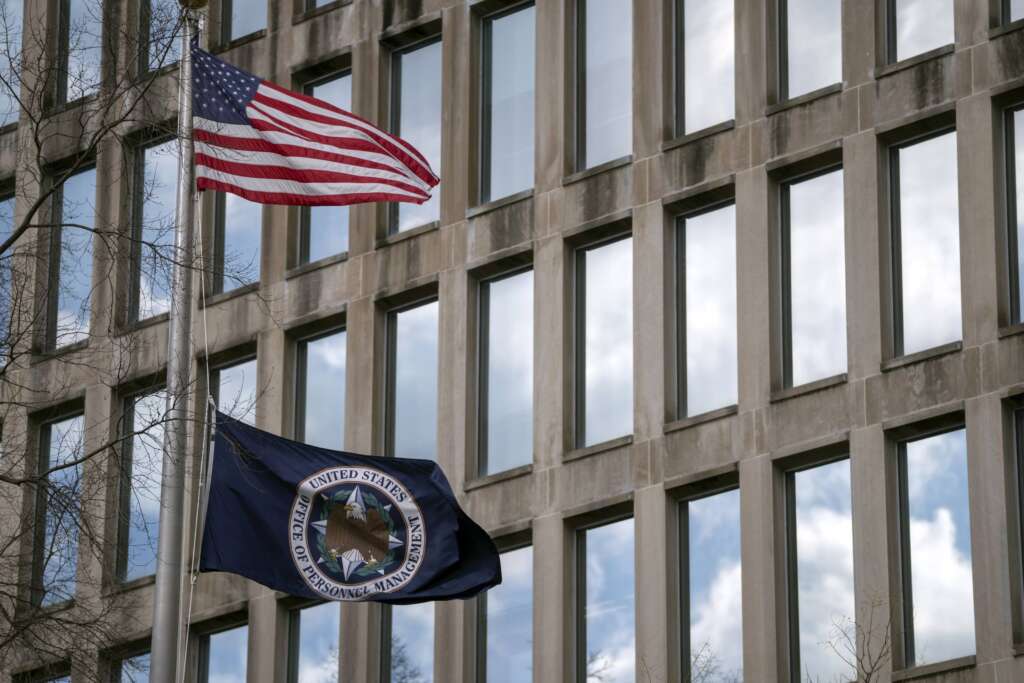
U.S. and agency flags fly outside the Theodore Roosevelt Building, location of the U.S. Office of Personnel Management, on Tuesday, Feb. 13, 2024, in Washington. Former President Donald Trump has plans to radically reshape the federal government if he returns to the White House, from promising to deport millions of immigrants in the U.S. illegally to firing tens of thousands of government workers. (AP Photo/Mark Schiefelbein)
Lawmakers on the House Oversight and Government Reform Committee have advanced a slew of federal workforce bills, one of which aims to make some significant changes to the federal probationary period.
The GOP-led EQUALS Act was one of about a dozen bills that passed favorably out of the committee on Tuesday. If enacted, it would require new federal employees to serve a two-year probationary period, doubling the length that most newly hired or promoted currently face.
Under the bill, agencies also would have to actively certify that a probationary employee “advances the public interest” before the employee can become officially tenured, while those who are not certified would be removed from their jobs. The legislation advanced in a party line vote of 24-19.
Rep. Brandon Gill (R-Texas), who introduced the legislation, said the EQUALS Act builds on an April executive order from President Donald Trump, which similarly required agencies to review and actively sign off on probationary workers’ continued employment.
“President Trump could not be more right,” Gill said. “Probationary periods and trial periods are long-standing, essential tools to ensure newly hired federal employees are sufficiently performing before their appointments are finalized permanently.”
Democrats on the committee criticized the Republicans’ bill, arguing that extending the length of the probationary period would negatively impact federal recruitment, as well as open the doors to more terminations of new hires in the government.
“This bill would double the time during which federal employees have limited due process and appeal rights as probationary employees. During this time they could be fired within 30 days’ notice, they have limited rights to an attorney or representative and they generally cannot appeal their removal,” Oversight Committee Ranking Member Robert Garcia (R-Calif.) said Tuesday. “At a time when Donald Trump is attempting illegal mass firings and purging experts from agencies across our government, this bill is a dangerous step in the wrong direction.”
Rep. James Walkinshaw (D-Va.) added that the EQUALS Act would “give the Trump administration yet another tool to weaponize against federal employees who they perceive as ideological threats, and to continue efforts to destroy the non-partisan civil service.”
Gill, however, argued that the bill would not lead to mass terminations, but instead only make sure that new federal employees are carefully reviewed. He also pointed to a 2015 report from the Government Accountability Office, as well as a 2005 report from the Merit Systems Protection Board, both of which call for reforms to the probationary period.
“An employee can often work for the federal government for over 25 years,” Gill said. “Having an extra year of probationary status to ensure the right employee becomes tenured is a common sense, good government measure.”
During the committee meeting, Rep. Stephen Lynch (D-Mass.) motioned to strike the EQUALS Act and replace it with legislation to first require GAO to review effects of prior probationary period extensions before making any long-term changes. Lynch’s amendment was struck down by the committee’s Republican majority.
Legislation on official time advances
Committee Republicans also advanced a bill that would require agencies to report in greater detail the use of official time by federal employees governmentwide. The Official Time Reporting Act passed out of the committee in a vote of 24-19 along party lines.
If enacted, the bill would require all agencies to submit reports on how much official time is used in each fiscal year, and justify any potential increases in official time that may occur.
During the committee meeting, Republican lawmakers argued that official time takes away from employees’ job responsibilities. Rep. Virginia Foxx (R-N.C.), the lead co-sponsor on the bill, also criticized the lack of agencies’ reporting on official time over the last several years.
The bill “will let the American people know exactly how much of their hard-earned money is spent not providing valuable service, but on federal employee union activities,” Foxx said.
Some committee Democrats, however, described the legislation as an attack on union rights. The lawmakers emphasized that official time is used for activities that support federal employees, while raising concerns about the possibility that the bill could let the Trump administration further limit union rights.
“This year under the Trump administration, federal employees have faced job insecurity, financial strain and the loss of collective bargaining agreements. This bill will make matters worse,” Rep. Maxwell Frost (D-Fla.) said. “We all benefit when unions and their members are empowered to prevent and address retaliation, discrimination and sexual harassment.”
Generally, official time hours can go toward negotiating union contracts, meeting with management, filing grievances or representing employees dealing with management disputes. Under law, federal unions are allotted specific amounts of time and resources to conduct these activities.
Federal unions, including the American Federation of Government Employees, have pushed back against the Trump administration’s characterization of official time as “taxpayer-funded union time,” calling it a misrepresentation.
During Tuesday’s meeting, Garcia argued that official time leads to lower staff turnover and higher employee morale, while also preventing potential legal costs down the road.
“Official time is work time that employees are allowed to use for making the workplace safe and protecting workers from discrimination or harassment,” he said.
Committee approves some bills with bipartisan support
In contrast, some legislation that the committee approved on Tuesday gained strong bipartisan support from lawmakers. That includes bills on training for federal supervisors, skills-based hiring of federal contractors and amending the system for relocation payments for federal employees.
The Federal Supervisor Education Act, for instance, unanimously advanced out of the Oversight committee in a vote of 43-0. If enacted, the legislation would require agencies to work with OPM to create training programs for newly hired or promoted agency managers and supervisors.
Rep. William Timmons (R-S.C.), who introduced the legislation in October, argued during Tuesday’s meeting that many federal supervisors step into leadership roles without enough training, and with no clear expectations for how to adjust to a managerial role in government.
“Agencies promote strong technical employees into supervisory jobs, and then send them in blind,” Timmons said. “That leads to low productivity, uneven standards and a system where good employees feel unsupported and bad employees rarely face consequences.”
Timmons added that the legislation would result in “real, meaningful training,” rather than being “a slideshow or a checkbox exercise.”
Although he said he mostly agreed with the bill’s intentions, Walkinshaw proposed striking one provision of the legislation. The initial bill text included a requirement that supervisory training programs must include additional training on the probationary period — something that Walkinshaw argued was outside the bill’s scope.
Committee Republicans agreed to adopt Walkinshaw’s amendment, after saying that it would result in stronger bipartisan support for the bill. Ultimately, the legislation advanced unanimously, with the amendment included.
“I am a strong supporter of the goal of this legislation,” Walkinshaw said. “Almost all of the language will provide supervisors within the federal workforce the appropriate training and resources to ensure there are strong leaders within their respective agencies.”
The federal offices are back open and hundreds of thousands of federal workershave returned to work after the longest shutdown in history. But nothing is back to normal — federal workers say morale and trust in leadership are at an all-time low, tensions are high between furloughed staff and those who worked through the shutdown, schedules are slipping and projects are being pushed back, and more people are accelerating their retirement plans or leaving federal service altogether.
The recent shutdown, however, has just exacerbated the existing problems and added to what federal workers described as an already extremely trying year for the federal workforce.
“As if morale wasn’t already non-existent, it sure is now. I expect a surge of people to (quiet) quit and I expect the remaining players to be bombarded with work with no support or guidance from leadership,” one employee told Federal News Network.
“The mission is dead. Operations are barely running. Morale is toast,” another federal worker said.
“Everything about being a federal employee in 2025 has destroyed workforce morale — from constant [reduction-in-force] threats, to losing colleagues to early/forced retirements and firings, to the loss of any telework to facilitate work/life balance for working parents or senior caregivers, this is the worst professional year I have experienced in nearly 20 years of service to my country. Nothing about the current [Office of Management and Budget] approach to leadership has moved our country forward,” another employee said.
A Federal News Network survey, conducted online between Nov. 17-30, asked federal workers what it has been like going back to work after the 43-day government shutdown. Survey respondents were self-selected, and they self-reported information to verify their status as current federal employees.
Federal workers described the experience as disorienting — returning to thousands of unanswered emails and scrambling to catch up with partners who kept work moving during the shutdown. There was little to no guidance from top management; they reported overwhelming backlogs and project schedules going completely awry.
Many said overloaded or outdated IT systems, lapsed system access and computer issues made even basic tasks difficult.
“IT issues as devices are set to expire and become inactive after 30 days of non-use, supervisory chain is still not back to work and others are catching up on leave. There are large gaps within the higher chain of command, tremendous amount of confusion, no clear description of how to verify back pay and related deductions are accurate, statutory deadlines did not stop during the shutdown, so crushing workload to return to,” one employee said on Nov. 24.
“It is not so simple as flipping a switch. We are still waiting on funds to arrive and are unable to work on things until those funds arrive,” another federal worker said on Nov. 18.
“I engage in very technical work. A 1.5-month shutdown has thoroughly derailed my train of thought. It will take a long time to refamiliarize myself with what issues were being sorted out, what solutions I had been pursuing, even how any of my own code works,” another employee said.
Several federal workers said their agencies could face budget cuts due to not hitting mandatory spending benchmarks — goals that are “impossible to achieve” after a 40-plus day lapse in appropriations.
In addition, many employees now have to use their “use-or-lose” annual leave before the end of the year, which will further delay progress and extend timelines.
Nearly 1,500 people responded to the survey. Out of 739 federal workers who responded to this question, nearly 47% of respondents said it would take them more than two weeks to catch up on all the work missed during the shutdown.
“My program was halted immediately, but will take two months to ramp back up,” one worker said.
“Can you really ever catch up? Some work will just be lost — deprioritized in the chaos,” another federal employee said.
And the threat of another shutdown is looming — the bill President Donald Trump signed into law keeps the government open only through Jan. 30. The uncertainty, workers say, is making people reluctant to fully dive back into work.
“With holidays coming, this will set projects back months,” one employee said.
Federal employees who worked during the shutdown also expressed “apathy and annoyance” toward furloughed employees who did not work during the shutdown, saying the resentment has led to conflicts and made collaboration difficult.
“Expect operations to be negatively affected as the furlough has driven a wedge between those furloughed employees and those who remained on the job,” one federal employee said.
Receiving back pay
Most of the federal workers worked without pay during the shutdown, missing more than four weeks of pay.
When the government reopened on Nov. 13, the Office of Personnel Management said it would take several business days for workers to get their back pay.
Out of 728 individuals, 200 federal workers — about 27.5% — said they received their back pay within one-to-three days after returning to work. Another 200 said they were paid within four-to-seven days. For the remaining 323 individuals, it took more than a week to receive their back pay.
Source: Federal News Network November 2025 survey of 1,467 current federal employees.
Many employees told Federal News Network that there was a lot of confusion about how to process timesheets and guidance changed a few times the first two days, which had contributed to the delay in issuing our pay.
“Smithsonian still has not managed to get us paid. They are wasting time making sure everyone has the correct time codes rather than getting people paid. It’s more important to them that they take a couple weeks to record we were furloughed. Can’t pay the mortgage, but at least they’ll have the correct time code,” one employee said on Nov. 22.
One Interior Department employee told Federal News Network on Dec. 1 the agency had only paid them for 72 hours worked during the shutdown and had promised the remainder by Nov. 25 — they are still waiting on that payment. They added that none of the 69 civilian employees at the U.S. Park Police have been fully paid. Sworn officers, however, received a flat 80 hours per pay period, and while overtime and night-differential corrections were made, it’s not clear if that pay had been issued.
“We have not heard anything about when we will be paid beyond the deadline that passed a week ago, no reason has been provided to explain the delay,” the employee said. “I will be retiring early. While not the only reason, the recent hijinks played a role in my decision.”
One employee at INTERPOL Washington told Federal News Network on Dec. 1 that personnel there have received only partial back pay and some employees have only received pay for one pay period. The issue stems from the Justice Department’s decision to dismantle INTERPOL Washington and fold its remaining functions into the U.S. Marshals Service during the shutdown — while making changes in the pay system while payroll processing was underway.
The workers were initially told they would receive all of their back pay on Nov. 21, but instead received partial pay on Nov. 24. DOJ then promised the rest by Nov. 28, but only a handful of people were paid over that weekend. The agency now says it has finally identified the problem and that employees should be paid by Dec. 3.
“Every time that the DOJ claims to find a solution and puts another date out for when we should get paid, there is just another disappointment,” the INTERPOL Washington employee said.
Another Air Force civilian at Lackland Air Force Base, who was told they would be paid last week, is still waiting for their back pay now nearly three weeks after the shutdown ended. On Monday, they were told that “the comptroller squadron is working diligently to manually process over 3,000 timecards with an estimated completion date of Nov. 29.”
For many of those who received back pay, determining whether the amount was correct was nearly impossible.
Dozens of respondents said they were unsure if their payments were accurate because agencies did not issue accompanying paystubs for the affected pay periods. Several employees said since payroll providers such as the Defense Finance and Accounting Service do not provide leave and earnings statements for retroactive pay, meaning they will have to wait for the next pay period to verify whether the amount is correct.
“It seems to be off by a few hundred dollars, but I can’t determine where the discrepancy is,” one federal worker said on Nov. 26.
“We don’t know since it was a partial payment with no documentation,” another respondent said on Nov. 24.
“Many people at work say that their paychecks were less due to taxes on lump sum payouts,” another respondent said on Nov. 25.
More feds eyeing the exit
Federal workers were already overwhelmed, stretched thin and struggling with high levels of anxiety following the Trump administration’s push to reduce the size of the federal workforce. Now, the shutdown is pushing even more people out the door.
Out of 758 federal workers, 329 respondents — about 43.4% — said that the shutdown made them reconsider staying in federal service.
Source: Federal News Network November 2025 survey of 1,467 current federal employees.
Many said they are actively looking for an out, while for others the shutdown reinforced their decision to retire
“It is so untenable that I plan to quit in the next month or so. The situation has gotten even worse since returning,” one employee said.
“The shutdown did solidify that I will retire the first date I can,” a federal worker said.
“I have dedicated 20 years to serving my country, including service in the U.S. Army. It’s pretty thankless to be a federal civilian employee now. I used to encourage my children to pursue a similar career but now I am encouraging them to stay away from federal service,” another employee said.
Financial, mental health toll
More than half of federal employees — 58% of respondents — reported experiencing financial challenges during the shutdown, and nearly a third said they struggled to pay bills. Over 51% of federal workers said they had to rely on credit cards, loans or emergency savings to pay their bills, while 14% reported missing rent, mortgage or other payments. About 10% of federal workers said they needed outside assistance, such as food banks and relief programs. But notably, nearly 62% said the shutdown impacted their mental health.
Source: Federal News Network November 2025 survey of 1,467 current federal employees.
Several respondents said they dipped into retirement accounts or cleared out emergency savings to stay afloat, while others reported delaying Christmas shopping, postponing home repairs or borrowing from family members to cover basic needs. Younger workers and those in single-income households were hit especially hard.
And while some said they were fortunate enough to have savings or a second household income, many still described the experience as deeply destabilizing.
“Fortunately, we are a two-income, no-child household and good savers. But I did give a monetary gift to a colleague who is in a much more tenuous situation,” a federal worker said.
“I requested a skip loan payment on my car since I could without fees. I have paid for things out of savings and since I’m a bit older I can do that, but I’m depleting savings still as I continue to not be paid,” one employee said.
“Outsiders calling it a ‘free vacation’ don’t understand the effects the shutdown has on furloughed staff,” another employee said.
Workers described experiencing “constant dread and worry,” “incredible stress and anxiety” and “the feeling of absolutely no protections.”
“It was very stressful. I had to take a part-time job,” one employee said.
Ultimately, one worker said, the impacts were “cruel and petty and proved to be irrelevant to either side achieving their stated goals.”
If you would like to contact this reporter about recent changes in the federal government, please email anastasia.obis@federalnewsnetwork.com or reach out on Signal at (301) 830-2747.
The State Department is telling some employees targeted by mass layoffs this summer that their official separation date is imminent — and is not affected by a shutdown-ending spending deal that forced some agencies to rescind layoff notices.
The department’s human resources office, in a notice sent Monday evening, said Foreign Service employees who received reduction-in-force notices on July 11 will be officially separated from the agency this Friday, Dec. 5.
According to the Bureau of Global Talent Management, State Department attorneys determined that a recent stopgap spending bill passed by Congress, which ended the longest government shutdown, does not require the agency to rescind any RIF notices that were sent before the shutdown.
“Following formal written guidance from both the Office of Management and Budget and Department of Justice Office of Legal Counsel, the Department of State’s Office of the Legal Adviser has determined that completing the reductions in force (RIFs) noticed prior to the lapse in appropriations does not violate the Antideficiency Act (ADA) or any other restriction within HR 5371,” the memo obtained by Federal News Network states. “Given this determination, the Department will finalize your separation or involuntary retirement on Friday, December 5.”
The department, as part of this update, has modified the official separation date for impacted employees.
Foreign Service employees were originally told they would be separated from the agency on Nov. 10, when the agency was still affected by the government shutdown. Those employees will now be separated from the State Department on Dec. 5
In a separate notice, Global Talent Management said the State Department is extending administrative leave for all Foreign Service employees who were scheduled for separation as part of the RIF.
“We are reviewing the administrative errors in all SF-50s issued on Friday, November 7, to ensure that all information is accurate,” the notice states, referring to a federal employee’s official employment record.
It’s not clear what administrative errors the department intends to correct. An employee’s SF-50 form shared with Federal News Network shows that Lew Olowski, the department’s top HR official, approved the RIFs to go into effect on Nov. 10.
A State Department spokesperson told Federal News Network that, “since the State Department’s lawful reduction in force (RIF) process was commenced and initiated well before the lapse in appropriations, the eliminated positions are not impacted by the language in the recent continuing resolution.”
“Legal opinions published by both OMB and DOJ confirm that outcome,” the spokesperson said. “The State Department will proceed with executing the RIF process as planned.”
A Foreign Service officer who received a RIF notice told Federal News Network that the State Department “can’t just extend admin leave” to set a new separation date.
The Foreign Service officer, who requested anonymity because they were not cleared to speak to the media, said moving the original Nov. 10 separation date amounts to a “de facto reinstatement,” and that the department would need to issue entirely new RIF notices and provide at least a 60-day notice for that new separation date.
“This entire action just seems patently unlawful, and I do not understand how the department plans to get away with it,” the Foreign Service officer said.
By law, each federal employee subject to a RIF “is entitled to a specific written notice at least 60 full days before the effective date of release.”
According to the SF-50 notice, employees eligible for severance will receive a lump-sum payment on Jan. 1, 2026.
The State Department laid off more than 1,300 employees on July 11. It sent RIF notices to more than 1,100 civil service employees and nearly 250 Foreign Service employees who were based in the United States at the time.
Questions about the possibility of reinstatement primarily focused on laid-off Foreign Service officers, who had been on administrative leave for a longer period than their civil service counterparts.
Foreign Service employees who received RIF notices were scheduled to be officially 120 days out from their RIF notices. But civil service employees who received RIF notices had only 60 days before their official separation. They left the department in early September.
The State Department and several other agencies have rejected calls from laid-off employees, unions and Democratic lawmakers who say more federal employees are eligible for reinstatement than what the Trump administration has allowed.
The American Foreign Service Association said last month that its interpretation of the continuing resolution passed by Congress on Nov. 12 blocks the State Department from moving forward with its layoff notices.
The continuing resolution Congress passed on Nov. 12 states that “any reduction in force proposed, noticed, initiated, executed, implemented, or otherwise taken by an Executive Agency between October 1, 2025, and the date of enactment, shall have no force or effect.”
“We understand that Congress intended for this language to apply to as many federal employees as possible, including those who received layoff notices from the State Department on July 11,” AFSA wrote.
On Tuesday, AFSA said it is working closely with the American Federation of Government Employees and will be pursuing legal action.
“This action flies in the face of the current funding law, which clearly prohibits using any federal resources to carry out layoffs during this period,” AFSA said in a statement. “That includes sending notices, processing paperwork, or taking any step to advance these separations.”
Democratic lawmakers say agencies aren’t reinstating as many federal employees as they should be under the spending deal.
Sen. Tim Kaine (D-Va.) is leading the push for more RIF rescissions, along with several of his Democratic colleagues.
Kaine was one of eight Democratic senators who broke ranks to pass the stopgap spending bill, only after Republicans agreed to include language that would protect federal employees from layoffs at least through Jan. 30, 2026. Kaine and his colleagues backed standalone legislation during the shutdown that would have also barred the Trump administration from moving ahead with its most recent wave of mass layoffs.
Kaine, along with Sens. Ed Markey (D-Mass.), Jack Reed (D-R.I.), and Patty Murray (D-Wash.), said the continuing resolution — particularly Section 120 of the stopgap bill — placed a moratorium on RIFs involving federal employees, and that the “moratorium is broad, clear and unequivocal.”
Agencies, however, have followed a narrower interpretation, and have only reinstated federal employees who received RIF notices between Oct 1 and Nov. 12. Agencies told a federal court that they rescinded shutdown-era RIF notices for more than 3,600 employees.
Federal News Network first reported that the Small Business Administration told 77 recently laid-off employees this week that they could get their jobs back, but rescinded that offer a day later.
An SBA spokesperson said in a statement that the agency “has determined that the most recent continuing resolution signed into law does not apply to any RIFs executed by the SBA.”
The Democratic senators told SBA Administrator Kelly Loeffler that the agency is “unlawfully pursuing reductions in force,” and that dozens of recently laid-off employees the agency hasn’t reinstated “have a right to continue their employment.”
A group of 35 former General Services Administration employees also called on the agency to rescind their RIF notices, on the grounds that Congress intended to reinstate them.
GSA’s Associate General Counsel Daniel Hall told their attorneys in a Nov. 24 letter that the RIF notices “were issued before and separate from the lapse in appropriations occurring on October 1, 2025, and are outside of the intended scope of the Act and its provisions on RIFs.”
Most funds in the Thrift Savings Plan saw minimal growth in November, with 15 of 16 coming in higher than where they finished in October. But no fund saw an increase greater than 0.64% for the past 30 days. And only the S fund saw a month over month decline, dropping 0.45%. The I Fund remains the biggest winner for the year with a total increase of 28.54%, while four L Funds also produced returns of greater than 20% in 2025.
The Postal Service’s new delivery vehicles are rolling out on routes across the country. USPS said more than 35,000 of those vehicles are out on the road. That’s about a third of its new fleet. More than 100,000 vehicles will be deployed by 2028 and nearly half of them will be electric vehicles. Congress gave USPS $3 billion in 2022 to buy more electric vehicles than it could afford to buy on its own.
The Trump administration is taking down yet another government program tailored toward early-career employees and talent development in the federal workforce. The Office of Personnel Management will soon sunset the Federal Academic Alliance. This is a governmentwide program that let federal employees access advanced degree opportunities at reduced tuition costs. The agency attributed its cancellation decision to a low participation rate, as well as more internal training options becoming available to employees over time. Employees currently in the program have until Jan. 19 to enroll into programs using the benefits through the end of their current academic term. OPM will shut the program website and other assets down by Jan. 30.
The Department of Health and Human Services faces a months-long backlog of reasonable accommodation requests from its employees. HHS said it will centralize the processing of reasonable accommodation requests on behalf of its component agencies. HHS said it’s taking on a backlog of more than 3,000 requests from the Centers for Disease Control and Prevention. It’s not clear how long it will take HHS to review each individual request. But the department said it will need about six to eight months to clear the backlog. A CDC memo said telework “should not be given as an interim accommodation,” while a reasonable accommodation request is under review.
The Coast Guard is at risk of more cost overruns on one of its newest class of ships. That new warning comes from the Government Accountability Office, which said the service is pressing ahead with plans for its Offshore Patrol Cutter without a stable design. GAO said moving ahead with the second stage of the acquisition program too quickly could mean a repeat of some of the missteps the service suffered during the program’s first phase. In stage one, starting construction before designs were stabilized wound up leading to expensive rework.
The Defense Department is putting more than $400 million toward immediate barracks repairs. Defense Secretary Pete Hegseth said the department is also launching more than $800 million in critical barracks renovations. Hegseth recently stood up a “barracks task force,” which he said has completed wall-to-wall assessments of facilities across the Navy, Marine Corps, Air Force, Space Force and the 18th Airborne Corps, with Reserve and National Guard inspections expected to wrap up by the end of January. “In our first 30 days, we've purchased new furnishings and mattresses for 81 barracks, reaching more than 15,000 service members, and we've executed $101 million of quality of life improvements since October 27 that includes new door locks in 10 barracks, affecting over 6,000 war fighters, new security systems in 13 barracks, which is peace of mind for another 1,500 plus service members. I'm getting monthly reports to confirm the work is actually getting accomplished.”
The Marine Corps is encouraging qualified Marines to move into counterintelligence and human intelligence roles. The Corps’ Manpower and Reserve Affairs has identified these positions as a critical specialty. The service said the demand for Marines in counterintelligence and human intelligence roles will remain high for the foreseeable future. Officials say Marines selected for these roles will receive extensive training and have opportunities to support Joint Forces and interagency partners. Marines who make the switch could earn over $100,000 in bonuses.
The Defense Department wants to shake up how it works with value-added resellers. The Pentagon is considering placing a 5% cap on most fees charged by resellers starting with a specific special item number, or SIN, for IT products. A draft memo obtained by Federal News Network said this cap would only apply to IT products bought through GSA's schedule contract. The initial focus of this reseller cap would focus on SIN 33411, which is for the purchasing of new electronic equipment, including desktops, laptops and servers. DoD said it spent about $2 billion in fiscal 2024 through the GSA schedule on these technology products.
The Department of Health and Human Services faces a months-long backlog of reasonable accommodation requests from its employees, as the department embarks on major changes to how it handles these requests.
HHS is preparing to roll out a new reasonable accommodation policy later this week. Several HHS components, however, recently set their own new policies, which more broadly cover telework and how often employees may work from home.
The new policy comes at a time when the Trump administration has called on the federal workforce to show up to the office full-time, and has rolled back options for some employees to work from home full-time or occasionally each two-week pay period.
Federal agencies are required under the Rehabilitation Act to provide reasonable accommodations to qualified employees with disabilities, as long as that accommodation does not result in an “undue hardship” for agencies.
The Centers for Disease Control and Prevention told employees in a memo last week that its Accommodation Tracking System (ATS) was shutting down, and that, effective immediately, reasonable accommodations will be “centralized at the HHS level.”
According to the memo obtained by Federal News Network, HHS will need to work through a backlog of about 3,330 of CDC’s pending reasonable accommodation requests.
It’s not clear how long it will take HHS to review each individual reasonable accommodation request, but according to the CDC memo, HHS expects it will take six to eight months to get through the backlog.
It’s not clear if other HHS components are also facing a backlog of reasonable accommodation requests.
The CDC memo states that its Office of Human Resources announced telework “should not be given as an interim accommodation,” while a reasonable accommodation request is under review.
“If the employee requests telework, the employee must still report into the office until a decision is made (or use leave),” the CDC memo states.
HHS Press Secretary Emily Hilliard told Federal News Network in a statement Monday that “HHS is centralizing reasonable accommodation requests in alignment with President Trump’s executive order on return to work.”
“The department remains committed to processing these requests as quickly as possible,” Hilliard said.
The CDC memo also states HHS is expected to release an updated reasonable accommodation policy later this week.
Several CDC employees told Federal News Network that the agency has recently unveiled a new telework policy, in which employees are limited to 80 hours of telework per year, and that reasonable accommodations cannot include regular/scheduled or full-time telework.
A CDC spokesperson said in a statement that “this shift aligns with President Trump’s executive order on returning federal employees to in-person work, ensuring the government is best positioned to deliver results for the American people.
In September, the CDC said it would stop approving telework requests for employees with reasonable accommodations, but temporarily reversed course on that decision, according to internal agency emails obtained by Federal News Network.
A separate email obtained by Federal News Network told HHS employees with pending reasonable accommodations that “all existing reasonable accommodation programs have been consolidated to form the HHS Reasonable Accommodation (RA) Taskforce, servicing the entire HHS workforce.”
The email, sent by an HHS reasonable accommodations coordinator, instructs employees with pending reasonable accommodation requests to complete a questionnaire within seven calendar days, and to submit medical documentation within 20 calendar days.
The email states that failure to submit the required medical documentation by this deadline will result in a “closure of your request.”
The American Federation of Government Employees Local 2883, which represents CDC headquarters employees in Atlanta, told members in an email on Nov. 26 that the agency is once again taking steps to end full-time telework for employees with reasonable accommodations.
AFGE Local 2883 wrote that on the first day back to work after the 43-day government shutdown ended, CDC employees were told that supervisors no longer have authority to approve temporary 90-day agreements for full-time telework, and that their temporary accommodations that expired over the shutdown could not be renewed.
“Some were told their current, non-expired RAs were cancelled outright. Still others were told telework is no longer a reasonable accommodation available to CDC staff. Scores of employees with disabilities were instructed to return to the office or take leave,” the union wrote.
AFGE Local 2883 told members that CDC’s actions stand in “direct defiance” of the return-to-office mandate that President Donald Trump signed on his first day in office, as well as follow-up guidance from the Office of Management and Budget and Office of Personnel Management.
“This harmful policy change keeps us from doing our jobs for the American people in the best way possible. It works against the safety and well-being of all of our colleagues, including many of whom were forced to return to a campus still marred by unrepaired bullet holes from the August shooting. And it violates our rights as federal workers. It’s against the law to mass-deny any type of reasonable accommodation for everyone in the agency,” the union wrote.
According to the union, however, HHS reasonable accommodation coordinators have said “telework is still a reasonable accommodation at CDC,” and that existing temporary reasonable accommodations granted on or before Sept. 15 will continue and can be extended or modified as appropriate.
“CDC’s misrepresentation of HHS’s policy on reasonable accommodations terrorized both the supervisors who implemented it and the employees who suffered as a result,” the union wrote. “This is a confusing and stressful time for many of us, especially as there has been no clear guidance across offices for what comes next. We cannot let this chaos and uncertainty stand, and we will demand clear leadership and full transparency.”
Despite these restrictions on telework as reasonable accommodations, some parts of HHS are, more broadly, easing up on work-from-home restrictions.
At the Centers for Medicare and Medicaid Services, Administrator Mehmet Oz told staff in a Nov. 14 email that CMS employees will be able to take up to four telework days per month, “in recognition of the hard work that you all have put in this year.”
According to the email, employees who scored a 4.5 or higher on their most recent performance rating will be eligible to take two days of telework per two-week pay period. Employees who scored between 4.49 and 3.0 will be eligible to day a single telework day per pay period.
The new policy went into effect on Nov. 17. Oz told employees that these telework days would not count against the 80 hours of telework that all HHS employees can take each year. CMS did not respond to a request for comment.
Oz told CMS staff that any telework in excess of that 80-hour limit would require an office-level or center-level signoff, including by the political leadership for that component.
“Those requests must include a detailed writeup justifying the exception and need to then be sent forward to be approved by the COO for CMS,” Oz wrote. “All requests beyond the 80 hours will be sent to HHS for tracking and awareness.”
According to the email, new employees won’t be eligible for telework until they are at least six months into the job.
“Once they have completed their probationary period and received their first-year performance review then their telework status can reflect that performance rating,” Oz wrote.
The House Oversight and Government Reform Committee is convening Tuesday morning to mark up a slew of bills, many of which would impact the federal workforce in one way or another.
Tuesday’s meeting will be the first legislative markup session the committee has held in nearly two months, with the last being prior to the 43-day government shutdown. Any bills that the committee approves during the markup will advance to the full House for further consideration.
Several other legislative changes may be on the horizon as well. Here are three key bills up for the committee’s consideration that may bring significant changes for the federal workforce:
Probationary period, federal workforce changes
One Republican-led bill, introduced by Rep. Brandon Gill (R-Texas) in October, aims to cement many of the changes the Trump administration has made to the government’s rules for the probationary period in the federal workforce.
If enacted, the so-called EQUALS Act would require most new federal employees to serve a two-year probationary period — a time in which employees have limited appeal rights and are easier to remove, before their employment in the federal workforce can be solidified.
Part of the bill would compel agencies to evaluate their employees regularly throughout the federal probationary period. And in the last 30 days of that two-year period, agencies would have to certify — and get the Office of Personnel Management to approve — that the probationary employee “advances the public interest,” before the employee can become tenured.
Any probationary employees who are not actively certified by their agency would be terminated, according to the GOP-led legislation.
The bill also states that when making a decision on whether to keep a probationary employee, agencies can additionally consider performance and conduct; the “needs and interests” of the agency; and whether the employee would advance “organizational goals” or “efficiency.”
The EQUALS Act aligns with efforts from the Trump administration earlier this year to overhaul the rules for the government’s probationary period. In April, President Donald Trump called for the creation of “Civil Service Rule XI,” which similarly required agencies to review and actively sign off on probationary workers’ continued employment before they can be moved out of a probationary period.
Trump’s executive order also expanded the reasons that probationary period employees can be fired. In June, OPM further clarified that probationary employees can be terminated based on broader reasons than the previous limitations set only to performance or conduct.
The House bill also comes after the Trump administration fired tens of thousands of probationary employees earlier this year, stating that the removals were due to “poor performance.” But in September, a federal judge found that OPM unlawfully directed the mass probationary firings. The judge ordered agencies to update employees’ personnel files to reflect that their firings were not due to performance or misconduct.
An eye on official time
A separate bill teed up by Republicans would compel agencies to provide much more detail on federal union representatives’ use of official time to both Congress and the public on an annual basis.
The Official Time Reporting Act from Rep. Virginia Foxx (R-N.C.) would require all agencies to submit reports on how much official time is used in each fiscal year, and justify any potential increases in official time that may occur.
The legislation would then require OPM and the Office of Management and Budget to create and send a joint report to Congress, and make publicly available online, the details of official time governmentwide. Those reports would have to cover how much official time each federal employee used, as well as provide data on official time hours calculated against the total number of bargaining unit employees for an “official time rate.”
Under the GOP-led legislation, those annual reports would additionally have to detail the specific purpose of all official time, the amount of money withheld for union dues, the cost of pay and benefits for all employees while they are on official time, and the office space and resources union representatives use while on official time.
Generally, official time refers to on-the-clock hours that go toward work such as negotiating union contracts, meeting with management, filing complaints or grievances against an agency, or representing employees who are dealing with disciplinary actions or other management disputes. Federal unions are allotted, by law, specific and limited amounts of agency time and resources to conduct activities on official time.
Official time by union representatives has been a major target of the Trump administration this year. Some agencies have either reduced or fully removed official time options, in response to executive orders from Trump calling for the termination of collective bargaining at the majority of executive branch agencies.
The administration’s actions have received major pushback from federal unions such as the American Federation of Government Employees, which said OPM’s characterization of official time as “taxpayer-funded union time” is false and stigmatizing.
Mandatory executive training
During Tuesday’s markup, Oversight committee lawmakers also plan to consider legislation that would require a mandatory training program all managers and supervisors across the federal workforce would have to take.
Under the Federal Supervisor Education Act, which Rep. William Timmons (R-S.C.) introduced in October, agencies would have to work with OPM to create training programs for agency managers, with at least some modules focused on goals like performance management, employee engagement and productivity.
The bill would also require the training programs to cover how supervisors should manage employees who have “unacceptable performance,” as well as how to make use of the probationary period. The bill also mandates that managers and supervisors receive training on how to address reports of harassment, prohibited personnel practices, employee rights, and more.
The legislation emphasizes that agencies should use “instructor-based” training as much as practicable. If enacted, supervisors would have to complete the training within one year of being appointed to a supervisory role, and would have to retake the trainings at least once every three years following that.
The Republican-led effort comes after OPM launched two federal workforce training programs for senior executives in November, incorporating common themes from the Trump administration on “accountability,” performance management and adherence to the president’s priorities.
Although both new programs are optional, OPM still told agencies to “set the expectation” that all career Senior Executive Service members should at least complete training modules on “returning to founding principles” and “implementing administration priorities” within the next year.
In the Oversight committee meeting Tuesday, all three federal workforce bills, along with many others, will be up for consideration and potential advancement in the House.
A new forecast projects that defense spending will keep rising through 2035, while civilian agencies face years of flat or shrinking budgets, continued cuts and growing pressure to scale back.
The Professional Services Council’s latest federal market forecast, compiled with input from more than 400 industry volunteers and subject-matter experts, predicts that in an environment where legislative logjam is likely to persist, defense spending will continue rising at roughly 2% annually after its first $1 trillion budget in fiscal 2026 — a one-time spike driven by reconciliation — while cuts will “continue to fall disproportionately on civil agencies until elections change the balance of power.”
“What this means in practical terms is that the fiscal environment for the next decade will be tight, competitive, highly dependent on supplemental funding, reconciliation and prone to crisis-driven appropriations. Base budgets alone will struggle to drive new initiatives, especially on the non-defense side. In this environment, as one of our interviewees suggested, it’s best to keep your customers close and your congressional supporters and lobbyists closer,” Mike Riley, a volunteer for PSC’s Vision Federal Market Forecast told reporters last week.
In the defense space, PSC volunteers said their discussions with defense stakeholders revealed a shift, or “strategic realignment,” in the Pentagon’s priorities. While the Indo-Pacific Command remains of “elevated importance,” the Northern Command and Southern Command are gaining new emphasis as the department puts greater focus on homeland, border security and expands its presence in Latin America and the Caribbean.
“This year was a bit of an interesting year for us. A lot of defense folks acknowledge the growing importance under this administration, but also a lot of consternation about the directions the administration might be going and just kind of the lack of clarity. There’s some continuing trends — deterring China, integrated deterrence, that pivot to the Pacific — that’s an ongoing thing that didn’t change from the previous administration. Of course, border security, the Department finds itself in an uncomfortable position,” Jason Dombrowski, a volunteer for PSC’s Vision Federal Market Forecast, said.
“They are getting a little bit more heavily involved in domestic politics than they would otherwise prefer to. Certainly, they always reiterated their intent to be responsive to the commander in chief. But historically, of course, the American military has tried to avoid a domestic role,” he added.
The department is also placing greater emphasis on the Golden Dome missile defense system, shipbuilding and munitions under this administration.
“I think everyone’s been paying attention to the news that there has been some very notable plus ups and focuses of this administration, most notably around shipbuilding, but also to include things like nuclear modernization, which in previous years we had highlighted as a potential toss up, but this year definitely moved into the winners category,” Dombrowski said.
Acquisition reform
The Defense Department also moves to implement Defense Secretary Pete Hegseth’s sweeping acquisition reforms, which emphasize greater competition, faster delivery and making commercial technology the default option. It’s unclear whether the department has the ability to implement those changes given deep personnel cuts across the contracting workforce.
“The contracting professionals — there seems to be a large reduction. How do we get this done? That fundamental capacity to get things done is really going to make a difference, whether you’re putting out contracts, supply chain, workforce throughput … It’s going to affect how we can actually help out the government. Adaptability is the name of the game,”Jim Kainz, a PSC volunteer, said.
In addition, the department’s new acquisition strategy promises to lower barriers to entry to encourage startups and non-traditional vendors to join the defense industrial base. Dombrowski said that while stakeholders are cautiously optimistic about the reforms, there is also a “healthy cynicism of saying, ‘How is this time any different?’”
“This administration has made a big priority of trying to attract new people, and we looked at the pros and cons of it. It’s probably worth noting that, aside from a few very notable successes that we can all figure out, there hasn’t really been much movement in this regard,” Dombrowski said.
“We’re very excited, certainly [Commercial Solutions Opening] and [Other Transaction Authority] and just a variety of things that should provide a lot of flexibility, but let’s see it,” he added.
Winner and losers
Dombrowski and Kainz said several areas emerged as clear “losers” in this year’s defense outlook, including the department’s buying power, which continues to erode as inflation and reshoring efforts drive up costs across programs.
Legacy systems and advisory and assistance services are facing cuts, and U.S. Africa Command and Central Command are being pushed lower on the priority list as resources shift toward European Command.
There is also uncertainty around operations and maintenance funding, which Dombrowski and Kainz said remains a major concern for both think tanks and potential customers. Sustainability initiatives appear to be split — the “green side of sustainability” will most certainly lose ground, while efforts tied to energy resilience may gain momentum.
Contested logistics, once considered a toss-up, is gaining traction as a priority, and scalability — the ability to rapidly increase production in a crisis — is emerging as a clear winner across the department.
Overall, research and development spending is increasing, but only in areas related to advanced weapon systems, technologies, drones and energy.
“However, there’s a belief and a growing expectation that the contracting community will bear more of those responsibilities,” Dombrowski said. “It’s really unclear where that line is going to be drawn between things that are really government exclusive where DoD is willing to pick up all costs associated to it. There are things we can all imagine, like fighter jets. But what about things that are more in the gray areas? Avionics, business process systems, back-office systems, things like that — definitely more of a sense that we are going to have to be developing those on our own.”
If you would like to contact this reporter about recent changes in the federal government, please email anastasia.obis@federalnewsnetwork.com or reach out on Signal at (301) 830-2747.

 Login
Login