❌

Reading view

There are new articles available, click to refresh the page.

Hubble Spots a Storm of New Stars

2 min read

Hubble Spots a Storm of New Stars
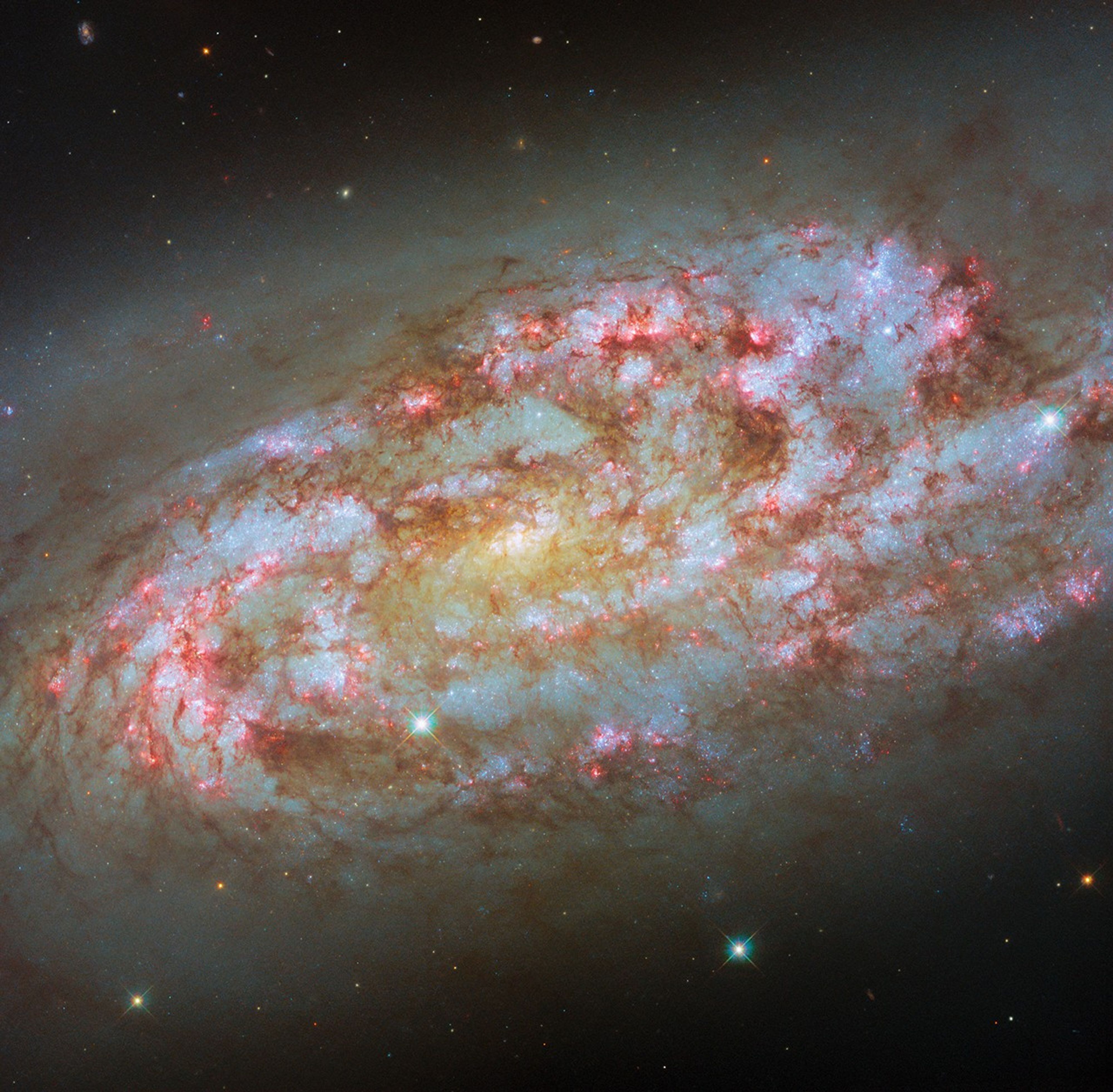
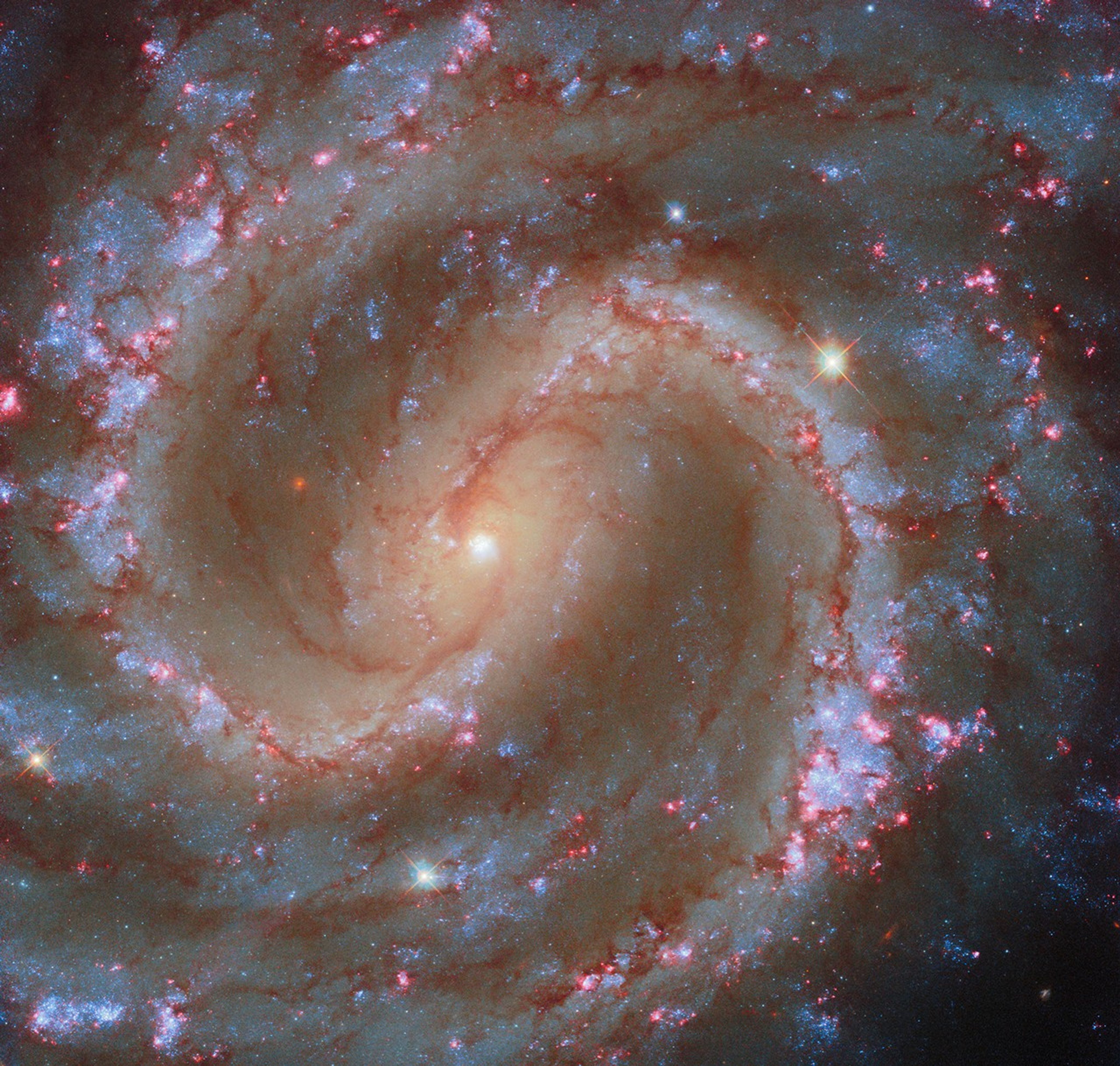
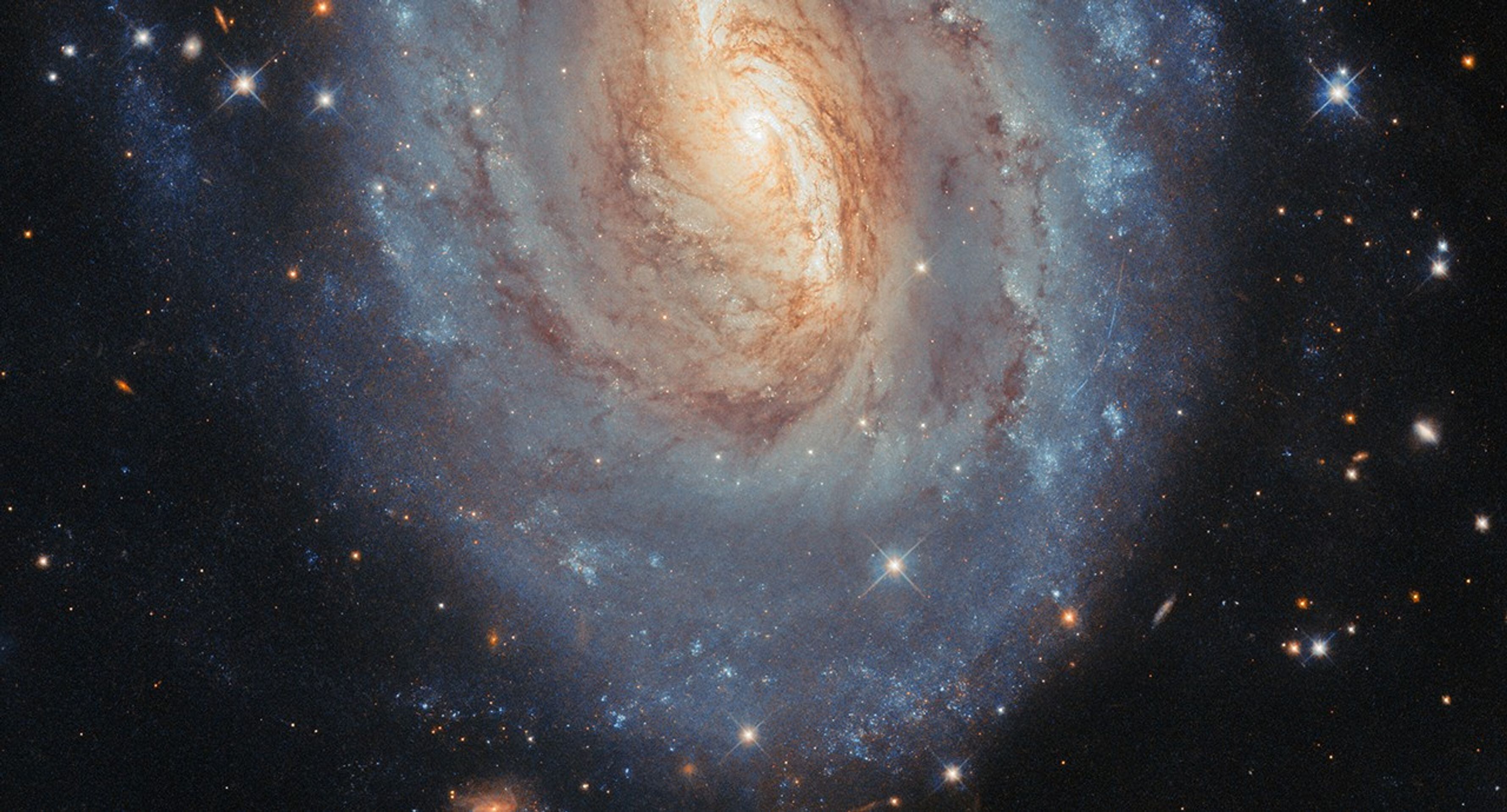
A spiral galaxy, seen partly from the side, with a messy, turbulent appearance. Its disc is made of multiple patchy arms that contain numerous sparkling blue and glowing red regions β€” star clusters and star-forming nebulae. Thick clumps of dark reddish dust swirl through the disc. The glow of the disc extends out into the dark background, where both distant and nearby stars can be seen.
This NASA/ESA Hubble Space Telescope image features the spiral galaxy named NGC 1792.
ESA/Hubble & NASA, D. Thilker, F. Belfiore, J. Lee and the PHANGS-HST Team

This NASA/ESA Hubble Space Telescope image features a stormy and highly active spiral galaxy named NGC 1792. Located over 50 million light-years from Earth in the constellation Columba (the Dove), the bright glow of the galaxy’s center is offset by the flocculent and sparkling spiral arms swirling around it.

NGC 1792 is just as fascinating to astronomers as its chaotic look might imply. Classified as a starburst galaxy, it is a powerhouse of star formation, with spiral arms rich in star-forming regions. In fact, it is surprisingly luminous for its mass. The galaxy is close to a larger neighbor, NGC 1808, and astronomers think the strong gravitational interaction between the two stirred up the reserves of gas in this galaxy. The result is a torrent of star formation, concentrated on the side closest to its neighbor, where gravity has a stronger effect. NGC 1792 is a perfect target for astronomers seeking to understand the complex interactions between gas, star clusters, and supernovae in galaxies.

Hubble studied this galaxy before. This new image includes additional data collected throughout 2025, providing a deeper view of the tumultuous activity taking place in the galaxy. Blossoming red lights in the galaxy’s arms mark Hydrogen-alpha (H-alpha) emission from dense clouds of hydrogen molecules. The newly forming stars within these clouds shine powerfully with ultraviolet radiation. This intense radiation ionizes the hydrogen gas, stripping away electrons which causes the gas to emit H-alpha light. H-alpha is a very particular red wavelength of light and a tell-tale sign of new stars.

Instagram logo
Linkedin logo

Media Contact:

Claire AndreoliΒ (claire.andreoli@nasa.gov)
NASA’sΒ Goddard Space Flight Center,Β Greenbelt, MD

Hubble Seeks Clusters in β€˜Lost Galaxy’

2 min read

Hubble Seeks Clusters in β€˜Lost Galaxy’

A close-in view of a spiral galaxy that faces the viewer. Brightly lit spiral arms swing outward through the galaxy’s disk, starting from an elliptical region in its center. Thick strands of dark reddish dust spread across the disk, primarily along the spiral arms. The arms also contain many glowing, pink-red spots where stars form and clumps of bright-blue star clusters. Beyond its spiral arms, the galaxy is a bit fainter and speckled with blue stars.
This NASA/ESA Hubble Space Telescope image features the spiral galaxy NGC 4535.
ESA/Hubble & NASA, F. Belfiore, J. Lee and the PHANGS-HST Team

Today’s NASA/ESA Hubble Space Telescope image features the spiral galaxy NGC 4535, which is situated about 50 million light-years away in the constellation Virgo (the Maiden). Through a small telescope, this galaxy appears extremely faint, giving it the nickname β€˜Lost Galaxy’. With a mirror spanning nearly eight feet (2.4 meters) across and its location above Earth’s light-obscuring atmosphere, Hubble can easily observe dim galaxies like NGC 4535 and pick out features like its massive spiral arms and central bar of stars.

This image features NGC 4535’s young star clusters, which dot the galaxy’s spiral arms. Glowing-pink clouds surround many of these bright-blue star groupings. These clouds, called H II (β€˜H-two’) regions, are a sign that the galaxy is home to especially young, hot, and massive stars that blaze with high-energy radiation. Such massive stars shake up their surroundings by heating their birth clouds with powerful stellar winds, eventually exploding as supernovae.

The image incorporates data from an observing program designed to catalog roughly 50,000 H II regions in nearby star-forming galaxies like NGC 4535. Hubble released a previous image of NGC 4535 in 2021. Both the 2021 image and this new image incorporate observations from the PHANGS observing program, which seeks to understand the connections between young stars and cold gas. Today’s image adds a new dimension to our understanding of NGC 4535 by capturing the brilliant red glow of the nebulae that encircle massive stars in their first few million years of life.

Facebook logo
Instagram logo

Media Contact:

Claire AndreoliΒ (claire.andreoli@nasa.gov)
NASA’sΒ Goddard Space Flight Center,Β Greenbelt, MD

Hubble Studies Star Ages in Colorful Galaxy

2 min read

Hubble Studies Star Ages in Colorful Galaxy

An oval-shaped spiral galaxy. Only the center and lower half of the galaxy is in frame. Its center is primarily golden in color with a white glowing core, while its thick spiral arms are mostly blue, particularly at the outskirts; these colors merge in between. Dark lanes of dust swirl through the center, blocking some of the galaxy’s light. Stars and distant galaxies are visible around the edges on a black background.
This NASA/ESA Hubble Space Telescope image features the spiral galaxy called NGC 6000.
ESA/Hubble & NASA, A. Filippenko; Acknowledgment: M. H. Γ–zsaraΓ§

Stars of all ages are on display in this NASA/ESA Hubble Space Telescope image of the sparkling spiral galaxy called NGC 6000, located 102 million light-years away in the constellation Scorpius.

NGC 6000 has a glowing yellow center and glittering blue outskirts. These colors reflect differences in the average ages, masses, and temperatures of the galaxy’s stars. At the heart of the galaxy, the stars tend to be older and smaller. Less massive stars are cooler than more massive stars, and somewhat counterintuitively, cooler stars are redder, while hotter stars are bluer. Farther out along NGC 6000’s spiral arms, brilliant star clusters host young, massive stars that appear distinctly blue.

Hubble collected the data for this image while surveying the sites of recent supernova explosions in nearby galaxies. NGC 6000 hosted two recent supernovae: SN 2007ch in 2007 and SN 2010as in 2010. Using Hubble’s sensitive detectors, researchers can discern the faint glow of supernovae years after the initial explosion. These observations help constrain the masses of supernovae progenitor stars and can indicate if they had any stellar companions.

By zooming in to the right side of the galaxy’s disk in this image, you can see a set of four thin yellow and blue lines. These lines are an asteroid in our solar system that was drifting across Hubble’s field of view as it gazed at NGC 6000. The four lines are due to four different exposures recorded one after another with slight pauses in between. Image processors combined these four exposures to create the final image. The lines appear dashed with alternating colors because each exposure used a filter to collect very specific wavelengths of light, in this case around red and blue. Having these separate exposures of particular wavelengths is important to study and compare stars by their colors β€” but it also makes asteroid interlopers very obvious!

Facebook logo
Instagram logo

Media Contact:

Claire AndreoliΒ (claire.andreoli@nasa.gov)
NASA’sΒ Goddard Space Flight Center,Β Greenbelt, MD

Hubble Captures Puzzling Galaxy

2 min read

Hubble Captures Puzzling Galaxy

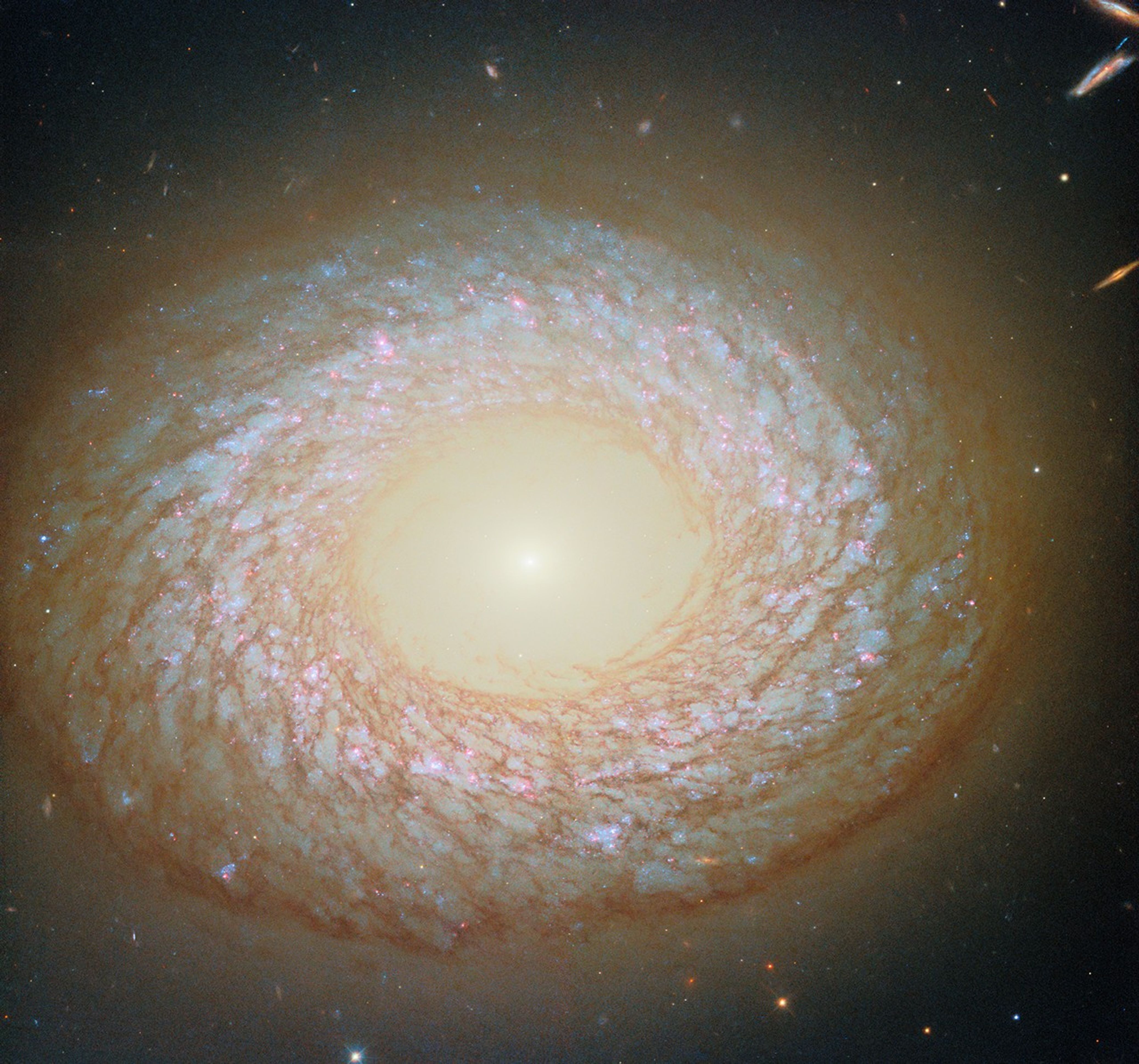
A galaxy seen face-on, with a slightly elliptical disk that appears to have a hole in the center like a doughnut. In the hole, the core is a brightly glowing point that shines light out beyond the edge of the disk. Around the hole is an inner ring of dust, and at the galaxy’s edge is a thicker outer ring of dust, with a swirling web of dust strands in between. Blue stars and red nebulae are visible behind the dust.
This NASA/ESA Hubble Space Telescope image features the galaxy NGC 2775.
ESA/Hubble & NASA, F. Belfiore, J. Lee and the PHANGS-HST Team

This NASA/ESA Hubble Space Telescope image features a galaxy that’s hard to categorize. The galaxy in question is NGC 2775, which lies 67 million light-years away in the constellation Cancer (the Crab). NGC 2775 sports a smooth, featureless center that is devoid of gas, resembling an elliptical galaxy. It also has a dusty ring with patchy star clusters, like a spiral galaxy. Which is it: spiral or elliptical β€” or neither?

Because we can only view NGC 2775 from one angle, it’s difficult to say for sure. Some researchers classify NGC 2775 as a spiral galaxy because of its feathery ring of stars and dust, while others classify it as a lenticular galaxy. Lenticular galaxies have features common to both spiral and elliptical galaxies.

Astronomers aren’t certain of exactly how lenticular galaxies come to be, and they might form in a variety of ways. Lenticular galaxies might be spiral galaxies that merged with other galaxies, or that have mostly run out of star-forming gas and lost their prominent spiral arms. They also might have started out more like elliptical galaxies, then collected gas into a disk around them.

Some evidence suggests that NGC 2775 merged with other galaxies in the past. Invisible in this Hubble image, NGC 2775 has a tail of hydrogen gas that stretches almost 100,000 light-years around the galaxy. This faint tail could be the remnant of one or more galaxies that wandered too close to NGC 2775 before being stretched apart and absorbed. If NGC 2775 merged with other galaxies in the past, it could explain the galaxy’s strange appearance today.

Most astronomers classify NGC 2775 as a flocculent spiral galaxy. Flocculent spirals have poorly defined, discontinuous arms that are often described as β€œfeathery” or as β€œtufts” of stars that loosely form spiral arms.

Hubble previously released an image of NGC 2775 in 2020. This new version adds observations of a specific wavelength of red light emitted by clouds of hydrogen gas surrounding massive young stars, visible as bright, pinkish clumps in the image. This additional wavelength of light helps astronomers better define where new stars are forming in the galaxy.

Facebook logo
Instagram logo

Media Contact:

Claire AndreoliΒ (claire.andreoli@nasa.gov)
NASA’sΒ Goddard Space Flight Center,Β Greenbelt, MD

Hubble Images Celestial Cigar’s Smoldering Heart

2 min read

Hubble Images Celestial Cigar’s Smoldering Heart

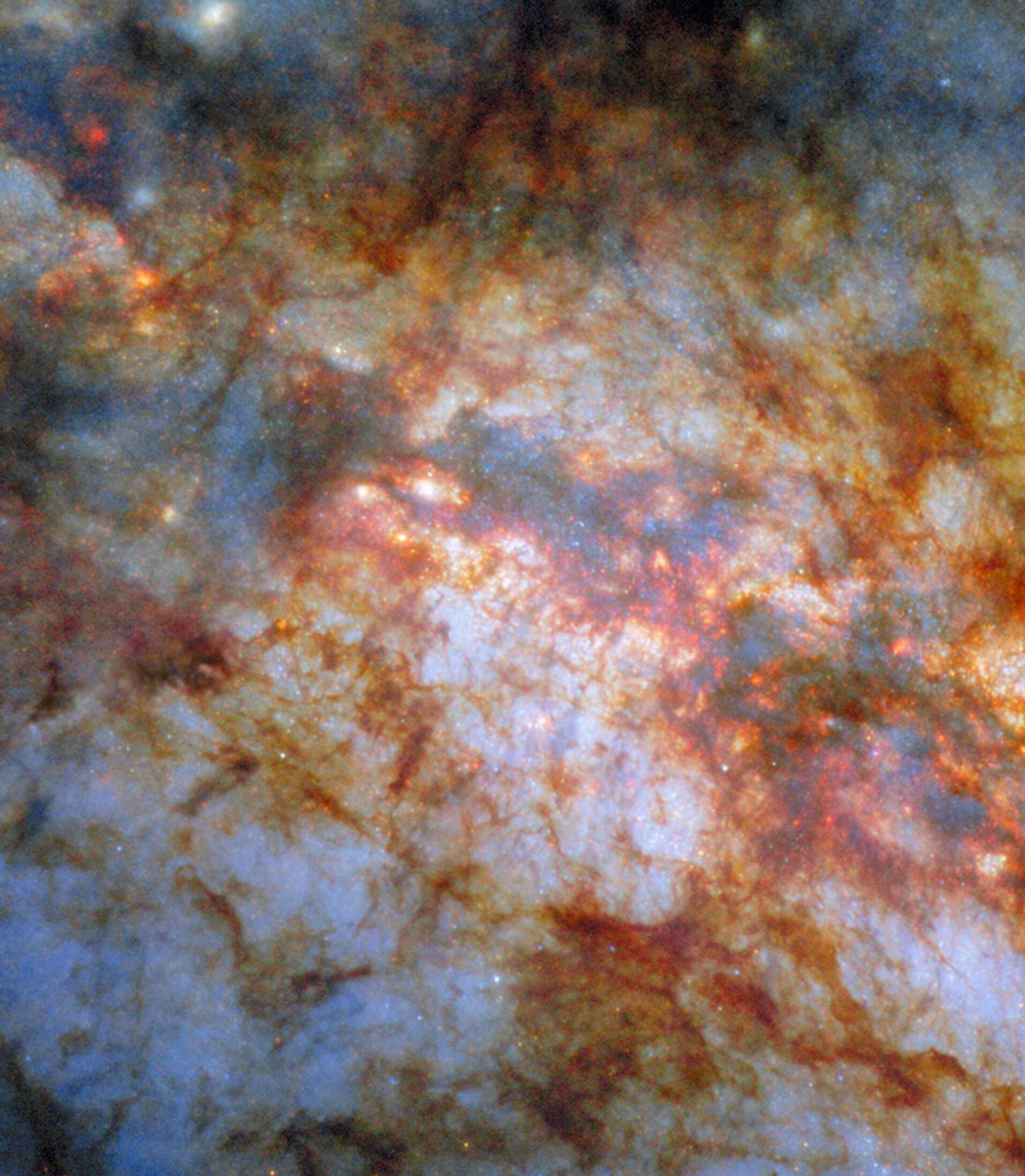
A close-in view of the center of galaxy M82. Bright, bluish light radiating from the center is due to stars actively forming there. A thick lane of gas, black in the center and red around the edges, crosses the center and blocks much of the light. Thinner strands and clumps of reddish dust cover much of the rest of the view.
This NASA/ESA Hubble Space Telescope image features the central region of spiral galaxy Messier 82.
ESA/Hubble & NASA, W. D. Vacca

This NASA/ESA Hubble Space Telescope image reveals new details in Messier 82 (M82), home to brilliant stars whose light is shaded by sculptural clouds made of clumps and streaks of dust and gas. This image features the star-powered heart of the galaxy, located just 12 million light-years away in the constellation Ursa Major (the Great Bear). Popularly known as the Cigar Galaxy, M82 is considered a nearby galaxy.

It’s no surprise that M82 is packed with stars. The galaxy forms stars 10 times faster than the Milky Way. Astronomers call it a starburst galaxy. The intense starbirth period that grips this galaxy gave rise to super star clusters in the galaxy’s heart. Each of these super star clusters holds hundreds of thousands of stars and is more luminous than a typical star cluster. Researchers used Hubble to home in on these massive clusters and reveal how they form and evolve.

Hubble’s previous views of the galaxy captured ultraviolet and visible light in 2012 and near-infrared and visible light in 2006 to celebrate Hubble’s 16th anniversary. NASA’s Chandra X-ray Observatory and Spitzer Space Telescope also imaged this starburst galaxy. Combining the visible and near-infrared light Hubble data with Chandra’s x-ray and Spitzer’s deeper infrared view provides a detailed look at the galaxy’s stars, along with the dust and gas from which stars form. More recently the NASA/ESA/CSA James Webb Space Telescope turned its eye toward the galaxy, producing infrared images in 2024 and earlier this year. These multiple views at different wavelengths of light provide us with a more accurate and complete picture of this galaxy so that we can better understand its environment. Each of these NASA observatories delivers unique and complementary information about the galaxy’s physical processes. Combining their data yields insights that enhance our understanding in a way that no single observatory could accomplish alone. This image features something not seen in previously released Hubble images of the galaxy:Β  data from the High Resolution Channel of the Advanced Camera for Surveys.

Explore More

Facebook logo
Instagram logo

Media Contact:

Claire AndreoliΒ (claire.andreoli@nasa.gov)
NASA’sΒ Goddard Space Flight Center,Β Greenbelt, MD

❌