Reading view

There are new articles available, click to refresh the page.

Survey: Millennials and Gen Z Trading Cocktails for Cannabis Drinks

Younger Americans are increasingly using cannabis-infused beverages as a substitute for alcohol — with one in three millennials and Gen Z workers choosing THC drinks over booze for after-work activities like happy hours, according to a new poll.

The survey from Drug Rehab USA assessed the recreational preferences of 1,000 employed adults, finding more evidence that as the marijuana legalization movement achieves greater success and as awareness of alcohol-related harms has spread, a significant portion of those generations are opting for cannabis over booze.

All told, 66 percent of American adults say they've tried alcohol alternatives over the past six months. And 24 percent of respondents said they've “at least partially” replaced alcohol with non-alcoholic or cannabis-based drinks.

Millennials and Gen Z are leading that trend, as one in three said they used THC beverages instead of alcohol drinks.

“To unwind after work, 45 percent drink alcohol, while 24 percent use nicotine, 20 percent turn to cannabis, and 16 percent choose alcohol alternatives like mocktails, non-alcoholic beer, or CBD,” the survey found.

“When it comes to winding down after a long day, Americans are reaching for a mix of familiar comforts and emerging alternatives,” Drug Rehab USA said. “While alcohol still dominates, the competition between nicotine and cannabis shows how habits are evolving across generations.”

“After-work rituals are no longer limited to a nightly drink — or even to alcohol at all. From THC-infused beverages to nicotine pouches and non-alcoholic alternatives, today's habits reflect a broader redefinition of what it means to unwind. While motivations vary — stress, routine, social connection — the through-line is clear: Americans are turning to consumable rituals to draw a line between work and rest. For many, those rituals begin within the hour and recur multiple times a week.”

The survey findings largely track with other research assessing emerging trends in cannabis and alcohol use.

For example, a recent rodent study determined that the cannabinoid CBD reduces rates of binge drinking and alcohol blood concentrations.

Results of a separate study published in the journal Molecular Psychiatry also indicated that a single, 800-milligram dose of CBD can help manage certain alcohol cravings among people with alcohol use disorder (AUD), supporting the use of the marijuana component as a potential treatment option for problem drinkers.

Federally funded research into the effects of cannabis on alcohol use that was published in May also found that people who used marijuana immediately before drinking subsequently consumed fewer alcoholic beverages and reported lower cravings for alcohol.

The study follows a separate survey analysis published in March that found that three in four young adults reported substituting cannabis for alcohol at least once per week — a “fast-emerging” trend that reflects the “rapid expansion” of the hemp product marketplace.

The report from Bloomberg Intelligence (BI) found that, across various demographics, cannabis is increasingly being used as an alternative to alcohol and even non-alcoholic beverages as more companies — including major multi-state marijuana operators (MSOs) — expand their offerings.

The findings were largely consistent with a growing body of studies indicating that cannabis — whether federally legal hemp or still-prohibited marijuana — is being utilized as a substitute for many Americans amid the reform movement.

An earlier survey from YouGov, for example, found that a majority of Americans believe regular alcohol consumption is more harmful than regular marijuana use. Even so, more adults said they personally prefer drinking alcohol to consuming cannabis despite the health risks.

A separate poll released in January determined that more than half of marijuana consumers say they drink less alcohol, or none at all, after using cannabis.

Yet another survey — which was supported by the National Institute on Drug Abuse (NIDA) and released in December — found that young adults are nearly three times more likely to use marijuana than alcohol on a daily or near-daily basis.

That poll provided more granular, age-specific findings than a similar report published last year, finding that more Americans overall smoke marijuana on a daily basis than drink alcohol every day — and that alcohol drinkers are more likely to say they would benefit from limiting their use than cannabis consumers are.

A separate study published in the journal Addiction last year similarly found that there are more U.S. adults who use marijuana daily than who drink alcohol every day.

In December, BI also published the results of a survey indicating that substitution of cannabis for alcohol is “soaring” as the state-level legalization movement expands and relative perceptions of harm shift. A significant portion of Americans also said in that poll that they substitute marijuana for cigarettes and painkillers.

Another BI analysis from last September projected that the expansion of the marijuana legalization movement will continue to pose a “significant threat” to the alcohol industry, citing survey data that suggests more people are using cannabis as a substitute for alcoholic beverages such as beer and wine.

Yet another study on the impact of marijuana consumption on people's use of other drugs that was released in December suggested that, for many, cannabis may act as a less-dangerous substitute, allowing people to reduce their intake of substances such as alcohol, methamphetamine, and opioids like morphine.

A study out of Canada, where marijuana is federally legal, found that legalization was “associated with a decline in beer sales,” suggesting a substitution effect.

The analyses are consistent with other recent survey data that more broadly looked at American views on marijuana versus alcohol. For example, a Gallup survey found that respondents view cannabis as less harmful than alcohol, tobacco, and nicotine vapes — and more adults now smoke cannabis than smoke cigarettes.

A separate survey released by the American Psychiatric Association (APA) and Morning Consult last June also found that Americans consider marijuana to be significantly less dangerous than cigarettes, alcohol, and opioids — and they say cannabis is less addictive than each of those substances, as well as technology.

Meanwhile, a leading alcohol industry association is calling on Congress to dial back language in a House committee-approved spending bill that would ban most consumable hemp products, instead proposing to maintain the legalization of naturally derived cannabinoids from the crop and only prohibit synthetic items.


Written by Kyle Jaeger for Marijuana Moment | Featured image by Gina Coleman/Weedmaps

The post Survey: Millennials and Gen Z Trading Cocktails for Cannabis Drinks appeared first on Weedmaps News.

Marijuana Use By Older Americans Has Nearly Doubled In The Last Three Years, AARP-Backed Study Shows

A new study supported by AARP shows that marijuana use by older people in the U.S. has nearly doubled in the last three years—with most saying they use cannabis to relieve pain, help with sleep, improve mental health, and achieve other benefits.

More than 1 in 5 Americans aged 50 and older now say they've used marijuana at least once in the past year, according to the survey conducted by the University of Michigan, while more than 1 in 10 consumed cannabis at least monthly. Researchers say they expect use rates among older adults to continue to increase as more states legalize.

Customer and budtender interacting inside a dispensary.Gina Coleman/Weedmaps

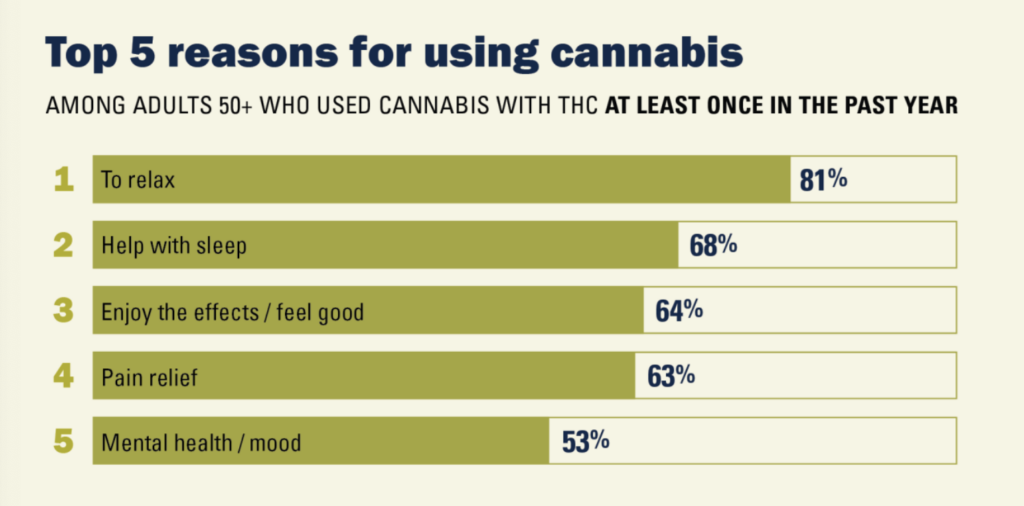
Among respondents who did use cannabis within the past year, 81 percent said it was to relax, 68 percent reported using the drug as a sleep aid, and 64 percent said it was simply to enjoy marijuana's effects and feel good. Another 63 percent said they used cannabis for pain relief, while 53 percent said they used it to promote mental health.

AARP, which supported the study, noted that the 21 percent of Americans over 50 who now report using marijuana in the past year represents an increase in use among older adults nationally—nearly double the 12 percent who said in the prior edition of the poll in 2021 that they consumed cannabis in the past 12 months.

In the latest survey, 12 percent said they used cannabis at least once a month, and 9 percent of people nationally said they consumed marijuana on a weekly basis, while 5 percent said they were daily users.

According to the new survey, the younger segment of older adults—ages 50 to 64—were more likely to use on a monthly basis, as were people in fair or poor health and low-income households.

Graph of the top 5 reasons older adults use cannabis.University of Michigan National Poll on Healthy Aging via Marijuana Moment

In Michigan, which opened adult-use cannabis sales in December 2019, use rates were notably higher, with 27 percent reporting past-year use, 14 percent reporting weekly use, and 9 percent using cannabis daily or almost daily.

The data from the Michigan Poll on Healthy Aging asked 1,079 older adults in Michigan and 3,012 non-Michigan adults about their cannabis habits, focusing on THC-containing products in particular.

Authors of the new report say their findings underscore the need for further cannabis education.

“Our findings, in Michigan and nationally, show the need for more education and awareness, especially among those who choose to use cannabis more frequently,” Erin E. Bonar, a researcher and addiction psychologist, said in a statement.

“With some form of cannabis use now legalized in 38 states and on the ballot this November in several others, and the federal rescheduling process underway, cannabis use is likely to grow,” she added. “But as this poll shows, it is not risk-free, and more attention is needed to identify and reduce those risks.”

More than half (56 percent) of regular cannabis consumers—those who reported using at least monthly—said they'd discussed cannabis use with a healthcare provider, and nearly 4 in 5 (79 percent) said they believe marijuana is stronger than it was in decades past.

Bonar, however, noted that those numbers mean that 21 percent of older adults may not be aware of increases in THC levels since the 1990s and earlier. She also emphasized that while 72 percent of people believe that cannabis can be addictive, that means more than a quarter are at least skeptical.

“We see more people using cannabis as it's legalized, and we don't have enough information yet to know: Are there safe ways of using? Are there recommended guidelines?” Bonar told AARP. “So seeing the number creep up like that in the absence of really good scientific data to help guide people's decisions with this, that's a little bit concerning.”

Jeffrey Kullgren, an internal medicine professor at the University of Michigan and a doctor at the Veterans Affairs Ann Arbor Healthcare system, directed the newly released poll. In a statement, he underscored the importance of people talking to healthcare providers about their cannabis use, which can help identify possibly risky drug interactions as well as signs of problem use.

“Even if your doctor, nurse practitioner or pharmacist doesn't ask if you're using cannabis products, it's important to offer this information, no matter whether you're using it to address a physical or mental health concern, or simply for pleasure,” says Kullgren, a primary care physician at the VA Ann Arbor Healthcare System and associate professor of internal medicine at U-M. “Many prescription medications and over-the-counter drugs, as well as alcohol, can interact with cannabis and cause unexpected or unwanted effects. And there are only a few conditions where we have good evidence of a medical benefit from cannabis, though this could change with time.”

The University of Michigan also noted in a description of the findings that federal rescheduling of cannabis to Schedule III under the Controlled Substances Act (CSA) “may free more researchers to do studies of cannabis-derived products in clinical trials involving human volunteers.”

“Right now,” it adds, “such research is very limited because of federal restrictions.”

The new findings come after a separate study earlier this year concluded that cannabis-based products may provide multiple therapeutic benefits for older adults, including for health, well-being, sleep and mood.

Authors of that study, published in the journal Drugs and Aging, also observed “sizable reductions in pain severity and pain interference among older aged patients [reporting] chronic pain as their primary condition.”

Closeup of customer and budtender's hands holding cannabis jars at a dispensary.Gina Coleman/Weedmaps

Researchers said that the investigation was meant to address “a general paucity of high-quality research” around cannabis and older adults “and a common methodological practice of excluding those aged over 65 years from clinical trials” at a time when older patients are increasingly turning to medical marijuana for relief.

“International evidence that older individuals may be the fastest-growing increase in the use of medical marijuana, coupled with their frequent exclusion from controlled trials, indicates a growing need for real-world evidence to assess the effectiveness and safety of these drugs for older individuals,” the paper said.

Meanwhile, U.S. officials at the National Institutes of Health (NIH) announced this spring that the agency will use $8.4 million to support clinical trials into the safety and efficacy of psychedelic-assisted therapy to treat chronic pain in older adults.

A government notice about the grant program says the research can include “classic” psychedelics—including psilocybin, DMT, LSD, and mescaline—as well as similar compounds such as MDMA. Cannabis and ketamine are not considered psychedelics for the purposes of the clinical trials.

A federally funded study last year found that among U.S. adults, cannabis and psychedelic use were both at “historic highs,” while teen marijuana use remained stable.


Written by Ben Adlin for Marijuana Moment | Featured image by Gina Coleman/Weedmaps

The post Marijuana Use By Older Americans Has Nearly Doubled In The Last Three Years, AARP-Backed Study Shows appeared first on Weedmaps News.

❌