Reading view

There are new articles available, click to refresh the page.

Crypto Interest Fades Among US Investors as Risk Tolerance Declines: FINRA Study

Interest in crypto among US investors has cooled significantly, with fewer considering new purchases despite maintained ownership levels, according to a comprehensive study released by the FINRA Investor Education Foundation.

The findings reveal a broader retreat from high-risk investment behaviors as market conditions and investor attitudes shift dramatically from the pandemic-era surge.

The Financial Industry Regulatory Authority study, based on survey data from 2,861 US investors with non-retirement investment accounts, found that while 27% still hold cryptocurrency, unchanged from 2021, only 26% are now considering purchasing digital assets, down sharply from 33% three years earlier.
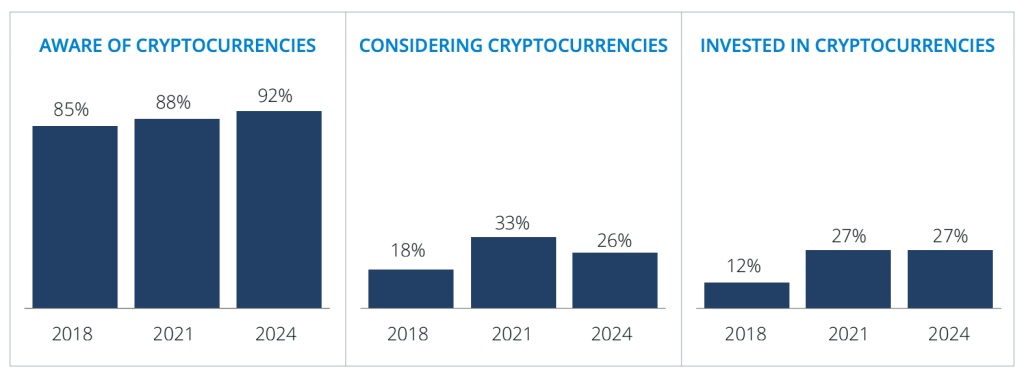
Crypto US Investors FINRA Study - Awareness of crypto
Source: FINRA

New Investors Retreat as Market Enthusiasm Wanes

The pace of Americans entering the investment market has slowed dramatically since the cryptocurrency boom years.

Only 8% of current investors began investing within the past two years, a steep drop from 21% who started during the two years preceding the 2021 study.

The shift suggests the tide of pandemic-era market participation has entirely ebbed, with younger adults particularly affected by the reversal.

Young investors under 35 saw their participation rate fall from 32% in 2021 to 26% in 2024, erasing gains made during the market surge.
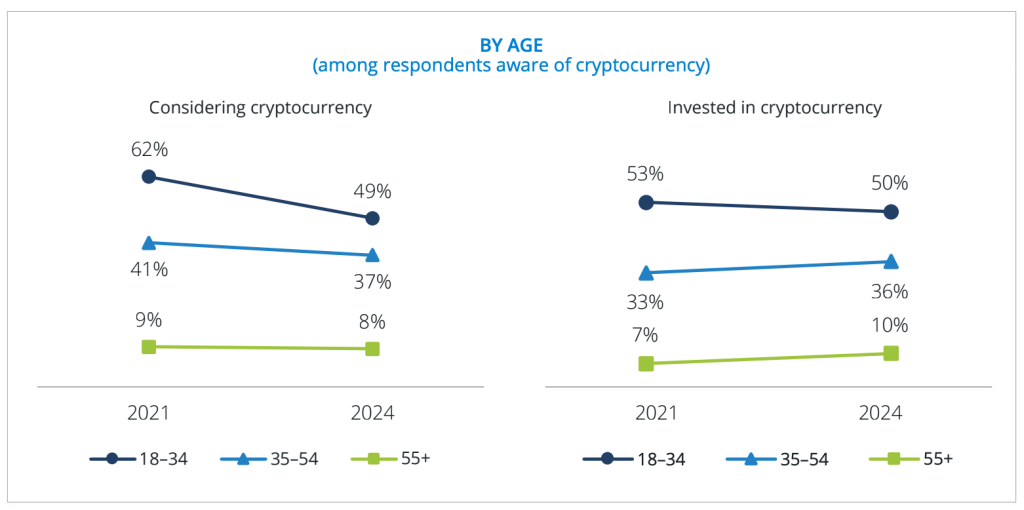
Crypto US Investors FINRA Study - Investment by age
Source: FINRA

Similarly, investment rates declined among people of color and men, reversing increases observed just three years earlier.

The median age of investors who entered the market around 2019-2021 rose from 31 to 38, indicating many younger participants left the market entirely.

Beyond slower entry rates, investors pulled back from various high-risk positions. Cryptocurrency is now viewed as extremely or very risky by 66% of those aware of digital assets, up from 58% in 2021.

The percentage holding penny stocks, REITs, private placements, and structured notes all declined to 2018 levels after brief increases.

Risk Appetite Shrinks Across Demographics

Investors’ willingness to embrace substantial portfolio risk dropped to just 8% in 2024 from 12% in 2021, with the decline most pronounced among younger market participants.

Among investors under 35, those willing to take substantial risks fell from 24% to 15%, creating a notable contradiction; 62% of this age group still believe they need big risks to reach financial goals.

The latest FINRA Foundation research on investors provides rich insights into how market conditions, technology and generational shifts are changing the profile of investing and reshaping investor behaviors and attitudes,” said Jonathan Sokobin, FINRA Foundation Chair and Chief Economist.

Despite reduced risk appetite, younger investors continue to engage in behaviors that carry greater potential losses.

43% of those under 35 trade options, compared to 10% of investors 55 and older, while 22% make margin purchases, versus just 4% of older participants.

Meanwhile, 13% of all investors report buying meme stocks or viral investments, including 29% of those under 35.

The crypto decline appears most dramatic among new investors. Those with less than 2 years’ experience who are considering digital assets dropped from 61% in 2021 to 48% in 2024, while consideration among experienced investors fell less sharply.

Among investors under 35 specifically, cryptocurrency consideration plummeted from 62% to 49%, compared to smaller declines in older age groups.

Social Media Influence Grows Despite Market Caution

The study found social media “Finfluencers” now guide investment decisions for 26% of investors, rising to 61% among those under 35.

YouTube remains the dominant platform for investment information, with 30% overall usage, rising to 61% among younger investors.

Word of mouth from friends and family emerged as the top information source for 85% of investors under 35, surpassing recommendations from financial professionals at 67%.

Concern over investment fraud has risen somewhat, with 37% of investors worried about losing money to scams, up from 31% in 2021.

However, the vast majority, 89%, do not believe they have been targeted in investment fraud.

When presented with a fraudulent offer promising “guaranteed, risk-free 25% annual returns,” half of investors said they would invest, revealing significant gaps in fraud awareness.

FINRA Foundation President Gerri Walsh emphasized the continuing importance of investor education.

They still struggle with gaps in investing knowledge and risk assessment, which can leave them vulnerable to costly missteps,” Walsh said. “Investor education efforts remain critically important.

Notably, the findings oppose broader market trends showing that crypto adoption continues to grow, with separate surveys indicating that over 50 million American adults now own digital assets.

Another also links declining homeownership affordability to increased crypto speculation among younger generations seeking alternative wealth-building strategies.

The post Crypto Interest Fades Among US Investors as Risk Tolerance Declines: FINRA Study appeared first on Cryptonews.


Former Signature Bank Executives Launch N3XT, a Blockchain-Based 24/7 Payments Bank

By: Amin Ayan

Former leaders of the shuttered crypto-friendly Signature Bank have returned with a new venture built around always-on settlement.

Key Takeaways:

  • N3XT is a Wyoming-chartered, fully reserved blockchain bank built for institutional clients.
  • The bank uses a private blockchain with programmable smart-contract payments and will not offer lending.
  • N3XT has secured backing from major crypto investors including Winklevoss Capital, Paradigm and HACK VC.

Their new institution, N3XT, is a state-chartered, blockchain-based bank designed to move money at any hour, with near-instant finality.

N3XT Unveils 24/7 Payments Platform Built on Private Blockchain

Announced on Thursday, N3XT says it will operate on a private blockchain that allows transactions to clear around the clock.

The platform supports programmable payments through smart contracts and is built to work alongside stablecoins, utility tokens and other digital assets.

The institution will run under Wyoming’s Special Purpose Depository Institution framework, a charter that allows fully reserved, non-lending banks designed to custody digital assets.

The effort is led by Signature Bank founder Scott Shay, whose former institution was one of three crypto-linked banks that collapsed during the 2023 banking turmoil.

Signature, alongside Silicon Valley Bank and Silvergate, fell after deposit outflows accelerated and market confidence evaporated.

The Federal Deposit Insurance Corporation seized Signature in March 2023, citing liquidity pressure, concentration risks and a rapid run by large uninsured depositors.

N3XT’s leadership includes another Signature veteran, Jeffrey Wallis, previously the bank’s director of digital asset and Web3 strategy. Wallis will serve as CEO and president. He said the new institution is built around the idea that financial transfers should be as frictionless as sending digital information.

“We’re applying crypto innovations to banking to deliver instant, programmable payments for institutional clients,” Wallis said.

To avoid the vulnerabilities that contributed to Signature’s downfall, N3XT will not offer lending. The bank says all deposits will be backed one-to-one by cash or short-term U.S. Treasurys, with daily disclosures of reserve holdings.

It’s been a long time coming. Today, I am extremely excited to announce the launch of N3XT.

As CEO, I could not be prouder of the team that brought this vision to life. Together, we've built a safer, faster, more modern foundation for how businesses move money. https://t.co/TrDpVJYIo5

— Jeffrey Wallis (@jeffwallis) December 4, 2025

That structure mirrors elements of stablecoin issuers, while keeping the institution within the contours of a regulated bank charter.

The firm is currently onboarding businesses from several industries, including crypto, foreign exchange, shipping, logistics and other sectors that depend on continuous settlement.

N3XT has drawn notable support from the venture community. The company completed three funding rounds with backing from Winklevoss Capital, Paradigm, and HACK VC.

HACK co-founder Alexander Pack wrote on X that the firm is backing N3XT as it emerges from stealth, praising its founders for returning to the industry after Signature’s closure.

European Banking Giants Unite to Launch Euro Stablecoin

As reported, ten of Europe’s largest banks have formed a consortium to issue a euro-backed stablecoin by mid-2026, marking the region’s strongest attempt yet to push back against U.S. dollar dominance in digital finance.

The group, which includes BNP Paribas, ING, UniCredit, CaixaBank, Danske Bank and others, has created an Amsterdam-based entity, Qivalis, to develop a MiCA-compliant digital payment instrument.

Euro-denominated stablecoins remain negligible today, representing just $649 million compared to a market almost entirely controlled by dollar-pegged tokens.

Qivalis has put together a heavyweight leadership team as it moves through regulatory approvals. Former Coinbase Germany chief Jan-Oliver Sell will serve as CEO, with ING veteran Floris Lugt as CFO.

The group has already applied for an electronic money institution license with the Dutch Central Bank, and says more European lenders may still join the initiative.

The post Former Signature Bank Executives Launch N3XT, a Blockchain-Based 24/7 Payments Bank appeared first on Cryptonews.

Bitcoin Whales Go Defensive While Retail Remains Passive: A Tale of Two Markets

Bitcoin has fallen below the $90,000 level, intensifying speculation that the market may be entering the early stages of a broader bearish cycle. The drop comes as on-chain and derivatives data reveal a notable shift in investor behavior, especially among large holders.

According to a recent CryptoQuant report by Darkfost, whales have become significantly more active on Binance, driving a marked increase in BTC inflows to the exchange. This rise in transfers exceeding 100 BTC suggests that the market’s largest players have begun adjusting their positioning, often a sign of evolving risk attitudes and strategic repositioning.

Meanwhile, Bitcoin has been in a corrective phase for nearly two months, consolidating after its prior rally. This pause has been accompanied by a sharp contraction in Open Interest, which has fallen from $47.5 billion to roughly $29 billion today.

The decline reflects substantial disengagement from speculative positions, whether triggered by cautious profit-taking or by liquidations cascading through the derivatives market.

Whale Defense Intensifies as Retail Investors Remain Passive

Darkfost highlights that the rise in whale inflows—measured using a 90-day average—offers a deeper understanding of the current market mood. This metric shows that major holders are prioritizing protection in an increasingly uncertain environment.

Since Bitcoin’s last all-time high, the average whale inflow to Binance has effectively doubled, now approaching 4,000 BTC. Such an increase is rarely insignificant; it typically reflects hedging, de-risking, or preparing liquidity for active repositioning.

In contrast, inflows from retail investors have remained relatively stable and far less volatile. Their exchange activity has not experienced the same directional surge, suggesting that smaller market participants have not meaningfully adjusted their exposure. This divergence creates a striking behavioral split between investor classes.

Binance Whales/Retail Bitcoin Inflows | Source: CryptoQuant

While whales shift into a defensive posture—moving coins, reassessing exposure, and potentially preparing for further downside—retail participants appear more passive. This may indicate slower reaction times to macro and on-chain signals or simply lower capital at risk.

Historically, such patterns emerge during transitional phases in the market, when sophisticated holders take early precautionary measures before broader sentiment shifts. The growing contrast reinforces the idea that Bitcoin is navigating a phase where caution dominates among its biggest players.

Bitcoin Tests 200 SMA as Market Searches for Direction

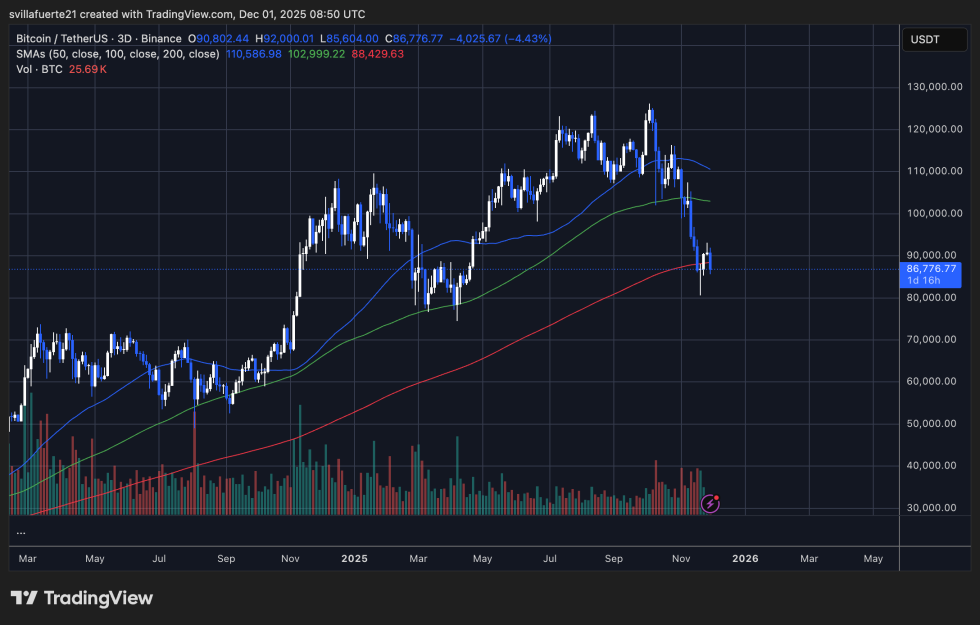
Bitcoin’s 3-day chart shows a decisive shift in momentum, with price breaking below the 50 SMA and 100 SMA after weeks of persistent selling pressure. The failure to hold the $90,000 level pushed BTC into its sharpest correction since mid-2024, and the structure now reflects a market struggling to stabilize. The current candle cluster is forming directly on top of the 200 SMA, a historically significant long-term support zone that often separates cyclical uptrends from deeper bearish phases.

BTC consolidates around key level | Source: BTCUSDT chart on TradingView

The reaction so far has been mixed. BTC briefly dipped below the 200 SMA before recovering back above it, signaling that buyers are attempting to defend the trend boundary. However, the bounce lacks conviction, and volume remains elevated on down candles—an indication that sellers are still aggressive. As long as BTC trades below the 50 and 100 SMAs, the market structure remains vulnerable.

The downtrend also shows a clear sequence of lower highs and lower lows, confirming that momentum favors continuation unless $92,000–$95,000 is reclaimed. Losing the 200 SMA on a closing basis would open the door to deeper retracements toward $78,000 and $72,000, where prior consolidation zones sit.

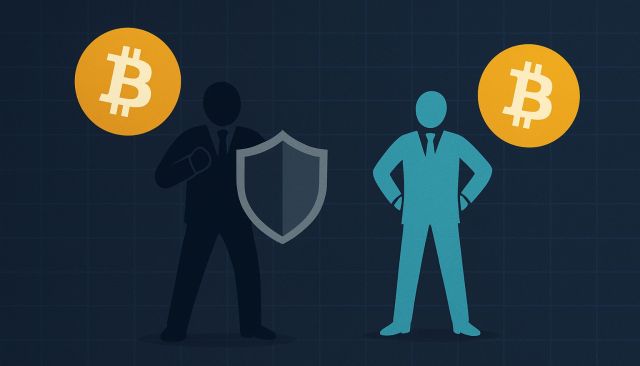
Featured image from ChatGPT, chart from TradingView.com

If You Truly Understood What It Takes to Build a Crypto Exchange, Would You Still Do It?

Table of Contents

Finding the Purpose Behind the Platform

Blueprinting the Technical Architecture

Engineering the Trading Foundation

Securing User Trust Through Compliance

Shaping a User-Friendly Trading Environment

Managing Operations and Market Entry

Expanding for Long-Term Growth

Conclusion

Finding the Purpose Behind the Platform

Every exchange begins with a purpose. Before diving into the technical landscape, creators must clarify why the exchange is being built and who it is meant to serve. In this initial stage, Crypto Exchange Development helps convert ideas into realistic expectations. Businesses outline their target audience, the features users will need, and the long-term goals of the platform.

Some platforms aim for beginner-friendly design, while others focus on high-volume professional trading. This difference shapes the identity of the system early. Many entrepreneurs choose to create your own crypto exchange vision because traditional platforms do not fully meet their intended user experience or business strategy.

Crypto Exchange
What It Takes to Build a Crypto Exchange, Would You Still Do It?

A clear purpose also influences cost, roadmap planning, and how the exchange will compete in a rapidly growing industry.

Blueprinting the Technical Architecture

Once the vision is defined, the next challenge is translating it into a structured technical plan. During this phase, Crypto Exchange Development establishes the system architecture, technology stack, and infrastructure required for long-term scalability.

This blueprint includes backend logic, blockchain connections, database modeling, and performance layers. It ensures that the exchange can handle growth and adapt to market changes. Every architectural decision carries long-term effects from how quickly transactions process to how efficiently new features integrate.

Businesses choosing to create your own crypto exchange system often realize the importance of this stage because it determines how well the exchange will function during peak demand and rapid expansion.

Engineering the Trading Foundation

At the center of every exchange lies the trading engine and its coordinated components. This is the most performance-critical stage, where Crypto Exchange Development focuses on low latency, accurate order matching, and seamless asset movement.

To clarify how this part works,

Core Components of the Trading Structure

  • Matching Engine: Processes buy and sell orders instantly with minimal delay.
  • Order Books: Reflect real-time activity and maintain accurate pricing.
  • Wallet Systems: Manage deposits, withdrawals, and asset storage with reliability.
  • Trading Data Feeds: Update charts and prices without lag to ensure transparency.

A refined trading foundation ensures users enjoy fast execution, even during market volatility. This is one of the reasons companies prefer to create your own crypto exchange tailored to performance, rather than settling for rigid, low-capacity systems.

Securing User Trust Through Compliance

Security and compliance determine whether users trust the platform with their assets. In this stage, Crypto Exchange Development integrates advanced protections, monitoring tools, and verification systems. Security must evolve continuously because threats shift over time.

Compliance adds another layer of responsibility. Exchanges must follow regulations related to identity verification, financial reporting, and anti-fraud rules. Proper compliance builds credibility and allows expansion into multiple regions.

Businesses planning to create your own crypto exchange for global markets often place extra focus on compliance frameworks because they directly affect licensing and operational mobility.

Shaping a User-Friendly Trading Environment

While backend systems power the exchange, the user interface shapes the experience. This section focuses entirely on clarity and simplicity. Here, Crypto Exchange Development works on navigation structure, layout flow, data visibility, and user behavior patterns.

A clean interface builds user comfort. Traders want easy access to charts, order panels, wallet functions, and transaction histories. When the interface feels intuitive, users spend less time figuring out features and more time engaging with the platform.

This experience-driven approach is why many owners choose to create your own crypto exchange with custom layouts that reflect their brand identity and user expectations.

Managing Operations and Market Entry

Running an exchange requires continuous operational management. This section will include the second and final points list, as you requested points in any two subheadings only.

During this stage, Crypto Exchange Development blends technical processes with business workflows. Operations cover user support, monitoring, reporting, and administrative tools. Liquidity is another crucial factor exchanges must ensure active trading markets and stable pricing.

Key Operational Elements

  • Customer Support Systems: Provide guidance through chats, emails, and automated responses.
  • Liquidity Partnerships: Prevent slippage and maintain healthy market conditions.
  • Administrative Dashboards: Help manage data, users, and trading activities efficiently.
  • Monitoring Tools: Track performance, alerts, and unusual movements.

When entering the market, businesses planning to create your own crypto exchange for professional users must invest in operations that keep the platform stable and competitive.

Expanding for Long-Term Growth

After the exchange launches, ongoing improvements determine future success. Growth includes adding new trading options, enhancing speed, improving security, and expanding global reach. This stage ensures the exchange remains relevant as the industry evolves.

During this process, Crypto Exchange Development focuses on scalability the ability to support more users, more assets, and more transactions without compromising performance. Upgrades must stay aligned with market trends such as staking, multi-chain features, token listings, and advanced analytics.

Businesses planning to create your own crypto exchange ecosystem often build scalable systems from the start, ensuring smooth adaptation to future demands.

Conclusion

Understanding the full picture of building an exchange reveals how layered and strategic the process truly is. From purpose-setting and architecture design to operations, security, and long-term scaling, each step plays a vital role. With the right focus and structured approach, businesses can confidently create your own crypto exchange and build a platform equipped for modern digital markets.


If You Truly Understood What It Takes to Build a Crypto Exchange, Would You Still Do It? was originally published in Coinmonks on Medium, where people are continuing the conversation by highlighting and responding to this story.

Harvard Triples Bitcoin ETF Stake, Makes It Largest Public Holding

Bitcoin Magazine

Harvard Triples Bitcoin ETF Stake, Makes It Largest Public Holding

Harvard University’s endowment has been quietly and massively increasing its Bitcoin holdings. 

The university bought more than 6.8 million shares of BlackRock’s iShares Bitcoin Trust (IBIT) as of September 30. The investment is valued at $442.8 million.

This marks a 257% increase from Harvard’s previous holding of 1.9 million shares, worth $116.6 million. The move makes IBIT Harvard’s largest publicly disclosed position. It is also the biggest single-quarter increase in its holdings, according the the filing. 

Harvard Management Company runs the university’s $57 billion endowment. The Bitcoin ETF now represents just under 1% of total endowment assets. 

Bloomberg ETF analyst Eric Balchunas said it is “super rare” for a university to invest in an ETF. He added that the stake is “as good a validation as an ETF can get.”

FUN FACT: Harvard University holds more in Bitcoin ETFs than it holds shares in Microsoft. pic.twitter.com/Lzblc1gjcP

— Bitcoin Magazine (@BitcoinMagazine) November 15, 2025

Despite Bitcoin’s recent price drop below $93,000, the move signals growing institutional acceptance. IBIT remains the world’s largest spot Bitcoin ETF, with nearly $75 billion in net assets.

Harvard also increased its gold exposure. The endowment nearly doubled its holding in SPDR Gold Shares (GLD) to 661,391 shares, worth $235.1 million. 

Other major holdings remain in U.S. tech companies, including Amazon, Microsoft, Meta, and Alphabet. The endowment also added positions in Klarna ($16.8 million) and Taiwan Semiconductor ($59.1 million).

The increase in Bitcoin and gold allocations highlights Harvard’s focus on portfolio diversification. Analysts see this as part of a wider institutional trend. Bitwise analyst Ryan Rasmussen said the stake may grow to 1% or even 5% as peer institutions follow.

Institutions other then Harvard are buying Bitcoin

Other institutions are also increasing Bitcoin ETF exposure. Emory University disclosed a 91% increase in its Grayscale Bitcoin Mini Trust ETF holdings, totaling over $42 million.

An Abu Dhabi sovereign wealth fund, Al Warda Investments, reported a 230% increase in IBIT holdings, now valued at $517.6 million.

Harvard’s Bitcoin move is rare but significant. Institutional investors traditionally avoid ETFs, preferring private equity, real estate, or direct investments. 

The university’s entry could encourage similar strategies across other endowments, pension funds, and sovereign wealth funds.

At the time of writing, Bitcoin’s price is nearing $92,000, putting it almost 30% below its all-time high near $126,000 — a level referenced in earlier market coverage. The drop follows weeks of sharp selling, with BTC sliding from the mid-110,000s — where it was trading when panic hit and rumors swirled about large institutional outflows — to its current lows.

This post Harvard Triples Bitcoin ETF Stake, Makes It Largest Public Holding first appeared on Bitcoin Magazine and is written by Micah Zimmerman.

❌