Reading view

There are new articles available, click to refresh the page.

Crypto Enters First Net-Positive Liquidity Since 2022, Says Delphi Digital

Crypto research firm Delphi Digital argues that global dollar liquidity has quietly flipped from a structural headwind to a marginal tailwind for risk assets for the first time since early 2022 – with 2026 emerging as the key inflection point for digital assets.

In a macro thread on X, Delphi says “the Fed’s rate path heading into next year is the clearest it’s been in years.” Futures imply another 25-basis-point cut by December 2025, taking the federal funds rate to roughly 3.5–3.75%. “The forward curve prices at least 3 more cuts through 2026, putting us in the low 3s by year-end if the path holds,” the firm notes.

Short-term benchmarks have already adjusted. According to Delphi, “SOFR and fed funds have drifted toward the high 3% range. Real rates have rolled over from their 2023–2024 peaks. But nothing has collapsed. This is a controlled descent rather than a pivot.” The characterization is important: this is not a return to zero rates, but a gradual easing that removes pressure on duration and high-beta assets.

The more consequential shift is in the liquidity plumbing. “QT ends on December 1. The TGA is set to draw down rather than refill. The RRP has been fully depleted,” Delphi writes. “Together, these create the first net positive liquidity environment since early 2022.”

Crypto Bulls Can Rejoice As The Macro Regime Is Shifting

In a follow-up post, the firm is explicit: “The Fed’s liquidity buffer is gone. Reverse Repo Balances collapsed from over $2 trillion at the peak to practically zero.” In 2023, a swollen RRP allowed the Treasury to refill its General Account without directly draining bank reserves, because money-market funds could absorb issuance out of the RRP. “With the RRP now at the floor, that buffer no longer exists,” Delphi warns.

From here, “any future Treasury issuance or TGA rebuild has to come directly out of bank reserves.” That forces a policy choice. As Delphi puts it, “The Fed is left with two options: let reserves drift lower and risk another repo spike or expand the balance sheet to provide liquidity directly. Given how badly 2019 went, the second path is far more likely.”

In that scenario, the central bank would shift from shrinking its balance sheet to adding reserves, reversing a core dynamic of the past two years. “Combined with QT ending and the TGA set to draw down, marginal liquidity is turning net positive for the first time since early 2022,” Delphi concludes. “A key headwind for crypto could be fading.”

For the crypto market, the firm frames 2026 as the pivotal year: “2026 is the year policy stops being a headwind and becomes a mild tailwind. The kind that favors duration, large caps, gold, and digital assets with structural demand behind them.”

Rather than calling for an immediate price spike, Delphi’s thesis is that the macro regime is shifting toward a more supportive, liquidity-positive backdrop for Bitcoin and larger crypto assets as policy eases and the era of aggressive balance-sheet contraction comes to an end.

At press time, the total crypto market cap was at $3.1 trillion.

Total crypto market cap

75% Chance Crypto Is ‘Crossing The Chasm’ Now, Says Moonrock Capital Boss

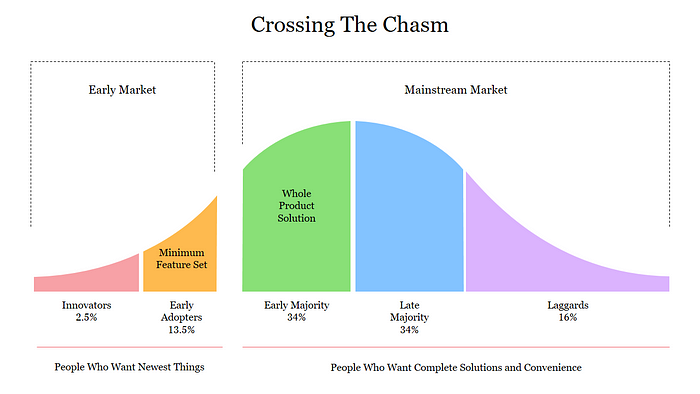
Moonrock Capital founder Simon Dedic says the crypto industry is nearing a decisive transition from an early-adopter niche to a mainstream market, assigning a 75% probability that the sector will “finish crossing the chasm and enter the early-majority phase next year.”

Is The Crypto Market Crossing The Chasm?

Dedic frames his outlook using the classic technology adoption curve, which splits the market into innovators (2.5%), early adopters (13.5%), an early majority (34%), late majority (34%) and laggards (16%). The critical “chasm” lies between early adopters—“people who want newest things” and accept a minimum feature set—and the early majority, who demand a “whole product solution” and prioritize complete, convenient offerings.

Crypto Crossing The Chasm

In his base case, Dedic argues that crypto is now close to exiting that chasm. If so, he says, “the classic 4-year cycles are dead. The market will have matured and will increasingly correlate with macro cycles and industry fundamentals rather than self-fulfilling narratives.” Under this scenario, pricing would be governed less by reflexive narratives around halvings or “altseason” and more by the sector’s real economic role and its interaction with broader financial conditions.

He assigns a 20% probability to a less advanced stage of adoption in which the industry is “still in the early-adopter phase and only now beginning to cross the chasm.” In that case, he believes crypto could face “a 1-3 year bear market while the industry finds itself and pushes toward early-majority adoption.” Here, the established four-year pattern could remain intact, with another prolonged downturn before mainstream product-market fit is fully achieved.

The remaining 5% is reserved for a failure scenario in which the sector never secures such fit. “We get stuck in the chasm and never find true mainstream pmf,” Dedic writes, warning that crypto could then “turn into a zero sum game and we will just PvP trade money from one to the other.”

Dedic makes clear he views that outcome as unlikely. He cites “regulatory tailwinds, institutional adoption, and the accelerating fundamentals of our industry” as reasons to believe the market is already in scenario one, “standing right in front of the biggest adoption wave crypto has ever seen, and likely ever will see.”

He also argues that market structure and culture must evolve alongside adoption. “The 4 year cycles and simple narrative chasing are dead,” he says. While “the onchain online casino will always be part of our identity, it will shrink into a niche. It’s time for the industry to mature and start playing the serious game.”

For Dedic, that conviction is not theoretical. “An incredible decade lies ahead for those willing to evolve,” he concludes, adding that he is “betting basically all my money on the idea that this is only just getting started.”

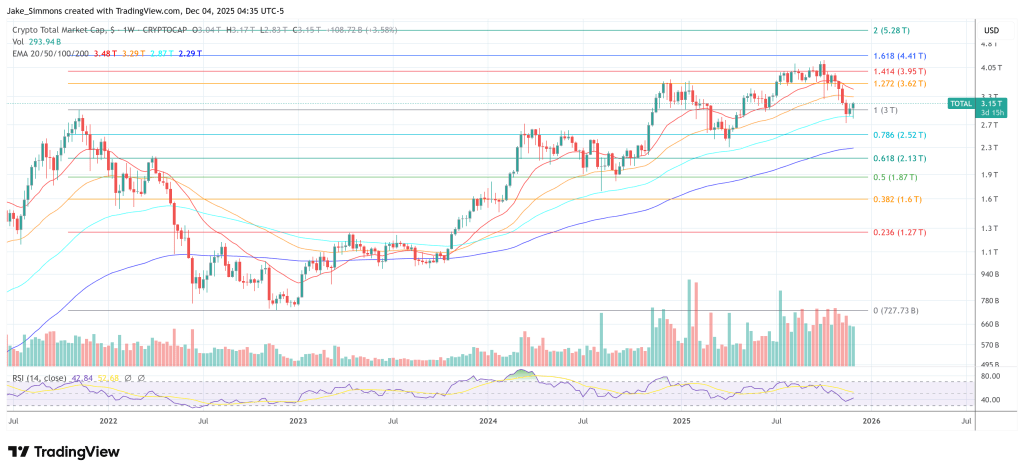
At press time, the total crypto market cap stood at $3.15 trillion.

Total crypto market cap

Why Did Crypto Really Underperform In 2025? The Hard Truths

For most of 2025, the crypto price action felt out of sync with the rest of the risk complex. Equities, gold and even parts of the defense and AI trade found sustained bids, while Bitcoin repeatedly failed to hold breakouts and altcoins bled liquidity.

A widely circulated X post by pseudonymous macro commentator and crypto analyst “plur_daddy” offers one of the most coherent internal diagnoses of what went wrong. His argument is not about a single shock, but about structural supply, fading belief and a new kind of existential risk.

Why Crypto Truly Lagged In 2025

At the core is ownership concentration and the long-awaited six-figure exit ramp. Bitcoin, he argues, “never fully distributed out at lower prices.” Large OG balances accumulated over more than a decade remained tightly held, and 2025 finally offered them both price and liquidity. With spot ETFs, deep derivatives markets and institutional counterparties in place, there was “heavy liquidity available for exiting large bags at the mythical $100k price target,” in line with the long-running meme of “dumping on the suits.”

Around that price region, several narratives converged: the perceived apex of the four-year cycle, a shift in Bitcoin’s image “from being a cypherpunk beacon to a Wall St/Trump family vehicle,” and mounting unease about quantum computing. For holders with essentially their entire net worth in BTC, that mix changed the calculus.

He asks readers to imagine “someone who has massive bags that can’t be sold overnight, with 99.99% of their wealth tied up in a single asset.” Quantum is not cast as an imminent catastrophe, but as a persistent tail risk whose timeline “has been accelerating.” Technical fixes exist, but “they’re all difficult,” and he highlights “the political dysfunction within the Bitcoin dev community.”

Once that worry lodges, he says, “the mind-virus is hard to shake.” With an estimated “$200–250bn+ of OG holdings out there,” it becomes “totally rational to dump a meaningful part of the bag.” In his summary line, “BTC got to a price where the supply overwhelmed the demand in the market.”

The second leg of the underperformance story is narrative. “There wasn’t anything to believe in,” he writes. The meme of financial nihilism may describe reality for some, but “does not captivate the interest of retail buyers.” At the same time, equity markets were selling far more compelling dreams around “AI, quantum, space, drones, nuclear, and defense.”

On the macro-hedge front, “the debasement story for BTC was real but gold simply beat it out.” Bitcoin faced adverse supply dynamics just as gold enjoyed “favorable demand dynamics (Central Bank buying),” weakening BTC’s claim as the superior monetary hedge.

Within crypto itself, there was also a vacuum. In late 2023 and early 2024, the ETFs and then Trump provided powerful, easy-to-grasp narratives. “In 2025,” he argues, “there also wasn’t a narrative around liquidity, or an overarching sense of hope and optimism around what crypto could achieve for the world.”

Liquidity still matters, but in his framing crypto is now “the tip of the spear for liquidity conditions,” a “blow-off valve for excess liquidity.” With conditions “without any doubt” the loosest in 2021 and “meaningfully more loose in 2024 over 2025,” price action simply tracked that tightening.

At the same time, the risk-reward stopped making sense for many participants. BTC “still had a lot of volatility and risk and traded like aids,” he writes, and that was acceptable when the upside was a 3–5x. As people “came to Jesus on the shift in potential upside,” and watched episodes such as the “$10bn seller in July,” they began to question whether trillion-dollar valuations and $500k–$1m BTC really “passed the smell test.”

The internal market structure did the rest. In a “liquidity deprived state,” the game turned increasingly “PvP,” with capital concentrating into sharps who then “offramp the money into other asset classes, helping to fuel them.” Severe altcoin weakness “ultimately became a drag on BTC as well,” because it pushed people to “fully offramp from the crypto ecosystem, instead of taking profits into BTC.”

Looking ahead, his base case is quietly bearish on narratives and quietly constructive on time. Bitcoin “most likely” needs “a period of re-accumulation.” OG selling and quantum awareness will remain overhangs, while “gold and silver are cleaner and simpler bets on debasement.” Liquidity “may improve a lot if Trump successfully takes over the Fed,” but that is “a complex process, and half a year away.”

As of the end of 2025, in his telling, crypto underperformance is not a glitch – it is the logical outcome of who owns the coins, what they fear, and what the rest of the world chose to believe in instead.

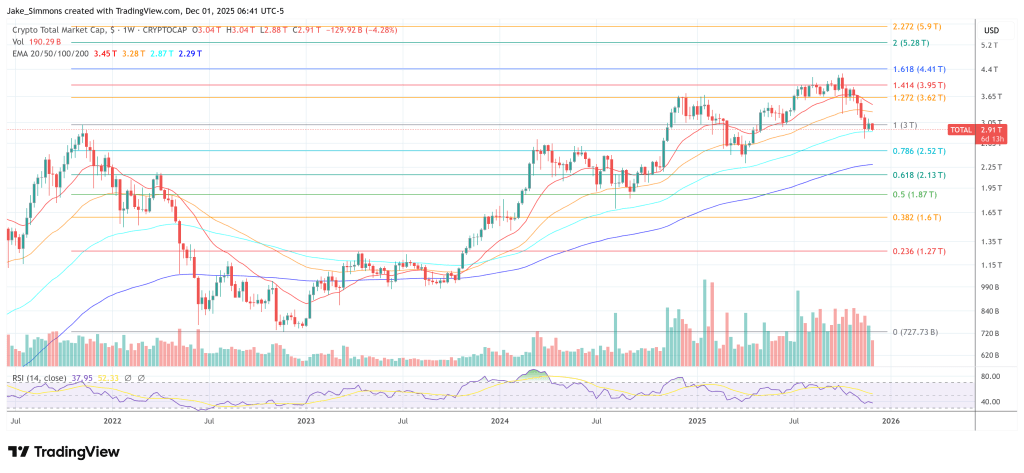
At press time, the total crypto market cap stood at $2.91 trillion.

Total crypto market cap

$32 Million Crypto Heist: North Korea’s Lazarus Suspected In Upbit Breach

South Korea’s largest cryptocurrency exchange, Upbit, is facing a second major security crisis after 44.5 billion won (around $30–32 million) in digital assets were drained from a hot wallet, with authorities “strongly” suspecting North Korea’s Lazarus Group.

According to ICT industry sources and government officials cited by Yonhap News on November 28, investigators are focusing on Lazarus, a hacking unit under North Korea’s Reconnaissance General Bureau, as the likely perpetrator. The group was also suspected in Upbit’s 2019 breach, when approximately 58 billion won in Ethereum was stolen.

North Korean Crypto Hackers Strike Again

The latest incident again centers on a hot wallet — an internet-connected operational wallet — replicating the core vulnerability of 2019. A government official quoted by Yonhap said the attack likely did not involve a deep server exploit but instead an administrative compromise: “Rather than a server attack, it’s possible they compromised an administrator account or impersonated an administrator to transfer funds,” adding that because the earlier hack used this method, “we consider this approach the most likely.”

Security experts point to the post-hack on-chain behavior as key circumstantial evidence. After the theft, the funds were rapidly “hopped” through other exchange wallets and then subjected to “mixing,” a laundering technique designed to break traceability.

One expert noted that “funds were hopped to other exchange wallets before mixing occurred. This can be seen as the modus operandi of the Lazarus Group,” adding that “once mixing occurs, transactions become untraceable.” Because FATF member countries cannot legally operate mixing services, the expert argued it is “highly likely North Korea was responsible.”

The timing has raised additional suspicion. The hack occurred on November 27, the same day Naver and Upbit operator Dunamu held a high-profile joint press conference at Naver’s “1784” headquarters to present their group-integration and AI/Web3 expansion strategy.

A security expert suggested the date may have been intentionally chosen: “Hackers often have a strong desire to show off. It’s possible they chose the 27th as the hacking date to flaunt their timing, selecting the very day of the merger announcement.” The attack also lands almost exactly six years after Upbit’s 2019 hack, which occurred on November 27.

Regulatory and supervisory bodies have moved quickly. Following a December interpretation by the Financial Services Commission that virtual asset exchanges’ user transaction data falls under the Credit Information Act, the Financial Supervisory Service and the Korea Financial Security Institute have launched an on-site inspection of Upbit. The Korea Internet & Security Agency has joined to provide technical support.

At press time, the total crypto market cap stood at $3.07 trillion.

Total crypto market cap

❌