Reading view

There are new articles available, click to refresh the page.

Discovery Alert: ‘Baby’ Planet Photographed in a Ring around a Star for the First Time! 
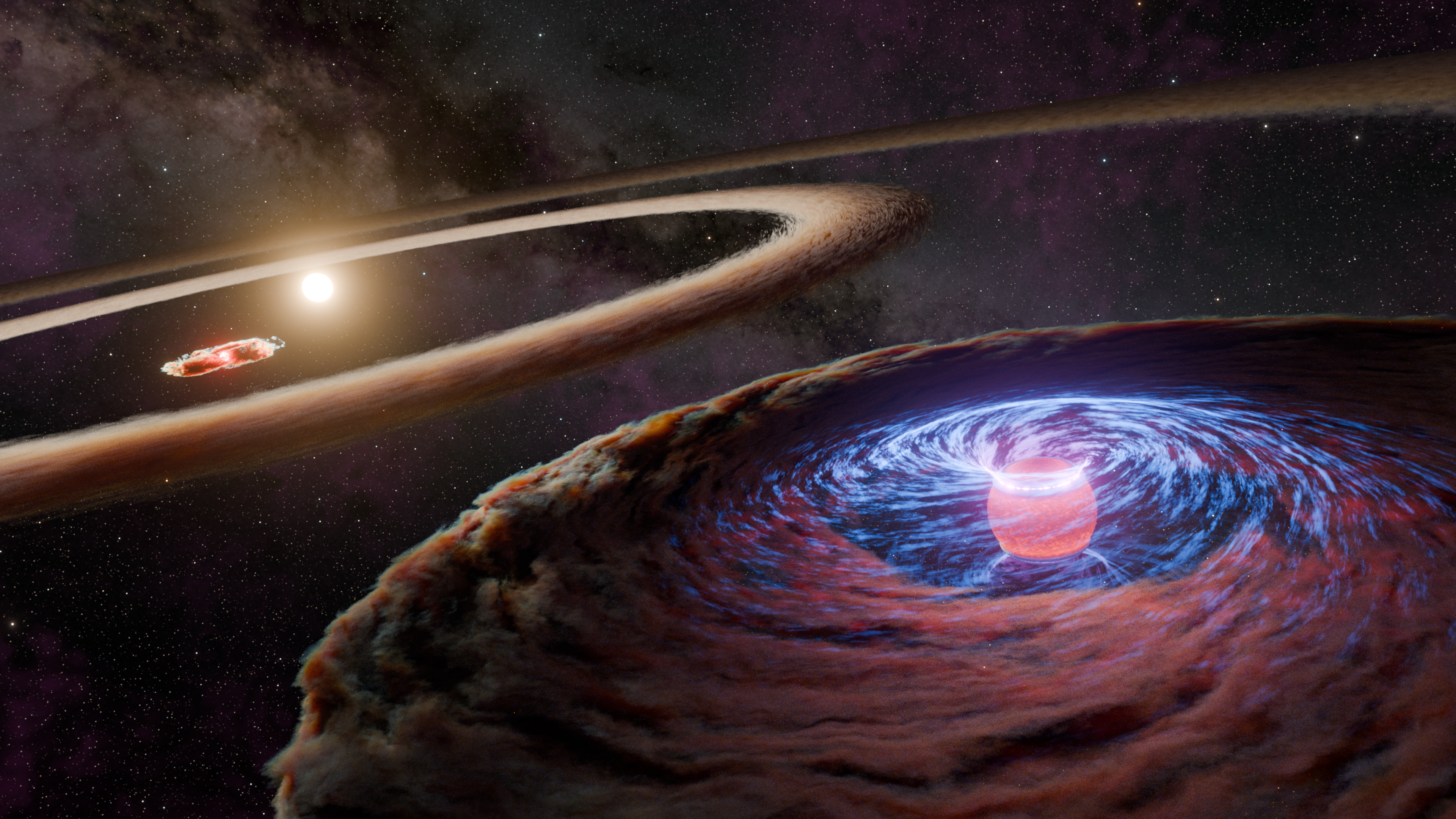
This artist's concept depicts the protoplanet WISPIT 2b accreting matter as it orbits around its star, WISPIT 2.
This artist’s concept depicts the protoplanet WISPIT 2b accreting matter as it orbits around its star, WISPIT 2.
NASA/JPL-Caltech/R. Hurt (IPAC)

The (Proto) Planet: 

WISPIT 2b 

The Discovery: 

Researchers have discovered a young protoplanet called WISPIT 2b embedded in a ring-shaped gap in a disk encircling a young star. While theorists have thought that planets likely exist in these gaps (and possibly even create them), this is the first time that it has actually been observed.

This image of the WISPIT 2 system was captured by the Magellan Telescope in Chile and the Large Binocular Telescope in Arizona. The protoplanet WISPIT 2b is a small purple dot to the right of a bright white ring of dust surrounding the system's star. A fainter white ring outside of WISPIT 2b can be seen.
This image of the WISPIT 2 system was captured by the Magellan Telescope in Chile and the Large Binocular Telescope in Arizona. The protoplanet WISPIT 2b is a small purple dot to the right of a bright white ring of dust surrounding the system’s star. A fainter white ring outside of WISPIT 2b can be seen.
Laird Close, University of Arizona

Key Takeaway: 

Researchers have directly detected – essentially photographed – a new planet called WISPIT 2b, labeled a protoplanet because it is an astronomical object that is accumulating material and growing into a fully-realized planet. However, even in its “proto” state, WISPIT 2b is a gas giant about 5 times as massive as Jupiter. This massive protoplanet is just about 5 million years old, or almost 1,000 times younger than the Earth, and about 437 light-years from Earth. 

Being a giant and still-growing baby planet, WISPIT 2b is interesting to study on its own, but its location in this protoplanetary disk gap is even more fascinating. Protoplanetary disks are made of gas and dust that surround young stars and function as the birthplace for new planets. 

Within these disks, gaps or clearings in the dust and gas can form, appearing as empty rings. Scientists have long suggested that these growing planets are likely responsible for clearing the material in these gaps, pushing and scattering dusty disk material outwards and greeting the ring gaps in the first place. Our own solar system was once just a protoplanetary disk, and it’s possible that Jupiter and Saturn may have cleared ring gaps like this in that disk  many, many years ago. 

But despite continued observation of stars with these kinds of disks, there was never any direct evidence of a growing planet found in one of these ring gaps. That is, until now. As reported in this paper, WISPIT 2b was directly observed in one of the ring gaps around its star, WISPIT 2. 

Another interesting aspect of this discovery is that WISPIT 2b appears to have formed where it was found, it didn’t form elsewhere and move into the gap somehow. 
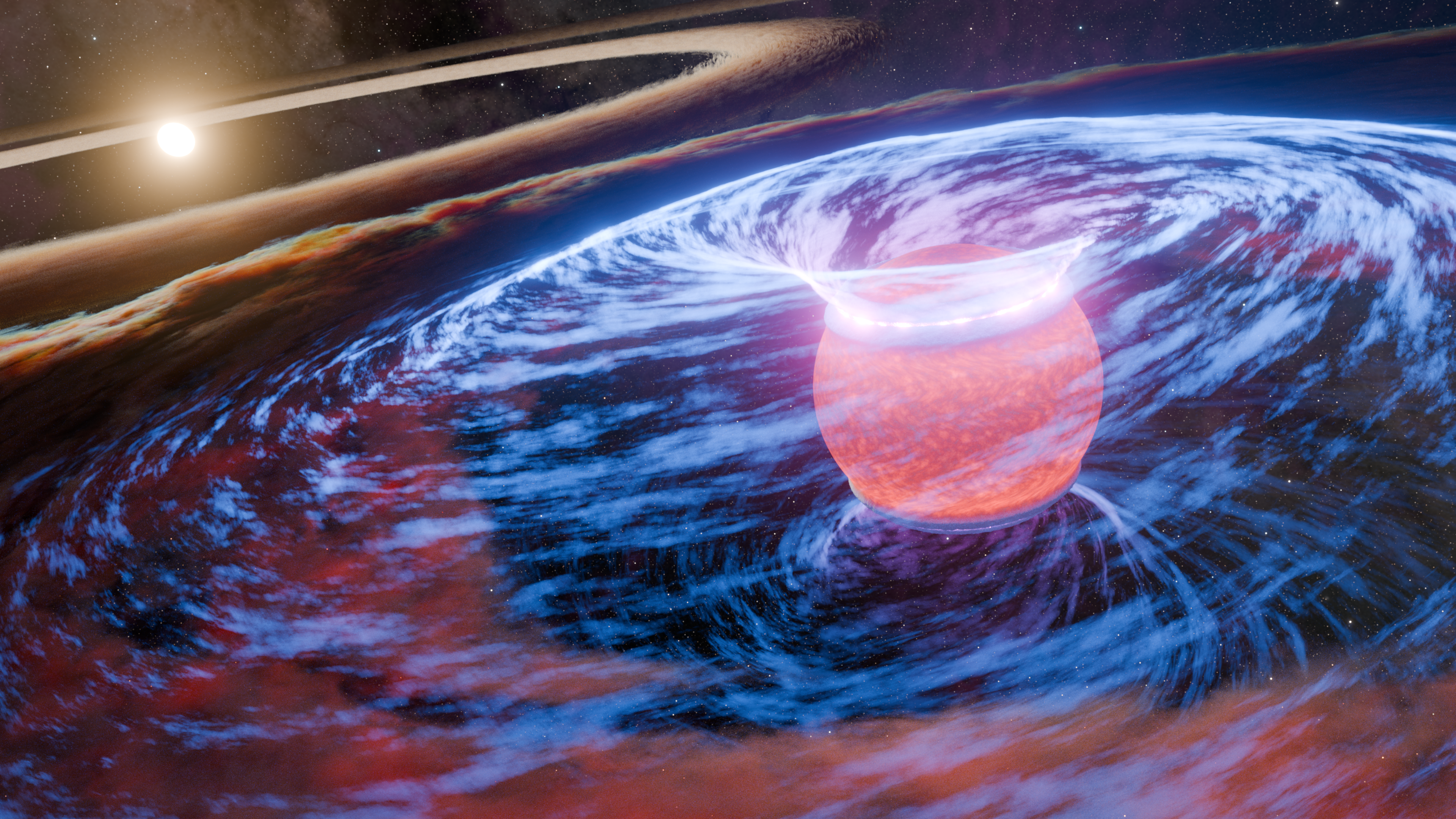
This artist's concept depicts a close-up of the protoplanet WISPIT 2b accreting matter as it orbits around its star, WISPIT 2.
This artist’s concept depicts a close-up of the protoplanet WISPIT 2b accreting matter as it orbits around its star, WISPIT 2.
NASA/JPL-Caltech/R. Hurt (IPAC)

Details: 

The star WISPIT 2 was first observed using VLT-SPHERE (Very Large Telescope – Spectro-Polarimetric High-contrast Exoplanet REsearch), a ground-based telescope in northern Chile operated by the European Southern Observatory. In these observations, the rings and gap around this star were first seen. 

Following these observations of the system, researchers looked at WISPIT 2, and spotted the planet WISPIT 2b for the first time, using the University of Arizona’s MagAO-X extreme adaptive optics system, a high-contrast exoplanet imager at the Magellan 2 (Clay) Telescope at Las Campanas Observatory in Chile. 

This technology adds another unique layer to this discovery. The MagAO-X instrument captures direct images, so it didn’t just detect WISPIT 2b, it essentially captured a photograph of the protoplanet.    

The team used this technology to study the WISPIT 2 system in what is called H-alpha, or Hydrogen-alpha, light. This is a type of visible light that is emitted when hydrogen gas falls from a protoplanetary disk onto young, growing planets. This could look like a ring of super heated plasma circling the planet. This plasma emits the H-alpha light that MagAO-X is specially designed to detect (even if it is a very faint signal compared to the bright star nearby). 

When looking at the system in H-alpha light, the team spotted a clear dot in one of the dark ring gaps in the disk around WISPIT 2. This dot? The planet WISPIT 2b. 

In addition to observing the protoplanet’s H-alpha emission using MagAO-X, the team also studied the protoplanet in other wavelengths of infrared light using the LMIRcam detector as part of the The Large Binocular Telescope Interferometer instrument on the University of Arizona’s Large Binocular Telescope.

Fun Facts: 

In addition to discovering WISPIT 2b, this team spotted a second dot in one of the other dark ring gaps even closer to the star WISPIT 2. This second dot has been identified as another candidate planet that will likely be investigated in future studies of the system. 

The Discoverers: 

WISPIT-2b was discovered by a team led by University of Arizona astronomer Laird Close and Richelle van Capelleveen, an astronomy graduate student at Leiden Observatory in the Netherlands. This followed the recent discovery of the WISPIT 2 disk and ring system using the VLT, which was led by van Capelleveen. 

This discovery was detailed in the paper “Wide Separation Planets in Time (WISPIT): Discovery of a Gap Hα Protoplanet WISPIT 2b with MagAO-X,” published August 26, 2025 in the Astrophysical Journal Letters. A second paper led by van Capelleveen and the University of Galway published on the same day in the Astrophysical Journal Letters. 

This research was partially supported by a grant from the NASA eXoplanet Research Program. MagAO-X was developed in part by a grant from the U.S. National Science Foundation with support from the Heising-Simons Foundation.

NASA’s Tally of Planets Outside Our Solar System Reaches 6,000

6 min read

Preparations for Next Moonwalk Simulations Underway (and Underwater)

It’s been 30 years since the discovery of the first planet around another star like our Sun. With every new discovery, scientists move closer to answering whether there are other planets like Earth that could host life as we know it. NASA/JPL-Caltech

The milestone highlights the accelerating rate of discoveries, just over three decades since the first exoplanets were found.

The official number of exoplanets — planets outside our solar system — tracked by NASA has reached 6,000. Confirmed planets are added to the count on a rolling basis by scientists from around the world, so no single planet is considered the 6,000th entry. The number is monitored by NASA’s Exoplanet Science Institute (NExScI), based at Caltech’s IPAC in Pasadena, California. There are more than 8,000 additional candidate planets awaiting confirmation, with NASA leading the world in searching for life in the universe.

“This milestone represents decades of cosmic exploration driven by NASA space telescopes — exploration that has completely changed the way humanity views the night sky,” said Shawn Domagal-Goldman, acting director, Astrophysics Division, NASA Headquarters in Washington. “Step by step, from discovery to characterization, NASA missions have built the foundation to answering a fundamental question: Are we alone? Now, with our upcoming Nancy Grace Roman Space Telescope and Habitable Worlds Observatory, America will lead the next giant leap — studying worlds like our own around stars like our Sun. This is American ingenuity, and a promise of discovery that unites us all.”

Artist’s concept, from small, rocky worlds and gas giants
Scientists have found thousands of exoplanets (planets outside our solar system) throughout the galaxy. Most can be studied only indirectly, but scientists know they vary widely, as depicted in this artist’s concept, from small, rocky worlds and gas giants to water-rich planets and those as hot as stars.
NASA’s Goddard Space Flight Center

The milestone comes 30 years after the first exoplanet was discovered around a star similar to our Sun, in 1995. (Prior to that, a few planets had been identified around stars that had burned all their fuel and collapsed.) Although researchers think there are billions of planets in the Milky Way galaxy, finding them remains a challenge. In addition to discovering many individual planets with fascinating characteristics as the total number of known exoplanets climbs, scientists are able to see how the general planet population compares to the planets of our own solar system.

For example, while our solar system hosts an equal number of rocky and giant planets, rocky planets appear to be more common in the universe. Researchers have also found a range of planets entirely different from those in our solar system. There are Jupiter-size planets that orbit closer to their parent star than Mercury orbits the Sun; planets that orbit two stars, no stars, and dead stars; planets covered in lava; some with the density of Styrofoam; and others with clouds made of gemstones.

“Each of the different types of planets we discover gives us information about the conditions under which planets can form and, ultimately, how common planets like Earth might be, and where we should be looking for them,” said Dawn Gelino, head of NASA’s Exoplanet Exploration Program (ExEP), located at the agency’s Jet Propulsion Laboratory in Southern California. “If we want to find out if we’re alone in the universe, all of this knowledge is essential.” 

Searching for other worlds

Fewer than 100 exoplanets have been directly imaged, because most planets are so faint they get lost in the light from their parent star. The other four methods of planet detection are indirect. With the transit method, for instance, astronomers look for a star to dim for a short period as an orbiting planet passes in front of it.

To account for the possibility that something other than an exoplanet is responsible for a particular signal, most exoplanet candidates must be confirmed by follow-up observations, often using an additional telescope, and that takes time. That’s why there is a long list of candidates in the NASA Exoplanet Archive (hosted by NExScI) waiting to be confirmed.

“We really need the whole community working together if we want to maximize our investments in these missions that are churning out exoplanets candidates,” said Aurora Kesseli, the deputy science lead for the NASA Exoplanet Archive at IPAC. “A big part of what we do at NExScI is build tools that help the community go out and turn candidate planets into confirmed planets.”

The rate of exoplanet discoveries has accelerated in recent years (the database reached 5,000 confirmed exoplanets just three years ago), and this trend seems likely to continue. Kesseli and her colleagues anticipate receiving thousands of additional exoplanet candidates from the ESA (European Space Agency) Gaia mission, which finds planets through a technique called astrometry, and NASA’s upcoming Nancy Grace Roman Space Telescope, which will discover thousands of new exoplanets primarily through a technique called gravitational microlensing.

Artists concept of various exoplanet missions
Many telescopes contribute to the search for and study of exoplanets, including some in space (artists concepts shown here) and on the ground. Doing the work are organizations around the world, including ESA (European Space Agency), CSA (Canadian Space Agency), and NSF (National Science Foundation).
NASA/JPL-Caltech

Future exoplanets

At NASA, the future of exoplanet science will emphasize finding rocky planets similar to Earth and studying their atmospheres for biosignatures — any characteristic, element, molecule, substance, or feature that can be used as evidence of past or present life. NASA’s James Webb Space Telescope has already analyzed the chemistry of over 100 exoplanet atmospheres.

But studying the atmospheres of planets the size and temperature of Earth will require new technology. Specifically, scientists need better tools to block the glare of the star a planet orbits. And in the case of an Earth-like planet, the glare would be significant: The Sun is about 10 billion times brighter than Earth — which would be more than enough to drown out our home planet’s light if viewed by a distant observer.

NASA has two main initiatives to try overcoming this hurdle. The Roman telescope will carry a technology demonstration instrument called the Roman Coronagraph that will test new technologies for blocking starlight and making faint planets visible. At its peak performance, the coronagraph should be able to directly image a planet the size and temperature of Jupiter orbiting a star like our Sun, and at a similar distance from that star. With its microlensing survey and coronagraphic observations, Roman will reveal new details about the diversity of planetary systems, showing how common solar systems like our own may be across the galaxy.

Additional advances in coronagraph technology will be needed to build a coronagraph that can detect a planet like Earth. NASA is working on a concept for such a mission, currently named the Habitable Worlds Observatory.

More about ExEP, NExScI 

NASA’s Exoplanet Exploration Program is responsible for implementing the agency’s plans for the discovery and understanding of planetary systems around nearby stars. It acts as a focal point for exoplanet science and technology and integrates cohesive strategies for future discoveries. The science operations and analysis center for ExEP is NExScI, based at IPAC, a science and data center for astrophysics and planetary science at Caltech. JPL is managed by Caltech for NASA.

/

News Media Contact

Calla Cofield
Jet Propulsion Laboratory, Pasadena, Calif.
626-808-2469
calla.e.cofield@jpl.nasa.gov

2025-119

💾

The official number of exoplanets, planets outside our solar system, confirmed by NASA has reached 6,000.Thirty years ago, the first exoplanet was discovered a...
❌