Reading view

There are new articles available, click to refresh the page.

NASA Sets Coverage for Astronaut Jonny Kim, Crewmates Return
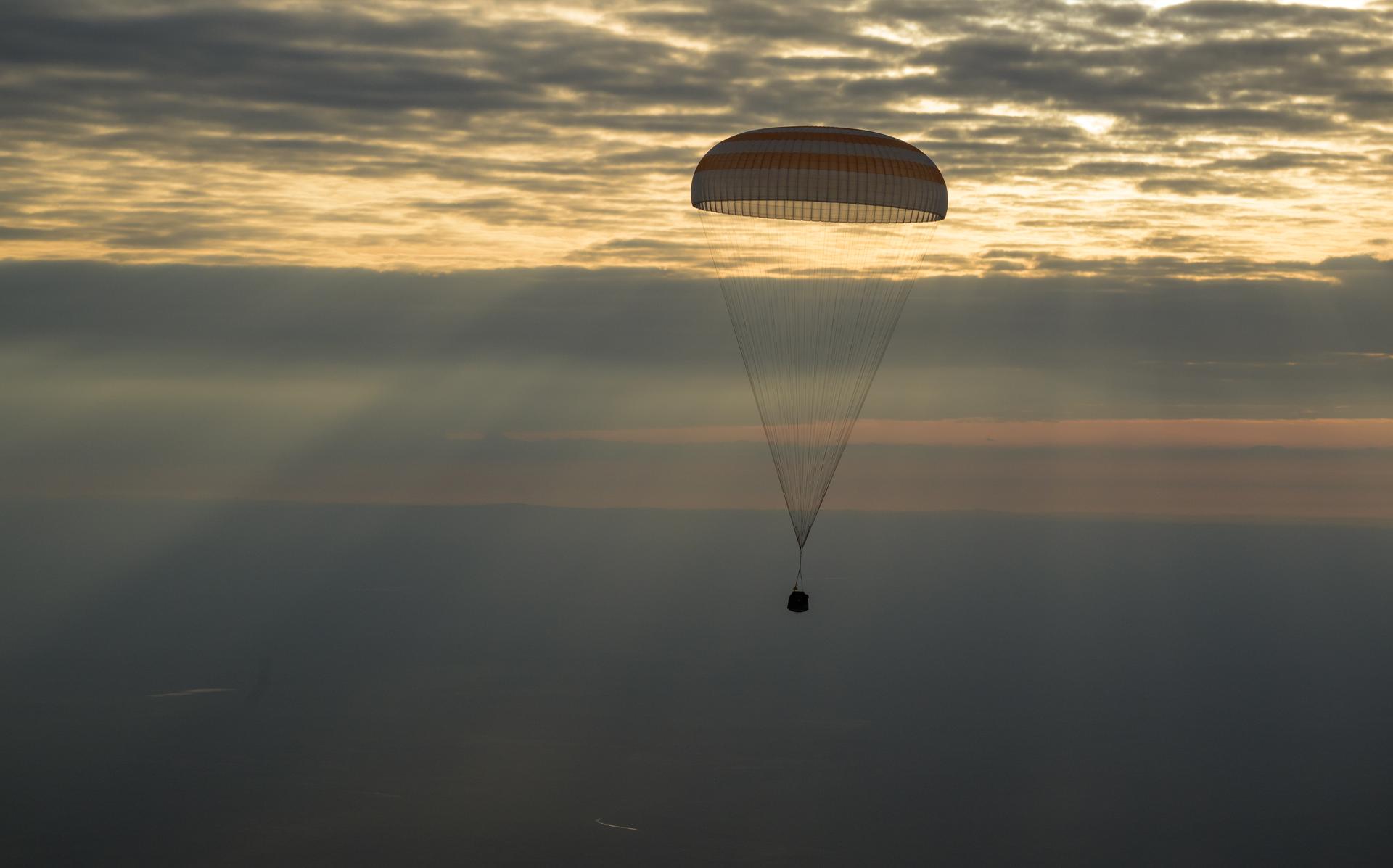
The photo features a dim horizon with the Soyuz MS-26 spacecraft as it lands by parachute.
The Soyuz MS-26 spacecraft is seen as it lands on April 20, 2025 (April 19 Eastern time) in a remote area near the town of Zhezkazgan, Kazakhstan, with the Expedition 71/72 crew aboard.
NASA/Bill Ingalls

NASA astronaut Jonny Kim, accompanied by Roscosmos cosmonauts Sergey Ryzhikov and Alexey Zubritsky, is preparing to depart the International Space Station aboard the Soyuz MS-27 spacecraft and return to Earth.

Kim, Ryzhikov, and Zubritsky will undock from the station’s Prichal module at 8:41 p.m. EST on Monday, Dec. 8, headed for a parachute-assisted landing at 12:04 a.m. on Tuesday, Dec. 9 (10:04 a.m. local time in Kazakhstan), on the steppe of Kazakhstan, southeast of the city of Dzhezkazgan.

Watch NASA’s live coverage of the crew’s return on NASA+, Amazon Prime, and the agency’s YouTube channel. Learn how to stream NASA content through a variety of online platforms, including social media.

The space station change of command ceremony will begin at 10:30 a.m. Sunday, Dec. 7, on NASA+ and the agency’s YouTube channel. Rzyhikov will hand over station command to NASA astronaut Mike Fincke for Expedition 74, which begins at the time of Soyuz MS-27 undocking.

Kim and his crewmates are completing a 245-day mission aboard the station. At the conclusion of their mission, they will have orbited Earth 3,920 times and traveled nearly 104 million miles. This was the first flight for Kim and Zubritsky to the orbiting laboratory, while Ryzhikov is ending his third trip to space.

After landing, the three crew members will fly by helicopter to Karaganda, Kazakhstan, where recovery teams are based. Kim will board a NASA aircraft and return to Houston, while Ryzhikov and Zubritsky will depart for their training base in Star City, Russia.

NASA’s coverage is as follows (all times Eastern and subject to change based on real-time operations):

Sunday, Dec. 7:

10:30 a.m. – Expedition 73/74 change of command ceremony begins on NASA+ Amazon Prime, and YouTube.

Monday, Dec. 8:

4:45 p.m. – Farewells and hatch closing coverage begins on NASA+, Amazon Prime, and YouTube.

5:10 p.m. – Hatch closing

8:15 p.m. – Undocking coverage beings on NASA+, Amazon Prime, and YouTube.

8:41 p.m. – Undocking

10:30 p.m. – Deorbit and landing coverage begins on NASA+, Amazon Prime, and YouTube.

11:10 p.m. – Deorbit burn

Tuesday, Dec. 9:

12:04 a.m. – Landing

For more than 25 years, people have lived and worked continuously aboard the International Space Station, advancing scientific knowledge and making research breakthroughs that are not possible on Earth. The station is a critical testbed for NASA to understand and overcome the challenges of long-duration spaceflight and to expand commercial opportunities in low Earth orbit. As commercial companies concentrate on providing human space transportation services and destinations as part of a robust low Earth orbit economy, NASA is focusing its resources on deep space missions to the Moon as part of the Artemis campaign in preparation for future human missions to Mars.

Learn more about International Space Station research and operations at:

https://www.nasa.gov/station

-end-

Josh Finch / Jimi Russell
Headquarters, Washington
202-358-1100
joshua.a.finch@nasa.gov / james.j.russell@nasa.gov

Sandra Jones / Joseph Zakrzewski
Johnson Space Center, Houston
281-483-5111
sandra.p.jones@nasa.gov / joseph.a.zakrzewski@nasa.gov
Share

Details

Last Updated
Dec 04, 2025
Editor
Elizabeth Shaw

NASA’s Moon Rocket Celebrates 250 Years of American Innovation

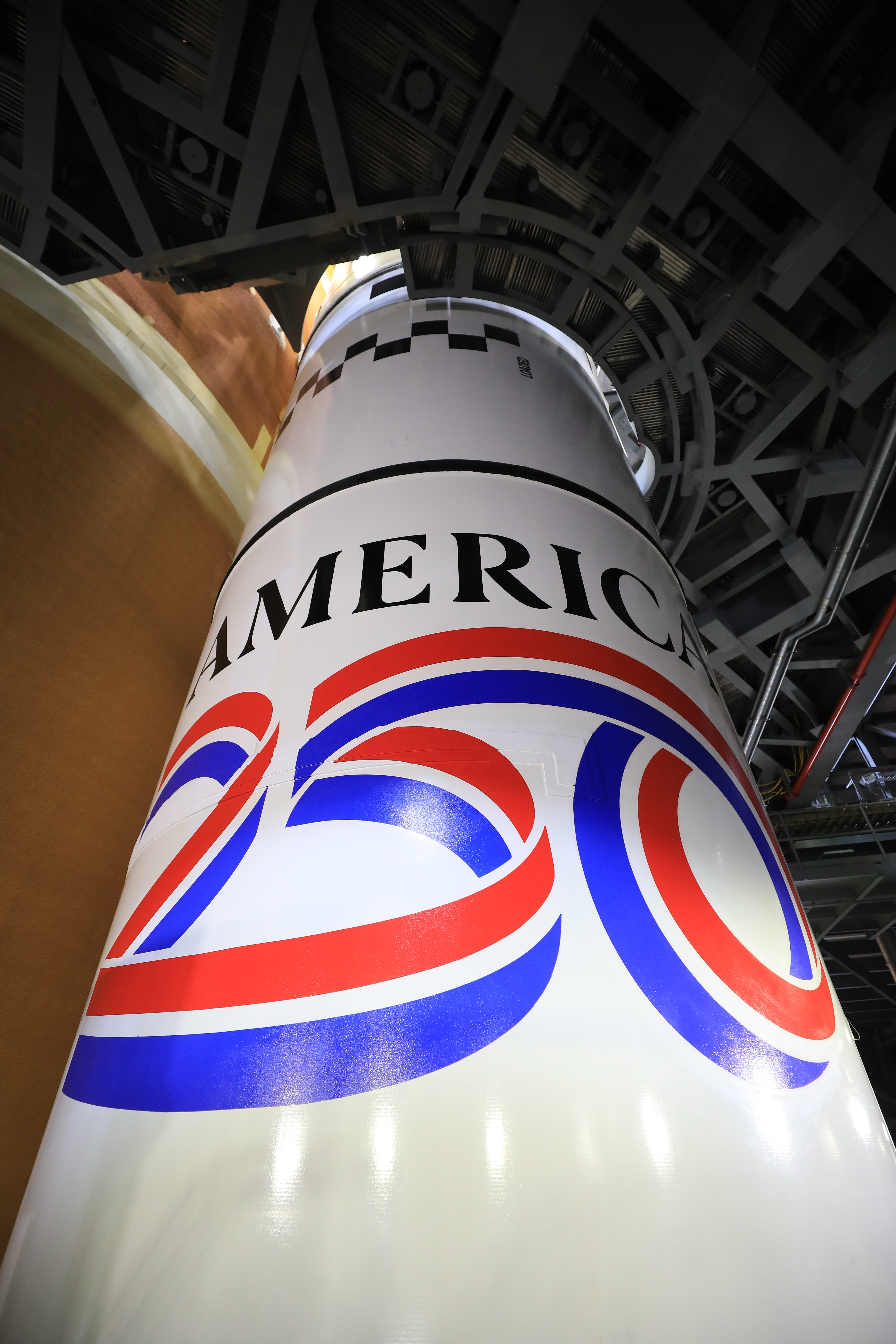
Image shows the America 250 logo in black, red, blue colors painted on the white solid rocket boosters of NASA's SLS (Space Launch System) rocket at NASA's Kennedy Space Center in Florida on Dec. 1, 2025.

NASA is marking America’s 250th year with a bold new symbol of the nation’s relentless drive to explore.

The America 250 emblem is now on the twin solid rocket boosters of the SLS (Space Launch System) rocket for Artemis II — the powerhouse that will launch a crew of four around the Moon next year. Unveiled Tuesday, the design echoes the America 250 Commission’s Spirit of Innovation theme, honoring a country that has never stopped pushing the horizon forward.

At NASA’s Kennedy Space Center in Florida, technicians spent recent weeks carefully applying the emblem on the rocket inside the Vehicle Assembly Building — the same place where rockets for Apollo once stood. Engineers are running final tests on SLS and the Orion spacecraft as preparations intensify for Artemis II.

The roughly 10-day Artemis II journey around the Moon will mark a defining moment in this new era of American exploration — paving the way for U.S. crews to land on the lunar surface and ultimately push onward to Mars.

America’s spirit of discovery is alive, and Artemis is carrying it to the Moon and beyond.

Image credit: NASA/Ben Smegelsky

What is BioSentinel?

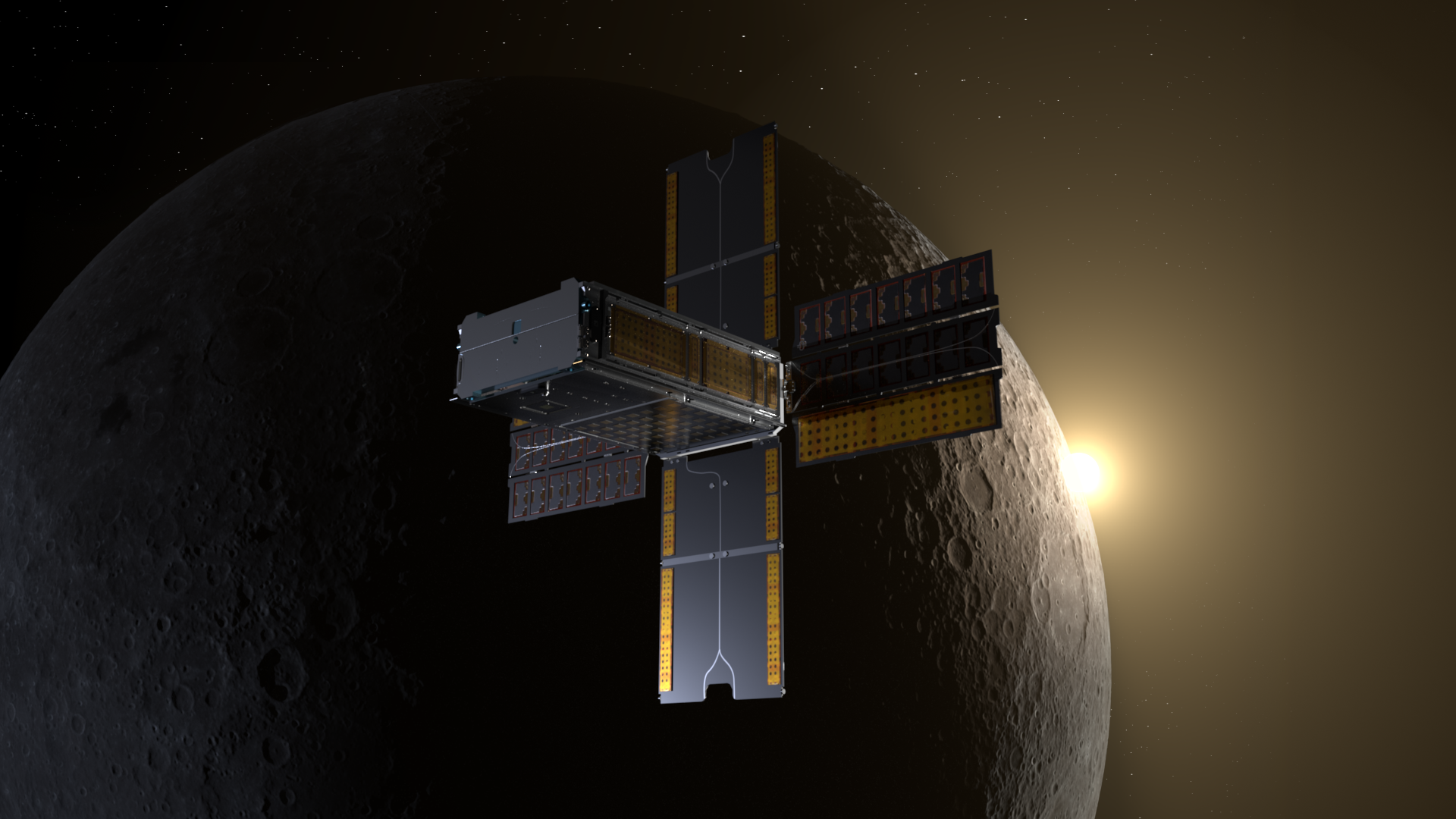
Illustration of the BioSentinel spacecraft, flying past the Moon with the CubeSat's solar arrays fully deployed, facing the Sun.
llustration of BioSentinel’s spacecraft flying past the Moon.
NASA/Daniel Rutter

Editor’s Note: This article was updated Nov. 21, 2025 shortly after BioSentinel’s mission marked three years of operation in deep space.

Astronauts live in a pretty extreme environment aboard the International Space Station. Orbiting about 250 miles above the Earth in the weightlessness of microgravity, they rely on commercial cargo missions about every two months to deliver new supplies and experiments. And yet, this place is relatively protected in terms of space radiation. The Earth’s magnetic field shields space station crew from much of the radiation that can damage the DNA in our cells and lead to serious health problems. When future astronauts set off on long journeys deeper into space, they will be venturing into more perilous radiation environments and will need substantial protection. With the help of a biology experiment within a small satellite called BioSentinel, scientists at NASA’s Ames Research Center, in California’s Silicon Valley, are taking an early step toward finding solutions.

To learn the basics of what happens to life in space, researchers often use “model organisms” that we understand relatively well. This helps show the differences between what happens in space and on Earth more clearly. For BioSentinel, NASA is using yeast – the very same yeast that makes bread rise and beer brew. In both our cells and yeast cells, the type of high-energy radiation encountered in deep space can cause breaks in the two entwined strands of DNA that carry genetic information. Often, DNA damage can be repaired by cells in a process that is very similar between yeast and humans.                             

Conceptual graphic of a radiation particle causing a DNA DSB
Conceptual graphic of a radiation particle causing a double-stranded DNA break.

BioSentinel set out to be the first long-duration biology experiment to take place beyond where the space station orbits near Earth. BioSentinel’s spacecraft is one of 10 CubeSats that launched aboard Artemis I, the first flight of the Artemis program’s Space Launch System, NASA’s powerful new rocket. The cereal box-sized satellite traveled to deep space on the rocket then flew past the Moon in a direction to orbit the Sun.  Once the satellite was in position beyond our planet’s protective magnetic field, the BioSentinel team triggered a series of experiments remotely, activating two strains of the yeast Saccharomyces cerevisiae to grow in the presence of space radiation. Samples of yeast were activated at different time points throughout the six- to twelve-month mission.

One strain is the yeast commonly found in nature, while the other was selected because it has trouble repairing its DNA. By comparing how the two strains respond to the deep space radiation environment, researchers will learn more about the health risks posed to humans during long-term exploration and be able to develop informed strategies for reducing potential damage.

During the initial phase of the mission, which began in December 2022 and completed in April 2023, the BioSentinel team successfully operated BioSentinel’s BioSensor hardware – a miniature biotechnology laboratory designed to measure how living yeast cells respond to long-term exposure to space radiation – in deep space. The team completed four experiments lasting two-weeks each but did not observe any yeast cell growth. They determined that deep space radiation was not the cause of the inactive yeast cells, but that their lack of growth was likely due to the yeast expiring after extended storage time of the spacecraft ahead of launch. 

Although the yeast did not activate as intended to gather observations on the impact of radiation on living yeast cells, BioSentinel’s onboard radiation detector – that measures the type and dose of radiation hitting the spacecraft – continues to collect data in deep space.

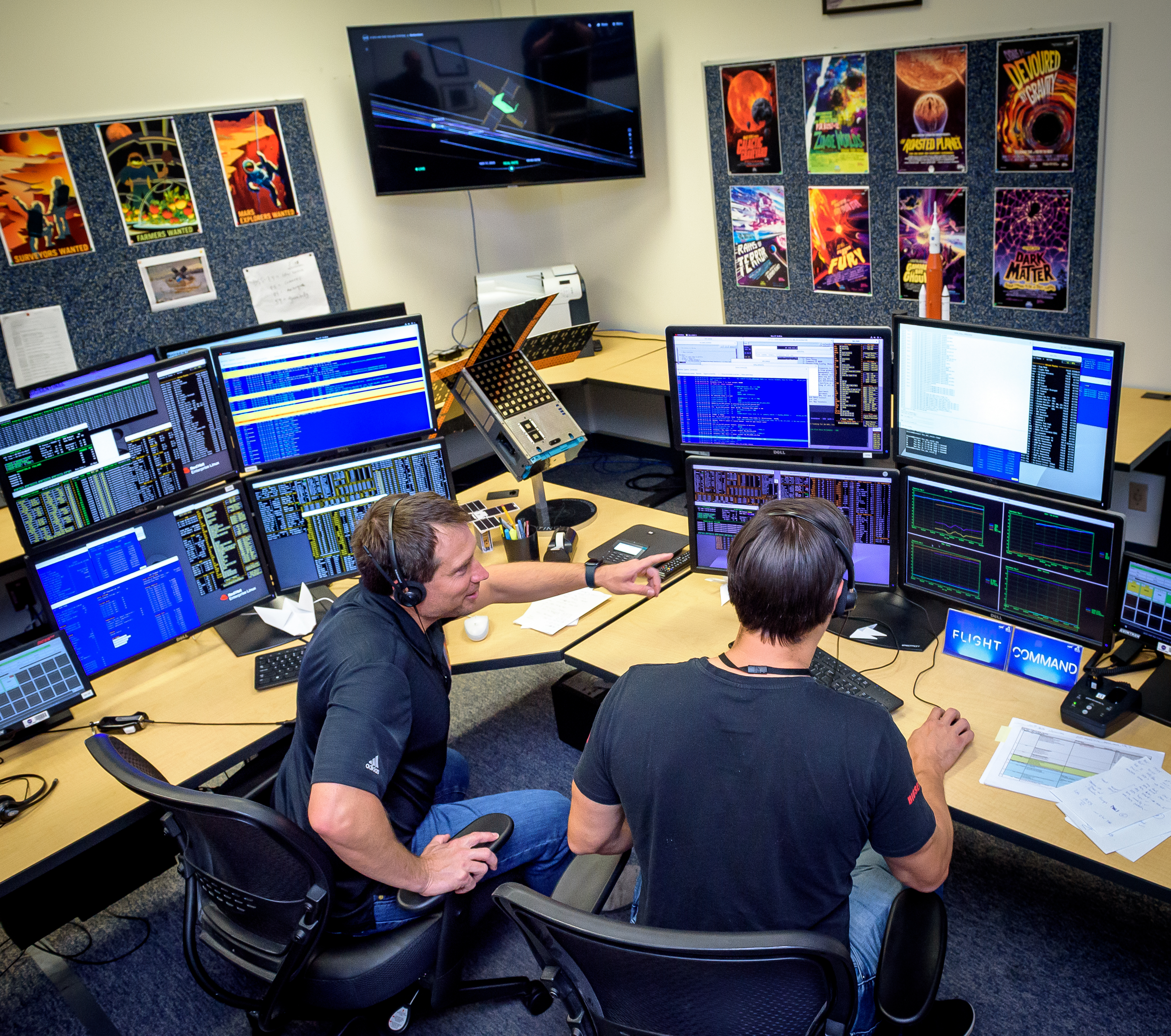
Two people looking at data on several computer monitors, with a model of the BioSentinel spacecraft in the background.
Jesse Fusco, left, and James Milsk, right, at the BioSentinel command console at the Multi-Mission Operations Center at NASA’s Ames Research Center in Silicon Valley. The team is receiving spacecraft telemetry at the three-year timepoint since the mission launched on Artemis I. BioSentinel continues to fly in its heliocentric orbit, now more than 48 million miles from Earth.
NASA/Don Richey

NASA has extended BioSentinel’s mission to continue collecting valuable deep space radiation data in the unique, high-radiation environment beyond low Earth orbit.

The Sun has an 11-year cycle, in which solar activity rises and falls in the form of powerful solar flares and giant eruptions called coronal mass ejections. As the solar cycle progresses from maximum to a declining phase, scientists expect strong solar activity to continue through 2026, with some of the strongest storms seen during this declining phase. These events send powerful bursts of energy, magnetic fields, and plasma into space which causes the aurora and can interfere with satellite signals. Solar radiation events from particles accelerated to high speeds can also pose a threat to astronauts in space.

Built on a history of small-satellite biology

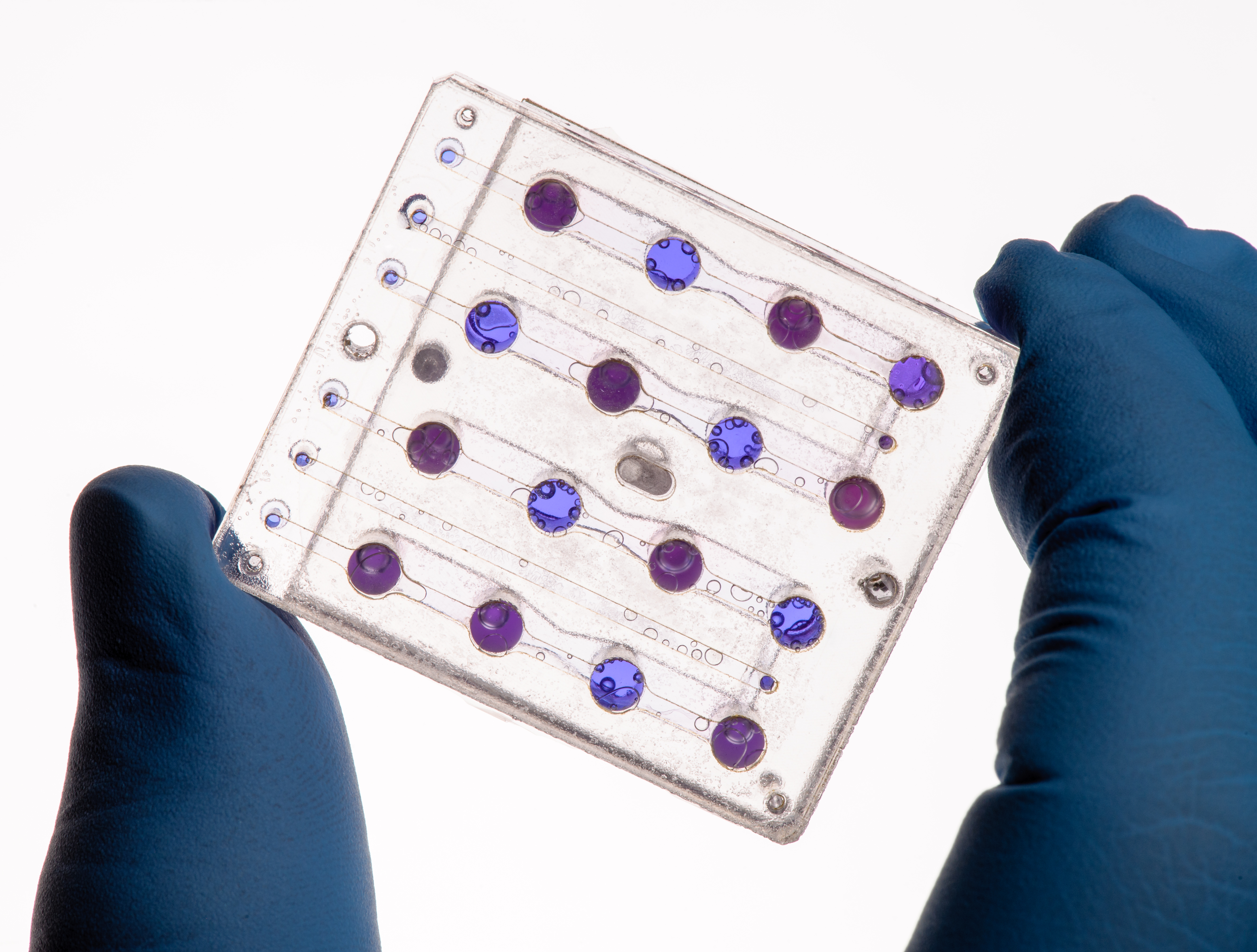
The BioSentinel project builds on Ames’ history of carrying out biology studies in space using CubeSats – small satellites built from individual units each about four inches cubed. BioSentinel is a six-unit spacecraft weighing about 30 pounds. It houses the yeast cells in tiny compartments inside microfluidic cards – custom hardware that allows for the controlled flow of extremely small volumes of liquids that will activate and sustain the yeast. Data about radiation levels and the yeast’s growth and metabolism will be collected and stored aboard the spacecraft and then transmitted to the science team back on Earth.

A reserve set of microfluidic cards containing yeast samples will be activated if the satellite encounters a solar particle event, a radiation storm coming from the Sun that is a particularly severe health risk for future deep space explorers. 

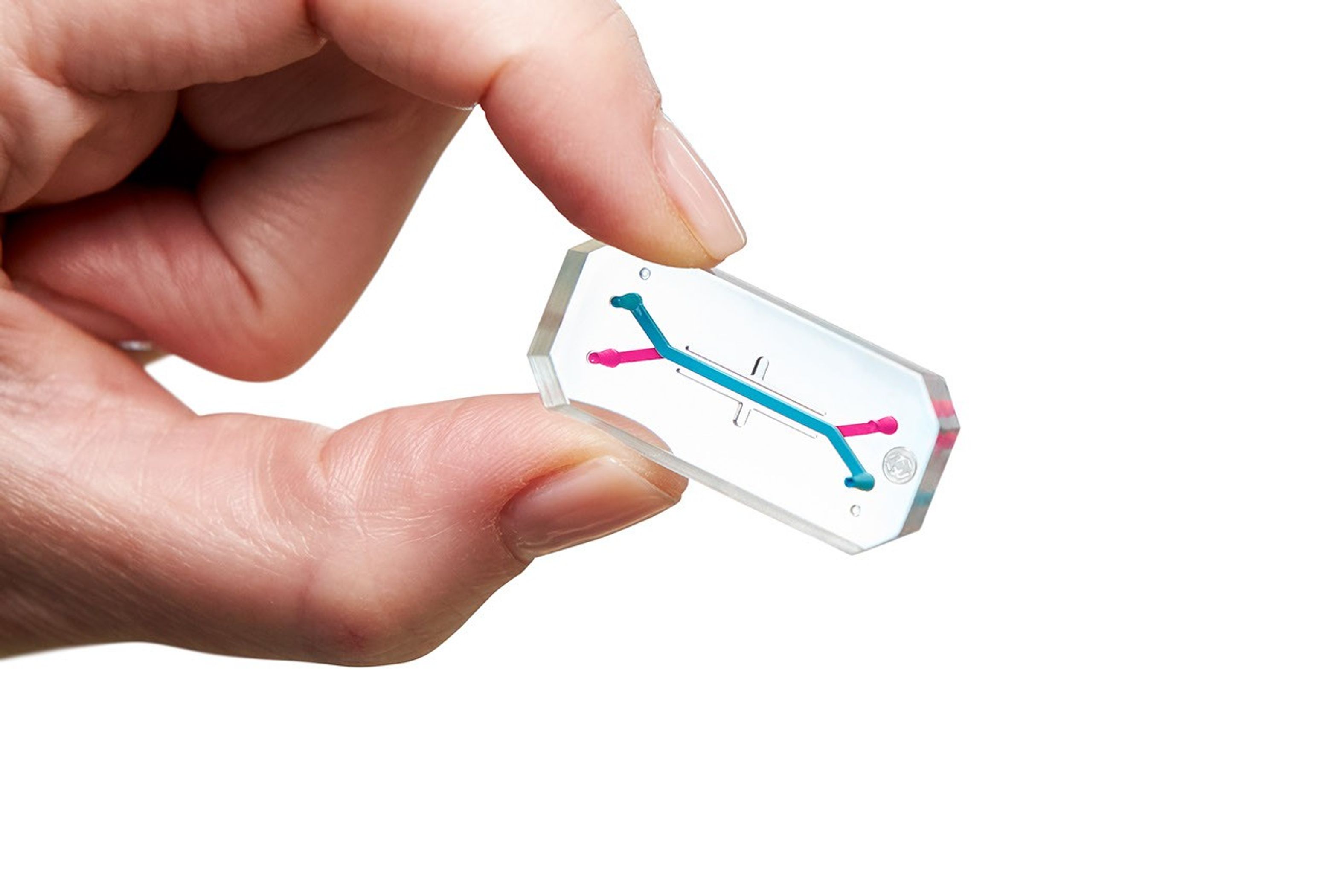
BioSentinel Fluidics Card
BioSentinel’s microfluidics card, designed at NASA’s Ames Research Center in Silicon Valley, California, will be used to study the impact of interplanetary space radiation on yeast. Once in orbit, the growth and metabolic activity of the yeast will be measured using a three-color LED detection system and a dye that provides a readout of yeast cell activity. Here, pink wells contain actively growing yeast cells that have turned the dye from blue to pink color.
NASA/Dominic Hart

Multiple BioSentinels will compare various gravity and radiation environments

In addition to the pioneering BioSentinel mission that will traverse the deep space environment, identical experiments take place under different radiation and gravity conditions. One ran on the space station, in microgravity that is similar to deep space, but with comparatively less radiation. Other experiments took place on the ground, for comparison with Earth’s gravity and radiation levels. These additional versions show scientists how to compare Earth and space station-based science experiments – which can be conducted much more readily – to the fierce radiation that future astronauts will encounter in space.

Taken together, the BioSentinel data will be critical for interpreting the effects of space radiation exposure, reducing the risks associated with long-term human exploration, and confirming existing models of the effects of space radiation on living organisms. 

Milestones

  • December 2021: The BioSentinel ISS Control experiment launched to the International Space Station aboard SpaceX’s 24th commercial resupply services mission.
  • January 2022: The BioSentinel ISS Control experiment began science operations aboard the International Space Station.
  • February 2022: The BioSentinel ISS Control experiment began ground control science operations at NASA Ames.
  • June 2022: The BioSentinel ISS Control experiment completed science operations. The hardware was returned to Earth in August aboard SpaceX’s CRS-25 Dragon.
  • October 2022: The BioSentinel ISS Control experiment completed ground control science operations at NASA Ames. 
  • Nov. 16, 2022: BioSentinel launched to deep space aboard Artemis I.
  • Dec. 5, 2022: BioSentinel began science operations in deep space.
  • Dec. 19, 2022: BioSentinel began ground control science operations at NASA Ames.
  • Nov. 16, 2024: BioSentinel marks two years of continuous radiation observations in deep space, now more than 30 million miles from Earth.
  • Nov. 16, 2025: BioSentinel marks three years of continuous radiation observations in deep space, now more than 48 million miles from Earth.

Partners:

  • NASA Ames leads the science, hardware design and development of the BioSentinel mission.
  • Partner organizations include NASA’s Johnson Space Center in Houston and NASA’s Jet Propulsion Laboratory in Southern California. 
  • BioSentinel is funded by the Mars Campaign Development (MCO) Division within the Exploration Systems Development Mission Directorate at NASA headquarters in Washington.
  • BioSentinel’s extended mission is supported by the Heliophysics Division of NASA’s Science Mission Directorate at NASA headquarters in Washington, the MCO, and the NASA Electronic Parts and Packaging Program within NASA’s Space Technology Mission Directorate at NASA Headquarters in Washington.

Learn more:

For researchers: 

For news media:

  • Members of the news media interested in covering this topic should reach out to the NASA Ames newsroom

NASA Awards Company to Attempt Swift Spacecraft Orbit Boost

NASA’s Neil Gehrels Swift Observatory, shown in this artist’s concept, orbits Earth as it studies the ever-changing universe.
Credit: NASA’s Goddard Space Flight Center Conceptual Image Lab

Driving rapid innovation in the American space industry, NASA has awarded Katalyst Space Technologies of Flagstaff, Arizona, a contract to raise a spacecraft’s orbit. Katalyst’s robotic servicing spacecraft will rendezvous with NASA’s Neil Gehrels Swift Observatory and raise it to a higher altitude, demonstrating a key capability for the future of space exploration and extending the Swift mission’s science lifetime.

NASA’s Swift launched in 2004 to explore the universe’s most powerful explosions, called gamma-ray bursts. The spacecraft’s low Earth orbit has been decaying gradually, which happens to satellites over time. However, because of recent increases in the Sun’s activity, Swift is experiencing more atmospheric drag than anticipated, speeding up its orbital decay. While NASA could have allowed the observatory to reenter Earth’s atmosphere, as many missions do at the end of their lifetimes, Swift’s lowering orbit presents an opportunity to advance American spacecraft servicing technology.

“This industry collaboration to boost Swift’s orbit is just one of many ways NASA works for the nation every day,” said Nicky Fox, associate administrator, Science Mission Directorate, NASA Headquarters in Washington. “By moving quickly to pursue innovative commercial solutions, we’re further developing the space industry and strengthening American space leadership. This daring mission also will demonstrate our ability to go from concept to implementation in less than a year — a rapid-response capability important for our future in space as we send humans back to the Moon under the Artemis campaign, to Mars, and beyond.”

The orbit boost is targeted for spring 2026, though NASA will continue to monitor any changes in solar activity that may impact this target timeframe. A successful Swift boost would be the first time a commercial robotic spacecraft captures a government satellite that is uncrewed, or not originally designed to be serviced in space.

“Given how quickly Swift’s orbit is decaying, we are in a race against the clock, but by leveraging commercial technologies that are already in development, we are meeting this challenge head-on,” said Shawn Domagal-Goldman, acting director, Astrophysics Division, NASA Headquarters. “This is a forward-leaning, risk-tolerant approach for NASA. But attempting an orbit boost is both more affordable than replacing Swift’s capabilities with a new mission, and beneficial to the nation — expanding the use of satellite servicing to a new and broader class of spacecraft.”

Swift leads NASA’s fleet of space telescopes in studying changes in the high-energy universe. When a rapid, sudden event takes place in the cosmos, Swift serves as a “dispatcher,” providing critical information that allows other “first responder” missions to follow up to learn more about how the universe works. For more than two decades, Swift has led NASA’s missions in providing new insights on these events, together broadening our understanding of everything from exploding stars, stellar flares, and eruptions in active galaxies, to comets and asteroids in our own solar system and high-energy lightning events on Earth.

NASA has awarded Katalyst $30 million to move forward with implementation under a Phase III award as an existing participant in NASA’s Small Business Innovation Research (SBIR) Program, managed by the agency’s Space Technology Mission Directorate. This approach allowed NASA to pursue an orbit boost for Swift on a shorter development timeline than would otherwise be possible, given the rapid rate at which Swift’s orbit is decaying.

“America’s space economy is brimming with cutting-edge solutions, and opportunities like this allow NASA to tap into them for real-world challenges,” said Clayton Turner, associate administrator, NASA’s Space Technology Mission Directorate, NASA Headquarters. “Orbital decay is a common, natural occurrence for satellites, and this collaboration may open the door to extending the life of more spacecraft in the future. By working with industry, NASA fosters rapid, agile technology development, advancing capabilities to benefit the missions of today and unlock the discoveries of tomorrow.” 

The NASA SBIR program is part of America’s Seed Fund, the nation’s largest source of early-stage, non-dilutive funding for innovative technologies. Through this program, entrepreneurs, startups, and small businesses with less than 500 employees can receive funding and non-monetary support to build, mature, and commercialize their technologies, advancing NASA missions and helping solve important challenges facing our country.

NASA’s Goddard Space Flight Center in Greenbelt, Maryland, manages the Swift mission in collaboration with Penn State, the Los Alamos National Laboratory in New Mexico, and Northrop Grumman Space Systems in Dulles, Virginia. Other partners include the UK Space Agency, University of Leicester and Mullard Space Science Laboratory in the United Kingdom, Brera Observatory in Italy, and the Italian Space Agency.

To learn more about the Swift mission, visit:

https://www.nasa.gov/swift

-end-

Alise Fisher / Jasmine Hopkins
Headquarters, Washington
202-358-2546 / 321-432-4624
alise.m.fisher@nasa.gov / jasmine.s.hopkins@nasa.gov
NASA’s Deep Space Communications Demo Exceeds Project Expectations

5 min read

Preparations for Next Moonwalk Simulations Underway (and Underwater)

Infrared photograph, the Optical Communications Telescope Laboratory at JPL’s Table Mountain Facility
In this infrared photograph, the Optical Communications Telescope Laboratory at JPL’s Table Mountain Facility near Wrightwood, California, beams its eight-laser beacon to the Deep Space Optical Communications flight laser transceiver aboard NASA’s Psyche spacecraft.
NASA/JPL-Caltech

The project has exceeded all of its technical goals after two years, setting up the foundations of high-speed communications for NASA’s future human missions to Mars.

NASA’s Deep Space Optical Communications technology successfully showed that data encoded in lasers could be reliably transmitted, received, and decoded after traveling millions of miles from Earth at distances comparable to Mars. Nearly two years after launching aboard the agency’s Psyche mission in 2023, the technology demonstration recently completed its 65th and final pass, sending a laser signal to Psyche and receiving the return signal, from 218 million miles away. 

“NASA is setting America on the path to Mars, and advancing laser communications technologies brings us one step closer to streaming high-definition video and delivering valuable data from the Martian surface faster than ever before,” said acting NASA Administrator Sean Duffy. “Technology unlocks discovery, and we are committed to testing and proving the capabilities needed to enable the Golden Age of exploration.”

This video details how the Deep Space Optical Communications experiment broke records and how the technology demonstration could pave the way for future high-bandwidth data transmission out to Mars distances and beyond. NASA/JPL-Caltech

Record-breaking technology

Just a month after launch, the Deep Space Optical Communications demonstration proved it could send a signal back to Earth it established a link with the optical terminal aboard the Psyche spacecraft.

“NASA Technology tests hardware in the harsh environment of space to understand its limits and prove its capabilities,” said Clayton Turner, associate administrator, Space Technology Mission Directorate at NASA Headquarters in Washington. “Over two years, this technology surpassed our expectations, demonstrating data rates comparable to those of household broadband internet and sending engineering and test data to Earth from record-breaking distances.”

On Dec. 11, 2023, the demonstration achieved a historic first by streaming an ultra-high-definition video to Earth from over 19 million miles away (about 80 times the distance between Earth and the Moon), at the system’s maximum bitrate of 267 megabits per second. The project also surpassed optical communications distance records on Dec. 3, 2024, when it downlinked Psyche data from 307 million miles away (farther than the average distance between Earth and Mars). In total, the experiment’s ground terminals received 13.6 terabits of data from Psyche.

How it works

Managed by NASA’s Jet Propulsion Laboratory (JPL) in Southern California, the experiment consists of a flight laser transceiver mounted on the Psyche spacecraft, along with two ground stations to receive and send data from Earth. A powerful 3-kilowatt uplink laser at JPL’s Table Mountain Facility transmitted a laser beacon to Psyche, helping the transceiver determine where to aim the optical communications laser back to Earth.

Both Psyche and Earth are moving through space at tremendous speeds, and they are so distant from each other that the laser signal — which travels at the speed of light — can take several minutes to reach its destination. By using the precise pointing required from the ground and flight laser transmitters to close the communication link, teams at NASA proved that optical communications can be done to support future missions throughout the solar system.

Another element of the experiment included detecting and decoding a faint signal after the laser traveled millions of miles. The project enlisted a 200-inch telescope at Caltech’s Palomar Observatory in San Diego County as its primary downlink station, which provided enough light-collecting area to collect the faintest photons. Those photons were then directed to a high-efficiency detector array at the observatory, where the information encoded in the photons could be processed.   

“We faced many challenges, from weather events that shuttered our ground stations to wildfires in Southern California that impacted our team members,” said Abi Biswas, Deep Space Optical Communications project technologist and supervisor at JPL. “But we persevered, and I am proud that our team embraced the weekly routine of optically transmitting and receiving data from Psyche. We constantly improved performance and added capabilities to get used to this novel kind of deep space communication, stretching the technology to its limits.”

Brilliant new era

In another test, data was downlinked to an experimental radio frequency-optical “hybrid” antenna at the Deep Space Network’s Goldstone complex near Barstow, California. The antenna was retrofitted with an array of seven mirrors, totaling 3 feet in diameter, enabling the antenna to receive radio frequency and optical signals from Psyche simultaneously.

The project also used Caltech’s Palomar Observatory and a smaller 1-meter telescope at Table Mountain to receive the same signal from Psyche. Known as “arraying,” this is commonly done with radio antennas to better receive weak signals and build redundancy into the system.

“As space exploration continues to evolve, so do our data transfer needs,” said Kevin Coggins, deputy associate administrator, NASA’s SCaN (Space Communications and Navigation) program at the agency’s headquarters. “Future space missions will require astronauts to send high-resolution images and instrument data from the Moon and Mars back to Earth. Bolstering our capabilities of traditional radio frequency communications with the power and benefits of optical communications will allow NASA to meet these new requirements.”

This demonstration is the latest in a series of optical communication experiments funded by the Space Technology Mission Directorate’s Technology Demonstration Missions Program managed at NASA’s Marshall Space Flight Center in Huntsville, Alabama, and the agency’s SCaN program within the Space Operations Mission Directorate. The Psyche mission is led by Arizona State University. Lindy Elkins-Tanton of the University of California, Berkeley is the principal investigator. NASA JPL, managed by Caltech in Pasadena, California, is responsible for the mission’s overall management.

To learn more about the laser communications demo, visit:

https://www.jpl.nasa.gov/missions/deep-space-optical-communications-dsoc/

News Media Contact

Ian J. O’Neill
Jet Propulsion Laboratory, Pasadena, Calif.
818-354-2649
ian.j.oneill@jpl.nasa.gov
2025-120

💾

NASA’s Deep Space Optical Communications (DSOC) technology demonstration has successfully concluded after two years, surpassing all technical goals and pavin...

New NASA Mission to Reveal Earth’s Invisible ‘Halo’

5 min read

New NASA Mission to Reveal Earth’s Invisible ‘Halo’

This story is also available in Spanish.

A new NASA mission will capture images of Earth’s invisible “halo,” the faint light given off by our planet’s outermost atmospheric layer, the exosphere, as it morphs and changes in response to the Sun. Understanding the physics of the exosphere is a key step toward forecasting dangerous conditions in near-Earth space, a requirement for protecting Artemis astronauts traveling through the region on the way to the Moon or on future trips to Mars. The Carruthers Geocorona Observatory will launch from NASA’s Kennedy Space Center in Florida no earlier than Tuesday, Sept. 23.

Revealing Earth’s invisible edge

In the early 1970s, scientists could only speculate about how far Earth’s atmosphere extended into space. The mystery was rooted in the exosphere, our atmosphere’s outermost layer, which begins some 300 miles up. Theorists conceived of it as a cloud of hydrogen atoms — the lightest element in existence — that had risen so high the atoms were actively escaping into space.

But the exosphere reveals itself only via a faint “halo” of ultraviolet light known as the geocorona. Pioneering scientist and engineer Dr. George Carruthers set himself the task of seeing it. After launching a few prototypes on test rockets, he developed an ultraviolet camera ready for a one-way trip to space.

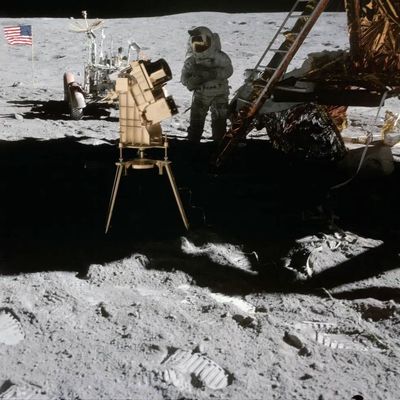
An astronaut stands on the Moon near a lunar module and scientific equipment, with an American flag and lunar rover in the background. The lunar surface is covered in footprints and gray dust.
Apollo 16 astronaut John Young is pictured on the lunar surface with George Carruthers’ gold-plated Far Ultraviolet Camera/Spectrograph, the first Moon-based observatory. The Lunar Module “Orion” is on the right and the Lunar Roving Vehicle is parked in the background next to the American flag.
NASA

In April 1972, Apollo 16 astronauts placed Carruthers’ camera on the Moon’s Descartes Highlands, and humanity got its first glimpse of Earth’s geocorona. The images it produced were as stunning for what they captured as they were for what they didn’t.

“The camera wasn’t far enough away, being at the Moon, to get the entire field of view,” said Lara Waldrop, principal investigator for the Carruthers Geocorona Observatory. “And that was really shocking — that this light, fluffy cloud of hydrogen around the Earth could extend that far from the surface.” Waldrop leads the mission from the University of Illinois Urbana-Champaign, where George Carruthers was an alumnus.

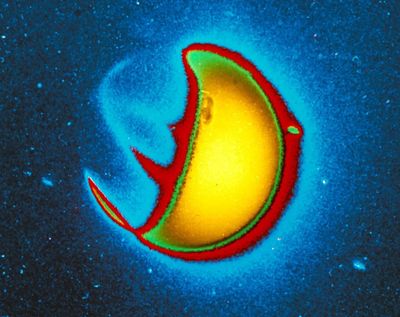
A false-color, close-up image of Earth’s exosphere as captured by the Carruthers Geocorona Observatory against a dark blue background. The image shows a semicircle glowing yellow and outlined in red.
The first image of UV light from Earth’s outer atmosphere, the geocorona, taken from a telescope designed and built by George Carruthers. The telescope took the image while on the Moon during the Apollo 16 mission in 1972.
G. Carruthers (NRL) et al./Far UV Camera/NASA/Apollo 16

Our planet, in a new light

Today, the exosphere is thought to stretch at least halfway to the Moon. But the reasons for studying go beyond curiosity about its size.

As solar eruptions reach Earth, they hit the exosphere first, setting off a chain of reactions that sometimes culminate in dangerous space weather storms. Understanding the exosphere’s response is important to predicting and mitigating the effects of these storms. In addition, hydrogen — one of the atomic building blocks of water, or H2O — escapes through the exosphere. Mapping that escape process will shed light on why Earth retains water while other planets don’t, helping us find exoplanets, or planets outside our solar system, that might do the same.

NASA’s Carruthers Geocorona Observatory, named in honor of George Carruthers, is designed to capture the first continuous movies of Earth’s exosphere, revealing its full expanse and internal dynamics.

“We’ve never had a mission before that was dedicated to making exospheric observations,” said Alex Glocer, the Carruthers mission scientist at NASA’s Goddard Space Flight Center in Greenbelt, Maryland. “It’s really exciting that we’re going to get these measurements for the first time.”

Download this video from NASA’s Scientific Visualization Studio.

Journey to L1

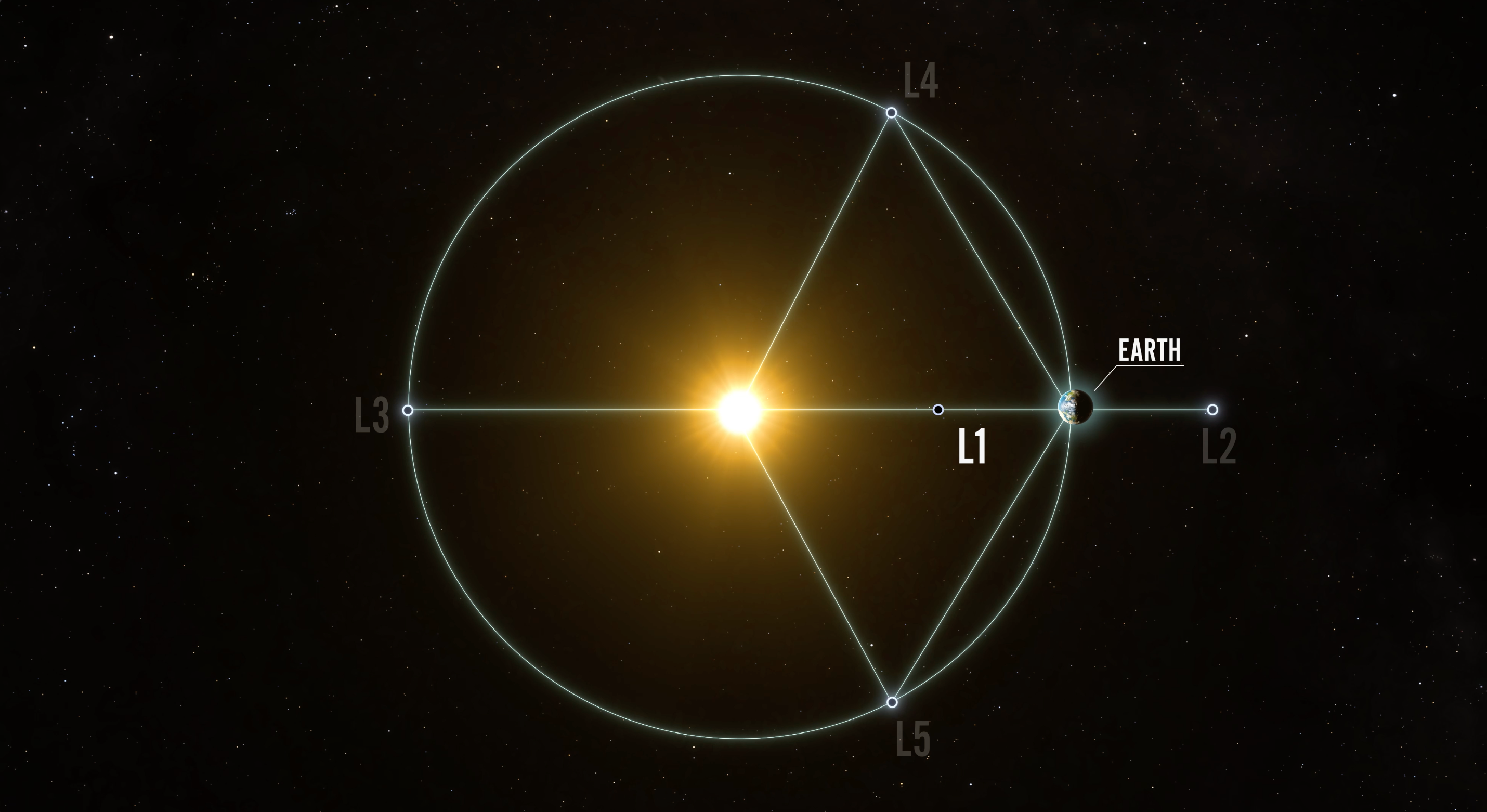
At 531 pounds and roughly the size of a loveseat sofa, the Carruthers spacecraft will launch aboard a SpaceX Falcon 9 rocket along with NASA’s IMAP (Interstellar Mapping and Acceleration Probe) spacecraft and the National Oceanic and Atmospheric Administration’s SWFO-L1 (Space Weather Follow On – Lagrange 1) space weather satellite. After launch, all three missions will commence a four-month cruise phase to Lagrange point 1 (L1), a location approximately 1 million miles closer to the Sun than Earth is. After a one-month period for science checkouts, Carruthers’ two-year science phase will begin in March 2026.

An artist’s concept showing a diagram including the Sun, Earth, and five labeled points (L1–L5) representing the Sun-Earth Lagrange Points, where gravitational forces balance in the Sun-Earth system, against the backdrop of space. L1, where the Carruthers spacecraft will orbit, is labeled with brighter, bold text. Earth is labeled as well.
Artist’s concept of the five Sun-Earth Lagrange points in space. At Lagrange points, the gravitational pull of two large masses counteract, allowing spacecraft to reduce fuel consumption needed to remain in position. The L1 point of the Earth-Sun system affords an uninterrupted view of the Sun and will be home to three new heliophysics missions in 2025: NASA’s Interstellar Mapping and Acceleration Probe (IMAP), NASA’s Carruthers Geocorona Observatory, and NOAA’s Space Weather Follow-On – Lagrange 1 (SWFO – L1).
NASA’s Conceptual Image Lab/Krystofer Kim

From L1, roughly four times farther away than the Moon, Carruthers will capture a comprehensive view of the exosphere using two ultraviolet cameras, a near-field imager and a wide-field imager.

“The near-field imager lets you zoom up really close to see how the exosphere is varying close to the planet,” Glocer said. “The wide-field imager lets you see the full scope and expanse of the exosphere, and how it’s changing far away from the Earth’s surface.”

The two imagers will together map hydrogen atoms as they move through the exosphere and ultimately out to space. But what we learn about atmospheric escape on our home planet applies far beyond it.

“Understanding how that works at Earth will greatly inform our understanding of exoplanets and how quickly their atmospheres can escape,” Waldrop said.

By studying the physics of Earth, the one planet we know that supports life, the Carruthers Geocorona Observatory can help us know what to look for elsewhere in the universe.

The Carruthers Geocorona Observatory mission is led by Lara Waldrop from the University of Illinois Urbana-Champaign. The Space Sciences Laboratory at the University of California, Berkeley leads mission implementation, design and development of the payload in collaboration with Utah State University’s Space Dynamics Laboratory. The Carruthers spacecraft was designed and built by BAE Systems. NASA’s Explorers and Heliophysics Projects Division at the agency’s Goddard Space Flight Center in Greenbelt, Maryland, manages the mission for the agency’s Heliophysics Division at NASA Headquarters in Washington.

By Miles Hatfield
NASA’s Goddard Space Flight Center, Greenbelt, Md.

Keep Exploring

Discover More Topics From NASA

NASA’s IMAP Mission to Study Boundaries of Our Home in Space

6 min read

NASA’s IMAP Mission to Study Boundaries of Our Home in Space

Summary

  • NASA’s new Interstellar Mapping and Acceleration Probe, or IMAP, will launch no earlier than Tuesday, Sept. 23 to study the heliosphere, a giant shield created by the Sun.
  • The mission will chart the heliosphere’s boundaries to help us better understand the protection it offers life on Earth and how it changes with the Sun’s activity.
  • The IMAP mission will also provide near real-time measurements of the solar wind, data that can be used to improve models predicting the impacts of space weather ranging from power-line disruptions to loss of satellites, to the health of voyaging astronauts.

Space is a dangerous place — one that NASA continues to explore for the benefit of all. It’s filled with radiation and high-energy particles that can damage DNA and circuit boards alike. Yet life endures in our solar system in part because of the heliosphere, a giant bubble created by the Sun that extends far beyond Neptune’s orbit.

With NASA’s new Interstellar Mapping and Acceleration Probe, or IMAP, launching no earlier than Tuesday, Sept. 23, humanity is set to get a better look at the heliosphere than ever before. The mission will chart the boundaries of the heliosphere to help us better understand the protection it offers and how it changes with the Sun’s activity. The IMAP mission will also provide near real-time measurements of space weather conditions essential for the Artemis campaign and deep space travel. 

“With IMAP, we’ll push forward the boundaries of knowledge and understanding of our place not only in the solar system, but our place in the galaxy as a whole,” said Patrick Koehn, IMAP program scientist at NASA Headquarters in Washington. “As humanity expands and explores beyond Earth, missions like IMAP will add new pieces of the space weather puzzle that fills the space between Parker Solar Probe at the Sun and the Voyagers beyond the heliopause.”

Download this video from NASA’s Scientific Visualization Studio.

Domain of Sun

The heliosphere is created by the constant outflow of material and magnetic fields from the Sun called the solar wind. As the solar system moves through the Milky Way, the solar wind’s interaction with interstellar material carves out the bubble of the heliosphere. Studying the heliosphere helps scientists understand our home in space and how it came to be habitable.

As a modern-day celestial cartographer, IMAP will map the boundary of our heliosphere and study how the heliosphere interacts with the local galactic neighborhood beyond. It will chart the vast range of particles, dust, ultraviolet light, and magnetic fields in interplanetary space, to investigate the energization of charged particles from the Sun and their interaction with interstellar space.

The IMAP mission builds on NASA’s Voyager and IBEX (Interstellar Boundary Explorer) missions. In 2012 and 2018, the twin Voyager spacecraft became the first human-made objects to cross the heliosphere’s boundary and send back measurements from interstellar space. It gave scientists a snapshot of what the boundary looked like and where it was in two specific locations. While IBEX has been mapping the heliosphere, it has left many questions unanswered. With 30 times higher resolution and faster imaging, IMAP will help fill in the unknowns about the heliosphere.

Energetic neutral atoms: atomic messengers from our heliosphere’s edge

Of IMAP’s 10 instruments, three will investigate the boundaries of the heliosphere by collecting energetic neutral atoms, or ENAs. Many ENAs originate as positively charged particles released by the Sun but after racing across the solar system, these particles run into particles in interstellar space. In this collision, some of those positively charged particles become neutral, and an energetic neutral atom is born. The interaction also redirects the new ENAs, and some ricochet back toward the Sun.

Charged particles are forced to follow magnetic field lines, but ENAs travel in a straight line, unaffected by the twists, turns, and turbulences in the magnetic fields that permeate space and shape the boundary of the heliosphere. This means scientists can track where these atomic messengers came from and study distant regions of space from afar. The IMAP mission will use the ENAs it collects near Earth to trace back their origins and construct maps of the boundaries of the heliosphere, which would otherwise be invisible from such a distance.

“With its comprehensive state-of-the-art suite of instruments, IMAP will advance our understanding of two fundamental questions of how particles are energized and transported throughout the heliosphere and how the heliosphere itself interacts with our galaxy,” said Shri Kanekal, IMAP mission scientist at NASA’s Goddard Space Flight Center in Greenbelt, Maryland.

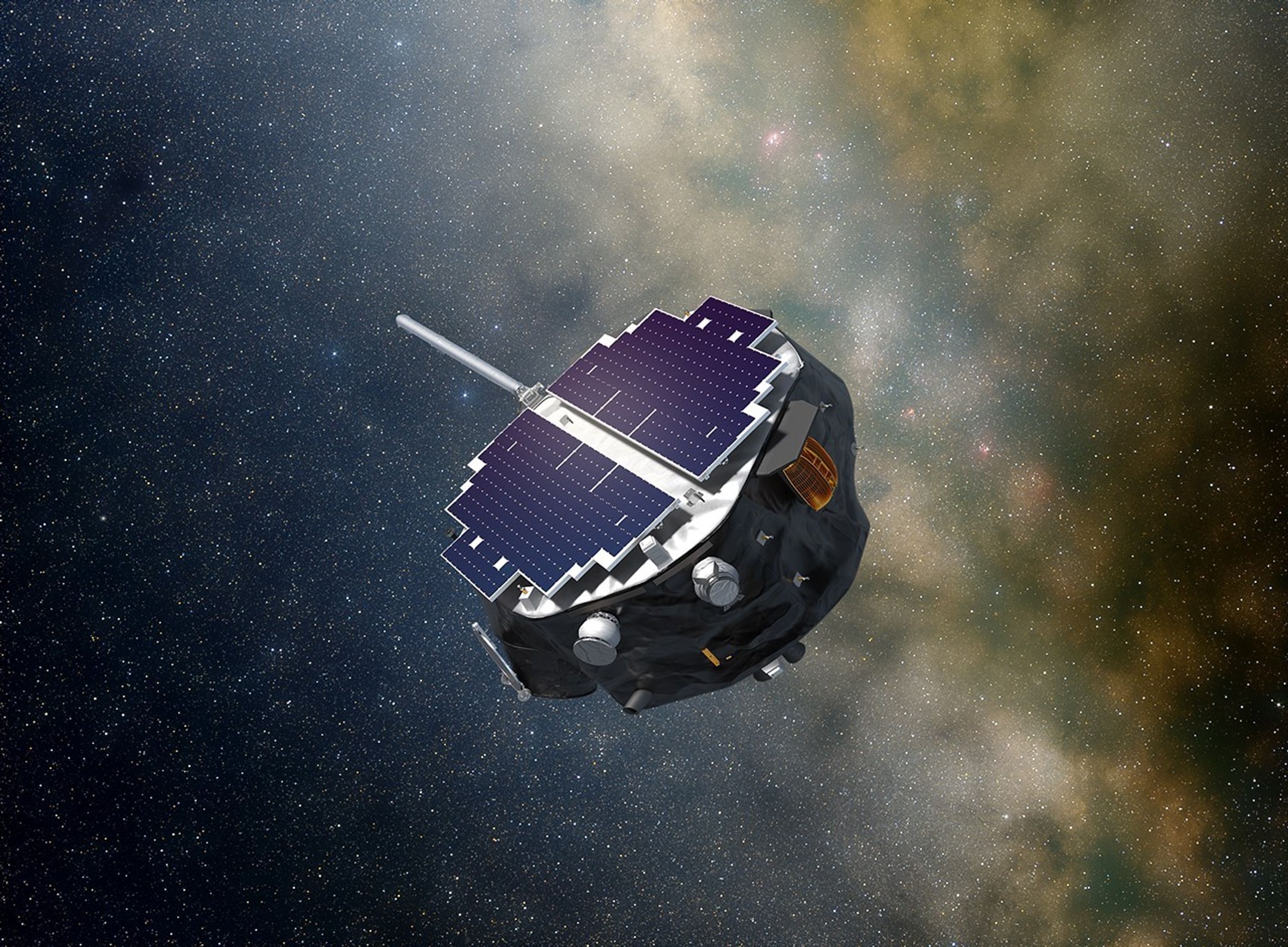
A circular spacecraft floats in space with stars and dust visible in the background.
The IMAP mission will study the heliosphere, our home in space.
NASA/Princeton University/Patrick McPike

Space weather: monitoring solar wind

The IMAP mission will also support near real-time observations of the solar wind and energetic solar particles, which can produce hazardous conditions in the space environment near Earth. From its location at Lagrange Point 1, about 1 million miles from Earth toward the Sun, IMAP will provide around a half hour’s warning of dangerous particles headed toward our planet. The mission’s data will help with the development of models that can predict the impacts of space weather ranging from power-line disruptions to loss of satellites.

“The IMAP mission will provide very important information for deep space travel, where astronauts will be directly exposed to the dangers of the solar wind,” said David McComas, IMAP principal investigator at Princeton University.

Cosmic dust: hints of the galaxy beyond

In addition to measuring ENAs and solar wind particles, IMAP will also make direct measurements of interstellar dust — clumps of particles originating outside of the solar system that are smaller than a grain of sand. This space dust is largely composed of rocky or carbon-rich grains leftover from the aftermath of supernova explosions. 

The specific elemental composition of this space dust is a postmark for where it comes from in the galaxy. Studying cosmic dust can provide insight into the compositions of stars from far outside our solar system. It will also help scientists significantly advance what we know about these basic cosmic building materials and provide information on what the material between stars is made of.

David McComas leads the mission with an international team of 27 partner institutions. APL is managing the development phase and building the spacecraft, and it will operate the mission. IMAP is the fifth mission in NASA’s Solar Terrestrial Probes Program portfolio. The Explorers and Heliophysics Projects Division at NASA Goddard manages the STP Program for the agency’s Heliophysics Division of NASA’s Science Mission Directorate. NASA’s Launch Services Program, based at NASA’s Kennedy Space Center in Florida, manages the launch service for the mission.

By Mara Johnson-Groh
NASA’s Goddard Space Flight Center, Greenbelt, Md.

Keep Exploring

Discover More Topics From NASA

Regions on Asteroid Explored by NASA’s Lucy Mission Get Official Names

The IAU (International Astronomical Union), an international non-governmental research organization and global naming authority for celestial objects, has approved official names for features on Donaldjohanson, an asteroid NASA’s Lucy spacecraft visited on April 20. In a nod to the fossilized inspiration for the names of the asteroid and spacecraft, the IAU’s selections recognize significant sites and discoveries on Earth that further our understanding of humanity’s origins.

The asteroid was named in 2015 after paleoanthropologist Donald Johanson, discoverer of one of the most famous fossils ever found of a female hominin, or ancient human ancestor, nicknamed Lucy. Just as the Lucy fossil revolutionized our understanding of human evolution, NASA’s Lucy mission aims to revolutionize our understanding of solar system evolution by studying at least eight Trojan asteroids that share an orbit with Jupiter.

The Lucy spacecraft cartoon character peeking out from behind an artistic rendering of the two-lobed asteroid Donaldjohanson with the words “Greetings from Donaldjohanson.”
Postcard commemorating NASA’s Lucy spacecraft April 20, 2025, encounter with the asteroid Donaldjohanson.
NASA’s Goddard Space Flight Center

Donaldjohanson, located in the main asteroid belt between the orbits of Mars and Jupiter, was a target for Lucy because it offered an opportunity for a comprehensive “dress rehearsal” for Lucy’s main mission, with all three of its science instruments carrying out observation sequences very similar to the ones that will occur at the Trojans.

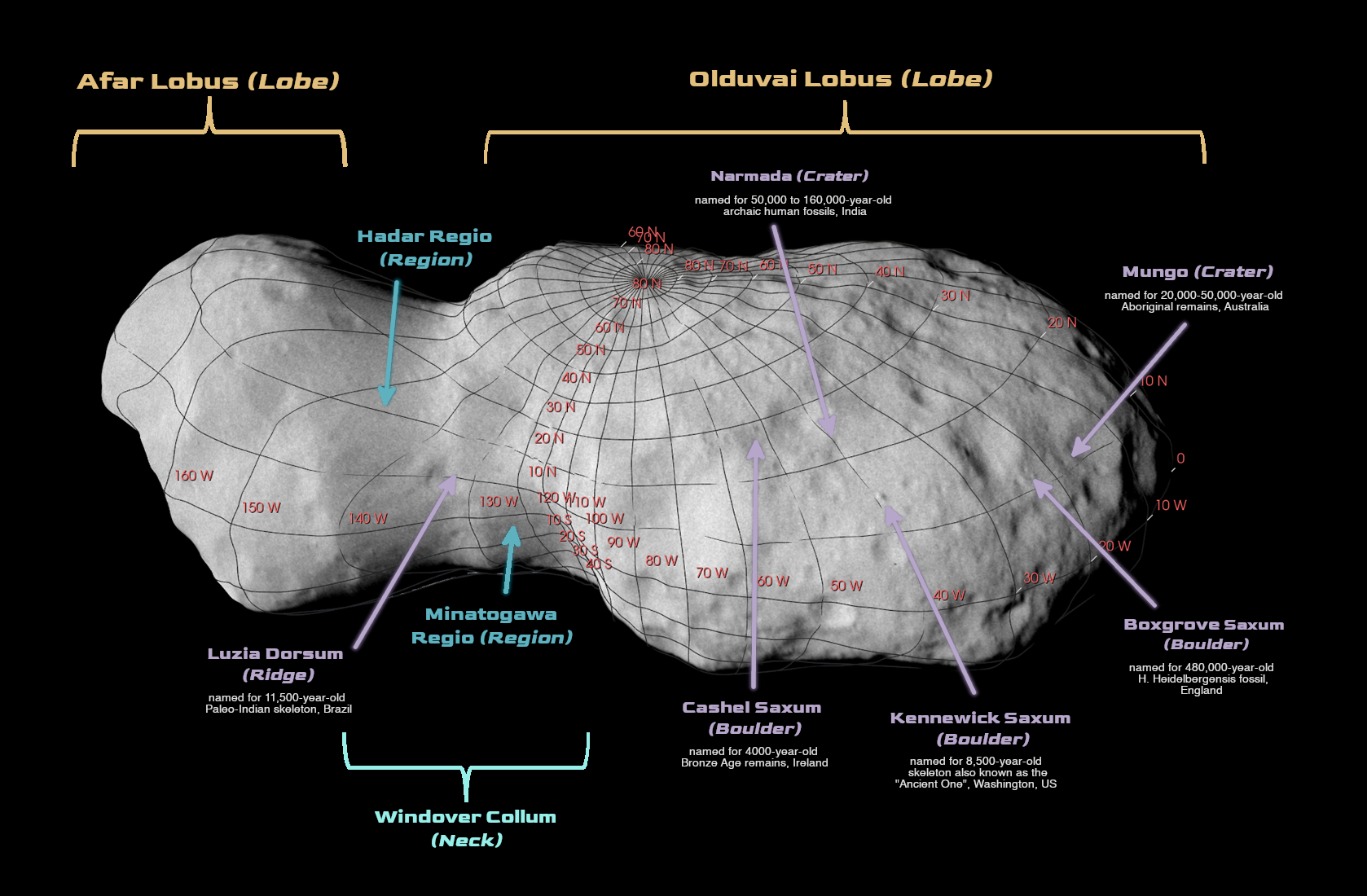
After exploring the asteroid and getting to see its features up close, the Lucy science and engineering team proposed to name the asteroid’s surface features in recognition of significant paleoanthropological sites and discoveries, which the IAU accepted.

The smaller lobe is called Afar Lobus, after the Ethiopian region where Lucy and other hominin fossils were found. The larger lobe is named Olduvai Lobus, after the Tanzanian river gorge that has also yielded many important hominin discoveries.

The asteroid’s neck, Windover Collum, which joins those two lobes, is named after the Windover Archeological Site near Cape Canaveral Space Force Station in Florida — where NASA’s Lucy mission launched in 2021. Human remains and artifacts recovered from that site revolutionized our understanding of the people who lived in Florida around 7,300 years ago.

The asteroid Donaldjohanson with latitude and longitude lines and arrows indicating the names of various features on the surface.
Officially recognized names of geologic features on the asteroid Donaldjohanson.
NASA Goddard/SwRI/Johns Hopkins APL

Two smooth areas on the asteroid’s neck are named Hadar Regio, marking the specific site of Johanson’s discovery of the Lucy fossil, and Minatogawa Regio, after the location where the oldest known hominins in Japan were found. Select boulders and craters on Donaldjohanson are named after notable fossils ranging from pre-Homo sapiens hominins to ancient modern humans. The IAU also approved a coordinate system for mapping features on this uniquely shaped small world.

As of Sept. 9, the Lucy spacecraft was nearly 300 million miles (480 million km) from the Sun en route to its August 2027 encounter with its first Trojan asteroid called Eurybates. This places Lucy about three quarters of the way through the main asteroid belt. Since its encounter with Donaldjohanson, Lucy has been cruising without passing close to any other asteroids, and without requiring any trajectory correction maneuvers.

The team continues to carefully monitor the instruments and spacecraft as it travels farther from the Sun into a cooler environment.

Stay tuned at nasa.gov/lucy for more updates as Lucy continues its journey toward the never-before-explored Jupiter Trojan asteroids, and download a postcard commemorating the Donaldjohanson encounter.

By Katherine Kretke
Southwest Research Institute

Media Contact:

Lonnie Shekhtman

lonnie.shekhtman@nasa.gov

NASA’s Goddard Space Flight Center, Greenbelt, Md.

❌